



The Europe Headless Content Management System Software Market is expected to witness market growth of 16.7% CAGR during the forecast period (2026-2033) achieving a market size of USD 1.39 billion by 2032.
The Germany market dominated the Europe Headless Content Management System Software Market by country in 2025, and is expected to continue to be a dominant market till 2033; thereby, achieving a market value of $311.4 million by 2033. The UK market is expected to witness a CAGR of 15.8% during 2026-2033. Additionally, the France market is expected to witness a CAGR of 17.5% during 2026-2033. Germany and the UK led the Europe Headless Content Management System Software Market by Country with a combined market share of 42.5% in 2025. The Spain market is expected to witness a CAGR of 19% during the forecast period.
The Europe Headless Content Management System Software Market has evolved in response to the region’s accelerating digital transformation initiatives and the growing demand for flexible omnichannel content delivery frameworks. Enterprises across Europe initially relied on traditional monolithic content management systems; however, increasing adoption of mobile applications, e-commerce platforms, and cloud-native architectures created the need for API-first and decoupled content ecosystems. The transition toward headless CMS platforms gained momentum as organizations sought greater scalability, customization, and seamless integration with modern frontend technologies. Strong digital infrastructure across countries such as Germany, the UK, and France further accelerated adoption, especially among enterprises emphasizing customer-centric digital experiences. The market has also benefited from the expansion of cloud computing, microservices architecture, and increasing investments in digital experience platforms.
The market is witnessing strong momentum driven by omnichannel content delivery strategies, AI-enabled personalization capabilities, and cloud-native deployment adoption. European enterprises are increasingly leveraging headless CMS platforms to manage dynamic content across websites, mobile applications, IoT devices, and digital commerce platforms in real time. AI-powered content automation, intelligent tagging, and personalized content recommendations are emerging as key innovation areas within the market. Additionally, regulatory frameworks such as GDPR are shaping platform development, compelling vendors to focus heavily on data governance, security, and compliance management.
Market participants are adopting ecosystem expansion strategies through partnerships with cloud providers, analytics vendors, and e-commerce solution providers to strengthen interoperability and enhance enterprise adoption. Competition is largely influenced by technological sophistication, API extensibility, scalability, and integration flexibility rather than pricing alone. Increasing investments in composable digital experience platforms and modular architectures continue to reshape the competitive environment across Europe.
German enterprises are emphasizing secure and compliant content architectures aligned with stringent EU regulatory frameworks, which further drives demand for scalable and cloud-native headless CMS solutions. The market is also benefiting from increasing adoption of composable digital experience platforms integrated with AI-driven analytics and personalization tools. Strong cloud infrastructure and enterprise modernization programs continue to position Germany as the leading regional market.
The UK market is witnessing robust adoption of headless CMS platforms due to rapid expansion of digital commerce, cloud computing, and customer experience optimization initiatives. Enterprises in the UK are increasingly prioritizing flexible and framework-agnostic content management solutions capable of supporting web, mobile, and emerging digital channels simultaneously. The strong presence of technology startups, SaaS vendors, and digital agencies is accelerating innovation within the market. Organizations are leveraging AI-enabled content automation and real-time content orchestration to improve engagement and operational efficiency. Additionally, the growing need for scalable digital ecosystems across financial services, media, and retail sectors continues to drive market expansion in the country.
France is emerging as a high-growth market driven by increasing enterprise investments in digital transformation, omnichannel communication, and cloud-based infrastructure modernization. Businesses are rapidly adopting headless CMS solutions to support multilingual content delivery, personalized customer interactions, and enhanced digital experience management. The integration of analytics, AI-driven recommendation engines, and automation capabilities into content workflows is becoming increasingly prominent among French enterprises. Regulatory focus on data security and compliance is further encouraging organizations to adopt secure and scalable headless CMS platforms. Growing adoption across retail, healthcare, and digital media industries is expected to continue supporting long-term market growth throughout the forecast period.
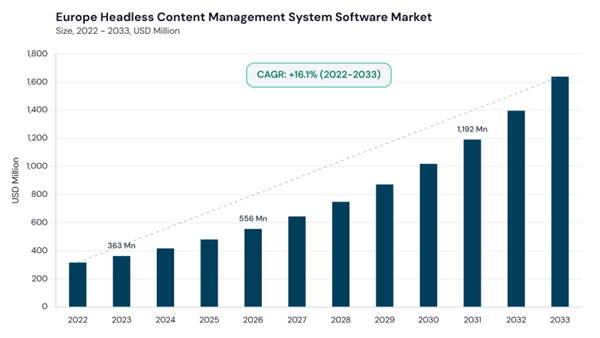
The Germany market dominated the Europe Headless Content Management System Software Market by country in 2025, and is expected to continue to be a dominant market till 2033; thereby, achieving a market value of $311.4 million by 2033. The UK market is expected to witness a CAGR of 15.8% during 2026-2033. Additionally, the France market is expected to witness a CAGR of 17.5% during 2026-2033. Germany and the UK led the Europe Headless Content Management System Software Market by Country with a combined market share of 42.5% in 2025. The Spain market is expected to witness a CAGR of 19% during the forecast period.
The Europe Headless Content Management System Software Market has evolved in response to the region’s accelerating digital transformation initiatives and the growing demand for flexible omnichannel content delivery frameworks. Enterprises across Europe initially relied on traditional monolithic content management systems; however, increasing adoption of mobile applications, e-commerce platforms, and cloud-native architectures created the need for API-first and decoupled content ecosystems. The transition toward headless CMS platforms gained momentum as organizations sought greater scalability, customization, and seamless integration with modern frontend technologies. Strong digital infrastructure across countries such as Germany, the UK, and France further accelerated adoption, especially among enterprises emphasizing customer-centric digital experiences. The market has also benefited from the expansion of cloud computing, microservices architecture, and increasing investments in digital experience platforms.
The market is witnessing strong momentum driven by omnichannel content delivery strategies, AI-enabled personalization capabilities, and cloud-native deployment adoption. European enterprises are increasingly leveraging headless CMS platforms to manage dynamic content across websites, mobile applications, IoT devices, and digital commerce platforms in real time. AI-powered content automation, intelligent tagging, and personalized content recommendations are emerging as key innovation areas within the market. Additionally, regulatory frameworks such as GDPR are shaping platform development, compelling vendors to focus heavily on data governance, security, and compliance management.
Market participants are adopting ecosystem expansion strategies through partnerships with cloud providers, analytics vendors, and e-commerce solution providers to strengthen interoperability and enhance enterprise adoption. Competition is largely influenced by technological sophistication, API extensibility, scalability, and integration flexibility rather than pricing alone. Increasing investments in composable digital experience platforms and modular architectures continue to reshape the competitive environment across Europe.
Component Outlook
Based on Component, the market is segmented into Software and Services. The Software market dominated the Europe Headless Content Management System Software Market by Component in 2025, and is expected to continue to be a dominant market till 2033; thereby, achieving a market value of $1.07 billion by 2033. The Services market is expected to witness a CAGR of 17.3% during 2026-2033.Deployment Outlook
Based on Deployment, the market is segmented into Cloud and On-Premise. The Cloud market dominated the Europe Headless Content Management System Software Market by Deployment in 2025, and is expected to continue to be a dominant market till 2033; thereby, achieving a market value of $1.29 billion by 2033. The On-Premise market is expected to witness a CAGR of 16.2% during 2026-2033.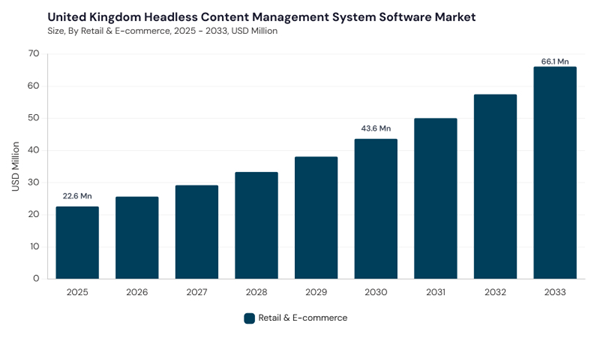
Application Outlook
Based on Application, the market is segmented into Web Content Management, E-commerce Content Management, Mobile Content Management, Digital Experience Management, Omnichannel Content Delivery, and Other Application. The Web Content Management market dominated the Europe Headless Content Management System Software Market by Application in 2025, and is expected to continue to be a dominant market till 2033; thereby, achieving a market value of $447.8 million by 2033. The Mobile Content Management market is expected to witness the highest CAGR of 17.2% during 2026-2033. Additionally, the Digital Experience Management and Omnichannel Content Delivery markets are expected to witness a CAGR of 17.6% during the forecast period.End Use Outlook
Based on End Use, the market is segmented into Retail & E-commerce, Media & Entertainment, IT & Telecom, BFSI, Healthcare, Travel & Hospitality, Education, and Other End Use. The Retail & E-commerce market dominated the Europe Headless Content Management System Software Market by End Use in 2025, and is expected to continue to remain dominant throughout the forecast period. The Media & Entertainment segment also captured a substantial market share due to increasing demand for real-time content publishing, digital media distribution, and personalized audience engagement strategies across Europe.Country Outlook
Germany represents one of the most technologically advanced markets for Headless Content Management System Software in Europe, supported by strong enterprise digitalization initiatives and growing investments in Industry 4.0 infrastructure. Organizations across retail, automotive, manufacturing, and media sectors are increasingly deploying API-first content management systems to streamline omnichannel customer experiences and improve operational agility.German enterprises are emphasizing secure and compliant content architectures aligned with stringent EU regulatory frameworks, which further drives demand for scalable and cloud-native headless CMS solutions. The market is also benefiting from increasing adoption of composable digital experience platforms integrated with AI-driven analytics and personalization tools. Strong cloud infrastructure and enterprise modernization programs continue to position Germany as the leading regional market.
The UK market is witnessing robust adoption of headless CMS platforms due to rapid expansion of digital commerce, cloud computing, and customer experience optimization initiatives. Enterprises in the UK are increasingly prioritizing flexible and framework-agnostic content management solutions capable of supporting web, mobile, and emerging digital channels simultaneously. The strong presence of technology startups, SaaS vendors, and digital agencies is accelerating innovation within the market. Organizations are leveraging AI-enabled content automation and real-time content orchestration to improve engagement and operational efficiency. Additionally, the growing need for scalable digital ecosystems across financial services, media, and retail sectors continues to drive market expansion in the country.
France is emerging as a high-growth market driven by increasing enterprise investments in digital transformation, omnichannel communication, and cloud-based infrastructure modernization. Businesses are rapidly adopting headless CMS solutions to support multilingual content delivery, personalized customer interactions, and enhanced digital experience management. The integration of analytics, AI-driven recommendation engines, and automation capabilities into content workflows is becoming increasingly prominent among French enterprises. Regulatory focus on data security and compliance is further encouraging organizations to adopt secure and scalable headless CMS platforms. Growing adoption across retail, healthcare, and digital media industries is expected to continue supporting long-term market growth throughout the forecast period.
List of Key Companies Profiled
- Contentful GmbH
- Agility Inc.
- Contentstack Inc.
- Strapi, Inc.
- CoreMedia GmbH
- Adobe, Inc.
- Uniform Systems, Inc.
- Sitecore A/S
- Kontent.ai
- Liferay Inc.
Market Report Segmentation
By Component- Software
- Services
- Cloud
- On-Premise
- Web Content Management
- Mobile Content Management
- E-commerce Content Management
- Digital Experience Management
- Omnichannel Content Delivery
- Other Application
- Retail & E-commerce
- Media & Entertainment
- BFSI
- Healthcare
- IT & Telecom
- Travel & Hospitality
- Education
- Other End Use
- Germany
- UK
- France
- Russia
- Spain
- Italy
- Rest of Europe
Table of Contents
Chapter 1. Europe Market1.1 Market Overview
1.2 Key Factors Impacting Market
1.2.1 Market Drivers
1.2.2 Market Restraints
1.2.3 Market Opportunities
1.2.4 Market Challenges
1.2.5 Market Trends
1.2.6 State of Competition
1.2.7 Market Consolidation
1.2.8 Key Customer Criteria
1.3 Product Life Cycle
1.4 Segmentation By Component
1.4.1 Software
1.4.2 Services
1.5 Segmentation By Deployment
1.5.1 Cloud
1.5.2 On-premise
1.6 Segmentation By Application
1.6.1 Web Content Management
1.6.2 Mobile Content Management
1.6.3 E-commerce Content Management
1.6.4 Digital Experience Management
1.6.5 Omnichannel Content Delivery
1.6.6 Other Application
1.7 Segmentation By End Use
1.7.1 Retail & E-commerce
1.7.2 Media & Entertainment
1.7.3 BFSI
1.7.4 Healthcare
1.7.5 IT & Telecom
1.7.6 Travel & Hospitality
1.7.7 Education
1.7.8 Other End Use
1.8 Segmentation By Country
1.8.1 Germany
1.8.1.1 Segmentation By Component
1.8.1.1.1 Software
1.8.1.1.2 Services
1.8.1.2 Segmentation By Deployment
1.8.1.2.1 Cloud
1.8.1.2.2 On-Premise
1.8.1.3 Segmentation By Application
1.8.1.3.1 Web Content Management
1.8.1.3.2 Mobile Content Management
1.8.1.3.3 E-commerce Content Management
1.8.1.3.4 Digital Experience Management
1.8.1.3.5 Omnichannel Content Delivery
1.8.1.4 Segmentation By End Use
1.8.1.4.1 Retail & E-commerce
1.8.1.4.2 Media & Entertainment
1.8.1.4.3 BFSI
1.8.1.4.4 Healthcare
1.8.1.4.5 IT & Telecom
1.8.1.4.6 Travel & Hospitality
1.8.1.4.7 Education
1.8.1.4.8 Other End Use
1.8.2 UK
1.8.2.1 Segmentation By Component
1.8.2.1.1 Software
1.8.2.1.2 Services
1.8.2.2 Segmentation By Deployment
1.8.2.2.1 Cloud
1.8.2.2.2 On-Premise
1.8.2.3 Segmentation By Application
1.8.2.3.1 Web Content Management
1.8.2.3.2 Mobile Content Management
1.8.2.3.3 E-commerce Content Management
1.8.2.3.4 Digital Experience Management
1.8.2.3.5 Omnichannel Content Delivery
1.8.2.4 Segmentation By End Use
1.8.2.4.1 Retail & E-commerce
1.8.2.4.2 Media & Entertainment
1.8.2.4.3 BFSI
1.8.2.4.4 Healthcare
1.8.2.4.5 IT & Telecom
1.8.2.4.6 Travel & Hospitality
1.8.2.4.7 Education
1.8.2.4.8 Other End Use
1.8.3 France
1.8.3.1 Segmentation By Component
1.8.3.1.1 Software
1.8.3.1.2 Services
1.8.3.2 Segmentation By Deployment
1.8.3.2.1 Cloud
1.8.3.2.2 On-Premise
1.8.3.3 Segmentation By Application
1.8.3.3.1 Web Content Management
1.8.3.3.2 Mobile Content Management
1.8.3.3.3 E-commerce Content Management
1.8.3.3.4 Digital Experience Management
1.8.3.3.5 Omnichannel Content Delivery
1.8.3.4 Segmentation By End Use
1.8.3.4.1 Retail & E-commerce
1.8.3.4.2 Media & Entertainment
1.8.3.4.3 BFSI
1.8.3.4.4 Healthcare
1.8.3.4.5 IT & Telecom
1.8.3.4.6 Travel & Hospitality
1.8.3.4.7 Education
1.8.3.4.8 Other End Use
1.8.4 Russia
1.8.4.1 Segmentation By Component
1.8.4.1.1 Software
1.8.4.1.2 Services
1.8.4.2 Segmentation By Deployment
1.8.4.2.1 Cloud
1.8.4.2.2 On-Premise
1.8.4.3 Segmentation By Application
1.8.4.3.1 Web Content Management
1.8.4.3.2 Mobile Content Management
1.8.4.3.3 E-commerce Content Management
1.8.4.3.4 Digital Experience Management
1.8.4.3.5 Omnichannel Content Delivery
1.8.4.4 Segmentation By End Use
1.8.4.4.1 Retail & E-commerce
1.8.4.4.2 Media & Entertainment
1.8.4.4.3 BFSI
1.8.4.4.4 Healthcare
1.8.4.4.5 IT & Telecom
1.8.4.4.6 Travel & Hospitality
1.8.4.4.7 Education
1.8.4.4.8 Other End Use
1.8.5 Spain
1.8.5.1 Segmentation By Component
1.8.5.1.1 Software
1.8.5.1.2 Services
1.8.5.2 Segmentation By Deployment
1.8.5.2.1 Cloud
1.8.5.2.2 On-Premise
1.8.5.3 Segmentation By Application
1.8.5.3.1 Web Content Management
1.8.5.3.2 Mobile Content Management
1.8.5.3.3 E-commerce Content Management
1.8.5.3.4 Digital Experience Management
1.8.5.3.5 Omnichannel Content Delivery
1.8.5.4 Segmentation By End Use
1.8.5.4.1 Retail & E-commerce
1.8.5.4.2 Media & Entertainment
1.8.5.4.3 BFSI
1.8.5.4.4 Healthcare
1.8.5.4.5 IT & Telecom
1.8.5.4.6 Travel & Hospitality
1.8.5.4.7 Education
1.8.5.4.8 Other End Use
1.8.6 Italy
1.8.6.1 Segmentation By Component
1.8.6.1.1 Software
1.8.6.1.2 Services
1.8.6.2 Segmentation By Deployment
1.8.6.2.1 Cloud
1.8.6.2.2 On-Premise
1.8.6.3 Segmentation By Application
1.8.6.3.1 Web Content Management
1.8.6.3.2 Mobile Content Management
1.8.6.3.3 E-commerce Content Management
1.8.6.3.4 Digital Experience Management
1.8.6.3.5 Omnichannel Content Delivery
1.8.6.4 Segmentation By End Use
1.8.6.4.1 Retail & E-commerce
1.8.6.4.2 Media & Entertainment
1.8.6.4.3 BFSI
1.8.6.4.4 Healthcare
1.8.6.4.5 IT & Telecom
1.8.6.4.6 Travel & Hospitality
1.8.6.4.7 Education
1.8.6.4.8 Other End Use
1.8.7 Rest of Europe
1.8.7.1 Segmentation By Component
1.8.7.1.1 Software
1.8.7.1.2 Services
1.8.7.2 Segmentation By Deployment
1.8.7.2.1 Cloud
1.8.7.2.2 On-Premise
1.8.7.3 Segmentation By Application
1.8.7.3.1 Web Content Management
1.8.7.3.2 Mobile Content Management
1.8.7.3.3 E-commerce Content Management
1.8.7.3.4 Digital Experience Management
1.8.7.3.5 Omnichannel Content Delivery
1.8.7.4 Segmentation By End Use
1.8.7.4.1 Retail & E-commerce
1.8.7.4.2 Media & Entertainment
1.8.7.4.3 BFSI
1.8.7.4.4 Healthcare
1.8.7.4.5 IT & Telecom
1.8.7.4.6 Travel & Hospitality
1.8.7.4.7 Education
1.8.7.4.8 Other End Use
Chapter 2. Company Snapshot
2.1 Contentful GmbH
2.1.1 Business Overview
2.1.2 Key Information
2.1.3 Company Focus
2.1.4 Strategic Insights
2.1.5 Strategy Deployed
2.1.6 Product & Service Portfolio
2.1.7 Capability Overview
2.1.8 Technology & Innovation Focus
2.1.9 Customers / End Users
2.1.10 Competitive Positioning
2.1.11 Key Differentiators
2.1.12 Portfolio Matrix
2.1.13 SWOT Analysis
2.1.14 Future Outlook
2.2 Agility Inc.
2.2.1 Business Overview
2.2.2 Key Information
2.2.3 Company Focus
2.2.4 Strategic Insights
2.2.5 Strategy Deployed
2.2.6 Product & Service Portfolio
2.2.7 Capability Overview
2.2.8 Technology & Innovation Focus
2.2.9 Customers / End Users
2.2.10 Competitive Positioning
2.2.11 Key Differentiators
2.2.12 Portfolio Matrix
2.2.13 SWOT Analysis
2.2.14 Future Outlook
2.3 Contentstack Inc.
2.3.1 Business Overview
2.3.2 Key Information
2.3.3 Company Focus
2.3.4 Strategic Insights
2.3.5 Strategy Deployed
2.3.6 Product & Service Portfolio
2.3.7 Capability Overview
2.3.8 Technology & Innovation Focus
2.3.9 Customers / End Users
2.3.10 Competitive Positioning
2.3.11 Key Differentiators
2.3.12 Portfolio Matrix
2.3.13 SWOT Analysis
2.3.14 Future Outlook
2.4 Strapi, Inc.
2.4.1 Business Overview
2.4.2 Key Information
2.4.3 Company Focus
2.4.4 Strategic Insights
2.4.5 Strategy Deployed
2.4.6 Product & Service Portfolio
2.4.7 Capability Overview
2.4.8 Technology & Innovation Focus
2.4.9 Customers / End Users
2.4.10 Competitive Positioning
2.4.11 Key Differentiators
2.4.12 Portfolio Matrix
2.4.13 SWOT Analysis
2.4.14 Future Outlook
2.5 CoreMedia GmbH
2.5.1 Business Overview
2.5.2 Key Information
2.5.3 Company Focus
2.5.4 Strategic Insights
2.5.5 Strategy Deployed
2.5.6 Product & Service Portfolio
2.5.7 Capability Overview
2.5.8 Technology & Innovation Focus
2.5.9 Customers / End Users
2.5.10 Competitive Positioning
2.5.11 Key Differentiators
2.5.12 Portfolio Matrix
2.5.13 SWOT Analysis
2.5.14 Future Outlook
2.6 Adobe, Inc.
2.6.1 Business Overview
2.6.2 Key Information
2.6.3 Company Focus
2.6.4 Strategic Insights
2.6.5 Strategy Deployed
2.6.6 Product & Service Portfolio
2.6.7 Capability Overview
2.6.8 Technology & Innovation Focus
2.6.9 Customers / End Users
2.6.10 Competitive Positioning
2.6.11 Key Differentiators
2.6.12 Portfolio Matrix
2.6.13 SWOT Analysis
2.6.14 Future Outlook
2.7 Uniform Systems, Inc.
2.7.1 Business Overview
2.7.2 Key Information
2.7.3 Company Focus
2.7.4 Strategic Insights
2.7.5 Strategy Deployed
2.7.6 Product & Service Portfolio
2.7.7 Capability Overview
2.7.8 Technology & Innovation Focus
2.7.9 Customers / End Users
2.7.10 Competitive Positioning
2.7.11 Key Differentiators
2.7.12 Portfolio Matrix
2.7.13 SWOT Analysis
2.7.14 Future Outlook
2.8 Sitecore A/S
2.8.1 Business Overview
2.8.2 Key Information
2.8.3 Company Focus
2.8.4 Strategic Insights
2.8.5 Strategy Deployed
2.8.6 Product & Service Portfolio
2.8.7 Capability Overview
2.8.8 Technology & Innovation Focus
2.8.9 Customers / End Users
2.8.10 Competitive Positioning
2.8.11 Key Differentiators
2.8.12 Portfolio Matrix
2.8.13 SWOT Analysis
2.8.14 Future Outlook
2.9 Kontent.ai
2.9.1 Business Overview
2.9.2 Key Information
2.9.3 Company Focus
2.9.4 Strategic Insights
2.9.5 Strategy Deployed
2.9.6 Product & Service Portfolio
2.9.7 Capability Overview
2.9.8 Technology & Innovation Focus
2.9.9 Customers / End Users
2.9.10 Competitive Positioning
2.9.11 Key Differentiators
2.9.12 Portfolio Matrix
2.9.13 SWOT Analysis
2.9.14 Future Outlook
2.10 Liferay Inc.
2.10.1 Business Overview
2.10.2 Key Information
2.10.3 Company Focus
2.10.4 Strategic Insights
2.10.5 Strategy Deployed
2.10.6 Product & Service Portfolio
2.10.7 Capability Overview
2.10.8 Technology & Innovation Focus
2.10.9 Customers / End Users
2.10.10 Competitive Positioning
2.10.11 Key Differentiators
2.10.12 Portfolio Matrix
2.10.13 SWOT Analysis
2.10.14 Future Outlook
Companies Mentioned
- Contentful GmbH
- Agility Inc.
- Contentstack Inc.
- Strapi, Inc.
- CoreMedia GmbH
- Adobe, Inc.
- Uniform Systems, Inc.
- Sitecore A/S
- Kontent.ai
- Liferay Inc.


