+353-1-416-8900REST OF WORLD
+44-20-3973-8888REST OF WORLD
1-917-300-0470EAST COAST U.S
1-800-526-8630U.S. (TOLL FREE)

Global Organic Snacks Market Size, Share & Industry Analysis Report by Distribution Channel, Product, Regional Outlook and Forecast, 2026-2033

  • PDF Icon

    Report

  • 507 Pages
  • May 2026
  • Marqual IT Solutions Pvt. Ltd (KBV Research)
  • ID: 6275949
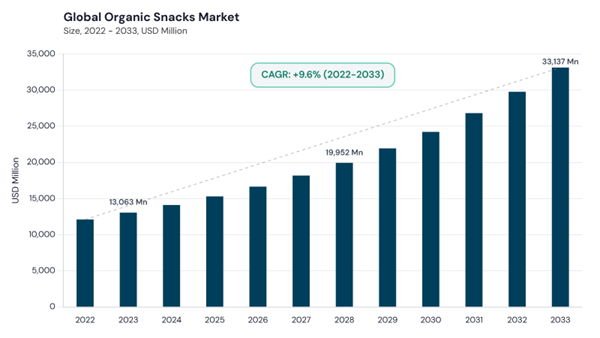
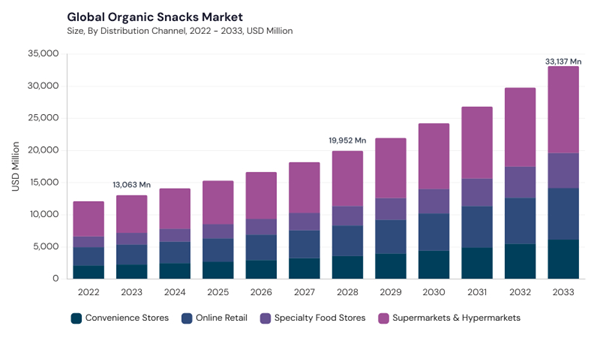
The Global Organic Snacks Market is expected to reach USD 33.13 billion by 2033, growing at a CAGR of 10.3% during the forecast period.


The growth of the Organic Snacks Market is primarily driven by increasing consumer preference for healthier, clean-label, and naturally sourced food products across both developed and emerging economies. Rising awareness regarding preventive healthcare, nutritional wellness, and sustainable food consumption is accelerating the demand for organic snack products globally. Consumers are increasingly shifting toward minimally processed, plant-based, and nutrient-rich snack alternatives free from artificial preservatives, pesticides, and genetically modified organisms (GMOs). Additionally, expanding retail penetration, increasing disposable incomes, and growing urbanization continue supporting strong market expansion across multiple regions.

Key Market Trends & Insights:

  • The North America Organic Snacks market dominated the Global Market in 2025, attaining a market value of USD 6.20 billion in 2025.
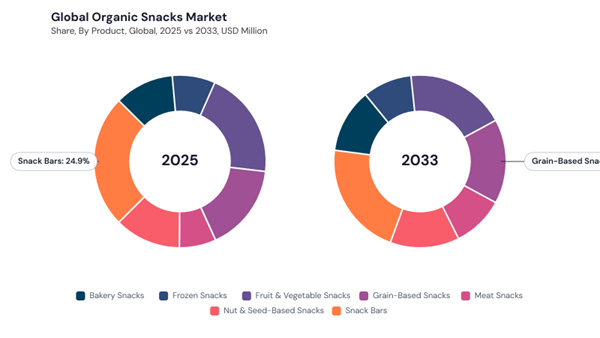
  • The Snack Bars segment dominated the Global Organic Snacks Market by Product in 2025, recording a market value of USD 3.80 billion.
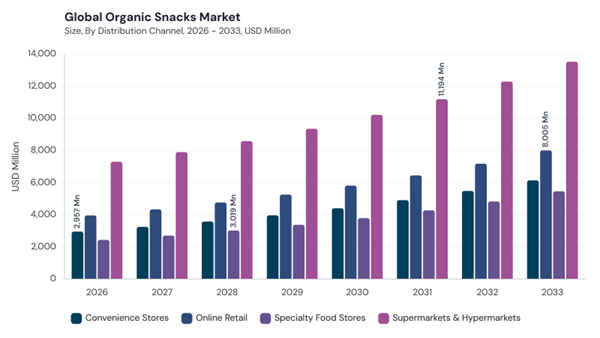
  • The Supermarkets & Hypermarkets segment dominated the Global Organic Snacks Market by Distribution Channel in 2025, attaining a market value of USD 6.76 billion.
  • The Online Retail segment is expected to witness strong growth during the forecast period driven by increasing e-commerce penetration and direct-to-consumer sales expansion.
  • Increasing demand for clean-label, plant-based, gluten-free, and minimally processed snack products continues driving innovation across the organic snacks industry globally.
The Global Organic Snacks Market has evolved significantly with the rising global focus on health-conscious food consumption and sustainable dietary habits. Organic snacks are manufactured using organically cultivated ingredients without synthetic pesticides, chemical fertilizers, artificial additives, or genetically modified organisms. Increasing consumer awareness regarding ingredient transparency, food safety, and environmental sustainability continues accelerating the adoption of organic snack products worldwide. The market is also benefiting from the rapid shift toward functional nutrition, convenience foods, and premium healthy snack alternatives among urban consumers.

The increasing demand for plant-based, protein-enriched, gluten-free, and minimally processed snack products is significantly influencing product innovation across the market. Manufacturers are increasingly introducing organic snack bars, baked snacks, fruit & vegetable snacks, nut-based products, and clean-label packaged foods targeting wellness-oriented consumers.


Companies operating in the market are increasingly focusing on product diversification, sustainable sourcing practices, biodegradable packaging solutions, and organic certification compliance to strengthen competitive positioning. Strategic partnerships with organic ingredient suppliers, expansion into emerging markets, and investments in digital marketing platforms continue shaping the competitive landscape of the Organic Snacks Market globally.

Driving and Restraining Factors

Drivers
  • Increasing Consumer Health Awareness and Clean Label Demand
  • Rising Adoption of Plant-Based and Functional Snack Products
  • Expanding Retail Distribution and E-commerce Penetration
  • Growing Preference for Sustainable and Organic Food Products
Restraints
  • High Production and Organic Certification Costs
  • Limited Availability of Certified Organic Raw Materials
  • Premium Pricing Compared to Conventional Snack Products
Opportunities
  • Expansion of Direct-to-Consumer and Online Retail Channels
  • Increasing Innovation in Protein-Rich and Functional Snacks
  • Growing Demand Across Emerging Economies
Challenges
  • Supply Chain Complexity and Organic Ingredient Sourcing Risks
  • Stringent Regulatory Compliance Requirements
  • Intense Competition from Conventional Healthy Snack Products

Market Share Analysis


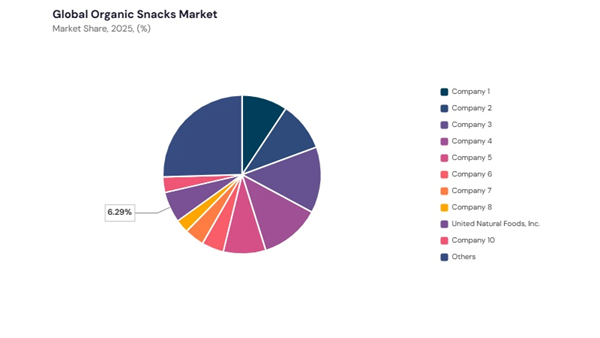
The leading players in the Organic Snacks Market are increasingly focusing on product innovation, sustainable sourcing, clean-label positioning, and premium organic certifications to strengthen their competitive positions globally. Companies continue emphasizing plant-based formulations, protein-rich snack products, gluten-free offerings, and environmentally responsible packaging solutions to address evolving consumer preferences. Strategic acquisitions, expansion into emerging markets, and increasing investments in digital retail infrastructure continue shaping market competition across the global organic snacks industry.

PepsiCo leads the market with approximately 13.47% market share, followed by General Mills, Danone. Other notable participants include United Natural Foods, Made In Nature, Navitas, UrthBox, and Paleovalley.

Product Outlook

Based on Product, the market is segmented into Snack Bars, Fruit & Vegetable Snacks, Grain-Based Snacks, Nut & Seed-Based Snacks, Bakery Snacks, Frozen Snacks, and Meat Snacks. The Snack Bars segment dominated the Global Organic Snacks Market by Product in 2025, attaining a market value of USD 3.80 billion. The dominance of the segment is attributed to increasing demand for portable, protein-rich, and functional snack products among fitness enthusiasts and health-conscious consumers.

Rising preference for gluten-free, plant-based, and nutrient-enriched snack bars continues supporting strong segment growth globally. Meanwhile, the Fruit & Vegetable Snacks segment attained a market value of USD 3.09 billion in 2025 owing to increasing consumer preference for minimally processed and naturally preserved snack products. Additionally, the Nut & Seed-Based Snacks segment continues witnessing strong demand supported by rising adoption of protein-rich and energy-boosting snack alternatives among wellness-focused consumers.

Distribution Channel Outlook

Based on Distribution Channel, the market is segmented into Supermarkets & Hypermarkets, Online Retail, Convenience Stores, and Specialty Food Stores. The Supermarkets & Hypermarkets segment dominated the Global Organic Snacks Market by Distribution Channel in 2025, attaining a market value of USD 6.76 billion. The dominance of the segment is supported by strong retail penetration, extensive product availability, promotional activities, and increasing accessibility of organic snack products across major retail chains globally. Meanwhile, the Online Retail segment recorded a market value of USD 3.63 billion in 2025 and is expected to witness strong growth during the forecast period owing to increasing e-commerce penetration, subscription-based snack delivery models, and rising direct-to-consumer sales strategies. Additionally, the Convenience Stores segment continues witnessing stable growth driven by increasing demand for healthy on-the-go snack products among urban consumers.

Regional Outlook

Region-wise, the market is analyzed across North America, Europe, Asia Pacific, and LAMEA. The North America market dominated the Global Organic Snacks Market in 2025, attaining a market value of USD 6.20 billion. The dominance of the region is attributed to high consumer awareness regarding clean-label foods, strong retail infrastructure, premium organic product adoption, and widespread availability of certified organic snack products across supermarkets and digital retail channels.

Meanwhile, the Europe market continues witnessing strong demand supported by increasing sustainability awareness, strict organic food regulations, and rising preference for environmentally responsible food products. The Asia Pacific market is expected to witness significant growth during the forecast period driven by rising disposable incomes, expanding urbanization, increasing health consciousness, and growing retail infrastructure across emerging economies. Additionally, the LAMEA market is gradually expanding owing to improving awareness regarding organic food products and increasing retail penetration across developing countries.
Market Competition and Attributes

The Organic Snacks Market is characterized by strong product differentiation, evolving dietary preferences, rapid product innovation, and increasing consumer focus on sustainability and transparency. Competition primarily revolves around ingredient authenticity, nutritional functionality, organic certification, plant-based formulations, and sustainable sourcing practices. Vendors are increasingly investing in biodegradable packaging technologies, AI-driven consumer analytics, and digital direct-to-consumer engagement strategies to strengthen long-term market positioning globally.

Recent Strategies Deployed in the Market

  • Mar-2025: PepsiCo expanded its organic snack portfolio with clean-label plant-based snack innovations targeting health-conscious consumers.
  • Jan-2025: General Mills strengthened its organic snack offerings through sustainable packaging initiatives and product diversification strategies.
  • Nov-2024: Danone invested in plant-based organic snack innovation and expanded digital direct-to-consumer retail channels.
  • Aug-2024: The Hain Celestial Group introduced new organic protein-rich snack bars with functional nutritional ingredients.
  • May-2024: Conagra Brands expanded retail distribution partnerships across North America and Europe for premium organic snack products.

List of Key Companies Profiled

  • PepsiCo
  • General Mills
  • Danone
  • Conagra Brands
  • The Hain Celestial Group
  • United Natural Foods
  • Made In Nature
  • Navitas
  • UrthBox
  • Paleovalley

Market Report Segmentation

By Product
  • Snack Bars
  • Fruit & Vegetable Snacks
  • Grain-Based Snacks
  • Nut & Seed-Based Snacks
  • Bakery Snacks
  • Frozen Snacks
  • Meat Snacks
By Distribution Channel
  • Supermarkets & Hypermarkets
  • Online Retail
  • Convenience Stores
  • Specialty Food Stores
By Geography
  • North America
    • US
    • Canada
    • Mexico
    • Rest of North America

  • Europe
    • Germany
    • UK
    • France
    • Italy
    • Spain
    • Rest of Europe

  • Asia Pacific
    • China
    • Japan
    • India
    • South Korea
    • Australia
    • Rest of Asia Pacific

  • LAMEA
    • Brazil
    • UAE
    • Saudi Arabia
    • South Africa
    • Rest of LAMEA

Table of Contents

Chapter 1. Market Overview
1.1 COVID-19 Impact
1.2 Market Composition and Scenario
Chapter 2. Key Factors Impacting Market
2.1.1 Market Drivers
2.1.2 Market Restraints
2.1.3 Market Opportunities
2.1.4 Market Challenges
2.1.5 Market Trends
2.1.6 State of Competition
2.1.7 Market Consolidation
2.1.8 Key Customer Criteria
Chapter 3. Product Life CycleChapter 4. Market Share Analysis
Chapter 5. Segmentation By Product
5.1 Grain-Based Snacks
5.2 Nut & Seed-Based Snacks
5.3 Meat Snacks
5.4 Snack Bars
5.5 Frozen Snacks
5.6 Fruit & Vegetable Snacks
5.7 Bakery Snacks
Chapter 6. Segmentation By Distribution Channel
6.1 Supermarkets & Hypermarkets
6.2 Convenience Stores
6.3 Specialty Food Stores
6.4 Online Retail
Chapter 7. North America Market
7.1 Market Overview
7.2 Key Factors Impacting Market
7.2.1 Market Drivers
7.2.2 Market Restraints
7.2.3 Market Opportunities
7.2.4 Market Challenges
7.2.5 Market Trends
7.2.6 State of Competition
7.2.7 Market Consolidation
7.2.8 Key Customer Criteria
7.3 Product Life Cycle
7.4 Segmentation By Product
7.4.1 Grain-Based Snacks
7.4.2 Nut & Seed-Based Snacks
7.4.3 Meat Snacks
7.4.4 Snack Bars
7.4.5 Frozen Snacks
7.4.6 Fruit & Vegetable Snacks
7.4.7 Bakery Snacks
7.5 Segmentation By Distribution Channel
7.5.1 Supermarkets & Hypermarkets
7.5.2 Convenience Stores
7.5.3 Specialty Food Stores
7.5.4 Online Retail
7.6 Segmentation By Country
7.6.1 US
7.6.1.1 Segmentation By Product
7.6.1.1.1 Grain-Based Snacks
7.6.1.1.2 Nut & Seed-Based Snacks
7.6.1.1.3 Meat Snacks
7.6.1.1.4 Snack Bars
7.6.1.1.5 Frozen Snacks
7.6.1.1.6 Fruit & Vegetable Snacks
7.6.1.1.7 Bakery Snacks
7.6.1.2 Segmentation By Distribution Channel
7.6.1.2.1 Supermarkets & Hypermarkets
7.6.1.2.2 Convenience Stores
7.6.1.2.3 Specialty Food Stores
7.6.1.2.4 Online Retail
7.6.2 Canada
7.6.2.1 Segmentation By Product
7.6.2.1.1 Grain-Based Snacks
7.6.2.1.2 Nut & Seed-Based Snacks
7.6.2.1.3 Meat Snacks
7.6.2.1.4 Snack Bars
7.6.2.1.5 Frozen Snacks
7.6.2.1.6 Fruit & Vegetable Snacks
7.6.2.1.7 Bakery Snacks
7.6.2.2 Segmentation By Distribution Channel
7.6.2.2.1 Supermarkets & Hypermarkets
7.6.2.2.2 Convenience Stores
7.6.2.2.3 Specialty Food Stores
7.6.2.2.4 Online Retail
7.6.3 Mexico
7.6.3.1 Segmentation By Product
7.6.3.1.1 Grain-Based Snacks
7.6.3.1.2 Nut & Seed-Based Snacks
7.6.3.1.3 Meat Snacks
7.6.3.1.4 Snack Bars
7.6.3.1.5 Frozen Snacks
7.6.3.1.6 Fruit & Vegetable Snacks
7.6.3.1.7 Bakery Snacks
7.6.3.2 Segmentation By Distribution Channel
7.6.3.2.1 Supermarkets & Hypermarkets
7.6.3.2.2 Convenience Stores
7.6.3.2.3 Specialty Food Stores
7.6.3.2.4 Online Retail
7.6.4 Rest of North America
7.6.4.1 Segmentation By Product
7.6.4.1.1 Grain-Based Snacks
7.6.4.1.2 Nut & Seed-Based Snacks
7.6.4.1.3 Meat Snacks
7.6.4.1.4 Snack Bars
7.6.4.1.5 Frozen Snacks
7.6.4.1.6 Fruit & Vegetable Snacks
7.6.4.1.7 Bakery Snacks
7.6.4.2 Segmentation By Distribution Channel
7.6.4.2.1 Supermarkets & Hypermarkets
7.6.4.2.2 Convenience Stores
7.6.4.2.3 Specialty Food Stores
7.6.4.2.4 Online Retail
Chapter 8. Europe Market
8.1 Market Overview
8.2 Key Factors Impacting Market
8.2.1 Market Drivers
8.2.2 Market Restraints
8.2.3 Market Opportunities
8.2.4 Market Challenges
8.2.5 Market Trends
8.2.6 State of Competition
8.2.7 Market Consolidation
8.2.8 Key Customer Criteria
8.3 Product Life Cycle
8.4 Segmentation By Product
8.4.1 Grain-Based Snacks
8.4.2 Nut & Seed-Based Snacks
8.4.3 Meat Snacks
8.4.4 Snack Bars
8.4.5 Frozen Snacks
8.4.6 Fruit & Vegetable Snacks
8.4.7 Bakery Snacks
8.5 Segmentation By Distribution Channel
8.5.1 Supermarkets & Hypermarkets
8.5.2 Convenience Stores
8.5.3 Specialty Food Stores
8.5.4 Online Retail
8.6 Segmentation By Country
8.6.1 Germany
8.6.1.1 Segmentation By Product
8.6.1.1.1 Grain-Based Snacks
8.6.1.1.2 Nut & Seed-Based Snacks
8.6.1.1.3 Meat Snacks
8.6.1.1.4 Snack Bars
8.6.1.1.5 Frozen Snacks
8.6.1.1.6 Fruit & Vegetable Snacks
8.6.1.1.7 Bakery Snacks
8.6.1.2 Segmentation By Distribution Channel
8.6.1.2.1 Supermarkets & Hypermarkets
8.6.1.2.2 Convenience Stores
8.6.1.2.3 Specialty Food Stores
8.6.1.2.4 Online Retail
8.6.2 UK
8.6.2.1 Segmentation By Product
8.6.2.1.1 Grain-Based Snacks
8.6.2.1.2 Nut & Seed-Based Snacks
8.6.2.1.3 Meat Snacks
8.6.2.1.4 Snack Bars
8.6.2.1.5 Frozen Snacks
8.6.2.1.6 Fruit & Vegetable Snacks
8.6.2.1.7 Bakery Snacks
8.6.2.2 Segmentation By Distribution Channel
8.6.2.2.1 Supermarkets & Hypermarkets
8.6.2.2.2 Convenience Stores
8.6.2.2.3 Specialty Food Stores
8.6.2.2.4 Online Retail
8.6.3 France
8.6.3.1 Segmentation By Product
8.6.3.1.1 Grain-Based Snacks
8.6.3.1.2 Nut & Seed-Based Snacks
8.6.3.1.3 Meat Snacks
8.6.3.1.4 Snack Bars
8.6.3.1.5 Frozen Snacks
8.6.3.1.6 Fruit & Vegetable Snacks
8.6.3.1.7 Bakery Snacks
8.6.3.2 Segmentation By Distribution Channel
8.6.3.2.1 Supermarkets & Hypermarkets
8.6.3.2.2 Convenience Stores
8.6.3.2.3 Specialty Food Stores
8.6.3.2.4 Online Retail
8.6.4 Russia
8.6.4.1 Segmentation By Product
8.6.4.1.1 Grain-Based Snacks
8.6.4.1.2 Nut & Seed-Based Snacks
8.6.4.1.3 Meat Snacks
8.6.4.1.4 Snack Bars
8.6.4.1.5 Frozen Snacks
8.6.4.1.6 Fruit & Vegetable Snacks
8.6.4.1.7 Bakery Snacks
8.6.4.2 Segmentation By Distribution Channel
8.6.4.2.1 Supermarkets & Hypermarkets
8.6.4.2.2 Convenience Stores
8.6.4.2.3 Specialty Food Stores
8.6.4.2.4 Online Retail
8.6.5 Spain
8.6.5.1 Segmentation By Product
8.6.5.1.1 Grain-Based Snacks
8.6.5.1.2 Nut & Seed-Based Snacks
8.6.5.1.3 Meat Snacks
8.6.5.1.4 Snack Bars
8.6.5.1.5 Frozen Snacks
8.6.5.1.6 Fruit & Vegetable Snacks
8.6.5.1.7 Bakery Snacks
8.6.5.2 Segmentation By Distribution Channel
8.6.5.2.1 Supermarkets & Hypermarkets
8.6.5.2.2 Convenience Stores
8.6.5.2.3 Specialty Food Stores
8.6.5.2.4 Online Retail
8.6.6 Italy
8.6.6.1 Segmentation By Product
8.6.6.1.1 Grain-Based Snacks
8.6.6.1.2 Nut & Seed-Based Snacks
8.6.6.1.3 Meat Snacks
8.6.6.1.4 Snack Bars
8.6.6.1.5 Frozen Snacks
8.6.6.1.6 Fruit & Vegetable Snacks
8.6.6.1.7 Bakery Snacks
8.6.6.2 Segmentation By Distribution Channel
8.6.6.2.1 Supermarkets & Hypermarkets
8.6.6.2.2 Convenience Stores
8.6.6.2.3 Specialty Food Stores
8.6.6.2.4 Online Retail
8.6.7 Rest of Europe
8.6.7.1 Segmentation By Product
8.6.7.1.1 Grain-Based Snacks
8.6.7.1.2 Nut & Seed-Based Snacks
8.6.7.1.3 Meat Snacks
8.6.7.1.4 Snack Bars
8.6.7.1.5 Frozen Snacks
8.6.7.1.6 Fruit & Vegetable Snacks
8.6.7.1.7 Bakery Snacks
8.6.7.2 Segmentation By Distribution Channel
8.6.7.2.1 Supermarkets & Hypermarkets
8.6.7.2.2 Convenience Stores
8.6.7.2.3 Specialty Food Stores
8.6.7.2.4 Online Retail
Chapter 9. Asia Pacific Market
9.1 Market Overview
9.2 Key Factors Impacting Market
9.2.1 Market Drivers
9.2.2 Market Restraints
9.2.3 Market Opportunities
9.2.4 Market Challenges
9.2.5 Market Trends
9.2.6 State of Competition
9.2.7 Market Consolidation
9.2.8 Key Customer Criteria
9.3 Product Life Cycle
9.4 Segmentation By Product
9.4.1 Grain-Based Snacks
9.4.2 Nut & Seed-Based Snacks
9.4.3 Meat Snacks
9.4.4 Snack Bars
9.4.5 Frozen Snacks
9.4.6 Fruit & Vegetable Snacks
9.4.7 Bakery Snacks
9.5 Segmentation By Distribution Channel
9.5.1 Supermarkets & Hypermarkets
9.5.2 Convenience Stores
9.5.3 Specialty Food Stores
9.5.4 Online Retail
9.6 Segmentation By Country
9.6.1 China
9.6.1.1 Segmentation By Product
9.6.1.1.1 Grain-Based Snacks
9.6.1.1.2 Nut & Seed-Based Snacks
9.6.1.1.3 Meat Snacks
9.6.1.1.4 Snack Bars
9.6.1.1.5 Frozen Snacks
9.6.1.1.6 Fruit & Vegetable Snacks
9.6.1.1.7 Bakery Snacks
9.6.1.2 Segmentation By Distribution Channel
9.6.1.2.1 Supermarkets & Hypermarkets
9.6.1.2.2 Convenience Stores
9.6.1.2.3 Specialty Food Stores
9.6.1.2.4 Online Retail
9.6.2 Japan
9.6.2.1 Segmentation By Product
9.6.2.1.1 Grain-Based Snacks
9.6.2.1.2 Nut & Seed-Based Snacks
9.6.2.1.3 Meat Snacks
9.6.2.1.4 Snack Bars
9.6.2.1.5 Frozen Snacks
9.6.2.1.6 Fruit & Vegetable Snacks
9.6.2.1.7 Bakery Snacks
9.6.2.2 Segmentation By Distribution Channel
9.6.2.2.1 Supermarkets & Hypermarkets
9.6.2.2.2 Convenience Stores
9.6.2.2.3 Specialty Food Stores
9.6.2.2.4 Online Retail
9.6.3 India
9.6.3.1 Segmentation By Product
9.6.3.1.1 Grain-Based Snacks
9.6.3.1.2 Nut & Seed-Based Snacks
9.6.3.1.3 Meat Snacks
9.6.3.1.4 Snack Bars
9.6.3.1.5 Frozen Snacks
9.6.3.1.6 Fruit & Vegetable Snacks
9.6.3.1.7 Bakery Snacks
9.6.3.2 Segmentation By Distribution Channel
9.6.3.2.1 Supermarkets & Hypermarkets
9.6.3.2.2 Convenience Stores
9.6.3.2.3 Specialty Food Stores
9.6.3.2.4 Online Retail
9.6.4 South Korea
9.6.4.1 Segmentation By Product
9.6.4.1.1 Grain-Based Snacks
9.6.4.1.2 Nut & Seed-Based Snacks
9.6.4.1.3 Meat Snacks
9.6.4.1.4 Snack Bars
9.6.4.1.5 Frozen Snacks
9.6.4.1.6 Fruit & Vegetable Snacks
9.6.4.1.7 Bakery Snacks
9.6.4.2 Segmentation By Distribution Channel
9.6.4.2.1 Supermarkets & Hypermarkets
9.6.4.2.2 Convenience Stores
9.6.4.2.3 Specialty Food Stores
9.6.4.2.4 Online Retail
9.6.5 Singapore
9.6.5.1 Segmentation By Product
9.6.5.1.1 Grain-Based Snacks
9.6.5.1.2 Nut & Seed-Based Snacks
9.6.5.1.3 Meat Snacks
9.6.5.1.4 Snack Bars
9.6.5.1.5 Frozen Snacks
9.6.5.1.6 Fruit & Vegetable Snacks
9.6.5.1.7 Bakery Snacks
9.6.5.2 Segmentation By Distribution Channel
9.6.5.2.1 Supermarkets & Hypermarkets
9.6.5.2.2 Convenience Stores
9.6.5.2.3 Specialty Food Stores
9.6.5.2.4 Online Retail
9.6.6 Malaysia
9.6.6.1 Segmentation By Product
9.6.6.1.1 Grain-Based Snacks
9.6.6.1.2 Nut & Seed-Based Snacks
9.6.6.1.3 Meat Snacks
9.6.6.1.4 Snack Bars
9.6.6.1.5 Frozen Snacks
9.6.6.1.6 Fruit & Vegetable Snacks
9.6.6.1.7 Bakery Snacks
9.6.6.2 Segmentation By Distribution Channel
9.6.6.2.1 Supermarkets & Hypermarkets
9.6.6.2.2 Convenience Stores
9.6.6.2.3 Specialty Food Stores
9.6.6.2.4 Online Retail
9.6.7 Rest of Asia Pacific
9.6.7.1 Segmentation By Product
9.6.7.1.1 Grain-Based Snacks
9.6.7.1.2 Nut & Seed-Based Snacks
9.6.7.1.3 Meat Snacks
9.6.7.1.4 Snack Bars
9.6.7.1.5 Frozen Snacks
9.6.7.1.6 Fruit & Vegetable Snacks
9.6.7.1.7 Bakery Snacks
9.6.7.2 Segmentation By Distribution Channel
9.6.7.2.1 Supermarkets & Hypermarkets
9.6.7.2.2 Convenience Stores
9.6.7.2.3 Specialty Food Stores
9.6.7.2.4 Online Retail
Chapter 10. LAMEA Market
10.1 Market Overview
10.2 Key Factors Impacting Market
10.2.1 Market Drivers
10.2.2 Market Restraints
10.2.3 Market Opportunities
10.2.4 Market Challenges
10.2.5 Market Trends
10.2.6 State of Competition
10.2.7 Market Consolidation
10.2.8 Key Customer Criteria
10.3 Product Life Cycle
10.4 Segmentation By Product
10.4.1 Grain-Based Snacks
10.4.2 Nut & Seed-Based Snacks
10.4.3 Meat Snacks
10.4.4 Snack Bars
10.4.5 Frozen Snacks
10.4.6 Fruit & Vegetable Snacks
10.4.7 Bakery Snacks
10.5 Segmentation By Distribution Channel
10.5.1 Supermarkets & Hypermarkets
10.5.2 Convenience Stores
10.5.3 Specialty Food Stores
10.5.4 Online Retail
10.6 Segmentation By Country
10.6.1 Brazil
10.6.1.1 Segmentation By Product
10.6.1.1.1 Grain-Based Snacks
10.6.1.1.2 Nut & Seed-Based Snacks
10.6.1.1.3 Meat Snacks
10.6.1.1.4 Snack Bars
10.6.1.1.5 Frozen Snacks
10.6.1.1.6 Fruit & Vegetable Snacks
10.6.1.1.7 Bakery Snacks
10.6.1.2 Segmentation By Distribution Channel
10.6.1.2.1 Supermarkets & Hypermarkets
10.6.1.2.2 Convenience Stores
10.6.1.2.3 Specialty Food Stores
10.6.1.2.4 Online Retail
10.6.2 Argentina
10.6.2.1 Segmentation By Product
10.6.2.1.1 Grain-Based Snacks
10.6.2.1.2 Nut & Seed-Based Snacks
10.6.2.1.3 Meat Snacks
10.6.2.1.4 Snack Bars
10.6.2.1.5 Frozen Snacks
10.6.2.1.6 Fruit & Vegetable Snacks
10.6.2.1.7 Bakery Snacks
10.6.2.2 Segmentation By Distribution Channel
10.6.2.2.1 Supermarkets & Hypermarkets
10.6.2.2.2 Convenience Stores
10.6.2.2.3 Specialty Food Stores
10.6.2.2.4 Online Retail
10.6.3 UAE
10.6.3.1 Segmentation By Product
10.6.3.1.1 Grain-Based Snacks
10.6.3.1.2 Nut & Seed-Based Snacks
10.6.3.1.3 Meat Snacks
10.6.3.1.4 Snack Bars
10.6.3.1.5 Frozen Snacks
10.6.3.1.6 Fruit & Vegetable Snacks
10.6.3.1.7 Bakery Snacks
10.6.3.2 Segmentation By Distribution Channel
10.6.3.2.1 Supermarkets & Hypermarkets
10.6.3.2.2 Convenience Stores
10.6.3.2.3 Specialty Food Stores
10.6.3.2.4 Online Retail
10.6.4 Saudi Arabia
10.6.4.1 Segmentation By Product
10.6.4.1.1 Grain-Based Snacks
10.6.4.1.2 Nut & Seed-Based Snacks
10.6.4.1.3 Meat Snacks
10.6.4.1.4 Snack Bars
10.6.4.1.5 Frozen Snacks
10.6.4.1.6 Fruit & Vegetable Snacks
10.6.4.1.7 Bakery Snacks
10.6.4.2 Segmentation By Distribution Channel
10.6.4.2.1 Supermarkets & Hypermarkets
10.6.4.2.2 Convenience Stores
10.6.4.2.3 Specialty Food Stores
10.6.4.2.4 Online Retail
10.6.5 South Africa
10.6.5.1 Segmentation By Product
10.6.5.1.1 Grain-Based Snacks
10.6.5.1.2 Nut & Seed-Based Snacks
10.6.5.1.3 Meat Snacks
10.6.5.1.4 Snack Bars
10.6.5.1.5 Frozen Snacks
10.6.5.1.6 Fruit & Vegetable Snacks
10.6.5.1.7 Bakery Snacks
10.6.5.2 Segmentation By Distribution Channel
10.6.5.2.1 Supermarkets & Hypermarkets
10.6.5.2.2 Convenience Stores
10.6.5.2.3 Specialty Food Stores
10.6.5.2.4 Online Retail
10.6.6 Nigeria
10.6.6.1 Segmentation By Product
10.6.6.1.1 Grain-Based Snacks
10.6.6.1.2 Nut & Seed-Based Snacks
10.6.6.1.3 Meat Snacks
10.6.6.1.4 Snack Bars
10.6.6.1.5 Frozen Snacks
10.6.6.1.6 Fruit & Vegetable Snacks
10.6.6.1.7 Bakery Snacks
10.6.6.2 Segmentation By Distribution Channel
10.6.6.2.1 Supermarkets & Hypermarkets
10.6.6.2.2 Convenience Stores
10.6.6.2.3 Specialty Food Stores
10.6.6.2.4 Online Retail
10.6.7 Rest of LAMEA
10.6.7.1 Segmentation By Product
10.6.7.1.1 Grain-Based Snacks
10.6.7.1.2 Nut & Seed-Based Snacks
10.6.7.1.3 Meat Snacks
10.6.7.1.4 Snack Bars
10.6.7.1.5 Frozen Snacks
10.6.7.1.6 Fruit & Vegetable Snacks
10.6.7.1.7 Bakery Snacks
10.6.7.2 Segmentation By Distribution Channel
10.6.7.2.1 Supermarkets & Hypermarkets
10.6.7.2.2 Convenience Stores
10.6.7.2.3 Specialty Food Stores
10.6.7.2.4 Online Retail
Chapter 11. Company Snapshot
11.1 Conagra Brands, Inc.
11.1.1 Business Overview
11.1.2 Key Information
11.1.3 Company Focus on Organic Snacks Market
11.1.4 Strategic Insights on Organic Snacks Market
11.1.5 Strategy Deployed for Organic Snacks Market
11.1.6 Product & Service Portfolio
11.1.7 Portfolio Categories
11.1.8 Key Products / Services (Representative)
11.1.9 Capability Overview
11.1.10 Technology & Innovation Focus
11.1.11 SWOT Analysis (Organic Snacks Market)
11.1.12 Customers / End Users
11.1.13 Competitive Positioning
11.1.14 Key Differentiators
11.1.15 Portfolio Matrix
11.1.16 Analyst View
11.1.17 Future Outlook for Organic Snacks Market
11.2 Danone S.A.
11.2.1 Business Overview
11.2.2 Key Information
11.2.3 Company Focus on Organic Snacks Market
11.2.4 Strategic Insights on Organic Snacks Market
11.2.5 Strategy Deployed for Organic Snacks Market
11.2.6 Product & Service Portfolio
11.2.7 Portfolio Categories
11.2.8 Key Products / Services (Representative)
11.2.9 Capability Overview
11.2.10 Technology & Innovation Focus
11.2.11 SWOT Analysis (Organic Snacks Market)
11.2.12 Customers / End Users
11.2.13 Competitive Positioning
11.2.14 Key Differentiators
11.2.15 Portfolio Matrix
11.2.16 Analyst View
11.2.17 Future Outlook for Organic Snacks Market
11.3 PepsiCo, Inc.
11.3.1 Business Overview
11.3.2 Key Information
11.3.3 Company Focus on Organic Snacks Market
11.3.4 Strategic Insights on Organic Snacks Market
11.3.5 Strategy Deployed for Organic Snacks Market
11.3.6 Product & Service Portfolio
11.3.7 Portfolio Categories
11.3.8 Key Products / Services (Representative)
11.3.9 Capability Overview
11.3.10 Technology & Innovation Focus
11.3.11 SWOT Analysis (Organic Snacks Market)
11.3.12 Customers / End Users
11.3.13 Competitive Positioning
11.3.14 Key Differentiators
11.3.15 Portfolio Matrix
11.3.16 Analyst View
11.3.17 Future Outlook for Organic Snacks Market
11.4 General Mills Inc.
11.4.1 Business Overview
11.4.2 Key Information
11.4.3 Company Focus on Organic Snacks Market
11.4.4 Strategic Insights on Organic Snacks Market
11.4.5 Strategy Deployed for Organic Snacks Market
11.4.6 Product & Service Portfolio
11.4.7 Portfolio Categories
11.4.8 Capability Overview
11.4.9 Technology & Innovation Focus
11.4.10 SWOT Analysis (Organic Snacks Market)
11.4.11 Customers / End Users
11.4.12 Competitive Positioning
11.4.13 Key Differentiators
11.4.14 Portfolio Matrix
11.4.15 Analyst View
11.4.16 Future Outlook for Organic Snacks Market
11.5 The Hain Celestial Group, Inc.
11.5.1 Business Overview
11.5.2 Key Information
11.5.3 Company Focus on Organic Snacks Market
11.5.4 Strategic Insights on Organic Snacks Market
11.5.5 Strategy Deployed for Organic Snacks Market
11.5.6 Product & Service Portfolio
11.5.7 Portfolio Categories
11.5.8 Key Products / Services (Representative)
11.5.9 Capability Overview
11.5.10 Technology & Innovation Focus
11.5.11 SWOT Analysis (Organic Snacks Market)
11.5.12 Customers / End Users
11.5.13 Competitive Positioning
11.5.14 Key Differentiators
11.5.15 Portfolio Matrix
11.5.16 Analyst View
11.5.17 Future Outlook for Organic Snacks Market
11.6 Made In Nature LLC
11.6.1 Business Overview
11.6.2 Key Information
11.6.3 Company Focus on Organic Snacks Market
11.6.4 Strategic Insights on Organic Snacks Market
11.6.5 Strategy Deployed for Organic Snacks Market
11.6.6 Product & Service Portfolio
11.6.7 Portfolio Categories
11.6.8 Key Products / Services (Representative)
11.6.9 Capability Overview
11.6.10 Technology & Innovation Focus
11.6.11 SWOT Analysis (Organic Snacks Market)
11.6.12 Customers / End Users
11.6.13 Competitive Positioning
11.6.14 Key Differentiators
11.6.15 Portfolio Matrix
11.6.16 Analyst View
11.6.17 Future Outlook for Organic Snacks Market
11.7 Navitas LLC
11.7.1 Business Overview
11.7.2 Key Information
11.7.3 Company Focus on Organic Snacks Market
11.7.4 Strategic Insights on Organic Snacks Market
11.7.5 Strategy Deployed for Organic Snacks Market
11.7.6 Product & Service Portfolio
11.7.7 Portfolio Categories
11.7.8 Key Products / Services (Representative)
11.7.9 Capability Overview
11.7.10 Technology & Innovation Focus
11.7.11 SWOT Analysis (Organic Snacks Market)
11.7.12 Customers / End Users
11.7.13 Competitive Positioning
11.7.14 Key Differentiators
11.7.15 Portfolio Matrix
11.7.16 Analyst View
11.7.17 Future Outlook for Organic Snacks Market
11.8 UrthBox Inc.
11.8.1 Business Overview
11.8.2 Key Information
11.8.3 Company Focus on Organic Snacks Market
11.8.4 Strategic Insights on Organic Snacks Market
11.8.5 Strategy Deployed for Organic Snacks Market
11.8.6 Product & Service Portfolio
11.8.7 Portfolio Categories
11.8.8 Key Products / Services (Representative)
11.8.9 Capability Overview
11.8.10 Technology & Innovation Focus
11.8.11 SWOT Analysis (Organic Snacks Market)
11.8.12 Customers / End Users
11.8.13 Competitive Positioning
11.8.14 Key Differentiators
11.8.15 Portfolio Matrix
11.8.16 Analyst View
11.8.17 Future Outlook for Organic Snacks Market
11.9 United Natural Foods, Inc.
11.9.1 Business Overview
11.9.2 Key Information
11.9.3 Company Focus on Organic Snacks Market
11.9.4 Strategic Insights on Organic Snacks Market
11.9.5 Strategy Deployed for Organic Snacks Market
11.9.6 Product & Service Portfolio
11.9.7 Portfolio Categories
11.9.8 Key Products / Services (Representative)
11.9.9 Capability Overview
11.9.10 Technology & Innovation Focus
11.9.11 SWOT Analysis (Organic Snacks Market)
11.9.12 Customers / End Users
11.9.13 Competitive Positioning
11.9.14 Key Differentiators
11.9.15 Portfolio Matrix
11.9.16 Analyst View
11.9.17 Future Outlook for Organic Snacks Market
11.10 Paleovalley, LLC
11.10.1 Business Overview
11.10.2 Key Information
11.10.3 Company Focus on Organic Snacks Market
11.10.4 Strategic Insights on Organic Snacks Market
11.10.5 Strategy Deployed for Organic Snacks Market
11.10.6 Product & Service Portfolio
11.10.7 Portfolio Categories
11.10.8 Key Products / Services (Representative)
11.10.9 Capability Overview
11.10.10 Technology & Innovation Focus
11.10.11 SWOT Analysis (Organic Snacks Market)
11.10.12 Customers / End Users
11.10.13 Competitive Positioning
11.10.14 Key Differentiators
11.10.15 Portfolio Matrix
11.10.16 Analyst View
11.10.17 Future Outlook for Organic Snacks Market
Chapter 12. Winning Imperatives of Organic Snacks Market

Companies Mentioned

  • PepsiCo
  • General Mills
  • Danone
  • Conagra Brands
  • The Hain Celestial Group
  • United Natural Foods
  • Made In Nature
  • Navitas
  • UrthBox
  • Paleovalley