



The Europe Surgical Simulation Market is expected to attain a market value of USD 324.89 is expected to witness market growth of 15.8% CAGR during the forecast period (2026-2033).
The Germany market dominated the Europe Surgical Simulation Market by country in 2025, and is expected to continue to be a dominant market till 2031; thereby, achieving a market value of USD 63.1 million by 2031. The UK market is expected to witness a CAGR of 14.6% during 2026-2033. Additionally, the France market is expected to witness a CAGR of 16.6% during 2026-2033.
The surgical simulation market in Europe has grown steadily because healthcare institutions increasingly emphasize patient safety, minimally invasive procedures, and advanced medical education. Surgical simulation initially focused on cadaver-based learning and physical anatomical models, but investments in digital healthcare technologies accelerated the adoption of virtual reality, augmented reality, haptic systems, and AI-powered simulation platforms. Collaborations among healthcare providers, universities, and medical technology companies further strengthened innovation in immersive learning systems and cloud-enabled training platforms. Public healthcare priorities related to procedural accuracy, patient outcome improvement, and standardized surgeon competency continue to influence market expansion throughout Europe.
AI-assisted surgical assessment, immersive VR-based training environments, and cloud-connected simulation systems are becoming increasingly popular across European healthcare institutions. More organizations are utilizing simulation technologies to improve surgeon performance, shorten learning curves, and reduce procedural complications. Market leaders are focusing on collaborative partnerships, modular training platforms, and realistic simulation environments to strengthen their market presence. Regulatory compliance, technological sophistication, and healthcare infrastructure modernization are major factors driving competition across the region rather than pricing strategies. Long-term investments in healthcare innovation, digital medical education, and robotic-assisted surgery training are expected to support stable market growth and continuous technological advancement.
Current trends focus on AI-assisted procedural analytics, cloud-based collaborative learning systems, and immersive simulation environments that replicate real-world surgical procedures. Healthcare organizations are increasingly investing in advanced surgical training centers and digital education infrastructure. The competitive landscape includes global medical technology providers, simulation software developers, healthcare startups, and university research collaborations. Future market growth is expected to be driven by technological innovation, increasing robotic-assisted surgeries, and continuous investments in healthcare modernization.
The Germany market dominated the Europe Surgical Simulation Market by country in 2025, and is expected to continue to be a dominant market till 2031; thereby, achieving a market value of USD 63.1 million by 2031. The UK market is expected to witness a CAGR of 14.6% during 2026-2033. Additionally, the France market is expected to witness a CAGR of 16.6% during 2026-2033.
The surgical simulation market in Europe has grown steadily because healthcare institutions increasingly emphasize patient safety, minimally invasive procedures, and advanced medical education. Surgical simulation initially focused on cadaver-based learning and physical anatomical models, but investments in digital healthcare technologies accelerated the adoption of virtual reality, augmented reality, haptic systems, and AI-powered simulation platforms. Collaborations among healthcare providers, universities, and medical technology companies further strengthened innovation in immersive learning systems and cloud-enabled training platforms. Public healthcare priorities related to procedural accuracy, patient outcome improvement, and standardized surgeon competency continue to influence market expansion throughout Europe.
AI-assisted surgical assessment, immersive VR-based training environments, and cloud-connected simulation systems are becoming increasingly popular across European healthcare institutions. More organizations are utilizing simulation technologies to improve surgeon performance, shorten learning curves, and reduce procedural complications. Market leaders are focusing on collaborative partnerships, modular training platforms, and realistic simulation environments to strengthen their market presence. Regulatory compliance, technological sophistication, and healthcare infrastructure modernization are major factors driving competition across the region rather than pricing strategies. Long-term investments in healthcare innovation, digital medical education, and robotic-assisted surgery training are expected to support stable market growth and continuous technological advancement.
Component Outlook
Based on Component, the market is segmented into Hardware, Software, and Services. The Hardware market dominated the Europe Surgical Simulation Market by Component in 2025, and is expected to continue to be a dominant market till 2031; thereby, achieving a market value of USD 158.3 million by 2031. The Software market is expected to witness a CAGR of 16.2% during 2026-2033. Additionally, the Services market is expected to witness a CAGR of 16.2% during 2026-2033.Technology Outlook
Based on Technology, the market is segmented into Physical / 3D-Printed Models, Virtual Reality (VR) Simulation, Augmented Reality (AR) Simulation, Haptic Simulation, and Web-based / Cloud-based Simulation. With a compound annual growth rate (CAGR) of 15.6% over the projection period, the Virtual Reality (VR) Simulation market dominated the Europe Surgical Simulation Market by Technology in 2025 and is expected to continue to be a prominent segment till 2031. The Physical / 3D-Printed Models market is expected to witness a CAGR of 14.9% during 2026-2033. The Web-based / Cloud-based Simulation market is expected to witness a CAGR of 18.1% during 2026-2033.End User Outlook
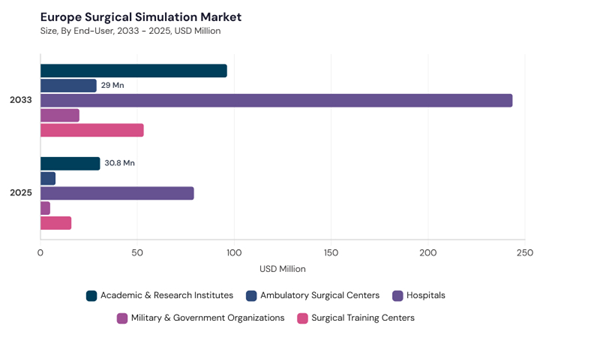
Based on End User, the market is segmented into Hospitals, Academic & Research Institutes, Surgical Training Centers, Ambulatory Surgical Centers, and Military & Government Organizations. The Hospitals market dominated the Europe Surgical Simulation Market by End User in 2025, and is expected to continue to be a dominant market till 2031; thereby, achieving a market value of USD 180.5 million by 2031. The Academic & Research Institutes market is expected to witness a CAGR of 15.5% during 2026-2033.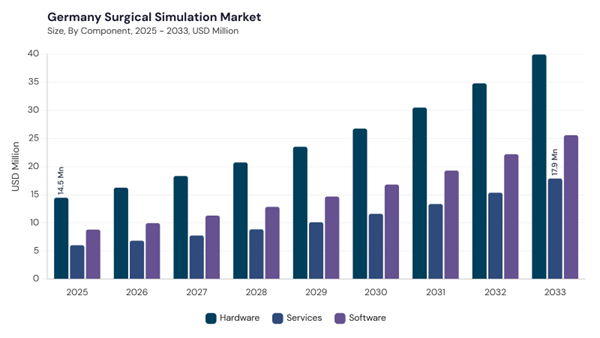
Specialty Outlook
Based on Specialty, the market is segmented into Orthopedic Surgery, Cardiovascular Surgery, Neurosurgery, General Surgery, Gastroenterology, Plastic & Reconstructive Surgery, and Other Specialty. The Orthopedic Surgery market dominated the Europe Surgical Simulation Market by Specialty in 2025, and is expected to continue to be a dominant market till 2031; thereby, achieving a market value of USD 89.1 million by 2031. The Cardiovascular Surgery market is expected to witness a CAGR of 15.4% during 2026-2033.Country Outlook
The Germany surgical simulation market is one of the most advanced healthcare training markets in Europe because of its strong healthcare infrastructure, technological innovation, and growing investments in medical education. Hospitals and academic institutions extensively utilize simulation systems for surgical training, robotic-assisted procedures, and competency-based learning programs. Increasing emphasis on reducing medical errors and improving procedural efficiency has accelerated the integration of VR, AR, and haptic-enabled simulation platforms into healthcare training environments.Current trends focus on AI-assisted procedural analytics, cloud-based collaborative learning systems, and immersive simulation environments that replicate real-world surgical procedures. Healthcare organizations are increasingly investing in advanced surgical training centers and digital education infrastructure. The competitive landscape includes global medical technology providers, simulation software developers, healthcare startups, and university research collaborations. Future market growth is expected to be driven by technological innovation, increasing robotic-assisted surgeries, and continuous investments in healthcare modernization.
List of Key Companies Profiled
- CAE Inc.
- 3D Systems Corporation
- Surgical Science Sweden AB
- VirtaMed AG
- Laerdal Medical AS
- Limbs & Things Ltd.
- Mentice AB
- Simulab Corporation
- Gaumard Scientific Company, Inc.
- Kyoto Kagaku Co., Ltd.
Market Report Segmentation
By Component- Hardware
- Software
- Services
- Physical / 3D-Printed Models
- Virtual Reality (VR) Simulation
- Augmented Reality (AR) Simulation
- Haptic Simulation
- Web-based / Cloud-based Simulation
- Hospitals
- Academic & Research Institutes
- Surgical Training Centers
- Ambulatory Surgical Centers
- Military & Government Organizations
- Orthopedic Surgery
- Cardiovascular Surgery
- Neurosurgery
- General Surgery
- Gastroenterology
- Plastic & Reconstructive Surgery
- Other Specialty
- Germany
- UK
- France
- Russia
- Spain
- Italy
- Rest of Europe
Table of Contents
Chapter 1. Europe Market1.1 Market Overview
1.2 Key Factors Impacting Market
1.2.1 Market Drivers
1.2.2 Market Restraints
1.2.3 Market Opportunities
1.2.4 Market Challenges
1.2.5 Market Trends
1.2.6 State of Competition
1.2.7 Market Consolidation
1.2.8 Key Customer Criteria
1.3 Product Life Cycle
1.4 Segmentation By Component
1.4.1 Hardware
1.4.2 Software
1.4.3 Services
1.5 Segmentation By Technology
1.5.1 Virtual Reality (VR) Simulation
1.5.2 Augmented Reality (AR) Simulation
1.5.3 Haptic Simulation
1.5.4 Web-based / Cloud-based Simulation
1.5.5 Physical / 3D-Printed Models
1.6 Segmentation By Specialty
1.6.1 Orthopedic Surgery
1.6.2 Cardiovascular Surgery
1.6.3 Neurosurgery
1.6.4 Gastroenterology
1.6.5 General Surgery
1.6.6 Plastic & Reconstructive Surgery
1.6.7 Other Specialty
1.7 Segmentation By End-User
1.7.1 Hospitals
1.7.2 Academic & Research Institutes
1.7.3 Surgical Training Centers
1.7.4 Ambulatory Surgical Centers
1.7.5 Military & Government Organizations
1.8 Segmentation By Country
1.8.1 Germany
1.8.1.1 Segmentation By Component
1.8.1.1.1 Hardware
1.8.1.1.2 Software
1.8.1.1.3 Services
1.8.1.2 Segmentation By Technology
1.8.1.2.1 Virtual Reality (VR) Simulation
1.8.1.2.2 Augmented Reality (AR) Simulation
1.8.1.2.3 Haptic Simulation
1.8.1.2.4 Web-based / Cloud-based Simulation
1.8.1.2.5 Physical / 3D-Printed Models
1.8.1.3 Segmentation By Specialty
1.8.1.3.1 Orthopedic Surgery
1.8.1.3.2 Cardiovascular Surgery
1.8.1.3.3 Neurosurgery
1.8.1.3.4 Gastroenterology
1.8.1.3.5 General Surgery
1.8.1.3.6 Plastic & Reconstructive Surgery
1.8.1.3.7 Other Specialty
1.8.1.4 Segmentation By End-User
1.8.1.4.1 Hospitals
1.8.1.4.2 Academic & Research Institutes
1.8.1.4.3 Surgical Training Centers
1.8.1.4.4 Ambulatory Surgical Centers
1.8.1.4.5 Military & Government Organizations
1.8.2 United Kingdom
1.8.2.1 Segmentation By Component
1.8.2.1.1 Hardware
1.8.2.1.2 Software
1.8.2.1.3 Services
1.8.2.2 Segmentation By Technology
1.8.2.2.1 Virtual Reality (VR) Simulation
1.8.2.2.2 Augmented Reality (AR) Simulation
1.8.2.2.3 Haptic Simulation
1.8.2.2.4 Web-based / Cloud-based Simulation
1.8.2.2.5 Physical / 3D-Printed Models
1.8.2.3 Segmentation By Specialty
1.8.2.3.1 Orthopedic Surgery
1.8.2.3.2 Cardiovascular Surgery
1.8.2.3.3 Neurosurgery
1.8.2.3.4 Gastroenterology
1.8.2.3.5 General Surgery
1.8.2.3.6 Plastic & Reconstructive Surgery
1.8.2.3.7 Other Specialty
1.8.2.4 Segmentation By End-User
1.8.2.4.1 Hospitals
1.8.2.4.2 Academic & Research Institutes
1.8.2.4.3 Surgical Training Centers
1.8.2.4.4 Ambulatory Surgical Centers
1.8.2.4.5 Military & Government Organizations
1.8.3 France
1.8.3.1 Segmentation By Component
1.8.3.1.1 Hardware
1.8.3.1.2 Software
1.8.3.1.3 Services
1.8.3.2 Segmentation By Technology
1.8.3.2.1 Virtual Reality (VR) Simulation
1.8.3.2.2 Augmented Reality (AR) Simulation
1.8.3.2.3 Haptic Simulation
1.8.3.2.4 Web-based / Cloud-based Simulation
1.8.3.2.5 Physical / 3D-Printed Models
1.8.3.3 Segmentation By Specialty
1.8.3.3.1 Orthopedic Surgery
1.8.3.3.2 Cardiovascular Surgery
1.8.3.3.3 Neurosurgery
1.8.3.3.4 Gastroenterology
1.8.3.3.5 General Surgery
1.8.3.3.6 Plastic & Reconstructive Surgery
1.8.3.3.7 Other Specialty
1.8.3.4 Segmentation By End-User
1.8.3.4.1 Hospitals
1.8.3.4.2 Academic & Research Institutes
1.8.3.4.3 Surgical Training Centers
1.8.3.4.4 Ambulatory Surgical Centers
1.8.3.4.5 Military & Government Organizations
1.8.4 Russia
1.8.4.1 Segmentation By Component
1.8.4.1.1 Hardware
1.8.4.1.2 Software
1.8.4.1.3 Services
1.8.4.2 Segmentation By Technology
1.8.4.2.1 Virtual Reality (VR) Simulation
1.8.4.2.2 Augmented Reality (AR) Simulation
1.8.4.2.3 Haptic Simulation
1.8.4.2.4 Web-based / Cloud-based Simulation
1.8.4.2.5 Physical / 3D-Printed Models
1.8.4.3 Segmentation By Specialty
1.8.4.3.1 Orthopedic Surgery
1.8.4.3.2 Cardiovascular Surgery
1.8.4.3.3 Neurosurgery
1.8.4.3.4 Gastroenterology
1.8.4.3.5 General Surgery
1.8.4.3.6 Plastic & Reconstructive Surgery
1.8.4.3.7 Other Specialty
1.8.4.4 Segmentation By End-User
1.8.4.4.1 Hospitals
1.8.4.4.2 Academic & Research Institutes
1.8.4.4.3 Surgical Training Centers
1.8.4.4.4 Ambulatory Surgical Centers
1.8.4.4.5 Military & Government Organizations
1.8.5 Spain
1.8.5.1 Segmentation By Component
1.8.5.1.1 Hardware
1.8.5.1.2 Software
1.8.5.1.3 Services
1.8.5.2 Segmentation By Technology
1.8.5.2.1 Virtual Reality (VR) Simulation
1.8.5.2.2 Augmented Reality (AR) Simulation
1.8.5.2.3 Haptic Simulation
1.8.5.2.4 Web-based / Cloud-based Simulation
1.8.5.2.5 Physical / 3D-Printed Models
1.8.5.3 Segmentation By Specialty
1.8.5.3.1 Orthopedic Surgery
1.8.5.3.2 Cardiovascular Surgery
1.8.5.3.3 Neurosurgery
1.8.5.3.4 Gastroenterology
1.8.5.3.5 General Surgery
1.8.5.3.6 Plastic & Reconstructive Surgery
1.8.5.3.7 Other Specialty
1.8.5.4 Segmentation By End-User
1.8.5.4.1 Hospitals
1.8.5.4.2 Academic & Research Institutes
1.8.5.4.3 Surgical Training Centers
1.8.5.4.4 Ambulatory Surgical Centers
1.8.5.4.5 Military & Government Organizations
1.8.6 Italy
1.8.6.1 Segmentation By Component
1.8.6.1.1 Hardware
1.8.6.1.2 Software
1.8.6.1.3 Services
1.8.6.2 Segmentation By Technology
1.8.6.2.1 Virtual Reality (VR) Simulation
1.8.6.2.2 Augmented Reality (AR) Simulation
1.8.6.2.3 Haptic Simulation
1.8.6.2.4 Web-based / Cloud-based Simulation
1.8.6.2.5 Physical / 3D-Printed Models
1.8.6.3 Segmentation By Specialty
1.8.6.3.1 Orthopedic Surgery
1.8.6.3.2 Cardiovascular Surgery
1.8.6.3.3 Neurosurgery
1.8.6.3.4 Gastroenterology
1.8.6.3.5 General Surgery
1.8.6.3.6 Plastic & Reconstructive Surgery
1.8.6.3.7 Other Specialty
1.8.6.4 Segmentation By End-User
1.8.6.4.1 Hospitals
1.8.6.4.2 Academic & Research Institutes
1.8.6.4.3 Surgical Training Centers
1.8.6.4.4 Ambulatory Surgical Centers
1.8.6.4.5 Military & Government Organizations
1.8.7 Rest of Europe
1.8.7.1 Segmentation By Component
1.8.7.1.1 Hardware
1.8.7.1.2 Software
1.8.7.1.3 Services
1.8.7.2 Segmentation By Technology
1.8.7.2.1 Virtual Reality (VR) Simulation
1.8.7.2.2 Augmented Reality (AR) Simulation
1.8.7.2.3 Haptic Simulation
1.8.7.2.4 Web-based / Cloud-based Simulation
1.8.7.2.5 Physical / 3D-Printed Models
1.8.7.3 Segmentation By Specialty
1.8.7.3.1 Orthopedic Surgery
1.8.7.3.2 Cardiovascular Surgery
1.8.7.3.3 Neurosurgery
1.8.7.3.4 Gastroenterology
1.8.7.3.5 General Surgery
1.8.7.3.6 Plastic & Reconstructive Surgery
1.8.7.3.7 Other Specialty
1.8.7.4 Segmentation By End-User
1.8.7.4.1 Hospitals
1.8.7.4.2 Academic & Research Institutes
1.8.7.4.3 Surgical Training Centers
1.8.7.4.4 Ambulatory Surgical Centers
1.8.7.4.5 Military & Government Organizations
Chapter 2. Company Profiles
2.1 Surgical Science Sweden AB
2.1.1 Company Overview
2.1.2 Financial Analysis
2.1.3 Segmental and Regional Analysis
2.1.2 Research & Development Expenses
2.1.5 Recent Strategies and Developments
2.1.5.1 Partnerships, Collaborations, and Agreements
2.1.5.2 Acquisition and Mergers
2.1.6 Strategic Insights
2.1.7 Strategy Deployed
2.1.8 SWOT Analysis
2.1.9 Future Outlook
2.2 Elevate Healthcare.
2.2.1 Company Overview
2.2.2 Recent Strategies and Developments
2.2.2.1 Partnerships, Collaborations, and Agreements
2.2.2.2 Product Launches and Product Expansions
2.2.3 Strategic Insights
2.2.2 Strategy Deployed
2.2.5 SWOT Analysis
2.2.6 Future Outlook
2.3 Laerdal Medical
2.3.1 Company Overview
2.3.2 Recent Strategies and Developments
2.3.2.1 Partnerships, Collaborations, and Agreements
2.3.2.2 Merger & Acquisition
2.3.2.3 Product Launches and Product Expansions
2.3.3 Strategic Insights
2.3.2 Strategy Deployed
2.3.5 SWOT Analysis
2.3.6 Future Outlook
2.2 3D Systems, Inc.
2.2.1 Company Overview
2.2.2 Financial Analysis
2.2.3 Segmental and Regional Analysis
2.2.2 Research & Development Expenses
2.2.5 Recent Strategies and Developments
2.2.5.1 Product Launches and Product Expansions
2.2.6 Strategic Insights
2.2.7 Strategy Deployed
2.2.8 SWOT Analysis
2.2.9 Future Outlook
2.5 Mentice AB
2.5.1 Company Overview
2.5.2 Recent Strategies and Developments
2.5.2.1 Acquisition and Mergers
2.5.3 Strategic Insights
2.5.2 Strategy Deployed
2.5.5 SWOT Analysis
2.5.6 Future Outlook
2.6 VirtaMed AG
2.6.1 Company Overview
2.6.2 Recent Strategies and Developments
2.6.2.1 Partnerships, Collaborations, and Agreements
2.6.3 Strategic Insights
2.6.2 Strategy Deployed
2.6.5 SWOT Analysis
2.6.6 Future Outlook
2.7 Gaumard Scientific Company
2.7.1 Company Overview
2.7.2 Recent Strategies and Developments
2.7.2.1 Product Launches and Product Expansions
2.7.3 Strategic Insights
2.7.2 Strategy Deployed
2.7.5 SWOT Analysis
2.7.6 Future Outlook
2.8 Simulab Corporation
2.8.1 Company Overview
2.8.2 Recent Strategies and Developments
2.8.2.1 Product Launches and Product Expansions
2.8.3 SWOT Analysis
2.9 Intuitive Surgical, Inc.
2.9.1 Company Overview
2.9.2 Financial Analysis
2.9.3 Research & Development Expenses
2.9.2 Recent Strategies and Developments
2.9.2.1 Product Launches and Product Expansions
2.9.5 Strategic Insights
2.9.6 Strategy Deployed
2.9.7 SWOT Analysis
2.9.8 Future Outlook
2.1 Osso VR
2.10.1 Company Overview
2.10.2 Strategic Insights
2.10.3 Strategy Deployed
2.10.2 SWOT Analysis
2.10.5 Future Outlook
Companies Mentioned
- CAE Inc.
- 3D Systems Corporation
- Surgical Science Sweden AB
- VirtaMed AG
- Laerdal Medical AS
- Limbs & Things Ltd.
- Mentice AB
- Simulab Corporation
- Gaumard Scientific Company, Inc.
- Kyoto Kagaku Co., Ltd.


