



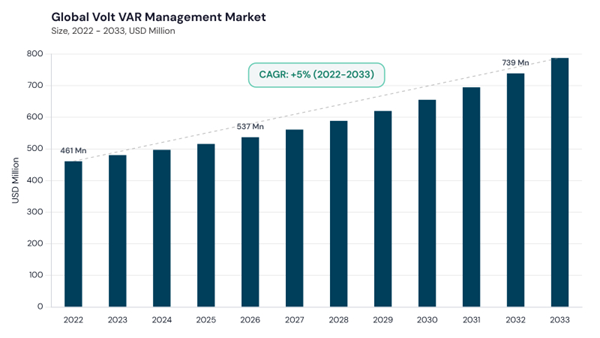
The Global Volt VAR Management Market size is expected to reach USD 787.6 Million by 2033, rising at a market growth of 5.6% CAGR during the forecast period.
The market is gaining momentum due to increasing investments in smart grid infrastructure, renewable energy integration, and grid modernization initiatives. Utilities are increasingly adopting Volt VAR management solutions to improve grid reliability, reduce energy losses, and optimize voltage stability across transmission and distribution networks.
The market is witnessing growing adoption across investor-owned utilities, municipal utilities, electric cooperatives, and industrial power networks. Increasing penetration of distributed energy resources, rising electricity demand, and expanding renewable integration projects are accelerating deployment of Volt VAR management solutions globally.
Leading companies in the Volt VAR management market are focusing on advanced automation technologies, AI-enabled grid analytics, and integrated software platforms to strengthen their market position. Market participants are increasingly investing in real-time monitoring solutions, predictive voltage optimization systems, and cloud-based grid management platforms to improve operational efficiency and grid reliability.
Companies are also expanding strategic collaborations with utilities, smart grid technology providers, and energy management firms to enhance interoperability and accelerate deployment of advanced Volt VAR solutions. Partnerships are supporting the integration of distributed energy resources, advanced metering infrastructure, and digital substations within modern power networks.
In addition, manufacturers and solution providers are strengthening regional expansion strategies and increasing investments in grid modernization projects across North America, Europe, and Asia Pacific. Rising investments in renewable energy infrastructure, smart cities, and intelligent power distribution systems are further encouraging companies to expand their product portfolios and service capabilities.
Eaton Corporation plc and GE Vernova Group also maintain strong market positions through integrated smart grid solutions and advanced distribution management offerings. Mid-sized and regional players continue to compete through specialized grid optimization technologies, localized deployments, and cost-efficient service models.
Future market share movements are expected to be influenced by increasing adoption of AI-enabled grid analytics, renewable energy integration, and cloud-based Volt VAR optimization platforms across utility networks.
Manufacturers are emphasizing interoperability with smart grids, distributed energy resource management systems, and utility automation platforms. Strategic partnerships with utilities, communication technology providers, and software developers are enabling broader ecosystem integration and improved system performance.
Regional expansion and flexible pricing models remain important competitive strategies, particularly in emerging economies where utilities are investing heavily in grid modernization and energy efficiency initiatives. Companies are also prioritizing modular and scalable solutions to support evolving utility requirements.
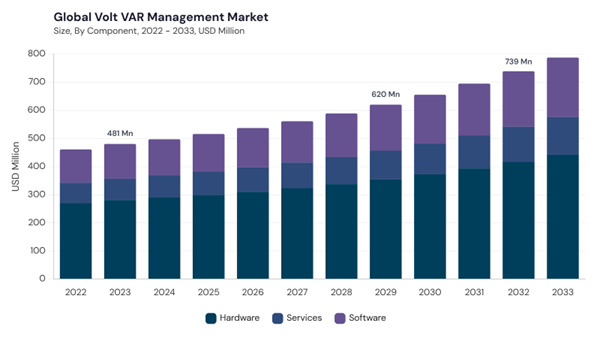
The market is gaining momentum due to increasing investments in smart grid infrastructure, renewable energy integration, and grid modernization initiatives. Utilities are increasingly adopting Volt VAR management solutions to improve grid reliability, reduce energy losses, and optimize voltage stability across transmission and distribution networks.
Key Market Trends & Insights
- The Distribution Network segment dominated the market in 2025 with a 68.86% share and is expected to reach USD 529.1 Million by 2033.
- The Hardware segment accounted for the largest share in 2025 with 58.08% revenue contribution and is projected to reach USD 442.3 Million by 2033.
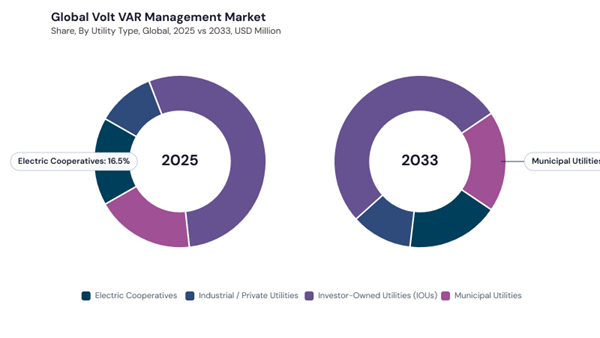
- Investor-Owned Utilities (IOUs) dominated the market in 2025 with a 54.12% share and are expected to reach USD 411.1 Million by 2033.
- North America dominated the global market in 2025 with USD 180.9 Million revenue owing to strong smart grid modernization initiatives.
- The Software segment is projected to reach USD 211.2 Million by 2033 due to increasing adoption of AI-driven grid optimization platforms.
- Asia Pacific is expected to witness strong growth during the forecast period due to expanding power infrastructure investments and renewable energy deployment.
The market is witnessing growing adoption across investor-owned utilities, municipal utilities, electric cooperatives, and industrial power networks. Increasing penetration of distributed energy resources, rising electricity demand, and expanding renewable integration projects are accelerating deployment of Volt VAR management solutions globally.
Leading companies in the Volt VAR management market are focusing on advanced automation technologies, AI-enabled grid analytics, and integrated software platforms to strengthen their market position. Market participants are increasingly investing in real-time monitoring solutions, predictive voltage optimization systems, and cloud-based grid management platforms to improve operational efficiency and grid reliability.
Companies are also expanding strategic collaborations with utilities, smart grid technology providers, and energy management firms to enhance interoperability and accelerate deployment of advanced Volt VAR solutions. Partnerships are supporting the integration of distributed energy resources, advanced metering infrastructure, and digital substations within modern power networks.
In addition, manufacturers and solution providers are strengthening regional expansion strategies and increasing investments in grid modernization projects across North America, Europe, and Asia Pacific. Rising investments in renewable energy infrastructure, smart cities, and intelligent power distribution systems are further encouraging companies to expand their product portfolios and service capabilities.
Driving and Restraining Factors
Drivers- Increasing Integration of Distributed Energy Resources (DERs)
- Growing Investments in Smart Grid Modernization
- Rising Demand for Grid Stability and Power Quality Optimization
- Advancements in Real-Time Monitoring and AI-Driven Grid Control Technologies
- High Capital Expenditure and Operational Costs
- Complex Regulatory and Compliance Requirements
- Integration Challenges with Legacy Grid Infrastructure
- Expansion of AI and Predictive Analytics in Grid Management
- Growing Adoption of Energy Storage and Smart Grid Technologies
- Increasing Renewable Energy Integration Across Utility Networks
- Voltage Regulation Complexity Across Distributed Networks
- Interoperability Issues with Diverse Grid Components
- Cybersecurity and Data Management Concerns in Smart Grid Systems
Market Share Analysis
The market remains moderately consolidated, with leading companies focusing heavily on intelligent grid management technologies and advanced automation capabilities. ABB Ltd. leads the market with an estimated share of more than 15%, followed by Schneider Electric SE with approximately 12% share and Siemens AG with nearly 10% share.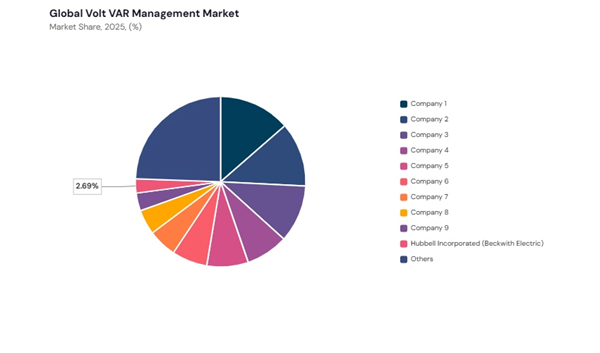
Eaton Corporation plc and GE Vernova Group also maintain strong market positions through integrated smart grid solutions and advanced distribution management offerings. Mid-sized and regional players continue to compete through specialized grid optimization technologies, localized deployments, and cost-efficient service models.
Future market share movements are expected to be influenced by increasing adoption of AI-enabled grid analytics, renewable energy integration, and cloud-based Volt VAR optimization platforms across utility networks.
Component Outlook
The component segment of the Volt VAR management market includes Hardware, Software, and Services. The Hardware segment dominated the market in 2025 due to rising deployment of voltage regulators, sensors, capacitor banks, and advanced control devices across utility networks. Software solutions are witnessing strong adoption owing to increasing demand for AI-driven analytics, real-time monitoring, and automated voltage optimization capabilities. Meanwhile, the Services segment continues to expand steadily due to growing requirements for consulting, integration, maintenance, and system optimization services across smart grid projects.Network Level Outlook
The network level segment comprises Distribution Network and Transmission Network. The Distribution Network segment accounted for the largest share in 2025 driven by increasing investments in smart distribution infrastructure, distributed energy resource integration, and voltage optimization at the grid edge. Transmission Network solutions are also gaining traction as utilities focus on maintaining voltage stability, reducing transmission losses, and improving power transfer efficiency across high-voltage networks. Growing deployment of FACTS devices and advanced reactive power management systems is further supporting market growth.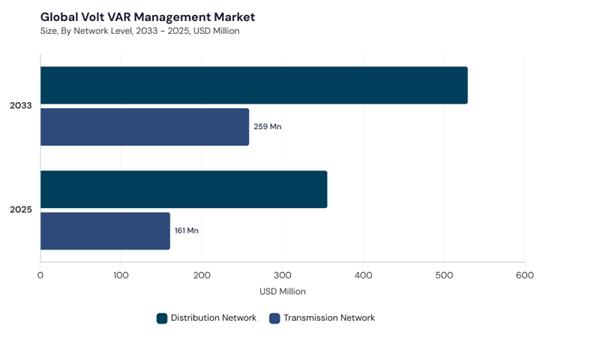
Utility Type Outlook
Based on utility type, the market is segmented into Investor-Owned Utilities (IOUs), Municipal Utilities, Electric Cooperatives, and Industrial / Private Utilities. Investor-Owned Utilities dominated the market in 2025 due to substantial investments in grid modernization, automation, and renewable integration projects. Municipal utilities are increasingly deploying Volt VAR management solutions to improve local grid reliability and energy efficiency. Electric cooperatives and industrial/private utilities are also witnessing growing adoption of intelligent voltage optimization systems to enhance operational efficiency and maintain power quality across distributed networks.Market Competition and Attributes
The Volt VAR management market is highly competitive, supported by continuous innovation in grid automation, AI-enabled analytics, and intelligent voltage optimization technologies. Companies are increasingly integrating cloud computing, machine learning, and advanced distribution management systems into their offerings to improve grid visibility and operational efficiency.Manufacturers are emphasizing interoperability with smart grids, distributed energy resource management systems, and utility automation platforms. Strategic partnerships with utilities, communication technology providers, and software developers are enabling broader ecosystem integration and improved system performance.
Regional expansion and flexible pricing models remain important competitive strategies, particularly in emerging economies where utilities are investing heavily in grid modernization and energy efficiency initiatives. Companies are also prioritizing modular and scalable solutions to support evolving utility requirements.
Recent Strategies Deployed in the Market
- March-2026: Oracle Corporation - Introduced agentic AI features in its AI Database to improve real-time grid decision-making and automation capabilities for Volt VAR management.
- February-2026: GE Vernova Group - Launched GridBeats APS software-defined automation platform to enhance voltage regulation and reactive power optimization across utility substations.
- February-2026: Siemens AG - Expanded electronics intelligence solutions to strengthen industrial automation and smart grid efficiency.
- January-2026: Landis+Gyr Group AG - Partnered with Mitsubishi Electric to accelerate grid-edge intelligence and distributed energy resource integration.
- November-2025: Schneider Electric SE - Highlighted advanced electrification and automation technologies during Innovation Summit North America 2025 to support intelligent grid operations.
- March-2025: Itron, Inc. - Launched IntelliFLEX platform to improve distributed energy resource integration and dynamic voltage optimization.
List of Key Companies Profiled
- ABB Ltd.
- Schneider Electric SE
- Siemens AG
- Eaton Corporation plc
- GE Vernova Group
- Oracle Corporation
- Landis+Gyr Group AG
- Itron, Inc.
- Hubbell Incorporated
- Mitsubishi Electric Corporation
Market Report Segmentation
By Component- Hardware
- Software
- Services
- Distribution Network
- Transmission Network
- Investor-Owned Utilities (IOUs)
- Municipal Utilities
- Electric Cooperatives
- Industrial / Private Utilities
- North America
- US
- Canada
- Mexico
- Rest of North America
- Europe
- Germany
- UK
- France
- Russia
- Spain
- Italy
- Rest of Europe
- Asia Pacific
- China
- Japan
- India
- South Korea
- Singapore
- Malaysia
- Rest of Asia Pacific
- LAMEA
- Brazil
- Argentina
- UAE
- Saudi Arabia
- South Africa
- Nigeria
- Rest of LAMEA
Table of Contents
Chapter 1. Global Market Overview
Chapter 2. Key Factors Impacting Market
Chapter 5. Competition Analysis - Global
Chapter 6. Segmentation By Component
Chapter 7. Segmentation By Network Level
Chapter 8. Segmentation By Utility Type
Chapter 9. North America Market
Chapter 10. Europe Market
Chapter 11. Asia Pacific Market
Chapter 12. LAMEA Market
Chapter 13. Company Profiles
Companies Mentioned
- ABB Ltd.
- Schneider Electric SE
- Siemens AG
- Eaton Corporation plc
- GE Vernova Group
- Oracle Corporation
- Landis+Gyr Group AG
- Itron, Inc.
- Hubbell Incorporated
- Mitsubishi Electric Corporation


