



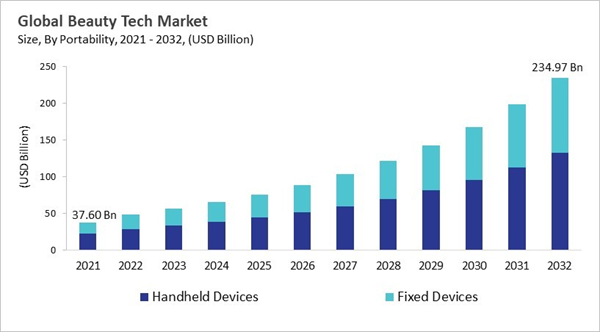
The Global Beauty Tech Market size is estimated at $76.03 billion in 2025 and is expected to reach $234.97 billion by 2032, rising at a market growth of 17.5% CAGR during the forecast period (2025-2032). The strong projected growth of the Global Beauty Tech Market is driven by increasing consumer demand for personalized beauty solutions, rising adoption of AI and AR in skincare and cosmetics, expanding e-commerce platforms, and growing investments by beauty brands in digital tools, smart devices, and virtual try-on technologies.
The beauty tech market has developed from basic digital integrations to a highly sophisticated, technology-driven ecosystem. Early advancements were propelled by social media and mobile technology, which resulted in innovations such as AI-based skin diagnostics, AR try-ons, and personalized product recommendations. The market transformed from being product-focused to experience-driven, high-resolution imaging, leveraging machine learning, seamless omnichannel experiences, and data analytics to deliver tailored beauty solutions. Key factors supporting the beauty tech market include widespread adoption of AR in e-commerce, AI-powered personalization, and rising emphasis on transparency and sustainability through technologies such as blockchain for supply chain tracking.
The competitive landscape in the beauty tech market is defined by strong innovation-led competition between regional players and global brands, with differentiation focused on user experience, personalization capabilities, and advanced technologies. Companies are emphasizing growth through strategic partnerships and investments in evolving technologies like AR, AI, and machine learning. Accelerated digital adoption, at-home beauty solutions, and virtual consultations are some of the elements supporting the market expansion. The ecosystem consists of service operators, technology providers, and end-users, forming a competitive market landscape defined by a strong focus on consumer-centric solutions, continuous innovations, and growing partnerships.
The leading players in the market are competing with diverse innovative offerings to remain competitive in the market. The above illustration shows the percentage of revenue shared by some of the leading companies in the market. The leading players of the market are adopting various strategies to cater demand coming from the different industries. The key developmental strategies in the market are Acquisitions, and Partnerships & Collaborations.
The beauty tech market is anticipated to grow at a steady pace in the Asia Pacific and LAMEA region. The market is driven by expanding middle-class populations, rising digital penetration, and increasing beauty consciousness. Regional nations, including South Korea, Japan, China, and India, are where tech-savvy consumers embrace smart skincare devices, mobile-based beauty applications, and social commerce platforms. Additionally, the LAMEA beauty tech market is also expected to showcase lucrative market opportunities. This is due to expanding internet access and a demographic eager to experiment with digital beauty solutions. Also, these regions offer growth opportunities supported by rising digital engagement and expanding consumer bases.
Key Market Trends & Insights:
- The North America market dominated Global Beauty Tech Market in 2024, accounting for a 37.23% revenue share in 2024.
- The U.S. market is projected to maintain its leadership in North America, reaching a market size of USD 63.25 billion by 2032.
- Among the various Type, the Hair Removal Devices segment dominated the global market, contributing a revenue share of 34.42% in 2024.
- In terms of Application, Salon / Clinics are expected to lead the global market, with a projected revenue share of 41.93% by 2032.
- Online channel emerged as the leading Distribution Channel in 2024, capturing a 49.77% revenue share, and is projected to retain its dominance during the forecast period.
The beauty tech market has developed from basic digital integrations to a highly sophisticated, technology-driven ecosystem. Early advancements were propelled by social media and mobile technology, which resulted in innovations such as AI-based skin diagnostics, AR try-ons, and personalized product recommendations. The market transformed from being product-focused to experience-driven, high-resolution imaging, leveraging machine learning, seamless omnichannel experiences, and data analytics to deliver tailored beauty solutions. Key factors supporting the beauty tech market include widespread adoption of AR in e-commerce, AI-powered personalization, and rising emphasis on transparency and sustainability through technologies such as blockchain for supply chain tracking.
The competitive landscape in the beauty tech market is defined by strong innovation-led competition between regional players and global brands, with differentiation focused on user experience, personalization capabilities, and advanced technologies. Companies are emphasizing growth through strategic partnerships and investments in evolving technologies like AR, AI, and machine learning. Accelerated digital adoption, at-home beauty solutions, and virtual consultations are some of the elements supporting the market expansion. The ecosystem consists of service operators, technology providers, and end-users, forming a competitive market landscape defined by a strong focus on consumer-centric solutions, continuous innovations, and growing partnerships.
Driving and Restraining Factors
Drivers- Growing Consumer Demand for Personalized and Performance-Driven Beauty Solutions
- Integration of AI and ML in Product Development and Customer Engagement
- Rising Consumer Emphasis on Sustainability and Ethical Beauty Technologies
- Expansion of Digital Transformation and Omni-Channel Retail Experiences
- Regulatory Complexity and Compliance Burden
- High Cost of Advanced Technology Integration
- Consumer Privacy Concerns and Data Security Issues
- AI-Driven Personalized Beauty Solutions
- Integration of Augmented Reality and the Metaverse in Beauty Retail
- Expansion of Home-Use Beauty Technology Devices
- Data Privacy and Security Concerns in Beauty Tech
- High Dependence on Technology Accuracy and Performance Limitations
- Limited Consumer Awareness and Digital Adoption Gaps
Market Share Analysis
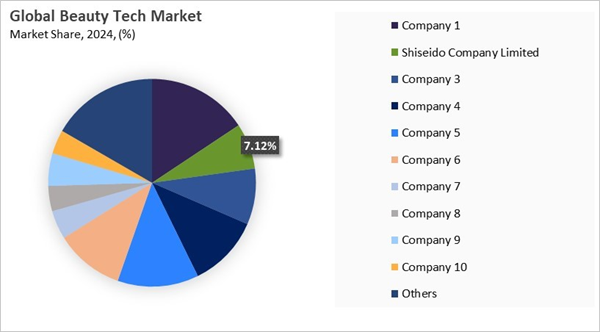
The leading players in the market are competing with diverse innovative offerings to remain competitive in the market. The above illustration shows the percentage of revenue shared by some of the leading companies in the market. The leading players of the market are adopting various strategies to cater demand coming from the different industries. The key developmental strategies in the market are Acquisitions, and Partnerships & Collaborations.
COVID-19 Impact Analysis
The COVID-19 pandemic hurt the beauty tech market because lockdowns forced salons, stores, and clinics to close, which made people spend less money on things they didn't need. Limited access to beauty services made people less interested in beauty tech devices, which hurt overall sales. At the same time, problems in the global supply chain led to shortages of raw materials, production delays, and higher operating costs. Uncertainty in the economy made people even less confident and less able to spend money, especially in developing areas. This led to more spending on basic goods. This made it less likely that people would buy high-end beauty gadgets like smart skincare devices. Companies also had to deal with money problems that made them less likely to invest in research and development. Because of this, innovation slowed down, which delayed the release of new products and hurt overall market growth during the pandemic. Thus, the COVID-19 pandemic had a negative impact on the market.Portability Outlook
Based on portability, the beauty tech market is characterized into handheld devices, and fixed devices. The fixed devices segment attained 42% revenue share in the beauty tech market in 2024. The fixed devices segment plays an important role in the global beauty tech market, particularly in professional and clinical environments. These devices are typically larger, more powerful, and designed for specialized treatments that require precision and consistency.Mode of operation Outlook
On the basis of mode of operation, the beauty tech market is classified into electric, battery operated, and manual. The battery-operated segment recorded 34% revenue share in the beauty tech market in 2024. The battery-operated segment represents a key category within the global beauty tech market, supported by its portability and convenience. These devices offer flexibility for users who prefer cordless operation, making them suitable for travel and everyday use.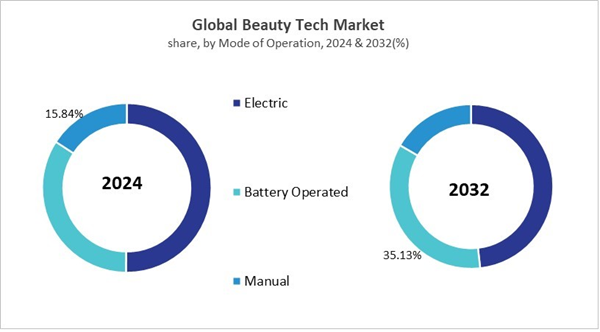
Regional Outlook
Region-wise, the beauty tech market is analyzed across North America, Europe, Asia Pacific, and LAMEA. The North America segment recorded 37% revenue share in the beauty tech market in 2024. In the North America and Europe region, the beauty tech market is estimated to grow at a significant rate. This is because of strong consumer awareness, high technological maturity, and early adoption of advanced solutions like AR-based virtual try-on, AI-driven skin diagnostics, and personalized skincare devices. North America’s market is witnessing innovations because of the presence of major beauty brands and technology companies investing largely in R&D, and a well-established e-commerce ecosystem. Furthermore, Europe beauty tech market is predicted to witness a prominent share in the forecast period. The market is driven by demand for transparent and sustainable beauty solutions, with stringent regulatory frameworks encouraging the adoption of ethical and clean technologies. Consumers in these regions emphasize personalized experiences, which has surged the integration of omnichannel strategies combining digital tools with in-store services.The beauty tech market is anticipated to grow at a steady pace in the Asia Pacific and LAMEA region. The market is driven by expanding middle-class populations, rising digital penetration, and increasing beauty consciousness. Regional nations, including South Korea, Japan, China, and India, are where tech-savvy consumers embrace smart skincare devices, mobile-based beauty applications, and social commerce platforms. Additionally, the LAMEA beauty tech market is also expected to showcase lucrative market opportunities. This is due to expanding internet access and a demographic eager to experiment with digital beauty solutions. Also, these regions offer growth opportunities supported by rising digital engagement and expanding consumer bases.
Recent Strategies Deployed in the Market
- Mar-2026: Amorepacific Corporation unveiled an AI-powered “Amore Mall” app featuring conversational AI to transform digital beauty retail. Leveraging generative AI, the platform offers personalized skincare advice, virtual consultations, and tailored product discovery. This innovation boosts customer engagement, improves conversion rates, and strengthens retention, positioning the company at the forefront of AI-driven beauty e-commerce evolution.
- Jan-2026: Shiseido Company Limited unveiled an AI-powered formulation system under its Fibona program to create advanced mist-based suncare products. Technology enhances UV protection and texture while accelerating development timelines. By reducing trial-and-error and enabling scalable R&D, the innovation reinforces Shiseido’s leadership in beauty tech and promotes wider adoption of AI-driven cosmetic science.
- Apr-2025: Unilever PLC announced the acquisition of wild, a refillable personal care brand to strengthen its sustainable, digitally driven beauty portfolio. The deal integrates eco-friendly packaging and a direct-to-consumer model, enhancing refill tracking and connected supply chains. This move boosts Unilever’s position in the evolving beauty tech market focused on personalization and circular economy solutions.
- Oct-2024: L'Oréal S.A. teamed up with Manhattan Associates to enhance its augmented beauty services through advanced supply chain and omnichannel capabilities. The collaboration enables real-time inventory tracking, seamless online-offline experiences, and efficient fulfillment, strengthening L’Oréal’s ability to deliver scalable, AI-driven, and personalized beauty services worldwide.
- Apr-2024: The Estee Lauder Companies, Inc. teamed up with Microsoft to integrate generative AI across operations. The initiative aims to boost product innovation, personalize consumer experiences, and streamline workflows. This move highlights rising AI adoption in beauty, intensifying competition as brands increasingly partner with tech firms for scalable, data-driven transformation.
- Jan-2023: L'Oréal S.A. unveiled two advanced AI-powered beauty technologies, featuring personalized skincare and assistive applications. Using computer vision and machine learning, the devices offer real-time diagnostics and tailored recommendations, boosting smart beauty adoption, enhancing inclusivity, and strengthening the company’s leadership in data-driven, connected beauty solutions.
List of Key Companies Profiled
- L'Oréal S.A.
- Shiseido Company Limited
- LVMH SE
- The Procter & Gamble Company
- The Estee Lauder Companies, Inc.
- Unilever PLC
- Amorepacific Corporation
- Johnson & Johnson
- Koninklijke Philips N.V.
- Panasonic Holdings Corporation
Market Report Segmentation
By Portability- Handheld Devices
- Fixed Devices
- Electric
- Battery Operated
- Manual
- Online
- Retail
- Direct Sales
- Salon / Clinics
- Home
- Spa
- Other Application
- Hair Removal Devices
- Rejuvenation (Anti-aging)
- Cleansing Devices
- Acne Devices
- Hair Growth Devices
- Oxygen / Steamer
- Other Type
- North America
- US
- Canada
- Mexico
- Rest of North America
- Europe
- Germany
- UK
- France
- Russia
- Spain
- Italy
- Rest of Europe
- Asia Pacific
- China
- Japan
- India
- South Korea
- Singapore
- Malaysia
- Rest of Asia Pacific
- LAMEA
- Brazil
- Argentina
- UAE
- Saudi Arabia
- South Africa
- Nigeria
- Rest of LAMEA
Table of Contents
Chapter 1. Market Scope & Methodology
Chapter 2. Market at a Glance
Chapter 3. Market Overview
Chapter 4. Market Trends
Chapter 5. State of Competition
Chapter 6. Market Consolidation
Chapter 7. Key Customer Criteria - Beauty Tech market
Chapter 8. Product Life Cycle
Chapter 9. Value Chain Analysis of Beauty Tech Market
Chapter 10. Competition Analysis - Global
Chapter 11. Global Beauty Tech Market by Portability
Chapter 12. Global Beauty Tech Market by Mode of Operation
Chapter 13. Global Beauty Tech Market by Distribution Channel
Chapter 14. Global Beauty Tech Market by Application
Chapter 15. Global Beauty Tech Market by Type
Chapter 16. Global Beauty Tech Market by Region
Chapter 17. Company Profiles
Companies Mentioned
- L'Oréal S.A.
- Shiseido Company Limited
- LVMH SE
- The Procter & Gamble Company
- The Estee Lauder Companies, Inc.
- Unilever PLC
- Amorepacific Corporation
- Johnson & Johnson
- Koninklijke Philips N.V.
- Panasonic Holdings Corporation


