



The Global Smart Watch Market is expected to reach USD 117.37 billion by 2033, growing at a CAGR of 15.3% during 2026-2033.
The Global Smart Watch Market has evolved from a niche wearable technology segment into a mainstream consumer electronics category that integrates connectivity, health monitoring, fitness tracking, productivity, and lifestyle management functionalities. Initially developed to extend smartphone capabilities through notifications and communication features, smart watches have transformed into sophisticated wearable devices capable of monitoring physiological parameters, supporting digital wellness, enabling contactless payments, and facilitating real-time connectivity. Advancements in sensor technologies, wireless communication, artificial intelligence, and miniaturized electronics have significantly enhanced smartwatch functionality, making them an integral part of the connected digital ecosystem.
The market continues to evolve through increasing consumer awareness regarding health and wellness, growing adoption of wearable technologies, expansion of digital healthcare ecosystems, and rising demand for multifunctional connected devices. Manufacturers are investing heavily in advanced biometric sensors, AI-driven analytics, enhanced battery technologies, and improved operating systems to strengthen product differentiation and consumer engagement. Furthermore, increasing integration of smart watches with healthcare platforms, fitness applications, and IoT ecosystems is expanding their role beyond personal convenience into preventive healthcare and remote monitoring applications. The major strategies followed by market participants are Product Launches, Partnerships & Collaborations, Technological Advancements, and Geographical Expansion.
The Smart Watch Market is characterized by moderate consolidation and intense competition among global consumer electronics companies, wearable technology providers, and fitness-focused device manufacturers. Competition is driven by innovation in health monitoring capabilities, ecosystem integration, battery performance, operating system functionality, connectivity features, and product design. Market participants continue investing in research and development, strategic partnerships, healthcare integration, and advanced software capabilities to strengthen market positioning and enhance user experiences.
The Smart Watch Market demonstrates a moderately consolidated competitive structure led by major technology companies and wearable device manufacturers. Competition increasingly revolves around ecosystem strength, health-monitoring innovation, software capabilities, battery efficiency, and user experience. Leading players continue to strengthen their positions through advanced biometric monitoring technologies, AI-enabled wellness platforms, smartphone integration, and expanding digital health ecosystems. Market dynamics are further shaped by increasing demand for connected devices, preventive healthcare solutions, and personalized fitness monitoring applications.
Based on End-User, the market is segmented into Male and Female. The Male market dominated the Global Smart Watch Market by End-User in 2025, and is expected to continue to be a dominant market till 2033; thereby, achieving a market value of USD 60.93 billion by 2033, growing at a CAGR of 14.9 % during the forecast period. The Female market is expected to witness a CAGR of 15.8% during 2026-2033.
The Male segment represents a significant portion of the market due to strong adoption among fitness enthusiasts, athletes, professionals, and technology-oriented consumers seeking advanced performance tracking, productivity features, and connected experiences. The Female segment continues to witness substantial growth driven by increasing demand for wellness monitoring, sleep tracking, stress management, women’s health applications, and fashion-oriented wearable devices. Manufacturers are increasingly introducing personalized features, stylish designs, and health-focused functionalities to enhance adoption across both consumer groups.
The iOS segment benefits from strong ecosystem integration, premium user experiences, robust application support, and advanced health-monitoring capabilities. The Android segment continues to expand through broad device compatibility, extensive manufacturer participation, and availability across multiple price points and consumer categories. Meanwhile, the Other Operating System segment caters to niche requirements through proprietary platforms offering specialized functionalities, extended battery performance, streamlined interfaces, and customized user experiences.
Running remains a major application area driven by increasing consumer focus on fitness tracking, activity monitoring, performance analytics, and health management. Checking Notifications continues to represent a core smartwatch functionality, enabling users to access communications, alerts, and updates conveniently through wearable devices.
Swimming and Cycling applications are benefiting from growing participation in sports, fitness activities, and outdoor recreation supported by specialized tracking features. Other Applications include sleep monitoring, stress management, navigation, mobile payments, productivity enhancement, and wellness management, reflecting the growing versatility of smartwatch technologies.
Region-wise, the Smart Watch Market is analyzed across North America, Europe, Asia Pacific, and LAMEA. The North America market dominated the Global Smart Watch Market by Region in 2025, and is expected to continue to be a dominant market till 2033; thereby, achieving a market value of USD 39.12 billion by 2033, growing at a CAGR of 14.5 % during the forecast period. The Asia Pacific market is expected to witness a CAGR of 16.1% during 2026-2033.
North America continues to maintain a strong market position due to high consumer awareness, strong purchasing power, advanced healthcare infrastructure, and widespread adoption of connected devices. Europe benefits from growing health consciousness, increasing wearable technology adoption, and strong demand for digital wellness solutions. Asia Pacific is witnessing substantial growth driven by rising smartphone penetration, expanding middle-class populations, increasing digitalization, and the availability of affordable smartwatch products. LAMEA continues to experience growing adoption supported by improving digital infrastructure, rising consumer electronics demand, and increasing awareness regarding wearable health and fitness technologies.
Smart Watch Market Coverage:
The Global Smart Watch Market has evolved from a niche wearable technology segment into a mainstream consumer electronics category that integrates connectivity, health monitoring, fitness tracking, productivity, and lifestyle management functionalities. Initially developed to extend smartphone capabilities through notifications and communication features, smart watches have transformed into sophisticated wearable devices capable of monitoring physiological parameters, supporting digital wellness, enabling contactless payments, and facilitating real-time connectivity. Advancements in sensor technologies, wireless communication, artificial intelligence, and miniaturized electronics have significantly enhanced smartwatch functionality, making them an integral part of the connected digital ecosystem.
Key Market Trends & Insights
- Growing integration of advanced health monitoring and biometric sensing technologies.
- The male segment constituted 53.4% revenue share in 2025
- The Android Operating system is growing at the highest growth rate of 15.5% CAGR
- The running application formed the highest revenue source constituting 32.2% revenue share in 2025
- Growing focus on sustainability and refurbishment initiatives.
- The rising adoption of Smart watches in Asia Pacific is leading to its high growth of 16.1% CAGR
- Increasing use of smart watches in preventive healthcare and remote monitoring.
- Growing investments in connected wearable ecosystems and digital wellness platforms.
The market continues to evolve through increasing consumer awareness regarding health and wellness, growing adoption of wearable technologies, expansion of digital healthcare ecosystems, and rising demand for multifunctional connected devices. Manufacturers are investing heavily in advanced biometric sensors, AI-driven analytics, enhanced battery technologies, and improved operating systems to strengthen product differentiation and consumer engagement. Furthermore, increasing integration of smart watches with healthcare platforms, fitness applications, and IoT ecosystems is expanding their role beyond personal convenience into preventive healthcare and remote monitoring applications. The major strategies followed by market participants are Product Launches, Partnerships & Collaborations, Technological Advancements, and Geographical Expansion.
The Smart Watch Market is characterized by moderate consolidation and intense competition among global consumer electronics companies, wearable technology providers, and fitness-focused device manufacturers. Competition is driven by innovation in health monitoring capabilities, ecosystem integration, battery performance, operating system functionality, connectivity features, and product design. Market participants continue investing in research and development, strategic partnerships, healthcare integration, and advanced software capabilities to strengthen market positioning and enhance user experiences.
Driving and Restraining Factors
Drivers- Enhanced Consumer Health Awareness Driving Smart Watch Demand
- Advancements in Connectivity Technologies Fueling Market Expansion
- Rising Investments and Strategic Collaborations Accelerating Market Growth
- Consumer Demand for Multifunctional Integrated Wearables Enhancing Market Dynamics
- High Cost and Affordability Constraints
- Data Privacy and Security Concerns
- Technical and Battery Life Limitations
- Integration of Advanced Health Monitoring Sensors into Smart Watches
- Expansion of the Refurbished and Secondary Market Ecosystem
- Leveraging Artificial Intelligence and Personalized Data Analytics
- Battery Life and Power Management Constraints
- Data Privacy and Security Vulnerabilities
- High Production Costs and Economic Accessibility
Market Share Analysis
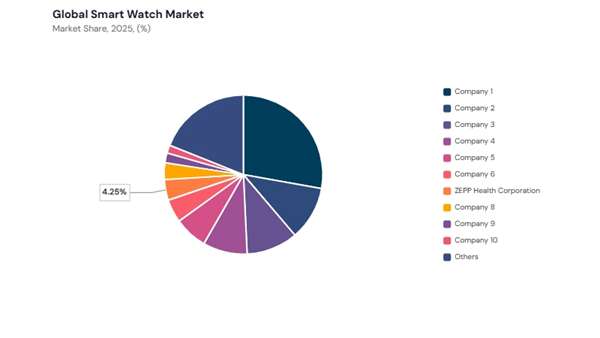
The Smart Watch Market demonstrates a moderately consolidated competitive structure led by major technology companies and wearable device manufacturers. Competition increasingly revolves around ecosystem strength, health-monitoring innovation, software capabilities, battery efficiency, and user experience. Leading players continue to strengthen their positions through advanced biometric monitoring technologies, AI-enabled wellness platforms, smartphone integration, and expanding digital health ecosystems. Market dynamics are further shaped by increasing demand for connected devices, preventive healthcare solutions, and personalized fitness monitoring applications.
End-User Outlook
Based on End-User, the market is segmented into Male and Female. The Male market dominated the Global Smart Watch Market by End-User in 2025, and is expected to continue to be a dominant market till 2033; thereby, achieving a market value of USD 60.93 billion by 2033, growing at a CAGR of 14.9 % during the forecast period. The Female market is expected to witness a CAGR of 15.8% during 2026-2033.
The Male segment represents a significant portion of the market due to strong adoption among fitness enthusiasts, athletes, professionals, and technology-oriented consumers seeking advanced performance tracking, productivity features, and connected experiences. The Female segment continues to witness substantial growth driven by increasing demand for wellness monitoring, sleep tracking, stress management, women’s health applications, and fashion-oriented wearable devices. Manufacturers are increasingly introducing personalized features, stylish designs, and health-focused functionalities to enhance adoption across both consumer groups.
Operating System Outlook
Based on Operating System, the market is segmented into iOS, Android, and Other Operating System. The iOS market dominated the Global Smart Watch Market by Operating System in 2025, and is expected to continue to be a dominant market till 2033; thereby, achieving a market value of USD 54.41 billion by 2033, growing at a CAGR of 14.9 % during the forecast period.The iOS segment benefits from strong ecosystem integration, premium user experiences, robust application support, and advanced health-monitoring capabilities. The Android segment continues to expand through broad device compatibility, extensive manufacturer participation, and availability across multiple price points and consumer categories. Meanwhile, the Other Operating System segment caters to niche requirements through proprietary platforms offering specialized functionalities, extended battery performance, streamlined interfaces, and customized user experiences.
Application Outlook
Based on Application, the market is segmented into Running, Checking Notifications, Swimming, Cycling, and Other Applications. The Running market dominated the Global Smart Watch Market by Application in 2025, and is expected to continue to be a dominant market till 2033; thereby, achieving a market value of USD 35.68 billion by 2033, growing at a CAGR of 14.4 % during the forecast period. The Checking Notifications market is expected to witness a CAGR of 15.1% during 2026-2033. Additionally, the Swimming market is expected to witness highest CAGR of 15.9% during 2026-2033.Running remains a major application area driven by increasing consumer focus on fitness tracking, activity monitoring, performance analytics, and health management. Checking Notifications continues to represent a core smartwatch functionality, enabling users to access communications, alerts, and updates conveniently through wearable devices.
Swimming and Cycling applications are benefiting from growing participation in sports, fitness activities, and outdoor recreation supported by specialized tracking features. Other Applications include sleep monitoring, stress management, navigation, mobile payments, productivity enhancement, and wellness management, reflecting the growing versatility of smartwatch technologies.
Regional Outlook
Region-wise, the Smart Watch Market is analyzed across North America, Europe, Asia Pacific, and LAMEA. The North America market dominated the Global Smart Watch Market by Region in 2025, and is expected to continue to be a dominant market till 2033; thereby, achieving a market value of USD 39.12 billion by 2033, growing at a CAGR of 14.5 % during the forecast period. The Asia Pacific market is expected to witness a CAGR of 16.1% during 2026-2033.
North America continues to maintain a strong market position due to high consumer awareness, strong purchasing power, advanced healthcare infrastructure, and widespread adoption of connected devices. Europe benefits from growing health consciousness, increasing wearable technology adoption, and strong demand for digital wellness solutions. Asia Pacific is witnessing substantial growth driven by rising smartphone penetration, expanding middle-class populations, increasing digitalization, and the availability of affordable smartwatch products. LAMEA continues to experience growing adoption supported by improving digital infrastructure, rising consumer electronics demand, and increasing awareness regarding wearable health and fitness technologies.
Smart Watch Market Coverage:
Recent Strategies Deployed in the Market
- Huawei expanded wearable technology ecosystem capabilities through investments in AI technologies, digital infrastructure, and connected-device platforms.
- Xiaomi strengthened smartwatch manufacturing and automation capabilities to improve production efficiency and wearable innovation.
- Apple expanded healthcare functionality through advanced health-monitoring technologies and wearable health solutions.
- Amazfit launched the Bip 6 smartwatch featuring enhanced health monitoring, fitness tracking, and lifestyle management capabilities.
- Amazfit introduced the T-Rex 3 Pro rugged smartwatch targeting outdoor and adventure-focused users.
- Polar launched the Ignite 3 Titanium smartwatch with advanced wellness guidance and fitness optimization technologies.
- Fossil expanded its touchscreen smartwatch portfolio with enhanced connectivity and health-monitoring functionalities.
- Samsung strengthened AI-driven healthcare ecosystem partnerships focused on wearable health monitoring and digital wellness solutions.
- Garmin expanded smart device integration initiatives supporting connected wearable applications and fitness ecosystems.
- Huawei expanded wearable technology presence across Middle Eastern and Asia-Pacific markets.
List of Key Companies Profiled
- Apple Inc.
- Samsung Electronics Co., Ltd.
- Huawei Technologies Co., Ltd.
- Xiaomi Corporation
- Garmin Ltd.
- Google LLC (Fitbit)
- Zepp Health Corporation
- Noise
- Fossil Group, Inc.
- Polar Electro Oy
Market Report Segmentation
By End-User- Male
- Female
- iOS
- Android
- Other Operating System
- Running
- Checking Notifications
- Swimming
- Cycling
- Other Applications
- North America
- US
- Canada
- Mexico
- Rest of North America
- Europe
- Germany
- UK
- France
- Russia
- Spain
- Italy
- Rest of Europe
- Asia Pacific
- China
- Japan
- India
- South Korea
- Singapore
- Malaysia
- Rest of Asia Pacific
- LAMEA
- Brazil
- Argentina
- UAE
- Saudi Arabia
- South Africa
- Nigeria
- Rest of LAMEA
Table of Contents
Chapter 1. Research Scope & Methodology
Chapter 2. Market Overview
Chapter 3. Key Factors Impacting Market
Chapter 6. Competition Analysis - Global
Chapter 7. Segmentation By End-User
Chapter 8. Segmentation By Operating System
Chapter 9. Segmentation By Application
Chapter 10. North America Market
Chapter 11. Europe Market
Chapter 12. Asia Pacific Market
Chapter 13. LAMEA Market
Chapter 14. Company Snapshot
Chapter 15. Winning Imperatives of Smart Watch Market
Companies Mentioned
• Apple Inc.• Samsung Electronics Co., Ltd.
• Huawei Technologies Co., Ltd.
• Xiaomi Corporation
• Garmin Ltd.
• Google LLC (Fitbit)
• Zepp Health Corporation
• Noise
• Fossil Group, Inc.
• Polar Electro Oy


