+353-1-416-8900REST OF WORLD
+44-20-3973-8888REST OF WORLD
1-917-300-0470EAST COAST U.S
1-800-526-8630U.S. (TOLL FREE)

Global AI Sales Development Representative Market Size, Share & Industry Analysis Report by Sales Strategy, Offering, End Use, Regional Outlook and Forecast, 2026-2033

  • PDF Icon

    Report

  • 667 Pages
  • May 2026
  • Marqual IT Solutions Pvt. Ltd (KBV Research)
  • ID: 6276011
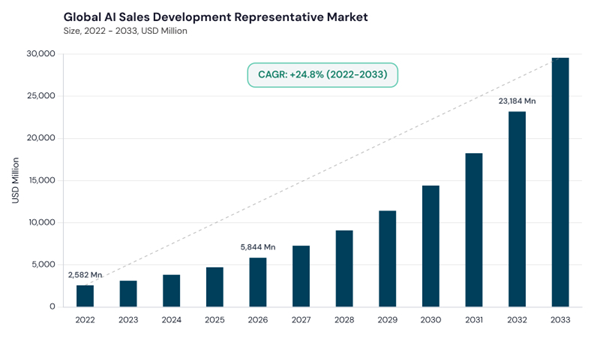
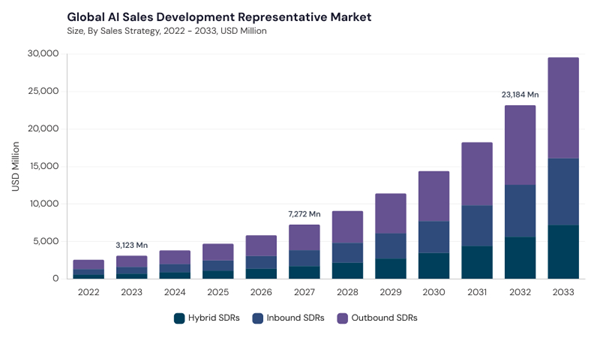
The Global AI Sales Development Representative Market is expected to reach USD 29.56 Billion by 2033, growing at a CAGR of 26.1% during the forecast period.


The growth of the AI Sales Development Representative Market is driven by the increasing adoption of artificial intelligence across enterprise sales operations, rising demand for automated lead generation and qualification, and the growing need for personalized customer engagement at scale. Organizations are increasingly integrating AI-driven SDR solutions with CRM platforms, predictive analytics tools, and conversational AI technologies to improve sales productivity, reduce manual workload, and enhance pipeline conversion efficiency. Furthermore, the rapid expansion of cloud-based AI platforms, generative AI capabilities, and intelligent workflow automation solutions is accelerating market adoption across industries including Technology & SaaS, Finance, E-commerce, Healthcare, Manufacturing, and Education.

Key Market Trends & Insights:

  • The North America AI Sales Development Representative market dominated the Global Market by Region in 2025, accounting for a 41.0% share.
  • The Outbound SDRs segment dominated the Global AI Sales Development Representative Market by Sales Strategy in 2025 with 47.4% share.
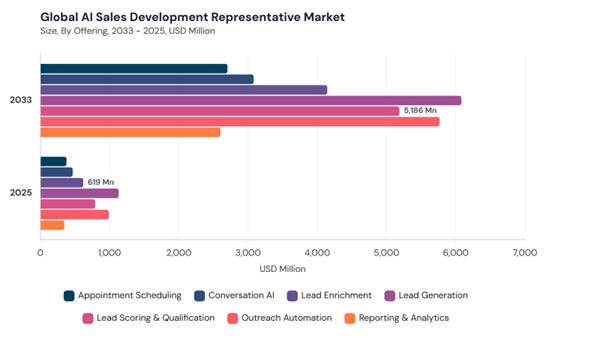
  • The Lead Generation segment acquired the highest revenue share of 23.9% in the Global AI Sales Development Representative Market by Offering in 2025.
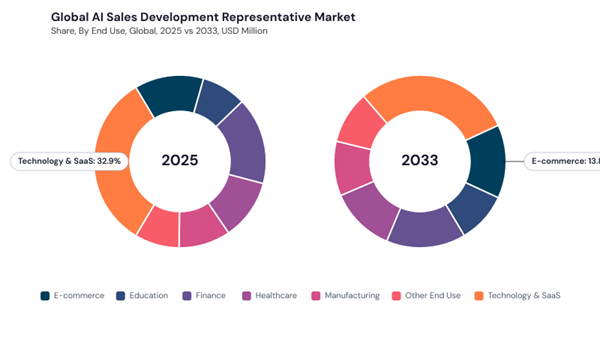
  • The Technology & SaaS segment dominated the Global AI Sales Development Representative Market by End Use in 2025 with 32.8% share.
  • The Reporting & Analytics segment is expected to witness the highest CAGR of 29.0% during 2026-2033 among offering segments.
  • The Lead Generation market is expected to achieve a market value of USD 6.1 Billion by 2033.
Today, AI SDR platforms are increasingly integrated into CRM systems, marketing automation platforms, and enterprise communication ecosystems to optimize lead scoring, automate outreach campaigns, and improve conversion rates. Organizations across industries are leveraging these solutions to streamline prospect identification, improve customer acquisition strategies, and enhance sales productivity while minimizing operational inefficiencies. The growing adoption of AI-powered customer intelligence and workflow automation is expected to further strengthen market expansion globally.

The major strategies followed by market participants are Product Innovation, Partnerships & Collaborations, and AI Capability Expansion to strengthen competitive positioning and improve sales automation capabilities. Companies are increasingly focusing on conversational AI, predictive lead scoring, outreach automation, and CRM interoperability to enhance customer engagement and optimize sales performance. Additionally, AI-native vendors are introducing autonomous AI agents capable of managing prospecting workflows, intelligent outreach, and appointment scheduling with minimal human intervention.

Driving and Restraining Factors

Drivers
  • Enhanced Lead Qualification and Prioritization Through AI-Driven Intelligence
  • Scalability and Efficiency Gains Realized via Automation of Sales Outreach
  • Integration of AI and Connected Data Sources for Smarter Sales Engagements
  • Acceleration of AI Investment and Adoption Across Business Functions Driving Market Expansion
Restraints
  • Regulatory and Compliance Challenges in AI Sales Development Representative Market
  • High Cost of Advanced AI Technology and Integration
  • Technical Limitations and Performance Reliability Concerns
Opportunities
  • AI-Driven Hyper-Personalization in Sales Outreach
  • Integration of Generative AI for Conversational Sales Intelligence
  • Leveraging AI for Compliance and Ethical Sales Automation
Challenges
  • Data Privacy and Compliance Complexities
  • Technological Integration and Interoperability Barriers
  • High Implementation Costs and Economic Accessibility

Market Share Analysis


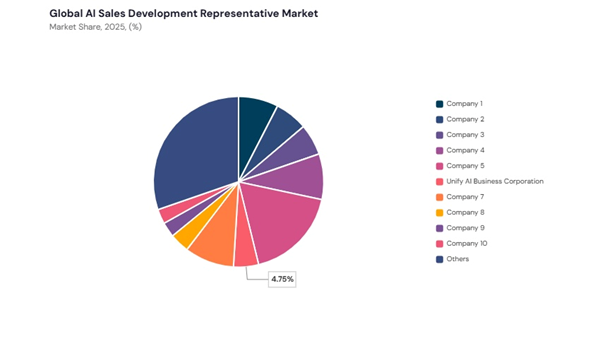
The global AI Sales Development Representative Market exhibits a fragmented and rapidly evolving competitive landscape led by both established CRM providers and emerging AI-native vendors. Salesforce leads the market with approximately 17.9% share owing to its strong enterprise penetration, extensive CRM ecosystem, and expanding AI-driven sales automation capabilities. Other prominent players include Cognism with 9.4% share, Clay Labs with 8.6%, and 11x AI with 7.6%, collectively strengthening competition through AI-powered prospecting, outreach automation, and lead enrichment solutions. Additionally, emerging vendors such as Artisan AI, Landbase, and Unify AI are accelerating innovation in autonomous sales agents and generative AI-driven workflow automation.

Sales Strategy Outlook

On the basis of Sales Strategy, the AI Sales Development Representative Market is classified into Outbound SDRs, Inbound SDRs, and Hybrid SDRs in 2025. The Outbound SDRs segment acquired the largest revenue share in the AI Sales Development Representative Market. This segment accounted for 47.4% of the overall market, driven by the increasing adoption of proactive sales approaches where businesses leverage AI-powered tools to initiate customer engagement. Organizations are focusing on outbound strategies to expand their customer base, generate high-quality leads, and improve conversion rates. The integration of AI in outbound processes enhances personalization, automates repetitive tasks, and enables data-driven decision-making, thereby strengthening the growth of this segment.

Offering Outlook

On the basis of Offering, the AI Sales Development Representative Market is classified into Lead Generation, Outreach Automation, Lead Scoring & Qualification, Lead Enrichment, Conversation AI, Appointment Scheduling, and Reporting & Analytics in 2025. The Lead Generation segment acquired the largest revenue share in the AI Sales Development Representative Market. This segment accounted for 23.968% share, driven by the increasing need for businesses to identify and capture potential customers efficiently. AI-powered lead generation tools help organizations analyze large datasets, identify prospects, and streamline the lead acquisition process, thereby enhancing overall sales productivity.

End Use Outlook

On the basis of End Use, the AI Sales Development Representative Market is classified into Technology & SaaS, Finance, E-commerce, Healthcare, Manufacturing, Education, and Other End Use in 2025. The Technology & SaaS segment acquired the largest revenue share in the AI Sales Development Representative Market. This segment accounted for 32.8% share, driven by the high adoption of AI-driven sales tools among technology companies and SaaS providers. These organizations rely heavily on automated sales processes to scale operations, manage large volumes of leads, and enhance customer acquisition strategies.

The E-commerce segment captured 12.98% share driven by rapid expansion of online retail and digital commerce platforms. Additionally, Healthcare accounted for 11.360% share owing to increasing use of AI SDR tools for patient engagement and communication management.

Regional Outlook

On the basis of Region, the AI Sales Development Representative Market is classified into North America, Europe, Asia Pacific, and LAMEA. The North America segment acquired the largest revenue share in the AI Sales Development Representative Market. This segment accounted for 41.00% share, driven by the early adoption of advanced technologies, strong presence of key market players, and high investment in AI-driven sales solutions. Organizations in the region are increasingly leveraging automation and analytics to enhance sales performance and customer engagement.

The Europe market is expected to witness substantial growth during the forecast period supported by rising digital transformation initiatives, increasing adoption of AI-powered CRM platforms, and growing emphasis on intelligent customer engagement solutions across enterprises. Meanwhile, the Asia Pacific region is projected to register the fastest growth rate owing to rapid digitalization, expansion of SaaS ecosystems, increasing cloud adoption, and strong growth of technology and e-commerce sectors across countries such as China, India, Japan, and South Korea. LAMEA is also gradually emerging as a promising market due to improving digital infrastructure and increasing awareness regarding automation-driven sales strategies.

Market Competition and Attributes

The AI Sales Development Representative Market is highly competitive and characterized by rapid innovation in conversational AI, predictive analytics, outreach automation, and generative AI technologies. Vendors compete on the basis of AI sophistication, CRM interoperability, personalization capabilities, and scalable deployment models. Competition is increasingly focused on improving customer engagement efficiency, automating sales workflows, and delivering actionable sales intelligence. Companies are also emphasizing pricing flexibility, ecosystem partnerships, and AI-driven workflow optimization to strengthen competitive positioning across enterprise sales environments.

AI Sales Development Representative Market Coverage:
Recent Strategies Deployed in the Market

  • Mar-2025: Salesforce expanded its generative AI-powered Sales Cloud capabilities to improve intelligent lead nurturing and predictive customer engagement workflows.
  • Jan-2025: Microsoft strengthened Dynamics 365 Copilot with AI-powered sales recommendations and automated outreach functionalities.
  • Oct-2024: HubSpot introduced advanced AI-powered outreach automation and email personalization capabilities.
  • Jul-2024: Oracle enhanced its AI-driven CRM ecosystem with predictive sales intelligence and conversational AI capabilities.
  • Apr-2024: ZoomInfo Technologies introduced upgraded AI-powered lead intelligence and intent-data analytics solutions to improve targeting accuracy and sales pipeline performance.

List of Key Companies Profiled

  • Salesforce
  • Cognism
  • Clay Labs
  • 11x AI
  • Artisan AI
  • Unify AI
  • Microsoft Corporation
  • Oracle Corporation
  • HubSpot, Inc.
  • ZoomInfo Technologies Inc.

Market Report Segmentation

By Sales Strategy
  • Outbound SDRs
  • Inbound SDRs
  • Hybrid SDRs
By Offering
  • Lead Generation
  • Outreach Automation
  • Lead Scoring & Qualification
  • Lead Enrichment
  • Conversation AI
  • Appointment Scheduling
  • Reporting & Analytics
By End Use
  • Technology & SaaS
  • Finance
  • E-commerce
  • Healthcare
  • Manufacturing
  • Education
  • Other End Use
By Geography
  • North America
    • US
    • Canada
    • Mexico
    • Rest of North America

  • Europe
    • Germany
    • UK
    • France
    • Russia
    • Spain
    • Italy
    • Rest of Europe

  • Asia Pacific
    • China
    • Japan
    • India
    • South Korea
    • Singapore
    • Malaysia
    • Rest of Asia Pacific

  • LAMEA
    • Brazil
    • Argentina
    • UAE
    • Saudi Arabia
    • South Africa
    • Nigeria
    • Rest of LAMEA

Table of Contents

Chapter 1. Global Market Overview
1.1 COVID-19 Impact
1.2 Market Composition and Scenario
Chapter 2. Key Factors Impacting Market
2.1 Market Drivers
2.2 Market Restraints
2.3 Market Opportunities
2.4 Market Challenges
2.5 Market Trends
2.6 State of Competition
2.7 Market Consolidation
2.8 Key Customer Criteria
Chapter 3. Product Life CycleChapter 4. Value Chain Analysis of AI Sales Development Representative Market
Chapter 5. Competition Analysis
5.1 Market Share Analysis
5.2 Porter Five Forces Analysis
Chapter 6. Segmentation By Offering Analysis
6.1 Lead Generation
6.2 Lead Enrichment
6.3 Outreach Automation
6.4 Lead Scoring & Qualification
6.5 Conversation AI
6.6 Appointment Scheduling
6.7 Reporting & Analytics
Chapter 7. Segmentation By Sales Strategy
7.1 Inbound SDRs
7.2 Outbound SDRs
7.3 Hybrid SDRs
Chapter 8. Segmentation By End Use
8.1 Technology & SaaS
8.2 Finance
8.3 Healthcare
8.4 Manufacturing
8.5 Education
8.6 E-commerce
8.7 Other End Use
Chapter 9. North America Market
9.1 Market Overview
9.2 Key Factors Impacting Market
9.2.1 Market Drivers
9.2.2 Market Restraints
9.2.3 Market Opportunities
9.2.4 Market Challenges
9.2.5 Market Trends
9.2.6 State of Competition
9.2.7 Market Consolidation
9.2.8 Key Customer Criteria
9.3 Product Life Cycle
9.4 Segmentation By Offering Analysis
9.4.1 Lead Generation
9.4.2 Lead Enrichment
9.4.3 Outreach Automation
9.4.4 Lead Scoring & Qualification
9.4.5 Conversation AI
9.4.6 Appointment Scheduling
9.4.7 Reporting & Analytics
9.5 Segmentation By Sales Strategy
9.5.1 Inbound SDRs
9.5.2 Outbound SDRs
9.5.3 Hybrid SDRs
9.6 Segmentation By End Use
9.6.1 Technology & SaaS
9.6.2 Finance
9.6.3 Healthcare
9.6.4 Manufacturing
9.6.5 Education
9.6.6 E-commerce
9.6.7 Other End Use
9.7 Segmentation By Country
9.7.1 United States
9.7.1.1 Segmentation By Offering Analysis
9.7.1.1.1 Lead Generation
9.7.1.1.2 Lead Enrichment
9.7.1.1.3 Outreach Automation
9.7.1.1.4 Lead Scoring & Qualification
9.7.1.1.5 Conversation AI
9.7.1.1.6 Appointment Scheduling
9.7.1.1.7 Reporting & Analytics
9.7.1.2 Segmentation By Sales Strategy
9.7.1.2.1 Inbound SDRs
9.7.1.2.2 Outbound SDRs
9.7.1.2.3 Hybrid SDRs
9.7.1.3 Segmentation By End Use
9.7.1.3.1 Technology & SaaS
9.7.1.3.2 Finance
9.7.1.3.3 Healthcare
9.7.1.3.4 Manufacturing
9.7.1.3.5 Education
9.7.1.3.6 E-commerce
9.7.1.3.7 Other End Use
9.7.2 Canada
9.7.2.1 Segmentation By Offering Analysis
9.7.2.1.1 Lead Generation
9.7.2.1.2 Lead Enrichment
9.7.2.1.3 Outreach Automation
9.7.2.1.4 Lead Scoring & Qualification
9.7.2.1.5 Conversation AI
9.7.2.1.6 Appointment Scheduling
9.7.2.1.7 Reporting & Analytics
9.7.2.2 Segmentation By Sales Strategy
9.7.2.2.1 Inbound SDRs
9.7.2.2.2 Outbound SDRs
9.7.2.2.3 Hybrid SDRs
9.7.2.3 Segmentation By End Use
9.7.2.3.1 Technology & SaaS
9.7.2.3.2 Finance
9.7.2.3.3 Healthcare
9.7.2.3.4 Manufacturing
9.7.2.3.5 Education
9.7.2.3.6 E-commerce
9.7.2.3.7 Other End Use
9.7.3 Mexico
9.7.3.1 Segmentation By Offering Analysis
9.7.3.1.1 Lead Generation
9.7.3.1.2 Lead Enrichment
9.7.3.1.3 Outreach Automation
9.7.3.1.4 Lead Scoring & Qualification
9.7.3.1.5 Conversation AI
9.7.3.1.6 Appointment Scheduling
9.7.3.1.7 Reporting & Analytics
9.7.3.2 Segmentation By Sales Strategy
9.7.3.2.1 Inbound SDRs
9.7.3.2.2 Outbound SDRs
9.7.3.2.3 Hybrid SDRs
9.7.3.3 Segmentation By End Use
9.7.3.3.1 Technology & SaaS
9.7.3.3.2 Finance
9.7.3.3.3 Healthcare
9.7.3.3.4 Manufacturing
9.7.3.3.5 Education
9.7.3.3.6 E-commerce
9.7.3.3.7 Other End Use
9.7.4 Rest of North America
9.7.4.1 Segmentation By Offering Analysis
9.7.4.1.1 Lead Generation
9.7.4.1.2 Lead Enrichment
9.7.4.1.3 Outreach Automation
9.7.4.1.4 Lead Scoring & Qualification
9.7.4.1.5 Conversation AI
9.7.4.1.6 Appointment Scheduling
9.7.4.1.7 Reporting & Analytics
9.7.4.2 Segmentation By Sales Strategy
9.7.4.2.1 Inbound SDRs
9.7.4.2.2 Outbound SDRs
9.7.4.2.3 Hybrid SDRs
9.7.4.3 Segmentation By End Use
9.7.4.3.1 Technology & SaaS
9.7.4.3.2 Finance
9.7.4.3.3 Healthcare
9.7.4.3.4 Manufacturing
9.7.4.3.5 Education
9.7.4.3.6 E-commerce
9.7.4.3.7 Other End Use
Chapter 10. Europe Market
10.1 Market Overview
10.2 Key Factors Impacting Market
10.2.1 Market Drivers
10.2.2 Market Restraints
10.2.3 Market Opportunities
10.2.4 Market Challenges
10.2.5 Market Trends
10.2.6 State of Competition
10.2.7 Market Consolidation
10.2.8 Key Customer Criteria
10.3 Product Life Cycle
10.4 Segmentation By Offering Type
10.4.1 Lead Generation
10.4.2 Lead Enrichment
10.4.3 Outreach Automation
10.4.4 Lead Scoring & Qualification
10.4.5 Conversation AI
10.4.6 Appointment Scheduling
10.4.7 Reporting & Analytics
10.5 Segmentation By Sales Strategy
10.5.1 Inbound SDRs
10.5.2 Outbound SDRs
10.5.3 Hybrid SDRs
10.6 Segment Analysis By End Use
10.6.1 Technology & SaaS
10.6.2 Finance
10.6.3 Healthcare
10.6.4 Manufacturing
10.6.5 Education
10.6.6 E-commerce
10.6.7 Other End Use
10.7 Segmentation By Country
10.7.1 Germany
10.7.1.1 Segmentation By Offering Analysis
10.7.1.1.1 Lead Generation
10.7.1.1.2 Lead Enrichment
10.7.1.1.3 Outreach Automation
10.7.1.1.4 Lead Scoring & Qualification
10.7.1.1.5 Conversation AI
10.7.1.1.6 Appointment Scheduling
10.7.1.1.7 Reporting & Analytics
10.7.1.2 Segmentation By Sales Strategy
10.7.1.2.1 Inbound SDRs
10.7.1.2.2 Outbound SDRs
10.7.1.2.3 Hybrid SDRs
10.7.1.3 Segmentation By End Use
10.7.1.3.1 Technology & SaaS
10.7.1.3.2 Finance
10.7.1.3.3 Healthcare
10.7.1.3.4 Manufacturing
10.7.1.3.5 Education
10.7.1.3.6 E-commerce
10.7.1.3.7 Other End Use
10.7.2 United Kingdom
10.7.2.1 Segmentation By Offering Analysis
10.7.2.1.1 Lead Generation
10.7.2.1.2 Lead Enrichment
10.7.2.1.3 Outreach Automation
10.7.2.1.4 Lead Scoring & Qualification
10.7.2.1.5 Conversation AI
10.7.2.1.6 Appointment Scheduling
10.7.2.1.7 Reporting & Analytics
10.7.2.2 Segmentation By Sales Strategy
10.7.2.2.1 Inbound SDRs
10.7.2.2.2 Outbound SDRs
10.7.2.2.3 Hybrid SDRs
10.7.2.3 Segmentation By End Use
10.7.2.3.1 Technology & SaaS
10.7.2.3.2 Finance
10.7.2.3.3 Healthcare
10.7.2.3.4 Manufacturing
10.7.2.3.5 Education
10.7.2.3.6 E-commerce
10.7.2.3.7 Other End Use
10.7.3 France
10.7.3.1 Segmentation By Offering Analysis
10.7.3.1.1 Lead Generation
10.7.3.1.2 Lead Enrichment
10.7.3.1.3 Outreach Automation
10.7.3.1.4 Lead Scoring & Qualification
10.7.3.1.5 Conversation AI
10.7.3.1.6 Appointment Scheduling
10.7.3.1.7 Reporting & Analytics
10.7.3.2 Segmentation By Sales Strategy
10.7.3.2.1 Inbound SDRs
10.7.3.2.2 Outbound SDRs
10.7.3.2.3 Hybrid SDRs
10.7.3.3 Segmentation By End Use
10.7.3.3.1 Technology & SaaS
10.7.3.3.2 Finance
10.7.3.3.3 Healthcare
10.7.3.3.4 Manufacturing
10.7.3.3.5 Education
10.7.3.3.6 E-commerce
10.7.3.3.7 Other End Use
10.7.4 Russia
10.7.4.1 Segmentation By Offering Analysis
10.7.4.1.1 Lead Generation
10.7.4.1.2 Lead Enrichment
10.7.4.1.3 Outreach Automation
10.7.4.1.4 Lead Scoring & Qualification
10.7.4.1.5 Conversation AI
10.7.4.1.6 Appointment Scheduling
10.7.4.1.7 Reporting & Analytics
10.7.4.2 Segmentation By Sales Strategy
10.7.4.2.1 Inbound SDRs
10.7.4.2.2 Outbound SDRs
10.7.4.2.3 Hybrid SDRs
10.7.4.3 Segmentation By End Use
10.7.4.3.1 Technology & SaaS
10.7.4.3.2 Finance
10.7.4.3.3 Healthcare
10.7.4.3.4 Manufacturing
10.7.4.3.5 Education
10.7.4.3.6 E-commerce
10.7.4.3.7 Other End Use
10.7.5 Spain
10.7.5.1 Segmentation By Offering Analysis
10.7.5.1.1 Lead Generation
10.7.5.1.2 Lead Enrichment
10.7.5.1.3 Outreach Automation
10.7.5.1.4 Lead Scoring & Qualification
10.7.5.1.5 Conversation AI
10.7.5.1.6 Appointment Scheduling
10.7.5.1.7 Reporting & Analytics
10.7.5.2 Segmentation By Sales Strategy
10.7.5.2.1 Inbound SDRs
10.7.5.2.2 Outbound SDRs
10.7.5.2.3 Hybrid SDRs
10.7.5.3 Segmentation By End Use
10.7.5.3.1 Technology & SaaS
10.7.5.3.2 Finance
10.7.5.3.3 Healthcare
10.7.5.3.4 Manufacturing
10.7.5.3.5 Education
10.7.5.3.6 E-commerce
10.7.5.3.7 Other End Use
10.7.6 Italy
10.7.6.1 Segmentation By Offering Analysis
10.7.6.1.1 Lead Generation
10.7.6.1.2 Lead Enrichment
10.7.6.1.3 Outreach Automation
10.7.6.1.4 Lead Scoring & Qualification
10.7.6.1.5 Conversation AI
10.7.6.1.6 Appointment Scheduling
10.7.6.1.7 Reporting & Analytics
10.7.6.2 Segmentation By Sales Strategy
10.7.6.2.1 Inbound SDRs
10.7.6.2.2 Outbound SDRs
10.7.6.2.3 Hybrid SDRs
10.7.6.3 Segmentation By End Use
10.7.6.3.1 Technology & SaaS
10.7.6.3.2 Finance
10.7.6.3.3 Healthcare
10.7.6.3.4 Manufacturing
10.7.6.3.5 Education
10.7.6.3.6 E-commerce
10.7.6.3.7 Other End Use
10.7.7 Rest of Europe
10.7.7.1 Segmentation By Offering Analysis
10.7.7.1.1 Lead Generation
10.7.7.1.2 Lead Enrichment
10.7.7.1.3 Outreach Automation
10.7.7.1.4 Lead Scoring & Qualification
10.7.7.1.5 Conversation AI
10.7.7.1.6 Appointment Scheduling
10.7.7.1.7 Reporting & Analytics
10.7.7.2 Segmentation By Sales Strategy
10.7.7.2.1 Inbound SDRs
10.7.7.2.2 Outbound SDRs
10.7.7.2.3 Hybrid SDRs
10.7.7.3 Segmentation By End Use
10.7.7.3.1 Technology & SaaS
10.7.7.3.2 Finance
10.7.7.3.3 Healthcare
10.7.7.3.4 Manufacturing
10.7.7.3.5 Education
10.7.7.3.6 E-commerce
10.7.7.3.7 Other End Use
Chapter 11. Asia Pacific Market
11.1 Market Overview
11.2 Key Factors Impacting Market
11.2.1 Market Drivers
11.2.2 Market Restraints
11.2.3 Market Opportunities
11.2.4 Market Challenges
11.2.5 Market Trends
11.2.6 State of Competition
11.2.7 Market Consolidation
11.2.8 Key Customer Criteria
11.3 Product Life Cycle
11.4 Segmentation By Offering
11.4.1 Lead Generation
11.4.2 Lead Enrichment
11.4.3 Outreach Automation
11.4.4 Lead Scoring & Qualification
11.4.5 Conversation AI
11.4.6 Appointment Scheduling
11.4.7 Reporting & Analytics
11.5 Segmentation By Sales Strategy
11.5.1 Inbound SDRs
11.5.2 Outbound SDRs
11.5.3 Hybrid SDRs
11.6 Segmentation By End Use
11.6.1 Technology & SaaS
11.6.2 Finance
11.6.3 Healthcare
11.6.4 Manufacturing
11.6.5 Education
11.6.6 E-commerce
11.6.7 Other End Use
11.7 Segmentation By Country
11.7.1 China
11.7.1.1 Segmentation By Offering Analysis
11.7.1.1.1 Lead Generation
11.7.1.1.2 Lead Enrichment
11.7.1.1.3 Outreach Automation
11.7.1.1.4 Lead Scoring & Qualification
11.7.1.1.5 Conversation AI
11.7.1.1.6 Appointment Scheduling
11.7.1.1.7 Reporting & Analytics
11.7.1.2 Segmentation By Sales Strategy
11.7.1.2.1 Inbound SDRs
11.7.1.2.2 Outbound SDRs
11.7.1.2.3 Hybrid SDRs
11.7.1.3 Segmentation By End Use
11.7.1.3.1 Technology & SaaS
11.7.1.3.2 Finance
11.7.1.3.3 Healthcare
11.7.1.3.4 Manufacturing
11.7.1.3.5 Education
11.7.1.3.6 E-commerce
11.7.1.3.7 Other End Use
11.7.2 Japan
11.7.2.1 Segmentation By Offering Analysis
11.7.2.1.1 Lead Generation
11.7.2.1.2 Lead Enrichment
11.7.2.1.3 Outreach Automation
11.7.2.1.4 Lead Scoring & Qualification
11.7.2.1.5 Conversation AI
11.7.2.1.6 Appointment Scheduling
11.7.2.1.7 Reporting & Analytics
11.7.2.2 Segmentation By Sales Strategy
11.7.2.2.1 Inbound SDRs
11.7.2.2.2 Outbound SDRs
11.7.2.2.3 Hybrid SDRs
11.7.2.3 Segmentation By End Use
11.7.2.3.1 Technology & SaaS
11.7.2.3.2 Finance
11.7.2.3.3 Healthcare
11.7.2.3.4 Manufacturing
11.7.2.3.5 Education
11.7.2.3.6 E-commerce
11.7.2.3.7 Other End Use
11.7.3 India
11.7.3.1 Segmentation By Offering Analysis
11.7.3.1.1 Lead Generation
11.7.3.1.2 Lead Enrichment
11.7.3.1.3 Outreach Automation
11.7.3.1.4 Lead Scoring & Qualification
11.7.3.1.5 Conversation AI
11.7.3.1.6 Appointment Scheduling
11.7.3.1.7 Reporting & Analytics
11.7.3.2 Segmentation By Sales Strategy
11.7.3.2.1 Inbound SDRs
11.7.3.2.2 Outbound SDRs
11.7.3.2.3 Hybrid SDRs
11.7.3.3 Segmentation By End Use
11.7.3.3.1 Technology & SaaS
11.7.3.3.2 Finance
11.7.3.3.3 Healthcare
11.7.3.3.4 Manufacturing
11.7.3.3.5 Education
11.7.3.3.6 E-commerce
11.7.3.3.7 Other End Use
11.7.4 South Korea
11.7.4.1 Segmentation By Offering Analysis
11.7.4.1.1 Lead Generation
11.7.4.1.2 Lead Enrichment
11.7.4.1.3 Outreach Automation
11.7.4.1.4 Lead Scoring & Qualification
11.7.4.1.5 Conversation AI
11.7.4.1.6 Appointment Scheduling
11.7.4.1.7 Reporting & Analytics
11.7.4.2 Segmentation By Sales Strategy
11.7.4.2.1 Inbound SDRs
11.7.4.2.2 Outbound SDRs
11.7.4.2.3 Hybrid SDRs
11.7.4.3 Segmentation By End Use
11.7.4.3.1 Technology & SaaS
11.7.4.3.2 Finance
11.7.4.3.3 Healthcare
11.7.4.3.4 Manufacturing
11.7.4.3.5 Education
11.7.4.3.6 E-commerce
11.7.4.3.7 Other End Use
11.7.5 Singapore
11.7.5.1 Segmentation By Offering Analysis
11.7.5.1.1 Lead Generation
11.7.5.1.2 Lead Enrichment
11.7.5.1.3 Outreach Automation
11.7.5.1.4 Lead Scoring & Qualification
11.7.5.1.5 Conversation AI
11.7.5.1.6 Appointment Scheduling
11.7.5.1.7 Reporting & Analytics
11.7.5.2 Segmentation By Sales Strategy
11.7.5.2.1 Inbound SDRs
11.7.5.2.2 Outbound SDRs
11.7.5.2.3 Hybrid SDRs
11.7.5.3 Segmentation By End Use
11.7.5.3.1 Technology & SaaS
11.7.5.3.2 Finance
11.7.5.3.3 Healthcare
11.7.5.3.4 Manufacturing
11.7.5.3.5 Education
11.7.5.3.6 E-commerce
11.7.5.3.7 Other End Use
11.7.6 Malaysia
11.7.6.1 Segmentation By Offering Analysis
11.7.6.1.1 Lead Generation
11.7.6.1.2 Lead Enrichment
11.7.6.1.3 Outreach Automation
11.7.6.1.4 Lead Scoring & Qualification
11.7.6.1.5 Conversation AI
11.7.6.1.6 Appointment Scheduling
11.7.6.1.7 Reporting & Analytics
11.7.6.2 Segmentation By Sales Strategy
11.7.6.2.1 Inbound SDRs
11.7.6.2.2 Outbound SDRs
11.7.6.2.3 Hybrid SDRs
11.7.6.3 Segmentation By End Use
11.7.6.3.1 Technology & SaaS
11.7.6.3.2 Finance
11.7.6.3.3 Healthcare
11.7.6.3.4 Manufacturing
11.7.6.3.5 Education
11.7.6.3.6 E-commerce
11.7.6.3.7 Other End Use
11.7.7 Rest of Asia Pacific
11.7.7.1 Segmentation By Offering Analysis
11.7.7.1.1 Lead Generation
11.7.7.1.2 Lead Enrichment
11.7.7.1.3 Outreach Automation
11.7.7.1.4 Lead Scoring & Qualification
11.7.7.1.5 Conversation AI
11.7.7.1.6 Appointment Scheduling
11.7.7.1.7 Reporting & Analytics
11.7.7.2 Segmentation By Sales Strategy
11.7.7.2.1 Inbound SDRs
11.7.7.2.2 Outbound SDRs
11.7.7.2.3 Hybrid SDRs
11.7.7.3 Segmentation By End Use
11.7.7.3.1 Technology & SaaS
11.7.7.3.2 Finance
11.7.7.3.3 Healthcare
11.7.7.3.4 Manufacturing
11.7.7.3.5 Education
11.7.7.3.6 E-commerce
11.7.7.3.7 Other End Use
Chapter 12. LAMEA Market
12.1 Market Overview
12.2 Key Factors Impacting Market
12.2.1 Market Drivers
12.2.2 Market Restraints
12.2.3 Market Opportunities
12.2.4 Market Challenges
12.2.5 Market Trends
12.2.6 State Of Competition
12.2.7 Market Consolidation
12.2.8 Key Customer Criteria
12.2.9 Product Life Cycle
12.3 Segmentation By Offering
12.3.1 Lead Generation
12.3.2 Lead Enrichment
12.3.3 Outreach Automation
12.3.4 Lead Scoring & Qualification
12.3.5 Conversation AI
12.3.6 Appointment Scheduling
12.3.7 Reporting & Analytics
12.4 Segmentation By Sales Strategy
12.4.1 Inbound SDRs
12.4.2 Outbound SDRs
12.4.3 Hybrid SDRs
12.5 Segmentation By End Use
12.5.1 Technology & SaaS
12.5.2 Finance
12.5.3 Healthcare
12.5.4 Manufacturing
12.5.5 Education
12.5.6 E-commerce
12.5.7 Other End use
12.6 Segmentation By Country
12.6.1 Brazil
12.6.1.1 Segmentation By Offering Analysis
12.6.1.1.1 Lead Generation
12.6.1.1.2 Lead Enrichment
12.6.1.1.3 Outreach Automation
12.6.1.1.4 Lead Scoring & Qualification
12.6.1.1.5 Conversation AI
12.6.1.1.6 Appointment Scheduling
12.6.1.1.7 Reporting & Analytics
12.6.1.2 Segmentation By Sales Strategy
12.6.1.2.1 Inbound SDRs
12.6.1.2.2 Outbound SDRs
12.6.1.2.3 Hybrid SDRs
12.6.1.3 Segmentation By End Use
12.6.1.3.1 Technology & SaaS
12.6.1.3.2 Finance
12.6.1.3.3 Healthcare
12.6.1.3.4 Manufacturing
12.6.1.3.5 Education
12.6.1.3.6 E-commerce
12.6.1.3.7 Other End Use
12.6.2 Argentina
12.6.2.1 Segmentation By Offering Analysis
12.6.2.1.1 Lead Generation
12.6.2.1.2 Lead Enrichment
12.6.2.1.3 Outreach Automation
12.6.2.1.4 Lead Scoring & Qualification
12.6.2.1.5 Conversation AI
12.6.2.1.6 Appointment Scheduling
12.6.2.1.7 Reporting & Analytics
12.6.2.2 Segmentation By Sales Strategy
12.6.2.2.1 Inbound SDRs
12.6.2.2.2 Outbound SDRs
12.6.2.2.3 Hybrid SDRs
12.6.2.3 Segmentation By End Use
12.6.2.3.1 Technology & SaaS
12.6.2.3.2 Finance
12.6.2.3.3 Healthcare
12.6.2.3.4 Manufacturing
12.6.2.3.5 Education
12.6.2.3.6 E-commerce
12.6.2.3.7 Other End Use
12.6.3 UAE
12.6.3.1 Segmentation By Offering Analysis
12.6.3.1.1 Lead Generation
12.6.3.1.2 Lead Enrichment
12.6.3.1.3 Outreach Automation
12.6.3.1.4 Lead Scoring & Qualification
12.6.3.1.5 Conversation AI
12.6.3.1.6 Appointment Scheduling
12.6.3.1.7 Reporting & Analytics
12.6.3.2 Segmentation By Sales Strategy
12.6.3.2.1 Inbound SDRs
12.6.3.2.2 Outbound SDRs
12.6.3.2.3 Hybrid SDRs
12.6.3.3 Segmentation By End Use
12.6.3.3.1 Technology & SaaS
12.6.3.3.2 Finance
12.6.3.3.3 Healthcare
12.6.3.3.4 Manufacturing
12.6.3.3.5 Education
12.6.3.3.6 E-commerce
12.6.3.3.7 Other End Use
12.6.4 Saudi Arabia
12.6.4.1 Segmentation By Offering Analysis
12.6.4.1.1 Lead Generation
12.6.4.1.2 Lead Enrichment
12.6.4.1.3 Outreach Automation
12.6.4.1.4 Lead Scoring & Qualification
12.6.4.1.5 Conversation AI
12.6.4.1.6 Appointment Scheduling
12.6.4.1.7 Reporting & Analytics
12.6.4.2 Segmentation By Sales Strategy
12.6.4.2.1 Inbound SDRs
12.6.4.2.2 Outbound SDRs
12.6.4.2.3 Hybrid SDRs
12.6.4.3 Segmentation By End Use
12.6.4.3.1 Technology & SaaS
12.6.4.3.2 Finance
12.6.4.3.3 Healthcare
12.6.4.3.4 Manufacturing
12.6.4.3.5 Education
12.6.4.3.6 E-commerce
12.6.4.3.7 Other End Use
12.6.5 South Africa
12.6.5.1 Segmentation By Offering Analysis
12.6.5.1.1 Lead Generation
12.6.5.1.2 Lead Enrichment
12.6.5.1.3 Outreach Automation
12.6.5.1.4 Lead Scoring & Qualification
12.6.5.1.5 Conversation AI
12.6.5.1.6 Appointment Scheduling
12.6.5.1.7 Reporting & Analytics
12.6.5.2 Segmentation By Sales Strategy
12.6.5.2.1 Inbound SDRs
12.6.5.2.2 Outbound SDRs
12.6.5.2.3 Hybrid SDRs
12.6.5.3 Segmentation By End Use
12.6.5.3.1 Technology & SaaS
12.6.5.3.2 Finance
12.6.5.3.3 Healthcare
12.6.5.3.4 Manufacturing
12.6.5.3.5 Education
12.6.5.3.6 E-commerce
12.6.5.3.7 Other End Use
12.6.6 Nigeria
12.6.6.1 Segmentation By Offering Analysis
12.6.6.1.1 Lead Generation
12.6.6.1.2 Lead Enrichment
12.6.6.1.3 Outreach Automation
12.6.6.1.4 Lead Scoring & Qualification
12.6.6.1.5 Conversation AI
12.6.6.1.6 Appointment Scheduling
12.6.6.1.7 Reporting & Analytics
12.6.6.2 Segmentation By Sales Strategy
12.6.6.2.1 Inbound SDRs
12.6.6.2.2 Outbound SDRs
12.6.6.2.3 Hybrid SDRs
12.6.6.3 Segmentation By End Use
12.6.6.3.1 Technology & SaaS
12.6.6.3.2 Finance
12.6.6.3.3 Healthcare
12.6.6.3.4 Manufacturing
12.6.6.3.5 Education
12.6.6.3.6 E-commerce
12.6.6.3.7 Other End Use
12.6.7 Rest of LAMEA
Chapter 13. Company Profiles
13.1 11x AI Inc.
13.1.1 Company Overview
13.1.13 Recent Strategies and Developments
13.1.13.1 Product Launches and Product Expansions
13.1.3 Company Focus
13.1.13 Strategic Insights
13.1.5 Strategy Deployed
13.1.6 SWOT Analysis
13.1.7 Future Outlook
13.13 Artisan AI Inc.
13.13.1 Company Overview
13.13.13 Company Focus
13.13.3 Strategic Insights
13.13.13 Strategy Deployed
13.13.5 SWOT Analysis
13.13.6 Future Outlook
13.3 Landbase, Inc.
13.3.1 Company Overview
13.3.13 Company Focus
13.3.3 Strategic Insights
13.3.13 Strategy Deployed
13.3.5 SWOT Analysis
13.3.6 Future Outlook
13.13 Clay Labs Inc.
13.13.1 Company Overview
13.13.13 Company Focus
13.13.3 Strategic Insights
13.13.13 Strategy Deployed
13.13.5 SWOT Analysis
13.13.6 Future Outlook
13.5 Salesforce, Inc.
13.5.1 Company Overview
13.5.13 Financial Analysis
13.5.3 Regional Analysis
13.5.13 Research & Development Expenses
13.5.5 Company Focus
13.5.6 Strategic Insights
13.5.7 Strategy Deployed
13.5.8 SWOT Analysis
13.5.9 Future Outlook
13.6 Unify AI Business Corporation
13.6.1 Company Overview
13.6.13 Company Focus
13.6.3 Strategic Insights
13.6.13 Strategy Deployed
13.6.5 SWOT Analysis
13.6.6 Future Outlook
13.7 Cognism Ltd.
13.7.1 Company Overview
13.7.13 Company Focus
13.7.3 Strategic Insights
13.7.13 Strategy Deployed
13.7.5 SWOT Analysis
13.7.6 Future Outlook
13.8 Jeeva AI, Inc.
13.8.1 Company Overview
13.8.13 Company Focus
13.8.3 Strategic Insights
13.8.13 Strategy Deployed
13.8.5 SWOT Analysis
13.8.6 Future Outlook
13.9 Alta AI Inc.
13.9.1 Company Overview
13.9.13 Company Focus
13.9.3 Strategic Insights
13.9.13 Strategy Deployed
13.9.5 SWOT Analysis
13.9.6 Future Outlook
13.1 AiSDR Inc.
13.10.1 Company Overview
13.10.13 Company Focus
13.10.3 Strategic Insights
13.10.13 Strategy Deployed
13.10.5 SWOT Analysis
13.10.6 Future Outlook
Chapter 14. Winning Imperatives of AI Sales Development Representative Market

Companies Mentioned

  • Salesforce
  • Cognism
  • Clay Labs
  • 11x AI
  • Artisan AI
  • Unify AI
  • Microsoft Corporation
  • Oracle Corporation
  • HubSpot, Inc.
  • ZoomInfo Technologies Inc.