+353-1-416-8900REST OF WORLD
+44-20-3973-8888REST OF WORLD
1-917-300-0470EAST COAST U.S
1-800-526-8630U.S. (TOLL FREE)

Global Supply Chain ERP Market Size, Share & Industry Analysis Report by Organization Size, Component, Deployment Mode, End-User, Regional Outlook and Forecast, 2026-2033

  • PDF Icon

    Report

  • 650 Pages
  • May 2026
  • Marqual IT Solutions Pvt. Ltd (KBV Research)
  • ID: 6276012
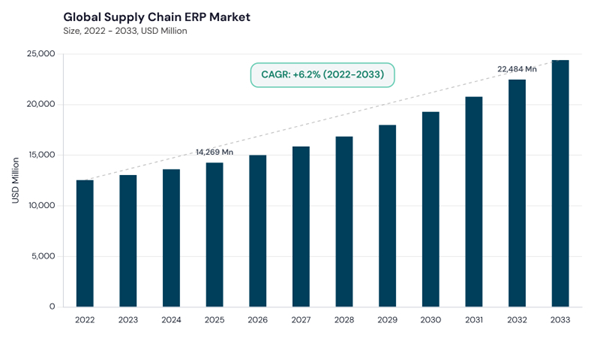
The Global Supply Chain ERP Market size is expected to reach USD 24.40 billion by 2033, rising at a market growth of 7.2% CAGR during the forecast period.


The market growth is driven by increasing demand for integrated supply chain management solutions, rising adoption of cloud-based ERP platforms, and growing focus on operational efficiency across industries. Businesses are increasingly deploying AI-enabled ERP systems to improve supply chain visibility, automate workflows, and enhance real-time decision-making capabilities across global operations.

Key Market Trends & Insights

  • The Large Enterprises segment dominated the market in 2025, accounting for a 67.77% revenue share due to increasing investments in enterprise-wide digital transformation initiatives.
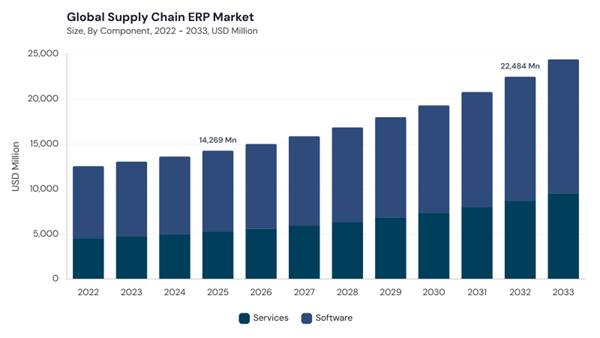
  • The Software segment accounted for the largest share of 63.08% in 2025 and is expected to reach USD 14.92 billion by 2033.
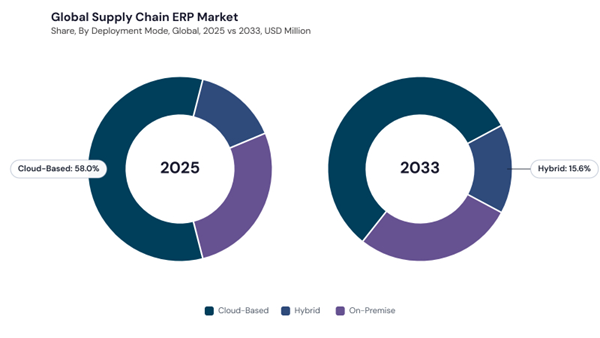
  • Cloud-Based deployment dominated the market in 2025 with a 57.97% revenue share owing to growing demand for scalable and remotely accessible ERP solutions.
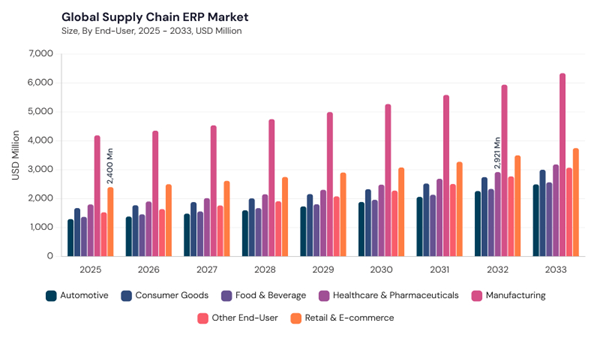
  • The Manufacturing segment dominated the market in 2025 and accounted for a 29.37% share driven by increasing demand for production planning and inventory optimization solutions.
  • North America dominated the market in 2025 with a 36.90% revenue share supported by strong ERP adoption across manufacturing, retail, and logistics industries.
  • The Global Supply Chain ERP Market is projected to grow from USD 14.27 billion in 2025 to USD 24.41 billion by 2033 driven by increasing adoption of AI-enabled and cloud-based ERP systems.
The major strategies followed by the market participants are Partnerships, Product Innovation, and Cloud Expansion as organizations focus on improving interoperability, automation, and supply chain intelligence capabilities. For instance, in February 2025, SAP SE expanded its AI-driven supply chain planning capabilities within SAP Integrated Business Planning to improve predictive forecasting and operational visibility. Additionally, in January 2025, Oracle Corporation enhanced Oracle Fusion Cloud SCM with generative AI-powered workflow automation and procurement intelligence features.


The Supply Chain ERP Market has evolved significantly from traditional enterprise planning systems into integrated digital platforms capable of managing procurement, logistics, inventory, warehousing, and supplier collaboration within a unified ecosystem. Earlier ERP systems primarily focused on transactional management, while modern solutions incorporate cloud computing, AI, analytics, and automation technologies to support agile and resilient supply chain operations.

Growing digital transformation initiatives across manufacturing, retail, healthcare, food & beverage, and automotive sectors continue to accelerate adoption of advanced supply chain ERP platforms. Organizations are increasingly investing in scalable ERP solutions to improve operational efficiency, reduce costs, optimize inventory levels, and strengthen supply chain resilience amid evolving market conditions and global trade complexities.

Market Share Analysis

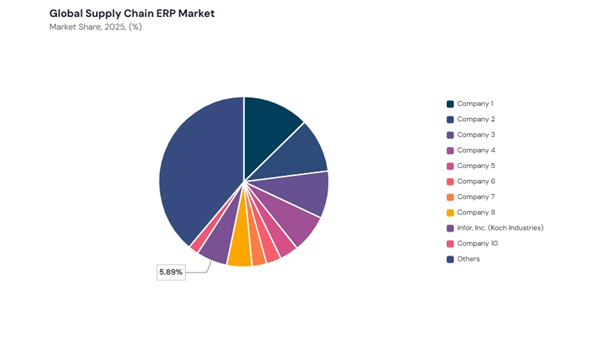
The Supply Chain ERP Market demonstrates a moderately fragmented competitive structure with the top market participants accounting for a significant share of global revenue. SAP SE held the leading market position with approximately 12.65% share, supported by its strong enterprise ERP ecosystem and extensive adoption across manufacturing and logistics-intensive industries.


Oracle Corporation and Microsoft Corporation continue to strengthen their positions through cloud-native ERP platforms, AI-driven analytics, and integrated supply chain management capabilities. Specialized providers including Blue Yonder, Infor, Manhattan Associates, and Kinaxis are gaining traction by offering advanced supply chain planning, warehouse management, and logistics optimization solutions. Mid-tier and niche vendors are also expanding through industry-specific ERP capabilities and faster deployment models.

Deployment Mode Outlook

Based on deployment mode, the market is segmented into Cloud-Based, On-Premise, and Hybrid. The Cloud-Based segment dominated the market in 2025 accounting for a 57.97% share owing to increasing demand for scalable, flexible, and remotely accessible ERP platforms. Organizations are increasingly adopting cloud ERP solutions to reduce infrastructure costs, improve operational agility, and enable real-time collaboration across global supply chain networks. The Hybrid segment is also witnessing steady growth as enterprises seek a balance between on-premise security and cloud scalability.

Component Outlook

Based on component, the market is segmented into Software and Services. The Software segment dominated the market in 2025 with a 63.08% revenue share driven by rising demand for integrated ERP platforms capable of automating procurement, inventory management, logistics, and forecasting operations. Organizations continue to invest in AI-enabled ERP software solutions to improve operational visibility, optimize workflows, and support data-driven supply chain management. The Services segment is also growing steadily due to increasing demand for implementation, consulting, training, and system integration services.

End-use Industry Outlook

Based on end-use industry, the market is segmented into Manufacturing, Retail & E-commerce, Healthcare & Pharmaceuticals, Food & Beverage, Consumer Goods, Automotive, and Other End-User industries. The Manufacturing segment dominated the market in 2025 accounting for a 29.37% revenue share due to increasing demand for production planning, inventory optimization, and supply chain coordination solutions. Retail & E-commerce organizations are also significantly adopting supply chain ERP systems to improve order management and inventory visibility, while healthcare and pharmaceutical companies are deploying ERP platforms to strengthen regulatory compliance and supply chain traceability.

Market Competition and Attributes

The Supply Chain ERP Market is highly competitive with companies focusing on AI-enabled analytics, cloud-native ERP platforms, automation, and integrated supply chain visibility solutions. Vendors are increasingly prioritizing interoperability, modular deployment capabilities, and real-time analytics to support complex and globalized supply chain operations across industries.


Strategic partnerships between ERP vendors, cloud service providers, logistics technology firms, and analytics companies continue to strengthen the competitive landscape. Companies are investing in AI, machine learning, IoT integration, and digital twin technologies to enhance predictive capabilities, improve inventory management, and streamline logistics operations.

Regional expansion strategies and flexible pricing models are also influencing competition as organizations seek scalable ERP deployments that align with operational requirements and budget considerations. Cloud migration services, cybersecurity capabilities, and regulatory compliance support remain important competitive differentiators among leading market participants.

Supply Chain ERP Market Report Coverage


Report AttributeDetails
Market size value in 2026 USD 15.01 Billion
Market size forecast in 2033 USD 24.40 Billion
Base Year 2025
Historical period 2022 to 2024
Forecast Period 2026 to 2033
Revenue Growth Rate CAGR of 6.9% from 2026 to 2033
Number of Pages 700+
Tables 750+
Report Coverage Market Trends, Revenue Estimation and Forecast, Segmentation Analysis, Regional and Country Breakdown, Competitive Landscape, Market Share Analysis, Porter’s Five Forces Analysis, Company Profiling, Company Strategic Developments, SWOT Analysis, Winning Imperatives
Segments Covered Component, Deployment Mode, End-User, Organization Size, Region
Country Scope
  • North America (US, Canada, Mexico, and Rest of North America)
  • Europe (Germany, UK, France, Russia, Spain, Italy, and Rest of Europe)
  • Asia Pacific (Japan, China, India, South Korea, Singapore, Malaysia, and Rest of Asia Pacific)
  • LAMEA (Brazil, Argentina, UAE, Saudi Arabia, South Africa, Nigeria, and Rest of LAMEA)
Companies Included SAP SE, Oracle Corporation, Microsoft Corporation, Blue Yonder Group, Inc., Kinaxis, Inc., Epicor Software Corporation, The Sage Group plc, Manhattan Associates, Inc., Infor, Inc., Workday, Inc.


Recent Strategies Deployed in the Market

  • Feb-2025: SAP SE expanded AI-driven predictive forecasting capabilities within SAP Integrated Business Planning to improve supply chain visibility and operational efficiency.
  • Jan-2025: Oracle Corporation enhanced Oracle Fusion Cloud SCM with generative AI-powered workflow automation and procurement intelligence capabilities.
  • Nov-2024: Microsoft Corporation introduced new AI-enabled analytics features within Dynamics 365 Supply Chain Management to strengthen real-time decision-making capabilities.
  • Oct-2024: Blue Yonder Group, Inc. expanded its cloud-based supply chain planning solutions to improve inventory optimization and logistics management for retail enterprises.
  • Sep-2024: Kinaxis, Inc. introduced advanced machine learning functionalities within its RapidResponse platform to enhance demand forecasting and supply chain resilience.

List of Companies Profiled

  • SAP SE
  • Oracle Corporation
  • Microsoft Corporation
  • Blue Yonder Group, Inc.
  • Kinaxis, Inc.
  • Epicor Software Corporation
  • The Sage Group plc
  • Manhattan Associates, Inc.
  • Infor, Inc.
  • Workday, Inc.

Global Supply Chain ERP Market Report Segmentation

By Component
  • Software
  • Services
By Deployment Mode
  • Cloud-Based
  • On-Premise
  • Hybrid
By End-User
  • Manufacturing
  • Retail & E-commerce
  • Healthcare & Pharmaceuticals
  • Food & Beverage
  • Consumer Goods
  • Automotive
  • Other End-User
By Organization Size
  • Large Enterprises
  • Small & Medium Enterprises (SMEs)
By Geography
  • North America
  • Europe
    • Germany
    • UK
    • France
    • Russia
    • Spain
    • Italy
    • Rest of Europe

  • Asia Pacific
    • China
    • Japan
    • India
    • South Korea
    • Singapore
    • Malaysia
    • Rest of Asia Pacific

  • LAMEA
    • Brazil
    • Argentina
    • UAE
    • Saudi Arabia
    • South Africa
    • Nigeria
    • Rest of LAMEA

Driving and Restraining Factors

Drivers
  • Enhanced Operational Agility Through Integrated Supply Chain and ERP Solutions
  • Adoption of Advanced Technologies including Artificial Intelligence and Machine Learning in Supply Chain ERP
  • Rising Need for End-to-End Supply Chain Visibility and Data-Driven Decision-Making
  • Increasing Complexity of Global Supply Chains and Regulatory Compliance Requirements
Restraints
  • High Implementation and Integration Costs
  • Customization Complexity and Limited Flexibility
  • Data Security and Regulatory Compliance Challenges
Opportunities
  • Integration of Generative AI with Supply Chain ERP Systems
  • Adoption of Digital Twin Technology within Supply Chain ERP Platforms
  • Expansion of Cloud-Based Supply Chain ERP Services for Scalability and Accessibility
Challenges
  • Limited Integration and Customization Capabilities
  • Data Privacy and Security Concerns
  • High Implementation Complexity and Cost Barriers

Market Competition and Attributes

The Supply Chain ERP Market is highly competitive with companies focusing on AI-enabled analytics, cloud-native ERP platforms, automation, and integrated supply chain visibility solutions. Vendors are increasingly prioritizing interoperability, modular deployment capabilities, and real-time analytics to support complex and globalized supply chain operations across industries.

Strategic partnerships between ERP vendors, cloud service providers, logistics technology firms, and analytics companies continue to strengthen the competitive landscape. Companies are investing in AI, machine learning, IoT integration, and digital twin technologies to enhance predictive capabilities, improve inventory management, and streamline logistics operations.

Regional expansion strategies and flexible pricing models are also influencing competition as organizations seek scalable ERP deployments that align with operational requirements and budget considerations. Cloud migration services, cybersecurity capabilities, and regulatory compliance support remain important competitive differentiators among leading market participants.

Recent Strategies Deployed in the Market

  • Feb-2025: SAP SE expanded AI-driven predictive forecasting capabilities within SAP Integrated Business Planning to improve supply chain visibility and operational efficiency.
  • Jan-2025: Oracle Corporation enhanced Oracle Fusion Cloud SCM with generative AI-powered workflow automation and procurement intelligence capabilities.
  • Nov-2024: Microsoft Corporation introduced new AI-enabled analytics features within Dynamics 365 Supply Chain Management to strengthen real-time decision-making capabilities.
  • Oct-2024: Blue Yonder Group, Inc. expanded its cloud-based supply chain planning solutions to improve inventory optimization and logistics management for retail enterprises.
  • Sep-2024: Kinaxis, Inc. introduced advanced machine learning functionalities within its RapidResponse platform to enhance demand forecasting and supply chain resilience.

List of Key Companies Profiled

  • SAP SE
  • Oracle Corporation
  • Microsoft Corporation
  • Infor
  • Blue Yonder Group, Inc.
  • Epicor Software Corporation
  • Workday, Inc.
  • Manhattan Associates, Inc.
  • Sage Group plc
  • Acumatica, Inc.
  • IFS AB
  • QAD Inc.

Market Report Segmentation

By Component
  • Software
  • Services
By Deployment Mode
  • Cloud-Based
  • On-Premise
  • Hybrid
By End-User
  • Manufacturing
  • Retail & E-commerce
  • Healthcare & Pharmaceuticals
  • Food & Beverage
  • Consumer Goods
  • Automotive
  • Other End-User
By Organization Size
  • Large Enterprises
  • Small & Medium Enterprises (SMEs)
By Geography
  • North America

Table of Contents

Chapter 1. Market Overview
1.1 COVID-19 Impact
1.2 Market Composition and Scenario
1.3 Key Factors Impacting Market
1.3.1 Market Drivers
1.3.2 Market Restraints
1.3.3 Market Opportunities
1.3.4 Market Challenges
1.3.5 Market Trends
1.3.6 State of Competition
1.3.7 Market Consolidation
1.3.8 Key Customer Criteria
Chapter 2. Product Life CycleChapter 3. Value Chain Analysis of Supply Chain ERP Market
Chapter 4. Competition Analysis - Global
4.1 Market Share Analysis
4.2 Porter Five Forces Analysis
Chapter 5. Segmentation By Component
5.1 Software
5.2 Services
Chapter 6. Segmentation By Deployment Mode
6.1 Cloud-Based
6.2 On-Premise
6.3 Hybrid
Chapter 7. Segmentation By End-User
7.1 Manufacturing
7.2 Retail & E-commerce
7.3 Healthcare & Pharmaceuticals
7.4 Food & Beverage
7.5 Consumer Goods
7.6 Automotive
7.7 Other End-User
Chapter 8. Segmentation By Organization Size
8.1 Large Enterprises
8.2 Small & Medium Enterprises (SMEs)
Chapter 9. North America Market
9.1 Market Overview
9.2 Key Factors Impacting Market
9.2.1 Market Drivers
9.2.2 Market Restraints
9.2.3 Market Opportunities
9.2.4 Market Challenges
9.2.5 Market Trends
9.2.6 State of Competition
9.2.7 Market Consolidation
9.2.8 Key Customer Criteria
9.3 Product Life Cycle
9.4 Segmentation By Component
9.4.1 Software
9.4.2 Services
9.5 Segmentation By Deployment Mode
9.5.1 Cloud-Based
9.5.2 On-Premise
9.5.3 Hybrid
9.6 Segmentation By End-User
9.6.1 Manufacturing
9.6.2 Retail & E-commerce
9.6.3 Healthcare & Pharmaceuticals
9.6.4 Food & Beverage
9.6.5 Consumer Goods
9.6.6 Automotive
9.6.7 Other End-User
9.7 Segmentation By Organization Size
9.7.1 Large Enterprises
9.7.2 Small & Medium Enterprises (SMEs)
9.8 Segmentation By Country
9.8.1 United States
9.8.1.1 Segmentation By Component
9.8.1.1.1 Software
9.8.1.1.2 Services
9.8.1.2 Segmentation By Deployment Mode
9.8.1.2.1 Cloud-Based
9.8.1.2.2 On-Premise
9.8.1.2.3 Hybrid
9.8.1.3 Segmentation By End-User
9.8.1.3.1 Manufacturing
9.8.1.3.2 Retail & E-commerce
9.8.1.3.3 Healthcare & Pharmaceuticals
9.8.1.3.4 Food & Beverage
9.8.1.3.5 Consumer Goods
9.8.1.3.6 Automotive
9.8.1.3.7 Other End-User
9.8.1.4 Segmentation By Organization Size
9.8.1.4.1 Large Enterprises
9.8.1.4.2 Small & Medium Enterprises (SMEs)
9.8.2 Canada
9.8.2.1 Segmentation By Component
9.8.2.1.1 Software
9.8.2.1.2 Services
9.8.2.2 Segmentation By Deployment Mode
9.8.2.2.1 Cloud-Based
9.8.2.2.2 On-Premise
9.8.2.2.3 Hybrid
9.8.2.3 Segmentation By End-User
9.8.2.3.1 Manufacturing
9.8.2.3.2 Retail & E-commerce
9.8.2.3.3 Healthcare & Pharmaceuticals
9.8.2.3.4 Food & Beverage
9.8.2.3.5 Consumer Goods
9.8.2.3.6 Automotive
9.8.2.3.7 Other End-User
9.8.2.4 Segmentation By Organization Size
9.8.2.4.1 Large Enterprises
9.8.2.4.2 Small & Medium Enterprises (SMEs)
9.8.3 Mexico
9.8.3.1 Segmentation By Component
9.8.3.1.1 Software
9.8.3.1.2 Services
9.8.3.2 Segmentation By Deployment Mode
9.8.3.2.1 Cloud-Based
9.8.3.2.2 On-Premise
9.8.3.2.3 Hybrid
9.8.3.3 Segmentation By End-User
9.8.3.3.1 Manufacturing
9.8.3.3.2 Retail & E-commerce
9.8.3.3.3 Healthcare & Pharmaceuticals
9.8.3.3.4 Food & Beverage
9.8.3.3.5 Consumer Goods
9.8.3.3.6 Automotive
9.8.3.3.7 Other End-User
9.8.3.4 Segmentation By Organization Size
9.8.3.4.1 Large Enterprises
9.8.3.4.2 Small & Medium Enterprises (SMEs)
9.8.4 Rest of North America
9.8.4.1 Segmentation By Component
9.8.4.1.1 Software
9.8.4.1.2 Services
9.8.4.2 Segmentation By Deployment Mode
9.8.4.2.1 Cloud-Based
9.8.4.2.2 On-Premise
9.8.4.2.3 Hybrid
9.8.4.3 Segmentation By End-User
9.8.4.3.1 Manufacturing
9.8.4.3.2 Retail & E-commerce
9.8.4.3.3 Healthcare & Pharmaceuticals
9.8.4.3.4 Food & Beverage
9.8.4.3.5 Consumer Goods
9.8.4.3.6 Automotive
9.8.4.3.7 Other End-User
9.8.4.4 Segmentation By Organization Size
9.8.4.4.1 Large Enterprises
9.8.4.4.2 Small & Medium Enterprises (SMEs)
Chapter 10. Europe Market
10.1 Market Overview
10.2 Key Factors Impacting Market
10.2.1 Market Drivers
10.2.2 Market Restraints
10.2.3 Market Opportunities
10.2.4 Market Challenges
10.2.5 Market Trends
10.2.6 State of Competition
10.2.7 Market Consolidation
10.2.8 Key Customer Criteria
10.3 Product Life Cycle
10.4 Segmentation By Component
10.4.1 Software
10.4.2 Services
10.5 Segmentation By Deployment Mode
10.5.1 Cloud-Based
10.5.2 On-Premise
10.5.3 Hybrid
10.6 Segmentation By End-User
10.6.1 Manufacturing
10.6.2 Retail & E-commerce
10.6.3 Healthcare & Pharmaceuticals
10.6.4 Food & Beverage
10.6.5 Consumer Goods
10.6.6 Automotive
10.6.7 Other End-User
10.7 Segmentation By Organization Size
10.7.1 Large Enterprises
10.7.2 Small & Medium Enterprises (SMEs)
10.8 Segmentation By Country
10.8.1 Germany
10.8.1.1 Segmentation By Component
10.8.1.1.1 Software
10.8.1.1.2 Services
10.8.1.2 Segmentation By Deployment Mode
10.8.1.2.1 Cloud-Based
10.8.1.2.2 On-Premise
10.8.1.2.3 Hybrid
10.8.1.3 Segmentation By End-User
10.8.1.3.1 Manufacturing
10.8.1.3.2 Retail & E-commerce
10.8.1.3.3 Healthcare & Pharmaceuticals
10.8.1.3.4 Food & Beverage
10.8.1.3.5 Consumer Goods
10.8.1.3.6 Automotive
10.8.1.3.7 Other End-User
10.8.1.4 Segmentation By Organization Size
10.8.1.4.1 Large Enterprises
10.8.1.4.2 Small & Medium Enterprises (SMEs)
10.8.2 United Kingdom
10.8.2.1 Segmentation By Component
10.8.2.1.1 Software
10.8.2.1.2 Services
10.8.2.2 Segmentation By Deployment Mode
10.8.2.2.1 Cloud-Based
10.8.2.2.2 On-Premise
10.8.2.2.3 Hybrid
10.8.2.3 Segmentation By End-User
10.8.2.3.1 Manufacturing
10.8.2.3.2 Retail & E-commerce
10.8.2.3.3 Healthcare & Pharmaceuticals
10.8.2.3.4 Food & Beverage
10.8.2.3.5 Consumer Goods
10.8.2.3.6 Automotive
10.8.2.3.7 Other End-User
10.8.2.4 Segmentation By Organization Size
10.8.2.4.1 Large Enterprises
10.8.2.4.2 Small & Medium Enterprises (SMEs)
10.8.3 France
10.8.3.1 Segmentation By Component
10.8.3.1.1 Software
10.8.3.1.2 Services
10.8.3.2 Segmentation By Deployment Mode
10.8.3.2.1 Cloud-Based
10.8.3.2.2 On-Premise
10.8.3.2.3 Hybrid
10.8.3.3 Segmentation By End-User
10.8.3.3.1 Manufacturing
10.8.3.3.2 Retail & E-commerce
10.8.3.3.3 Healthcare & Pharmaceuticals
10.8.3.3.4 Food & Beverage
10.8.3.3.5 Consumer Goods
10.8.3.3.6 Automotive
10.8.3.3.7 Other End-User
10.8.3.4 Segmentation By Organization Size
10.8.3.4.1 Large Enterprises
10.8.3.4.2 Small & Medium Enterprises (SMEs)
10.8.4 Russia
10.8.4.1 Segmentation By Component
10.8.4.1.1 Software
10.8.4.1.2 Services
10.8.4.2 Segmentation By Deployment Mode
10.8.4.2.1 Cloud-Based
10.8.4.2.2 On-Premise
10.8.4.2.3 Hybrid
10.8.4.3 Segmentation By End-User
10.8.4.3.1 Manufacturing
10.8.4.3.2 Retail & E-commerce
10.8.4.3.3 Healthcare & Pharmaceuticals
10.8.4.3.4 Food & Beverage
10.8.4.3.5 Consumer Goods
10.8.4.3.6 Automotive
10.8.4.3.7 Other End-User
10.8.4.4 Segmentation By Organization Size
10.8.4.4.1 Large Enterprises
10.8.4.4.2 Small & Medium Enterprises (SMEs)
10.8.5 Spain
10.8.5.1 Segmentation By Component
10.8.5.1.1 Software
10.8.5.1.2 Services
10.8.5.2 Segmentation By Deployment Mode
10.8.5.2.1 Cloud-Based
10.8.5.2.2 On-Premise
10.8.5.2.3 Hybrid
10.8.5.3 Segmentation By End-User
10.8.5.3.1 Manufacturing
10.8.5.3.2 Retail & E-commerce
10.8.5.3.3 Healthcare & Pharmaceuticals
10.8.5.3.4 Food & Beverage
10.8.5.3.5 Consumer Goods
10.8.5.3.6 Automotive
10.8.5.3.7 Other End-User
10.8.5.4 Segmentation By Organization Size
10.8.5.4.1 Large Enterprises
10.8.5.4.2 Small & Medium Enterprises (SMEs)
10.8.6 Italy
10.8.6.1 Segmentation By Component
10.8.6.1.1 Software
10.8.6.1.2 Services
10.8.6.2 Segmentation By Deployment Mode
10.8.6.2.1 Cloud-Based
10.8.6.2.2 On-Premise
10.8.6.2.3 Hybrid
10.8.6.3 Segmentation By End-User
10.8.6.3.1 Manufacturing
10.8.6.3.2 Retail & E-commerce
10.8.6.3.3 Healthcare & Pharmaceuticals
10.8.6.3.4 Food & Beverage
10.8.6.3.5 Consumer Goods
10.8.6.3.6 Automotive
10.8.6.3.7 Other End-User
10.8.6.4 Segmentation By Organization Size
10.8.6.4.1 Large Enterprises
10.8.6.4.2 Small & Medium Enterprises (SMEs)
10.8.7 Rest of Europe
10.8.7.1 Segmentation By Component
10.8.7.1.1 Software
10.8.7.1.2 Services
10.8.7.2 Segmentation By Deployment Mode
10.8.7.2.1 Cloud-Based
10.8.7.2.2 On-Premise
10.8.7.2.3 Hybrid
10.8.7.3 Segmentation By End-User
10.8.7.3.1 Manufacturing
10.8.7.3.2 Retail & E-commerce
10.8.7.3.3 Healthcare & Pharmaceuticals
10.8.7.3.4 Food & Beverage
10.8.7.3.5 Consumer Goods
10.8.7.3.6 Automotive
10.8.7.3.7 Other End-User
10.8.7.4 Segmentation By Organization Size
10.8.7.4.1 Large Enterprises
10.8.7.4.2 Small & Medium Enterprises (SMEs)
Chapter 11. Asia Pacific Market
11.1 Market Overview
11.2 Key Factors Impacting Market
11.2.1 Market Drivers
11.2.2 Market Restraints
11.2.3 Market Opportunities
11.2.4 Market Challenges
11.2.5 Market Trends
11.2.6 State of Competition
11.2.7 Market Consolidation
11.2.8 Key Customer Criteria
11.3 Product Life Cycle
11.4 Segmentation By Component
11.4.1 Software
11.4.2 Services
11.5 Segmentation By Deployment Mode
11.5.1 Cloud-Based
11.5.2 On-Premise
11.5.3 Hybrid
11.6 Segmentation By End-User
11.6.1 Manufacturing
11.6.2 Retail & E-commerce
11.6.3 Healthcare & Pharmaceuticals
11.6.4 Food & Beverage
11.6.5 Consumer Goods
11.6.6 Automotive
11.6.7 Other End-User
11.7 Segmentation By Organization Size
11.7.1 Large Enterprises
11.7.2 Small & Medium Enterprises (SMEs)
11.8 Segmentation By Country
11.8.1 China
11.8.1.1 Segmentation By Component
11.8.1.1.1 Software
11.8.1.1.2 Services
11.8.1.2 Segmentation By Deployment Mode
11.8.1.2.1 Cloud-Based
11.8.1.2.2 On-Premise
11.8.1.2.3 Hybrid
11.8.1.3 Segmentation By End-User
11.8.1.3.1 Manufacturing
11.8.1.3.2 Retail & E-commerce
11.8.1.3.3 Healthcare & Pharmaceuticals
11.8.1.3.4 Food & Beverage
11.8.1.3.5 Consumer Goods
11.8.1.3.6 Automotive
11.8.1.3.7 Other End-User
11.8.1.4 Segmentation By Organization Size
11.8.1.4.1 Large Enterprises
11.8.1.4.2 Small & Medium Enterprises (SMEs)
11.8.2 Japan
11.8.2.1 Segmentation By Component
11.8.2.1.1 Software
11.8.2.1.2 Services
11.8.2.2 Segmentation By Deployment Mode
11.8.2.2.1 Cloud-Based
11.8.2.2.2 On-Premise
11.8.2.2.3 Hybrid
11.8.2.3 Segmentation By End-User
11.8.2.3.1 Manufacturing
11.8.2.3.2 Retail & E-commerce
11.8.2.3.3 Healthcare & Pharmaceuticals
11.8.2.3.4 Food & Beverage
11.8.2.3.5 Consumer Goods
11.8.2.3.6 Automotive
11.8.2.3.7 Other End-User
11.8.2.4 Segmentation By Organization Size
11.8.2.4.1 Large Enterprises
11.8.2.4.2 Small & Medium Enterprises (SMEs)
11.8.3 India
11.8.3.1 Segmentation By Component
11.8.3.1.1 Software
11.8.3.1.2 Services
11.8.3.2 Segmentation By Deployment Mode
11.8.3.2.1 Cloud-Based
11.8.3.2.2 On-Premise
11.8.3.2.3 Hybrid
11.8.3.3 Segmentation By End-User
11.8.3.3.1 Manufacturing
11.8.3.3.2 Retail & E-commerce
11.8.3.3.3 Healthcare & Pharmaceuticals
11.8.3.3.4 Food & Beverage
11.8.3.3.5 Consumer Goods
11.8.3.3.6 Automotive
11.8.3.3.7 Other End-User
11.8.3.4 Segmentation By Organization Size
11.8.3.4.1 Large Enterprises
11.8.3.4.2 Small & Medium Enterprises (SMEs)
11.8.4 South Korea
11.8.4.1 Segmentation By Component
11.8.4.1.1 Software
11.8.4.1.2 Services
11.8.4.2 Segmentation By Deployment Mode
11.8.4.2.1 Cloud-Based
11.8.4.2.2 On-Premise
11.8.4.2.3 Hybrid
11.8.4.3 Segmentation By End-User
11.8.4.3.1 Manufacturing
11.8.4.3.2 Retail & E-commerce
11.8.4.3.3 Healthcare & Pharmaceuticals
11.8.4.3.4 Food & Beverage
11.8.4.3.5 Consumer Goods
11.8.4.3.6 Automotive
11.8.4.3.7 Other End-User
11.8.4.4 Segmentation By Organization Size
11.8.4.4.1 Large Enterprises
11.8.4.4.2 Small & Medium Enterprises (SMEs)
11.8.5 Singapore
11.8.5.1 Segmentation By Component
11.8.5.1.1 Software
11.8.5.1.2 Services
11.8.5.2 Segmentation By Deployment Mode
11.8.5.2.1 Cloud-Based
11.8.5.2.2 On-Premise
11.8.5.2.3 Hybrid
11.8.5.3 Segmentation By End-User
11.8.5.3.1 Manufacturing
11.8.5.3.2 Retail & E-commerce
11.8.5.3.3 Healthcare & Pharmaceuticals
11.8.5.3.4 Food & Beverage
11.8.5.3.5 Consumer Goods
11.8.5.3.6 Automotive
11.8.5.3.7 Other End-User
11.8.5.4 Segmentation By Organization Size
11.8.5.4.1 Large Enterprises
11.8.5.4.2 Small & Medium Enterprises (SMEs)
11.8.6 Malaysia
11.8.6.1 Segmentation By Component
11.8.6.1.1 Software
11.8.6.1.2 Services
11.8.6.2 Segmentation By Deployment Mode
11.8.6.2.1 Cloud-Based
11.8.6.2.2 On-Premise
11.8.6.2.3 Hybrid
11.8.6.3 Segmentation By End-User
11.8.6.3.1 Manufacturing
11.8.6.3.2 Retail & E-commerce
11.8.6.3.3 Healthcare & Pharmaceuticals
11.8.6.3.4 Food & Beverage
11.8.6.3.5 Consumer Goods
11.8.6.3.6 Automotive
11.8.6.3.7 Other End-User
11.8.6.4 Segmentation By Organization Size
11.8.6.4.1 Large Enterprises
11.8.6.4.2 Small & Medium Enterprises (SMEs)
11.8.7 Rest of Asia Pacific
11.8.7.1 Segmentation By Component
11.8.7.1.1 Software
11.8.7.1.2 Services
11.8.7.2 Segmentation By Deployment Mode
11.8.7.2.1 Cloud-Based
11.8.7.2.2 On-Premise
11.8.7.2.3 Hybrid
11.8.7.3 Segmentation By End-User
11.8.7.3.1 Manufacturing
11.8.7.3.2 Retail & E-commerce
11.8.7.3.3 Healthcare & Pharmaceuticals
11.8.7.3.4 Food & Beverage
11.8.7.3.5 Consumer Goods
11.8.7.3.6 Automotive
11.8.7.3.7 Other End-User
11.8.7.4 Segmentation By Organization Size
11.8.7.4.1 Large Enterprises
11.8.7.4.2 Small & Medium Enterprises (SMEs)
Chapter 12. LAMEA Market
12.1 Market Overview
12.2 Key Factors Impacting Market
12.2.1 Market Drivers
12.2.2 Market Restraints
12.2.3 Market Opportunities
12.2.4 Market Challenges
12.2.5 Market Trends
12.2.6 State of Competition
12.2.7 Market Consolidation
12.2.8 Key Customer Criteria
12.3 Product Life Cycle
12.4 Segmentation By Component
12.4.1 Software
12.4.2 Services
12.5 Segmentation By Deployment Mode
12.5.1 Cloud-Based
12.5.2 On-Premise
12.5.3 Hybrid
12.6 Segmentation By End-User
12.6.1 Manufacturing
12.6.2 Retail & E-commerce
12.6.3 Healthcare & Pharmaceuticals
12.6.4 Food & Beverage
12.6.5 Consumer Goods
12.6.6 Automotive
12.6.7 Other End-User
12.7 Segmentation By Organization Size
12.7.1 Large Enterprises
12.7.2 Small & Medium Enterprises (SMEs)
12.8 Segmentation By Country
12.8.1 Brazil
12.8.1.1 Segmentation By Component
12.8.1.1.1 Software
12.8.1.1.2 Services
12.8.1.2 Segmentation By Deployment Mode
12.8.1.2.1 Cloud-Based
12.8.1.2.2 On-Premise
12.8.1.2.3 Hybrid
12.8.1.3 Segmentation By End-User
12.8.1.3.1 Manufacturing
12.8.1.3.2 Retail & E-commerce
12.8.1.3.3 Healthcare & Pharmaceuticals
12.8.1.3.4 Food & Beverage
12.8.1.3.5 Consumer Goods
12.8.1.3.6 Automotive
12.8.1.3.7 Other End-User
12.8.1.4 Segmentation By Organization Size
12.8.1.4.1 Large Enterprises
12.8.1.4.2 Small & Medium Enterprises (SMEs)
12.8.2 Argentina
12.8.2.1 Segmentation By Component
12.8.2.1.1 Software
12.8.2.1.2 Services
12.8.2.2 Segmentation By Deployment Mode
12.8.2.2.1 Cloud-Based
12.8.2.2.2 On-Premise
12.8.2.2.3 Hybrid
12.8.2.3 Segmentation By End-User
12.8.2.3.1 Manufacturing
12.8.2.3.2 Retail & E-commerce
12.8.2.3.3 Healthcare & Pharmaceuticals
12.8.2.3.4 Food & Beverage
12.8.2.3.5 Consumer Goods
12.8.2.3.6 Automotive
12.8.2.3.7 Other End-User
12.8.2.4 Segmentation By Organization Size
12.8.2.4.1 Large Enterprises
12.8.2.4.2 Small & Medium Enterprises (SMEs)
12.8.3 UAE
12.8.3.1 Segmentation By Component
12.8.3.1.1 Software
12.8.3.1.2 Services
12.8.3.2 Segmentation By Deployment Mode
12.8.3.2.1 Cloud-Based
12.8.3.2.2 On-Premise
12.8.3.2.3 Hybrid
12.8.3.3 Segmentation By End-User
12.8.3.3.1 Manufacturing
12.8.3.3.2 Retail & E-commerce
12.8.3.3.3 Healthcare & Pharmaceuticals
12.8.3.3.4 Food & Beverage
12.8.3.3.5 Consumer Goods
12.8.3.3.6 Automotive
12.8.3.3.7 Other End-User
12.8.3.4 Segmentation By Organization Size
12.8.3.4.1 Large Enterprises
12.8.3.4.2 Small & Medium Enterprises (SMEs)
12.8.4 Saudi Arabia
12.8.4.1 Segmentation By Component
12.8.4.1.1 Software
12.8.4.1.2 Services
12.8.4.2 Segmentation By Deployment Mode
12.8.4.2.1 Cloud-Based
12.8.4.2.2 On-Premise
12.8.4.2.3 Hybrid
12.8.4.3 Segmentation By End-User
12.8.4.3.1 Manufacturing
12.8.4.3.2 Retail & E-commerce
12.8.4.3.3 Healthcare & Pharmaceuticals
12.8.4.3.4 Food & Beverage
12.8.4.3.5 Consumer Goods
12.8.4.3.6 Automotive
12.8.4.3.7 Other End-User
12.8.4.4 Segmentation By Organization Size
12.8.4.4.1 Large Enterprises
12.8.4.4.2 Small & Medium Enterprises (SMEs)
12.8.5 South Africa
12.8.5.1 Segmentation By Component
12.8.5.1.1 Software
12.8.5.1.2 Services
12.8.5.2 Segmentation By Deployment Mode
12.8.5.2.1 Cloud-Based
12.8.5.2.2 On-Premise
12.8.5.2.3 Hybrid
12.8.5.3 Segmentation By End-User
12.8.5.3.1 Manufacturing
12.8.5.3.2 Retail & E-commerce
12.8.5.3.3 Healthcare & Pharmaceuticals
12.8.5.3.4 Food & Beverage
12.8.5.3.5 Consumer Goods
12.8.5.3.6 Automotive
12.8.5.3.7 Other End-User
12.8.5.4 Segmentation By Organization Size
12.8.5.4.1 Large Enterprises
12.8.5.4.2 Small & Medium Enterprises (SMEs)
12.8.6 Nigeria
12.8.6.1 Segmentation By Component
12.8.6.1.1 Software
12.8.6.1.2 Services
12.8.6.2 Segmentation By Deployment Mode
12.8.6.2.1 Cloud-Based
12.8.6.2.2 On-Premise
12.8.6.2.3 Hybrid
12.8.6.3 Segmentation By End-User
12.8.6.3.1 Manufacturing
12.8.6.3.2 Retail & E-commerce
12.8.6.3.3 Healthcare & Pharmaceuticals
12.8.6.3.4 Food & Beverage
12.8.6.3.5 Consumer Goods
12.8.6.3.6 Automotive
12.8.6.3.7 Other End-User
12.8.6.4 Segmentation By Organization Size
12.8.6.4.1 Large Enterprises
12.8.6.4.2 Small & Medium Enterprises (SMEs)
12.8.7 Rest of LAMEA
12.8.7.1 Segmentation By Component
12.8.7.1.1 Software
12.8.7.1.2 Services
12.8.7.2 Segmentation By Deployment Mode
12.8.7.2.1 Cloud-Based
12.8.7.2.2 On-Premise
12.8.7.2.3 Hybrid
12.8.7.3 Segmentation By End-User
12.8.7.3.1 Manufacturing
12.8.7.3.2 Retail & E-commerce
12.8.7.3.3 Healthcare & Pharmaceuticals
12.8.7.3.4 Food & Beverage
12.8.7.3.5 Consumer Goods
12.8.7.3.6 Automotive
12.8.7.3.7 Other End-User
12.8.7.4 Segmentation By Organization Size
12.8.7.4.1 Large Enterprises
12.8.7.4.2 Small & Medium Enterprises (SMEs)
Chapter 13. Company Snapshot
13.1 SAP SE
13.1.1 Business Overview
13.1.2 Key Information
13.1.3 Company Focus
13.1.4 Strategic Insights
13.1.5 Strategy Deployed
13.1.6 Product & Service Portfolio
13.1.7 Capability Overview
13.1.8 Technology & Innovation Focus
13.1.9 Customers / End Users
13.1.10 Competitive Positioning
13.1.11 Key Differentiators
13.1.12 Portfolio Matrix
13.1.13 SWOT Analysis
13.1.14 Future Outlook
13.2 Oracle Corporation
13.2.1 Business Overview
13.2.2 Key Information
13.2.3 Company Focus
13.2.4 Strategic Insights
13.2.5 Strategy Deployed
13.2.6 Product & Service Portfolio
13.2.7 Capability Overview
13.2.8 Technology & Innovation Focus
13.2.9 Customers / End Users
13.2.10 Competitive Positioning
13.2.11 Key Differentiators
13.2.12 Portfolio Matrix
13.2.13 SWOT Analysis
13.2.14 Future Outlook
13.3 Microsoft Corporation
13.3.1 Business Overview
13.3.2 Key Information
13.3.3 Company Focus
13.3.4 Strategic Insights
13.3.5 Strategy Deployed
13.3.6 Product & Service Portfolio
13.3.7 Capability Overview
13.3.8 Technology & Innovation Focus
13.3.9 Customers / End Users
13.3.10 Competitive Positioning
13.3.11 Key Differentiators
13.3.12 Portfolio Matrix
13.3.13 SWOT Analysis
13.3.14 Future Outlook
13.4 Blue Yonder Group, Inc. (Panasonic Holdings Corporation)
13.4.1 Business Overview
13.4.2 Key Information
13.4.3 Company Focus
13.4.4 Strategic Insights
13.4.5 Strategy Deployed
13.4.6 Product & Service Portfolio
13.4.7 Capability Overview
13.4.8 Technology & Innovation Focus
13.4.9 Customers / End Users
13.4.10 Competitive Positioning
13.4.11 Key Differentiators
13.4.12 Portfolio Matrix
13.4.13 SWOT Analysis
13.4.14 Future Outlook
13.5 Kinaxis, Inc.
13.5.1 Business Overview
13.5.2 Key Information
13.5.3 Company Focus
13.5.4 Strategic Insights
13.5.5 Strategy Deployed
13.5.6 Product & Service Portfolio
13.5.7 Capability Overview
13.5.8 Technology & Innovation Focus
13.5.9 Customers / End Users
13.5.10 Competitive Positioning
13.5.11 Key Differentiators
13.5.12 Portfolio Matrix
13.5.13 SWOT Analysis
13.5.14 Future Outlook
13.6 Epicor Software Corporation
13.6.1 Business Overview
13.6.2 Key Information
13.6.3 Company Focus
13.6.4 Strategic Insights
13.6.5 Strategy Deployed
13.6.6 Product & Service Portfolio
13.6.7 Capability Overview
13.6.8 Technology & Innovation Focus
13.6.9 Customers / End Users
13.6.10 Competitive Positioning
13.6.11 Key Differentiators
13.6.12 Portfolio Matrix
13.6.13 SWOT Analysis
13.6.14 Future Outlook
13.7 The Sage Group plc
13.7.1 Business Overview
13.7.2 Key Information
13.7.3 Company Focus
13.7.4 Strategic Insights
13.7.5 Strategy Deployed
13.7.6 Product & Service Portfolio
13.7.7 Capability Overview
13.7.8 Technology & Innovation Focus
13.7.9 Customers / End Users
13.7.10 Competitive Positioning
13.7.11 Key Differentiators
13.7.12 Portfolio Matrix
13.7.13 SWOT Analysis
13.7.14 Future Outlook
13.8 Manhattan Associates, Inc.
13.8.1 Business Overview
13.8.2 Key Information
13.8.3 Company Focus
13.8.4 Strategic Insights
13.8.5 Strategy Deployed
13.8.6 Product & Service Portfolio
13.8.7 Capability Overview
13.8.8 Technology & Innovation Focus
13.8.9 Customers / End Users
13.8.10 Competitive Positioning
13.8.11 Key Differentiators
13.8.12 Portfolio Matrix
13.8.13 SWOT Analysis
13.8.14 Future Outlook
13.9 Infor, Inc. (Koch Industries)
13.9.1 Business Overview
13.9.2 Key Information
13.9.3 Company Focus
13.9.4 Strategic Insights
13.9.5 Strategy Deployed
13.9.6 Product & Service Portfolio
13.9.7 Capability Overview
13.9.8 Technology & Innovation Focus
13.9.9 Customers / End Users
13.9.10 Competitive Positioning
13.9.11 Key Differentiators
13.9.12 Portfolio Matrix
13.9.13 SWOT Analysis
13.9.14 Future Outlook
13.10 Workday, Inc.
13.10.1 Business Overview
13.10.2 Key Information
13.10.3 Company Focus
13.10.4 Strategic Insights
13.10.5 Strategy Deployed
13.10.6 Product & Service Portfolio
13.10.7 Capability Overview
13.10.8 Technology & Innovation Focus
13.10.9 Customers / End Users
13.10.10 Competitive Positioning
13.10.11 Key Differentiators
13.10.12 Portfolio Matrix
13.10.13 SWOT Analysis
13.10.14 Future Outlook
Chapter 14. Winning Imperatives of Supply Chain ERP Market

Companies Mentioned

  • SAP SE
  • Oracle Corporation
  • Microsoft Corporation
  • Blue Yonder Group, Inc.
  • Kinaxis, Inc.
  • Epicor Software Corporation
  • The Sage Group plc
  • Manhattan Associates, Inc.
  • Infor, Inc.
  • Workday, Inc.