+353-1-416-8900REST OF WORLD
+44-20-3973-8888REST OF WORLD
1-917-300-0470EAST COAST U.S
1-800-526-8630U.S. (TOLL FREE)

Global PFAS-Free Food Packaging Market Size, Share & Industry Analysis Report by Packaging Type, Material Type, End-user, Regional Outlook and Forecast, 2026-2033

  • PDF Icon

    Report

  • 629 Pages
  • May 2026
  • Marqual IT Solutions Pvt. Ltd (KBV Research)
  • ID: 6276014
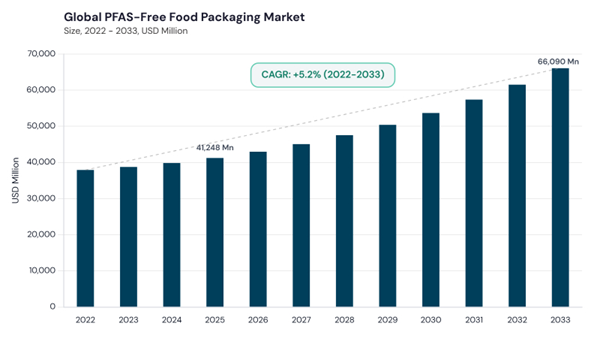
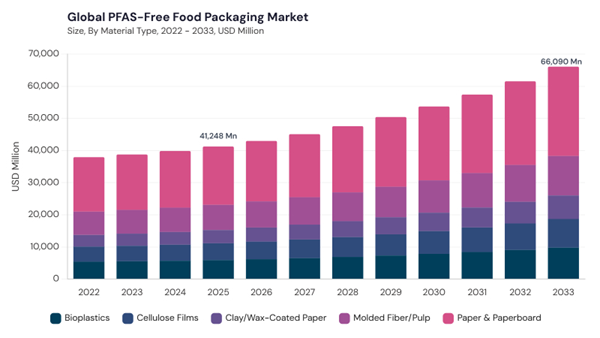
The Global PFAS-Free Food Packaging Market is expected to reach USD 66.08 billion by 2033, growing at a CAGR of 6.3% during the forecast period.


The market growth is driven by increasing regulatory restrictions on PFAS chemicals, rising consumer demand for sustainable packaging solutions, and rapid innovation in biodegradable and recyclable food-contact materials. Food manufacturers, restaurant chains, and packaging companies are increasingly transitioning toward PFAS-free coatings, molded fiber solutions, cellulose-based materials, and recyclable barrier technologies to align with sustainability goals and evolving regulatory standards. Increasing environmental concerns associated with fluorinated compounds and growing adoption of compostable packaging alternatives are further supporting long-term market expansion globally.

Key Market Trends & Insights

  • North America dominated the PFAS-Free Food Packaging Market in 2025 accounting for 36.8% revenue share owing to aggressive regulatory actions and strong sustainable packaging adoption.
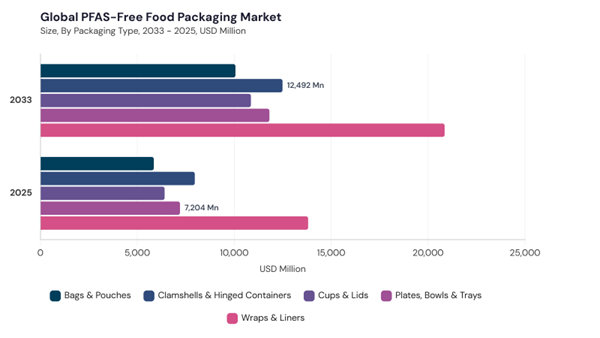
  • The Wraps & Liners segment led the market by Packaging Type in 2025 and is projected to attain USD 20.85 billion by 2033.
  • Paper & Paperboard emerged as the dominant Material Type segment in 2025 with 43.98% share due to increasing preference for recyclable and biodegradable packaging materials.
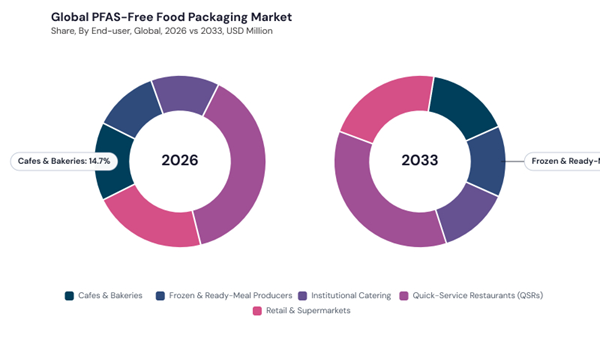
  • The Quick-Service Restaurants (QSRs) segment accounted for the highest revenue share in 2025 and is expected to reach USD 23.57 billion by 2033.
  • The Bioplastics segment is expected to register a CAGR of 6.7% during 2026-2033 supported by increasing adoption of compostable polymer technologies.
  • Biodegradable barrier coatings, recyclable fiber packaging, and water-based coating technologies are emerging as major industry trends.
The PFAS-Free Food Packaging Market is undergoing rapid transformation as governments, food brands, and consumers increasingly move away from fluorinated chemicals used in traditional grease-resistant food packaging materials. Growing evidence regarding the environmental persistence and potential health risks associated with PFAS exposure has accelerated regulatory bans and industry-wide transitions toward safer alternatives. Manufacturers are investing significantly in bio-based polymers, molded pulp packaging, cellulose films, and advanced biodegradable coatings capable of replicating the performance of PFAS without environmental toxicity.


Furthermore, rising demand for recyclable, compostable, and circular-economy-compatible food packaging solutions across foodservice, retail, and takeaway applications is further supporting market expansion globally. Innovations in water-based coatings, plant-derived waxes, and renewable barrier technologies are enabling scalable adoption while meeting food safety, performance, and sustainability requirements.

Driving and Restraining Factors

Drivers
  • Increasing regulatory pressure mandating PFAS-free food packaging
  • Rising consumer awareness regarding PFAS-related health concerns
  • Corporate sustainability commitments accelerating eco-friendly packaging adoption
  • Advancements in biodegradable coatings and renewable packaging materials
Restraints
  • High production costs associated with PFAS-free alternatives
  • Performance limitations of non-fluorinated barrier coatings
  • Regulatory fragmentation across global packaging markets
Opportunities
  • Expansion of recyclable and compostable food packaging solutions
  • Growing adoption of circular economy packaging models
  • Innovation in water-based and plant-derived barrier technologies
Challenges
  • Limited scalability of alternative coating technologies
  • Supply chain complexity for sustainable raw materials
  • Maintaining grease resistance and moisture barrier performance

Market Share Analysis

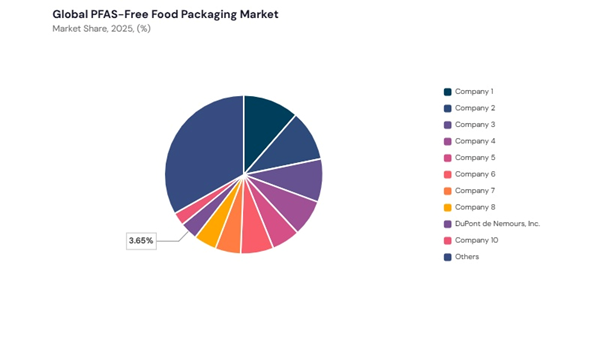
The PFAS-Free Food Packaging Market demonstrates a moderately fragmented competitive landscape characterized by strong participation from fiber-based packaging manufacturers, molded pulp innovators, sustainable material providers, and foodservice packaging companies. Major companies are increasingly focusing on biodegradable coatings, recyclable packaging systems, compostable food containers, and PFAS-free barrier technologies to strengthen competitive positioning.


Stora Enso Oyj accounted for a notable market share in 2025 supported by its strong renewable packaging portfolio, sustainable fiber technologies, and increasing investments in PFAS-free food packaging solutions. Companies such as Smurfit WestRock plc, UPM-Kymmene Corporation, Huhtamäki Oyj, and Novolex Holdings, LLC collectively strengthened their market presence through expansion of recyclable foodservice packaging and biodegradable coating technologies.

Other major participants include Graphic Packaging International, LLC, Pactiv Evergreen Inc., Genpak LLC, Dart Container Corporation, and Sabert Corporation. These companies continue to focus on sustainable material innovation, regulatory compliance, and eco-friendly packaging technologies to support long-term market expansion.

Packaging Type Outlook

Based on Packaging Type, the market is segmented into Wraps & Liners, Clamshells & Hinged Containers, Plates, Bowls & Trays, Cups & Lids, and Bags & Pouches. The Wraps & Liners segment dominated the market in 2025 owing to extensive adoption across takeaway food packaging, sandwich wraps, bakery applications, and quick-service restaurant operations. The segment is projected to attain a market size of USD 20.85 billion by 2033 supported by increasing replacement of fluorinated grease-resistant paper with recyclable and compostable alternatives. On the other hand, the Bags & Pouches segment is expected to witness the fastest CAGR of 7.3% during 2026-2033 due to growing demand for lightweight sustainable flexible packaging and eco-friendly food delivery solutions.

Material Type Outlook

Based on Material Type, the market is segmented into Paper & Paperboard, Molded Fiber/Pulp, Bioplastics, Cellulose Films, and Clay/Wax-Coated Paper. The Paper & Paperboard segment accounted for the largest revenue share of 43.98% in 2025 owing to strong recyclability, biodegradability, and widespread adoption across foodservice packaging applications.

The segment continues to benefit from increasing regulatory support for fiber-based food-contact materials and growing consumer preference for sustainable packaging solutions. Meanwhile, the Bioplastics segment is anticipated to emerge as the fastest-growing category with a CAGR of 6.7% during the forecast period driven by rising adoption of plant-based polymers, compostable packaging materials, and biodegradable food-contact solutions globally.

End-user Outlook

Based on End-user, the market is segmented into Quick-Service Restaurants (QSRs), Retail & Supermarkets, Cafes & Bakeries, Institutional Catering, and Frozen & Ready-Meal Producers. The Quick-Service Restaurants (QSRs) segment dominated the market in 2025 supported by large-scale sustainability initiatives among global restaurant chains and increasing transition toward PFAS-free food-contact packaging.

The segment is projected to surpass USD 23.57 billion by 2033 owing to expanding takeaway food consumption and increasing regulatory compliance requirements for foodservice packaging. In contrast, the Cafes & Bakeries segment is expected to record the highest CAGR of 7.3% during 2026-2033 due to rising adoption of sustainable bakery takeaway packaging and environmentally compliant disposable food containers.

Regional Outlook

Region-wise, the market is analyzed across North America, Europe, Asia Pacific, and LAMEA. North America dominated the market in 2025 accounting for 36.8% revenue share owing to aggressive PFAS regulations, strong sustainability initiatives, and increasing investments in environmentally compliant foodservice packaging solutions.


The region is expected to maintain its leadership position and is projected to reach USD 23.36 billion by 2033. Meanwhile, Asia Pacific is anticipated to witness the fastest CAGR of 6.9% during the forecast period supported by rapid urbanization, food delivery expansion, increasing environmental awareness, and rising adoption of sustainable food packaging technologies across China, India, Japan, and Southeast Asia.
Recent Strategies Deployed in the Market

  • Feb-2026: Stora Enso expanded its PFAS-free fiber packaging portfolio targeting sustainable foodservice applications.
  • Jan-2026: Huhtamäki Oyj introduced advanced water-based barrier coating technologies for recyclable food packaging.
  • Nov-2025: Smurfit WestRock plc strengthened compostable food packaging production capacity across North America.
  • Aug-2025: UPM-Kymmene Corporation expanded renewable barrier material innovations for food-contact applications.
  • June-2025: Novolex Holdings, LLC launched recyclable PFAS-free takeaway food packaging solutions targeting QSR chains.

List of Key Companies Profiled

  • Amcor Plc
  • Mondi Plc
  • Huhtamaki Oyj
  • Stora Enso Oyj
  • DS Smith Plc
  • Smurfit Westrock Plc
  • Graphic Packaging International, LLC
  • Sealed Air Corporation
  • Berry Global Group, Inc.
  • Novolex Holdings, LLC

Market Report Segmentation

By Packaging Type
  • Wraps & Liners
  • Clamshells & Hinged Containers
  • Plates, Bowls & Trays
  • Cups & Lids
  • Bags & Pouches
By Material Type
  • Paper & Paperboard
  • Molded Fiber/Pulp
  • Bioplastics
  • Cellulose Films
  • Clay/Wax-Coated Paper
By End-user
  • Quick-Service Restaurants (QSRs)
  • Retail & Supermarkets
  • Cafes & Bakeries
  • Institutional Catering
  • Frozen & Ready-Meal Producers
By Geography
  • North America
    • US
    • Canada
    • Mexico
    • Rest of North America

  • Europe
    • Germany
    • UK
    • France
    • Italy
    • Spain
    • Rest of Europe

  • Asia Pacific
    • China
    • Japan
    • India
    • South Korea
    • Australia
    • Rest of Asia Pacific

  • LAMEA
    • Brazil
    • UAE
    • Saudi Arabia
    • South Africa
    • Rest of LAMEA

Table of Contents

Chapter 1. Market Overview
1.1 COVID-19 Impact
1.2 Market Composition and Scenario
Chapter 2. Key Factors Impacting Market
2.1.1 Market Drivers
2.1.2 Market Restraints
2.1.3 Market Opportunities
2.1.4 Market Challenges
2.1.5 Market Trends
2.1.6 State of Competition
2.1.7 Market Consolidation
2.1.8 Key Customer Criteria
Chapter 3. Product Life CycleChapter 4. Value Chain Analysis of PFAS-Free Food Packaging MarketChapter 5. Market Share Analysis
Chapter 6. Segmentation By Packaging Type
6.1 Wraps & Liners
6.2 Clamshells & Hinged Containers
6.3 Plates, Bowls & Trays
6.4 Cups & Lids
6.5 Bags & Pouches
Chapter 7. Segmentation By Material Type
7.1 Paper & Paperboard
7.2 Molded Fiber/Pulp
7.3 Bioplastics
7.4 Cellulose Films
7.5 Clay/Wax-Coated Paper
Chapter 8. Segmentation By End-user
8.1 Quick-Service Restaurants (QSRs)
8.2 Retail & Supermarkets
8.3 Cafes & Bakeries
8.4 Institutional Catering
8.5 Frozen & Ready-Meal Producers
Chapter 9. North America Market
9.1 Market Overview
9.2 Key Factors Impacting Market
9.2.1 Market Drivers
9.2.2 Market Restraints
9.2.3 Market Opportunities
9.2.4 Market Challenges
9.2.5 Market Trends
9.2.6 State of Competition
9.2.7 Market Consolidation
9.2.8 Key Customer Criteria
9.3 Product Life Cycle
9.4 Segmentation By Packaging Type
9.4.1 Wraps & Liners
9.4.2 Clamshells & Hinged Containers
9.4.3 Plates, Bowls & Trays
9.4.4 Cups & Lids
9.4.5 Bags & Pouches
9.5 Segmentation By Material Type
9.5.1 Paper & Paperboard
9.5.2 Molded Fiber/Pulp
9.5.3 Bioplastics
9.5.4 Cellulose Films
9.5.5 Clay/Wax-Coated Paper
9.6 Segmentation By End-user
9.6.1 Quick-Service Restaurants (QSRs)
9.6.2 Retail & Supermarkets
9.6.3 Cafes & Bakeries
9.6.4 Institutional Catering
9.6.5 Frozen & Ready-Meal Producers
9.7 Segmentation By Country
9.7.1 US
9.7.1.1 Segmentation By Packaging Type
9.7.1.1.1 Wraps & Liners
9.7.1.1.2 Clamshells & Hinged Containers
9.7.1.1.3 Plates, Bowls & Trays
9.7.1.1.4 Cups & Lids
9.7.1.1.5 Bags & Pouches
9.7.1.2 Segmentation By Material Type
9.7.1.2.1 Paper & Paperboard
9.7.1.2.2 Molded Fiber/Pulp
9.7.1.2.3 Bioplastics
9.7.1.2.4 Cellulose Films
9.7.1.2.5 Clay/Wax-Coated Paper
9.7.1.3 Segmentation By End-user
9.7.1.3.1 Quick-Service Restaurants (QSRs)
9.7.1.3.2 Retail & Supermarkets
9.7.1.3.3 Cafes & Bakeries
9.7.1.3.4 Institutional Catering
9.7.1.3.5 Frozen & Ready-Meal Producers
9.7.2 Canada
9.7.2.1 Segmentation By Packaging Type
9.7.2.1.1 Wraps & Liners
9.7.2.1.2 Clamshells & Hinged Containers
9.7.2.1.3 Plates, Bowls & Trays
9.7.2.1.4 Cups & Lids
9.7.2.1.5 Bags & Pouches
9.7.2.2 Segmentation By Material Type
9.7.2.2.1 Paper & Paperboard
9.7.2.2.2 Molded Fiber/Pulp
9.7.2.2.3 Bioplastics
9.7.2.2.4 Cellulose Films
9.7.2.2.5 Clay/Wax-Coated Paper
9.7.2.3 Segmentation By End-user
9.7.2.3.1 Quick-Service Restaurants (QSRs)
9.7.2.3.2 Retail & Supermarkets
9.7.2.3.3 Cafes & Bakeries
9.7.2.3.4 Institutional Catering
9.7.2.3.5 Frozen & Ready-Meal Producers
9.7.3 Mexico
9.7.3.1 Segmentation By Packaging Type
9.7.3.1.1 Wraps & Liners
9.7.3.1.2 Clamshells & Hinged Containers
9.7.3.1.3 Plates, Bowls & Trays
9.7.3.1.4 Cups & Lids
9.7.3.1.5 Bags & Pouches
9.7.3.2 Segmentation By Material Type
9.7.3.2.1 Paper & Paperboard
9.7.3.2.2 Molded Fiber/Pulp
9.7.3.2.3 Bioplastics
9.7.3.2.4 Cellulose Films
9.7.3.2.5 Clay/Wax-Coated Paper
9.7.3.3 Segmentation By End-user
9.7.3.3.1 Quick-Service Restaurants (QSRs)
9.7.3.3.2 Retail & Supermarkets
9.7.3.3.3 Cafes & Bakeries
9.7.3.3.4 Institutional Catering
9.7.3.3.5 Frozen & Ready-Meal Producers
9.7.4 Rest of North America
9.7.4.1 Segmentation By Packaging Type
9.7.4.1.1 Wraps & Liners
9.7.4.1.2 Clamshells & Hinged Containers
9.7.4.1.3 Plates, Bowls & Trays
9.7.4.1.4 Cups & Lids
9.7.4.1.5 Bags & Pouches
9.7.4.2 Segmentation By Material Type
9.7.4.2.1 Paper & Paperboard
9.7.4.2.2 Molded Fiber/Pulp
9.7.4.2.3 Bioplastics
9.7.4.2.4 Cellulose Films
9.7.4.2.5 Clay/Wax-Coated Paper
9.7.4.3 Segmentation By End-user
9.7.4.3.1 Quick-Service Restaurants (QSRs)
9.7.4.3.2 Retail & Supermarkets
9.7.4.3.3 Cafes & Bakeries
9.7.4.3.4 Institutional Catering
9.7.4.3.5 Frozen & Ready-Meal Producers
Chapter 10. Europe Market
10.1 Market Overview
10.2 Key Factors Impacting Market
10.2.1 Market Drivers
10.2.2 Market Restraints
10.2.3 Market Opportunities
10.2.4 Market Challenges
10.2.5 Market Trends
10.2.6 State of Competition
10.2.7 Market Consolidation
10.2.8 Key Customer Criteria
10.3 Product Life Cycle
10.4 Segmentation By Packaging Type
10.4.1 Wraps & Liners
10.4.2 Clamshells & Hinged Containers
10.4.3 Plates, Bowls & Trays
10.4.4 Cups & Lids
10.4.5 Bags & Pouches
10.5 Segmentation By Material Type
10.5.1 Paper & Paperboard
10.5.2 Molded Fiber/Pulp
10.5.3 Bioplastics
10.5.4 Cellulose Films
10.5.5 Clay/Wax-Coated Paper
10.6 Segmentation By End-user
10.6.1 Quick-Service Restaurants (QSRs)
10.6.2 Retail & Supermarkets
10.6.3 Cafes & Bakeries
10.6.4 Institutional Catering
10.6.5 Frozen & Ready-Meal Producers
10.7 Segmentation By Country
10.7.1 Germany
10.7.1.1 Segmentation By Packaging Type
10.7.1.1.1 Wraps & Liners
10.7.1.1.2 Clamshells & Hinged Containers
10.7.1.1.3 Plates, Bowls & Trays
10.7.1.1.4 Cups & Lids
10.7.1.1.5 Bags & Pouches
10.7.1.2 Segmentation By Material Type
10.7.1.2.1 Paper & Paperboard
10.7.1.2.2 Molded Fiber/Pulp
10.7.1.2.3 Bioplastics
10.7.1.2.4 Cellulose Films
10.7.1.2.5 Clay/Wax-Coated Paper
10.7.1.3 Segmentation By End-user
10.7.1.3.1 Quick-Service Restaurants (QSRs)
10.7.1.3.2 Retail & Supermarkets
10.7.1.3.3 Cafes & Bakeries
10.7.1.3.4 Institutional Catering
10.7.1.3.5 Frozen & Ready-Meal Producers
10.7.2 UK
10.7.2.1 Segmentation By Packaging Type
10.7.2.1.1 Wraps & Liners
10.7.2.1.2 Clamshells & Hinged Containers
10.7.2.1.3 Plates, Bowls & Trays
10.7.2.1.4 Cups & Lids
10.7.2.1.5 Bags & Pouches
10.7.2.2 Segmentation By Material Type
10.7.2.2.1 Paper & Paperboard
10.7.2.2.2 Molded Fiber/Pulp
10.7.2.2.3 Bioplastics
10.7.2.2.4 Cellulose Films
10.7.2.2.5 Clay/Wax-Coated Paper
10.7.2.3 Segmentation By End-user
10.7.2.3.1 Quick-Service Restaurants (QSRs)
10.7.2.3.2 Retail & Supermarkets
10.7.2.3.3 Cafes & Bakeries
10.7.2.3.4 Institutional Catering
10.7.2.3.5 Frozen & Ready-Meal Producers
10.7.3 France
10.7.3.1 Segmentation By Packaging Type
10.7.3.1.1 Wraps & Liners
10.7.3.1.2 Clamshells & Hinged Containers
10.7.3.1.3 Plates, Bowls & Trays
10.7.3.1.4 Cups & Lids
10.7.3.1.5 Bags & Pouches
10.7.3.2 Segmentation By Material Type
10.7.3.2.1 Paper & Paperboard
10.7.3.2.2 Molded Fiber/Pulp
10.7.3.2.3 Bioplastics
10.7.3.2.4 Cellulose Films
10.7.3.2.5 Clay/Wax-Coated Paper
10.7.3.3 Segmentation By End-user
10.7.3.3.1 Quick-Service Restaurants (QSRs)
10.7.3.3.2 Retail & Supermarkets
10.7.3.3.3 Cafes & Bakeries
10.7.3.3.4 Institutional Catering
10.7.3.3.5 Frozen & Ready-Meal Producers
10.7.4 Russia
10.7.4.1 Segmentation By Packaging Type
10.7.4.1.1 Wraps & Liners
10.7.4.1.2 Clamshells & Hinged Containers
10.7.4.1.3 Plates, Bowls & Trays
10.7.4.1.4 Cups & Lids
10.7.4.1.5 Bags & Pouches
10.7.4.2 Segmentation By Material Type
10.7.4.2.1 Paper & Paperboard
10.7.4.2.2 Molded Fiber/Pulp
10.7.4.2.3 Bioplastics
10.7.4.2.4 Cellulose Films
10.7.4.2.5 Clay/Wax-Coated Paper
10.7.4.3 Segmentation By End-user
10.7.4.3.1 Quick-Service Restaurants (QSRs)
10.7.4.3.2 Retail & Supermarkets
10.7.4.3.3 Cafes & Bakeries
10.7.4.3.4 Institutional Catering
10.7.4.3.5 Frozen & Ready-Meal Producers
10.7.5 Spain
10.7.5.1 Segmentation By Packaging Type
10.7.5.1.1 Wraps & Liners
10.7.5.1.2 Clamshells & Hinged Containers
10.7.5.1.3 Plates, Bowls & Trays
10.7.5.1.4 Cups & Lids
10.7.5.1.5 Bags & Pouches
10.7.5.2 Segmentation By Material Type
10.7.5.2.1 Paper & Paperboard
10.7.5.2.2 Molded Fiber/Pulp
10.7.5.2.3 Bioplastics
10.7.5.2.4 Cellulose Films
10.7.5.2.5 Clay/Wax-Coated Paper
10.7.5.3 Segmentation By End-user
10.7.5.3.1 Quick-Service Restaurants (QSRs)
10.7.5.3.2 Retail & Supermarkets
10.7.5.3.3 Cafes & Bakeries
10.7.5.3.4 Institutional Catering
10.7.5.3.5 Frozen & Ready-Meal Producers
10.7.6 Italy
10.7.6.1 Segmentation By Packaging Type
10.7.6.1.1 Wraps & Liners
10.7.6.1.2 Clamshells & Hinged Containers
10.7.6.1.3 Plates, Bowls & Trays
10.7.6.1.4 Cups & Lids
10.7.6.1.5 Bags & Pouches
10.7.6.2 Segmentation By Material Type
10.7.6.2.1 Paper & Paperboard
10.7.6.2.2 Molded Fiber/Pulp
10.7.6.2.3 Bioplastics
10.7.6.2.4 Cellulose Films
10.7.6.2.5 Clay/Wax-Coated Paper
10.7.6.3 Segmentation By End-user
10.7.6.3.1 Quick-Service Restaurants (QSRs)
10.7.6.3.2 Retail & Supermarkets
10.7.6.3.3 Cafes & Bakeries
10.7.6.3.4 Institutional Catering
10.7.6.3.5 Frozen & Ready-Meal Producers
10.7.7 Rest of Europe
10.7.7.1 Segmentation By Packaging Type
10.7.7.1.1 Wraps & Liners
10.7.7.1.2 Clamshells & Hinged Containers
10.7.7.1.3 Plates, Bowls & Trays
10.7.7.1.4 Cups & Lids
10.7.7.1.5 Bags & Pouches
10.7.7.2 Segmentation By Material Type
10.7.7.2.1 Paper & Paperboard
10.7.7.2.2 Molded Fiber/Pulp
10.7.7.2.3 Bioplastics
10.7.7.2.4 Cellulose Films
10.7.7.2.5 Clay/Wax-Coated Paper
10.7.7.3 Segmentation By End-user
10.7.7.3.1 Quick-Service Restaurants (QSRs)
10.7.7.3.2 Retail & Supermarkets
10.7.7.3.3 Cafes & Bakeries
10.7.7.3.4 Institutional Catering
10.7.7.3.5 Frozen & Ready-Meal Producers
Chapter 11. Asia Pacific Market
11.1 Market Overview
11.2 Key Factors Impacting Market
11.2.1 Market Drivers
11.2.2 Market Restraints
11.2.3 Market Opportunities
11.2.4 Market Challenges
11.2.5 Market Trends
11.2.6 State of Competition
11.2.7 Market Consolidation
11.2.8 Key Customer Criteria
11.3 Product Life Cycle
11.4 Segmentation By Packaging Type
11.4.1 Wraps & Liners
11.4.2 Clamshells & Hinged Containers
11.4.3 Plates, Bowls & Trays
11.4.4 Cups & Lids
11.4.5 Bags & Pouches
11.5 Segmentation By Material Type
11.5.1 Paper & Paperboard
11.5.2 Molded Fiber/Pulp
11.5.3 Bioplastics
11.5.4 Cellulose Films
11.5.5 Clay/Wax-Coated Paper
11.6 Segmentation By End-user
11.6.1 Quick-Service Restaurants (QSRs)
11.6.2 Retail & Supermarkets
11.6.3 Cafes & Bakeries
11.6.4 Institutional Catering
11.6.5 Frozen & Ready-Meal Producers
11.7 Segmentation By Country
11.7.1 China
11.7.1.1 Segmentation By Packaging Type
11.7.1.1.1 Wraps & Liners
11.7.1.1.2 Clamshells & Hinged Containers
11.7.1.1.3 Plates, Bowls & Trays
11.7.1.1.4 Cups & Lids
11.7.1.1.5 Bags & Pouches
11.7.1.2 Segmentation By Material Type
11.7.1.2.1 Paper & Paperboard
11.7.1.2.2 Molded Fiber/Pulp
11.7.1.2.3 Bioplastics
11.7.1.2.4 Cellulose Films
11.7.1.2.5 Clay/Wax-Coated Paper
11.7.1.3 Segmentation By End-user
11.7.1.3.1 Quick-Service Restaurants (QSRs)
11.7.1.3.2 Retail & Supermarkets
11.7.1.3.3 Cafes & Bakeries
11.7.1.3.4 Institutional Catering
11.7.1.3.5 Frozen & Ready-Meal Producers
11.7.2 Japan
11.7.2.1 Segmentation By Packaging Type
11.7.2.1.1 Wraps & Liners
11.7.2.1.2 Clamshells & Hinged Containers
11.7.2.1.3 Plates, Bowls & Trays
11.7.2.1.4 Cups & Lids
11.7.2.1.5 Bags & Pouches
11.7.2.2 Segmentation By Material Type
11.7.2.2.1 Paper & Paperboard
11.7.2.2.2 Molded Fiber/Pulp
11.7.2.2.3 Bioplastics
11.7.2.2.4 Cellulose Films
11.7.2.2.5 Clay/Wax-Coated Paper
11.7.2.3 Segmentation By End-user
11.7.2.3.1 Quick-Service Restaurants (QSRs)
11.7.2.3.2 Retail & Supermarkets
11.7.2.3.3 Cafes & Bakeries
11.7.2.3.4 Institutional Catering
11.7.2.3.5 Frozen & Ready-Meal Producers
11.7.3 India
11.7.3.1 Segmentation By Packaging Type
11.7.3.1.1 Wraps & Liners
11.7.3.1.2 Clamshells & Hinged Containers
11.7.3.1.3 Plates, Bowls & Trays
11.7.3.1.4 Cups & Lids
11.7.3.1.5 Bags & Pouches
11.7.3.2 Segmentation By Material Type
11.7.3.2.1 Paper & Paperboard
11.7.3.2.2 Molded Fiber/Pulp
11.7.3.2.3 Bioplastics
11.7.3.2.4 Cellulose Films
11.7.3.2.5 Clay/Wax-Coated Paper
11.7.3.3 Segmentation By End-user
11.7.3.3.1 Quick-Service Restaurants (QSRs)
11.7.3.3.2 Retail & Supermarkets
11.7.3.3.3 Cafes & Bakeries
11.7.3.3.4 Institutional Catering
11.7.3.3.5 Frozen & Ready-Meal Producers
11.7.4 South Korea
11.7.4.1 Segmentation By Packaging Type
11.7.4.1.1 Wraps & Liners
11.7.4.1.2 Clamshells & Hinged Containers
11.7.4.1.3 Plates, Bowls & Trays
11.7.4.1.4 Cups & Lids
11.7.4.1.5 Bags & Pouches
11.7.4.2 Segmentation By Material Type
11.7.4.2.1 Paper & Paperboard
11.7.4.2.2 Molded Fiber/Pulp
11.7.4.2.3 Bioplastics
11.7.4.2.4 Cellulose Films
11.7.4.2.5 Clay/Wax-Coated Paper
11.7.4.3 Segmentation By End-user
11.7.4.3.1 Quick-Service Restaurants (QSRs)
11.7.4.3.2 Retail & Supermarkets
11.7.4.3.3 Cafes & Bakeries
11.7.4.3.4 Institutional Catering
11.7.4.3.5 Frozen & Ready-Meal Producers
11.7.5 Singapore
11.7.5.1 Segmentation By Packaging Type
11.7.5.1.1 Wraps & Liners
11.7.5.1.2 Clamshells & Hinged Containers
11.7.5.1.3 Plates, Bowls & Trays
11.7.5.1.4 Cups & Lids
11.7.5.1.5 Bags & Pouches
11.7.5.2 Segmentation By Material Type
11.7.5.2.1 Paper & Paperboard
11.7.5.2.2 Molded Fiber/Pulp
11.7.5.2.3 Bioplastics
11.7.5.2.4 Cellulose Films
11.7.5.2.5 Clay/Wax-Coated Paper
11.7.5.3 Segmentation By End-user
11.7.5.3.1 Quick-Service Restaurants (QSRs)
11.7.5.3.2 Retail & Supermarkets
11.7.5.3.3 Cafes & Bakeries
11.7.5.3.4 Institutional Catering
11.7.5.3.5 Frozen & Ready-Meal Producers
11.7.6 Malaysia
11.7.6.1 Segmentation By Packaging Type
11.7.6.1.1 Wraps & Liners
11.7.6.1.2 Clamshells & Hinged Containers
11.7.6.1.3 Plates, Bowls & Trays
11.7.6.1.4 Cups & Lids
11.7.6.1.5 Bags & Pouches
11.7.6.2 Segmentation By Material Type
11.7.6.2.1 Paper & Paperboard
11.7.6.2.2 Molded Fiber/Pulp
11.7.6.2.3 Bioplastics
11.7.6.2.4 Cellulose Films
11.7.6.2.5 Clay/Wax-Coated Paper
11.7.6.3 Segmentation By End-user
11.7.6.3.1 Quick-Service Restaurants (QSRs)
11.7.6.3.2 Retail & Supermarkets
11.7.6.3.3 Cafes & Bakeries
11.7.6.3.4 Institutional Catering
11.7.6.3.5 Frozen & Ready-Meal Producers
11.7.7 Rest of Asia Pacific
11.7.7.1 Segmentation By Packaging Type
11.7.7.1.1 Wraps & Liners
11.7.7.1.2 Clamshells & Hinged Containers
11.7.7.1.3 Plates, Bowls & Trays
11.7.7.1.4 Cups & Lids
11.7.7.1.5 Bags & Pouches
11.7.7.2 Segmentation By Material Type
11.7.7.2.1 Paper & Paperboard
11.7.7.2.2 Molded Fiber/Pulp
11.7.7.2.3 Bioplastics
11.7.7.2.4 Cellulose Films
11.7.7.2.5 Clay/Wax-Coated Paper
11.7.7.3 Segmentation By End-user
11.7.7.3.1 Quick-Service Restaurants (QSRs)
11.7.7.3.2 Retail & Supermarkets
11.7.7.3.3 Cafes & Bakeries
11.7.7.3.4 Institutional Catering
11.7.7.3.5 Frozen & Ready-Meal Producers
Chapter 12. LAMEA Market
12.1 Market Overview
12.2 Key Factors Impacting Market
12.2.1 Market Drivers
12.2.2 Market Restraints
12.2.3 Market Opportunities
12.2.4 Market Challenges
12.2.5 Market Trends
12.2.6 State of Competition
12.2.7 Market Consolidation
12.2.8 Key Customer Criteria
12.3 Product Life Cycle
12.4 Segmentation By Packaging Type
12.4.1 Wraps & Liners
12.4.2 Clamshells & Hinged Containers
12.4.3 Plates, Bowls & Trays
12.4.4 Cups & Lids
12.4.5 Bags & Pouches
12.5 Segmentation By Material Type
12.5.1 Paper & Paperboard
12.5.2 Molded Fiber/Pulp
12.5.3 Bioplastics
12.5.4 Cellulose Films
12.5.5 Clay/Wax-Coated Paper
12.6 Segmentation By End-user
12.6.1 Quick-Service Restaurants (QSRs)
12.6.2 Retail & Supermarkets
12.6.3 Cafes & Bakeries
12.6.4 Institutional Catering
12.6.5 Frozen & Ready-Meal Producers
12.7 Segmentation By Country
12.7.1 Brazil
12.7.1.1 Segmentation By Packaging Type
12.7.1.1.1 Wraps & Liners
12.7.1.1.2 Clamshells & Hinged Containers
12.7.1.1.3 Plates, Bowls & Trays
12.7.1.1.4 Cups & Lids
12.7.1.1.5 Bags & Pouches
12.7.1.2 Segmentation By Material Type
12.7.1.2.1 Paper & Paperboard
12.7.1.2.2 Molded Fiber/Pulp
12.7.1.2.3 Bioplastics
12.7.1.2.4 Cellulose Films
12.7.1.2.5 Clay/Wax-Coated Paper
12.7.1.3 Segmentation By End-user
12.7.1.3.1 Quick-Service Restaurants (QSRs)
12.7.1.3.2 Retail & Supermarkets
12.7.1.3.3 Cafes & Bakeries
12.7.1.3.4 Institutional Catering
12.7.1.3.5 Frozen & Ready-Meal Producers
12.7.2 Argentina
12.7.2.1 Segmentation By Packaging Type
12.7.2.1.1 Wraps & Liners
12.7.2.1.2 Clamshells & Hinged Containers
12.7.2.1.3 Plates, Bowls & Trays
12.7.2.1.4 Cups & Lids
12.7.2.1.5 Bags & Pouches
12.7.2.2 Segmentation By Material Type
12.7.2.2.1 Paper & Paperboard
12.7.2.2.2 Molded Fiber/Pulp
12.7.2.2.3 Bioplastics
12.7.2.2.4 Cellulose Films
12.7.2.2.5 Clay/Wax-Coated Paper
12.7.2.3 Segmentation By End-user
12.7.2.3.1 Quick-Service Restaurants (QSRs)
12.7.2.3.2 Retail & Supermarkets
12.7.2.3.3 Cafes & Bakeries
12.7.2.3.4 Institutional Catering
12.7.2.3.5 Frozen & Ready-Meal Producers
12.7.3 UAE
12.7.3.1 Segmentation By Packaging Type
12.7.3.1.1 Wraps & Liners
12.7.3.1.2 Clamshells & Hinged Containers
12.7.3.1.3 Plates, Bowls & Trays
12.7.3.1.4 Cups & Lids
12.7.3.1.5 Bags & Pouches
12.7.3.2 Segmentation By Material Type
12.7.3.2.1 Paper & Paperboard
12.7.3.2.2 Molded Fiber/Pulp
12.7.3.2.3 Bioplastics
12.7.3.2.4 Cellulose Films
12.7.3.2.5 Clay/Wax-Coated Paper
12.7.3.3 Segmentation By End-user
12.7.3.3.1 Quick-Service Restaurants (QSRs)
12.7.3.3.2 Retail & Supermarkets
12.7.3.3.3 Cafes & Bakeries
12.7.3.3.4 Institutional Catering
12.7.3.3.5 Frozen & Ready-Meal Producers
12.7.4 Saudi Arabia
12.7.4.1 Segmentation By Packaging Type
12.7.4.1.1 Wraps & Liners
12.7.4.1.2 Clamshells & Hinged Containers
12.7.4.1.3 Plates, Bowls & Trays
12.7.4.1.4 Cups & Lids
12.7.4.1.5 Bags & Pouches
12.7.4.2 Segmentation By Material Type
12.7.4.2.1 Paper & Paperboard
12.7.4.2.2 Molded Fiber/Pulp
12.7.4.2.3 Bioplastics
12.7.4.2.4 Cellulose Films
12.7.4.2.5 Clay/Wax-Coated Paper
12.7.4.3 Segmentation By End-user
12.7.4.3.1 Quick-Service Restaurants (QSRs)
12.7.4.3.2 Retail & Supermarkets
12.7.4.3.3 Cafes & Bakeries
12.7.4.3.4 Institutional Catering
12.7.4.3.5 Frozen & Ready-Meal Producers
12.7.5 South Africa
12.7.5.1 Segmentation By Packaging Type
12.7.5.1.1 Wraps & Liners
12.7.5.1.2 Clamshells & Hinged Containers
12.7.5.1.3 Plates, Bowls & Trays
12.7.5.1.4 Cups & Lids
12.7.5.1.5 Bags & Pouches
12.7.5.2 Segmentation By Material Type
12.7.5.2.1 Paper & Paperboard
12.7.5.2.2 Molded Fiber/Pulp
12.7.5.2.3 Bioplastics
12.7.5.2.4 Cellulose Films
12.7.5.2.5 Clay/Wax-Coated Paper
12.7.5.3 Segmentation By End-user
12.7.5.3.1 Quick-Service Restaurants (QSRs)
12.7.5.3.2 Retail & Supermarkets
12.7.5.3.3 Cafes & Bakeries
12.7.5.3.4 Institutional Catering
12.7.5.3.5 Frozen & Ready-Meal Producers
12.7.6 Nigeria
12.7.6.1 Segmentation By Packaging Type
12.7.6.1.1 Wraps & Liners
12.7.6.1.2 Clamshells & Hinged Containers
12.7.6.1.3 Plates, Bowls & Trays
12.7.6.1.4 Cups & Lids
12.7.6.1.5 Bags & Pouches
12.7.6.2 Segmentation By Material Type
12.7.6.2.1 Paper & Paperboard
12.7.6.2.2 Molded Fiber/Pulp
12.7.6.2.3 Bioplastics
12.7.6.2.4 Cellulose Films
12.7.6.2.5 Clay/Wax-Coated Paper
12.7.6.3 Segmentation By End-user
12.7.6.3.1 Quick-Service Restaurants (QSRs)
12.7.6.3.2 Retail & Supermarkets
12.7.6.3.3 Cafes & Bakeries
12.7.6.3.4 Institutional Catering
12.7.6.3.5 Frozen & Ready-Meal Producers
12.7.7 Rest of LAMEA
12.7.7.1 Segmentation By Packaging Type
12.7.7.1.1 Wraps & Liners
12.7.7.1.2 Clamshells & Hinged Containers
12.7.7.1.3 Plates, Bowls & Trays
12.7.7.1.4 Cups & Lids
12.7.7.1.5 Bags & Pouches
12.7.7.2 Segmentation By Material Type
12.7.7.2.1 Paper & Paperboard
12.7.7.2.2 Molded Fiber/Pulp
12.7.7.2.3 Bioplastics
12.7.7.2.4 Cellulose Films
12.7.7.2.5 Clay/Wax-Coated Paper
12.7.7.3 Segmentation By End-user
12.7.7.3.1 Quick-Service Restaurants (QSRs)
12.7.7.3.2 Retail & Supermarkets
12.7.7.3.3 Cafes & Bakeries
12.7.7.3.4 Institutional Catering
12.7.7.3.5 Frozen & Ready-Meal Producers
Chapter 13. Company Snapshot
13.1 Stora Enso Oyj
13.1.1 Business Overview
13.1.2 Key Information
13.1.3 Company Focus on PFAS-Free Food Packaging Market
13.1.4 Strategic Insights on PFAS-Free Food Packaging Market
13.1.5 Strategy Deployed for PFAS-Free Food Packaging Market
13.1.6 Product & Service Portfolio
13.1.7 Portfolio Categories
13.1.8 Key Products / Services (Representative)
13.1.9 Capability Overview
13.1.10 Technology & Innovation Focus
13.1.11 SWOT Analysis (PFAS-Free Food Packaging Market)
13.1.12 Customers / End Users
13.1.13 Competitive Positioning
13.1.14 Key Differentiators
13.1.15 Portfolio Matrix
13.1.16 Analyst View
13.1.17 Future Outlook for PFAS-Free Food Packaging Market
13.2 Smurfit Westrock plc.
13.2.1 Business Overview
13.2.2 Key Information
13.2.3 Company Focus on PFAS-Free Food Packaging Market
13.2.4 Strategic Insights on PFAS-Free Food Packaging Market
13.2.5 Strategy Deployed for PFAS-Free Food Packaging Market
13.2.6 Product & Service Portfolio
13.2.7 Portfolio Categories
13.2.8 Key Products / Services (Representative)
13.2.9 Capability Overview
13.2.10 Technology & Innovation Focus
13.2.11 SWOT Analysis (PFAS-Free Food Packaging Market)
13.2.12 Customers / End Users
13.2.13 Competitive Positioning
13.2.14 Key Differentiators
13.2.15 Portfolio Matrix
13.2.16 Analyst View
13.2.17 Future Outlook for PFAS-Free Food Packaging Market
13.3 UPM-Kymmene Corporation
13.3.1 Business Overview
13.3.2 Key Information
13.3.3 Company Focus on PFAS-Free Food Packaging Market
13.3.4 Strategic Insights on PFAS-Free Food Packaging Market
13.3.5 Strategy Deployed for PFAS-Free Food Packaging Market
13.3.6 Product & Service Portfolio
13.3.7 Portfolio Categories
13.3.8 Key Products / Services (Representative)
13.3.9 Capability Overview
13.3.10 Technology & Innovation Focus
13.3.11 SWOT Analysis (PFAS-Free Food Packaging Market)
13.3.12 Customers / End Users
13.3.13 Competitive Positioning
13.3.14 Key Differentiators
13.3.15 Portfolio Matrix
13.3.16 Analyst View
13.3.17 Future Outlook for PFAS-Free Food Packaging Market
13.4 Novolex Holdings, LLC
13.4.1 Business Overview
13.4.2 Key Information
13.4.3 Company Focus on PFAS-Free Food Packaging Market
13.4.4 Strategic Insights on PFAS-Free Food Packaging Market
13.4.5 Strategy Deployed for PFAS-Free Food Packaging Market
13.4.6 Product & Service Portfolio
13.4.7 Portfolio Categories
13.4.8 Key Products / Services (Representative)
13.4.9 Capability Overview
13.4.10 Technology & Innovation Focus
13.4.11 SWOT Analysis (PFAS-Free Food Packaging Market Context)
13.4.12 Customers / End Users
13.4.13 Competitive Positioning
13.4.14 Key Differentiators
13.4.15 Portfolio Matrix
13.4.16 Analyst View
13.4.17 Future Outlook for PFAS-Free Food Packaging Market
13.5 Footprint LLC
13.5.1 Business Overview
13.5.2 Key Information
13.5.3 Company Focus on PFAS-Free Food Packaging Market
13.5.4 Strategic Insights on PFAS-Free Food Packaging Market
13.5.5 Strategy Deployed for PFAS-Free Food Packaging Market
13.5.6 Product & Service Portfolio
13.5.7 Portfolio Categories
13.5.8 Key Products / Services (Representative)
13.5.9 Capability Overview
13.5.10 Technology & Innovation Focus
13.5.11 SWOT Analysis (PFAS-Free Food Packaging Market)
13.5.12 Customers / End Users
13.5.13 Competitive Positioning
13.5.14 Key Differentiators
13.5.15 Portfolio Matrix
13.5.16 Analyst View
13.5.17 Future Outlook for PFAS-Free Food Packaging Market
13.6 Huhtamäki Oyj
13.6.1 Business Overview
13.6.2 Key Information
13.6.3 Company Focus on PFAS-Free Food Packaging Market
13.6.4 Strategic Insights on PFAS-Free Food Packaging Market
13.6.5 Strategy Deployed for PFAS-Free Food Packaging Market
13.6.6 Product & Service Portfolio
13.6.7 Portfolio Categories
13.6.8 Key Products / Services (Representative)
13.6.9 Capability Overview
13.6.10 Technology & Innovation Focus
13.6.11 SWOT Analysis (PFAS-Free Food Packaging Market)
13.6.12 Customers / End Users
13.6.13 Competitive Positioning
13.6.14 Key Differentiators
13.6.15 Portfolio Matrix
13.6.16 Analyst View
13.6.17 Future Outlook for PFAS-Free Food Packaging Market
13.7 Georgia-Pacific LLC
13.7.1 Business Overview
13.7.2 Key Information
13.7.3 Company Focus on PFAS-Free Food Packaging Market
13.7.4 Strategic Insights on PFAS-Free Food Packaging Market
13.7.5 Strategy Deployed for PFAS-Free Food Packaging Market
13.7.6 Product & Service Portfolio
13.7.7 Portfolio Categories
13.7.8 Key Products / Services (Representative)
13.7.9 Capability Overview
13.7.10 Technology & Innovation Focus
13.7.11 SWOT Analysis (PFAS-Free Food Packaging Market)
13.7.12 Customers / End Users
13.7.13 Competitive Positioning
13.7.14 Key Differentiators
13.7.15 Portfolio Matrix
13.7.16 Analyst View
13.7.17 Future Outlook for PFAS-Free Food Packaging Market
13.8 Sabert Corporation
13.8.1 Business Overview
13.8.2 Key Information
13.8.3 Company Focus on PFAS-Free Food Packaging Market
13.8.4 Strategic Insights on PFAS-Free Food Packaging Market
13.8.5 Strategy Deployed for PFAS-Free Food Packaging Market
13.8.6 Product & Service Portfolio
13.8.7 Portfolio Categories
13.8.8 Key Products / Services (Representative)
13.8.9 Capability Overview
13.8.10 Technology & Innovation Focus
13.8.11 SWOT Analysis (PFAS-Free Food Packaging Market)
13.8.12 Customers / End Users
13.8.13 Competitive Positioning
13.8.14 Key Differentiators
13.8.15 Portfolio Matrix
13.8.16 Analyst View
13.8.17 Future Outlook for PFAS-Free Food Packaging Market
13.9 DuPont de Nemours, Inc.
13.9.1 Business Overview
13.9.2 Key Information
13.9.3 Company Focus on PFAS-Free Food Packaging Market
13.9.4 Strategic Insights on PFAS-Free Food Packaging Market
13.9.5 Strategy Deployed for PFAS-Free Food Packaging Market
13.9.6 Product & Service Portfolio
13.9.7 Portfolio Categories
13.9.8 Key Products / Services (Representative)
13.9.9 Capability Overview
13.9.10 Technology & Innovation Focus
13.9.11 SWOT Analysis (PFAS-Free Food Packaging Market)
13.9.12 Customers / End Users
13.9.13 Competitive Positioning
13.9.14 Key Differentiators
13.9.15 Portfolio Matrix
13.9.16 Analyst View
13.9.17 Future Outlook for PFAS-Free Food Packaging Market
13.10 Shenzhen YUTO Packaging Technology Co., Ltd.
13.10.1 Business Overview
13.10.2 Key Information
13.10.3 Company Focus on PFAS-Free Food Packaging Market
13.10.4 Strategic Insights on PFAS-Free Food Packaging Market
13.10.5 Strategy Deployed for PFAS-Free Food Packaging Market
13.10.6 Product & Service Portfolio
13.10.7 Portfolio Categories
13.10.8 Key Products / Services (Representative)
13.10.9 Capability Overview
13.10.10 Technology & Innovation Focus
13.10.11 SWOT Analysis (PFAS-Free Food Packaging Market)
13.10.12 Customers / End Users
13.10.13 Competitive Positioning
13.10.14 Key Differentiators
13.10.15 Portfolio Matrix
13.10.16 Analyst View
13.10.17 Future Outlook for PFAS-Free Food Packaging Market
Chapter 14. Winning Imperatives of PFAS-Free Food Packaging Market

Companies Mentioned

  • Amcor Plc
  • Mondi Plc
  • Huhtamaki Oyj
  • Stora Enso Oyj
  • DS Smith Plc
  • Smurfit Westrock Plc
  • Graphic Packaging International, LLC
  • Sealed Air Corporation
  • Berry Global Group, Inc.
  • Novolex Holdings, LLC