



The Global Anti Stretch Mark Products Market is expected to reach USD 2.21 billion by 2033, growing at a CAGR of 4.9% during 2026-2033.
The Global Anti Stretch Mark Products Market is witnessing steady growth, driven by rising skincare awareness, increasing demand for maternity care products, growing preference for preventive skincare, and expanding adoption of natural and science-backed formulations. The market originated from traditional topical remedies and natural oils used to improve skin hydration and elasticity, especially among postpartum women and individuals experiencing rapid body changes. Over time, advancements in dermatology and cosmetic chemistry transformed the market from basic moisturizing products into advanced creams, oils, lotions, body butters, and serums containing vitamins, peptides, botanical extracts, and collagen-supporting ingredients. Presently, the market is shaped by clean beauty preferences, pregnancy-safe formulations, e-commerce expansion, personalized skincare, social media influence, and growing demand for safe, effective, and dermatologically compatible stretch mark care solutions.
The Anti Stretch Mark Products Market is expanding as consumers increasingly seek products that support skin elasticity, hydration, repair, and visible improvement in stretch mark appearance. Demand is particularly strong among pregnant women, postpartum consumers, individuals experiencing weight fluctuation, adolescents, fitness-focused consumers, and men adopting body skincare routines. The market is also benefiting from rising preference for clean-label, cruelty-free, hypoallergenic, dermatologically tested, and natural formulations. At the same time, digital platforms, social media education, influencer endorsements, and online reviews are reshaping product discovery and purchasing behavior, encouraging brands to improve transparency, efficacy claims, and personalized customer engagement.
The Anti Stretch Mark Products Market is characterized by a moderately fragmented and consumer-wellness-driven competitive environment consisting of maternity skincare specialists, dermatological brands, pharmaceutical companies, natural personal care manufacturers, beauty brands, private-label manufacturers, and regional skincare providers. Competition is centered on product efficacy, safety profile, ingredient transparency, pregnancy compatibility, texture, absorption, brand trust, pricing, distribution reach, and digital marketing strength. Established brands compete through broad retail access, dermatologist credibility, maternity care positioning, and global recognition, while niche players compete through clean beauty claims, natural ingredients, premium formulations, targeted demographics, and direct-to-consumer engagement.
The Anti Stretch Mark Products Market exhibits a highly fragmented and consumer-wellness-driven competitive structure, with leading brands holding strong recognition alongside numerous regional skincare brands, private-label products, pharmacy-exclusive formulations, organic skincare companies, direct-to-consumer brands, and maternity care specialists. Bio-Oil leads the market, supported by strong global recognition, broad pharmacy and retail distribution, dermatologist recommendations, and established positioning in stretch mark and scar care. Palmer’s maintains a strong position through its cocoa butter-based skincare heritage, dedicated stretch mark care portfolio, and wide maternity and body care reach. Mustela and Clarins also represent major participants, supported by maternity skincare specialization, premium skincare positioning, brand trust, and international presence. Other key companies include Bayer, Weleda, Himalaya Wellness, Pierre Fabre, Mama Mio, and The Honest Company. Competition increasingly revolves around product efficacy, ingredient innovation, clinical validation, clean-label positioning, pregnancy-safe claims, digital marketing, e-commerce strength, and consumer trust.
Based on Products, the market is segmented into Creams, Lotions, Massage Oil, Body Butter, and Serum. The Creams market dominated the Global Anti Stretch Mark Products Market by Products in 2025, and is expected to continue to be a dominant market till 2033; thereby, achieving a market value of $691.7 million by 2033, growing at a CAGR of 3.5 % during the forecast period. The Lotions market is expected to witness a CAGR of 5.2% during 2026-2033. Additionally, the Massage Oil market is expected to witness highest CAGR of 5.7% during 2026-2033.
Creams are widely used for both prevention and treatment-oriented routines, especially during pregnancy, postpartum recovery, and rapid body changes. Lotions appeal to consumers seeking non-greasy daily hydration and convenient application. Massage oils are valued for their natural positioning, skin nourishment, and wellness-oriented use experience. Body butters attract consumers needing richer hydration and protective skin care. Serums serve consumers seeking advanced formulations with peptides, hyaluronic acid, or other active ingredients designed to improve skin texture and elasticity. Across all product categories, demand is increasingly influenced by natural ingredients, pregnancy-safe positioning, pleasant texture, and visible results.
Hypermarkets and supermarkets support broad consumer reach and impulse purchases through visible shelf placement and promotional offers. Pharmacy and drug stores build trust among consumers seeking safe and dermatologically compatible products. Online platforms provide detailed product information, customer reviews, subscription models, and personalized marketing, making them increasingly important for younger and digitally engaged consumers. Specialty stores offer expert guidance and premium product positioning, while other channels support integrated skincare solutions through professional recommendations and treatment-linked product sales.
Region-wise, the Anti Stretch Mark Products Market is analyzed across North America, Europe, Asia Pacific, and LAMEA. The Asia Pacific market dominated the Global Anti Stretch Mark Products Market by Region in 2025, and is expected to continue to be a dominant market till 2033; thereby, achieving a market value of $789.2 million by 2033, growing at a CAGR of 5.3 % during the forecast period. The North America market is expected to witness a CAGR of 4.3% during 2026-2033. Additionally, the Europe market is expected to witness a CAGR of 4.7% during 2026-2033.
Asia Pacific benefits from expanding beauty retail infrastructure, growing influence of digital beauty trends, and increasing demand for maternity and body care products. North America is shaped by strong brand recognition, premium skincare spending, clean beauty demand, and broad e-commerce penetration. Europe is influenced by natural ingredients, safety-conscious consumers, pharmacy-led skincare, and sustainability-focused personal care trends. LAMEA continues to grow as consumers increasingly adopt personal care products through supermarkets, pharmacies, specialty stores, and online channels.
Anti Stretch Mark Products Market Coverage
The Global Anti Stretch Mark Products Market is witnessing steady growth, driven by rising skincare awareness, increasing demand for maternity care products, growing preference for preventive skincare, and expanding adoption of natural and science-backed formulations. The market originated from traditional topical remedies and natural oils used to improve skin hydration and elasticity, especially among postpartum women and individuals experiencing rapid body changes. Over time, advancements in dermatology and cosmetic chemistry transformed the market from basic moisturizing products into advanced creams, oils, lotions, body butters, and serums containing vitamins, peptides, botanical extracts, and collagen-supporting ingredients. Presently, the market is shaped by clean beauty preferences, pregnancy-safe formulations, e-commerce expansion, personalized skincare, social media influence, and growing demand for safe, effective, and dermatologically compatible stretch mark care solutions.
Key Market Trends & Insights
- The Anti Stretch Mark Products Market reached USD 1.52 billion in 2025 and is expected to reach USD 2.21 billion by 2033, growing at a CAGR of 4.9% during 2026-2033.
- The Anti Stretch Mark Products Market grew from USD 1.34 billion in 2022 to USD 1.52 billion in 2025, registering a historical CAGR of 4.2% during 2022-2025.
- By product, Creams dominated the market in 2025 with USD 529.1 million and are projected to remain dominant through 2033, reaching USD 691.7 million.
- Serum is expected to be the fastest-growing product segment, recording a CAGR of 7.3% during 2026-2033.
- Massage Oil is also expected to show strong growth, increasing from USD 309.0 million in 2026 to USD 454.6 million by 2033, at a CAGR of 5.7%.
- By distribution channel, Hypermarkets & Supermarkets dominated the market in 2025 with USD 419.4 million and are expected to reach USD 565.0 million by 2033.
- Other Distribution Channel is expected to grow the fastest among distribution channels, registering a CAGR of 6.2% during 2026-2033.
- Online distribution is projected to grow at a CAGR of 5.1% during 2026-2033, reaching USD 556.9 million by 2033.
- Regionally, Asia Pacific dominated the market in 2025 with USD 527.1 million and is projected to maintain its lead through 2033, reaching USD 789.2 million.
- LAMEA is expected to be the fastest-growing region, with a CAGR of 6.0% during 2026-2033, followed by Asia Pacific at 5.3%.
The Anti Stretch Mark Products Market is expanding as consumers increasingly seek products that support skin elasticity, hydration, repair, and visible improvement in stretch mark appearance. Demand is particularly strong among pregnant women, postpartum consumers, individuals experiencing weight fluctuation, adolescents, fitness-focused consumers, and men adopting body skincare routines. The market is also benefiting from rising preference for clean-label, cruelty-free, hypoallergenic, dermatologically tested, and natural formulations. At the same time, digital platforms, social media education, influencer endorsements, and online reviews are reshaping product discovery and purchasing behavior, encouraging brands to improve transparency, efficacy claims, and personalized customer engagement.
The Anti Stretch Mark Products Market is characterized by a moderately fragmented and consumer-wellness-driven competitive environment consisting of maternity skincare specialists, dermatological brands, pharmaceutical companies, natural personal care manufacturers, beauty brands, private-label manufacturers, and regional skincare providers. Competition is centered on product efficacy, safety profile, ingredient transparency, pregnancy compatibility, texture, absorption, brand trust, pricing, distribution reach, and digital marketing strength. Established brands compete through broad retail access, dermatologist credibility, maternity care positioning, and global recognition, while niche players compete through clean beauty claims, natural ingredients, premium formulations, targeted demographics, and direct-to-consumer engagement.
Driving and Restraining Factors
Drivers- Increasing Consumer Demand for Science-Backed, Efficacious Formulations
- Expansion of Clean Beauty and Wellness-Oriented Preferences Among Target Demographics
- Influence of Social Media and Inclusive Marketing on Product Visibility and Consumer Engagement
- Rising Male Consumer Participation Accelerating Market Diversification and Growth
- Regulatory Compliance and Safety Evaluation Challenges
- High Production and Raw Material Costs
- Limited Scientific Consensus on Efficacy
- Development of Natural and Organic Anti-Stretch Mark Formulations
- Integration of Digital and Personalized Skincare Solutions
- Expansion into Male and Postpartum Demographics
- Limited Efficacy and Safety Concerns of Anti-Stretch Mark Products
- Stringent Regulatory Compliance and Ingredient Restrictions
- High Market Fragmentation and Consumer Skepticism Hindering Adoption
Market Share Analysis
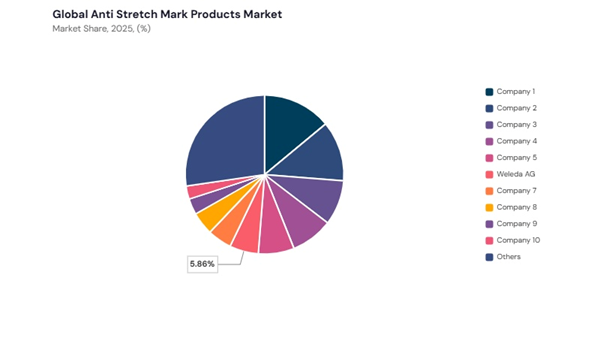
The Anti Stretch Mark Products Market exhibits a highly fragmented and consumer-wellness-driven competitive structure, with leading brands holding strong recognition alongside numerous regional skincare brands, private-label products, pharmacy-exclusive formulations, organic skincare companies, direct-to-consumer brands, and maternity care specialists. Bio-Oil leads the market, supported by strong global recognition, broad pharmacy and retail distribution, dermatologist recommendations, and established positioning in stretch mark and scar care. Palmer’s maintains a strong position through its cocoa butter-based skincare heritage, dedicated stretch mark care portfolio, and wide maternity and body care reach. Mustela and Clarins also represent major participants, supported by maternity skincare specialization, premium skincare positioning, brand trust, and international presence. Other key companies include Bayer, Weleda, Himalaya Wellness, Pierre Fabre, Mama Mio, and The Honest Company. Competition increasingly revolves around product efficacy, ingredient innovation, clinical validation, clean-label positioning, pregnancy-safe claims, digital marketing, e-commerce strength, and consumer trust.
Products Outlook
Based on Products, the market is segmented into Creams, Lotions, Massage Oil, Body Butter, and Serum. The Creams market dominated the Global Anti Stretch Mark Products Market by Products in 2025, and is expected to continue to be a dominant market till 2033; thereby, achieving a market value of $691.7 million by 2033, growing at a CAGR of 3.5 % during the forecast period. The Lotions market is expected to witness a CAGR of 5.2% during 2026-2033. Additionally, the Massage Oil market is expected to witness highest CAGR of 5.7% during 2026-2033.
Creams are widely used for both prevention and treatment-oriented routines, especially during pregnancy, postpartum recovery, and rapid body changes. Lotions appeal to consumers seeking non-greasy daily hydration and convenient application. Massage oils are valued for their natural positioning, skin nourishment, and wellness-oriented use experience. Body butters attract consumers needing richer hydration and protective skin care. Serums serve consumers seeking advanced formulations with peptides, hyaluronic acid, or other active ingredients designed to improve skin texture and elasticity. Across all product categories, demand is increasingly influenced by natural ingredients, pregnancy-safe positioning, pleasant texture, and visible results.
Distribution Channel Outlook
Based on Distribution Channel, the market is segmented into Hypermarkets and Supermarkets, Pharmacy and Drug Stores, Online, Specialty Stores, and Other Distribution Channel. The Hypermarkets & Supermarkets market dominated the Global Anti Stretch Mark Products Market by Distribution Channel in 2025, and is expected to continue to be a dominant market till 2033; thereby, achieving a market value of $565 million by 2033, growing at a CAGR of 4 % during the forecast period. The Pharmacy & Drug Stores market is expected to witness a CAGR of 4.7% during 2026-2033. Additionally, the Online market is expected to witness highest CAGR of 5.1% during 2026-2033.Hypermarkets and supermarkets support broad consumer reach and impulse purchases through visible shelf placement and promotional offers. Pharmacy and drug stores build trust among consumers seeking safe and dermatologically compatible products. Online platforms provide detailed product information, customer reviews, subscription models, and personalized marketing, making them increasingly important for younger and digitally engaged consumers. Specialty stores offer expert guidance and premium product positioning, while other channels support integrated skincare solutions through professional recommendations and treatment-linked product sales.
Regional Outlook
Region-wise, the Anti Stretch Mark Products Market is analyzed across North America, Europe, Asia Pacific, and LAMEA. The Asia Pacific market dominated the Global Anti Stretch Mark Products Market by Region in 2025, and is expected to continue to be a dominant market till 2033; thereby, achieving a market value of $789.2 million by 2033, growing at a CAGR of 5.3 % during the forecast period. The North America market is expected to witness a CAGR of 4.3% during 2026-2033. Additionally, the Europe market is expected to witness a CAGR of 4.7% during 2026-2033.
Asia Pacific benefits from expanding beauty retail infrastructure, growing influence of digital beauty trends, and increasing demand for maternity and body care products. North America is shaped by strong brand recognition, premium skincare spending, clean beauty demand, and broad e-commerce penetration. Europe is influenced by natural ingredients, safety-conscious consumers, pharmacy-led skincare, and sustainability-focused personal care trends. LAMEA continues to grow as consumers increasingly adopt personal care products through supermarkets, pharmacies, specialty stores, and online channels.
Anti Stretch Mark Products Market Coverage
Recent Strategies Deployed in the Market
- Leading brands expanded science-backed and dermatologically compatible formulations focused on improving skin elasticity, hydration, and visible stretch mark care.
- Maternity skincare specialists strengthened pregnancy-safe product positioning through gentle, hypoallergenic, and clean-label formulations designed for sensitive skin users.
- Natural and organic skincare brands expanded plant-based anti-stretch mark product lines using botanical oils, butters, extracts, and ethically sourced ingredients.
- Brands increased investment in digital platforms, influencer marketing, social media education, and direct-to-consumer channels to improve product discovery and engagement.
- Skincare companies expanded online availability through e-commerce platforms, brand-owned websites, subscription models, and personalized skincare recommendation tools.
- Private-label and specialized manufacturers introduced niche formulations targeting maternity care, postpartum recovery, sensitive skin, and clean beauty consumers.
- Companies continued investing in ingredient innovation, advanced delivery systems, product texture improvement, transparent labeling, and safety-focused formulation development.
List of Key Companies Profiled
- Bio-Oil
- Palmer’s
- Mustela
- Clarins
- Bayer
- Weleda
- Himalaya Wellness
- Pierre Fabre
- Mama Mio
- The Honest Company
Market Report Segmentation
By Products- Creams
- Lotions
- Massage Oil
- Body Butter
- Serum
- Hypermarkets and Supermarkets
- Pharmacy and Drug Stores
- Online
- Specialty Stores
- Other Distribution Channel
- North America
- US
- Canada
- Mexico
- Rest of North America
- Europe
- Germany
- UK
- France
- Russia
- Spain
- Italy
- Rest of Europe
- Asia Pacific
- China
- Japan
- India
- South Korea
- Singapore
- Malaysia
- Rest of Asia Pacific
- LAMEA
- Brazil
- Argentina
- UAE
- Saudi Arabia
- South Africa
- Nigeria
- Rest of LAMEA
Table of Contents
Chapter 1. Research Scope & Methodology
Chapter 2. Market Overview
Chapter 3. Key Factors Impacting Market
Chapter 6. Competition Analysis - Global
Chapter 7. Segmentation By Products
Chapter 8. Segmentation By Distribution Channel
Chapter 9. North America Market
Chapter 10. Europe Market
Chapter 11. Asia Pacific Market
Chapter 12. LAMEA Market
Chapter 13. Company Snapshot
Chapter 14. Winning Imperatives: Anti-Stretch Mark Products Market
Chapter 12. LAMEA Market
Chapter 13. Company Snapshot
Chapter 14. Winning Imperatives: Anti-Stretch Mark Products Market
Companies Mentioned
• Bio-Oil• Palmer’s
• Mustela
• Clarins
• Bayer
• Weleda
• Himalaya Wellness
• Pierre Fabre
• Mama Mio
• The Honest Company


