+353-1-416-8900REST OF WORLD
+44-20-3973-8888REST OF WORLD
1-917-300-0470EAST COAST U.S
1-800-526-8630U.S. (TOLL FREE)

Global Data Science Platform Market Size, Share & Industry Analysis Report by Component, Application, Vertical, Regional Outlook and Forecast, 2026-2033

  • PDF Icon

    Report

  • 652 Pages
  • May 2026
  • Marqual IT Solutions Pvt. Ltd (KBV Research)
  • ID: 6276016
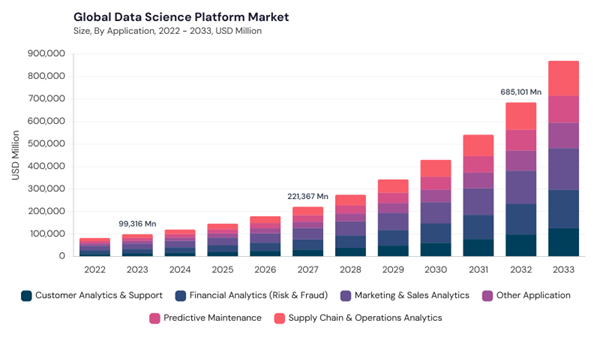
The Global Data Science Platform Market size is expected to reach USD 870.15 billion by 2033, rising at a market growth of 25.3% CAGR during the forecast period.


Growth in the market is driven by the increasing adoption of artificial intelligence (AI), machine learning (ML), and advanced analytics across enterprises seeking data-driven decision-making capabilities. Organizations are increasingly investing in scalable data science platforms to streamline data preparation, predictive modeling, visualization, and deployment processes. The growing need to manage large volumes of structured and unstructured data, coupled with rapid cloud adoption and digital transformation initiatives, is further accelerating market expansion. Moreover, advancements in automated machine learning (AutoML), real-time analytics, and collaborative data environments are enabling enterprises to improve operational efficiency, customer engagement, and business intelligence, thereby supporting strong market growth from 2026-2033.

Key Market Trends & Insights:

  • The North America Data Science Platform market dominated the Global Market in 2025, accounting for approximately 38.2% revenue share in 2025.
  • The United States Data Science Platform market generated a revenue of approximately USD 44.10 billion in 2025
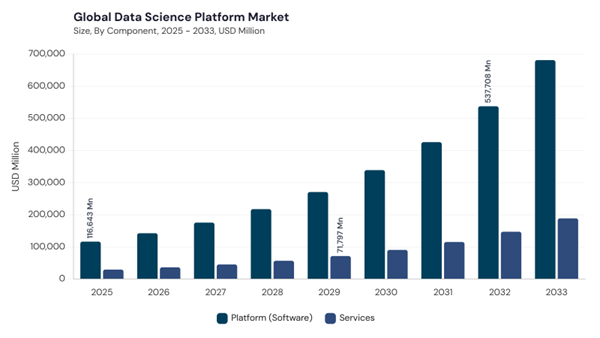
  • Among the various component segments, the Platform (Software) segment dominated the market accounting for 79.73% share in 2025.
  • The Services segment accounted for 20.27% share in 2025 owing to growing demand for consulting, deployment, integration, and managed analytics services.
  • In terms of application segmentation, the Marketing & Sales Analytics segment dominated the market in 2025 and is expected to achieve a market value of USD 185.11 billion by 2033, growing at a CAGR of 23.9% during the forecast period.
  • The Supply Chain & Operations Analytics segment is expected to witness the highest CAGR of 26.0% during the forecast period from 2026 to 2033.
  • The Asia Pacific market is expected to witness a CAGR of 26.0% during the forecast period from 2026 to 2033.
  • The North America market is expected to achieve a market value of USD 319.86 billion by 2033, growing at a CAGR of 24.7% during the forecast period.
The Global Data Science Platform Market has evolved significantly from traditional business intelligence and statistical analysis tools into advanced AI-driven ecosystems capable of managing end-to-end data workflows. Organizations across industries such as BFSI, healthcare, retail, manufacturing, telecommunications, and government are increasingly leveraging these platforms to extract actionable insights from massive volumes of data. The growing integration of cloud computing, big data technologies, natural language processing, and automated analytics has transformed how enterprises collect, process, and utilize information for competitive advantage.


The major strategies followed by market participants are Product Launches, Partnerships & Collaborations, and AI Integration as the key developmental strategies to strengthen their market positions. For instance, SAP continues focusing on real-time analytics, AI integration, and cloud-based data platforms through SAP Business Technology Platform and SAP Analytics Cloud. Similarly, Qlik is enhancing its AI-powered analytics and automated insights capabilities through Qlik AutoML and Qlik Cloud platforms. Vendors are also increasingly emphasizing cloud-native infrastructure, automation, and scalable analytics ecosystems to improve enterprise adoption and operational efficiency.

Driving and Restraining Factors

Drivers
  • Increasing Adoption of Artificial Intelligence and Machine Learning Across Enterprises
  • Rising Demand for Real-Time Data Analytics and Predictive Insights
  • Rapid Growth of Cloud Computing and Big Data Technologies
  • Growing Need for Automated and Collaborative Data Science Workflows
Restraints
  • High Costs and Resource Intensity
  • Data Privacy, Security, and Regulatory Compliance Risks
  • Shortage of Skilled Data Science Professionals
Opportunities
  • Expansion of Generative AI and Automated Machine Learning Solutions
  • Increasing Adoption Among SMEs Through Cloud-Based Platforms
  • Rising Demand for Industry-Specific Analytics Solutions
Challenges
  • Complexity in Managing Multi-Cloud and Hybrid Environments
  • Integration Challenges with Legacy IT Infrastructure
  • Ensuring Ethical AI and Explainable Analytics Practices

Market Share Analysis

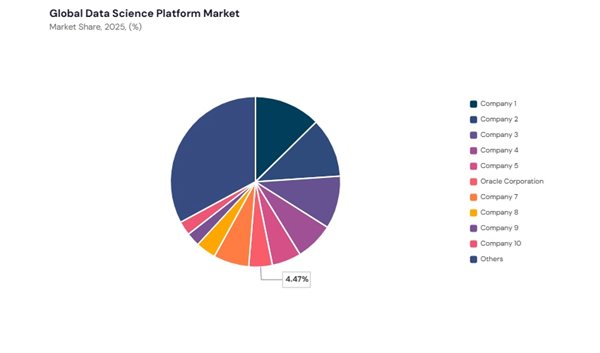
The leading players in the market are competing with diverse innovative offerings to remain competitive in the market. The leading players are increasingly investing in artificial intelligence, automation, cloud-native infrastructure, and integrated analytics ecosystems to strengthen market positioning. The key developmental strategies adopted in the market are Product Launches, Partnerships & Collaborations, Acquisitions, and AI Integration.


SAP SE maintains a strong market presence through integrated enterprise analytics, real-time data processing, and AI-powered business intelligence capabilities. IBM Corporation continues strengthening its analytics portfolio through cloud-based AI platforms and enterprise-grade governance solutions. Qlik Technologies differentiates itself through associative analytics, real-time data integration, and AI-driven self-service analytics capabilities. Oracle Corporation and SAS Institute Inc. also remain prominent market participants focusing on enterprise AI, predictive analytics, and scalable cloud-based data science environments.

Component Outlook

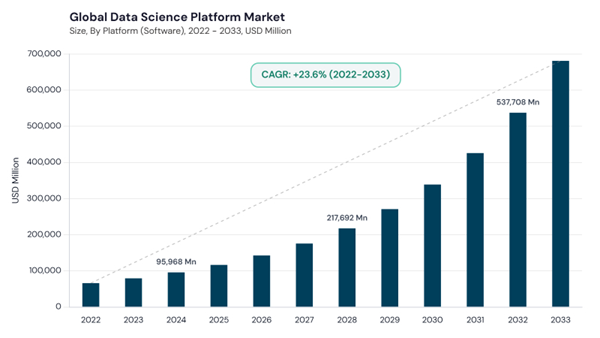
On the basis of component, the Data Science Platform Market is classified into Platform (Software) and Services. The Platform (Software) segment acquired the largest revenue share in the Data Science Platform Market in 2025 accounting for 79.73% share. The segment generated is expected to reach USD 681.23 billion by 2033. The segment is driven by increasing demand for integrated data science tools enabling data ingestion, processing, machine learning, visualization, and deployment within unified environments.

The Services segment is driven by increasing demand for consulting, implementation, deployment, integration, and managed services to ensure effective utilization of advanced analytics solutions.

Application Outlook

Based on application, the Data Science Platform Market is segmented into Marketing & Sales Analytics, Financial Analytics (Risk & Fraud), Supply Chain & Operations Analytics, Customer Analytics & Support, Predictive Maintenance, and Other Application.

The Marketing & Sales Analytics segment dominated the market in 2025 with a market value of USD 33.95 billion and is expected grow at 23.9% CAGR during the foredast period (2026 to 2033). The growth is attributed to increasing adoption of customer targeting, campaign optimization, customer behavior analytics, and personalized engagement strategies.

The Supply Chain & Operations Analytics segment is expected to witness the highest CAGR of 26.0% during 2026-2033 owing to rising demand for predictive logistics, operational intelligence, and AI-powered supply chain optimization solutions.

Vertical Outlook

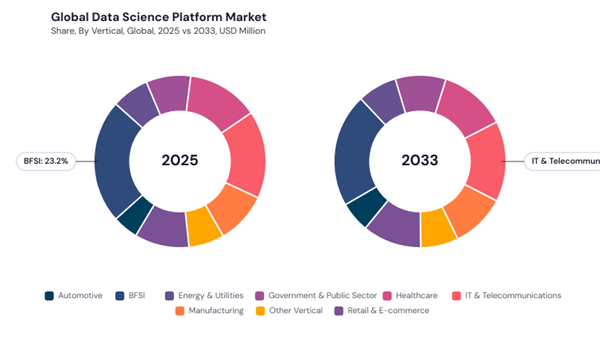
Based on vertical, the Data Science Platform Market is segmented into IT & Telecommunications, Healthcare, BFSI, Manufacturing, Retail & E-commerce, Energy & Utilities, Government & Public Sector, Automotive, and Other Vertical.

The BFSI segment dominated the market with a market value of USD 33.96 million in 2025 owing to increasing implementation of fraud detection, predictive analytics, risk management, and customer intelligence solutions. Financial institutions are increasingly leveraging AI-driven analytics to improve operational efficiency and regulatory compliance.

Regional Outlook

Region-wise, the Data Science Platform Market is analyzed across North America, Europe, Asia Pacific, and LAMEA. The North America market dominated the Global Data Science Platform Market by Region in 2025 with a market value of USD 55.88 billion and is expected to continue to be a dominant market till 2033; thereby, growing at a CAGR of 24.7% during the forecast period.


The Europe market recorded a market value of USD 41.83 billion in 2025 and is expected to reach USD 242.0 billion by 2033, growing at a CAGR of 24.9% during the forecast period.

The Asia Pacific market generated a revenue of USD 35.70 billion in 2025 and is expected to witness the fastest CAGR of 26.0% during 2026-2033 due to increasing AI adoption, rapid digital transformation, and cloud infrastructure expansion.

Market Competition and Attributes

The Data Science Platform Market is highly competitive and characterized by rapid technological innovation and AI-driven differentiation. Competition centers on the ability to deliver advanced analytics, automation, real-time processing, and scalable cloud-native architectures. Vendors differentiate themselves through predictive capabilities, machine learning integration, low-code/no-code interfaces, and governance functionalities. Partnerships with cloud providers, AI startups, and enterprise software vendors continue shaping competitive positioning globally.

The Data Science Platform Market is highly competitive and characterized by rapid innovation, technological advancements, and increasing investments in AI-powered analytics solutions. Competition primarily centers on the ability to provide scalable, secure, and integrated data science environments with advanced automation and collaboration features. Vendors differentiate themselves through machine learning capabilities, cloud-native architectures, real-time analytics, and explainable AI functionalities. Major market participants are continuously enhancing platform interoperability, automation, and governance capabilities to meet evolving enterprise requirements.
Recent Strategies Deployed in the Market

  • SAP SE strengthened its AI and analytics ecosystem through SAP Business Technology Platform and SAP Analytics Cloud integration.
  • Qlik Technologies enhanced its AI-powered analytics and automated machine learning capabilities through Qlik AutoML and Qlik Cloud.
  • IBM Corporation expanded cloud-native AI and governance capabilities to strengthen enterprise analytics adoption.
  • Oracle Corporation continued investing in integrated cloud analytics and machine learning infrastructure.
  • SAS Institute Inc. focused on explainable AI, advanced analytics, and scalable enterprise data science solutions.

List of Key Companies Profiled

  • IBM Corporation
  • SAP SE
  • Oracle Corporation
  • SAS Institute Inc.
  • Qlik Technologies Inc.
  • Microsoft Corporation
  • Google LLC
  • Amazon Web Services, Inc.
  • Databricks, Inc.
  • Alteryx, Inc.

Market Report Segmentation

By Component
  • Platform (Software)
  • Services
By Application
  • Marketing & Sales Analytics
  • Financial Analytics (Risk & Fraud)
  • Supply Chain & Operations Analytics
  • Customer Analytics & Support
  • Predictive Maintenance
  • Other Application
By Vertical
  • IT & Telecommunications
  • Healthcare
  • BFSI
  • Manufacturing
  • Retail & E-commerce
  • Energy & Utilities
  • Government & Public Sector
  • Automotive
  • Other Vertical
By Geography
  • North America
    • US
    • Canada
    • Mexico
    • Rest of North America

  • Europe
    • Germany
    • UK
    • France
    • Russia
    • Spain
    • Italy
    • Rest of Europe

  • Asia Pacific
    • China
    • Japan
    • India
    • South Korea
    • Singapore
    • Malaysia
    • Rest of Asia Pacific

  • LAMEA
    • Brazil
    • Argentina
    • UAE
    • Saudi Arabia
    • South Africa
    • Nigeria
    • Rest of LAMEA

Table of Contents

Chapter 1. Market Overview
1.1 COVID-19 Impact
1.2 Market Composition and Scenario
Chapter 2. Key Factors Impacting Market
2.1 Market Drivers
2.2 Market Restraints
2.3 Market Opportunities
2.4 Market Challenges
2.5 Market Trends
2.6 State of Competition
2.7 Market Consolidation
2.8 Key Customer Criteria
Chapter 3. Product Life CycleChapter 4. Value Chain Analysis of Data Science Platform Market
Chapter 5. Competition Analysis - Global
5.1 Market Share Analysis
5.2 Recent Developments and Strategies
5.2.1 Mergers & Acquisitions
5.2.2 Product Launch & Product Expansion
5.2.3 Partnership, Collaboration & Agreements
Chapter 6. Segmentation By Component
6.1 Platform (Software)
6.2 Services
Chapter 7. Segmentation By Application
7.1 Marketing & Sales Analytics
7.2 Financial Analytics (Risk & Fraud)
7.3 Supply Chain & Operations Analytics
7.4 Customer Analytics & Support
7.5 Predictive Maintenance
7.6 Other Application
Chapter 8. Segmentation By Vertical
8.1 IT & Telecommunications
8.2 Healthcare
8.3 BFSI
8.4 Manufacturing
8.5 Retail & E-commerce
8.6 Energy & Utilities
8.7 Government & Public Sector
8.8 Automotive
8.9 Other Vertical
Chapter 9. North America Market
9.1 Market Overview
9.2 Key Factors Impacting Market
9.2.1 Market Drivers
9.2.2 Market Restraints
9.2.3 Market Opportunities
9.2.4 Market Challenges
9.2.5 Market Trends
9.2.6 State of Competition
9.2.7 Market Consolidation
9.2.8 Key Customer Criteria
9.3 Product Life Cycle
9.4 Segmentation By Component
9.4.1 Platform (Software)
9.4.2 Services
9.5 Segmentation By Application
9.5.1 Marketing & Sales Analytics
9.5.2 Financial Analytics (Risk & Fraud)
9.5.3 Supply Chain & Operations Analytics
9.5.4 Customer Analytics & Support
9.5.5 Predictive Maintenance
9.5.6 Other Application
9.6 Segmentation By Vertical
9.6.1 IT & Telecommunications
9.6.2 Healthcare
9.6.3 BFSI
9.6.4 Manufacturing
9.6.5 Retail & E-commerce
9.6.6 Energy & Utilities
9.6.7 Government & Public Sector
9.6.8 Automotive
9.6.9 Other Vertical
9.7 Segmentation By Country
9.7.1 United States
9.7.1.1.1 Platform (Software)
9.7.1.1.2 Services
9.7.1.1.3 Marketing & Sales Analytics
9.7.1.1.4 Financial Analytics (Risk & Fraud)
9.7.1.1.5 Supply Chain & Operations Analytics
9.7.1.1.6 Customer Analytics & Support
9.7.1.1.7 Predictive Maintenance
9.7.1.1.8 Other Application
9.7.1.1.9 Segmentation By Vertical
9.7.1.1.10 BFSI
9.7.1.1.11 IT & Telecommunications
9.7.1.1.12 Healthcare
9.7.1.1.13 Retail & E-commerce
9.7.1.1.14 Manufacturing
9.7.1.1.15 Government & Public Sector
9.7.1.1.16 Energy & Utilities
9.7.1.1.17 Automotive
9.7.1.1.18 Other Vertical
9.7.2 Canada
9.7.2.1.1 Platform (Software)
9.7.2.1.2 Services
9.7.2.1.3 Marketing & Sales Analytics
9.7.2.1.4 Financial Analytics (Risk & Fraud)
9.7.2.1.5 Supply Chain & Operations Analytics
9.7.2.1.6 Customer Analytics & Support
9.7.2.1.7 Predictive Maintenance
9.7.2.1.8 Other Application
9.7.2.1.9 Segmentation By Vertical
9.7.2.1.10 BFSI
9.7.2.1.11 IT & Telecommunications
9.7.2.1.12 Healthcare
9.7.2.1.13 Retail & E-commerce
9.7.2.1.14 Manufacturing
9.7.2.1.15 Government & Public Sector
9.7.2.1.16 Energy & Utilities
9.7.2.1.17 Automotive
9.7.2.1.18 Other Vertical
9.7.3 Mexico
9.7.3.1.1 Platform (Software)
9.7.3.1.2 Services
9.7.3.1.3 Marketing & Sales Analytics
9.7.3.1.4 Financial Analytics (Risk & Fraud)
9.7.3.1.5 Supply Chain & Operations Analytics
9.7.3.1.6 Customer Analytics & Support
9.7.3.1.7 Predictive Maintenance
9.7.3.1.8 Other Application
9.7.3.1.9 Segmentation By Vertical
9.7.3.1.10 BFSI
9.7.3.1.11 IT & Telecommunications
9.7.3.1.12 Healthcare
9.7.3.1.13 Retail & E-commerce
9.7.3.1.14 Manufacturing
9.7.3.1.15 Government & Public Sector
9.7.3.1.16 Energy & Utilities
9.7.3.1.17 Automotive
9.7.3.1.18 Other Vertical
9.7.4 Rest of North America
9.7.4.1.1 Platform (Software)
9.7.4.1.2 Services
9.7.4.1.3 Marketing & Sales Analytics
9.7.4.1.4 Financial Analytics (Risk & Fraud)
9.7.4.1.5 Supply Chain & Operations Analytics
9.7.4.1.6 Customer Analytics & Support
9.7.4.1.7 Predictive Maintenance
9.7.4.1.8 Other Application
9.7.4.1.9 Segmentation By Vertical
9.7.4.1.10 BFSI
9.7.4.1.11 IT & Telecommunications
9.7.4.1.12 Healthcare
9.7.4.1.13 Retail & E-commerce
9.7.4.1.14 Manufacturing
9.7.4.1.15 Government & Public Sector
9.7.4.1.16 Energy & Utilities
9.7.4.1.17 Automotive
9.7.4.1.18 Other Vertical
Chapter 10. Europe Market
10.1 Market Overview
10.2 Key Factors Impacting Market
10.2.1 Market Drivers
10.2.2 Market Restraints
10.2.3 Market Opportunities
10.2.4 Market Challenges
10.2.5 Market Trends
10.2.6 State of Competition
10.2.7 Market Consolidation
10.2.8 Key Customer Criteria
10.3 Product Life Cycle
10.4 Segmentation By Component
10.4.1 Platform (Software)
10.4.2 Services
10.5 Segmentation By Application
10.5.1 Marketing & Sales Analytics
10.5.2 Financial Analytics (Risk & Fraud)
10.5.3 Supply Chain & Operations Analytics
10.5.4 Customer Analytics & Support
10.5.5 Predictive Maintenance
10.5.6 Other Application
10.6 Segmentation By Vertical
10.6.1 IT & Telecommunications
10.6.2 Healthcare
10.6.3 BFSI
10.6.4 Manufacturing
10.6.5 Retail & E-commerce
10.6.6 Energy & Utilities
10.6.7 Government & Public Sector
10.6.8 Automotive
10.6.9 Other Vertical
10.7 Segmentation By Country
10.7.1 Germany
10.7.1.1.1 Platform (Software)
10.7.1.1.2 Services
10.7.1.1.3 Marketing & Sales Analytics
10.7.1.1.4 Financial Analytics (Risk & Fraud)
10.7.1.1.5 Supply Chain & Operations Analytics
10.7.1.1.6 Customer Analytics & Support
10.7.1.1.7 Predictive Maintenance
10.7.1.1.8 Other Application
10.7.1.1.9 Segmentation By Vertical
10.7.1.1.10 BFSI
10.7.1.1.11 IT & Telecommunications
10.7.1.1.12 Healthcare
10.7.1.1.13 Retail & E-commerce
10.7.1.1.14 Manufacturing
10.7.1.1.15 Government & Public Sector
10.7.1.1.16 Energy & Utilities
10.7.1.1.17 Automotive
10.7.1.1.18 Other Vertical
10.7.2 United Kingdom
10.7.2.1.1 Platform (Software)
10.7.2.1.2 Services
10.7.2.1.3 Marketing & Sales Analytics
10.7.2.1.4 Financial Analytics (Risk & Fraud)
10.7.2.1.5 Supply Chain & Operations Analytics
10.7.2.1.6 Customer Analytics & Support
10.7.2.1.7 Predictive Maintenance
10.7.2.1.8 Other Application
10.7.2.1.9 Segmentation By Vertical
10.7.2.1.10 BFSI
10.7.2.1.11 IT & Telecommunications
10.7.2.1.12 Healthcare
10.7.2.1.13 Retail & E-commerce
10.7.2.1.14 Manufacturing
10.7.2.1.15 Government & Public Sector
10.7.2.1.16 Energy & Utilities
10.7.2.1.17 Automotive
10.7.2.1.18 Other Vertical
10.7.3 France
10.7.3.1.1 Platform (Software)
10.7.3.1.2 Services
10.7.3.1.3 Marketing & Sales Analytics
10.7.3.1.4 Financial Analytics (Risk & Fraud)
10.7.3.1.5 Supply Chain & Operations Analytics
10.7.3.1.6 Customer Analytics & Support
10.7.3.1.7 Predictive Maintenance
10.7.3.1.8 Other Application
10.7.3.1.9 Segmentation By Vertical
10.7.3.1.10 BFSI
10.7.3.1.11 IT & Telecommunications
10.7.3.1.12 Healthcare
10.7.3.1.13 Retail & E-commerce
10.7.3.1.14 Manufacturing
10.7.3.1.15 Government & Public Sector
10.7.3.1.16 Energy & Utilities
10.7.3.1.17 Automotive
10.7.3.1.18 Other Vertical
10.7.4 Russia
10.7.4.1.1 Platform (Software)
10.7.4.1.2 Services
10.7.4.1.3 Marketing & Sales Analytics
10.7.4.1.4 Financial Analytics (Risk & Fraud)
10.7.4.1.5 Supply Chain & Operations Analytics
10.7.4.1.6 Customer Analytics & Support
10.7.4.1.7 Predictive Maintenance
10.7.4.1.8 Other Application
10.7.4.1.9 Segmentation By Vertical
10.7.4.1.10 BFSI
10.7.4.1.11 IT & Telecommunications
10.7.4.1.12 Healthcare
10.7.4.1.13 Retail & E-commerce
10.7.4.1.14 Manufacturing
10.7.4.1.15 Government & Public Sector
10.7.4.1.16 Energy & Utilities
10.7.4.1.17 Automotive
10.7.4.1.18 Other Vertical
10.7.5 Spain
10.7.5.1.1 Platform (Software)
10.7.5.1.2 Services
10.7.5.1.3 Marketing & Sales Analytics
10.7.5.1.4 Financial Analytics (Risk & Fraud)
10.7.5.1.5 Supply Chain & Operations Analytics
10.7.5.1.6 Customer Analytics & Support
10.7.5.1.7 Predictive Maintenance
10.7.5.1.8 Other Application
10.7.5.1.9 Segmentation By Vertical
10.7.5.1.10 BFSI
10.7.5.1.11 IT & Telecommunications
10.7.5.1.12 Healthcare
10.7.5.1.13 Retail & E-commerce
10.7.5.1.14 Manufacturing
10.7.5.1.15 Government & Public Sector
10.7.5.1.16 Energy & Utilities
10.7.5.1.17 Automotive
10.7.5.1.18 Other Vertical
10.7.6 Italy
10.7.6.1.1 Platform (Software)
10.7.6.1.2 Services
10.7.6.1.3 Marketing & Sales Analytics
10.7.6.1.4 Financial Analytics (Risk & Fraud)
10.7.6.1.5 Supply Chain & Operations Analytics
10.7.6.1.6 Customer Analytics & Support
10.7.6.1.7 Predictive Maintenance
10.7.6.1.8 Other Application
10.7.6.1.9 Segmentation By Vertical
10.7.6.1.10 BFSI
10.7.6.1.11 IT & Telecommunications
10.7.6.1.12 Healthcare
10.7.6.1.13 Retail & E-commerce
10.7.6.1.14 Manufacturing
10.7.6.1.15 Government & Public Sector
10.7.6.1.16 Energy & Utilities
10.7.6.1.17 Automotive
10.7.6.1.18 Other Vertical
10.7.7 Rest of Europe
10.7.7.1.1 Platform (Software)
10.7.7.1.2 Services
10.7.7.1.3 Marketing & Sales Analytics
10.7.7.1.4 Financial Analytics (Risk & Fraud)
10.7.7.1.5 Supply Chain & Operations Analytics
10.7.7.1.6 Customer Analytics & Support
10.7.7.1.7 Predictive Maintenance
10.7.7.1.8 Other Application
10.7.7.1.9 Segmentation By Vertical
10.7.7.1.10 BFSI
10.7.7.1.11 IT & Telecommunications
10.7.7.1.12 Healthcare
10.7.7.1.13 Retail & E-commerce
10.7.7.1.14 Manufacturing
10.7.7.1.15 Government & Public Sector
10.7.7.1.16 Energy & Utilities
10.7.7.1.17 Automotive
10.7.7.1.18 Other Vertical
Chapter 11. Asia Pacific Market
11.1 Market Overview
11.2 Key Factors Impacting Market
11.2.1 Market Drivers
11.2.2 Market Restraints
11.2.3 Market Opportunities
11.2.4 Market Challenges
11.2.5 Market Trends
11.2.6 State of Competition
11.2.7 Market Consolidation
11.2.8 Key Customer Criteria
11.3 Product Life Cycle
11.4 Segmentation By Component
11.4.1 Platform (Software)
11.4.2 Services
11.5 Segmentation By Application
11.5.1 Marketing & Sales Analytics
11.5.2 Financial Analytics (Risk & Fraud)
11.5.3 Supply Chain & Operations Analytics
11.5.4 Customer Analytics & Support
11.5.5 Predictive Maintenance
11.5.6 Other Application
11.6 Segmentation By Vertical
11.6.1 IT & Telecommunications
11.6.2 Healthcare
11.6.3 BFSI
11.6.4 Manufacturing
11.6.5 Retail & E-commerce
11.6.6 Energy & Utilities
11.6.7 Government & Public Sector
11.6.8 Automotive
11.6.9 Other Vertical
11.7 Segmentation By Country
11.7.1 China
11.7.1.1.1 Platform (Software)
11.7.1.1.2 Services
11.7.1.1.3 Marketing & Sales Analytics
11.7.1.1.4 Financial Analytics (Risk & Fraud)
11.7.1.1.5 Supply Chain & Operations Analytics
11.7.1.1.6 Customer Analytics & Support
11.7.1.1.7 Predictive Maintenance
11.7.1.1.8 Other Application
11.7.1.1.9 Segmentation By Vertical
11.7.1.1.10 BFSI
11.7.1.1.11 IT & Telecommunications
11.7.1.1.12 Healthcare
11.7.1.1.13 Retail & E-commerce
11.7.1.1.14 Manufacturing
11.7.1.1.15 Government & Public Sector
11.7.1.1.16 Energy & Utilities
11.7.1.1.17 Automotive
11.7.1.1.18 Other Vertical
11.7.2 Japan
11.7.2.1.1 Platform (Software)
11.7.2.1.2 Services
11.7.2.1.3 Marketing & Sales Analytics
11.7.2.1.4 Financial Analytics (Risk & Fraud)
11.7.2.1.5 Supply Chain & Operations Analytics
11.7.2.1.6 Customer Analytics & Support
11.7.2.1.7 Predictive Maintenance
11.7.2.1.8 Other Application
11.7.2.1.9 Segmentation By Vertical
11.7.2.1.10 BFSI
11.7.2.1.11 IT & Telecommunications
11.7.2.1.12 Healthcare
11.7.2.1.13 Retail & E-commerce
11.7.2.1.14 Manufacturing
11.7.2.1.15 Government & Public Sector
11.7.2.1.16 Energy & Utilities
11.7.2.1.17 Automotive
11.7.2.1.18 Other Vertical
11.7.3 India
11.7.3.1.1 Platform (Software)
11.7.3.1.2 Services
11.7.3.1.3 Marketing & Sales Analytics
11.7.3.1.4 Financial Analytics (Risk & Fraud)
11.7.3.1.5 Supply Chain & Operations Analytics
11.7.3.1.6 Customer Analytics & Support
11.7.3.1.7 Predictive Maintenance
11.7.3.1.8 Other Application
11.7.3.1.9 Segmentation By Vertical
11.7.3.1.10 BFSI
11.7.3.1.11 IT & Telecommunications
11.7.3.1.12 Healthcare
11.7.3.1.13 Retail & E-commerce
11.7.3.1.14 Manufacturing
11.7.3.1.15 Government & Public Sector
11.7.3.1.16 Energy & Utilities
11.7.3.1.17 Automotive
11.7.3.1.18 Other Vertical
11.7.4 South Korea
11.7.4.1.1 Platform (Software)
11.7.4.1.2 Services
11.7.4.1.3 Marketing & Sales Analytics
11.7.4.1.4 Financial Analytics (Risk & Fraud)
11.7.4.1.5 Supply Chain & Operations Analytics
11.7.4.1.6 Customer Analytics & Support
11.7.4.1.7 Predictive Maintenance
11.7.4.1.8 Other Application
11.7.4.1.9 Segmentation By Vertical
11.7.4.1.10 BFSI
11.7.4.1.11 IT & Telecommunications
11.7.4.1.12 Healthcare
11.7.4.1.13 Retail & E-commerce
11.7.4.1.14 Manufacturing
11.7.4.1.15 Government & Public Sector
11.7.4.1.16 Energy & Utilities
11.7.4.1.17 Automotive
11.7.4.1.18 Other Vertical
11.7.5 Singapore
11.7.5.1.1 Platform (Software)
11.7.5.1.2 Services
11.7.5.1.3 Marketing & Sales Analytics
11.7.5.1.4 Financial Analytics (Risk & Fraud)
11.7.5.1.5 Supply Chain & Operations Analytics
11.7.5.1.6 Customer Analytics & Support
11.7.5.1.7 Predictive Maintenance
11.7.5.1.8 Other Application
11.7.5.1.9 Segmentation By Vertical
11.7.5.1.10 BFSI
11.7.5.1.11 IT & Telecommunications
11.7.5.1.12 Healthcare
11.7.5.1.13 Retail & E-commerce
11.7.5.1.14 Manufacturing
11.7.5.1.15 Government & Public Sector
11.7.5.1.16 Energy & Utilities
11.7.5.1.17 Automotive
11.7.5.1.18 Other Vertical
11.7.6 Malaysia
11.7.6.1.1 Platform (Software)
11.7.6.1.2 Services
11.7.6.1.3 Marketing & Sales Analytics
11.7.6.1.4 Financial Analytics (Risk & Fraud)
11.7.6.1.5 Supply Chain & Operations Analytics
11.7.6.1.6 Customer Analytics & Support
11.7.6.1.7 Predictive Maintenance
11.7.6.1.8 Other Application
11.7.6.1.9 Segmentation By Vertical
11.7.6.1.10 BFSI
11.7.6.1.11 IT & Telecommunications
11.7.6.1.12 Healthcare
11.7.6.1.13 Retail & E-commerce
11.7.6.1.14 Manufacturing
11.7.6.1.15 Government & Public Sector
11.7.6.1.16 Energy & Utilities
11.7.6.1.17 Automotive
11.7.6.1.18 Other Vertical
11.7.7 Rest of Asia Pacific
11.7.7.1.1 Platform (Software)
11.7.7.1.2 Services
11.7.7.1.3 Marketing & Sales Analytics
11.7.7.1.4 Financial Analytics (Risk & Fraud)
11.7.7.1.5 Supply Chain & Operations Analytics
11.7.7.1.6 Customer Analytics & Support
11.7.7.1.7 Predictive Maintenance
11.7.7.1.8 Other Application
11.7.7.1.9 Segmentation By Vertical
11.7.7.1.10 BFSI
11.7.7.1.11 IT & Telecommunications
11.7.7.1.12 Healthcare
11.7.7.1.13 Retail & E-commerce
11.7.7.1.14 Manufacturing
11.7.7.1.15 Government & Public Sector
11.7.7.1.16 Energy & Utilities
11.7.7.1.17 Automotive
11.7.7.1.18 Other Vertical
Chapter 12. LAMEA Market
12.1 Market Overview
12.2 Key Factors Impacting Market
12.2.1 Market Drivers
12.2.2 Market Restraints
12.2.3 Market Opportunities
12.2.4 Market Challenges
12.2.5 Market Trends
12.2.6 State of Competition
12.2.7 Market Consolidation
12.2.8 Key Customer Criteria
12.3 Product Life Cycle
12.4 Segmentation By Component
12.4.1 Platform (Software)
12.4.2 Services
12.5 Segmentation By Application
12.5.1 Marketing & Sales Analytics
12.5.2 Financial Analytics (Risk & Fraud)
12.5.3 Supply Chain & Operations Analytics
12.5.4 Customer Analytics & Support
12.5.5 Predictive Maintenance
12.5.6 Other Application
12.6 Segmentation By Vertical
12.6.1 IT & Telecommunications
12.6.2 Healthcare
12.6.3 BFSI
12.6.4 Manufacturing
12.6.5 Retail & E-commerce
12.6.6 Energy & Utilities
12.6.7 Government & Public Sector
12.6.8 Automotive
12.6.9 Other Vertical
12.7 Segmentation By Country
12.7.1 Brazil
12.7.1.1.1 Platform (Software)
12.7.1.1.2 Services
12.7.1.1.3 Marketing & Sales Analytics
12.7.1.1.4 Financial Analytics (Risk & Fraud)
12.7.1.1.5 Supply Chain & Operations Analytics
12.7.1.1.6 Customer Analytics & Support
12.7.1.1.7 Predictive Maintenance
12.7.1.1.8 Other Application
12.7.1.1.9 Segmentation By Vertical
12.7.1.1.10 BFSI
12.7.1.1.11 IT & Telecommunications
12.7.1.1.12 Healthcare
12.7.1.1.13 Retail & E-commerce
12.7.1.1.14 Manufacturing
12.7.1.1.15 Government & Public Sector
12.7.1.1.16 Energy & Utilities
12.7.1.1.17 Automotive
12.7.1.1.18 Other Vertical
12.7.2 Argentina
12.7.2.1.1 Platform (Software)
12.7.2.1.2 Services
12.7.2.1.3 Marketing & Sales Analytics
12.7.2.1.4 Financial Analytics (Risk & Fraud)
12.7.2.1.5 Supply Chain & Operations Analytics
12.7.2.1.6 Customer Analytics & Support
12.7.2.1.7 Predictive Maintenance
12.7.2.1.8 Other Application
12.7.2.1.9 Segmentation By Vertical
12.7.2.1.10 BFSI
12.7.2.1.11 IT & Telecommunications
12.7.2.1.12 Healthcare
12.7.2.1.13 Retail & E-commerce
12.7.2.1.14 Manufacturing
12.7.2.1.15 Government & Public Sector
12.7.2.1.16 Energy & Utilities
12.7.2.1.17 Automotive
12.7.2.1.18 Other Vertical
12.7.3 UAE
12.7.3.1.1 Platform (Software)
12.7.3.1.2 Services
12.7.3.1.3 Marketing & Sales Analytics
12.7.3.1.4 Financial Analytics (Risk & Fraud)
12.7.3.1.5 Supply Chain & Operations Analytics
12.7.3.1.6 Customer Analytics & Support
12.7.3.1.7 Predictive Maintenance
12.7.3.1.8 Other Application
12.7.3.1.9 Segmentation By Vertical
12.7.3.1.10 BFSI
12.7.3.1.11 IT & Telecommunications
12.7.3.1.12 Healthcare
12.7.3.1.13 Retail & E-commerce
12.7.3.1.14 Manufacturing
12.7.3.1.15 Government & Public Sector
12.7.3.1.16 Energy & Utilities
12.7.3.1.17 Automotive
12.7.3.1.18 Other Vertical
12.7.4 Saudi Arabia
12.7.4.1.1 Platform (Software)
12.7.4.1.2 Services
12.7.4.1.3 Marketing & Sales Analytics
12.7.4.1.4 Financial Analytics (Risk & Fraud)
12.7.4.1.5 Supply Chain & Operations Analytics
12.7.4.1.6 Customer Analytics & Support
12.7.4.1.7 Predictive Maintenance
12.7.4.1.8 Other Application
12.7.4.1.9 Segmentation By Vertical
12.7.4.1.10 BFSI
12.7.4.1.11 IT & Telecommunications
12.7.4.1.12 Healthcare
12.7.4.1.13 Retail & E-commerce
12.7.4.1.14 Manufacturing
12.7.4.1.15 Government & Public Sector
12.7.4.1.16 Energy & Utilities
12.7.4.1.17 Automotive
12.7.4.1.18 Other Vertical
12.7.5 South Africa
12.7.5.1.1 Platform (Software)
12.7.5.1.2 Services
12.7.5.1.3 Marketing & Sales Analytics
12.7.5.1.4 Financial Analytics (Risk & Fraud)
12.7.5.1.5 Supply Chain & Operations Analytics
12.7.5.1.6 Customer Analytics & Support
12.7.5.1.7 Predictive Maintenance
12.7.5.1.8 Other Application
12.7.5.1.9 Segmentation By Vertical
12.7.5.1.10 BFSI
12.7.5.1.11 IT & Telecommunications
12.7.5.1.12 Healthcare
12.7.5.1.13 Retail & E-commerce
12.7.5.1.14 Manufacturing
12.7.5.1.15 Government & Public Sector
12.7.5.1.16 Energy & Utilities
12.7.5.1.17 Automotive
12.7.5.1.18 Other Vertical
12.7.6 Nigeria
12.7.6.1.1 Platform (Software)
12.7.6.1.2 Services
12.7.6.1.3 Marketing & Sales Analytics
12.7.6.1.4 Financial Analytics (Risk & Fraud)
12.7.6.1.5 Supply Chain & Operations Analytics
12.7.6.1.6 Customer Analytics & Support
12.7.6.1.7 Predictive Maintenance
12.7.6.1.8 Other Application
12.7.6.1.9 Segmentation By Vertical
12.7.6.1.10 BFSI
12.7.6.1.11 IT & Telecommunications
12.7.6.1.12 Healthcare
12.7.6.1.13 Retail & E-commerce
12.7.6.1.14 Manufacturing
12.7.6.1.15 Government & Public Sector
12.7.6.1.16 Energy & Utilities
12.7.6.1.17 Automotive
12.7.6.1.18 Other Vertical
12.7.7 Rest of LAMEA
12.7.7.1.1 Platform (Software)
12.7.7.1.2 Services
12.7.7.1.3 Marketing & Sales Analytics
12.7.7.1.4 Financial Analytics (Risk & Fraud)
12.7.7.1.5 Supply Chain & Operations Analytics
12.7.7.1.6 Customer Analytics & Support
12.7.7.1.7 Predictive Maintenance
12.7.7.1.8 Other Application
12.7.7.1.9 Segmentation By Vertical
12.7.7.1.10 BFSI
12.7.7.1.11 IT & Telecommunications
12.7.7.1.12 Healthcare
12.7.7.1.13 Retail & E-commerce
12.7.7.1.14 Manufacturing
12.7.7.1.15 Government & Public Sector
12.7.7.1.16 Energy & Utilities
12.7.7.1.17 Automotive
12.7.7.1.18 Other Vertical
Chapter 13. Company Snapshot
13.1 Microsoft Corporation
13.1.1 Business Overview
13.1.2 Key Information
13.1.3 Company Focus
13.1.4 Strategic Insights
13.1.5 Strategy Deployed
13.1.6 Product & Service Portfolio
13.1.7 Capability Overview
13.1.8 Technology & Innovation Focus
13.1.9 Customers / End Users
13.1.10 Competitive Positioning
13.1.11 Key Differentiators
13.1.12 Portfolio Matrix
13.1.13 SWOT Analysis
13.1.14 Future Outlook
13.2 Amazon Web Services, Inc. (Amazon.com, Inc.)
13.2.1 Business Overview
13.2.2 Key Information
13.2.3 Company Focus
13.2.4 Strategic Insights
13.2.5 Strategy Deployed
13.2.6 Product & Service Portfolio
13.2.7 Capability Overview
13.2.8 Technology & Innovation Focus
13.2.9 Customers / End Users
13.2.10 Competitive Positioning
13.2.11 Key Differentiators
13.2.12 Portfolio Matrix
13.2.13 SWOT Analysis
13.2.14 Future Outlook
13.3 Google LLC (Alphabet Inc.)
13.3.1 Business Overview
13.3.2 Key Information
13.3.3 Company Focus
13.3.4 Strategic Insights
13.3.5 Strategy Deployed
13.3.6 Product & Service Portfolio
13.3.7 Capability Overview
13.3.8 Technology & Innovation Focus
13.3.9 Customers / End Users
13.3.10 Competitive Positioning
13.3.11 Key Differentiators
13.3.12 Portfolio Matrix
13.3.13 SWOT Analysis
13.3.14 Future Outlook
13.4 IBM Corporation
13.4.1 Business Overview
13.4.2 Key Information
13.4.3 Company Focus
13.4.4 Strategic Insights
13.4.5 Strategy Deployed
13.4.6 Product & Service Portfolio
13.4.7 Capability Overview
13.4.8 Technology & Innovation Focus
13.4.9 Customers / End Users
13.4.10 Competitive Positioning
13.4.11 Key Differentiators
13.4.12 Portfolio Matrix
13.4.13 SWOT Analysis
13.4.14 Future Outlook
13.5 SAS Institute Inc.
13.5.1 Business Overview
13.5.2 Key Information
13.5.3 Company Focus
13.5.4 Strategic Insights
13.5.5 Strategy Deployed
13.5.6 Product & Service Portfolio
13.5.7 Capability Overview
13.5.8 Technology & Innovation Focus
13.5.9 Customers / End Users
13.5.10 Competitive Positioning
13.5.11 Key Differentiators
13.5.12 Portfolio Matrix
13.5.13 SWOT Analysis
13.5.14 Future Outlook
13.6 Oracle Corporation
13.6.1 Business Overview
13.6.2 Key Information
13.6.3 Company Focus
13.6.4 Strategic Insights
13.6.5 Strategy Deployed
13.6.6 Product & Service Portfolio
13.6.7 Capability Overview
13.6.8 Technology & Innovation Focus
13.6.9 Customers / End Users
13.6.10 Competitive Positioning
13.6.11 Key Differentiators
13.6.12 Portfolio Matrix
13.6.13 SWOT Analysis
13.6.14 Future Outlook
13.7 Databricks, Inc.
13.7.1 Business Overview
13.7.2 Key Information
13.7.3 Company Focus
13.7.4 Strategic Insights
13.7.5 Strategy Deployed
13.7.6 Product & Service Portfolio
13.7.7 Capability Overview
13.7.8 Technology & Innovation Focus
13.7.9 Customers / End Users
13.7.10 Competitive Positioning
13.7.11 Key Differentiators
13.7.12 Portfolio Matrix
13.7.13 SWOT Analysis
13.7.14 Future Outlook
13.8 SAP SE
13.8.1 Business Overview
13.8.2 Key Information
13.8.3 Company Focus
13.8.4 Strategic Insights
13.8.5 Strategy Deployed
13.8.6 Product & Service Portfolio
13.8.7 Capability Overview
13.8.8 Technology & Innovation Focus
13.8.9 Customers / End Users
13.8.10 Competitive Positioning
13.8.11 Key Differentiators
13.8.12 Portfolio Matrix
13.8.13 SWOT Analysis
13.8.14 Future Outlook
13.9 Cloudera, Inc.
13.9.1 Business Overview
13.9.2 Key Information
13.9.3 Company Focus
13.9.4 Strategic Insights
13.9.5 Strategy Deployed
13.9.6 Product & Service Portfolio
13.9.7 Capability Overview
13.9.8 Technology & Innovation Focus
13.9.9 Customers / End Users
13.9.10 Competitive Positioning
13.9.11 Key Differentiators
13.9.12 Portfolio Matrix
13.9.13 SWOT Analysis
13.9.14 Future Outlook
13.10 QlikTech International A.B.
13.10.1 Business Overview
13.10.2 Key Information
13.10.3 Company Focus
13.10.4 Strategic Insights
13.10.5 Strategy Deployed
13.10.6 Product & Service Portfolio
13.10.7 Capability Overview
13.10.8 Technology & Innovation Focus
13.10.9 Customers / End Users
13.10.10 Competitive Positioning
13.10.11 Key Differentiators
13.10.12 Portfolio Matrix
13.10.13 SWOT Analysis
13.10.14 Future Outlook
Chapter 14. Winning Imperatives of Data Science Platform Market

Companies Mentioned

  • IBM Corporation
  • SAP SE
  • Oracle Corporation
  • SAS Institute Inc.
  • Qlik Technologies Inc.
  • Microsoft Corporation
  • Google LLC
  • Amazon Web Services, Inc.
  • Databricks, Inc.
  • Alteryx, Inc.