

+353-1-416-8900REST OF WORLD
+44-20-3973-8888REST OF WORLD
1-917-300-0470EAST COAST U.S
1-800-526-8630U.S. (TOLL FREE)

Global Artificial General Intelligence Market Size, Share & Industry Analysis Report by Type, Deployment, End User, Regional Outlook and Forecast, 2026-2033

  • PDF Icon

    Report

  • 602 Pages
  • June 2026
  • Marqual IT Solutions Pvt. Ltd (KBV Research)
  • ID: 6276024
The Global Artificial General Intelligence Market is expected to reach USD 1.78 billion by 2033, growing at a CAGR of 30.2% during 2026-2033.


The Global Artificial General Intelligence Market is witnessing strong growth, driven by rapid advances in generative AI, foundation models, autonomous agents, multimodal systems, and enterprise demand for intelligent automation. The market originated from foundational artificial intelligence research focused on creating systems capable of human-like reasoning, learning, adaptation, and problem-solving across diverse tasks. Over time, progress in machine learning, deep learning, natural language understanding, reinforcement learning, and scalable computing infrastructure shifted AGI development from theoretical research toward applied experimentation and early commercial exploration. Presently, the market is shaped by foundation model-based systems, autonomous agent frameworks, multimodal intelligence, hybrid cognitive architectures, cloud-based deployment, AI safety, regulatory governance, and growing enterprise interest in adaptive, general-purpose intelligent systems.

Key Market Trends & Insights

  • The Artificial General Intelligence Market reached USD 225.5 Million in 2025 and is expected to reach USD 1.78 billion by 2033, growing at a CAGR of 30.2% during 2026-2033.
  • The Artificial General Intelligence Market grew from USD 124.1 Million in 2022 to USD 225.5 Million in 2025, registering a historical CAGR of 22.0% during 2022-2025.
  • By type, Foundation Model-Based AGI dominated the market in 2025 with USD 87.9 Million and is projected to remain dominant through 2033, reaching USD 661.3 Million.
  • Multi-Modal AGI Systems are expected to be the fastest-growing type segment, recording a CAGR of 30.8% during 2026-2033, followed by Autonomous Agent-Based AGI at 30.7%.
  • By deployment, Cloud dominated the market in 2025 with USD 166.4 Million and is expected to reach USD 1.29 billion by 2033.
  • On-Premises deployment is expected to grow faster, registering a CAGR of 30.9% during 2026-2033, compared to 29.9% for Cloud.
  • By end user, IT & Telecommunications led the market in 2025 with USD 58.3 Million and is projected to reach USD 400.8 Million by 2033.
  • Other End User is expected to be the fastest-growing end-user segment, recording a CAGR of 34.1% during 2026-2033, followed by Government at 31.9%.
  • Regionally, North America dominated the market in 2025 with USD 88.4 Million and is projected to maintain its lead through 2033, reaching USD 665.2 Million.
  • LAMEA is expected to be the fastest-growing region, registering a CAGR of 33.2% during 2026-2033, followed by Asia Pacific at 30.9%.

The Artificial General Intelligence Market is expanding as organizations increasingly recognize the potential of advanced AI systems to support decision-making, automation, problem-solving, research acceleration, and intelligent workflow management. Demand is being driven by generative AI progress, enterprise digital transformation, growing need for autonomous reasoning systems, and rising interest in adaptable AI models that can work across multiple domains. The market is also benefiting from increasing investment in foundation models, AI agents, multimodal systems, advanced computing infrastructure, and AI governance frameworks. At the same time, safety, security, ethics, explainability, regulatory clarity, and trust remain central factors influencing adoption and commercialization.

The Artificial General Intelligence Market is characterized by a highly concentrated and innovation-driven competitive environment consisting of frontier AI research laboratories, hyperscale technology companies, advanced foundation model developers, cloud infrastructure providers, AI safety-focused firms, and emerging model developers. Competition is centered on cognitive capability, reasoning performance, multimodal intelligence, autonomous task execution, model safety, compute access, research talent, ecosystem strength, enterprise integration, and responsible deployment. Leading companies compete through advanced model development, strategic cloud partnerships, proprietary research, developer ecosystems, enterprise AI services, and scalable infrastructure, while emerging players compete through open models, specialized architectures, efficient training approaches, and safety-focused development.

Driving and Restraining Factors

Drivers
  • Rapid Advancement and Integration of Generative AI Technologies
  • Strategic Necessity of AI Adoption for Competitive Differentiation
  • Enhanced Decision-Making Efficiency in Complex Multinational Environments
  • Addressing Industry Complexity through AI-Driven Risk Management and Compliance
Restraints
  • High Complexity and Technical Limitations in Developing AGI Systems
  • Regulatory Uncertainty and Ethical Concerns Impacting AGI Development and Deployment
  • Substantial Capital Requirements and Investment Risks Restricting Market Expansion
Opportunities
  • Regulatory Framework Development for Artificial General Intelligence
  • Integration of Generative AGI Systems Across Diverse Industry Verticals
  • Investment and Collaboration in AGI Ecosystems for Accelerated Innovation
Challenges
  • Security Vulnerabilities and Robustness Limitations
  • Data Privacy and Ethical Compliance Constraints
  • Talent Scarcity and Expertise Fragmentation

Market Share Analysis
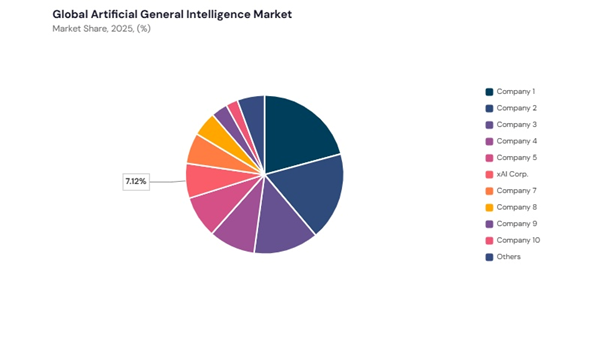


The Artificial General Intelligence Market exhibits a highly concentrated and innovation-driven competitive structure, with frontier AI developers and hyperscale technology companies holding strong positions. OpenAI leads the market, supported by pioneering work in large language models, multimodal AI, reinforcement learning, enterprise AI offerings, developer ecosystems, and broad commercial adoption. Google DeepMind remains a close competitor through advanced AI research, reinforcement learning expertise, scientific discovery systems, multimodal reasoning capabilities, and strong integration with Google’s infrastructure and cloud ecosystem. Anthropic, Microsoft, and Meta also represent major participants, supported by AI safety research, enterprise deployment capabilities, foundation model development, cloud infrastructure, and open-source AI initiatives. Other key companies include xAI, NVIDIA, DeepSeek, Mistral AI, and Safe Superintelligence. Competition increasingly revolves around reasoning breakthroughs, autonomy, multimodal intelligence, AI safety, computational efficiency, enterprise integration, model reliability, and the ability to move from advanced generative AI toward more general-purpose intelligent systems.

Type Outlook


Based on Type, the market is segmented into Foundation Model-Based AGI, Autonomous Agent-Based AGI, Multi-Modal AGI Systems, and Hybrid Cognitive AGI. The Foundation Model-Based AGI market dominated the Global Artificial General Intelligence Market by Type in 2025, and is expected to continue to be a dominant market till 2033; thereby, achieving a market value of USD 661.3 Million by 2033, growing at a CAGR of 29.4 % during the forecast period. The Autonomous Agent-Based AGI market is expected to witness a CAGR of 30.7% during 2026-2033. Additionally, the Multi-Modal AGI Systems market is expected to witness highest CAGR of 30.8% during 2026-2033.

Foundation model-based systems are widely used as adaptable base layers for enterprise automation, research support, customer engagement, knowledge management, and software development workflows. Autonomous agents support workflow automation, robotic control, virtual assistance, and operational optimization. Multimodal systems enhance situational awareness by combining different forms of information into unified reasoning outputs. Hybrid cognitive AGI supports applications requiring auditability, structured reasoning, legal analysis, scientific discovery, and knowledge-based problem-solving. Together, these type segments reflect multiple technological pathways toward more flexible and general-purpose intelligence.

Deployment Outlook

Based on Deployment, the market is segmented into Cloud and On-Premises. The Cloud market dominated the Global Artificial General Intelligence Market by Deployment in 2025, and is expected to continue to be a dominant market till 2033; thereby, achieving a market value of USD 1.29 billion by 2033, growing at a CAGR of 29.9 % during the forecast period. The On-Premises market is expected to witness a CAGR of 30.9% during 2026-2033.

Cloud deployment supports rapid experimentation, flexible usage, model access, enterprise integration, and managed AI services across industries. It is especially attractive for organizations seeking scalable AI infrastructure and faster innovation cycles. On-premises deployment is preferred by defense, healthcare, government, financial institutions, and other security-sensitive users where data sovereignty and compliance requirements are critical. Hybrid approaches are also gaining relevance as organizations balance cloud scalability with on-premises control for sensitive workloads.

End User Outlook

Based on End User, the market is segmented into IT and Telecommunications, BFSI, Healthcare, Manufacturing, Government, Aerospace and Defense, and Other End User. The IT & Telecommunications market dominated the Global Artificial General Intelligence Market by End User in 2025, and is expected to continue to be a dominant market till 2033; thereby, achieving a market value of USD 400.8 Million by 2033, growing at a CAGR of 27.9 % during the forecast period. The BFSI market is expected to witness a CAGR of 29% during 2026-2033. Additionally, the Healthcare market is expected to witness highest CAGR of 31% during 2026-2033.

IT and telecommunications users require adaptive systems that can manage complex digital infrastructure and large-scale data environments. BFSI users prioritize transparency, governance, security, and risk control. Healthcare users require accuracy, safety, compliance, and integration with clinical workflows. Manufacturing users need reliable automation and real-time operational intelligence. Government and defense users prioritize security, explainability, control, and mission-critical reliability. Other end users, including education, retail, energy, and transportation, are exploring AGI for personalized services, logistics optimization, smart infrastructure, and strategic decision-making.

Regional Outlook


Region-wise, the Artificial General Intelligence Market is analyzed across North America, Europe, Asia Pacific, and LAMEA. The North America market dominated the Global Artificial General Intelligence Market by Region in 2025, and is expected to continue to be a dominant market till 2033; thereby, achieving a market value of USD 665.2 Million by 2033, growing at a CAGR of 29.4 % during the forecast period.The Asia Pacific market is expected to witness a CAGR of 30.9% during 2026-2033. Additionally, the Europe market is expected to witness a CAGR of 29.7% during 2026-2033.

North America benefits from strong frontier model developers, hyperscale cloud providers, venture investment, and enterprise AI adoption. Asia Pacific is supported by digital infrastructure expansion, AI talent development, cloud adoption, and government-led technology initiatives. Europe is shaped by regulatory leadership, AI safety focus, research partnerships, and industry digitalization. LAMEA continues to expand as public and private organizations increasingly explore intelligent automation, digital transformation, and cloud-based AI services.

Artificial General Intelligence Market Coverage

Recent Strategies Deployed in the Market

  • OpenAI strengthened its frontier AI position through advanced model development, multimodal capabilities, enterprise AI offerings, developer ecosystem expansion, and strategic infrastructure partnerships.
  • Google DeepMind advanced AGI-related research through reinforcement learning, multimodal reasoning, scientific discovery systems, foundation model innovation, and integration with cloud-scale infrastructure.
  • Anthropic expanded its AI safety-focused model ecosystem through responsible AI development, enterprise-oriented large language models, and governance-centered deployment approaches.
  • Microsoft strengthened its AGI ecosystem through strategic AI investments, cloud-based AI deployment, enterprise integration, and large-scale infrastructure support.
  • Meta expanded its AI influence through open model development, large-scale AI research, developer engagement, and continued investment in advanced machine learning systems.
  • NVIDIA strengthened its role in the AGI ecosystem through AI computing infrastructure, GPU acceleration, model training platforms, and support for large-scale AI workloads.
  • Emerging AI developers expanded competitive intensity through efficient model architectures, open-weight approaches, specialized safety research, and frontier model experimentation.
  • AGI market participants continued investing in cognitive architectures, AI agents, multimodal systems, ethical governance, compute infrastructure, and human-centric AI design.

List of Key Companies Profiled

  • OpenAI
  • Google DeepMind
  • Anthropic
  • Microsoft
  • Meta
  • xAI
  • NVIDIA
  • DeepSeek
  • Mistral AI
  • Safe Superintelligence

Market Report Segmentation

By Type
  • Foundation Model-Based AGI
  • Autonomous Agent-Based AGI
  • Multi-Modal AGI Systems
  • Hybrid Cognitive AGI
By Deployment
  • Cloud
  • On-Premises
By End User
  • IT and Telecommunications
  • BFSI
  • Healthcare
  • Manufacturing
  • Government
  • Aerospace and Defense
  • Other End User
By Geography
  • North America
    • US
    • Canada
    • Mexico
    • Rest of North America

  • Europe
    • Germany
    • UK
    • France
    • Russia
    • Spain
    • Italy
    • Rest of Europe

  • Asia Pacific
    • China
    • Japan
    • India
    • South Korea
    • Austraia
    • Malaysia
    • Rest of Asia Pacific

  • LAMEA
    • Brazil
    • Argentina
    • UAE
    • Saudi Arabia
    • South Africa
    • Nigeria
    • Rest of LAMEA

Table of Contents

Chapter 1. Research Scope & Methodology
1.1 Market Definition
1.2 Analysis Period & Currency
1.3 Segmentation
1.4 Artificial General Intelligence Market, by Geography
1.5 Research Methodology
Chapter 2. Market Overview
2.1 COVID-19 Impact
2.2 Market Composition and Scenario
Chapter 3. Key Factors Impacting Market
3.1 Market Drivers
3.2 Market Restraints
3.3 Market Opportunities
3.4 Market Challenges
3.5 Market Trends
3.6 State of Competition
3.7 Market Consolidation
3.8 Key Customer Criteria
Chapter 4. Product Life CycleChapter 5. Value Chain Analysis of Artificial General Intelligence (AGI) MarketChapter 6. Market Share Analysis
Chapter 7. Segmentation By Type
7.1 Foundation Model-Based AGI
7.2 Autonomous Agent-Based AGI
7.3 Multi-Modal AGI Systems
7.4 Hybrid Cognitive AGI
Chapter 8. Segmentation By Deployment
8.1 Cloud
8.2 On-Premises
Chapter 9. Segmentation By End User
9.1 IT & Telecommunications
9.2 BFSI
9.3 Healthcare
9.4 Manufacturing
9.5 Government
9.6 Aerospace & Defense
9.7 Other End User
Chapter 10. North America Market
10.1 Market Overview
10.2 Key Factors Impacting Market
10.2.1 Market Drivers
10.2.2 Market Restraints
10.2.3 Market Opportunities
10.2.4 Market Challenges
10.2.5 Market Trends
10.2.6 State of Competition
10.2.7 Market Consolidation
10.2.8 Key Customer Criteria
10.3 Product Life Cycle
10.4 Segmentation By Type
10.4.1 Foundation Model-Based AGI
10.4.2 Autonomous Agent-Based AGI
10.4.3 Multi-Modal AGI Systems
10.4.4 Hybrid Cognitive AGI
10.5 Segmentation By Deployment
10.5.1 Cloud Deployment
10.5.2 On-Premises Deployment
10.6 Segmentation By End User
10.6.1 IT & Telecommunications
10.6.2 BFSI
10.6.3 Healthcare
10.6.4 Manufacturing
10.6.5 Government
10.6.6 Aerospace & Defense
10.6.7 Other End User
10.7 Segmentation By Country
10.7.1 US
10.7.1.1 Segmentation By Type
10.7.1.1.1 Foundation Model-Based AGI
10.7.1.1.2 Autonomous Agent-Based AGI
10.7.1.1.3 Multi-Modal AGI Systems
10.7.1.1.4 Hybrid Cognitive AGI
10.7.1.2 Segmentation By Deployment
10.7.1.2.1 Cloud
10.7.1.2.2 On-Premises
10.7.1.3 Segmentation By End User
10.7.1.3.1 IT & Telecommunications
10.7.1.3.2 BFSI
10.7.1.3.3 Healthcare
10.7.1.3.4 Manufacturing
10.7.1.3.5 Government
10.7.1.3.6 Aerospace & Defense
10.7.1.3.7 Other End User
10.7.2 Canada
10.7.2.1 Segmentation By Type
10.7.2.1.1 Foundation Model-Based AGI
10.7.2.1.2 Autonomous Agent-Based AGI
10.7.2.1.3 Multi-Modal AGI Systems
10.7.2.1.4 Hybrid Cognitive AGI
10.7.2.2 Segmentation By Deployment
10.7.2.2.1 Cloud
10.7.2.2.2 On-Premises
10.7.2.3 Segmentation By End User
10.7.2.3.1 IT & Telecommunications
10.7.2.3.2 BFSI
10.7.2.3.3 Healthcare
10.7.2.3.4 Manufacturing
10.7.2.3.5 Government
10.7.2.3.6 Aerospace & Defense
10.7.2.3.7 Other End User
10.7.3 Mexico
10.7.3.1 Segmentation By Type
10.7.3.1.1 Foundation Model-Based AGI
10.7.3.1.2 Autonomous Agent-Based AGI
10.7.3.1.3 Multi-Modal AGI Systems
10.7.3.1.4 Hybrid Cognitive AGI
10.7.3.2 Segmentation By Deployment
10.7.3.2.1 Cloud
10.7.3.2.2 On-Premises
10.7.3.3 Segmentation By End User
10.7.3.3.1 IT & Telecommunications
10.7.3.3.2 BFSI
10.7.3.3.3 Healthcare
10.7.3.3.4 Manufacturing
10.7.3.3.5 Government
10.7.3.3.6 Aerospace & Defense
10.7.3.3.7 Other End User
10.7.4 Rest of North America
10.7.4.1 Segmentation By Type
10.7.4.1.1 Foundation Model-Based AGI
10.7.4.1.2 Autonomous Agent-Based AGI
10.7.4.1.3 Multi-Modal AGI Systems
10.7.4.1.4 Hybrid Cognitive AGI
10.7.4.2 Segmentation By Deployment
10.7.4.2.1 Cloud
10.7.4.2.2 On-Premises
10.7.4.3 Segmentation By End User
10.7.4.3.1 IT & Telecommunications
10.7.4.3.2 BFSI
10.7.4.3.3 Healthcare
10.7.4.3.4 Manufacturing
10.7.4.3.5 Government
10.7.4.3.6 Aerospace & Defense
10.7.4.3.7 Other End User
Chapter 11. Europe Market
11.1 Market Overview
11.2 Key Factors Impacting Market
11.2.1 Market Drivers
11.2.2 Market Restraints
11.2.3 Market Opportunities
11.2.4 Market Challenges
11.2.5 Market Trends
11.2.6 State of Competition
11.2.7 Market Consolidation
11.2.8 Key Customer Criteria
11.3 Product Life Cycle
11.4 Segmentation By Type
11.4.1 Foundation Model-Based AGI
11.4.2 Autonomous Agent-Based AGI
11.4.3 Multi-Modal AGI Systems
11.4.4 Hybrid Cognitive AGI
11.5 Segmentation By Deployment
11.5.1 Cloud
11.5.2 On-Premises
11.6 Segmentation By End User
11.6.1 IT & Telecommunications
11.6.2 BFSI
11.6.3 Healthcare
11.6.4 Manufacturing
11.6.5 Government
11.6.6 Aerospace & Defense
11.6.7 Other End User
11.7 Segmentation By Country
11.7.1 Germany
11.7.1.1 Segmentation By Type
11.7.1.1.1 Foundation Model-Based AGI
11.7.1.1.2 Autonomous Agent-Based AGI
11.7.1.1.3 Multi-Modal AGI Systems
11.7.1.1.4 Hybrid Cognitive AGI
11.7.1.2 Segmentation By Deployment
11.7.1.2.1 Cloud
11.7.1.2.2 On-Premises
11.7.1.3 Segmentation By End User
11.7.1.3.1 IT & Telecommunications
11.7.1.3.2 BFSI
11.7.1.3.3 Healthcare
11.7.1.3.4 Manufacturing
11.7.1.3.5 Government
11.7.1.3.6 Aerospace & Defense
11.7.1.3.7 Other End User
11.7.2 UK
11.7.2.1 Segmentation By Type
11.7.2.1.1 Foundation Model-Based AGI
11.7.2.1.2 Autonomous Agent-Based AGI
11.7.2.1.3 Multi-Modal AGI Systems
11.7.2.1.4 Hybrid Cognitive AGI
11.7.2.2 Segmentation By Deployment
11.7.2.2.1 Cloud
11.7.2.2.2 On-Premises
11.7.2.3 Segmentation By End User
11.7.2.3.1 IT & Telecommunications
11.7.2.3.2 BFSI
11.7.2.3.3 Healthcare
11.7.2.3.4 Manufacturing
11.7.2.3.5 Government
11.7.2.3.6 Aerospace & Defense
11.7.2.3.7 Other End User
11.7.3 France
11.7.3.1 Segmentation By Type
11.7.3.1.1 Foundation Model-Based AGI
11.7.3.1.2 Autonomous Agent-Based AGI
11.7.3.1.3 Multi-Modal AGI Systems
11.7.3.1.4 Hybrid Cognitive AGI
11.7.3.2 Segmentation By Deployment
11.7.3.2.1 Cloud
11.7.3.2.2 On-Premises
11.7.3.3 Segmentation By End User
11.7.3.3.1 IT & Telecommunications
11.7.3.3.2 BFSI
11.7.3.3.3 Healthcare
11.7.3.3.4 Manufacturing
11.7.3.3.5 Government
11.7.3.3.6 Aerospace & Defense
11.7.3.3.7 Other End User
11.7.4 Russia
11.7.4.1 Segmentation By Type
11.7.4.1.1 Foundation Model-Based AGI
11.7.4.1.2 Autonomous Agent-Based AGI
11.7.4.1.3 Multi-Modal AGI Systems
11.7.4.1.4 Hybrid Cognitive AGI
11.7.4.2 Segmentation By Deployment
11.7.4.2.1 Cloud
11.7.4.2.2 On-Premises
11.7.4.3 Segmentation By End User
11.7.4.3.1 IT & Telecommunications
11.7.4.3.2 BFSI
11.7.4.3.3 Healthcare
11.7.4.3.4 Manufacturing
11.7.4.3.5 Government
11.7.4.3.6 Aerospace & Defense
11.7.4.3.7 Other End User
11.7.5 Spain
11.7.5.1 Segmentation By Type
11.7.5.1.1 Foundation Model-Based AGI
11.7.5.1.2 Autonomous Agent-Based AGI
11.7.5.1.3 Multi-Modal AGI Systems
11.7.5.1.4 Hybrid Cognitive AGI
11.7.5.2 Segmentation By Deployment
11.7.5.2.1 Cloud
11.7.5.2.2 On-Premises
11.7.5.3 Segmentation By End User
11.7.5.3.1 IT & Telecommunications
11.7.5.3.2 BFSI
11.7.5.3.3 Healthcare
11.7.5.3.4 Manufacturing
11.7.5.3.5 Government
11.7.5.3.6 Aerospace & Defense
11.7.5.3.7 Other End User
11.7.6 Italy
11.7.6.1 Segmentation By Type
11.7.6.1.1 Foundation Model-Based AGI
11.7.6.1.2 Autonomous Agent-Based AGI
11.7.6.1.3 Multi-Modal AGI Systems
11.7.6.1.4 Hybrid Cognitive AGI
11.7.6.2 Segmentation By Deployment
11.7.6.2.1 Cloud
11.7.6.2.2 On-Premises
11.7.6.3 Segmentation By End User
11.7.6.3.1 IT & Telecommunications
11.7.6.3.2 BFSI
11.7.6.3.3 Healthcare
11.7.6.3.4 Manufacturing
11.7.6.3.5 Government
11.7.6.3.6 Aerospace & Defense
11.7.6.3.7 Other End User
11.7.7 Rest of Europe
11.7.7.1 Segmentation By Type
11.7.7.1.1 Foundation Model-Based AGI
11.7.7.1.2 Autonomous Agent-Based AGI
11.7.7.1.3 Multi-Modal AGI Systems
11.7.7.1.4 Hybrid Cognitive AGI
11.7.7.2 Segmentation By Deployment
11.7.7.2.1 Cloud
11.7.7.2.2 On-Premises
11.7.7.3 Segmentation By End User
11.7.7.3.1 IT & Telecommunications
11.7.7.3.2 BFSI
11.7.7.3.3 Healthcare
11.7.7.3.4 Manufacturing
11.7.7.3.5 Government
11.7.7.3.6 Aerospace & Defense
11.7.7.3.7 Other End User
Chapter 12. Asia Pacific Market
12.1 Market Overview
12.2 Key Factors Impacting Market
12.2.1 Market Drivers
12.2.2 Market Restraints
12.2.3 Market Opportunities
12.2.4 Market Challenges
12.2.5 Market Trends
12.2.6 State of Competition
12.2.7 Market Consolidation
12.2.8 Key Customer Criteria
12.3 Product Life Cycle
12.4 Segmentation By Type
12.4.1 Foundation Model-Based AGI
12.4.2 Autonomous Agent-Based AGI
12.4.3 Multi-Modal AGI Systems
12.4.4 Hybrid Cognitive AGI
12.5 Segmentation By Deployment
12.5.1 Cloud
12.5.2 On-Premises
12.6 Segmentation By End User
12.6.1 IT & Telecommunications
12.6.2 BFSI
12.6.3 Healthcare
12.6.4 Manufacturing
12.6.5 Government
12.6.6 Aerospace & Defense
12.6.7 Other End User
12.7 Segmentation By Country
12.7.1 China
12.7.1.1 Segmentation By Type
12.7.1.1.1 Foundation Model-Based AGI
12.7.1.1.2 Autonomous Agent-Based AGI
12.7.1.1.3 Multi-Modal AGI Systems
12.7.1.1.4 Hybrid Cognitive AGI
12.7.1.2 Segmentation By Deployment
12.7.1.2.1 Cloud
12.7.1.2.2 On-Premises
12.7.1.3 Segmentation By End User
12.7.1.3.1 IT & Telecommunications
12.7.1.3.2 BFSI
12.7.1.3.3 Healthcare
12.7.1.3.4 Manufacturing
12.7.1.3.5 Government
12.7.1.3.6 Aerospace & Defense
12.7.1.3.7 Other End User
12.7.2 Japan
12.7.2.1 Segmentation By Type
12.7.2.1.1 Foundation Model-Based AGI
12.7.2.1.2 Autonomous Agent-Based AGI
12.7.2.1.3 Multi-Modal AGI Systems
12.7.2.1.4 Hybrid Cognitive AGI
12.7.2.2 Segmentation By Deployment
12.7.2.2.1 Cloud
12.7.2.2.2 On-Premises
12.7.2.3 Segmentation By End User
12.7.2.3.1 IT & Telecommunications
12.7.2.3.2 BFSI
12.7.2.3.3 Healthcare
12.7.2.3.4 Manufacturing
12.7.2.3.5 Government
12.7.2.3.6 Aerospace & Defense
12.7.2.3.7 Other End User
12.7.3 India
12.7.3.1 Segmentation By Type
12.7.3.1.1 Foundation Model-Based AGI
12.7.3.1.2 Autonomous Agent-Based AGI
12.7.3.1.3 Multi-Modal AGI Systems
12.7.3.1.4 Hybrid Cognitive AGI
12.7.3.2 Segmentation By Deployment
12.7.3.2.1 Cloud
12.7.3.2.2 On-Premises
12.7.3.3 Segmentation By End User
12.7.3.3.1 IT & Telecommunications
12.7.3.3.2 BFSI
12.7.3.3.3 Healthcare
12.7.3.3.4 Manufacturing
12.7.3.3.5 Government
12.7.3.3.6 Aerospace & Defense
12.7.3.3.7 Other End User
12.7.4 South Korea
12.7.4.1 Segmentation By Type
12.7.4.1.1 Foundation Model-Based AGI
12.7.4.1.2 Autonomous Agent-Based AGI
12.7.4.1.3 Multi-Modal AGI Systems
12.7.4.1.4 Hybrid Cognitive AGI
12.7.4.2 Segmentation By Deployment
12.7.4.2.1 Cloud
12.7.4.2.2 On-Premises
12.7.4.3 Segmentation By End User
12.7.4.3.1 IT & Telecommunications
12.7.4.3.2 BFSI
12.7.4.3.3 Healthcare
12.7.4.3.4 Manufacturing
12.7.4.3.5 Government
12.7.4.3.6 Aerospace & Defense
12.7.4.3.7 Other End User
12.7.5 Australia
12.7.5.1 Segmentation By Type
12.7.5.1.1 Foundation Model-Based AGI
12.7.5.1.2 Autonomous Agent-Based AGI
12.7.5.1.3 Multi-Modal AGI Systems
12.7.5.1.4 Hybrid Cognitive AGI
12.7.5.2 Segmentation By Deployment
12.7.5.2.1 Cloud
12.7.5.2.2 On-Premises
12.7.5.3 Segmentation By End User
12.7.5.3.1 IT & Telecommunications
12.7.5.3.2 BFSI
12.7.5.3.3 Healthcare
12.7.5.3.4 Manufacturing
12.7.5.3.5 Government
12.7.5.3.6 Aerospace & Defense
12.7.5.3.7 Other End User
12.7.6 Malaysia
12.7.6.1 Segmentation By Type
12.7.6.1.1 Foundation Model-Based AGI
12.7.6.1.2 Autonomous Agent-Based AGI
12.7.6.1.3 Multi-Modal AGI Systems
12.7.6.1.4 Hybrid Cognitive AGI
12.7.6.2 Segmentation By Deployment
12.7.6.2.1 Cloud
12.7.6.2.2 On-Premises
12.7.6.3 Segmentation By End User
12.7.6.3.1 IT & Telecommunications
12.7.6.3.2 BFSI
12.7.6.3.3 Healthcare
12.7.6.3.4 Manufacturing
12.7.6.3.5 Government
12.7.6.3.6 Aerospace & Defense
12.7.6.3.7 Other End User
12.7.7 Rest of Asia Pacific
12.7.7.1 Segmentation By Type
12.7.7.1.1 Foundation Model-Based AGI
12.7.7.1.2 Autonomous Agent-Based AGI
12.7.7.1.3 Multi-Modal AGI Systems
12.7.7.1.4 Hybrid Cognitive AGI
12.7.7.2 Segmentation By Deployment
12.7.7.2.1 Cloud
12.7.7.2.2 On-Premises
12.7.7.3 Segmentation By End User
12.7.7.3.1 IT & Telecommunications
12.7.7.3.2 BFSI
12.7.7.3.3 Healthcare
12.7.7.3.4 Manufacturing
12.7.7.3.5 Government
12.7.7.3.6 Aerospace & Defense
12.7.7.3.7 Other End User
Chapter 13. LAMEA Market
13.1 Market Overview
13.2 Key Factors Impacting Market
13.2.1 Market Drivers
13.2.2 Market Restraints
13.2.3 Market Opportunities
13.2.4 Market Challenges
13.2.5 Market Trends
13.2.6 State of Competition
13.2.7 Market Consolidation
13.2.8 Key Customer Criteria
13.3 Product Life Cycle
13.4 Segmentation By Type
13.4.1 Foundation Model-Based AGI
13.4.2 Autonomous Agent-Based AGI
13.4.3 Multi-Modal AGI Systems
13.4.4 Hybrid Cognitive AGI
13.5 Segmentation By Deployment
13.5.1 Cloud
13.5.2 On-Premises
13.6 Segmentation By End User
13.6.1 IT & Telecommunications
13.6.2 BFSI
13.6.3 Healthcare
13.6.4 Manufacturing
13.6.5 Government
13.6.6 Aerospace & Defense
13.6.7 Other End User
13.7 Segmentation By Country
13.7.1 Brazil
13.7.1.1 Segmentation By Type
13.7.1.1.1 Foundation Model-Based AGI
13.7.1.1.2 Autonomous Agent-Based AGI
13.7.1.1.3 Multi-Modal AGI Systems
13.7.1.1.4 Hybrid Cognitive AGI
13.7.1.2 Segmentation By Deployment
13.7.1.2.1 Cloud
13.7.1.2.2 On-Premises
13.7.1.3 Segmentation By End User
13.7.1.3.1 IT & Telecommunications
13.7.1.3.2 BFSI
13.7.1.3.3 Healthcare
13.7.1.3.4 Manufacturing
13.7.1.3.5 Government
13.7.1.3.6 Aerospace & Defense
13.7.1.3.7 Other End User
13.7.2 Argentina
13.7.2.1 Segmentation By Type
13.7.2.1.1 Foundation Model-Based AGI
13.7.2.1.2 Autonomous Agent-Based AGI
13.7.2.1.3 Multi-Modal AGI Systems
13.7.2.1.4 Hybrid Cognitive AGI
13.7.2.2 Segmentation By Deployment
13.7.2.2.1 Cloud
13.7.2.2.2 On-Premises
13.7.2.3 Segmentation By End User
13.7.2.3.1 IT & Telecommunications
13.7.2.3.2 BFSI
13.7.2.3.3 Healthcare
13.7.2.3.4 Manufacturing
13.7.2.3.5 Government
13.7.2.3.6 Aerospace & Defense
13.7.2.3.7 Other End User
13.7.3 UAE
13.7.3.1 Segmentation By Type
13.7.3.1.1 Foundation Model-Based AGI
13.7.3.1.2 Autonomous Agent-Based AGI
13.7.3.1.3 Multi-Modal AGI Systems
13.7.3.1.4 Hybrid Cognitive AGI
13.7.3.2 Segmentation By Deployment
13.7.3.2.1 Cloud
13.7.3.2.2 On-Premises
13.7.3.3 Segmentation By End User
13.7.3.3.1 IT & Telecommunications
13.7.3.3.2 BFSI
13.7.3.3.3 Healthcare
13.7.3.3.4 Manufacturing
13.7.3.3.5 Government
13.7.3.3.6 Aerospace & Defense
13.7.3.3.7 Other End User
13.7.4 Saudi Arabia
13.7.4.1 Segmentation By Type
13.7.4.1.1 Foundation Model-Based AGI
13.7.4.1.2 Autonomous Agent-Based AGI
13.7.4.1.3 Multi-Modal AGI Systems
13.7.4.1.4 Hybrid Cognitive AGI
13.7.4.2 Segmentation By Deployment
13.7.4.2.1 Cloud
13.7.4.2.2 On-Premises
13.7.4.3 Segmentation By End User
13.7.4.3.1 IT & Telecommunications
13.7.4.3.2 BFSI
13.7.4.3.3 Healthcare
13.7.4.3.4 Manufacturing
13.7.4.3.5 Government
13.7.4.3.6 Aerospace & Defense
13.7.4.3.7 Other End User
13.7.5 South Africa
13.7.5.1 Segmentation By Type
13.7.5.1.1 Foundation Model-Based AGI
13.7.5.1.2 Autonomous Agent-Based AGI
13.7.5.1.3 Multi-Modal AGI Systems
13.7.5.1.4 Hybrid Cognitive AGI
13.7.5.2 Segmentation By Deployment
13.7.5.2.1 Cloud
13.7.5.2.2 On-Premises
13.7.5.3 Segmentation By End User
13.7.5.3.1 IT & Telecommunications
13.7.5.3.2 BFSI
13.7.5.3.3 Healthcare
13.7.5.3.4 Manufacturing
13.7.5.3.5 Government
13.7.5.3.6 Aerospace & Defense
13.7.5.3.7 Other End User
13.7.6 Nigeria
13.7.6.1 Segmentation By Type
13.7.6.1.1 Foundation Model-Based AGI
13.7.6.1.2 Autonomous Agent-Based AGI
13.7.6.1.3 Multi-Modal AGI Systems
13.7.6.1.4 Hybrid Cognitive AGI
13.7.6.2 Segmentation By Deployment
13.7.6.2.1 Cloud
13.7.6.2.2 On-Premises
13.7.6.3 Segmentation By End User
13.7.6.3.1 IT & Telecommunications
13.7.6.3.2 BFSI
13.7.6.3.3 Healthcare
13.7.6.3.4 Manufacturing
13.7.6.3.5 Government
13.7.6.3.6 Aerospace & Defense
13.7.6.3.7 Other End User
13.7.7 Rest of LAMEA
13.7.7.1 Segmentation By Type
13.7.7.1.1 Foundation Model-Based AGI
13.7.7.1.2 Autonomous Agent-Based AGI
13.7.7.1.3 Multi-Modal AGI Systems
13.7.7.1.4 Hybrid Cognitive AGI
13.7.7.2 Segmentation By Deployment
13.7.7.2.1 Cloud
13.7.7.2.2 On-Premises
13.7.7.3 Segmentation By End User
13.7.7.3.1 IT & Telecommunications
13.7.7.3.2 BFSI
13.7.7.3.3 Healthcare
13.7.7.3.4 Manufacturing
13.7.7.3.5 Government
13.7.7.3.6 Aerospace & Defense
13.7.7.3.7 Other End User
Chapter 14. Company Snapshot
14.1 OpenAI, L.L.C.
14.1.1 Business Overview
14.1.2 Key Information
14.1.3 Company Focus
14.1.4 Strategic Insights
14.1.5 Strategy Deployed
14.1.6 Product & Service Portfolio
14.1.7 Capability Overview
14.1.8 Technology & Innovation Focus
14.1.9 SWOT Analysis
14.1.10 Customers / End Users
14.1.11 Competitive Positioning
14.1.12 Key Differentiators
14.1.13 Portfolio Matrix
14.1.14 Analyst View
14.1.15 Future Outlook
14.2 Google DeepMind
14.2.1 Business Overview
14.2.2 Key Information
14.2.3 Company Focus
14.2.4 Strategic Insights
14.2.5 Strategy Deployed
14.2.6 Product & Service Portfolio
14.2.7 Capability Overview
14.2.8 Technology & Innovation Focus
14.2.9 SWOT Analysis
14.2.10 Customers / End Users
14.2.11 Competitive Positioning
14.2.12 Key Differentiators
14.2.13 Portfolio Matrix
14.2.14 Analyst View
14.2.15 Future Outlook
14.3 Anthropic PBC
14.3.1 Business Overview
14.3.2 Key Information
14.3.3 Company Focus
14.3.4 Strategic Insights
14.3.5 Strategy Deployed
14.3.6 Product & Service Portfolio
14.3.7 Capability Overview
14.3.8 Technology & Innovation Focus
14.3.9 SWOT Analysis
14.3.10 Customers / End Users
14.3.11 Competitive Positioning
14.3.12 Key Differentiators
14.3.13 Portfolio Matrix
14.3.14 Analyst View
14.3.15 Future Outlook
14.4 Microsoft Corporation
14.4.1 Business Overview
14.4.2 Key Information
14.4.3 Company Focus
14.4.4 Strategic Insights
14.4.5 Strategy Deployed
14.4.6 Product & Service Portfolio
14.4.7 Capability Overview
14.4.8 Technology & Innovation Focus
14.4.9 SWOT Analysis
14.4.10 Customers / End Users
14.4.11 Competitive Positioning
14.4.12 Key Differentiators
14.4.13 Portfolio Matrix
14.4.14 Analyst View
14.4.15 Future Outlook
14.5 Meta Platforms, Inc.
14.5.1 Business Overview
14.5.2 Key Information
14.5.3 Company Focus
14.5.4 Strategic Insights
14.5.5 Strategy Deployed
14.5.6 Product & Service Portfolio
14.5.7 Capability Overview
14.5.8 Technology & Innovation Focus
14.5.9 SWOT Analysis
14.5.10 Customers / End Users
14.5.11 Competitive Positioning
14.5.12 Key Differentiators
14.5.13 Portfolio Matrix
14.5.14 Analyst View
14.5.15 Future Outlook
14.6 xAI Corp.
14.6.1 Business Overview
14.6.2 Key Information
14.6.3 Company Focus
14.6.4 Strategic Insights
14.6.5 Strategy Deployed
14.6.6 Product & Service Portfolio
14.6.7 Capability Overview
14.6.8 Technology & Innovation Focus
14.6.9 SWOT Analysis
14.6.10 Customers / End Users
14.6.11 Competitive Positioning
14.6.12 Key Differentiators
14.6.13 Portfolio Matrix
14.6.14 Analyst View
14.6.15 Future Outlook
14.7 NVIDIA Corporation
14.7.1 Business Overview
14.7.2 Key Information
14.7.3 Company Focus
14.7.4 Strategic Insights
14.7.5 Strategy Deployed
14.7.6 Product & Service Portfolio
14.7.7 Capability Overview
14.7.8 Technology & Innovation Focus
14.7.9 SWOT Analysis
14.7.10 Customers / End Users
14.7.11 Competitive Positioning
14.7.12 Key Differentiators
14.7.13 Portfolio Matrix
14.7.14 Analyst View
14.7.15 Future Outlook
14.8 DeepSeek AI
14.8.1 Business Overview
14.8.2 Key Information
14.8.3 Company Focus
14.8.4 Strategic Insights
14.8.5 Strategy Deployed
14.8.6 Product & Service Portfolio
14.8.7 Capability Overview
14.8.8 Technology & Innovation Focus
14.8.9 SWOT Analysis
14.8.10 Customers / End Users
14.8.11 Competitive Positioning
14.8.12 Key Differentiators
14.8.13 Portfolio Matrix
14.8.14 Analyst View
14.8.15 Future Outlook
14.9 Mistral AI
14.9.1 Business Overview
14.9.2 Key Information
14.9.3 Company Focus
14.9.4 Strategic Insights
14.9.5 Strategy Deployed
14.9.6 Product & Service Portfolio
14.9.7 Capability Overview
14.9.8 Technology & Innovation Focus
14.9.9 SWOT Analysis
14.9.10 Customers / End Users
14.9.11 Competitive Positioning
14.9.12 Key Differentiators
14.9.13 Portfolio Matrix
14.9.14 Analyst View
14.9.15 Future Outlook
14.10 Safe Superintelligence Inc. (SSI Inc.)
14.10.1 Business Overview
14.10.2 Key Information
14.10.3 Company Focus
14.10.4 Strategic Insights
14.10.5 Strategy Deployed
14.10.6 Product & Service Portfolio
14.10.7 Capability Overview
14.10.8 Technology & Innovation Focus
14.10.9 SWOT Analysis
14.10.10 Competitive Positioning
14.10.11 Key Differentiators
14.10.12 Portfolio Matrix
14.10.13 Analyst View
14.10.14 Future Outlook
Chapter 15. Winning Imperatives
11.7.6.2 Segmentation By Deployment
11.7.6.2.1 Cloud
11.7.6.2.2 On-Premises
11.7.6.3 Segmentation By End User
11.7.6.3.1 IT & Telecommunications
11.7.6.3.2 BFSI
11.7.6.3.3 Healthcare
11.7.6.3.4 Manufacturing
11.7.6.3.5 Government
11.7.6.3.6 Aerospace & Defense
11.7.6.3.7 Other End User
11.7.7 Rest of Europe
11.7.7.1 Segmentation By Type
11.7.7.1.1 Foundation Model-Based AGI
11.7.7.1.2 Autonomous Agent-Based AGI
11.7.7.1.3 Multi-Modal AGI Systems
11.7.7.1.4 Hybrid Cognitive AGI
11.7.7.2 Segmentation By Deployment
11.7.7.2.1 Cloud
11.7.7.2.2 On-Premises
11.7.7.3 Segmentation By End User
11.7.7.3.1 IT & Telecommunications
11.7.7.3.2 BFSI
11.7.7.3.3 Healthcare
11.7.7.3.4 Manufacturing
11.7.7.3.5 Government
11.7.7.3.6 Aerospace & Defense
11.7.7.3.7 Other End User
Chapter 12. Asia Pacific Market
12.1 Market Overview
12.2 Key Factors Impacting Market
12.2.1 Market Drivers
12.2.2 Market Restraints
12.2.3 Market Opportunities
12.2.4 Market Challenges
12.2.5 Market Trends
12.2.6 State of Competition
12.2.7 Market Consolidation
12.2.8 Key Customer Criteria
12.3 Product Life Cycle
12.4 Segmentation By Type
12.4.1 Foundation Model-Based AGI
12.4.2 Autonomous Agent-Based AGI
12.4.3 Multi-Modal AGI Systems
12.4.4 Hybrid Cognitive AGI
12.5 Segmentation By Deployment
12.5.1 Cloud
12.5.2 On-Premises
12.6 Segmentation By End User
12.6.1 IT & Telecommunications
12.6.2 BFSI
12.6.3 Healthcare
12.6.4 Manufacturing
12.6.5 Government
12.6.6 Aerospace & Defense
12.6.7 Other End User
12.7 Segmentation By Country
12.7.1 China
12.7.1.1 Segmentation By Type
12.7.1.1.1 Foundation Model-Based AGI
12.7.1.1.2 Autonomous Agent-Based AGI
12.7.1.1.3 Multi-Modal AGI Systems
12.7.1.1.4 Hybrid Cognitive AGI
12.7.1.2 Segmentation By Deployment
12.7.1.2.1 Cloud
12.7.1.2.2 On-Premises
12.7.1.3 Segmentation By End User
12.7.1.3.1 IT & Telecommunications
12.7.1.3.2 BFSI
12.7.1.3.3 Healthcare
12.7.1.3.4 Manufacturing
12.7.1.3.5 Government
12.7.1.3.6 Aerospace & Defense
12.7.1.3.7 Other End User
12.7.2 Japan
12.7.2.1 Segmentation By Type
12.7.2.1.1 Foundation Model-Based AGI
12.7.2.1.2 Autonomous Agent-Based AGI
12.7.2.1.3 Multi-Modal AGI Systems
12.7.2.1.4 Hybrid Cognitive AGI
12.7.2.2 Segmentation By Deployment
12.7.2.2.1 Cloud
12.7.2.2.2 On-Premises
12.7.2.3 Segmentation By End User
12.7.2.3.1 IT & Telecommunications
12.7.2.3.2 BFSI
12.7.2.3.3 Healthcare
12.7.2.3.4 Manufacturing
12.7.2.3.5 Government
12.7.2.3.6 Aerospace & Defense
12.7.2.3.7 Other End User
12.7.3 India
12.7.3.1 Segmentation By Type
12.7.3.1.1 Foundation Model-Based AGI
12.7.3.1.2 Autonomous Agent-Based AGI
12.7.3.1.3 Multi-Modal AGI Systems
12.7.3.1.4 Hybrid Cognitive AGI
12.7.3.2 Segmentation By Deployment
12.7.3.2.1 Cloud
12.7.3.2.2 On-Premises
12.7.3.3 Segmentation By End User
12.7.3.3.1 IT & Telecommunications
12.7.3.3.2 BFSI
12.7.3.3.3 Healthcare
12.7.3.3.4 Manufacturing
12.7.3.3.5 Government
12.7.3.3.6 Aerospace & Defense
12.7.3.3.7 Other End User
12.7.4 South Korea
12.7.4.1 Segmentation By Type
12.7.4.1.1 Foundation Model-Based AGI
12.7.4.1.2 Autonomous Agent-Based AGI
12.7.4.1.3 Multi-Modal AGI Systems
12.7.4.1.4 Hybrid Cognitive AGI
12.7.4.2 Segmentation By Deployment
12.7.4.2.1 Cloud
12.7.4.2.2 On-Premises
12.7.4.3 Segmentation By End User
12.7.4.3.1 IT & Telecommunications
12.7.4.3.2 BFSI
12.7.4.3.3 Healthcare
12.7.4.3.4 Manufacturing
12.7.4.3.5 Government
12.7.4.3.6 Aerospace & Defense
12.7.4.3.7 Other End User
12.7.5 Australia
12.7.5.1 Segmentation By Type
12.7.5.1.1 Foundation Model-Based AGI
12.7.5.1.2 Autonomous Agent-Based AGI
12.7.5.1.3 Multi-Modal AGI Systems
12.7.5.1.4 Hybrid Cognitive AGI
12.7.5.2 Segmentation By Deployment
12.7.5.2.1 Cloud
12.7.5.2.2 On-Premises
12.7.5.3 Segmentation By End User
12.7.5.3.1 IT & Telecommunications
12.7.5.3.2 BFSI
12.7.5.3.3 Healthcare
12.7.5.3.4 Manufacturing
12.7.5.3.5 Government
12.7.5.3.6 Aerospace & Defense
12.7.5.3.7 Other End User
12.7.6 Malaysia
12.7.6.1 Segmentation By Type
12.7.6.1.1 Foundation Model-Based AGI
12.7.6.1.2 Autonomous Agent-Based AGI
12.7.6.1.3 Multi-Modal AGI Systems
12.7.6.1.4 Hybrid Cognitive AGI
12.7.6.2 Segmentation By Deployment
12.7.6.2.1 Cloud
12.7.6.2.2 On-Premises
12.7.6.3 Segmentation By End User
12.7.6.3.1 IT & Telecommunications
12.7.6.3.2 BFSI
12.7.6.3.3 Healthcare
12.7.6.3.4 Manufacturing
12.7.6.3.5 Government
12.7.6.3.6 Aerospace & Defense
12.7.6.3.7 Other End User
12.7.7 Rest of Asia Pacific
12.7.7.1 Segmentation By Type
12.7.7.1.1 Foundation Model-Based AGI
12.7.7.1.2 Autonomous Agent-Based AGI
12.7.7.1.3 Multi-Modal AGI Systems
12.7.7.1.4 Hybrid Cognitive AGI
12.7.7.2 Segmentation By Deployment
12.7.7.2.1 Cloud
12.7.7.2.2 On-Premises
12.7.7.3 Segmentation By End User
12.7.7.3.1 IT & Telecommunications
12.7.7.3.2 BFSI
12.7.7.3.3 Healthcare
12.7.7.3.4 Manufacturing
12.7.7.3.5 Government
12.7.7.3.6 Aerospace & Defense
12.7.7.3.7 Other End User
Chapter 13. LAMEA Market
13.1 Market Overview
13.2 Key Factors Impacting Market
13.2.1 Market Drivers
13.2.2 Market Restraints
13.2.3 Market Opportunities
13.2.4 Market Challenges
13.2.5 Market Trends
13.2.6 State of Competition
13.2.7 Market Consolidation
13.2.8 Key Customer Criteria
13.3 Product Life Cycle
13.4 Segmentation By Type
13.4.1 Foundation Model-Based AGI
13.4.2 Autonomous Agent-Based AGI
13.4.3 Multi-Modal AGI Systems
13.4.4 Hybrid Cognitive AGI
13.5 Segmentation By Deployment
13.5.1 Cloud
13.5.2 On-Premises
13.6 Segmentation By End User
13.6.1 IT & Telecommunications
13.6.2 BFSI
13.6.3 Healthcare
13.6.4 Manufacturing
13.6.5 Government
13.6.6 Aerospace & Defense
13.6.7 Other End User
13.7 Segmentation By Country
13.7.1 Brazil
13.7.1.1 Segmentation By Type
13.7.1.1.1 Foundation Model-Based AGI
13.7.1.1.2 Autonomous Agent-Based AGI
13.7.1.1.3 Multi-Modal AGI Systems
13.7.1.1.4 Hybrid Cognitive AGI
13.7.1.2 Segmentation By Deployment
13.7.1.2.1 Cloud
13.7.1.2.2 On-Premises
13.7.1.3 Segmentation By End User
13.7.1.3.1 IT & Telecommunications
13.7.1.3.2 BFSI
13.7.1.3.3 Healthcare
13.7.1.3.4 Manufacturing
13.7.1.3.5 Government
13.7.1.3.6 Aerospace & Defense
13.7.1.3.7 Other End User
13.7.2 Argentina
13.7.2.1 Segmentation By Type
13.7.2.1.1 Foundation Model-Based AGI
13.7.2.1.2 Autonomous Agent-Based AGI
13.7.2.1.3 Multi-Modal AGI Systems
13.7.2.1.4 Hybrid Cognitive AGI
13.7.2.2 Segmentation By Deployment
13.7.2.2.1 Cloud
13.7.2.2.2 On-Premises
13.7.2.3 Segmentation By End User
13.7.2.3.1 IT & Telecommunications
13.7.2.3.2 BFSI
13.7.2.3.3 Healthcare
13.7.2.3.4 Manufacturing
13.7.2.3.5 Government
13.7.2.3.6 Aerospace & Defense
13.7.2.3.7 Other End User
13.7.3 UAE
13.7.3.1 Segmentation By Type
13.7.3.1.1 Foundation Model-Based AGI
13.7.3.1.2 Autonomous Agent-Based AGI
13.7.3.1.3 Multi-Modal AGI Systems
13.7.3.1.4 Hybrid Cognitive AGI
13.7.3.2 Segmentation By Deployment
13.7.3.2.1 Cloud
13.7.3.2.2 On-Premises
13.7.3.3 Segmentation By End User
13.7.3.3.1 IT & Telecommunications
13.7.3.3.2 BFSI
13.7.3.3.3 Healthcare
13.7.3.3.4 Manufacturing
13.7.3.3.5 Government
13.7.3.3.6 Aerospace & Defense
13.7.3.3.7 Other End User
13.7.4 Saudi Arabia
13.7.4.1 Segmentation By Type
13.7.4.1.1 Foundation Model-Based AGI
13.7.4.1.2 Autonomous Agent-Based AGI
13.7.4.1.3 Multi-Modal AGI Systems
13.7.4.1.4 Hybrid Cognitive AGI
13.7.4.2 Segmentation By Deployment
13.7.4.2.1 Cloud
13.7.4.2.2 On-Premises
13.7.4.3 Segmentation By End User
13.7.4.3.1 IT & Telecommunications
13.7.4.3.2 BFSI
13.7.4.3.3 Healthcare
13.7.4.3.4 Manufacturing
13.7.4.3.5 Government
13.7.4.3.6 Aerospace & Defense
13.7.4.3.7 Other End User
13.7.5 South Africa
13.7.5.1 Segmentation By Type
13.7.5.1.1 Foundation Model-Based AGI
13.7.5.1.2 Autonomous Agent-Based AGI
13.7.5.1.3 Multi-Modal AGI Systems
13.7.5.1.4 Hybrid Cognitive AGI
13.7.5.2 Segmentation By Deployment
13.7.5.2.1 Cloud
13.7.5.2.2 On-Premises
13.7.5.3 Segmentation By End User
13.7.5.3.1 IT & Telecommunications
13.7.5.3.2 BFSI
13.7.5.3.3 Healthcare
13.7.5.3.4 Manufacturing
13.7.5.3.5 Government
13.7.5.3.6 Aerospace & Defense
13.7.5.3.7 Other End User
13.7.6 Nigeria
13.7.6.1 Segmentation By Type
13.7.6.1.1 Foundation Model-Based AGI
13.7.6.1.2 Autonomous Agent-Based AGI
13.7.6.1.3 Multi-Modal AGI Systems
13.7.6.1.4 Hybrid Cognitive AGI
13.7.6.2 Segmentation By Deployment
13.7.6.2.1 Cloud
13.7.6.2.2 On-Premises
13.7.6.3 Segmentation By End User
13.7.6.3.1 IT & Telecommunications
13.7.6.3.2 BFSI
13.7.6.3.3 Healthcare
13.7.6.3.4 Manufacturing
13.7.6.3.5 Government
13.7.6.3.6 Aerospace & Defense
13.7.6.3.7 Other End User
13.7.7 Rest of LAMEA
13.7.7.1 Segmentation By Type
13.7.7.1.1 Foundation Model-Based AGI
13.7.7.1.2 Autonomous Agent-Based AGI
13.7.7.1.3 Multi-Modal AGI Systems
13.7.7.1.4 Hybrid Cognitive AGI
13.7.7.2 Segmentation By Deployment
13.7.7.2.1 Cloud
13.7.7.2.2 On-Premises
13.7.7.3 Segmentation By End User
13.7.7.3.1 IT & Telecommunications
13.7.7.3.2 BFSI
13.7.7.3.3 Healthcare
13.7.7.3.4 Manufacturing
13.7.7.3.5 Government
13.7.7.3.6 Aerospace & Defense
13.7.7.3.7 Other End User
Chapter 14. Company Snapshot
14.1 OpenAI, L.L.C.
14.1.1 Business Overview
14.1.2 Key Information
14.1.3 Company Focus
14.1.4 Strategic Insights
14.1.5 Strategy Deployed
14.1.6 Product & Service Portfolio
14.1.7 Capability Overview
14.1.8 Technology & Innovation Focus
14.1.9 SWOT Analysis
14.1.10 Customers / End Users
14.1.11 Competitive Positioning
14.1.12 Key Differentiators
14.1.13 Portfolio Matrix
14.1.14 Analyst View
14.1.15 Future Outlook
14.2 Google DeepMind
14.2.1 Business Overview
14.2.2 Key Information
14.2.3 Company Focus
14.2.4 Strategic Insights
14.2.5 Strategy Deployed
14.2.6 Product & Service Portfolio
14.2.7 Capability Overview
14.2.8 Technology & Innovation Focus
14.2.9 SWOT Analysis
14.2.10 Customers / End Users
14.2.11 Competitive Positioning
14.2.12 Key Differentiators
14.2.13 Portfolio Matrix
14.2.14 Analyst View
14.2.15 Future Outlook
14.3 Anthropic PBC
14.3.1 Business Overview
14.3.2 Key Information
14.3.3 Company Focus
14.3.4 Strategic Insights
14.3.5 Strategy Deployed
14.3.6 Product & Service Portfolio
14.3.7 Capability Overview
14.3.8 Technology & Innovation Focus
14.3.9 SWOT Analysis
14.3.10 Customers / End Users
14.3.11 Competitive Positioning
14.3.12 Key Differentiators
14.3.13 Portfolio Matrix
14.3.14 Analyst View
14.3.15 Future Outlook
14.4 Microsoft Corporation
14.4.1 Business Overview
14.4.2 Key Information
14.4.3 Company Focus
14.4.4 Strategic Insights
14.4.5 Strategy Deployed
14.4.6 Product & Service Portfolio
14.4.7 Capability Overview
14.4.8 Technology & Innovation Focus
14.4.9 SWOT Analysis
14.4.10 Customers / End Users
14.4.11 Competitive Positioning
14.4.12 Key Differentiators
14.4.13 Portfolio Matrix
14.4.14 Analyst View
14.4.15 Future Outlook
14.5 Meta Platforms, Inc.
14.5.1 Business Overview
14.5.2 Key Information
14.5.3 Company Focus
14.5.4 Strategic Insights
14.5.5 Strategy Deployed
14.5.6 Product & Service Portfolio
14.5.7 Capability Overview
14.5.8 Technology & Innovation Focus
14.5.9 SWOT Analysis
14.5.10 Customers / End Users
14.5.11 Competitive Positioning
14.5.12 Key Differentiators
14.5.13 Portfolio Matrix
14.5.14 Analyst View
14.5.15 Future Outlook
14.6 xAI Corp.
14.6.1 Business Overview
14.6.2 Key Information
14.6.3 Company Focus
14.6.4 Strategic Insights
14.6.5 Strategy Deployed
14.6.6 Product & Service Portfolio
14.6.7 Capability Overview
14.6.8 Technology & Innovation Focus
14.6.9 SWOT Analysis
14.6.10 Customers / End Users
14.6.11 Competitive Positioning
14.6.12 Key Differentiators
14.6.13 Portfolio Matrix
14.6.14 Analyst View
14.6.15 Future Outlook
14.7 NVIDIA Corporation
14.7.1 Business Overview
14.7.2 Key Information
14.7.3 Company Focus
14.7.4 Strategic Insights
14.7.5 Strategy Deployed
14.7.6 Product & Service Portfolio
14.7.7 Capability Overview
14.7.8 Technology & Innovation Focus
14.7.9 SWOT Analysis
14.7.10 Customers / End Users
14.7.11 Competitive Positioning
14.7.12 Key Differentiators
14.7.13 Portfolio Matrix
14.7.14 Analyst View
14.7.15 Future Outlook
14.8 DeepSeek AI
14.8.1 Business Overview
14.8.2 Key Information
14.8.3 Company Focus
14.8.4 Strategic Insights
14.8.5 Strategy Deployed
14.8.6 Product & Service Portfolio
14.8.7 Capability Overview
14.8.8 Technology & Innovation Focus
14.8.9 SWOT Analysis
14.8.10 Customers / End Users
14.8.11 Competitive Positioning
14.8.12 Key Differentiators
14.8.13 Portfolio Matrix
14.8.14 Analyst View
14.8.15 Future Outlook
14.9 Mistral AI
14.9.1 Business Overview
14.9.2 Key Information
14.9.3 Company Focus
14.9.4 Strategic Insights
14.9.5 Strategy Deployed
14.9.6 Product & Service Portfolio
14.9.7 Capability Overview
14.9.8 Technology & Innovation Focus
14.9.9 SWOT Analysis
14.9.10 Customers / End Users
14.9.11 Competitive Positioning
14.9.12 Key Differentiators
14.9.13 Portfolio Matrix
14.9.14 Analyst View
14.9.15 Future Outlook
14.10 Safe Superintelligence Inc. (SSI Inc.)
14.10.1 Business Overview
14.10.2 Key Information
14.10.3 Company Focus
14.10.4 Strategic Insights
14.10.5 Strategy Deployed
14.10.6 Product & Service Portfolio
14.10.7 Capability Overview
14.10.8 Technology & Innovation Focus
14.10.9 SWOT Analysis
14.10.10 Competitive Positioning
14.10.11 Key Differentiators
14.10.12 Portfolio Matrix
14.10.13 Analyst View
14.10.14 Future Outlook
Chapter 15. Winning Imperatives
13.7.3.3.6 Aerospace & Defense
13.7.3.3.7 Other End User
13.7.4 Saudi Arabia
13.7.4.1 Segmentation By Type
13.7.4.1.1 Foundation Model-Based AGI
13.7.4.1.2 Autonomous Agent-Based AGI
13.7.4.1.3 Multi-Modal AGI Systems
13.7.4.1.4 Hybrid Cognitive AGI
13.7.4.2 Segmentation By Deployment
13.7.4.2.1 Cloud
13.7.4.2.2 On-Premises
13.7.4.3 Segmentation By End User
13.7.4.3.1 IT & Telecommunications
13.7.4.3.2 BFSI
13.7.4.3.3 Healthcare
13.7.4.3.4 Manufacturing
13.7.4.3.5 Government
13.7.4.3.6 Aerospace & Defense
13.7.4.3.7 Other End User
13.7.5 South Africa
13.7.5.1 Segmentation By Type
13.7.5.1.1 Foundation Model-Based AGI
13.7.5.1.2 Autonomous Agent-Based AGI
13.7.5.1.3 Multi-Modal AGI Systems
13.7.5.1.4 Hybrid Cognitive AGI
13.7.5.2 Segmentation By Deployment
13.7.5.2.1 Cloud
13.7.5.2.2 On-Premises
13.7.5.3 Segmentation By End User
13.7.5.3.1 IT & Telecommunications
13.7.5.3.2 BFSI
13.7.5.3.3 Healthcare
13.7.5.3.4 Manufacturing
13.7.5.3.5 Government
13.7.5.3.6 Aerospace & Defense
13.7.5.3.7 Other End User
13.7.6 Nigeria
13.7.6.1 Segmentation By Type
13.7.6.1.1 Foundation Model-Based AGI
13.7.6.1.2 Autonomous Agent-Based AGI
13.7.6.1.3 Multi-Modal AGI Systems
13.7.6.1.4 Hybrid Cognitive AGI
13.7.6.2 Segmentation By Deployment
13.7.6.2.1 Cloud
13.7.6.2.2 On-Premises
13.7.6.3 Segmentation By End User
13.7.6.3.1 IT & Telecommunications
13.7.6.3.2 BFSI
13.7.6.3.3 Healthcare
13.7.6.3.4 Manufacturing
13.7.6.3.5 Government
13.7.6.3.6 Aerospace & Defense
13.7.6.3.7 Other End User
13.7.7 Rest of LAMEA
13.7.7.1 Segmentation By Type
13.7.7.1.1 Foundation Model-Based AGI
13.7.7.1.2 Autonomous Agent-Based AGI
13.7.7.1.3 Multi-Modal AGI Systems
13.7.7.1.4 Hybrid Cognitive AGI
13.7.7.2 Segmentation By Deployment
13.7.7.2.1 Cloud
13.7.7.2.2 On-Premises
13.7.7.3 Segmentation By End User
13.7.7.3.1 IT & Telecommunications
13.7.7.3.2 BFSI
13.7.7.3.3 Healthcare
13.7.7.3.4 Manufacturing
13.7.7.3.5 Government
13.7.7.3.6 Aerospace & Defense
13.7.7.3.7 Other End User
Chapter 14. Company Snapshot
14.1 OpenAI, L.L.C.
14.1.1 Business Overview
14.1.2 Key Information
14.1.3 Company Focus
14.1.4 Strategic Insights
14.1.5 Strategy Deployed
14.1.6 Product & Service Portfolio
14.1.7 Capability Overview
14.1.8 Technology & Innovation Focus
14.1.9 SWOT Analysis
14.1.10 Customers / End Users
14.1.11 Competitive Positioning
14.1.12 Key Differentiators
14.1.13 Portfolio Matrix
14.1.14 Analyst View
14.1.15 Future Outlook
14.2 Google DeepMind
14.2.1 Business Overview
14.2.2 Key Information
14.2.3 Company Focus
14.2.4 Strategic Insights
14.2.5 Strategy Deployed
14.2.6 Product & Service Portfolio
14.2.7 Capability Overview
14.2.8 Technology & Innovation Focus
14.2.9 SWOT Analysis
14.2.10 Customers / End Users
14.2.11 Competitive Positioning
14.2.12 Key Differentiators
14.2.13 Portfolio Matrix
14.2.14 Analyst View
14.2.15 Future Outlook
14.3 Anthropic PBC
14.3.1 Business Overview
14.3.2 Key Information
14.3.3 Company Focus
14.3.4 Strategic Insights
14.3.5 Strategy Deployed
14.3.6 Product & Service Portfolio
14.3.7 Capability Overview
14.3.8 Technology & Innovation Focus
14.3.9 SWOT Analysis
14.3.10 Customers / End Users
14.3.11 Competitive Positioning
14.3.12 Key Differentiators
14.3.13 Portfolio Matrix
14.3.14 Analyst View
14.3.15 Future Outlook
14.4 Microsoft Corporation
14.4.1 Business Overview
14.4.2 Key Information
14.4.3 Company Focus
14.4.4 Strategic Insights
14.4.5 Strategy Deployed
14.4.6 Product & Service Portfolio
14.4.7 Capability Overview
14.4.8 Technology & Innovation Focus
14.4.9 SWOT Analysis
14.4.10 Customers / End Users
14.4.11 Competitive Positioning
14.4.12 Key Differentiators
14.4.13 Portfolio Matrix
14.4.14 Analyst View
14.4.15 Future Outlook
14.5 Meta Platforms, Inc.
14.5.1 Business Overview
14.5.2 Key Information
14.5.3 Company Focus
14.5.4 Strategic Insights
14.5.5 Strategy Deployed
14.5.6 Product & Service Portfolio
14.5.7 Capability Overview
14.5.8 Technology & Innovation Focus
14.5.9 SWOT Analysis
14.5.10 Customers / End Users
14.5.11 Competitive Positioning
14.5.12 Key Differentiators
14.5.13 Portfolio Matrix
14.5.14 Analyst View
14.5.15 Future Outlook
14.6 xAI Corp.
14.6.1 Business Overview
14.6.2 Key Information
14.6.3 Company Focus
14.6.4 Strategic Insights
14.6.5 Strategy Deployed
14.6.6 Product & Service Portfolio
14.6.7 Capability Overview
14.6.8 Technology & Innovation Focus
14.6.9 SWOT Analysis
14.6.10 Customers / End Users
14.6.11 Competitive Positioning
14.6.12 Key Differentiators
14.6.13 Portfolio Matrix
14.6.14 Analyst View
14.6.15 Future Outlook
14.7 NVIDIA Corporation
14.7.1 Business Overview
14.7.2 Key Information
14.7.3 Company Focus
14.7.4 Strategic Insights
14.7.5 Strategy Deployed
14.7.6 Product & Service Portfolio
14.7.7 Capability Overview
14.7.8 Technology & Innovation Focus
14.7.9 SWOT Analysis
14.7.10 Customers / End Users
14.7.11 Competitive Positioning
14.7.12 Key Differentiators
14.7.13 Portfolio Matrix
14.7.14 Analyst View
14.7.15 Future Outlook
14.8 DeepSeek AI
14.8.1 Business Overview
14.8.2 Key Information
14.8.3 Company Focus
14.8.4 Strategic Insights
14.8.5 Strategy Deployed
14.8.6 Product & Service Portfolio
14.8.7 Capability Overview
14.8.8 Technology & Innovation Focus
14.8.9 SWOT Analysis
14.8.10 Customers / End Users
14.8.11 Competitive Positioning
14.8.12 Key Differentiators
14.8.13 Portfolio Matrix
14.8.14 Analyst View
14.8.15 Future Outlook
14.9 Mistral AI
14.9.1 Business Overview
14.9.2 Key Information
14.9.3 Company Focus
14.9.4 Strategic Insights
14.9.5 Strategy Deployed
14.9.6 Product & Service Portfolio
14.9.7 Capability Overview
14.9.8 Technology & Innovation Focus
14.9.9 SWOT Analysis
14.9.10 Customers / End Users
14.9.11 Competitive Positioning
14.9.12 Key Differentiators
14.9.13 Portfolio Matrix
14.9.14 Analyst View
14.9.15 Future Outlook
14.10 Safe Superintelligence Inc. (SSI Inc.)
14.10.1 Business Overview
14.10.2 Key Information
14.10.3 Company Focus
14.10.4 Strategic Insights
14.10.5 Strategy Deployed
14.10.6 Product & Service Portfolio
14.10.7 Capability Overview
14.10.8 Technology & Innovation Focus
14.10.9 SWOT Analysis
14.10.10 Competitive Positioning
14.10.11 Key Differentiators
14.10.12 Portfolio Matrix
14.10.13 Analyst View
14.10.14 Future Outlook
Chapter 15. Winning Imperatives

Companies Mentioned

• OpenAI
• Google DeepMind
• Anthropic
• Microsoft
• Meta
• xAI
• NVIDIA
• DeepSeek
• Mistral AI
• Safe Superintelligence