+353-1-416-8900REST OF WORLD
+44-20-3973-8888REST OF WORLD
1-917-300-0470EAST COAST U.S
1-800-526-8630U.S. (TOLL FREE)

Global Healthy Biscuits Market Size, Share & Industry Analysis Report by Product Type, Ingredient Type, Distribution Channel, Regional Outlook and Forecast, 2026-2033

  • PDF Icon

    Report

  • 584 Pages
  • May 2026
  • Marqual IT Solutions Pvt. Ltd (KBV Research)
  • ID: 6276032
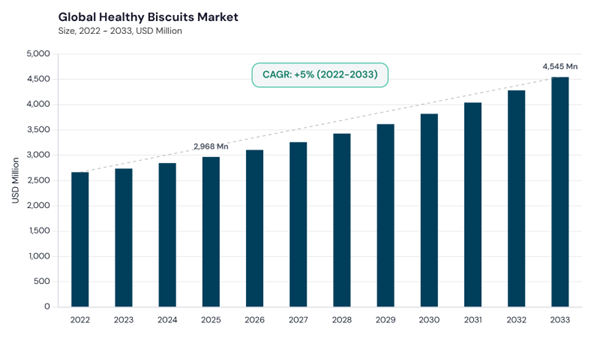
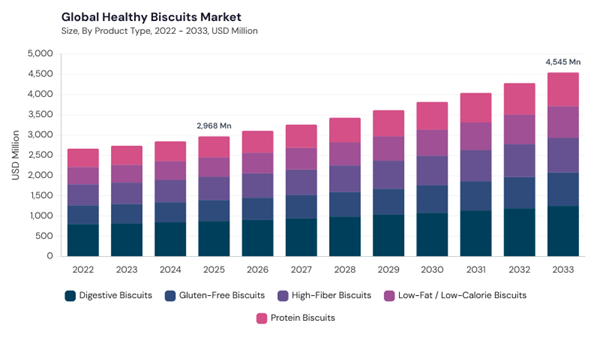
The Global Healthy Biscuits Market size is expected to reach USD 4.54 billion by 2033, growing at a CAGR of 5.6% during the forecast period.


The market growth is driven by rising consumer awareness regarding healthy eating habits, increasing demand for low-calorie and functional snacks, and growing preference for clean-label and nutrient-rich bakery products. Consumers are increasingly shifting toward healthier snack alternatives containing whole grains, fibers, proteins, natural sweeteners, and plant-based ingredients. Additionally, increasing prevalence of obesity, diabetes, digestive disorders, and gluten intolerance is accelerating the adoption of digestive, high-fiber, gluten-free, and protein-enriched biscuits globally.

The market has evolved significantly from conventional biscuit products toward functional and wellness-focused snack categories. Manufacturers are increasingly integrating nutraceutical ingredients, dietary fibers, probiotics, plant proteins, and low-sugar formulations to improve the nutritional profile of biscuits while maintaining taste and texture. Advancements in food processing technologies, ingredient innovation, and sustainable packaging solutions are further transforming the competitive landscape of the healthy biscuits industry.

Key Market Trends & Insights

  • Europe dominated the Healthy Biscuits Market in 2025 accounting for 32.97% revenue share.
  • The Digestive Biscuits segment emerged as the leading Product Type segment with 29.49% revenue share in 2025.
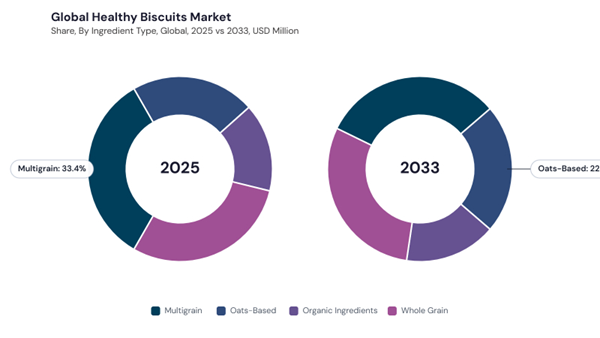
  • The Multigrain segment dominated the Ingredient Type segmentation with 33.42% market share in 2025.
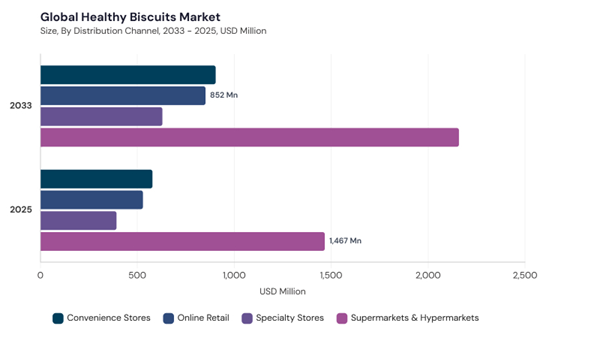
  • Supermarkets & Hypermarkets accounted for the highest revenue share of 49.44% in 2025 by Distribution Channel.
  • Growing demand for gluten-free, low-fat, and protein-rich biscuits is reshaping product innovation globally.
  • Clean-label ingredients, plant-based nutrition, and sustainable packaging are emerging as key industry trends.
The Healthy Biscuits Market is undergoing rapid transformation as consumers increasingly prioritize nutritional value, digestive wellness, weight management, and functional benefits in everyday snacking. Manufacturers are actively reformulating products using whole grains, oats, multigrain blends, natural sweeteners, and fiber-rich ingredients to align with evolving health-conscious consumer preferences. Additionally, rising adoption of gluten-free diets, protein-enriched foods, and low-calorie snacks is accelerating demand across both developed and emerging economies.


Technological advancements such as automation, AI-driven formulation systems, enzyme-assisted baking, and microencapsulation technologies are enabling companies to improve product consistency, shelf life, and nutritional efficacy without compromising flavor. The integration of nutraceutical ingredients and functional additives is also strengthening the market’s position within the broader functional foods and healthy snacking ecosystem.

Driving and Restraining Factors

Drivers
  • Rising consumer preference for gluten-free and nutrient-enriched biscuits
  • Increasing demand for convenient and on-the-go healthy snack products
  • Growing awareness regarding digestive wellness and weight management
  • Innovation in nutraceutical ingredients and functional biscuit formulations
Restraints
  • High production costs associated with premium healthy ingredients
  • Stringent food labeling and regulatory compliance requirements
  • Taste and texture challenges in low-fat and high-fiber formulations
Opportunities
  • Expansion of plant-based and clean-label biscuit formulations
  • Growing demand for functional and fortified snack products
  • Rising adoption of sustainable and eco-friendly packaging solutions
Challenges
  • Ingredient sourcing and supply chain volatility
  • Consumer skepticism regarding taste and health claims
  • Maintaining affordability while offering premium nutrition profiles

Market Share Analysis

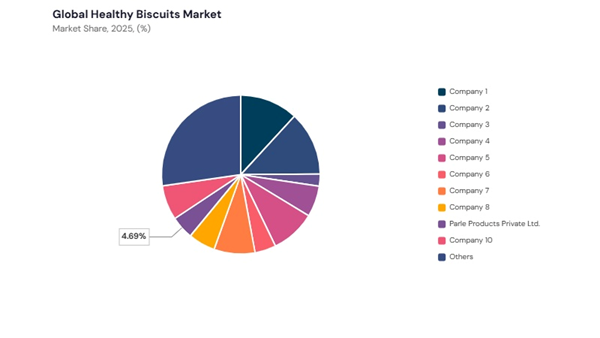
The Healthy Biscuits Market demonstrates a moderately fragmented competitive landscape characterized by the presence of multinational food companies, regional bakery brands, private-label manufacturers, and emerging health-focused startups. Companies are competing aggressively through product innovation, functional ingredient integration, clean-label positioning, and sustainable sourcing initiatives.


Mondelez International led the market with approximately 13.03% market share owing to its extensive healthy biscuit portfolio, strong global distribution network, and continuous investment in reduced-sugar and functional snack innovations. Nestlé followed with more than 10% share supported by its nutrition-focused product positioning and strong brand credibility in the health and wellness segment.

Other major participants include Kellogg Company, Britannia Industries, General Mills, ITC Limited, Parle Products, Unilever, and Kraft Heinz. These companies continue investing heavily in gluten-free formulations, protein-enriched snacks, fiber-based products, and clean-label innovations to strengthen long-term market positioning.

Product Type Outlook

Based on Product Type, the market is segmented into Digestive Biscuits, High-Fiber Biscuits, Gluten-Free Biscuits, Low-Fat / Low-Calorie Biscuits, and Protein Biscuits. The Digestive Biscuits segment dominated the market in 2025 with 29.49% revenue share owing to increasing consumer focus on digestive health and fiber-rich daily snacks. The segment is expected to reach USD 1.25 billion by 2033. Meanwhile, the High-Fiber Biscuits segment is witnessing strong growth supported by rising awareness regarding weight management and digestive wellness. The Protein Biscuits segment is also gaining significant traction among fitness-conscious consumers and active lifestyle populations globally.

Ingredient Type Outlook

Based on Ingredient Type, the market is segmented into Multigrain, Whole Grain, Oats-Based, and Organic Ingredients. The Multigrain segment accounted for the highest revenue share of 33.42% in 2025 due to strong consumer preference for nutrient-rich and diversified grain compositions. The segment is projected to reach USD 1.43 billion by 2033. The Whole Grain segment also witnessed substantial demand supported by increasing awareness regarding heart health and sustained energy release. Meanwhile, Oats-Based biscuits continue gaining popularity due to their cholesterol-lowering properties and digestive health benefits.

Distribution Channel Outlook

Based on Distribution Channel, the market is segmented into Supermarkets & Hypermarkets, Convenience Stores, Online Retail, and Specialty Stores. The Supermarkets & Hypermarkets segment dominated the market with 49.44% revenue share in 2025 owing to strong retail penetration, product visibility, and consumer preference for one-stop shopping experiences. Online Retail is emerging as a fast-growing channel due to rapid e-commerce expansion, increasing digital penetration, and rising consumer preference for home delivery and subscription-based healthy snack purchases.

Regional Outlook

Region-wise, the market is analyzed across North America, Europe, Asia Pacific, and LAMEA. Europe dominated the Healthy Biscuits Market in 2025 accounting for 32.97% revenue share due to strong awareness regarding healthy eating habits, established demand for functional snacks, and favorable regulatory support for nutritional labeling. North America accounted for 29.22% share driven by increasing health consciousness and rising demand for convenient nutritious snacks. Asia Pacific is anticipated to witness strong growth during the forecast period supported by rising disposable income, urbanization, changing dietary habits, and rapid expansion of organized retail and e-commerce infrastructure.

Market Competition and Attributes

The Healthy Biscuits Market is highly innovation-driven and consumer-centric. Competition is centered around functional nutrition, ingredient transparency, sensory optimization, sustainable sourcing, and product differentiation. Manufacturers are focusing heavily on gluten-free, protein-enriched, high-fiber, low-calorie, and clean-label formulations to strengthen brand loyalty and capture evolving health-conscious consumer segments.


Technological innovation in baking processes, automation, nutraceutical integration, and ingredient optimization is increasingly becoming a major competitive differentiator. Strategic partnerships with ingredient suppliers, nutrition research organizations, and digital marketing platforms are also shaping the future competitive landscape of the market.
Recent Strategies Deployed in the Market

  • Mar-2026: Ferrero acquired WK Kellogg Co to strengthen its healthy snacking and better-for-you biscuit portfolio.
  • Apr-2026: Mondelez International advanced cultivated cocoa butter technology to improve nutritional profiles and sustainability of biscuit products.
  • Apr-2026: PepsiCo restructured its product portfolio to prioritize healthier low-sugar and high-fiber snack categories.
  • Mar-2025: Nestlé expanded its Maggi Air Fryer product range targeting healthier cooking and reduced-fat snack solutions.
  • Feb-2022: Kraft Heinz partnered with Google to enhance AI-driven personalization and digital engagement for healthier food products.

List of Key Companies Profiled

  • Mondelez International, Inc.
  • Nestlé S.A.
  • Kellogg Company
  • Britannia Industries Limited
  • General Mills, Inc.
  • PepsiCo, Inc.
  • The Campbell’s Company
  • McKee Foods Corporation
  • Lotus Bakeries NV
  • Walkers Shortbread Ltd.

Market Report Segmentation

By Product Type
  • Digestive Biscuits
  • High-Fiber Biscuits
  • Gluten-Free Biscuits
  • Low-Fat / Low-Calorie Biscuits
  • Protein Biscuits
By Ingredient Type
  • Multigrain
  • Whole Grain
  • Oats-Based
  • Organic Ingredients
By Distribution Channel
  • Supermarkets & Hypermarkets
  • Convenience Stores
  • Online Retail
  • Specialty Stores
By Geography
  • North America
    • US
    • Canada
    • Mexico
    • Rest of North America

  • Europe
    • Germany
    • UK
    • France
    • Italy
    • Spain
    • Rest of Europe

  • Asia Pacific
    • China
    • Japan
    • India
    • South Korea
    • Australia
    • Rest of Asia Pacific

  • LAMEA
    • Brazil
    • UAE
    • Saudi Arabia
    • South Africa
    • Rest of LAMEA

Table of Contents

Chapter 1. Market Overview
1.1 COVID-19 Impact
1.2 Market Composition and Scenario
Chapter 2. Key Factors Impacting Market
2.1.1 Market Drivers
2.1.2 Market Restraints
2.1.3 Market Opportunities
2.1.4 Market Challenges
2.1.5 Market Trends
2.1.6 State of Competition
2.1.7 Market Consolidation
2.1.8 Key Customer Criteria
Chapter 3. Product Life CycleChapter 4. Value Chain Analysis of Healthy Biscuits Market
Chapter 5. Competition Analysis - Global
5.1 Market Share Analysis
5.2 Recent Development and Strategies
5.2.1 Mergers & Acquisitions
5.2.2 Product Launch & Product Expansion
5.2.3 Partnership, Collaboration & Agreements
Chapter 6. Segmentation By Product Type
6.1 Digestive Biscuits
6.2 High-Fiber Biscuits
6.3 Protein Biscuits
6.4 Gluten-Free Biscuits
6.5 Low-Fat / Low-Calorie Biscuits
Chapter 7. Segmentation By Ingredient Type
7.1 Whole Grain
7.2 Multigrain
7.3 Oats-Based
7.4 Organic Ingredients
Chapter 8. Segmentation By Distribution Channel
8.1 Supermarkets & Hypermarkets
8.2 Convenience Stores
8.3 Online Retail
8.4 Specialty Stores
Chapter 9. North America Market
9.1 Market Overview
9.2 Key Factors Impacting Market
9.2.1 Market Drivers
9.2.2 Market Restraints
9.2.3 Market Opportunities
9.2.4 Market Challenges
9.2.5 Market Trends
9.2.6 State of Competition
9.2.7 Market Consolidation
9.2.8 Key Customer Criteria
9.3 Product Life Cycle
9.4 Segmentation By Product Type
9.4.1 Digestive Biscuits
9.4.2 High-Fiber Biscuits
9.4.3 Protein Biscuits
9.4.4 Gluten-Free Biscuits
9.4.5 Low-Fat / Low-Calorie Biscuits
9.5 Segmentation By Ingredient Type
9.5.1 Whole Grain
9.5.2 Multigrain
9.5.3 Oats-Based
9.5.4 Organic Ingredients
9.6 Segmentation By Distribution Channel
9.6.1 Supermarkets & Hypermarkets
9.6.2 Convenience Stores
9.6.3 Online Retail
9.6.4 Specialty Stores
9.7 Segmentation By Country
9.7.1 US
9.7.1.1 Segmentation By Product Type
9.7.1.1.1 Digestive Biscuits
9.7.1.1.2 High-Fiber Biscuits
9.7.1.1.3 Protein Biscuits
9.7.1.1.4 Gluten-Free Biscuits
9.7.1.1.5 Low-Fat / Low-Calorie Biscuits
9.7.1.2 Segmentation By Ingredient Type
9.7.1.2.1 Whole Grain
9.7.1.2.2 Multigrain
9.7.1.2.3 Oats-Based
9.7.1.2.4 Organic Ingredients
9.7.1.3 Segmentation By Distribution Channel
9.7.1.3.1 Supermarkets & Hypermarkets
9.7.1.3.2 Convenience Stores
9.7.1.3.3 Online Retail
9.7.1.3.4 Specialty Stores
9.7.2 Canada
9.7.2.1 Segmentation By Product Type
9.7.2.1.1 Digestive Biscuits
9.7.2.1.2 High-Fiber Biscuits
9.7.2.1.3 Protein Biscuits
9.7.2.1.4 Gluten-Free Biscuits
9.7.2.1.5 Low-Fat / Low-Calorie Biscuits
9.7.2.2 Segmentation By Ingredient Type
9.7.2.2.1 Whole Grain
9.7.2.2.2 Multigrain
9.7.2.2.3 Oats-Based
9.7.2.2.4 Organic Ingredients
9.7.2.3 Segmentation By Distribution Channel
9.7.2.3.1 Supermarkets & Hypermarkets
9.7.2.3.2 Convenience Stores
9.7.2.3.3 Online Retail
9.7.2.3.4 Specialty Stores
9.7.3 Mexico
9.7.3.1 Segmentation By Product Type
9.7.3.1.1 Digestive Biscuits
9.7.3.1.2 High-Fiber Biscuits
9.7.3.1.3 Protein Biscuits
9.7.3.1.4 Gluten-Free Biscuits
9.7.3.1.5 Low-Fat / Low-Calorie Biscuits
9.7.3.2 Segmentation By Ingredient Type
9.7.3.2.1 Whole Grain
9.7.3.2.2 Multigrain
9.7.3.2.3 Oats-Based
9.7.3.2.4 Organic Ingredients
9.7.3.3 Segmentation By Distribution Channel
9.7.3.3.1 Supermarkets & Hypermarkets
9.7.3.3.2 Convenience Stores
9.7.3.3.3 Online Retail
9.7.3.3.4 Specialty Stores
9.7.4 Rest of North America
9.7.4.1 Segmentation By Product Type
9.7.4.1.1 Digestive Biscuits
9.7.4.1.2 High-Fiber Biscuits
9.7.4.1.3 Protein Biscuits
9.7.4.1.4 Gluten-Free Biscuits
9.7.4.1.5 Low-Fat / Low-Calorie Biscuits
9.7.4.2 Segmentation By Ingredient Type
9.7.4.2.1 Whole Grain
9.7.4.2.2 Multigrain
9.7.4.2.3 Oats-Based
9.7.4.2.4 Organic Ingredients
9.7.4.3 Segmentation By Distribution Channel
9.7.4.3.1 Supermarkets & Hypermarkets
9.7.4.3.2 Convenience Stores
9.7.4.3.3 Online Retail
9.7.4.3.4 Specialty Stores
Chapter 10. Europe Market
10.1 Market Overview
10.2 Key Factors Impacting Market
10.2.1 Market Drivers
10.2.2 Market Restraints
10.2.3 Market Opportunities
10.2.4 Market Challenges
10.2.5 Market Trends
10.2.6 State of Competition
10.2.7 Market Consolidation
10.2.8 Key Customer Criteria
10.3 Product Life Cycle
10.4 Segmentation By Product Type
10.4.1 Digestive Biscuits
10.4.2 High-Fiber Biscuits
10.4.3 Protein Biscuits
10.4.4 Gluten-Free Biscuits
10.4.5 Low-Fat / Low-Calorie Biscuits
10.5 Segmentation By Ingredient Type
10.5.1 Whole Grain
10.5.2 Multigrain
10.5.3 Oats-Based
10.5.4 Organic Ingredients
10.6 Segmentation By Distribution Channel
10.6.1 Supermarkets & Hypermarkets
10.6.2 Convenience Stores
10.6.3 Online Retail
10.6.4 Specialty Stores
10.7 Segmentation By Country
10.7.1 Germany
10.7.1.1 Segmentation By Product Type
10.7.1.1.1 Digestive Biscuits
10.7.1.1.2 High-Fiber Biscuits
10.7.1.1.3 Protein Biscuits
10.7.1.1.4 Gluten-Free Biscuits
10.7.1.1.5 Low-Fat / Low-Calorie Biscuits
10.7.1.2 Segmentation By Ingredient Type
10.7.1.2.1 Whole Grain
10.7.1.2.2 Multigrain
10.7.1.2.3 Oats-Based
10.7.1.2.4 Organic Ingredients
10.7.1.3 Segmentation By Distribution Channel
10.7.1.3.1 Supermarkets & Hypermarkets
10.7.1.3.2 Convenience Stores
10.7.1.3.3 Online Retail
10.7.1.3.4 Specialty Stores
10.7.2 UK
10.7.2.1 Segmentation By Product Type
10.7.2.1.1 Digestive Biscuits
10.7.2.1.2 High-Fiber Biscuits
10.7.2.1.3 Protein Biscuits
10.7.2.1.4 Gluten-Free Biscuits
10.7.2.1.5 Low-Fat / Low-Calorie Biscuits
10.7.2.2 Segmentation By Ingredient Type
10.7.2.2.1 Whole Grain
10.7.2.2.2 Multigrain
10.7.2.2.3 Oats-Based
10.7.2.2.4 Organic Ingredients
10.7.2.3 Segmentation By Distribution Channel
10.7.2.3.1 Supermarkets & Hypermarkets
10.7.2.3.2 Convenience Stores
10.7.2.3.3 Online Retail
10.7.2.3.4 Specialty Stores
10.7.3 France
10.7.3.1 Segmentation By Product Type
10.7.3.1.1 Digestive Biscuits
10.7.3.1.2 High-Fiber Biscuits
10.7.3.1.3 Protein Biscuits
10.7.3.1.4 Gluten-Free Biscuits
10.7.3.1.5 Low-Fat / Low-Calorie Biscuits
10.7.3.2 Segmentation By Ingredient Type
10.7.3.2.1 Whole Grain
10.7.3.2.2 Multigrain
10.7.3.2.3 Oats-Based
10.7.3.2.4 Organic Ingredients
10.7.3.3 Segmentation By Distribution Channel
10.7.3.3.1 Supermarkets & Hypermarkets
10.7.3.3.2 Convenience Stores
10.7.3.3.3 Online Retail
10.7.3.3.4 Specialty Stores
10.7.4 Russia
10.7.4.1 Segmentation By Product Type
10.7.4.1.1 Digestive Biscuits
10.7.4.1.2 High-Fiber Biscuits
10.7.4.1.3 Protein Biscuits
10.7.4.1.4 Gluten-Free Biscuits
10.7.4.1.5 Low-Fat / Low-Calorie Biscuits
10.7.4.2 Segmentation By Ingredient Type
10.7.4.2.1 Whole Grain
10.7.4.2.2 Multigrain
10.7.4.2.3 Oats-Based
10.7.4.2.4 Organic Ingredients
10.7.4.3 Segmentation By Distribution Channel
10.7.4.3.1 Supermarkets & Hypermarkets
10.7.4.3.2 Convenience Stores
10.7.4.3.3 Online Retail
10.7.4.3.4 Specialty Stores
10.7.5 Spain
10.7.5.1 Segmentation By Product Type
10.7.5.1.1 Digestive Biscuits
10.7.5.1.2 High-Fiber Biscuits
10.7.5.1.3 Protein Biscuits
10.7.5.1.4 Gluten-Free Biscuits
10.7.5.1.5 Low-Fat / Low-Calorie Biscuits
10.7.5.2 Segmentation By Ingredient Type
10.7.5.2.1 Whole Grain
10.7.5.2.2 Multigrain
10.7.5.2.3 Oats-Based
10.7.5.2.4 Organic Ingredients
10.7.5.3 Segmentation By Distribution Channel
10.7.5.3.1 Supermarkets & Hypermarkets
10.7.5.3.2 Convenience Stores
10.7.5.3.3 Online Retail
10.7.5.3.4 Specialty Stores
10.7.6 Italy
10.7.6.1 Segmentation By Product Type
10.7.6.1.1 Digestive Biscuits
10.7.6.1.2 High-Fiber Biscuits
10.7.6.1.3 Protein Biscuits
10.7.6.1.4 Gluten-Free Biscuits
10.7.6.1.5 Low-Fat / Low-Calorie Biscuits
10.7.6.2 Segmentation By Ingredient Type
10.7.6.2.1 Whole Grain
10.7.6.2.2 Multigrain
10.7.6.2.3 Oats-Based
10.7.6.2.4 Organic Ingredients
10.7.6.3 Segmentation By Distribution Channel
10.7.6.3.1 Supermarkets & Hypermarkets
10.7.6.3.2 Convenience Stores
10.7.6.3.3 Online Retail
10.7.6.3.4 Specialty Stores
10.7.7 Rest of Europe
10.7.7.1 Segmentation By Product Type
10.7.7.1.1 Digestive Biscuits
10.7.7.1.2 High-Fiber Biscuits
10.7.7.1.3 Protein Biscuits
10.7.7.1.4 Gluten-Free Biscuits
10.7.7.1.5 Low-Fat / Low-Calorie Biscuits
10.7.7.2 Segmentation By Ingredient Type
10.7.7.2.1 Whole Grain
10.7.7.2.2 Multigrain
10.7.7.2.3 Oats-Based
10.7.7.2.4 Organic Ingredients
10.7.7.3 Segmentation By Distribution Channel
10.7.7.3.1 Supermarkets & Hypermarkets
10.7.7.3.2 Convenience Stores
10.7.7.3.3 Online Retail
10.7.7.3.4 Specialty Stores
Chapter 11. Asia Pacific Market
11.1 Market Overview
11.2 Key Factors Impacting Market
11.2.1 Market Drivers
11.2.2 Market Restraints
11.2.3 Market Opportunities
11.2.4 Market Challenges
11.2.5 Market Trends
11.2.6 State of Competition
11.2.7 Market Consolidation
11.2.8 Key Customer Criteria
11.3 Product Life Cycle
11.4 Segmentation By Product Type
11.4.1 Digestive Biscuits
11.4.2 High-Fiber Biscuits
11.4.3 Protein Biscuits
11.4.4 Gluten-Free Biscuits
11.4.5 Low-Fat / Low-Calorie Biscuits
11.5 Segmentation By Ingredient Type
11.5.1 Whole Grain
11.5.2 Multigrain
11.5.3 Oats-Based
11.5.4 Organic Ingredients
11.6 Segmentation By Distribution Channel
11.6.1 Supermarkets & Hypermarkets
11.6.2 Convenience Stores
11.6.3 Online Retail
11.6.4 Specialty Stores
11.7 Segmentation By Country
11.7.1 China
11.7.1.1 Segmentation By Product Type
11.7.1.1.1 Digestive Biscuits
11.7.1.1.2 High-Fiber Biscuits
11.7.1.1.3 Protein Biscuits
11.7.1.1.4 Gluten-Free Biscuits
11.7.1.1.5 Low-Fat / Low-Calorie Biscuits
11.7.1.2 Segmentation By Ingredient Type
11.7.1.2.1 Whole Grain
11.7.1.2.2 Multigrain
11.7.1.2.3 Oats-Based
11.7.1.2.4 Organic Ingredients
11.7.1.3 Segmentation By Distribution Channel
11.7.1.3.1 Supermarkets & Hypermarkets
11.7.1.3.2 Convenience Stores
11.7.1.3.3 Online Retail
11.7.1.3.4 Specialty Stores
11.7.2 Japan
11.7.2.1 Segmentation By Product Type
11.7.2.1.1 Digestive Biscuits
11.7.2.1.2 High-Fiber Biscuits
11.7.2.1.3 Protein Biscuits
11.7.2.1.4 Gluten-Free Biscuits
11.7.2.1.5 Low-Fat / Low-Calorie Biscuits
11.7.2.2 Segmentation By Ingredient Type
11.7.2.2.1 Whole Grain
11.7.2.2.2 Multigrain
11.7.2.2.3 Oats-Based
11.7.2.2.4 Organic Ingredients
11.7.2.3 Segmentation By Distribution Channel
11.7.2.3.1 Supermarkets & Hypermarkets
11.7.2.3.2 Convenience Stores
11.7.2.3.3 Online Retail
11.7.2.3.4 Specialty Stores
11.7.3 India
11.7.3.1 Segmentation By Product Type
11.7.3.1.1 Digestive Biscuits
11.7.3.1.2 High-Fiber Biscuits
11.7.3.1.3 Protein Biscuits
11.7.3.1.4 Gluten-Free Biscuits
11.7.3.1.5 Low-Fat / Low-Calorie Biscuits
11.7.3.2 Segmentation By Ingredient Type
11.7.3.2.1 Whole Grain
11.7.3.2.2 Multigrain
11.7.3.2.3 Oats-Based
11.7.3.2.4 Organic Ingredients
11.7.3.3 Segmentation By Distribution Channel
11.7.3.3.1 Supermarkets & Hypermarkets
11.7.3.3.2 Convenience Stores
11.7.3.3.3 Online Retail
11.7.3.3.4 Specialty Stores
11.7.4 South Korea
11.7.4.1 Segmentation By Product Type
11.7.4.1.1 Digestive Biscuits
11.7.4.1.2 High-Fiber Biscuits
11.7.4.1.3 Protein Biscuits
11.7.4.1.4 Gluten-Free Biscuits
11.7.4.1.5 Low-Fat / Low-Calorie Biscuits
11.7.4.2 Segmentation By Ingredient Type
11.7.4.2.1 Whole Grain
11.7.4.2.2 Multigrain
11.7.4.2.3 Oats-Based
11.7.4.2.4 Organic Ingredients
11.7.4.3 Segmentation By Distribution Channel
11.7.4.3.1 Supermarkets & Hypermarkets
11.7.4.3.2 Convenience Stores
11.7.4.3.3 Online Retail
11.7.4.3.4 Specialty Stores
11.7.5 Singapore
11.7.5.1 Segmentation By Product Type
11.7.5.1.1 Digestive Biscuits
11.7.5.1.2 High-Fiber Biscuits
11.7.5.1.3 Protein Biscuits
11.7.5.1.4 Gluten-Free Biscuits
11.7.5.1.5 Low-Fat / Low-Calorie Biscuits
11.7.5.2 Segmentation By Ingredient Type
11.7.5.2.1 Whole Grain
11.7.5.2.2 Multigrain
11.7.5.2.3 Oats-Based
11.7.5.2.4 Organic Ingredients
11.7.5.3 Segmentation By Distribution Channel
11.7.5.3.1 Supermarkets & Hypermarkets
11.7.5.3.2 Convenience Stores
11.7.5.3.3 Online Retail
11.7.5.3.4 Specialty Stores
11.7.6 Malaysia
11.7.6.1 Segmentation By Product Type
11.7.6.1.1 Digestive Biscuits
11.7.6.1.2 High-Fiber Biscuits
11.7.6.1.3 Protein Biscuits
11.7.6.1.4 Gluten-Free Biscuits
11.7.6.1.5 Low-Fat / Low-Calorie Biscuits
11.7.6.2 Segmentation By Ingredient Type
11.7.6.2.1 Whole Grain
11.7.6.2.2 Multigrain
11.7.6.2.3 Oats-Based
11.7.6.2.4 Organic Ingredients
11.7.6.3 Segmentation By Distribution Channel
11.7.6.3.1 Supermarkets & Hypermarkets
11.7.6.3.2 Convenience Stores
11.7.6.3.3 Online Retail
11.7.6.3.4 Specialty Stores
11.7.7 Rest of Asia Pacific
11.7.7.1 Segmentation By Product Type
11.7.7.1.1 Digestive Biscuits
11.7.7.1.2 High-Fiber Biscuits
11.7.7.1.3 Protein Biscuits
11.7.7.1.4 Gluten-Free Biscuits
11.7.7.1.5 Low-Fat / Low-Calorie Biscuits
11.7.7.2 Segmentation By Ingredient Type
11.7.7.2.1 Whole Grain
11.7.7.2.2 Multigrain
11.7.7.2.3 Oats-Based
11.7.7.2.4 Organic Ingredients
11.7.7.3 Segmentation By Distribution Channel
11.7.7.3.1 Supermarkets & Hypermarkets
11.7.7.3.2 Convenience Stores
11.7.7.3.3 Online Retail
11.7.7.3.4 Specialty Stores
Chapter 12. LAMEA Market
12.1 Market Overview
12.2 Key Factors Impacting Market
12.2.1 Market Drivers
12.2.2 Market Restraints
12.2.3 Market Opportunities
12.2.4 Market Challenges
12.2.5 Market Trends
12.2.6 State of Competition
12.2.7 Market Consolidation
12.2.8 Key Customer Criteria
12.3 Product Life Cycle
12.4 Segmentation By Product Type
12.4.1 Digestive Biscuits
12.4.2 High-Fiber Biscuits
12.4.3 Protein Biscuits
12.4.4 Gluten-Free Biscuits
12.4.5 Low-Fat / Low-Calorie Biscuits
12.5 Segmentation By Ingredient Type
12.5.1 Whole Grain
12.5.2 Multigrain
12.5.3 Oats-Based
12.5.4 Organic Ingredients
12.6 Segmentation By Distribution Channel
12.6.1 Supermarkets & Hypermarkets
12.6.2 Convenience Stores
12.6.3 Online Retail
12.6.4 Specialty Stores
12.7 Segmentation By Country
12.7.1 Brazil
12.7.1.1 Segmentation By Product Type
12.7.1.1.1 Digestive Biscuits
12.7.1.1.2 High-Fiber Biscuits
12.7.1.1.3 Protein Biscuits
12.7.1.1.4 Gluten-Free Biscuits
12.7.1.1.5 Low-Fat / Low-Calorie Biscuits
12.7.1.2 Segmentation By Ingredient Type
12.7.1.2.1 Whole Grain
12.7.1.2.2 Multigrain
12.7.1.2.3 Oats-Based
12.7.1.2.4 Organic Ingredients
12.7.1.3 Segmentation By Distribution Channel
12.7.1.3.1 Supermarkets & Hypermarkets
12.7.1.3.2 Convenience Stores
12.7.1.3.3 Online Retail
12.7.1.3.4 Specialty Stores
12.7.2 Argentina
12.7.2.1 Segmentation By Product Type
12.7.2.1.1 Digestive Biscuits
12.7.2.1.2 High-Fiber Biscuits
12.7.2.1.3 Protein Biscuits
12.7.2.1.4 Gluten-Free Biscuits
12.7.2.1.5 Low-Fat / Low-Calorie Biscuits
12.7.2.2 Segmentation By Ingredient Type
12.7.2.2.1 Whole Grain
12.7.2.2.2 Multigrain
12.7.2.2.3 Oats-Based
12.7.2.2.4 Organic Ingredients
12.7.2.3 Segmentation By Distribution Channel
12.7.2.3.1 Supermarkets & Hypermarkets
12.7.2.3.2 Convenience Stores
12.7.2.3.3 Online Retail
12.7.2.3.4 Specialty Stores
12.7.3 UAE
12.7.3.1 Segmentation By Product Type
12.7.3.1.1 Digestive Biscuits
12.7.3.1.2 High-Fiber Biscuits
12.7.3.1.3 Protein Biscuits
12.7.3.1.4 Gluten-Free Biscuits
12.7.3.1.5 Low-Fat / Low-Calorie Biscuits
12.7.3.2 Segmentation By Ingredient Type
12.7.3.2.1 Whole Grain
12.7.3.2.2 Multigrain
12.7.3.2.3 Oats-Based
12.7.3.2.4 Organic Ingredients
12.7.3.3 Segmentation By Distribution Channel
12.7.3.3.1 Supermarkets & Hypermarkets
12.7.3.3.2 Convenience Stores
12.7.3.3.3 Online Retail
12.7.3.3.4 Specialty Stores
12.7.4 Saudi Arabia
12.7.4.1 Segmentation By Product Type
12.7.4.1.1 Digestive Biscuits
12.7.4.1.2 High-Fiber Biscuits
12.7.4.1.3 Protein Biscuits
12.7.4.1.4 Gluten-Free Biscuits
12.7.4.1.5 Low-Fat / Low-Calorie Biscuits
12.7.4.2 Segmentation By Ingredient Type
12.7.4.2.1 Whole Grain
12.7.4.2.2 Multigrain
12.7.4.2.3 Oats-Based
12.7.4.2.4 Organic Ingredients
12.7.4.3 Segmentation By Distribution Channel
12.7.4.3.1 Supermarkets & Hypermarkets
12.7.4.3.2 Convenience Stores
12.7.4.3.3 Online Retail
12.7.4.3.4 Specialty Stores
12.7.5 South Africa
12.7.5.1 Segmentation By Product Type
12.7.5.1.1 Digestive Biscuits
12.7.5.1.2 High-Fiber Biscuits
12.7.5.1.3 Protein Biscuits
12.7.5.1.4 Gluten-Free Biscuits
12.7.5.1.5 Low-Fat / Low-Calorie Biscuits
12.7.5.2 Segmentation By Ingredient Type
12.7.5.2.1 Whole Grain
12.7.5.2.2 Multigrain
12.7.5.2.3 Oats-Based
12.7.5.2.4 Organic Ingredients
12.7.5.3 Segmentation By Distribution Channel
12.7.5.3.1 Supermarkets & Hypermarkets
12.7.5.3.2 Convenience Stores
12.7.5.3.3 Online Retail
12.7.5.3.4 Specialty Stores
12.7.6 Nigeria
12.7.6.1 Segmentation By Product Type
12.7.6.1.1 Digestive Biscuits
12.7.6.1.2 High-Fiber Biscuits
12.7.6.1.3 Protein Biscuits
12.7.6.1.4 Gluten-Free Biscuits
12.7.6.1.5 Low-Fat / Low-Calorie Biscuits
12.7.6.2 Segmentation By Ingredient Type
12.7.6.2.1 Whole Grain
12.7.6.2.2 Multigrain
12.7.6.2.3 Oats-Based
12.7.6.2.4 Organic Ingredients
12.7.6.3 Segmentation By Distribution Channel
12.7.6.3.1 Supermarkets & Hypermarkets
12.7.6.3.2 Convenience Stores
12.7.6.3.3 Online Retail
12.7.6.3.4 Specialty Stores
12.7.7 Rest of LAMEA
12.7.7.1 Segmentation By Product Type
12.7.7.1.1 Digestive Biscuits
12.7.7.1.2 High-Fiber Biscuits
12.7.7.1.3 Protein Biscuits
12.7.7.1.4 Gluten-Free Biscuits
12.7.7.1.5 Low-Fat / Low-Calorie Biscuits
12.7.7.2 Segmentation By Ingredient Type
12.7.7.2.1 Whole Grain
12.7.7.2.2 Multigrain
12.7.7.2.3 Oats-Based
12.7.7.2.4 Organic Ingredients
12.7.7.3 Segmentation By Distribution Channel
12.7.7.3.1 Supermarkets & Hypermarkets
12.7.7.3.2 Convenience Stores
12.7.7.3.3 Online Retail
12.7.7.3.4 Specialty Stores
Chapter 13. Company Snapshot
13.1 Nestle S.A.
13.1.1 Business Overview
13.1.2 Key Information
13.1.3 Company Focus on Healthy Biscuits Market
13.1.4 Strategic Insights on Healthy Biscuits Market
13.1.5 Strategy Deployed for Healthy Biscuits Market
13.1.6 Product & Service Portfolio
13.1.7 Key Products / Services (Representative)
13.1.8 Capability Overview
13.1.9 Technology & Innovation Focus
13.1.10 SWOT Analysis (Healthy Biscuits Market)
13.1.11 Customers / End Users
13.1.12 Competitive Positioning
13.1.13 Key Differentiators
13.1.14 Portfolio Matrix
13.1.15 Analyst View
13.1.16 Future Outlook for Healthy Biscuits Market
13.2 Mondelez International, Inc.
13.2.1 Business Overview
13.2.2 Key Information
13.2.3 Company Focus on Healthy Biscuits Market
13.2.4 Strategic Insights on Healthy Biscuits Market
13.2.5 Strategy Deployed for Healthy Biscuits Market
13.2.6 Product & Service Portfolio
13.2.7 Capability Overview
13.2.8 Technology & Innovation Focus
13.2.9 SWOT Analysis (Healthy Biscuits Market)
13.2.10 Customers / End Users
13.2.11 Competitive Positioning
13.2.12 Key Differentiators
13.2.13 Portfolio Matrix
13.2.14 Analyst View
13.2.15 Future Outlook for Healthy Biscuits Market
13.3 General Mills Inc.
13.3.1 Business Overview
13.3.2 Key Information
13.3.3 Company Focus on Healthy Biscuits Market
13.3.4 Strategic Insights on Healthy Biscuits Market
13.3.5 Strategy Deployed for Healthy Biscuits Market
13.3.6 Product & Service Portfolio
13.3.7 Capability Overview
13.3.8 Technology & Innovation Focus
13.3.9 SWOT Analysis (Healthy Biscuits Market)
13.3.10 Customers / End Users
13.3.11 Competitive Positioning
13.3.12 Key Differentiators
13.3.13 Portfolio Matrix
13.3.14 Analyst View
13.3.15 Future Outlook for Healthy Biscuits Market
13.4 The Kraft Heinz Company
13.4.1 Business Overview
13.4.2 Key Information
13.4.3 Company Focus on Healthy Biscuits Market
13.4.4 Strategic Insights on Healthy Biscuits Market
13.4.5 Strategy Deployed for Healthy Biscuits Market
13.4.6 Product & Service Portfolio
13.4.7 Capability Overview
13.4.8 Technology & Innovation Focus
13.4.9 SWOT Analysis (Healthy Biscuits Market)
13.4.10 Customers / End Users
13.4.11 Competitive Positioning
13.4.12 Key Differentiators
13.4.13 Portfolio Matrix
13.4.14 Analyst View
13.4.15 Future Outlook for Healthy Biscuits Market
13.5 PepsiCo, Inc.
13.5.1 Business Overview
13.5.2 Key Information
13.5.3 Company Focus on Healthy Biscuits Market
13.5.4 Strategic Insights on Healthy Biscuits Market
13.5.5 Strategy Deployed for Healthy Biscuits Market
13.5.6 Product & Service Portfolio
13.5.7 Capability Overview
13.5.8 Technology & Innovation Focus
13.5.9 SWOT Analysis (Healthy Biscuits Market)
13.5.10 Customers / End Users
13.5.11 Competitive Positioning
13.5.12 Key Differentiators
13.5.13 Portfolio Matrix
13.5.14 Analyst View
13.5.15 Future Outlook for Healthy Biscuits Market
13.6 Unilever PLC
13.6.1 Business Overview
13.6.2 Key Information
13.6.3 Company Focus on Healthy Biscuits Market
13.6.4 Strategic Insights on Healthy Biscuits Market
13.6.5 Strategy Deployed for Healthy Biscuits Market
13.6.6 Product & Service Portfolio
13.6.7 Capability Overview
13.6.8 Technology & Innovation Focus
13.6.9 SWOT Analysis (Healthy Biscuits Market)
13.6.10 Customers / End Users
13.6.11 Competitive Positioning
13.6.12 Key Differentiators
13.6.13 Portfolio Matrix
13.6.14 Analyst View
13.6.15 Future Outlook for Healthy Biscuits Market
13.7 Kellogg Company
13.7.1 Business Overview
13.7.2 Key Information
13.7.3 Company Focus on Healthy Biscuits Market
13.7.4 Strategic Insights on Healthy Biscuits Market
13.7.5 Strategy Deployed for Healthy Biscuits Market
13.7.6 Product & Service Portfolio
13.7.7 Capability Overview
13.7.8 Technology & Innovation Focus
13.7.9 SWOT Analysis (Healthy Biscuits Market)
13.7.10 Customers / End Users
13.7.11 Competitive Positioning
13.7.12 Key Differentiators
13.7.13 Portfolio Matrix
13.7.14 Analyst View
13.7.15 Future Outlook for Healthy Biscuits Market
13.8 ITC Limited
13.8.1 Business Overview
13.8.2 Key Information
13.8.3 Company Focus on Healthy Biscuits Market
13.8.4 Strategic Insights on Healthy Biscuits Market
13.8.5 Strategy Deployed for Healthy Biscuits Market
13.8.6 Product & Service Portfolio
13.8.7 Capability Overview
13.8.8 Technology & Innovation Focus
13.8.9 SWOT Analysis (Healthy Biscuits Market)
13.8.10 Customers / End Users
13.8.11 Competitive Positioning
13.8.12 Key Differentiators
13.8.13 Portfolio Matrix
13.8.14 Analyst View
13.8.15 Future Outlook for Healthy Biscuits Market
13.9 Parle Products Private Ltd.
13.9.1 Business Overview
13.9.2 Key Information
13.9.3 Company Focus on Healthy Biscuits Market
13.9.4 Strategic Insights on Healthy Biscuits Market
13.9.5 Strategy Deployed for Healthy Biscuits Market
13.9.6 Product & Service Portfolio
13.9.7 Portfolio Categories
13.9.8 Capability Overview
13.9.9 Technology & Innovation Focus
13.9.10 SWOT Analysis (Healthy Biscuits Market)
13.9.11 Customers / End Users
13.9.12 Competitive Positioning
13.9.13 Key Differentiators
13.9.14 Portfolio Matrix
13.9.15 Analyst View
13.9.16 Future Outlook for Healthy Biscuits Market
13.10 Britannia Industries Limited
13.10.1 Business Overview
13.10.2 Key Information
13.10.3 Company Focus on Healthy Biscuits Market
13.10.4 Strategic Insights on Healthy Biscuits Market
13.10.5 Strategy Deployed for Healthy Biscuits Market
13.10.6 Product & Service Portfolio
13.10.7 Portfolio Categories
13.10.8 Capability Overview
13.10.9 Technology & Innovation Focus
13.10.10 SWOT Analysis (Healthy Biscuits Market)
13.10.11 Customers / End Users
13.10.12 Competitive Positioning
13.10.13 Key Differentiators
13.10.14 Portfolio Matrix
13.10.15 Analyst View
13.10.16 Future Outlook for Healthy Biscuits Market
Chapter 14. Winning Imperatives of Healthy Biscuits Market

Companies Mentioned

  • Mondelez International, Inc.
  • Nestlé S.A.
  • Kellogg Company
  • Britannia Industries Limited
  • General Mills, Inc.
  • PepsiCo, Inc.
  • The Campbell’s Company
  • McKee Foods Corporation
  • Lotus Bakeries NV
  • Walkers Shortbread Ltd.