+353-1-416-8900REST OF WORLD
+44-20-3973-8888REST OF WORLD
1-917-300-0470EAST COAST U.S
1-800-526-8630U.S. (TOLL FREE)

Global Ultra-Low Latency Connectivity Market Size, Share & Industry Analysis Report by Component, Network Technology, Application, End User, Regional Outlook and Forecast, 2026-2033

  • PDF Icon

    Report

  • 820 Pages
  • May 2026
  • Marqual IT Solutions Pvt. Ltd (KBV Research)
  • ID: 6276034
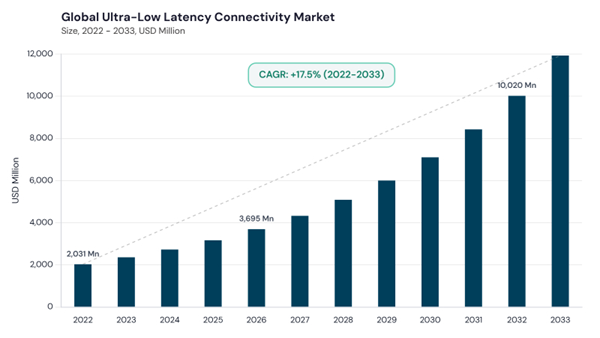
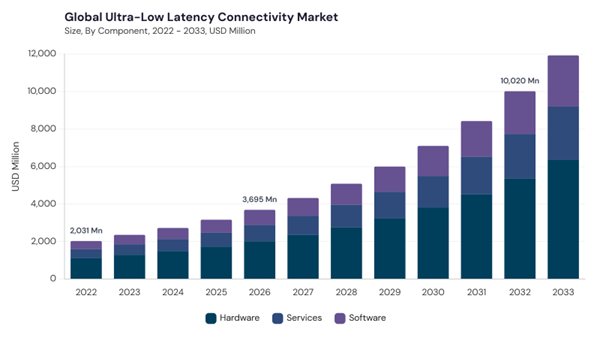
The Global Ultra-Low Latency Connectivity Market size is expected to reach USD 11.93 Billion by 2033, rising at a market growth of 18.2% CAGR during the forecast period (2026-2033).


The market is experiencing significant growth driven by increasing demand for real-time digital communication, edge computing infrastructure, and mission-critical applications requiring ultra-fast response times. Expanding deployment of 5G standalone networks, AI-enabled networking technologies, and fiber-optic infrastructure is further accelerating market expansion globally.

Key Market Trends & Insights

  • Hardware dominated the Ultra-Low Latency Connectivity Market in 2025 with 54.71% revenue share due to increasing deployment of edge infrastructure and high-speed networking equipment.
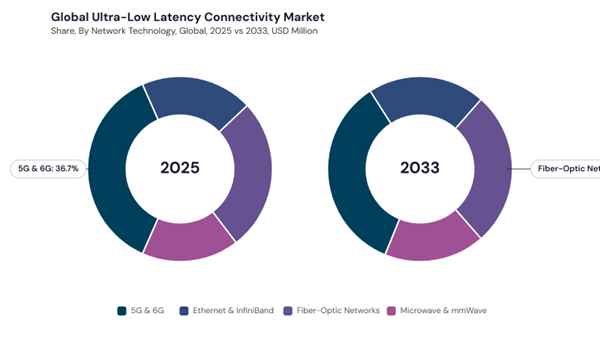
  • 5G & 6G accounted for the largest share of 36.71% in 2025 and is projected to continue dominating due to rapid next-generation wireless network deployment.
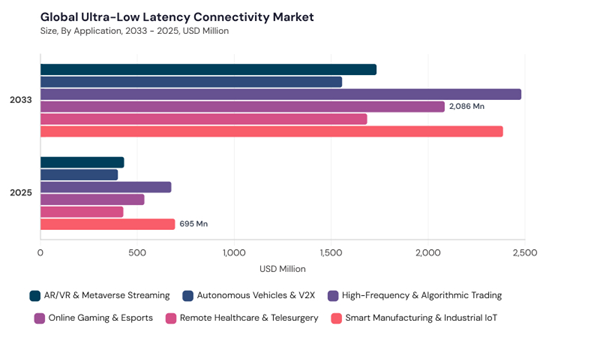
  • Smart Manufacturing & Industrial IoT dominated the application segment with 21.94% revenue share in 2025 and is expected to reach USD 2.38 billion by 2033.
  • Fiber-Optic Networks are projected to reach USD 3.22 billion by 2033 driven by rising investments in broadband modernization and high-capacity network infrastructure.
  • Services segment is expected to reach USD 2.84 billion by 2033 owing to increasing demand for managed low-latency connectivity and network optimization services.
  • Software solutions are projected to reach USD 2.73 billion by 2033 supported by rising adoption of AI-driven orchestration, virtualization, and latency monitoring platforms.
Ultra-low latency connectivity solutions have evolved rapidly with advancements in 5G, edge computing, AI-driven networking, and high-performance communication infrastructure. Organizations across industries are increasingly deploying these solutions to support applications requiring near real-time responsiveness, including industrial automation, autonomous systems, cloud gaming, AR/VR streaming, and financial trading platforms.

The market is witnessing strong adoption across IT & telecommunications, manufacturing, BFSI, healthcare, transportation & logistics, and media & entertainment sectors. Increasing investments in smart infrastructure, distributed cloud ecosystems, industrial IoT, and next-generation broadband networks continue to strengthen global market growth.


Companies operating in the ultra-low latency connectivity market are focusing on infrastructure modernization, AI-enabled network optimization, and strategic collaborations to strengthen market competitiveness. Market participants are investing in 5G standalone infrastructure, edge computing deployments, software-defined networking, and low-latency fiber connectivity to support real-time applications. Partnerships among telecom operators, cloud providers, and networking technology companies are further accelerating deployment and innovation across global markets.

Driving and Restraining Factors

Drivers
  • Rising Deployment of 5G Standalone and Edge Computing Infrastructure
  • Increasing Demand for Real-Time Communication and Mission-Critical Applications
  • Growing Adoption of Industrial IoT and Smart Manufacturing Technologies
  • Expansion of Cloud Gaming, AR/VR, and Immersive Digital Experiences
Restraints
  • High Infrastructure Deployment and Maintenance Costs
  • Complexity Associated with Network Integration and Interoperability
  • Data Privacy and Cybersecurity Concerns Across Distributed Networks
Opportunities
  • Growing Investments in Autonomous Mobility and Connected Vehicle Ecosystems
  • Rising Adoption of AI-Driven Network Optimization Technologies
  • Expansion of Edge Data Centers and Distributed Cloud Infrastructure
Challenges
  • Latency Management Across Complex Multi-Network Environments
  • Limited Availability of Advanced Networking Infrastructure in Emerging Regions
  • Increasing Power Consumption and Operational Complexity of High-Speed Networks

Market Share Analysis

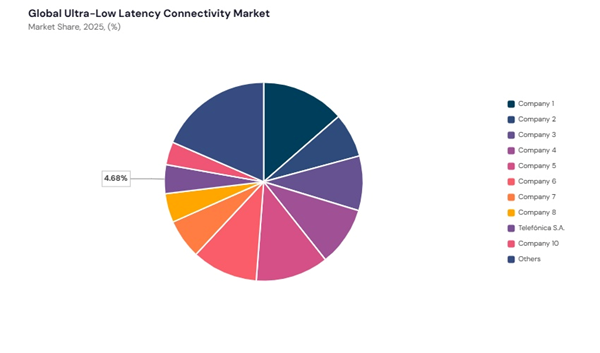
The ultra-low latency connectivity market remains moderately consolidated, with leading global players accounting for a significant share of overall market revenue. Major companies such as Cisco Systems, Inc., Nokia Corporation, Telefonaktiebolaget LM Ericsson, and Huawei Technologies Co., Ltd. maintain strong market positions through extensive networking portfolios, global infrastructure capabilities, and continuous investments in 5G and edge computing technologies.


Cloud infrastructure providers and data center operators are also strengthening their market presence through strategic investments in low-latency routing, distributed edge cloud deployments, and AI-enabled networking solutions. Mid-sized and niche providers are increasingly gaining traction by offering specialized connectivity services for gaming, industrial automation, autonomous mobility, and financial trading applications. Future market share shifts are expected to be influenced by advancements in AI networking, 6G development, network virtualization, and distributed edge architectures.

Network Technology Outlook

Based on Network Technology, the market is segmented into 5G & 6G, Fiber-Optic Networks, Ethernet & InfiniBand, and Microwave & mmWave. The 5G & 6G segment dominated the market in 2025 with 36.71% revenue share due to rapid next-generation wireless network deployment and increasing demand for ultra-reliable low-latency communication. Fiber-optic networks continue to maintain strong market presence as the backbone infrastructure for high-speed and reliable connectivity. Ethernet & InfiniBand technologies are also witnessing substantial adoption in hyperscale data centers, AI workloads, and high-performance computing environments requiring deterministic low-latency communication.

Component Outlook

Based on Component, the market is segmented into Hardware, Services, and Software. The Hardware segment acquired the largest revenue share of 54.71% in 2025 owing to increasing deployment of routers, switches, edge devices, and advanced networking infrastructure required for real-time communication. Services are also witnessing strong growth as organizations increasingly depend on managed connectivity, integration, and network optimization services. Software solutions continue gaining traction with growing adoption of AI-driven network orchestration, virtualization, and traffic management platforms.

End-use Industry Outlook

Based on End-use Industry, the market is segmented into IT & Telecommunications, Manufacturing, BFSI, Media & Entertainment, Transportation & Logistics, Healthcare, and Other End Users. The IT & Telecommunications segment dominated the market with 25.09% revenue share in 2025 owing to significant investments in 5G rollout, edge computing, and cloud networking infrastructure. Manufacturing and BFSI sectors are also witnessing strong adoption due to increasing demand for real-time automation, trading systems, and mission-critical communication networks. Healthcare, transportation, and media industries continue expanding adoption to support telemedicine, connected mobility, cloud gaming, and immersive digital experiences.

Regional Outlook

Based on Region, the market is segmented into North America, Europe, Asia Pacific, and LAMEA. North America dominated the Ultra-Low Latency Connectivity Market in 2025 due to strong investments in 5G infrastructure, edge computing, hyperscale data centers, and advanced networking technologies across the U.S. and Canada. The presence of major telecom operators, cloud service providers, and AI networking companies continues to strengthen regional market growth.

Asia Pacific is expected to witness the fastest growth during the forecast period owing to rapid digital transformation, expanding industrial automation initiatives, and increasing deployment of smart city infrastructure across China, Japan, South Korea, and India. Europe also accounted for a significant market share in 2025 and is projected to reach USD 2.74 billion by 2033 driven by increasing investments in fiber-optic infrastructure, industrial IoT, and next-generation enterprise connectivity solutions. Meanwhile, the LAMEA region is gradually gaining traction due to expanding telecom modernization projects and rising adoption of connected technologies across enterprise environments.

Market Competition And Attributes

The ultra-low latency connectivity market is highly competitive and includes telecom operators, cloud service providers, networking equipment manufacturers, and edge infrastructure companies. Competition is primarily centered around network speed, reliability, scalability, and the ability to support mission-critical applications with minimal latency.

Innovation remains a major competitive factor, with companies increasingly integrating AI-driven traffic optimization, edge analytics, network virtualization, and cloud-native orchestration capabilities into their offerings. Vendors are also focusing on interoperability and software-defined networking architectures to improve flexibility and network performance across complex digital ecosystems.

Partnerships and ecosystem collaborations continue to shape market expansion strategies. Telecom providers, cloud companies, and hardware vendors are working together to build integrated low-latency infrastructures for industrial automation, cloud gaming, autonomous mobility, and immersive communication applications. Regional expansion strategies, flexible pricing models, and investments in edge data centers are also strengthening competitive positioning globally.

Ultra-Low Latency Connectivity Market Coverage
Recent Strategies Deployed In The Market

  • Mar-2025: Nokia Corporation expanded its edge networking portfolio to strengthen ultra-low latency enterprise connectivity solutions.
  • Jan-2025: Ericsson partnered with telecom operators to accelerate deployment of low-latency 5G standalone infrastructure.
  • Nov-2024: Cisco Systems introduced AI-powered network optimization capabilities for real-time latency management.
  • Sep-2024: Huawei Technologies enhanced its fiber-optic networking solutions to support ultra-fast enterprise communication infrastructure.
  • Jul-2024: Juniper Networks expanded cloud-native routing and automation capabilities for edge computing environments.
  • May-2024: Verizon Communications strengthened its multi-access edge computing infrastructure to support real-time digital applications.

List of Key Companies Profiled

  • Cisco Systems, Inc.
  • Nokia Corporation
  • Telefonaktiebolaget LM Ericsson
  • Huawei Technologies Co., Ltd.
  • Juniper Networks
  • Verizon Communications Inc.
  • AT&T Inc.
  • NEC Corporation
  • Fujitsu Limited
  • ZTE Corporation

Market Report Segmentation

By Component
  • Hardware
  • Services
  • Software
By Network Technology
  • 5G & 6G
  • Fiber-Optic Networks
  • Ethernet & InfiniBand
  • Microwave & mmWave
By Application
  • Smart Manufacturing & Industrial IoT
  • High-Frequency & Algorithmic Trading
  • Online Gaming & Esports
  • AR/VR & Metaverse Streaming
  • Autonomous Vehicles & V2X
  • Remote Healthcare & Telesurgery
By End-use Industry
  • IT & Telecommunications
  • Manufacturing
  • BFSI
  • Media & Entertainment
  • Transportation & Logistics
  • Healthcare
  • Other End Users
By Geography
  • North America
    • US
    • Canada
    • Mexico
    • Rest of North America

  • Europe
    • Germany
    • UK
    • France
    • Russia
    • Spain
    • Italy
    • Rest of Europe

  • Asia Pacific
    • China
    • Japan
    • India
    • South Korea
    • Singapore
    • Malaysia
    • Rest of Asia Pacific

  • LAMEA
    • Brazil
    • Argentina
    • UAE
    • Saudi Arabia
    • South Africa
    • Nigeria
    • Rest of LAMEA

Table of Contents

Chapter 1. Market Overview
1.1 COVID-19 Impact
1.2 Market Composition and Scenario
Chapter 2. Key Factors Impacting Market
2.1 Market Drivers
2.2 Market Restraints
2.3 Market Opportunities
2.4 Market Challenges
2.5 Market Trends
2.6 State of Competition
2.7 Market Consolidation
2.8 Key Customer Criteria
Chapter 3. Product Life CycleChapter 4. Value Chain Analysis of Ultra-Low Latency Connectivity Market
Chapter 5. Competition Analysis - Global
5.1 Market Share Analysis
5.2 Recent Development and Strategies
5.2.1 Mergers & Acquisitions
5.3 Product Launch & Product Expansion
5.3.1 Partnership, Collaboration & Agreements
Chapter 6. Segmentation By Component
6.1 Hardware
6.2 Software
6.3 Services
Chapter 7. Segmentation By Network Technology
7.1 5G & 6G
7.2 Fiber-Optic Networks
7.3 Ethernet & InfiniBand
7.4 Microwave & mmWave
Chapter 8. Segmentation By Application
8.1 High-Frequency & Algorithmic Trading
8.2 Online Gaming & Esports
8.3 AR/VR & Metaverse Streaming
8.4 Smart Manufacturing & Industrial IoT
8.5 Remote Healthcare & Telesurgery
8.6 Autonomous Vehicles & V2X
Chapter 9. Segmentation By End User
9.1 BFSI
9.2 Media & Entertainment
9.3 Manufacturing
9.4 Healthcare
9.5 Transportation & Logistics
9.6 IT & Telecommunications
9.7 Other End User
Chapter 10. North America Market
10.1 Market Overview
10.2 Key Factors Impacting Market
10.2.1 Market Drivers
10.2.2 Market Restraints
10.2.3 Market Opportunities
10.2.4 Market Challenges
10.2.5 Market Trends
10.2.6 State of Competition
10.2.7 Market Consolidation
10.2.8 Key Customer Criteria
10.3 Product Life Cycle
10.4 Segmentation By Component
10.4.1 Hardware
10.4.2 Software
10.4.3 Services
10.5 Segmentation By Network Technology
10.5.1 5G & 6G
10.5.2 Fiber-Optic Networks
10.5.3 Ethernet & InfiniBand
10.5.4 Microwave & mmWave
10.6 Segmentation By Application
10.6.1 High-Frequency & Algorithmic Trading
10.6.2 Online Gaming & Esports
10.6.3 AR/VR & Metaverse Streaming
10.6.4 Smart Manufacturing & Industrial IoT
10.6.5 Remote Healthcare & Telesurgery
10.7 Segmentation By End User
10.7.1 BFSI
10.7.2 Media & Entertainment
10.7.3 Manufacturing
10.7.4 Healthcare
10.7.5 Transportation & Logistics
10.7.6 IT & Telecommunications
10.7.7 Other End User
10.8 Segmentation By Country
10.8.1 United States
10.8.1.1 Segmentation By Component
10.8.1.1.1 Hardware
10.8.1.1.2 Services
10.8.1.1.3 Software
10.8.1.2 Segmentation By Network Technology
10.8.1.2.1 5G & 6G
10.8.1.2.2 Fiber-Optic Networks
10.8.1.2.3 Ethernet & InfiniBand
10.8.1.2.4 Microwave & mmWave
10.8.1.3 Segmentation By Application
10.8.1.3.1 High-Frequency & Algorithmic Trading
10.8.1.3.2 Online Gaming & Esports
10.8.1.3.3 AR/VR & Metaverse Streaming
10.8.1.3.4 Smart Manufacturing & Industrial IoT
10.8.1.3.5 Remote Healthcare & Telesurgery
10.8.1.3.6 Autonomous Vehicles & V2X
10.8.1.4 Segmentation By End User
10.8.1.4.1 BFSI
10.8.1.4.2 Media & Entertainment
10.8.1.4.3 Manufacturing
10.8.1.4.4 Healthcare
10.8.1.4.5 Transportation & Logistics
10.8.1.4.6 IT & Telecommunications
10.8.1.4.7 Other End User
10.8.2 Canada
10.8.2.1 Segmentation By Component
10.8.2.1.1 Hardware
10.8.2.1.2 Services
10.8.2.1.3 Software
10.8.2.2 Segmentation By Network Technology
10.8.2.2.1 5G & 6G
10.8.2.2.2 Fiber-Optic Networks
10.8.2.2.3 Ethernet & InfiniBand
10.8.2.2.4 Microwave & mmWave
10.8.2.3 Segmentation By Application
10.8.2.3.1 High-Frequency & Algorithmic Trading
10.8.2.3.2 Online Gaming & Esports
10.8.2.3.3 AR/VR & Metaverse Streaming
10.8.2.3.4 Smart Manufacturing & Industrial IoT
10.8.2.3.5 Remote Healthcare & Telesurgery
10.8.2.3.6 Autonomous Vehicles & V2X
10.8.2.4 Segmentation By End User
10.8.2.4.1 BFSI
10.8.2.4.2 Media & Entertainment
10.8.2.4.3 Manufacturing
10.8.2.4.4 Healthcare
10.8.2.4.5 Transportation & Logistics
10.8.2.4.6 IT & Telecommunications
10.8.2.4.7 Other End User
10.8.3 Mexico
10.8.3.1 Segmentation By Component
10.8.3.1.1 Hardware
10.8.3.1.2 Services
10.8.3.1.3 Software
10.8.3.2 Segmentation By Network Technology
10.8.3.2.1 5G & 6G
10.8.3.2.2 Fiber-Optic Networks
10.8.3.2.3 Ethernet & InfiniBand
10.8.3.2.4 Microwave & mmWave
10.8.3.3 Segmentation By Application
10.8.3.3.1 High-Frequency & Algorithmic Trading
10.8.3.3.2 Online Gaming & Esports
10.8.3.3.3 AR/VR & Metaverse Streaming
10.8.3.3.4 Smart Manufacturing & Industrial IoT
10.8.3.3.5 Remote Healthcare & Telesurgery
10.8.3.3.6 Autonomous Vehicles & V2X
10.8.3.4 Segmentation By End User
10.8.3.4.1 BFSI
10.8.3.4.2 Media & Entertainment
10.8.3.4.3 Manufacturing
10.8.3.4.4 Healthcare
10.8.3.4.5 Transportation & Logistics
10.8.3.4.6 IT & Telecommunications
10.8.3.4.7 Other End User
10.8.4 Rest of North America
10.8.4.1 Segmentation By Component
10.8.4.1.1 Hardware
10.8.4.1.2 Services
10.8.4.1.3 Software
10.8.4.2 Segmentation By Network Technology
10.8.4.2.1 5G & 6G
10.8.4.2.2 Fiber-Optic Networks
10.8.4.2.3 Ethernet & InfiniBand
10.8.4.2.4 Microwave & mmWave
10.8.4.3 Segmentation By Application
10.8.4.3.1 High-Frequency & Algorithmic Trading
10.8.4.3.2 Online Gaming & Esports
10.8.4.3.3 AR/VR & Metaverse Streaming
10.8.4.3.4 Smart Manufacturing & Industrial IoT
10.8.4.3.5 Remote Healthcare & Telesurgery
10.8.4.3.6 Autonomous Vehicles & V2X
10.8.4.4 Segmentation By End User
10.8.4.4.1 BFSI
10.8.4.4.2 Media & Entertainment
10.8.4.4.3 Manufacturing
10.8.4.4.4 Healthcare
10.8.4.4.5 Transportation & Logistics
10.8.4.4.6 IT & Telecommunications
10.8.4.4.7 Other End User
Chapter 11. Europe Market
11.1 Market Overview
11.2 Key Factors Impacting Market
11.2.1 Market Drivers
11.2.2 Market Restraints
11.2.3 Market Opportunities
11.2.4 Market Challenges
11.2.5 Market Trends
11.2.6 State of Competition
11.2.7 Market Consolidation
11.2.8 Key Customer Criteria
11.3 Product Life Cycle
11.4 Segmentation By Component
11.4.1 Hardware
11.4.2 Software
11.4.3 Services
11.5 Segmentation By Network Technology
11.5.1 5G & 6G
11.5.2 Fiber-Optic Networks
11.5.3 Ethernet & InfiniBand
11.5.4 Microwave & mmWave
11.6 Segmentation By Application
11.6.1 High-Frequency & Algorithmic Trading
11.6.2 Online Gaming & Esports
11.6.3 AR/VR & Metaverse Streaming
11.6.4 Smart Manufacturing & Industrial IoT
11.6.5 Autonomous Vehicles & V2X
11.6.6 Remote Healthcare & Telesurgery
11.7 Segmentation By End User
11.7.1 BFSI
11.7.2 Media & Entertainment
11.7.3 Manufacturing
11.7.4 Healthcare
11.7.5 Transportation & Logistics
11.7.6 IT & Telecommunications
11.7.7 Other End User
11.8 Segmentation By Country
11.8.1 Germany
11.8.1.1 Segmentation By Component
11.8.1.1.1 Hardware
11.8.1.1.2 Services
11.8.1.1.3 Software
11.8.1.2 Segmentation By Network Technology
11.8.1.2.1 5G & 6G
11.8.1.2.2 Fiber-Optic Networks
11.8.1.2.3 Ethernet & InfiniBand
11.8.1.2.4 Microwave & mmWave
11.8.1.3 Segmentation By Application
11.8.1.3.1 High-Frequency & Algorithmic Trading
11.8.1.3.2 Online Gaming & Esports
11.8.1.3.3 AR/VR & Metaverse Streaming
11.8.1.3.4 Smart Manufacturing & Industrial IoT
11.8.1.3.5 Remote Healthcare & Telesurgery
11.8.1.3.6 Autonomous Vehicles & V2X
11.8.1.4 Segmentation By End User
11.8.1.4.1 BFSI
11.8.1.4.2 Media & Entertainment
11.8.1.4.3 Manufacturing
11.8.1.4.4 Healthcare
11.8.1.4.5 Transportation & Logistics
11.8.1.4.6 IT & Telecommunications
11.8.1.4.7 Other End User
11.8.2 United Kingdom
11.8.2.1 Segmentation By Component
11.8.2.1.1 Hardware
11.8.2.1.2 Services
11.8.2.1.3 Software
11.8.2.2 Segmentation By Network Technology
11.8.2.2.1 5G & 6G
11.8.2.2.2 Fiber-Optic Networks
11.8.2.2.3 Ethernet & InfiniBand
11.8.2.2.4 Microwave & mmWave
11.8.2.3 Segmentation By Application
11.8.2.3.1 High-Frequency & Algorithmic Trading
11.8.2.3.2 Online Gaming & Esports
11.8.2.3.3 AR/VR & Metaverse Streaming
11.8.2.3.4 Smart Manufacturing & Industrial IoT
11.8.2.3.5 Remote Healthcare & Telesurgery
11.8.2.3.6 Autonomous Vehicles & V2X
11.8.2.4 Segmentation By End User
11.8.2.4.1 BFSI
11.8.2.4.2 Media & Entertainment
11.8.2.4.3 Manufacturing
11.8.2.4.4 Healthcare
11.8.2.4.5 Transportation & Logistics
11.8.2.4.6 IT & Telecommunications
11.8.2.4.7 Other End User
11.8.3 France
11.8.3.1 Segmentation By Component
11.8.3.1.1 Hardware
11.8.3.1.2 Services
11.8.3.1.3 Software
11.8.3.2 Segmentation By Network Technology
11.8.3.2.1 5G & 6G
11.8.3.2.2 Fiber-Optic Networks
11.8.3.2.3 Ethernet & InfiniBand
11.8.3.2.4 Microwave & mmWave
11.8.3.3 Segmentation By Application
11.8.3.3.1 High-Frequency & Algorithmic Trading
11.8.3.3.2 Online Gaming & Esports
11.8.3.3.3 AR/VR & Metaverse Streaming
11.8.3.3.4 Smart Manufacturing & Industrial IoT
11.8.3.3.5 Remote Healthcare & Telesurgery
11.8.3.3.6 Autonomous Vehicles & V2X
11.8.3.4 Segmentation By End User
11.8.3.4.1 BFSI
11.8.3.4.2 Media & Entertainment
11.8.3.4.3 Manufacturing
11.8.3.4.4 Healthcare
11.8.3.4.5 Transportation & Logistics
11.8.3.4.6 IT & Telecommunications
11.8.3.4.7 Other End User
11.8.4 Russia
11.8.4.1 Segmentation By Component
11.8.4.1.1 Hardware
11.8.4.1.2 Services
11.8.4.1.3 Software
11.8.4.2 Segmentation By Network Technology
11.8.4.2.1 5G & 6G
11.8.4.2.2 Fiber-Optic Networks
11.8.4.2.3 Ethernet & InfiniBand
11.8.4.2.4 Microwave & mmWave
11.8.4.3 Segmentation By Application
11.8.4.3.1 High-Frequency & Algorithmic Trading
11.8.4.3.2 Online Gaming & Esports
11.8.4.3.3 AR/VR & Metaverse Streaming
11.8.4.3.4 Smart Manufacturing & Industrial IoT
11.8.4.3.5 Remote Healthcare & Telesurgery
11.8.4.3.6 Autonomous Vehicles & V2X
11.8.4.4 Segmentation By End User
11.8.4.4.1 BFSI
11.8.4.4.2 Media & Entertainment
11.8.4.4.3 Manufacturing
11.8.4.4.4 Healthcare
11.8.4.4.5 Transportation & Logistics
11.8.4.4.6 IT & Telecommunications
11.8.4.4.7 Other End User
11.8.5 Spain
11.8.5.1 Segmentation By Component
11.8.5.1.1 Hardware
11.8.5.1.2 Services
11.8.5.1.3 Software
11.8.5.2 Segmentation By Network Technology
11.8.5.2.1 5G & 6G
11.8.5.2.2 Fiber-Optic Networks
11.8.5.2.3 Ethernet & InfiniBand
11.8.5.2.4 Microwave & mmWave
11.8.5.3 Segmentation By Application
11.8.5.3.1 High-Frequency & Algorithmic Trading
11.8.5.3.2 Online Gaming & Esports
11.8.5.3.3 AR/VR & Metaverse Streaming
11.8.5.3.4 Smart Manufacturing & Industrial IoT
11.8.5.3.5 Remote Healthcare & Telesurgery
11.8.5.3.6 Autonomous Vehicles & V2X
11.8.5.4 Segmentation By End User
11.8.5.4.1 BFSI
11.8.5.4.2 Media & Entertainment
11.8.5.4.3 Manufacturing
11.8.5.4.4 Healthcare
11.8.5.4.5 Transportation & Logistics
11.8.5.4.6 IT & Telecommunications
11.8.5.4.7 Other End User
11.8.6 Italy
11.8.6.1 Segmentation By Component
11.8.6.1.1 Hardware
11.8.6.1.2 Services
11.8.6.1.3 Software
11.8.6.2 Segmentation By Network Technology
11.8.6.2.1 5G & 6G
11.8.6.2.2 Fiber-Optic Networks
11.8.6.2.3 Ethernet & InfiniBand
11.8.6.2.4 Microwave & mmWave
11.8.6.3 Segmentation By Application
11.8.6.3.1 High-Frequency & Algorithmic Trading
11.8.6.3.2 Online Gaming & Esports
11.8.6.3.3 AR/VR & Metaverse Streaming
11.8.6.3.4 Smart Manufacturing & Industrial IoT
11.8.6.3.5 Remote Healthcare & Telesurgery
11.8.6.3.6 Autonomous Vehicles & V2X
11.8.6.4 Segmentation By End User
11.8.6.4.1 BFSI
11.8.6.4.2 Media & Entertainment
11.8.6.4.3 Manufacturing
11.8.6.4.4 Healthcare
11.8.6.4.5 Transportation & Logistics
11.8.6.4.6 IT & Telecommunications
11.8.6.4.7 Other End User
11.8.7 Rest of Europe
11.8.7.1 Segmentation By Component
11.8.7.1.1 Hardware
11.8.7.1.2 Services
11.8.7.1.3 Software
11.8.7.2 Segmentation By Network Technology
11.8.7.2.1 5G & 6G
11.8.7.2.2 Fiber-Optic Networks
11.8.7.2.3 Ethernet & InfiniBand
11.8.7.2.4 Microwave & mmWave
11.8.7.3 Segmentation By Application
11.8.7.3.1 High-Frequency & Algorithmic Trading
11.8.7.3.2 Online Gaming & Esports
11.8.7.3.3 AR/VR & Metaverse Streaming
11.8.7.3.4 Smart Manufacturing & Industrial IoT
11.8.7.3.5 Remote Healthcare & Telesurgery
11.8.7.3.6 Autonomous Vehicles & V2X
11.8.7.4 Segmentation By End User
11.8.7.4.1 BFSI
11.8.7.4.2 Media & Entertainment
11.8.7.4.3 Manufacturing
11.8.7.4.4 Healthcare
11.8.7.4.5 Transportation & Logistics
11.8.7.4.6 IT & Telecommunications
11.8.7.4.7 Other End User
Chapter 12. Asia Pacific Market
12.1 Market Overview
12.2 Key Factors Impacting Market
12.2.1 Market Drivers
12.2.2 Market Restraints
12.2.3 Market Opportunities
12.2.4 Market Challenges
12.2.5 Market Trends
12.2.6 State of Competition
12.2.7 Market Consolidation
12.2.8 Key Customer Criteria
12.3 Product Life Cycle
12.4 Segmentation By Component
12.4.1 Hardware
12.4.2 Software
12.4.3 Services
12.5 Segmentation By Network Technology
12.5.1 5G & 6G
12.5.2 Fiber-Optic Networks
12.5.3 Ethernet & InfiniBand
12.5.4 Microwave & mmWave
12.6 Segmentation By Application
12.6.1 High-Frequency & Algorithmic Trading
12.6.2 Online Gaming & Esports
12.6.3 AR/VR & Metaverse Streaming
12.6.4 Smart Manufacturing & Industrial IoT
12.6.5 Remote Healthcare & Telesurgery
12.6.6 Autonomous Vehicles & V2X
12.7 Segmentation By End User
12.7.1 BFSI
12.7.2 Media & Entertainment
12.7.3 Manufacturing
12.7.4 Healthcare
12.7.5 Transportation & Logistics
12.7.6 IT & Telecommunications
12.7.7 Other End User
12.8 Segmentation By Country
12.8.1 China
12.8.1.1 Segmentation By Component
12.8.1.1.1 Hardware
12.8.1.1.2 Services
12.8.1.1.3 Software
12.8.1.2 Segmentation By Network Technology
12.8.1.2.1 5G & 6G
12.8.1.2.2 Fiber-Optic Networks
12.8.1.2.3 Ethernet & InfiniBand
12.8.1.2.4 Microwave & mmWave
12.8.1.3 Segmentation By Application
12.8.1.3.1 High-Frequency & Algorithmic Trading
12.8.1.3.2 Online Gaming & Esports
12.8.1.3.3 AR/VR & Metaverse Streaming
12.8.1.3.4 Smart Manufacturing & Industrial IoT
12.8.1.3.5 Remote Healthcare & Telesurgery
12.8.1.3.6 Autonomous Vehicles & V2X
12.8.1.4 Segmentation By End User
12.8.1.4.1 BFSI
12.8.1.4.2 Media & Entertainment
12.8.1.4.3 Manufacturing
12.8.1.4.4 Healthcare
12.8.1.4.5 Transportation & Logistics
12.8.1.4.6 IT & Telecommunications
12.8.1.4.7 Other End User
12.8.2 Japan
12.8.2.1 Segmentation By Component
12.8.2.1.1 Hardware
12.8.2.1.2 Services
12.8.2.1.3 Software
12.8.2.2 Segmentation By Network Technology
12.8.2.2.1 5G & 6G
12.8.2.2.2 Fiber-Optic Networks
12.8.2.2.3 Ethernet & InfiniBand
12.8.2.2.4 Microwave & mmWave
12.8.2.3 Segmentation By Application
12.8.2.3.1 High-Frequency & Algorithmic Trading
12.8.2.3.2 Online Gaming & Esports
12.8.2.3.3 AR/VR & Metaverse Streaming
12.8.2.3.4 Smart Manufacturing & Industrial IoT
12.8.2.3.5 Remote Healthcare & Telesurgery
12.8.2.3.6 Autonomous Vehicles & V2X
12.8.2.4 Segmentation By End User
12.8.2.4.1 BFSI
12.8.2.4.2 Media & Entertainment
12.8.2.4.3 Manufacturing
12.8.2.4.4 Healthcare
12.8.2.4.5 Transportation & Logistics
12.8.2.4.6 IT & Telecommunications
12.8.2.4.7 Other End User
12.8.3 India
12.8.3.1 Segmentation By Component
12.8.3.1.1 Hardware
12.8.3.1.2 Services
12.8.3.1.3 Software
12.8.3.2 Segmentation By Network Technology
12.8.3.2.1 5G & 6G
12.8.3.2.2 Fiber-Optic Networks
12.8.3.2.3 Ethernet & InfiniBand
12.8.3.2.4 Microwave & mmWave
12.8.3.3 Segmentation By Application
12.8.3.3.1 High-Frequency & Algorithmic Trading
12.8.3.3.2 Online Gaming & Esports
12.8.3.3.3 AR/VR & Metaverse Streaming
12.8.3.3.4 Smart Manufacturing & Industrial IoT
12.8.3.3.5 Remote Healthcare & Telesurgery
12.8.3.3.6 Autonomous Vehicles & V2X
12.8.3.4 Segmentation By End User
12.8.3.4.1 BFSI
12.8.3.4.2 Media & Entertainment
12.8.3.4.3 Manufacturing
12.8.3.4.4 Healthcare
12.8.3.4.5 Transportation & Logistics
12.8.3.4.6 IT & Telecommunications
12.8.3.4.7 Other End User
12.8.4 South Korea
12.8.4.1 Segmentation By Component
12.8.4.1.1 Hardware
12.8.4.1.2 Services
12.8.4.1.3 Software
12.8.4.2 Segmentation By Network Technology
12.8.4.2.1 5G & 6G
12.8.4.2.2 Fiber-Optic Networks
12.8.4.2.3 Ethernet & InfiniBand
12.8.4.2.4 Microwave & mmWave
12.8.4.3 Segmentation By Application
12.8.4.3.1 High-Frequency & Algorithmic Trading
12.8.4.3.2 Online Gaming & Esports
12.8.4.3.3 AR/VR & Metaverse Streaming
12.8.4.3.4 Smart Manufacturing & Industrial IoT
12.8.4.3.5 Remote Healthcare & Telesurgery
12.8.4.3.6 Autonomous Vehicles & V2X
12.8.4.4 Segmentation By End User
12.8.4.4.1 BFSI
12.8.4.4.2 Media & Entertainment
12.8.4.4.3 Manufacturing
12.8.4.4.4 Healthcare
12.8.4.4.5 Transportation & Logistics
12.8.4.4.6 IT & Telecommunications
12.8.4.4.7 Other End User
12.8.5 Singapore
12.8.5.1 Segmentation By Component
12.8.5.1.1 Hardware
12.8.5.1.2 Services
12.8.5.1.3 Software
12.8.5.2 Segmentation By Network Technology
12.8.5.2.1 5G & 6G
12.8.5.2.2 Fiber-Optic Networks
12.8.5.2.3 Ethernet & InfiniBand
12.8.5.2.4 Microwave & mmWave
12.8.5.3 Segmentation By Application
12.8.5.3.1 High-Frequency & Algorithmic Trading
12.8.5.3.2 Online Gaming & Esports
12.8.5.3.3 AR/VR & Metaverse Streaming
12.8.5.3.4 Smart Manufacturing & Industrial IoT
12.8.5.3.5 Remote Healthcare & Telesurgery
12.8.5.3.6 Autonomous Vehicles & V2X
12.8.5.4 Segmentation By End User
12.8.5.4.1 BFSI
12.8.5.4.2 Media & Entertainment
12.8.5.4.3 Manufacturing
12.8.5.4.4 Healthcare
12.8.5.4.5 Transportation & Logistics
12.8.5.4.6 IT & Telecommunications
12.8.5.4.7 Other End User
12.8.6 Malaysia
12.8.6.1 Segmentation By Component
12.8.6.1.1 Hardware
12.8.6.1.2 Services
12.8.6.1.3 Software
12.8.6.2 Segmentation By Network Technology
12.8.6.2.1 5G & 6G
12.8.6.2.2 Fiber-Optic Networks
12.8.6.2.3 Ethernet & InfiniBand
12.8.6.2.4 Microwave & mmWave
12.8.6.3 Segmentation By Application
12.8.6.3.1 High-Frequency & Algorithmic Trading
12.8.6.3.2 Online Gaming & Esports
12.8.6.3.3 AR/VR & Metaverse Streaming
12.8.6.3.4 Smart Manufacturing & Industrial IoT
12.8.6.3.5 Remote Healthcare & Telesurgery
12.8.6.3.6 Autonomous Vehicles & V2X
12.8.6.4 Segmentation By End User
12.8.6.4.1 BFSI
12.8.6.4.2 Media & Entertainment
12.8.6.4.3 Manufacturing
12.8.6.4.4 Healthcare
12.8.6.4.5 Transportation & Logistics
12.8.6.4.6 IT & Telecommunications
12.8.6.4.7 Other End User
12.8.7 Rest of Asia Pacific
12.8.7.1 Segmentation By Component
12.8.7.1.1 Hardware
12.8.7.1.2 Services
12.8.7.1.3 Software
12.8.7.2 Segmentation By Network Technology
12.8.7.2.1 5G & 6G
12.8.7.2.2 Fiber-Optic Networks
12.8.7.2.3 Ethernet & InfiniBand
12.8.7.2.4 Microwave & mmWave
12.8.7.3 Segmentation By Application
12.8.7.3.1 High-Frequency & Algorithmic Trading
12.8.7.3.2 Online Gaming & Esports
12.8.7.3.3 AR/VR & Metaverse Streaming
12.8.7.3.4 Smart Manufacturing & Industrial IoT
12.8.7.3.5 Remote Healthcare & Telesurgery
12.8.7.3.6 Autonomous Vehicles & V2X
12.8.7.4 Segmentation By End User
12.8.7.4.1 BFSI
12.8.7.4.2 Media & Entertainment
12.8.7.4.3 Manufacturing
12.8.7.4.4 Healthcare
12.8.7.4.5 Transportation & Logistics
12.8.7.4.6 IT & Telecommunications
12.8.7.4.7 Other End User
Chapter 13. LAMEA Market
13.1 Market Overview
13.2 Key Factors Impacting Market
13.2.1 Market Drivers
13.2.2 Market Restraints
13.2.3 Market Opportunities
13.2.4 Market Challenges
13.2.5 Market Trends
13.2.6 State of Competition
13.2.7 Market Consolidation
13.2.8 Key Customer Criteria
13.3 Product Life Cycle
13.4 Segmentation By Component
13.4.1 Hardware
13.4.2 Software
13.4.3 Services
13.5 Segmentation By Network Technology
13.5.1 5G & 6G
13.5.2 Fiber-Optic Networks
13.5.3 Ethernet & InfiniBand
13.5.4 Microwave & mmWave
13.6 Segmentation By Application
13.6.1 High-Frequency & Algorithmic Trading
13.6.2 Online Gaming & Esports
13.6.3 AR/VR & Metaverse Streaming
13.6.4 Smart Manufacturing & Industrial IoT
13.6.5 Remote Healthcare & Telesurgery
13.6.6 Autonomous Vehicles & V2X
13.7 Segmentation By End User
13.7.1 BFSI
13.7.2 Healthcare
13.7.3 Manufacturing
13.7.4 Transportation & Logistics
13.7.5 IT & Telecommunications
13.7.6 Media & Entertainment
13.7.7 Other End User
13.8 Segmentation By Country
13.8.1 Brazil
13.8.1.1 Segmentation By Component
13.8.1.1.1 Hardware
13.8.1.1.2 Services
13.8.1.1.3 Software
13.8.1.2 Segmentation By Network Technology
13.8.1.2.1 5G & 6G
13.8.1.2.2 Fiber-Optic Networks
13.8.1.2.3 Ethernet & InfiniBand
13.8.1.2.4 Microwave & mmWave
13.8.1.3 Segmentation By Application
13.8.1.3.1 High-Frequency & Algorithmic Trading
13.8.1.3.2 Online Gaming & Esports
13.8.1.3.3 AR/VR & Metaverse Streaming
13.8.1.3.4 Smart Manufacturing & Industrial IoT
13.8.1.3.5 Remote Healthcare & Telesurgery
13.8.1.3.6 Autonomous Vehicles & V2X
13.8.1.4 Segmentation By End User
13.8.1.4.1 BFSI
13.8.1.4.2 Media & Entertainment
13.8.1.4.3 Manufacturing
13.8.1.4.4 Healthcare
13.8.1.4.5 Transportation & Logistics
13.8.1.4.6 IT & Telecommunications
13.8.1.4.7 Other End User
13.8.2 Argentina
13.8.2.1 Segmentation By Component
13.8.2.1.1 Hardware
13.8.2.1.2 Services
13.8.2.1.3 Software
13.8.2.2 Segmentation By Network Technology
13.8.2.2.1 5G & 6G
13.8.2.2.2 Fiber-Optic Networks
13.8.2.2.3 Ethernet & InfiniBand
13.8.2.2.4 Microwave & mmWave
13.8.2.3 Segmentation By Application
13.8.2.3.1 High-Frequency & Algorithmic Trading
13.8.2.3.2 Online Gaming & Esports
13.8.2.3.3 AR/VR & Metaverse Streaming
13.8.2.3.4 Smart Manufacturing & Industrial IoT
13.8.2.3.5 Remote Healthcare & Telesurgery
13.8.2.3.6 Autonomous Vehicles & V2X
13.8.2.4 Segmentation By End User
13.8.2.4.1 BFSI
13.8.2.4.2 Media & Entertainment
13.8.2.4.3 Manufacturing
13.8.2.4.4 Healthcare
13.8.2.4.5 Transportation & Logistics
13.8.2.4.6 IT & Telecommunications
13.8.2.4.7 Other End User
13.8.3 UAE
13.8.3.1 Segmentation By Component
13.8.3.1.1 Hardware
13.8.3.1.2 Services
13.8.3.1.3 Software
13.8.3.2 Segmentation By Network Technology
13.8.3.2.1 5G & 6G
13.8.3.2.2 Fiber-Optic Networks
13.8.3.2.3 Ethernet & InfiniBand
13.8.3.2.4 Microwave & mmWave
13.8.3.3 Segmentation By Application
13.8.3.3.1 High-Frequency & Algorithmic Trading
13.8.3.3.2 Online Gaming & Esports
13.8.3.3.3 AR/VR & Metaverse Streaming
13.8.3.3.4 Smart Manufacturing & Industrial IoT
13.8.3.3.5 Remote Healthcare & Telesurgery
13.8.3.3.6 Autonomous Vehicles & V2X
13.8.3.4 Segmentation By End User
13.8.3.4.1 BFSI
13.8.3.4.2 Media & Entertainment
13.8.3.4.3 Manufacturing
13.8.3.4.4 Healthcare
13.8.3.4.5 Transportation & Logistics
13.8.3.4.6 IT & Telecommunications
13.8.3.4.7 Other End User
13.8.4 Saudi Arabia
13.8.4.1 Segmentation By Component
13.8.4.1.1 Hardware
13.8.4.1.2 Services
13.8.4.1.3 Software
13.8.4.2 Segmentation By Network Technology
13.8.4.2.1 5G & 6G
13.8.4.2.2 Fiber-Optic Networks
13.8.4.2.3 Ethernet & InfiniBand
13.8.4.2.4 Microwave & mmWave
13.8.4.3 Segmentation By Application
13.8.4.3.1 High-Frequency & Algorithmic Trading
13.8.4.3.2 Online Gaming & Esports
13.8.4.3.3 AR/VR & Metaverse Streaming
13.8.4.3.4 Smart Manufacturing & Industrial IoT
13.8.4.3.5 Remote Healthcare & Telesurgery
13.8.4.3.6 Autonomous Vehicles & V2X
13.8.4.4 Segmentation By End User
13.8.4.4.1 BFSI
13.8.4.4.2 Media & Entertainment
13.8.4.4.3 Manufacturing
13.8.4.4.4 Healthcare
13.8.4.4.5 Transportation & Logistics
13.8.4.4.6 IT & Telecommunications
13.8.4.4.7 Other End User
13.8.5 South Africa
13.8.5.1 Segmentation By Component
13.8.5.1.1 Hardware
13.8.5.1.2 Services
13.8.5.1.3 Software
13.8.5.2 Segmentation By Network Technology
13.8.5.2.1 5G & 6G
13.8.5.2.2 Fiber-Optic Networks
13.8.5.2.3 Ethernet & InfiniBand
13.8.5.2.4 Microwave & mmWave
13.8.5.3 Segmentation By Application
13.8.5.3.1 High-Frequency & Algorithmic Trading
13.8.5.3.2 Online Gaming & Esports
13.8.5.3.3 AR/VR & Metaverse Streaming
13.8.5.3.4 Smart Manufacturing & Industrial IoT
13.8.5.3.5 Remote Healthcare & Telesurgery
13.8.5.3.6 Autonomous Vehicles & V2X
13.8.5.4 Segmentation By End User
13.8.5.4.1 BFSI
13.8.5.4.2 Media & Entertainment
13.8.5.4.3 Manufacturing
13.8.5.4.4 Healthcare
13.8.5.4.5 Transportation & Logistics
13.8.5.4.6 IT & Telecommunications
13.8.5.4.7 Other End User
13.8.6 Nigeria
13.8.6.1 Segmentation By Component
13.8.6.1.1 Hardware
13.8.6.1.2 Services
13.8.6.1.3 Software
13.8.6.2 Segmentation By Network Technology
13.8.6.2.1 5G & 6G
13.8.6.2.2 Fiber-Optic Networks
13.8.6.2.3 Ethernet & InfiniBand
13.8.6.2.4 Microwave & mmWave
13.8.6.3 Segmentation By Application
13.8.6.3.1 High-Frequency & Algorithmic Trading
13.8.6.3.2 Online Gaming & Esports
13.8.6.3.3 AR/VR & Metaverse Streaming
13.8.6.3.4 Smart Manufacturing & Industrial IoT
13.8.6.3.5 Remote Healthcare & Telesurgery
13.8.6.3.6 Autonomous Vehicles & V2X
13.8.6.4 Segmentation By End User
13.8.6.4.1 BFSI
13.8.6.4.2 Media & Entertainment
13.8.6.4.3 Manufacturing
13.8.6.4.4 Healthcare
13.8.6.4.5 Transportation & Logistics
13.8.6.4.6 IT & Telecommunications
13.8.6.4.7 Other End User
13.8.7 Rest of LAMEA
13.8.7.1 Segmentation By Component
13.8.7.1.1 Hardware
13.8.7.1.2 Services
13.8.7.1.3 Software
13.8.7.2 Segmentation By Network Technology
13.8.7.2.1 5G & 6G
13.8.7.2.2 Fiber-Optic Networks
13.8.7.2.3 Ethernet & InfiniBand
13.8.7.2.4 Microwave & mmWave
13.8.7.3 Segmentation By Application
13.8.7.3.1 High-Frequency & Algorithmic Trading
13.8.7.3.2 Online Gaming & Esports
13.8.7.3.3 AR/VR & Metaverse Streaming
13.8.7.3.4 Smart Manufacturing & Industrial IoT
13.8.7.3.5 Remote Healthcare & Telesurgery
13.8.7.3.6 Autonomous Vehicles & V2X
13.8.7.4 Segmentation By End User
13.8.7.4.1 BFSI
13.8.7.4.2 Media & Entertainment
13.8.7.4.3 Manufacturing
13.8.7.4.4 Healthcare
13.8.7.4.5 Transportation & Logistics
13.8.7.4.6 IT & Telecommunications
13.8.7.4.7 Other End User
Chapter 14. Company Snapshot
14.1 Cisco Systems, Inc.
14.1.1 Business Overview
14.1.2 Key Information
14.1.3 Company Focus
14.1.4 Strategic Insights
14.1.5 Strategy Deployed
14.1.6 Product & Service Portfolio
14.1.7 Capability Overview
14.1.8 Technology & Innovation Focus
14.1.9 Customers / End Users
14.1.10 Competitive Positioning
14.1.11 Key Differentiators
14.1.12 Portfolio Matrix
14.1.13 SWOT Analysis
14.1.14 Future Outlook
14.2 Juniper Networks, Inc.
14.2.1 Business Overview
14.2.2 Key Information
14.2.3 Company Focus
14.2.4 Strategic Insights
14.2.5 Strategy Deployed
14.2.6 Product & Service Portfolio
14.2.7 Capability Overview
14.2.8 Technology & Innovation Focus
14.2.9 Customers / End Users
14.2.10 Competitive Positioning
14.2.11 Key Differentiators
14.2.12 Portfolio Matrix
14.2.13 SWOT Analysis
14.2.14 Future Outlook
14.3 Arista Networks, Inc.
14.3.1 Business Overview
14.3.2 Key Information
14.3.3 Company Focus
14.3.4 Strategic Insights
14.3.5 Strategy Deployed
14.3.6 Product & Service Portfolio
14.3.7 Capability Overview
14.3.8 Technology & Innovation Focus
14.3.9 Customers / End Users
14.3.10 Competitive Positioning
14.3.11 Key Differentiators
14.3.12 Portfolio Matrix
14.3.13 SWOT Analysis
14.3.14 Future Outlook
14.4 Broadcom Inc.
14.4.1 Business Overview
14.4.2 Key Information
14.4.3 Company Focus
14.4.4 Strategic Insights
14.4.5 Strategy Deployed
14.4.6 Product & Service Portfolio
14.4.7 Capability Overview
14.4.8 Technology & Innovation Focus
14.4.9 Customers / End Users
14.4.10 Competitive Positioning
14.4.11 Key Differentiators
14.4.12 Portfolio Matrix
14.4.13 SWOT Analysis
14.4.14 Future Outlook
14.5 Intel Corporation
14.5.1 Business Overview
14.5.2 Key Information
14.5.3 Company Focus
14.5.4 Strategic Insights
14.5.5 Strategy Deployed
14.5.6 Product & Service Portfolio
14.5.7 Capability Overview
14.5.8 Technology & Innovation Focus
14.5.9 Customers / End Users
14.5.10 Competitive Positioning
14.5.11 Key Differentiators
14.5.12 Portfolio Matrix
14.5.13 SWOT Analysis
14.5.14 Future Outlook
14.6 Qualcomm Incorporated (Qualcomm Technologies, Inc.)
14.6.1 Business Overview
14.6.2 Key Information
14.6.3 Company Focus
14.6.4 Strategic Insights
14.6.5 Strategy Deployed
14.6.6 Product & Service Portfolio
14.6.7 Capability Overview
14.6.8 Technology & Innovation Focus
14.6.9 Customers / End Users
14.6.10 Competitive Positioning
14.6.11 Key Differentiators
14.6.12 Portfolio Matrix
14.6.13 SWOT Analysis
14.6.14 Future Outlook
14.7 Verizon Communications, Inc.
14.7.1 Business Overview
14.7.2 Key Information
14.7.3 Company Focus
14.7.4 Strategic Insights
14.7.5 Strategy Deployed
14.7.6 Product & Service Portfolio
14.7.7 Capability Overview
14.7.8 Technology & Innovation Focus
14.7.9 Customers / End Users
14.7.10 Competitive Positioning
14.7.11 Key Differentiators
14.7.12 Portfolio Matrix
14.7.13 SWOT Analysis
14.7.14 Future Outlook
14.8 NTT DOCOMO, INC.
14.8.1 Business Overview
14.8.2 Key Information
14.8.3 Company Focus
14.8.4 Strategic Insights
14.8.5 Strategy Deployed
14.8.6 Product & Service Portfolio
14.8.7 Capability Overview
14.8.8 Technology & Innovation Focus
14.8.9 Customers / End Users
14.8.10 Competitive Positioning
14.8.11 Key Differentiators
14.8.12 Portfolio Matrix
14.8.13 SWOT Analysis
14.8.14 Future Outlook
14.9 Telefónica S.A.
14.9.1 Business Overview
14.9.2 Key Information
14.9.3 Company Focus
14.9.4 Strategic Insights
14.9.5 Strategy Deployed
14.9.6 Product & Service Portfolio
14.9.7 Capability Overview
14.9.8 Technology & Innovation Focus
14.9.9 Customers / End Users
14.9.10 Competitive Positioning
14.9.11 Key Differentiators
14.9.12 Portfolio Matrix
14.9.13 SWOT Analysis
14.9.14 Future Outlook
14.10 Colt Technology Services Group Limited
14.10.1 Business Overview
14.10.2 Key Information
14.10.3 Company Focus
14.10.4 Strategic Insights
14.10.5 Strategy Deployed
14.10.6 Product & Service Portfolio
14.10.7 Capability Overview
14.10.8 Technology & Innovation Focus
14.10.9 Customers / End Users
14.10.10 Competitive Positioning
14.10.11 Key Differentiators
14.10.12 Portfolio Matrix
14.10.13 SWOT Analysis
14.10.14 Future Outlook
Chapter 15. Winning Imperatives of Ultra-Low Latency Connectivity Market

Companies Mentioned

  • Cisco Systems, Inc.
  • Nokia Corporation
  • Telefonaktiebolaget LM Ericsson
  • Huawei Technologies Co., Ltd.
  • Juniper Networks
  • Verizon Communications Inc.
  • AT&T Inc.
  • NEC Corporation
  • Fujitsu Limited
  • ZTE Corporation