



The Global Flip-Chip LED Market is expected to reach USD 16.44 billion by 2033, growing at a CAGR of 10.1% during 2026-2033.
The Global Flip-Chip LED Market has emerged as a critical segment within the semiconductor and optoelectronics industry, driven by increasing demand for high-performance lighting, advanced display technologies, and energy-efficient illumination solutions. Flip-chip LED technology enhances electrical and thermal performance by eliminating wire bonding and enabling direct chip-to-substrate connections, resulting in superior heat dissipation, higher current densities, and improved reliability. These advantages have accelerated adoption across automotive lighting, displays, consumer electronics, industrial lighting, and emerging micro-LED applications.
The market continues to evolve through advancements in semiconductor packaging, substrate materials, and precision bonding technologies. Growing investments in mini-LED and micro-LED displays, increasing demand for high-brightness automotive lighting systems, and rising adoption of UV-LED applications are creating new growth opportunities. Furthermore, manufacturers are focusing on improving production efficiency, reducing thermal resistance, and developing advanced packaging solutions to enhance device performance while supporting next-generation display and lighting applications.
The Flip-Chip LED Market is characterized by moderate consolidation and strong technology-driven competition. Market participants compete through innovations in chip architecture, thermal management, packaging technologies, and manufacturing precision. Companies are investing heavily in micro-LED development, advanced display technologies, automotive lighting solutions, and semiconductor packaging capabilities to strengthen their competitive positions. Strategic collaborations, geographical expansion, production scaling, and product innovation remain key growth strategies adopted by industry participants.
The Flip-Chip LED Market demonstrates a moderately consolidated competitive structure supported by a combination of global LED manufacturers, semiconductor packaging providers, display technology companies, and advanced optoelectronics suppliers. Market leaders continue to strengthen their positions through investments in mini-LED and micro-LED technologies, automotive lighting innovation, display advancements, and manufacturing scale optimization. The market remains highly innovation-oriented, with competition increasingly focused on luminous efficiency, thermal performance, packaging precision, yield optimization, and next-generation display integration. Strategic partnerships, technology development, production expansion, and localization initiatives continue to shape competitive dynamics across the industry.
Based on Material, the market is segmented into GaN, AlGaInP, and Other Materials. The GaN market dominated the Global Flip-Chip LED Market by Material in 2025, and is expected to continue to be a dominant market till 2033; thereby, achieving a market value of USD 7.97 billion by 2033, growing at a CAGR of 9.5 % during the forecast period. The AlGaInP market is expected to witness a CAGR of 10.5% during 2026-2033. Additionally, the Other Material market is expected to witness highest CAGR of 10.8% during 2026-2033.
GaN remains the dominant material category owing to its superior electron mobility, thermal stability, and efficiency characteristics that support high-brightness lighting, automotive applications, displays, and ultraviolet LED solutions. AlGaInP continues to play an important role in red, orange, and yellow wavelength applications including automotive signaling, displays, and traffic systems. Meanwhile, emerging materials are gaining attention for specialized applications such as infrared sensing, biomedical devices, phototherapy, and advanced optical systems, supporting ongoing innovation across the Flip-Chip LED ecosystem.
White and Blue wavelength LEDs continue to account for a significant portion of market demand due to their widespread use in general illumination, display backlighting, consumer electronics, and automotive lighting. Red and Green LEDs maintain strong demand across signage, displays, automotive applications, and industrial systems. Other wavelengths, including ultraviolet and infrared LEDs, are witnessing growing adoption in sterilization, sensing, healthcare, communication, and industrial automation applications, creating new opportunities for market expansion.
Low-power Flip-Chip LEDs are extensively utilized in consumer electronics, indicators, and compact display applications requiring energy-efficient illumination. Mid-power LEDs support a broad range of automotive, commercial lighting, and display applications through balanced performance and thermal management capabilities. High-power Flip-Chip LEDs continue to witness growing demand in industrial lighting, automotive headlamps, horticulture lighting, UV applications, and specialized illumination systems where high brightness and reliability are critical.
General lighting continues to represent a major application segment driven by increasing adoption of energy-efficient lighting systems. Automotive lighting remains a key growth area supported by the expansion of adaptive lighting technologies, electric vehicles, and advanced safety systems. Displays and signage benefit from growing demand for fine-pitch LED displays, mini-LEDs, and micro-LED technologies. Backlighting applications continue to expand across consumer electronics and display manufacturing, while other applications including UV sterilization, horticulture lighting, healthcare devices, and optical sensing are creating additional growth opportunities.
Region-wise, the Flip-Chip LED Market is analyzed across North America, Europe, Asia Pacific, and LAMEA. The Asia Pacific market dominated the Global Flip-Chip LED Market by Region in 2025, and is expected to continue to be a dominant market till 2033; thereby, achieving a market value of USD 7.35 billion by 2033, growing at a CAGR of 10.3 % during the forecast period. The North America market is expected to witness a CAGR of 9.2% during 2026-2033.
Asia Pacific represents the leading regional market due to its strong semiconductor manufacturing ecosystem, concentration of LED production facilities, and rapidly expanding display and electronics industries. North America continues to benefit from advanced technology adoption, automotive innovation, and increasing investments in next-generation display solutions. Europe maintains strong demand supported by automotive manufacturing, industrial automation, and energy-efficient lighting initiatives. LAMEA is witnessing gradual expansion driven by infrastructure development, smart city projects, and increasing adoption of advanced lighting technologies.
Flip-Chip LED Market Coverage
The Global Flip-Chip LED Market has emerged as a critical segment within the semiconductor and optoelectronics industry, driven by increasing demand for high-performance lighting, advanced display technologies, and energy-efficient illumination solutions. Flip-chip LED technology enhances electrical and thermal performance by eliminating wire bonding and enabling direct chip-to-substrate connections, resulting in superior heat dissipation, higher current densities, and improved reliability. These advantages have accelerated adoption across automotive lighting, displays, consumer electronics, industrial lighting, and emerging micro-LED applications.
Key Market Trends & Insights
- Growing adoption of micro-LED and mini-LED display technologies.
- Increasing utilization of flip-chip LEDs in automotive lighting systems.
- Rising demand for high-brightness and energy-efficient lighting solutions.
- Expansion of UV-C and deep ultraviolet LED applications.
- Advancements in thermal management and heat dissipation technologies.
- Growing investment in advanced semiconductor packaging and wafer-level manufacturing.
- Increasing deployment of flip-chip LEDs in AI-enabled lighting and smart infrastructure.
- Rising focus on production automation and precision bonding technologies.
The market continues to evolve through advancements in semiconductor packaging, substrate materials, and precision bonding technologies. Growing investments in mini-LED and micro-LED displays, increasing demand for high-brightness automotive lighting systems, and rising adoption of UV-LED applications are creating new growth opportunities. Furthermore, manufacturers are focusing on improving production efficiency, reducing thermal resistance, and developing advanced packaging solutions to enhance device performance while supporting next-generation display and lighting applications.
The Flip-Chip LED Market is characterized by moderate consolidation and strong technology-driven competition. Market participants compete through innovations in chip architecture, thermal management, packaging technologies, and manufacturing precision. Companies are investing heavily in micro-LED development, advanced display technologies, automotive lighting solutions, and semiconductor packaging capabilities to strengthen their competitive positions. Strategic collaborations, geographical expansion, production scaling, and product innovation remain key growth strategies adopted by industry participants.
Driving and Restraining Factors
Drivers- Advancements in Thermal Management and Heat Dissipation Technologies
- Integration of Ultra-Fine Pitch and Micro-LED Applications
- Shift from Wire Bonding to Flip-Chip Packaging in Semiconductor LED Industry
- Rising Demand for High-Power, High-Performance Solid-State Lighting Solutions
- High Manufacturing Complexity and Yield Challenges
- Supply Chain Vulnerabilities and Geopolitical Dependencies
- Stringent Quality Standards and Regulatory Compliance Requirements
- Advanced Substrate and Packaging Technologies Driving Performance Enhancement
- Expansion through Fine-Pitch and Micro-LED Display Applications
- Strategic Localization and Production Scaling in Emerging Manufacturing Hubs
- High Manufacturing Complexity and Yield Challenges
- Insufficient Thermal Management Solutions for High-Power Applications
- Regulatory and Standardization Barriers Impeding Global Market Integration
Market Share Analysis
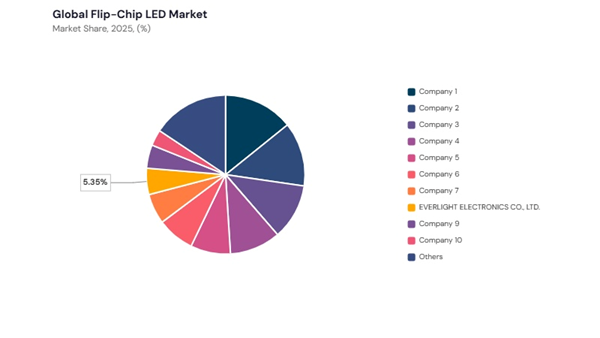
The Flip-Chip LED Market demonstrates a moderately consolidated competitive structure supported by a combination of global LED manufacturers, semiconductor packaging providers, display technology companies, and advanced optoelectronics suppliers. Market leaders continue to strengthen their positions through investments in mini-LED and micro-LED technologies, automotive lighting innovation, display advancements, and manufacturing scale optimization. The market remains highly innovation-oriented, with competition increasingly focused on luminous efficiency, thermal performance, packaging precision, yield optimization, and next-generation display integration. Strategic partnerships, technology development, production expansion, and localization initiatives continue to shape competitive dynamics across the industry.
Material Outlook
Based on Material, the market is segmented into GaN, AlGaInP, and Other Materials. The GaN market dominated the Global Flip-Chip LED Market by Material in 2025, and is expected to continue to be a dominant market till 2033; thereby, achieving a market value of USD 7.97 billion by 2033, growing at a CAGR of 9.5 % during the forecast period. The AlGaInP market is expected to witness a CAGR of 10.5% during 2026-2033. Additionally, the Other Material market is expected to witness highest CAGR of 10.8% during 2026-2033.
GaN remains the dominant material category owing to its superior electron mobility, thermal stability, and efficiency characteristics that support high-brightness lighting, automotive applications, displays, and ultraviolet LED solutions. AlGaInP continues to play an important role in red, orange, and yellow wavelength applications including automotive signaling, displays, and traffic systems. Meanwhile, emerging materials are gaining attention for specialized applications such as infrared sensing, biomedical devices, phototherapy, and advanced optical systems, supporting ongoing innovation across the Flip-Chip LED ecosystem.
Wavelength Outlook
Based on Wavelength, the market is categorized into Blue, White, Red, Green, and Other Wavelengths. The Blue market dominated the Global Flip-Chip LED Market by Wavelength in 2025, and is expected to continue to be a dominant market till 2033; thereby, achieving a market value of USD 6.17 billion by 2033, growing at a CAGR of 9.4 % during the forecast period. The White market is expected to witness a CAGR of 9.9% during 2026-2033. The Other Wavelength market is expected to witness a CAGR of 11.9% during 2026-2033.White and Blue wavelength LEDs continue to account for a significant portion of market demand due to their widespread use in general illumination, display backlighting, consumer electronics, and automotive lighting. Red and Green LEDs maintain strong demand across signage, displays, automotive applications, and industrial systems. Other wavelengths, including ultraviolet and infrared LEDs, are witnessing growing adoption in sterilization, sensing, healthcare, communication, and industrial automation applications, creating new opportunities for market expansion.
Power Class Outlook
Based on Power Class, the market is segmented into Low Power, Mid Power, and High Power. The Low Power market dominated the Global Flip-Chip LED Market by Power Class in 2025, and is expected to continue to be a dominant market till 2033; thereby, achieving a market value of USD 6.98 billion by 2033, growing at a CAGR of 9.5 % during the forecast period. The Mid Power market is expected to witness a CAGR of 10.5% during 2026-2033.Low-power Flip-Chip LEDs are extensively utilized in consumer electronics, indicators, and compact display applications requiring energy-efficient illumination. Mid-power LEDs support a broad range of automotive, commercial lighting, and display applications through balanced performance and thermal management capabilities. High-power Flip-Chip LEDs continue to witness growing demand in industrial lighting, automotive headlamps, horticulture lighting, UV applications, and specialized illumination systems where high brightness and reliability are critical.
Application Outlook
Based on Application, the market is divided into General Lighting, Automotive Lighting, Displays & Signage, Backlighting, and Other Applications. The General Lighting market dominated the Global Flip-Chip LED Market by Application in 2025, and is expected to continue to be a dominant market till 2033; thereby, achieving a market value of USD 6.66 billion by 2033, growing at a CAGR of 9.4 % during the forecast period. The Automotive Lighting market is expected to witness a CAGR of 9.8% during 2026-2033.General lighting continues to represent a major application segment driven by increasing adoption of energy-efficient lighting systems. Automotive lighting remains a key growth area supported by the expansion of adaptive lighting technologies, electric vehicles, and advanced safety systems. Displays and signage benefit from growing demand for fine-pitch LED displays, mini-LEDs, and micro-LED technologies. Backlighting applications continue to expand across consumer electronics and display manufacturing, while other applications including UV sterilization, horticulture lighting, healthcare devices, and optical sensing are creating additional growth opportunities.
Regional Outlook
Region-wise, the Flip-Chip LED Market is analyzed across North America, Europe, Asia Pacific, and LAMEA. The Asia Pacific market dominated the Global Flip-Chip LED Market by Region in 2025, and is expected to continue to be a dominant market till 2033; thereby, achieving a market value of USD 7.35 billion by 2033, growing at a CAGR of 10.3 % during the forecast period. The North America market is expected to witness a CAGR of 9.2% during 2026-2033.
Asia Pacific represents the leading regional market due to its strong semiconductor manufacturing ecosystem, concentration of LED production facilities, and rapidly expanding display and electronics industries. North America continues to benefit from advanced technology adoption, automotive innovation, and increasing investments in next-generation display solutions. Europe maintains strong demand supported by automotive manufacturing, industrial automation, and energy-efficient lighting initiatives. LAMEA is witnessing gradual expansion driven by infrastructure development, smart city projects, and increasing adoption of advanced lighting technologies.
Flip-Chip LED Market Coverage
Recent Strategies Deployed in the Market
- Seoul Semiconductor introduced a natural-light LED technology platform designed to replicate sunlight characteristics while improving lighting efficiency and user comfort.
- ams OSRAM expanded its MicroLED technology portfolio focused on intelligent illumination, automotive lighting, and next-generation display applications.
- Samsung expanded advanced LED display solutions utilizing Flip-Chip technologies to improve brightness efficiency and visual performance.
- LG Innotek expanded automotive lighting innovations through advanced LED technologies supporting vehicle safety and adaptive illumination systems.
- Tata Electronics and ASML entered into a strategic technology agreement supporting semiconductor manufacturing expansion and advanced packaging capabilities.
- Major LED display and semiconductor manufacturers expanded advanced display technologies across global markets to strengthen market penetration and supply chain capabilities.
List of Key Companies Profiled
- Samsung Electronics Co., Ltd.
- NICHIA Corporation
- Seoul Semiconductor Co., Ltd.
- ams-OSRAM AG
- Koninklijke Philips N.V.
- Ennostar Corporation
- LG Innotek Co., Ltd.
- EVERLIGHT Electronics Co., Ltd.
- Penguin Solutions, Inc.
- Amkor Technology, Inc.
Market Report Segmentation
By Material- GaN
- AlGaInP
- Other Materials
- Blue
- White
- Red
- Green
- Other Wavelengths
- Low Power
- Mid Power
- High Power
- General Lighting
- Automotive Lighting
- Displays & Signage
- Backlighting
- Other Applications
- North America
- US
- Canada
- Mexico
- Rest of North America
- Europe
- Germany
- UK
- France
- Russia
- Spain
- Italy
- Rest of Europe
- Asia Pacific
- China
- Japan
- India
- South Korea
- Singapore
- Malaysia
- Rest of Asia Pacific
- LAMEA
- Brazil
- Argentina
- UAE
- Saudi Arabia
- South Africa
- Nigeria
- Rest of LAMEA
Table of Contents
Chapter 1. Research Scope & Methodology
Chapter 2. Market Overview
Chapter 3. Key Factors Impacting Market
Chapter 6. Competition Analysis - Global
Chapter 7. Segmentation By Material
Chapter 8. Segmentation By Wavelength
Chapter 9. Segmentation By Power Class
Chapter 10. Segmentation By Application
Chapter 11. North America Market
Chapter 12. Europe Market
Chapter 13. Asia Pacific Market
Chapter 14. LAMEA Market
Chapter 15. Company Snapshot
Chapter 16. Winning Imperatives of Flip-Chip LED Market
Chapter 14. LAMEA Market
Chapter 15. Company Snapshot
Chapter 16. Winning Imperatives of Flip-Chip LED Market
Chapter 15. Company Snapshot
Companies Mentioned
• Samsung Electronics Co., Ltd.• NICHIA Corporation
• Seoul Semiconductor Co., Ltd.
• ams-OSRAM AG
• Koninklijke Philips N.V.
• Ennostar Corporation
• LG Innotek Co., Ltd.
• EVERLIGHT Electronics Co., Ltd.
• Penguin Solutions, Inc.
• Amkor Technology, Inc.


