+353-1-416-8900REST OF WORLD
+44-20-3973-8888REST OF WORLD
1-917-300-0470EAST COAST U.S
1-800-526-8630U.S. (TOLL FREE)

Global Database Security Market Size, Share & Industry Analysis Report by Deployment Mode, Organization Size, Solution Type, Industry Vertical, Regional Outlook and Forecast, 2026-2033

  • PDF Icon

    Report

  • 776 Pages
  • May 2026
  • Marqual IT Solutions Pvt. Ltd (KBV Research)
  • ID: 6276041
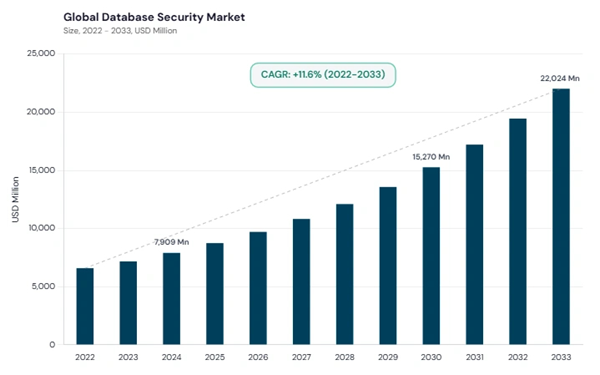
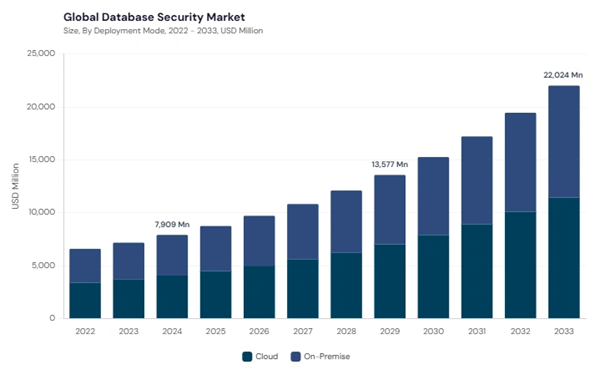
The Global Database Security Market size is expected to reach USD 22.02 Billion by 2033, rising at a market growth of 12.4% CAGR during the forecast period.


The market is advancing as organizations strengthen protection around structured and unstructured data across hybrid, cloud, and on-premise database environments. Rising compliance demands, cloud migration, and AI-led threat detection are expanding the role of database security from a technical control layer into a core enterprise risk function.

Key Market Trends & Insights

  • North America dominated the global market in 2025 with a 39.80% revenue share and is projected to reach USD 7.50 billion by 2032.
  • Cloud accounted for the largest deployment share at 51.40% in 2025 and is expected to reach USD 10.09 billion by 2032.
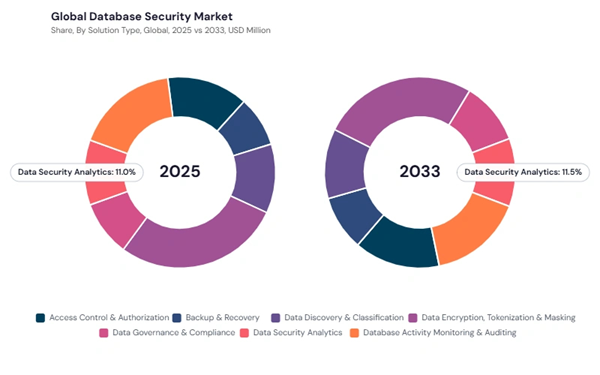
  • Data Encryption, Tokenization & Masking dominated solution type in 2025 with a 28.22% share and is projected to reach USD 5.16 billion by 2032.
  • Large Enterprises accounted for 63.45% of market revenue in 2025 and are projected to reach USD 12.01 billion by 2032.
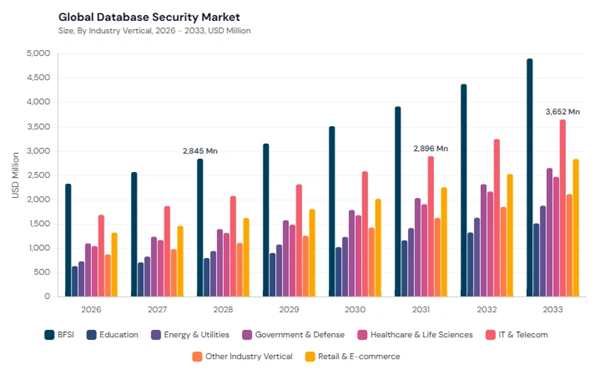
  • BFSI led the industry vertical landscape with a 24.22% revenue share in 2025 and is expected to reach USD 4.90 billion by 2033.
  • Asia Pacific is expected to remain the faster-growing major region, with a 13.1% CAGR through 2033 as digital transformation and cyber-risk exposure rise across the region.
The database security market originated from the growing need to protect sensitive information stored in enterprise databases as digital systems became central to business operations. Basic access control and authentication methods gave way to more sophisticated approaches such as encryption, monitoring, masking, and vulnerability assessment as data volumes and database complexity increased.


Today the market serves a wide set of industries including BFSI, IT & Telecom, Retail & E-commerce, Government & Defense, Healthcare & Life Sciences, Energy & Utilities, Education, and other data-intensive sectors. As more workloads move into cloud and hybrid architectures, database security has become more intelligent, more distributed, and more tightly aligned with governance, risk, and compliance requirements.

Leading vendors are investing in AI-driven analytics, behavioral monitoring, automated remediation, and privacy-enhancing technologies to improve real-time response and reduce operational complexity. Partnerships with cloud providers, compliance specialists, and broader cybersecurity ecosystems remain central to product expansion, while localization and cloud-native architecture investment are helping vendors capture growth across highly regulated and fast-digitizing markets.

Driving and Restraining Factors

Drivers
  • Increasing Regulatory Compliance Requirements and Data Privacy Concerns
  • Rising Incidence and Sophistication of Cyberattacks Targeting Databases
  • Digital Transformation and Cloud Migration Accelerating Database Security Needs
  • Growing Adoption of Artificial Intelligence and Machine Learning for Enhanced Database Security
Restraints
  • Regulatory Complexity and Compliance Burden
  • High Cost of Implementation and Operational Maintenance
  • Technical Challenges Posed by Diverse and Disparate Database Environments
Opportunities
  • Advancement of AI-Driven Database Security Solutions
  • Expansion of Database Security Solutions for Cloud and Hybrid Architectures
  • Regulatory Compliance and Data Privacy-Driven Security Enhancements
Challenges
  • Complex Regulatory Compliance Burdens in Database Security
  • Integration and Interoperability Challenges Across Heterogeneous Database Environments
  • High Cost and Resource Intensiveness of Advanced Database Security Solutions

Market Share Analysis

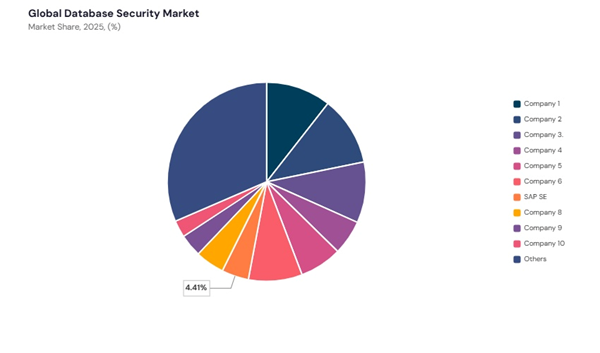
The global Database Security market is moderately fragmented, with the top ten companies accounting for about 68.52% of total market revenue and the remaining 31.48% held by other providers. Oracle leads with approximately 11.22% share, supported by its database-native position and integrated security features. IBM follows, while Microsoft holds 9.91%, reflecting strong traction for enterprise and cloud-first security platforms.


A second competitive layer includes Thales Group, Fortinet, and McAfee, representing the data protection and broader cybersecurity stack. SAP and OpenText hold notable positions inside enterprise application and compliance-led environments, while Cisco and Huawei contribute from the infrastructure and telecom security layer. Future share movement is likely to be driven by cloud adoption, AI-led threat detection, and stronger data-centric security approaches across hybrid environments.

Deployment Mode Outlook

Cloud deployment is increasingly central to the Database Security market because it supports scalability, flexible provisioning, and easier alignment with distributed enterprise architectures. It dominated the market in 2025 and remains the leading deployment model as organizations protect data across multi-cloud and SaaS-heavy environments. On-premise security still holds a large role because many buyers need stronger control over sensitive datasets, infrastructure governance, and data sovereignty, especially in regulated sectors.

Solution Type Outlook

Solution demand is led by Data Encryption, Tokenization & Masking, which continues to anchor the market because securing data at rest and in transit remains a foundational requirement. Database Activity Monitoring & Auditing also maintains strong relevance where visibility, accountability, and compliance reporting are essential. Access Control & Authorization is expected to grow the fastest, reflecting a broader shift toward zero-trust architectures and identity-centric enforcement in modern database environments.

Organization Size Outlook

Based on organization size, the Database Security Market is segmented into Large Enterprises and Small & Medium-sized Enterprises (SMEs). The Large Enterprises segment held the largest revenue share of 63.45% in 2025, supported by high data volumes, complex IT environments, and strong investments in advanced security frameworks to address cyber threats and compliance requirements. The SMEs segment is witnessing rising demand as smaller businesses increasingly recognize the importance of protecting sensitive data. The growing availability of cloud-based database security solutions is making advanced protection more accessible to SMEs, while increasing cyberattack incidents and regulatory pressures continue to support adoption across this segment.

Industry Vertical Outlook

BFSI remains the leading vertical because financial institutions handle highly sensitive customer and transaction data under constant regulatory and cyber-risk pressure. IT & Telecom also contributes substantial demand because of scale, network complexity, and heavy cloud usage. Retail & E-commerce is emerging as one of the stronger growth areas as digital commerce expands and organizations place more emphasis on securing payment, customer, and behavioral data across fast-moving transactional systems.

Regional Outlook

North America dominated the Database Security Market by region in 2025 with a 39.80% revenue share, supported by strong adoption of advanced cybersecurity technologies and the presence of major market players. Organizations across the region continue to prioritize data protection, regulatory compliance, and early adoption of innovative security solutions. Europe accounted for 28.20% of the market in 2025, driven by strict data protection regulations and growing enterprise investments in robust database security frameworks.


Asia Pacific is seeing strong momentum due to rapid digital transformation, rising cyber threats, and expanding cloud and IT infrastructure. LAMEA share remains smaller, increasing awareness of cybersecurity risks, rising digitalization, and growing investments in infrastructure and security solutions are supporting steady market expansion.

Market Competition and Attributes

Competition in database security is shaped by a layered mix of database-native vendors, broader cybersecurity firms, and cloud platform providers. Product differentiation increasingly depends on how well vendors combine encryption, monitoring, access control, analytics, and compliance reporting into a scalable operating model.

Innovation is strongest around AI, zero-trust controls, and integrated data-centric security frameworks. Buyers want tools that can work across hybrid and multi-cloud environments without losing visibility or policy consistency, which keeps interoperability and ecosystem partnerships near the center of vendor strategy.

Pricing pressure is also present, especially as vendors compete for mid-market and cloud-first buyers. This is encouraging more modular product packaging, flexible deployment models, and managed-service support to broaden adoption without weakening core protection capabilities.

Database Security Market Coverage:
Recent Strategies Deployed In The Market

  • June 2025: Thales Group - Launched File Activity Monitoring for unstructured data security, extending real-time visibility and insider-risk detection across hybrid environments.
  • November 2025: Cisco Systems - Expanded its secure infrastructure strategy with embedded data protection for hybrid enterprise environments, improving continuous monitoring and automated threat detection.
  • March 2026: Huawei - Introduced cloud-native database innovation for financial data security in Thailand, combining encryption, monitoring, and AI-driven security for regulated workloads.
  • March 2022: Huawei - Expanded cloud-based data infrastructure for secure telecom data environments, strengthening scalable protection for large-volume communications data.
  • February 2026: Cisco Systems - Donated Project CodeGuard to the Coalition for Secure AI to strengthen software supply chain and AI-driven data security, reinforcing protection around data-intensive platforms.

List of Key Companies Profiled

  • Oracle Corporation
  • IBM Corporation
  • Microsoft Corporation
  • Thales Group S.A.
  • Fortinet, Inc.
  • McAfee, LLC
  • SAP SE
  • OpenText Corporation
  • Cisco Systems, Inc.
  • Huawei Technologies Co., Ltd.

Market Report Segmentation

By Deployment Mode
  • Cloud
  • On-Premise
By Solution Type
  • Data Encryption, Tokenization & Masking
  • Database Activity Monitoring & Auditing
  • Access Control & Authorization
  • Data Security Analytics
  • Data Governance & Compliance
  • Backup & Recovery
  • Data Discovery & Classification
By Organization Size
  • Large Enterprises
  • Small & Medium-sized Enterprises (SMEs)
By Industry Vertical
  • BFSI
  • IT & Telecom
  • Retail & E-commerce
  • Government & Defense
  • Healthcare & Life Sciences
  • Energy & Utilities
  • Education
  • Other Industry Vertical
By Geography
  • North America
    • US
    • Canada
    • Mexico
    • Rest of North America

  • Europe
    • Germany
    • UK
    • France
    • Russia
    • Spain
    • Italy
    • Rest of Europe

  • Asia Pacific
    • China
    • Japan
    • India
    • South Korea
    • Singapore
    • Malaysia
    • Rest of Asia Pacific

  • LAMEA
    • Brazil
    • Argentina
    • UAE
    • Saudi Arabia
    • South Africa
    • Nigeria
    • Rest of LAMEA

Table of Contents

Chapter 1. Global Market Overview
1.1 COVID-19 Impact
1.2 Market Composition and Scenario
Chapter 2. Key Factors Impacting Market
2.1.1 Market Drivers
2.1.2 Market Restraints
2.1.3 Market Opportunities
2.1.4 Market Challenges
2.1.5 Market Trends
2.1.6 State of Competition
2.1.7 Market Consolidation
2.1.8 Key Customer Criteria
Chapter 3. Product Life CycleChapter 4. Value Chain Analysis of Database Security Market
Chapter 5. Competition Analysis - Global
5.1 Market Share Analysis
5.2 Recent Development and Strategies
5.2.1 Product Launch & Product Expansion
5.2.2 Partnership, Collaboration & Agreements
Chapter 6. Segmentation By Deployment Mode
6.1 Cloud
6.2 On-Premise
Chapter 7. Segmentation By Organization Size
7.1 Large Enterprises
7.2 Small & Medium-sized Enterprises (SMEs)
Chapter 8. Segmentation By Solution Type
8.1 Data Discovery & Classification
8.2 Data Encryption, Tokenization & Masking
8.3 Database Activity Monitoring & Auditing
8.4 Access Control & Authorization
8.5 Data Security Analytics
8.6 Backup & Recovery
8.7 Data Governance & Compliance
Chapter 9. Segmentation By Industry Vertical
9.1 BFSI
9.2 IT & Telecom
9.3 Retail & E-commerce
9.4 Government & Defense
9.5 Healthcare & Life Sciences
9.6 Energy & Utilities
9.7 Education
9.8 Other Industry Vertical
Chapter 10. North America Market
10.1 Market Overview
10.2 Key Factors Impacting Market
10.2.1 Market Drivers
10.2.2 Market Restraints
10.2.3 Market Opportunities
10.2.4 Market Challenges
10.2.5 Market Trends
10.2.6 State of Competition
10.2.7 Market Consolidation
10.2.8 Key Customer Criteria
10.3 Product Life Cycle
10.4 Segmentation By Deployment Mode
10.4.1 Cloud
10.4.2 On-Premise
10.5 Segmentation By Organization Size
10.5.1 Large Enterprises
10.5.2 Small & Medium-sized Enterprises (SMEs)
10.6 Segmentation By Solution Type
10.6.1 Data Discovery & Classification
10.6.2 Data Encryption, Tokenization & Masking
10.6.3 Database Activity Monitoring & Auditing
10.6.4 Access Control & Authorization
10.6.5 Data Security Analytics
10.6.6 Backup & Recovery
10.6.7 Data Governance & Compliance
10.7 Segmentation By Industry Vertical
10.7.1 BFSI
10.7.2 IT & Telecom
10.7.3 Retail & E-commerce
10.7.4 Government & Defense
10.7.5 Healthcare & Life Sciences
10.7.6 Energy & Utilities
10.7.7 Education
10.7.8 Other Industry Vertical
10.8 Segmentation By Country
10.8.1 US
10.8.1.1 Segmentation By Deployment Mode
10.8.1.1.1 Cloud
10.8.1.1.2 On-Premise
10.8.1.2 Segmentation By Organization Size
10.8.1.2.1 Large Enterprises
10.8.1.2.2 Small & Medium-sized Enterprises (SMEs)
10.8.1.3 Segmentation By Solution Type
10.8.1.3.1 Data Discovery & Classification
10.8.1.3.2 Data Encryption, Tokenization & Masking
10.8.1.3.3 Database Activity Monitoring & Auditing
10.8.1.3.4 Access Control & Authorization
10.8.1.3.5 Data Security Analytics
10.8.1.3.6 Backup & Recovery
10.8.1.3.7 Data Governance & Compliance
10.8.1.4 Segmentation By Industry Vertical
10.8.1.4.1 BFSI
10.8.1.4.2 IT & Telecom
10.8.1.4.3 Retail & E-commerce
10.8.1.4.4 Government & Defense
10.8.1.4.5 Healthcare & Life Sciences
10.8.1.4.6 Energy & Utilities
10.8.1.4.7 Education
10.8.1.4.8 Other Industry Vertical
10.8.2 Canada
10.8.2.1 Segmentation By Deployment Mode
10.8.2.1.1 Cloud
10.8.2.1.2 On-Premise
10.8.2.2 Segmentation By Organization Size
10.8.2.2.1 Large Enterprises
10.8.2.2.2 Small & Medium-sized Enterprises (SMEs)
10.8.2.3 Segmentation By Solution Type
10.8.2.3.1 Data Discovery & Classification
10.8.2.3.2 Data Encryption, Tokenization & Masking
10.8.2.3.3 Database Activity Monitoring & Auditing
10.8.2.3.4 Access Control & Authorization
10.8.2.3.5 Data Security Analytics
10.8.2.3.6 Backup & Recovery
10.8.2.3.7 Data Governance & Compliance
10.8.2.4 Segmentation By Industry Vertical
10.8.2.4.1 BFSI
10.8.2.4.2 IT & Telecom
10.8.2.4.3 Retail & E-commerce
10.8.2.4.4 Government & Defense
10.8.2.4.5 Healthcare & Life Sciences
10.8.2.4.6 Energy & Utilities
10.8.2.4.7 Education
10.8.2.4.8 Other Industry Vertical
10.8.3 Mexico
10.8.3.1 Segmentation By Deployment Mode
10.8.3.1.1 Cloud
10.8.3.1.2 On-Premise
10.8.3.2 Segmentation By Organization Size
10.8.3.2.1 Large Enterprises
10.8.3.2.2 Small & Medium-sized Enterprises (SMEs)
10.8.3.3 Segmentation By Solution Type
10.8.3.3.1 Data Discovery & Classification
10.8.3.3.2 Data Encryption, Tokenization & Masking
10.8.3.3.3 Database Activity Monitoring & Auditing
10.8.3.3.4 Access Control & Authorization
10.8.3.3.5 Data Security Analytics
10.8.3.3.6 Backup & Recovery
10.8.3.3.7 Data Governance & Compliance
10.8.3.4 Segmentation By Industry Vertical
10.8.3.4.1 BFSI
10.8.3.4.2 IT & Telecom
10.8.3.4.3 Retail & E-commerce
10.8.3.4.4 Government & Defense
10.8.3.4.5 Healthcare & Life Sciences
10.8.3.4.6 Energy & Utilities
10.8.3.4.7 Education
10.8.3.4.8 Other Industry Vertical
10.8.4 Rest of North America
10.8.4.1 Segmentation By Deployment Mode
10.8.4.1.1 Cloud
10.8.4.1.2 On-Premise
10.8.4.2 Segmentation By Organization Size
10.8.4.2.1 Large Enterprises
10.8.4.2.2 Small & Medium-sized Enterprises (SMEs)
10.8.4.3 Segmentation By Solution Type
10.8.4.3.1 Data Discovery & Classification
10.8.4.3.2 Data Encryption, Tokenization & Masking
10.8.4.3.3 Database Activity Monitoring & Auditing
10.8.4.3.4 Access Control & Authorization
10.8.4.3.5 Data Security Analytics
10.8.4.3.6 Backup & Recovery
10.8.4.3.7 Data Governance & Compliance
10.8.4.4 Segmentation By Industry Vertical
10.8.4.4.1 BFSI
10.8.4.4.2 IT & Telecom
10.8.4.4.3 Retail & E-commerce
10.8.4.4.4 Government & Defense
10.8.4.4.5 Healthcare & Life Sciences
10.8.4.4.6 Energy & Utilities
10.8.4.4.7 Education
10.8.4.4.8 Other Industry Vertical
Chapter 11. Europe Market
11.1 Market Overview
11.2 Key Factors Impacting Market
11.2.1 Market Drivers
11.2.2 Market Restraints
11.2.3 Market Opportunities
11.2.4 Market Challenges
11.2.5 Market Trends
11.2.6 State of Competition
11.2.7 Market Consolidation
11.2.8 Key Customer Criteria
11.3 Product Life Cycle
11.4 Segmentation By Deployment Mode
11.4.1 Cloud
11.4.2 On-Premise
11.5 Segmentation By Organization Size
11.5.1 Large Enterprises
11.5.2 Small & Medium-sized Enterprises (SMEs)
11.6 Segmentation By Solution Type
11.6.1 Data Discovery & Classification
11.6.2 Data Encryption, Tokenization & Masking
11.6.3 Database Activity Monitoring & Auditing
11.6.4 Access Control & Authorization
11.6.5 Data Security Analytics
11.6.6 Backup & Recovery
11.6.7 Data Governance & Compliance
11.7 Segmentation By Industry Vertical
11.7.1 BFSI
11.7.2 IT & Telecom
11.7.3 Retail & E-commerce
11.7.4 Government & Defense
11.7.5 Healthcare & Life Sciences
11.7.6 Energy & Utilities
11.7.7 Education
11.7.8 Other Industry Vertical
11.8 Segmentation By Country
11.8.1 Germany
11.8.1.1 Segmentation By Deployment Mode
11.8.1.1.1 Cloud
11.8.1.1.2 On-Premise
11.8.1.2 Segmentation By Organization Size
11.8.1.2.1 Large Enterprises
11.8.1.2.2 Small & Medium-sized Enterprises (SMEs)
11.8.1.3 Segmentation By Solution Type
11.8.1.3.1 Data Discovery & Classification
11.8.1.3.2 Data Encryption, Tokenization & Masking
11.8.1.3.3 Database Activity Monitoring & Auditing
11.8.1.3.4 Access Control & Authorization
11.8.1.3.5 Data Security Analytics
11.8.1.3.6 Backup & Recovery
11.8.1.3.7 Data Governance & Compliance
11.8.1.4 Segmentation By Industry Vertical
11.8.1.4.1 BFSI
11.8.1.4.2 IT & Telecom
11.8.1.4.3 Retail & E-commerce
11.8.1.4.4 Government & Defense
11.8.1.4.5 Healthcare & Life Sciences
11.8.1.4.6 Energy & Utilities
11.8.1.4.7 Education
11.8.1.4.8 Other Industry Vertical
11.8.2 UK
11.8.2.1 Segmentation By Deployment Mode
11.8.2.1.1 Cloud
11.8.2.1.2 On-Premise
11.8.2.2 Segmentation By Organization Size
11.8.2.2.1 Large Enterprises
11.8.2.2.2 Small & Medium-sized Enterprises (SMEs)
11.8.2.3 Segmentation By Solution Type
11.8.2.3.1 Data Discovery & Classification
11.8.2.3.2 Data Encryption, Tokenization & Masking
11.8.2.3.3 Database Activity Monitoring & Auditing
11.8.2.3.4 Access Control & Authorization
11.8.2.3.5 Data Security Analytics
11.8.2.3.6 Backup & Recovery
11.8.2.3.7 Data Governance & Compliance
11.8.2.4 Segmentation By Industry Vertical
11.8.2.4.1 BFSI
11.8.2.4.2 IT & Telecom
11.8.2.4.3 Retail & E-commerce
11.8.2.4.4 Government & Defense
11.8.2.4.5 Healthcare & Life Sciences
11.8.2.4.6 Energy & Utilities
11.8.2.4.7 Education
11.8.2.4.8 Other Industry Vertical
11.8.3 France
11.8.3.1 Segmentation By Deployment Mode
11.8.3.1.1 Cloud
11.8.3.1.2 On-Premise
11.8.3.2 Segmentation By Organization Size
11.8.3.2.1 Large Enterprises
11.8.3.2.2 Small & Medium-sized Enterprises (SMEs)
11.8.3.3 Segmentation By Solution Type
11.8.3.3.1 Data Discovery & Classification
11.8.3.3.2 Data Encryption, Tokenization & Masking
11.8.3.3.3 Database Activity Monitoring & Auditing
11.8.3.3.4 Access Control & Authorization
11.8.3.3.5 Data Security Analytics
11.8.3.3.6 Backup & Recovery
11.8.3.3.7 Data Governance & Compliance
11.8.3.4 Segmentation By Industry Vertical
11.8.3.4.1 BFSI
11.8.3.4.2 IT & Telecom
11.8.3.4.3 Retail & E-commerce
11.8.3.4.4 Government & Defense
11.8.3.4.5 Healthcare & Life Sciences
11.8.3.4.6 Energy & Utilities
11.8.3.4.7 Education
11.8.3.4.8 Other Industry Vertical
11.8.4 Russia
11.8.4.1 Segmentation By Deployment Mode
11.8.4.1.1 Cloud
11.8.4.1.2 On-Premise
11.8.4.2 Segmentation By Organization Size
11.8.4.2.1 Large Enterprises
11.8.4.2.2 Small & Medium-sized Enterprises (SMEs)
11.8.4.3 Segmentation By Solution Type
11.8.4.3.1 Data Discovery & Classification
11.8.4.3.2 Data Encryption, Tokenization & Masking
11.8.4.3.3 Database Activity Monitoring & Auditing
11.8.4.3.4 Access Control & Authorization
11.8.4.3.5 Data Security Analytics
11.8.4.3.6 Backup & Recovery
11.8.4.3.7 Data Governance & Compliance
11.8.4.4 Segmentation By Industry Vertical
11.8.4.4.1 BFSI
11.8.4.4.2 IT & Telecom
11.8.4.4.3 Retail & E-commerce
11.8.4.4.4 Government & Defense
11.8.4.4.5 Healthcare & Life Sciences
11.8.4.4.6 Energy & Utilities
11.8.4.4.7 Education
11.8.4.4.8 Other Industry Vertical
11.8.5 Spain
11.8.5.1 Segmentation By Deployment Mode
11.8.5.1.1 Cloud
11.8.5.1.2 On-Premise
11.8.5.2 Segmentation By Organization Size
11.8.5.2.1 Large Enterprises
11.8.5.2.2 Small & Medium-sized Enterprises (SMEs)
11.8.5.3 Segmentation By Solution Type
11.8.5.3.1 Data Discovery & Classification
11.8.5.3.2 Data Encryption, Tokenization & Masking
11.8.5.3.3 Database Activity Monitoring & Auditing
11.8.5.3.4 Access Control & Authorization
11.8.5.3.5 Data Security Analytics
11.8.5.3.6 Backup & Recovery
11.8.5.3.7 Data Governance & Compliance
11.8.5.4 Segmentation By Industry Vertical
11.8.5.4.1 BFSI
11.8.5.4.2 IT & Telecom
11.8.5.4.3 Retail & E-commerce
11.8.5.4.4 Government & Defense
11.8.5.4.5 Healthcare & Life Sciences
11.8.5.4.6 Energy & Utilities
11.8.5.4.7 Education
11.8.5.4.8 Other Industry Vertical
11.8.6 Italy
11.8.6.1 Segmentation By Deployment Mode
11.8.6.1.1 Cloud
11.8.6.1.2 On-Premise
11.8.6.2 Segmentation By Organization Size
11.8.6.2.1 Large Enterprises
11.8.6.2.2 Small & Medium-sized Enterprises (SMEs)
11.8.6.3 Segmentation By Solution Type
11.8.6.3.1 Data Discovery & Classification
11.8.6.3.2 Data Encryption, Tokenization & Masking
11.8.6.3.3 Database Activity Monitoring & Auditing
11.8.6.3.4 Access Control & Authorization
11.8.6.3.5 Data Security Analytics
11.8.6.3.6 Backup & Recovery
11.8.6.3.7 Data Governance & Compliance
11.8.6.4 Segmentation By Industry Vertical
11.8.6.4.1 BFSI
11.8.6.4.2 IT & Telecom
11.8.6.4.3 Retail & E-commerce
11.8.6.4.4 Government & Defense
11.8.6.4.5 Healthcare & Life Sciences
11.8.6.4.6 Energy & Utilities
11.8.6.4.7 Education
11.8.6.4.8 Other Industry Vertical
11.8.7 Rest of Europe
11.8.7.1 Segmentation By Deployment Mode
11.8.7.1.1 Cloud
11.8.7.1.2 On-Premise
11.8.7.2 Segmentation By Organization Size
11.8.7.2.1 Large Enterprises
11.8.7.2.2 Small & Medium-sized Enterprises (SMEs)
11.8.7.3 Segmentation By Solution Type
11.8.7.3.1 Data Discovery & Classification
11.8.7.3.2 Data Encryption, Tokenization & Masking
11.8.7.3.3 Database Activity Monitoring & Auditing
11.8.7.3.4 Access Control & Authorization
11.8.7.3.5 Data Security Analytics
11.8.7.3.6 Backup & Recovery
11.8.7.3.7 Data Governance & Compliance
11.8.7.4 Segmentation By Industry Vertical
11.8.7.4.1 BFSI
11.8.7.4.2 IT & Telecom
11.8.7.4.3 Retail & E-commerce
11.8.7.4.4 Government & Defense
11.8.7.4.5 Healthcare & Life Sciences
11.8.7.4.6 Energy & Utilities
11.8.7.4.7 Education
11.8.7.4.8 Other Industry Vertical
Chapter 12. Asia Pacific Market
12.1 Market Overview
12.2 Key Factors Impacting Market
12.2.1 Market Drivers
12.2.2 Market Restraints
12.2.3 Market Opportunities
12.2.4 Market Challenges
12.2.5 Market Trends
12.2.6 State of Competition
12.2.7 Market Consolidation
12.2.8 Key Customer Criteria
12.3 Product Life Cycle
12.4 Segmentation By Deployment Mode
12.4.1 Cloud
12.4.2 On-Premise
12.5 Segmentation By Organization Size
12.5.1 Large Enterprises
12.5.2 Small & Medium-sized Enterprises (SMEs)
12.6 Segmentation By Solution Type
12.6.1 Data Discovery & Classification
12.6.2 Data Encryption, Tokenization & Masking
12.6.3 Database Activity Monitoring & Auditing
12.6.4 Access Control & Authorization
12.6.5 Data Security Analytics
12.6.6 Backup & Recovery
12.6.7 Data Governance & Compliance
12.7 Segmentation By Industry Vertical
12.7.1 BFSI
12.7.2 IT & Telecom
12.7.3 Retail & E-commerce
12.7.4 Government & Defense
12.7.5 Healthcare & Life Sciences
12.7.6 Energy & Utilities
12.7.7 Education
12.7.8 Other Industry Vertical
12.8 Segmentation By Country
12.8.1 China
12.8.1.1 Segmentation By Deployment Mode
12.8.1.1.1 Cloud
12.8.1.1.2 On-Premise
12.8.1.2 Segmentation By Organization Size
12.8.1.2.1 Large Enterprises
12.8.1.2.2 Small & Medium-sized Enterprises (SMEs)
12.8.1.3 Segmentation By Solution Type
12.8.1.3.1 Data Discovery & Classification
12.8.1.3.2 Data Encryption, Tokenization & Masking
12.8.1.3.3 Database Activity Monitoring & Auditing
12.8.1.3.4 Access Control & Authorization
12.8.1.3.5 Data Security Analytics
12.8.1.3.6 Backup & Recovery
12.8.1.3.7 Data Governance & Compliance
12.8.1.4 Segmentation By Industry Vertical
12.8.1.4.1 BFSI
12.8.1.4.2 IT & Telecom
12.8.1.4.3 Retail & E-commerce
12.8.1.4.4 Government & Defense
12.8.1.4.5 Healthcare & Life Sciences
12.8.1.4.6 Energy & Utilities
12.8.1.4.7 Education
12.8.1.4.8 Other Industry Vertical
12.8.2 Japan
12.8.2.1 Segmentation By Deployment Mode
12.8.2.1.1 Cloud
12.8.2.1.2 On-Premise
12.8.2.2 Segmentation By Organization Size
12.8.2.2.1 Large Enterprises
12.8.2.2.2 Small & Medium-sized Enterprises (SMEs)
12.8.2.3 Segmentation By Solution Type
12.8.2.3.1 Data Discovery & Classification
12.8.2.3.2 Data Encryption, Tokenization & Masking
12.8.2.3.3 Database Activity Monitoring & Auditing
12.8.2.3.4 Access Control & Authorization
12.8.2.3.5 Data Security Analytics
12.8.2.3.6 Backup & Recovery
12.8.2.3.7 Data Governance & Compliance
12.8.2.4 Segmentation By Industry Vertical
12.8.2.4.1 BFSI
12.8.2.4.2 IT & Telecom
12.8.2.4.3 Retail & E-commerce
12.8.2.4.4 Government & Defense
12.8.2.4.5 Healthcare & Life Sciences
12.8.2.4.6 Energy & Utilities
12.8.2.4.7 Education
12.8.2.4.8 Other Industry Vertical
12.8.3 India
12.8.3.1 Segmentation By Deployment Mode
12.8.3.1.1 Cloud
12.8.3.1.2 On-Premise
12.8.3.2 Segmentation By Organization Size
12.8.3.2.1 Large Enterprises
12.8.3.2.2 Small & Medium-sized Enterprises (SMEs)
12.8.3.3 Segmentation By Solution Type
12.8.3.3.1 Data Discovery & Classification
12.8.3.3.2 Data Encryption, Tokenization & Masking
12.8.3.3.3 Database Activity Monitoring & Auditing
12.8.3.3.4 Access Control & Authorization
12.8.3.3.5 Data Security Analytics
12.8.3.3.6 Backup & Recovery
12.8.3.3.7 Data Governance & Compliance
12.8.3.4 Segmentation By Industry Vertical
12.8.3.4.1 BFSI
12.8.3.4.2 IT & Telecom
12.8.3.4.3 Retail & E-commerce
12.8.3.4.4 Government & Defense
12.8.3.4.5 Healthcare & Life Sciences
12.8.3.4.6 Energy & Utilities
12.8.3.4.7 Education
12.8.3.4.8 Other Industry Vertical
12.8.4 South Korea
12.8.4.1 Segmentation By Deployment Mode
12.8.4.1.1 Cloud
12.8.4.1.2 On-Premise
12.8.4.2 Segmentation By Organization Size
12.8.4.2.1 Large Enterprises
12.8.4.2.2 Small & Medium-sized Enterprises (SMEs)
12.8.4.3 Segmentation By Solution Type
12.8.4.3.1 Data Discovery & Classification
12.8.4.3.2 Data Encryption, Tokenization & Masking
12.8.4.3.3 Database Activity Monitoring & Auditing
12.8.4.3.4 Access Control & Authorization
12.8.4.3.5 Data Security Analytics
12.8.4.3.6 Backup & Recovery
12.8.4.3.7 Data Governance & Compliance
12.8.4.4 Segmentation By Industry Vertical
12.8.4.4.1 BFSI
12.8.4.4.2 IT & Telecom
12.8.4.4.3 Retail & E-commerce
12.8.4.4.4 Government & Defense
12.8.4.4.5 Healthcare & Life Sciences
12.8.4.4.6 Energy & Utilities
12.8.4.4.7 Education
12.8.4.4.8 Other Industry Vertical
12.8.5 Singapore
12.8.5.1 Segmentation By Deployment Mode
12.8.5.1.1 Cloud
12.8.5.1.2 On-Premise
12.8.5.2 Segmentation By Organization Size
12.8.5.2.1 Large Enterprises
12.8.5.2.2 Small & Medium-sized Enterprises (SMEs)
12.8.5.3 Segmentation By Solution Type
12.8.5.3.1 Data Discovery & Classification
12.8.5.3.2 Data Encryption, Tokenization & Masking
12.8.5.3.3 Database Activity Monitoring & Auditing
12.8.5.3.4 Access Control & Authorization
12.8.5.3.5 Data Security Analytics
12.8.5.3.6 Backup & Recovery
12.8.5.3.7 Data Governance & Compliance
12.8.5.4 Segmentation By Industry Vertical
12.8.5.4.1 BFSI
12.8.5.4.2 IT & Telecom
12.8.5.4.3 Retail & E-commerce
12.8.5.4.4 Government & Defense
12.8.5.4.5 Healthcare & Life Sciences
12.8.5.4.6 Energy & Utilities
12.8.5.4.7 Education
12.8.5.4.8 Other Industry Vertical
12.8.6 Malaysia
12.8.6.1 Segmentation By Deployment Mode
12.8.6.1.1 Cloud
12.8.6.1.2 On-Premise
12.8.6.2 Segmentation By Organization Size
12.8.6.2.1 Large Enterprises
12.8.6.2.2 Small & Medium-sized Enterprises (SMEs)
12.8.6.3 Segmentation By Solution Type
12.8.6.3.1 Data Discovery & Classification
12.8.6.3.2 Data Encryption, Tokenization & Masking
12.8.6.3.3 Database Activity Monitoring & Auditing
12.8.6.3.4 Access Control & Authorization
12.8.6.3.5 Data Security Analytics
12.8.6.3.6 Backup & Recovery
12.8.6.3.7 Data Governance & Compliance
12.8.6.4 Segmentation By Industry Vertical
12.8.6.4.1 BFSI
12.8.6.4.2 IT & Telecom
12.8.6.4.3 Retail & E-commerce
12.8.6.4.4 Government & Defense
12.8.6.4.5 Healthcare & Life Sciences
12.8.6.4.6 Energy & Utilities
12.8.6.4.7 Education
12.8.6.4.8 Other Industry Vertical
12.8.7 Rest of Asia Pacific
12.8.7.1 Segmentation By Deployment Mode
12.8.7.1.1 Cloud
12.8.7.1.2 On-Premise
12.8.7.2 Segmentation By Organization Size
12.8.7.2.1 Large Enterprises
12.8.7.2.2 Small & Medium-sized Enterprises (SMEs)
12.8.7.3 Segmentation By Solution Type
12.8.7.3.1 Data Discovery & Classification
12.8.7.3.2 Data Encryption, Tokenization & Masking
12.8.7.3.3 Database Activity Monitoring & Auditing
12.8.7.3.4 Access Control & Authorization
12.8.7.3.5 Data Security Analytics
12.8.7.3.6 Backup & Recovery
12.8.7.3.7 Data Governance & Compliance
12.8.7.4 Segmentation By Industry Vertical
12.8.7.4.1 BFSI
12.8.7.4.2 IT & Telecom
12.8.7.4.3 Retail & E-commerce
12.8.7.4.4 Government & Defense
12.8.7.4.5 Healthcare & Life Sciences
12.8.7.4.6 Energy & Utilities
12.8.7.4.7 Education
12.8.7.4.8 Other Industry Vertical
Chapter 13. LAMEA Market
13.1 Market Overview
13.2 Key Factors Impacting Market
13.2.1 Market Drivers
13.2.2 Market Restraints
13.2.3 Market Opportunities
13.2.4 Market Challenges
13.2.5 Market Trends
13.2.6 State of Competition
13.2.7 Market Consolidation
13.2.8 Key Customer Criteria
13.3 Product Life Cycle
13.4 Segmentation By Deployment Mode
13.4.1 Cloud
13.4.2 On-Premise
13.5 Segmentation By Organization Size
13.5.1 Large Enterprises
13.5.2 Small & Medium-sized Enterprises (SMEs)
13.6 Segmentation By Solution Type
13.6.1 Data Discovery & Classification
13.6.2 Data Encryption, Tokenization & Masking
13.6.3 Database Activity Monitoring & Auditing
13.6.4 Access Control & Authorization
13.6.5 Data Security Analytics
13.6.6 Backup & Recovery
13.6.7 Data Governance & Compliance
13.7 Segmentation By Industry Vertical
13.7.1 BFSI
13.7.2 IT & Telecom
13.7.3 Retail & E-commerce
13.7.4 Government & Defense
13.7.5 Healthcare & Life Sciences
13.7.6 Energy & Utilities
13.7.7 Education
13.7.8 Other Industry Vertical
13.8 Segmentation By Country
13.8.1 Brazil
13.8.1.1 Segmentation By Deployment Mode
13.8.1.1.1 Cloud
13.8.1.1.2 On-Premise
13.8.1.2 Segmentation By Organization Size
13.8.1.2.1 Large Enterprises
13.8.1.2.2 Small & Medium-sized Enterprises (SMEs)
13.8.1.3 Segmentation By Solution Type
13.8.1.3.1 Data Discovery & Classification
13.8.1.3.2 Data Encryption, Tokenization & Masking
13.8.1.3.3 Database Activity Monitoring & Auditing
13.8.1.3.4 Access Control & Authorization
13.8.1.3.5 Data Security Analytics
13.8.1.3.6 Backup & Recovery
13.8.1.3.7 Data Governance & Compliance
13.8.1.4 Segmentation By Industry Vertical
13.8.1.4.1 BFSI
13.8.1.4.2 IT & Telecom
13.8.1.4.3 Retail & E-commerce
13.8.1.4.4 Government & Defense
13.8.1.4.5 Healthcare & Life Sciences
13.8.1.4.6 Energy & Utilities
13.8.1.4.7 Education
13.8.1.4.8 Other Industry Vertical
13.8.2 Argentina
13.8.2.1 Segmentation By Deployment Mode
13.8.2.1.1 Cloud
13.8.2.1.2 On-Premise
13.8.2.2 Segmentation By Organization Size
13.8.2.2.1 Large Enterprises
13.8.2.2.2 Small & Medium-sized Enterprises (SMEs)
13.8.2.3 Segmentation By Solution Type
13.8.2.3.1 Data Discovery & Classification
13.8.2.3.2 Data Encryption, Tokenization & Masking
13.8.2.3.3 Database Activity Monitoring & Auditing
13.8.2.3.4 Access Control & Authorization
13.8.2.3.5 Data Security Analytics
13.8.2.3.6 Backup & Recovery
13.8.2.3.7 Data Governance & Compliance
13.8.2.4 Segmentation By Industry Vertical
13.8.2.4.1 BFSI
13.8.2.4.2 IT & Telecom
13.8.2.4.3 Retail & E-commerce
13.8.2.4.4 Government & Defense
13.8.2.4.5 Healthcare & Life Sciences
13.8.2.4.6 Energy & Utilities
13.8.2.4.7 Education
13.8.2.4.8 Other Industry Vertical
13.8.3 UAE
13.8.3.1 Segmentation By Deployment Mode
13.8.3.1.1 Cloud
13.8.3.1.2 On-Premise
13.8.3.2 Segmentation By Organization Size
13.8.3.2.1 Large Enterprises
13.8.3.2.2 Small & Medium-sized Enterprises (SMEs)
13.8.3.3 Segmentation By Solution Type
13.8.3.3.1 Data Discovery & Classification
13.8.3.3.2 Data Encryption, Tokenization & Masking
13.8.3.3.3 Database Activity Monitoring & Auditing
13.8.3.3.4 Access Control & Authorization
13.8.3.3.5 Data Security Analytics
13.8.3.3.6 Backup & Recovery
13.8.3.3.7 Data Governance & Compliance
13.8.3.4 Segmentation By Industry Vertical
13.8.3.4.1 BFSI
13.8.3.4.2 IT & Telecom
13.8.3.4.3 Retail & E-commerce
13.8.3.4.4 Government & Defense
13.8.3.4.5 Healthcare & Life Sciences
13.8.3.4.6 Energy & Utilities
13.8.3.4.7 Education
13.8.3.4.8 Other Industry Vertical
13.8.4 Saudi Arabia
13.8.4.1 Segmentation By Deployment Mode
13.8.4.1.1 Cloud
13.8.4.1.2 On-Premise
13.8.4.2 Segmentation By Organization Size
13.8.4.2.1 Large Enterprises
13.8.4.2.2 Small & Medium-sized Enterprises (SMEs)
13.8.4.3 Segmentation By Solution Type
13.8.4.3.1 Data Discovery & Classification
13.8.4.3.2 Data Encryption, Tokenization & Masking
13.8.4.3.3 Database Activity Monitoring & Auditing
13.8.4.3.4 Access Control & Authorization
13.8.4.3.5 Data Security Analytics
13.8.4.3.6 Backup & Recovery
13.8.4.3.7 Data Governance & Compliance
13.8.4.4 Segmentation By Industry Vertical
13.8.4.4.1 BFSI
13.8.4.4.2 IT & Telecom
13.8.4.4.3 Retail & E-commerce
13.8.4.4.4 Government & Defense
13.8.4.4.5 Healthcare & Life Sciences
13.8.4.4.6 Energy & Utilities
13.8.4.4.7 Education
13.8.4.4.8 Other Industry Vertical
13.8.5 South Africa
13.8.5.1 Segmentation By Deployment Mode
13.8.5.1.1 Cloud
13.8.5.1.2 On-Premise
13.8.5.2 Segmentation By Organization Size
13.8.5.2.1 Large Enterprises
13.8.5.2.2 Small & Medium-sized Enterprises (SMEs)
13.8.5.3 Segmentation By Solution Type
13.8.5.3.1 Data Discovery & Classification
13.8.5.3.2 Data Encryption, Tokenization & Masking
13.8.5.3.3 Database Activity Monitoring & Auditing
13.8.5.3.4 Access Control & Authorization
13.8.5.3.5 Data Security Analytics
13.8.5.3.6 Backup & Recovery
13.8.5.3.7 Data Governance & Compliance
13.8.5.4 Segmentation By Industry Vertical
13.8.5.4.1 BFSI
13.8.5.4.2 IT & Telecom
13.8.5.4.3 Retail & E-commerce
13.8.5.4.4 Government & Defense
13.8.5.4.5 Healthcare & Life Sciences
13.8.5.4.6 Energy & Utilities
13.8.5.4.7 Education
13.8.5.4.8 Other Industry Vertical
13.8.6 Nigeria
13.8.6.1 Segmentation By Deployment Mode
13.8.6.1.1 Cloud
13.8.6.1.2 On-Premise
13.8.6.2 Segmentation By Organization Size
13.8.6.2.1 Large Enterprises
13.8.6.2.2 Small & Medium-sized Enterprises (SMEs)
13.8.6.3 Segmentation By Solution Type
13.8.6.3.1 Data Discovery & Classification
13.8.6.3.2 Data Encryption, Tokenization & Masking
13.8.6.3.3 Database Activity Monitoring & Auditing
13.8.6.3.4 Access Control & Authorization
13.8.6.3.5 Data Security Analytics
13.8.6.3.6 Backup & Recovery
13.8.6.3.7 Data Governance & Compliance
13.8.6.4 Segmentation By Industry Vertical
13.8.6.4.1 BFSI
13.8.6.4.2 IT & Telecom
13.8.6.4.3 Retail & E-commerce
13.8.6.4.4 Government & Defense
13.8.6.4.5 Healthcare & Life Sciences
13.8.6.4.6 Energy & Utilities
13.8.6.4.7 Education
13.8.6.4.8 Other Industry Vertical
13.8.7 Rest of LAMEA
13.8.7.1 Segmentation By Deployment Mode
13.8.7.1.1 Cloud
13.8.7.1.2 On-Premise
13.8.7.2 Segmentation By Organization Size
13.8.7.2.1 Large Enterprises
13.8.7.2.2 Small & Medium-sized Enterprises (SMEs)
13.8.7.3 Segmentation By Solution Type
13.8.7.3.1 Data Discovery & Classification
13.8.7.3.2 Data Encryption, Tokenization & Masking
13.8.7.3.3 Database Activity Monitoring & Auditing
13.8.7.3.4 Access Control & Authorization
13.8.7.3.5 Data Security Analytics
13.8.7.3.6 Backup & Recovery
13.8.7.3.7 Data Governance & Compliance
13.8.7.4 Segmentation By Industry Vertical
13.8.7.4.1 BFSI
13.8.7.4.2 IT & Telecom
13.8.7.4.3 Retail & E-commerce
13.8.7.4.4 Government & Defense
13.8.7.4.5 Healthcare & Life Sciences
13.8.7.4.6 Energy & Utilities
13.8.7.4.7 Education
13.8.7.4.8 Other Industry Vertical
Chapter 14. Company Snapshot
14.1 IBM Corporation
14.1.1 Business Overview
14.1.2 Key Information
14.1.3 Company Focus
14.1.4 Strategic Insights
14.1.5 Strategy Deployed
14.1.6 Product & Service Portfolio
14.1.7 Capability Overview
14.1.8 Technology & Innovation Focus
14.1.9 Customers / End Users
14.1.10 Competitive Positioning
14.1.11 Key Differentiators
14.1.12 Portfolio Matrix
14.1.13 SWOT Analysis
14.1.14 Future Outlook
14.2 Oracle Corporation
14.2.1 Business Overview
14.2.2 Key Information
14.2.3 Company Focus
14.2.4 Strategic Insights
14.2.5 Strategy Deployed
14.2.6 Product & Service Portfolio
14.2.7 Capability Overview
14.2.8 Technology & Innovation Focus
14.2.9 Customers / End Users
14.2.10 Competitive Positioning
14.2.11 Key Differentiators
14.2.12 Portfolio Matrix
14.2.13 SWOT Analysis
14.2.14 Future Outlook
14.3 Microsoft Corporation
14.3.1 Business Overview
14.3.2 Key Information
14.3.3 Company Focus
14.3.4 Strategic Insights
14.3.5 Strategy Deployed
14.3.6 Product & Service Portfolio
14.3.7 Capability Overview
14.3.8 Technology & Innovation Focus
14.3.9 Customers / End Users
14.3.10 Competitive Positioning
14.3.11 Key Differentiators
14.3.12 Portfolio Matrix
14.3.13 SWOT Analysis
14.3.14 Future Outlook
14.4 McAfee Corp.
14.4.1 Business Overview
14.4.2 Key Information
14.4.3 Company Focus
14.4.4 Strategic Insights
14.4.5 Strategy Deployed
14.4.6 Product & Service Portfolio
14.4.7 Capability Overview
14.4.8 Technology & Innovation Focus
14.4.9 Customers / End Users
14.4.10 Competitive Positioning
14.4.11 Key Differentiators
14.4.12 Portfolio Matrix
14.4.13 SWOT Analysis
14.4.14 Future Outlook
14.5 Fortinet, Inc.
14.5.1 Business Overview
14.5.2 Key Information
14.5.3 Company Focus
14.5.4 Strategic Insights
14.5.5 Strategy Deployed
14.5.6 Product & Service Portfolio
14.5.7 Capability Overview
14.5.8 Technology & Innovation Focus
14.5.9 Customers / End Users
14.5.10 Competitive Positioning
14.5.11 Key Differentiators
14.5.12 Portfolio Matrix
14.5.13 SWOT Analysis
14.5.14 Future Outlook
14.6 Thales Group S.A.
14.6.1 Business Overview
14.6.2 Key Information
14.6.3 Company Focus
14.6.4 Strategic Insights
14.6.5 Strategy Deployed
14.6.6 Product & Service Portfolio
14.6.7 Capability Overview
14.6.8 Technology & Innovation Focus
14.6.9 Customers / End Users
14.6.10 Competitive Positioning
14.6.11 Key Differentiators
14.6.12 Portfolio Matrix
14.6.13 SWOT Analysis
14.6.14 Future Outlook
14.7 SAP SE
14.7.1 Business Overview
14.7.2 Key Information
14.7.3 Company Focus
14.7.4 Strategic Insights
14.7.5 Strategy Deployed
14.7.6 Product & Service Portfolio
14.7.7 Capability Overview
14.7.8 Technology & Innovation Focus
14.7.9 Customers / End Users
14.7.10 Competitive Positioning
14.7.11 Key Differentiators
14.7.12 Portfolio Matrix
14.7.13 SWOT Analysis
14.7.14 Future Outlook
14.8 Open Text Corporation
14.8.1 Business Overview
14.8.2 Key Information
14.8.3 Company Focus
14.8.4 Strategic Insights
14.8.5 Strategy Deployed
14.8.6 Product & Service Portfolio
14.8.7 Capability Overview
14.8.8 Technology & Innovation Focus
14.8.9 Customers / End Users
14.8.10 Competitive Positioning
14.8.11 Key Differentiators
14.8.12 Portfolio Matrix
14.8.13 SWOT Analysis
14.8.14 Future Outlook
14.9 Cisco Systems, Inc.
14.9.1 Business Overview
14.9.2 Key Information
14.9.3 Company Focus
14.9.4 Strategic Insights
14.9.5 Strategy Deployed
14.9.6 Product & Service Portfolio
14.9.7 Capability Overview
14.9.8 Technology & Innovation Focus
14.9.9 Customers / End Users
14.9.10 Competitive Positioning
14.9.11 Key Differentiators
14.9.12 Portfolio Matrix
14.9.13 SWOT Analysis
14.9.14 Future Outlook
14.10 Huawei Technologies Co., Ltd. (Huawei Investment & Holding Co., Ltd.)
14.10.1 Business Overview
14.10.2 Key Information
14.10.3 Company Focus
14.10.4 Strategic Insights
14.10.5 Strategy Deployed
14.10.6 Product & Service Portfolio
14.10.7 Capability Overview
14.10.8 Technology & Innovation Focus
14.10.9 Customers / End Users
14.10.10 Competitive Positioning
14.10.11 Key Differentiators
14.10.12 Portfolio Matrix
14.10.13 SWOT Analysis
14.10.14 Future Outlook
Chapter 15. Winning Imperatives of Database Security Market

Companies Mentioned

  • Oracle Corporation
  • IBM Corporation
  • Microsoft Corporation
  • Thales Group S.A.
  • Fortinet, Inc.
  • McAfee, LLC
  • SAP SE
  • OpenText Corporation
  • Cisco Systems, Inc.
  • Huawei Technologies Co., Ltd.