

+353-1-416-8900REST OF WORLD
+44-20-3973-8888REST OF WORLD
1-917-300-0470EAST COAST U.S
1-800-526-8630U.S. (TOLL FREE)

Global Scalp Massager Devices Market Size, Share & Industry Analysis Report by Type, Power Source, Application, End-User, Regional Outlook and Forecast, 2026-2033

  • PDF Icon

    Report

  • 575 Pages
  • June 2026
  • Marqual IT Solutions Pvt. Ltd (KBV Research)
  • ID: 6276049
The Global Scalp Massager Devices Market is expected to reach USD 1.13 billion by 2033, growing at a CAGR of 7.1% during 2026-2033.


The Global Scalp Massager Devices Market has evolved from traditional manual scalp massage tools into a technologically advanced personal wellness and haircare category. Initially developed as simple handheld devices designed to stimulate the scalp and improve relaxation, scalp massagers have progressively incorporated ergonomic designs, motorized functions, vibration technologies, and intelligent features that enhance user comfort and effectiveness. Growing awareness regarding scalp health, hair wellness, and preventive personal care has transformed these devices from basic grooming accessories into integral components of modern self-care routines. The market continues to benefit from increasing consumer interest in non-invasive wellness solutions that support relaxation, scalp stimulation, and overall haircare management.

Key Market Trends & Insights

  • Electric scalp massagers dominated the market in 2025, generating USD 408.5 million, representing approximately 61.6% of total market revenue.
  • Manual scalp massagers are projected to grow faster (7.4% CAGR) than electric devices (6.9% CAGR) through 2033.
  • Asia Pacific was the largest regional market in 2025, valued at USD 228.5 million, ahead of North America (USD 207.0 million) and Europe (USD 173.6 million).
  • Asia Pacific is expected to remain the largest regional market by 2033, reaching USD 404.1 million, while LAMEA will record the fastest regional growth rate of 8.3% CAGR.
  • By power source, Rechargeable devices held the largest share in 2025 with USD 367.7 million, accounting for more than 55% of market revenue.
  • Corded Electric Devices are forecast to be the fastest-growing power-source segment, expanding at 8.3% CAGR from 2026 to 2033.
  • Hair Growth & Anti-Hair Loss was the leading application segment in 2025, generating USD 226.3 million and remaining the largest application through 2033.
  • Stress Relief & Relaxation is expected to be the fastest-growing major application segment, registering a 7.6% CAGR during the forecast period.
  • Individual Consumers accounted for the majority of demand in 2025 with USD 536.8 million (about 81% of total market revenue), while the Professional Use segment is projected to grow faster at 8.4% CAGR through 2033.

The market is experiencing significant transformation driven by rising awareness of scalp health, increasing adoption of wellness-oriented personal care devices, and growing consumer demand for convenient at-home beauty solutions. Manufacturers are investing heavily in product innovation, incorporating features such as adjustable massage modes, rechargeable batteries, waterproof designs, heat therapy, and smart connectivity. Furthermore, the convergence of beauty, wellness, and technology is encouraging the development of multifunctional scalp care devices that provide therapeutic, cosmetic, and relaxation benefits simultaneously. Strategic partnerships, product innovation initiatives, and expanding e-commerce distribution channels continue to support market growth globally.

The Scalp Massager Devices Market is characterized by a moderately fragmented competitive landscape comprising personal care device manufacturers, wellness technology providers, beauty brands, and scalp health specialists. Competition is driven by product innovation, ergonomic design, functionality, pricing strategies, brand reputation, and distribution reach. Market participants are actively investing in research and development to introduce advanced massage technologies, smart features, and enhanced user experiences. Strategic partnerships, digital marketing initiatives, product diversification, and geographic expansion continue to shape competitive dynamics across the industry.

Driving and Restraining Factors

Drivers
  • Increased Consumer Awareness of Scalp Health and Hair Care Benefits
  • Rise in Integration of Advanced Technologies in Personal Care Devices
  • Expanding Wellness and Self-Care Trends Amid Lifestyle Changes
  • Increasing Availability through Diverse Distribution Channels and Marketing Initiatives
Restraints
  • Regulatory Compliance and Safety Certification Challenges
  • High Production and Performance Cost Constraints
  • Consumer Skepticism and Limited Awareness Regarding Efficacy
Opportunities
  • Advanced Integration of Smart Wearable Technology in Scalp Massager Devices
  • Rising Demand for Scalp Wellness Amid Beauty and Self-Care Trends
  • Expansion Through Eco-Friendly and Sustainable Product Innovations
Challenges
  • Limited Consumer Awareness and Skepticism Regarding Efficacy
  • Cost Constraints and Affordability Barriers
  • Regulatory and Safety Compliance Complexities

Market Share Analysis
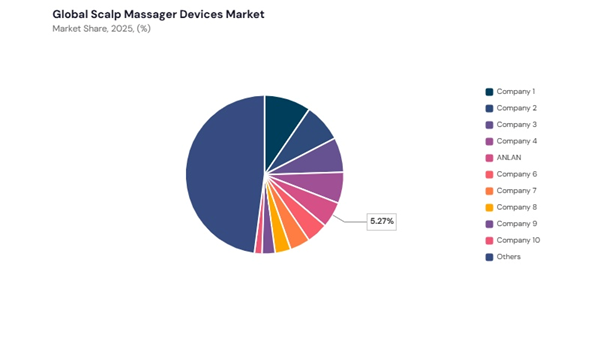


The Scalp Massager Devices Market exhibits a highly fragmented and innovation-driven competitive environment. Competition is shaped by technological advancements, ergonomic improvements, wellness-focused product positioning, and expanding digital retail channels. Market participants continuously focus on enhancing user experience through advanced vibration systems, smart connectivity, waterproof designs, and therapeutic functionalities. The growing influence of wellness trends, scalp health awareness, and premium personal care solutions continues to encourage innovation and strategic differentiation among market participants.

Type Outlook


Based on Type, the market is segmented into Electric and Manual. The Electric market dominated the Global Scalp Massager Devices Market by Type in 2025, and is expected to continue to be a dominant market till 2033; thereby, achieving a market value of USD 688.8 Million by 2033, growing at a CAGR of 6.9 % during the forecast period. The Manual market is expected to witness a CAGR of 7.4% during 2026-2033.

Electric scalp massagers represent a major segment owing to increasing consumer preference for automated scalp care solutions offering enhanced convenience, multiple massage modes, vibration functions, and ergonomic designs. The segment continues to benefit from technological advancements and growing consumer demand for premium wellness devices. Manual scalp massagers maintain significant demand due to their affordability, portability, simplicity, and compatibility with natural scalp care routines. Consumers seeking accessible and easy-to-use scalp stimulation solutions continue to support growth within this segment.

Power Source Outlook

Based on Power Source, the market is segmented into Rechargeable, Battery-operated, and Corded Electric Devices. The Rechargeable market dominated the Global Scalp Massager Devices Market by Power Source in 2025, and is expected to continue to be a dominant market till 2033; thereby, achieving a market value of USD 607.3 Million by 2033, growing at a CAGR of 6.6 % during the forecast period. The Battery-operated market is expected to witness a CAGR of 7.5% during 2026-2033. The Corded Electric Devices market is expected to witness a CAGR of 8.3% during 2026-2033.

Rechargeable devices are witnessing strong adoption due to their portability, sustainability benefits, convenience, and compatibility with modern charging technologies. Battery-operated devices remain popular among consumers seeking immediate usability, portability, and operational flexibility without charging requirements. Corded Electric Devices continue to attract users who prioritize uninterrupted operation, consistent performance, and extended massage sessions. Manufacturers are continuously improving efficiency, ergonomics, and user experience across all power source categories to address evolving consumer preferences.

Application Outlook

Based on Application, the market is segmented into Hair Growth & Anti-Hair Loss, Scalp Health & Dandruff Control, Stress Relief & Relaxation, and Other Applications. The Hair Growth & Anti-Hair Loss market dominated the Global Scalp Massager Devices Market by Application in 2025, and is expected to continue to be a dominant market till 2033; thereby, achieving a market value of USD 371 Million by 2033, growing at a CAGR of 6.5 % during the forecast period. The Scalp Health & Dandruff Control market is expected to witness a CAGR of 6.9% during 2026-2033.

Hair Growth & Anti-Hair Loss applications continue to gain traction as consumers increasingly seek non-invasive solutions to support scalp circulation and healthier hair conditions. Scalp Health & Dandruff Control applications benefit from growing awareness regarding scalp hygiene and preventive haircare practices. Stress Relief & Relaxation remains an important segment driven by increasing consumer interest in wellness-oriented self-care products that support relaxation and tension reduction. Other Applications include scalp stimulation, product absorption enhancement, and general grooming support, reflecting the expanding versatility of scalp massager devices.

End-User Outlook

Based on End-User, the market is segmented into Individual Consumer and Professional Use. The Individual Consumer segment dominates the market due to growing adoption of at-home wellness and personal care routines. Consumers increasingly utilize scalp massagers for relaxation, scalp maintenance, haircare support, and overall wellness enhancement. The Professional Use segment is gaining momentum through adoption by salons, spas, wellness centers, and scalp treatment clinics seeking to enhance customer experiences and provide specialized scalp care services. Growing investment in premium wellness and beauty treatments continues to support demand within professional settings.

Regional Outlook


Region-wise, the Scalp Massager Devices Market is analyzed across North America, Europe, Asia Pacific, and LAMEA. The Asia Pacific market dominated the Global Scalp Massager Devices Market by Region in 2025, and is expected to continue to be a dominant market till 2033; thereby, achieving a market value of USD 404.1 Million by 2033, growing at a CAGR of 7.6% during the forecast period. The North America market is expected to witness a CAGR of 6.5% during 2026-2033. Additionally, the Europe market is expected to witness a CAGR of 6.9% during 2026-2033.

Asia Pacific represents a leading regional market due to growing awareness of scalp health, strong beauty and wellness cultures, increasing disposable incomes, and expanding adoption of personal care technologies. North America continues to witness strong demand supported by high consumer spending on wellness products and increasing interest in advanced scalp care solutions. Europe benefits from growing demand for premium grooming products, preventive scalp care practices, and wellness-focused beauty routines. LAMEA is experiencing increasing adoption supported by urbanization, expanding access to personal care products, and rising awareness regarding scalp wellness benefits.

Scalp Massager Devices Market Coverage:

Recent Strategies Deployed in the Market

  • Breo launched the LumiHeal Pro FDA-cleared laser scalp massager designed to support scalp stimulation, wellness-focused therapy, and hair wellness management.
  • Panasonic expanded its healthy living and personal wellness technology portfolio through the introduction of wellness-focused consumer innovations.
  • Vegamour strengthened its hair wellness positioning through expansion of scalp care and hair wellness product offerings.
  • Beauty and wellness brands increased collaborations with influencers and digital creators to promote scalp wellness routines and scalp massage technologies.
  • Companies expanded social commerce initiatives across platforms such as TikTok, Instagram, and YouTube to improve consumer education and product visibility.
  • Scalp wellness and hair therapy device providers expanded international market presence through e-commerce and digital retail channels.
  • Manufacturers increased investments in smart features, ergonomic improvements, and multifunctional scalp care technologies.
  • Companies strengthened product portfolios through integration of vibration technologies, heat therapy, and personalized massage functions.

List of Key Companies Profiled

  • Breo-Official
  • Panasonic Holdings Corporation
  • HoMedics (FKA Distributing)
  • Comfier
  • ANLAN
  • VEGAMOUR LLC
  • Denman Inc.
  • Jupiter (Zero Flakes Given)
  • Shenzhen FREATACH Technology
  • LEONOR GREYL

Market Report Segmentation

By Type
  • Electric
  • Manual
By Power Source
  • Rechargeable
  • Battery-operated
  • Corded Electric Devices
By Application
  • Hair Growth & Anti-Hair Loss
  • Scalp Health & Dandruff Control
  • Stress Relief & Relaxation
  • Other Applications
By End-User
  • Individual Consumer
  • Professional Use
By Geography
  • North America
    • US
    • Canada
    • Mexico
    • Rest of North America

  • Europe
    • Germany
    • UK
    • France
    • Russia
    • Spain
    • Italy
    • Rest of Europe

  • Asia Pacific
    • China
    • Japan
    • India
    • South Korea
    • Singapore
    • Malaysia
    • Rest of Asia Pacific

  • LAMEA
    • Brazil
    • Argentina
    • UAE
    • Saudi Arabia
    • South Africa
    • Nigeria
    • Rest of LAMEA

Table of Contents

Chapter 1. Research Scope & Methodology
1.1 Market Definition
1.2 Analysis Period & Currency
1.3 Segmentation
1.4 Scalp Massager Devices Market, by Geography
1.5 Research Methodology
Chapter 2. Market Overview
2.1 COVID-19
2.2 Market Composition and Scenario
Chapter 3. Key Factors Impacting Market
3.1 Market Drivers
3.2 Market Restraints
3.3 Market Opportunities
3.4 Market Challenges
3.5 Market Trends
3.6 State of Competition
3.7 Market Consolidation
3.8 Key Customer Criteria
Chapter 4. Product Life CycleChapter 5. Value Chain Analysis of Scalp Massager Devices Market
Chapter 6. Competition Analysis - Global
6.1 Market Share Analysis
6.2 Recent Developments and Strategies
6.2.1 Product Launch & Product Expansion
6.2.2 Partnership, Collaboration & Agreements
6.2.3 Geographical Expansion
Chapter 7. Segmentation By Type
7.1 Manual
7.2 Electric Scalp
Chapter 8. Segmentation By Power Source
8.1 Rechargeable
8.2 Battery-operated
8.3 Corded Electric Devices
Chapter 9. Segmentation By Application
9.1 Hair Growth & Anti-Hair Loss
9.2 Scalp Health & Dandruff Control
9.3 Stress Relief & Relaxation
9.4 Other Application
Chapter 10. Segmentation By End-User
10.1 Individual Consumer
10.2 Professional Use
Chapter 11. North America Market
11.1 Market Overview
11.2 Key Factors Impacting Market
11.2.1 Market Drivers
11.2.2 Market Restraints
11.2.3 Market Opportunities
11.2.4 Market Challenges
11.2.5 Market Trends
11.2.6 State of Competition
11.2.7 Market Consolidation
11.2.8 Key Customer Criteria
11.3 Product Life Cycle
11.4 Segmentation By Type
11.4.1 Electric
11.4.2 Manual
11.5 Segmentation By Power Source
11.5.1 Rechargeable
11.5.2 Battery-Operated
11.5.3 Corded Electric
11.6 Segmentation By Application
11.6.1 Hair Growth & Anti-Hair Loss
11.6.2 Scalp Health & Dandruff Control
11.6.3 Stress Relief & Relaxation
11.6.4 Other Application
11.7 Segmentation By End-User
11.7.1 Individual Consumer
11.7.2 Professional Use
11.8 Segmentation By Country
11.8.1 US
11.8.1.1 Segmentation By Type
11.8.1.1.1 Electric
11.8.1.1.2 Manual
11.8.1.2 Segmentation By Power Source
11.8.1.2.1 Rechargeable Scalp
11.8.1.2.2 Battery-operated
11.8.1.2.3 Corded Electric Devices
11.8.1.3 Segmentation By Application
11.8.1.3.1 Hair Growth & Anti-Hair Loss
11.8.1.3.2 Scalp Health & Dandruff Control
11.8.1.3.3 Stress Relief & Relaxation
11.8.1.3.4 Other Application
11.8.1.4 Segmentation By End-User
11.8.1.4.1 Individual Consumer
11.8.1.4.2 Professional Use
11.8.2 Canada
11.8.2.1 Segmentation By Type
11.8.2.1.1 Electric
11.8.2.1.2 Manual
11.8.2.2 Segmentation By Power Source
11.8.2.2.1 Rechargeable Scalp
11.8.2.2.2 Battery-operated
11.8.2.2.3 Corded Electric Devices
11.8.2.3 Segmentation By Application
11.8.2.3.1 Hair Growth & Anti-Hair Loss
11.8.2.3.2 Scalp Health & Dandruff Control
11.8.2.3.3 Stress Relief & Relaxation
11.8.2.3.4 Other Application
11.8.2.4 Segmentation By End-User
11.8.2.4.1 Individual Consumer
11.8.2.4.2 Professional Use
11.8.3 Mexico
11.8.3.1 Segmentation By Type
11.8.3.1.1 Electric
11.8.3.1.2 Manual
11.8.3.2 Segmentation By Power Source
11.8.3.2.1 Rechargeable Scalp
11.8.3.2.2 Battery-operated
11.8.3.2.3 Corded Electric Devices
11.8.3.3 Segmentation By Application
11.8.3.3.1 Hair Growth & Anti-Hair Loss
11.8.3.3.2 Scalp Health & Dandruff Control
11.8.3.3.3 Stress Relief & Relaxation
11.8.3.3.4 Other Application
11.8.3.4 Segmentation By End-User
11.8.3.4.1 Individual Consumer
11.8.3.4.2 Professional Use
11.8.4 Rest of North America
11.8.4.1 Segmentation By Type
11.8.4.1.1 Electric
11.8.4.1.2 Manual
11.8.4.2 Segmentation By Power Source
11.8.4.2.1 Rechargeable Scalp
11.8.4.2.2 Battery-operated
11.8.4.2.3 Corded Electric Devices
11.8.4.3 Segmentation By Application
11.8.4.3.1 Hair Growth & Anti-Hair Loss
11.8.4.3.2 Scalp Health & Dandruff Control
11.8.4.3.3 Stress Relief & Relaxation
11.8.4.3.4 Other Application
11.8.4.4 Segmentation By End-User
11.8.4.4.1 Individual Consumer
11.8.4.4.2 Professional Use
Chapter 12. Europe Market
12.1 Market Overview
12.2 Key Factors Impacting Market
12.2.1 Market Drivers
12.2.2 Market Restraints
12.2.3 Market Opportunities
12.2.4 Market Challenges
12.2.5 Market Trends
12.2.6 State of Competition
12.2.7 Market Consolidation
12.2.8 Key Customer Criteria
12.3 Product Life Cycle
12.4 Segmentation By Type
12.4.1 Electric
12.4.2 Manual
12.5 Segmentation By Power Source
12.5.1 Rechargeable
12.5.2 Battery-operated
12.5.3 Corded Electric
12.6 Segmentation By Application
12.6.1 Hair Growth & Anti-Hair Loss
12.6.2 Scalp Health & Dandruff Control
12.6.3 Stress Relief & Relaxation
12.6.4 Other Application
12.7 Segmentation By End-User
12.7.1 Individual Consumer
12.7.2 Professional Use
12.8 Segmentation By Country
12.8.1 Germany
12.8.1.1 Segmentation By Type
12.8.1.1.1 Electric
12.8.1.1.2 Manual
12.8.1.2 Segmentation By Power Source
12.8.1.2.1 Rechargeable Scalp
12.8.1.2.2 Battery-operated
12.8.1.2.3 Corded Electric Devices
12.8.1.3 Segmentation By Application
12.8.1.3.1 Hair Growth & Anti-Hair Loss
12.8.1.3.2 Scalp Health & Dandruff Control
12.8.1.3.3 Stress Relief & Relaxation
12.8.1.3.4 Other Application
12.8.1.4 Segmentation By End-User
12.8.1.4.1 Individual Consumer
12.8.1.4.2 Professional Use
12.8.2 UK
12.8.2.1 Segmentation By Type
12.8.2.1.1 Electric
12.8.2.1.2 Manual
12.8.2.2 Segmentation By Power Source
12.8.2.2.1 Rechargeable Scalp
12.8.2.2.2 Battery-operated
12.8.2.2.3 Corded Electric Devices
12.8.2.3 Segmentation By Application
12.8.2.3.1 Hair Growth & Anti-Hair Loss
12.8.2.3.2 Scalp Health & Dandruff Control
12.8.2.3.3 Stress Relief & Relaxation
12.8.2.3.4 Other Application
12.8.2.4 Segmentation By End-User
12.8.2.4.1 Individual Consumer
12.8.2.4.2 Professional Use
12.8.3 France
12.8.3.1 Segmentation By Type
12.8.3.1.1 Electric
12.8.3.1.2 Manual
12.8.3.2 Segmentation By Power Source
12.8.3.2.1 Rechargeable Scalp
12.8.3.2.2 Battery-operated
12.8.3.2.3 Corded Electric Devices
12.8.3.3 Segmentation By Application
12.8.3.3.1 Hair Growth & Anti-Hair Loss
12.8.3.3.2 Scalp Health & Dandruff Control
12.8.3.3.3 Stress Relief & Relaxation
12.8.3.3.4 Other Application
12.8.3.4 Segmentation By End-User
12.8.3.4.1 Individual Consumer
12.8.3.4.2 Professional Use
12.8.4 Russia
12.8.4.1 Segmentation By Type
12.8.4.1.1 Electric
12.8.4.1.2 Manual
12.8.4.2 Segmentation By Power Source
12.8.4.2.1 Rechargeable Scalp
12.8.4.2.2 Battery-operated
12.8.4.2.3 Corded Electric Devices
12.8.4.3 Segmentation By Application
12.8.4.3.1 Hair Growth & Anti-Hair Loss
12.8.4.3.2 Scalp Health & Dandruff Control
12.8.4.3.3 Stress Relief & Relaxation
12.8.4.3.4 Other Application
12.8.4.4 Segmentation By End-User
12.8.4.4.1 Individual Consumer
12.8.4.4.2 Professional Use
12.8.5 Spain
12.8.5.1 Segmentation By Type
12.8.5.1.1 Electric
12.8.5.1.2 Manual
12.8.5.2 Segmentation By Power Source
12.8.5.2.1 Rechargeable Scalp
12.8.5.2.2 Battery-operated
12.8.5.2.3 Corded Electric Devices
12.8.5.3 Segmentation By Application
12.8.5.3.1 Hair Growth & Anti-Hair Loss
12.8.5.3.2 Scalp Health & Dandruff Control
12.8.5.3.3 Stress Relief & Relaxation
12.8.5.3.4 Other Application
12.8.5.4 Segmentation By End-User
12.8.5.4.1 Individual Consumer
12.8.5.4.2 Professional Use
12.8.6 Italy
12.8.6.1 Segmentation By Type
12.8.6.1.1 Electric
12.8.6.1.2 Manual
12.8.6.2 Segmentation By Power Source
12.8.6.2.1 Rechargeable Scalp
12.8.6.2.2 Battery-operated
12.8.6.2.3 Corded Electric Devices
12.8.6.3 Segmentation By Application
12.8.6.3.1 Hair Growth & Anti-Hair Loss
12.8.6.3.2 Scalp Health & Dandruff Control
12.8.6.3.3 Stress Relief & Relaxation
12.8.6.3.4 Other Application
12.8.6.4 Segmentation By End-User
12.8.6.4.1 Individual Consumer
12.8.6.4.2 Professional Use
12.8.7 Rest of Europe
12.8.7.1 Segmentation By Type
12.8.7.1.1 Electric
12.8.7.1.2 Manual
12.8.7.2 Segmentation By Power Source
12.8.7.2.1 Rechargeable Scalp
12.8.7.2.2 Battery-operated
12.8.7.2.3 Corded Electric Devices
12.8.7.3 Segmentation By Application
12.8.7.3.1 Hair Growth & Anti-Hair Loss
12.8.7.3.2 Scalp Health & Dandruff Control
12.8.7.3.3 Stress Relief & Relaxation
12.8.7.3.4 Other Application
12.8.7.4 Segmentation By End-User
12.8.7.4.1 Individual Consumer
12.8.7.4.2 Professional Use
Chapter 13. Asia Pacific Market
13.1 Market Overview
13.2 Key Factors Impacting Market
13.2.1 Market Drivers
13.2.2 Market Restraints
13.2.3 Market Opportunities
13.2.4 Market Challenges
13.2.5 Market Trends
13.2.6 State of Competition
13.2.7 Market Consolidation
13.2.8 Key Customer Criteria
13.3 Product Life Cycle
13.4 Segmentation By Type
13.4.1 Electric Scalp
13.4.2 Manual Scalp
13.5 Segmentation By Power Source
13.5.1 Rechargeable
13.5.2 Battery-operated
13.5.3 Corded Electric
13.6 Segmentation By Application
13.6.1 Hair Growth & Anti-Hair Loss
13.6.2 Scalp Health & Dandruff Control
13.6.3 Stress Relief & Relaxation
13.6.4 Other Application
13.7 Segmentation By End-User
13.7.1 Individual Consumer
13.7.2 Professional Use
13.8 Segmentation By Country
13.8.1 China
13.8.1.1 Segmentation By Type
13.8.1.1.1 Electric
13.8.1.1.2 Manual
13.8.1.2 Segmentation By Power Source
13.8.1.2.1 Rechargeable Scalp
13.8.1.2.2 Battery-operated
13.8.1.2.3 Corded Electric Devices
13.8.1.3 Segmentation By Application
13.8.1.3.1 Hair Growth & Anti-Hair Loss
13.8.1.3.2 Scalp Health & Dandruff Control
13.8.1.3.3 Stress Relief & Relaxation
13.8.1.3.4 Other Application
13.8.1.4 Segmentation By End-User
13.8.1.4.1 Individual Consumer
13.8.1.4.2 Professional Use
13.8.2 Japan
13.8.2.1 Segmentation By Type
13.8.2.1.1 Electric
13.8.2.1.2 Manual
13.8.2.2 Segmentation By Power Source
13.8.2.2.1 Rechargeable Scalp
13.8.2.2.2 Battery-operated
13.8.2.2.3 Corded Electric Devices
13.8.2.3 Segmentation By Application
13.8.2.3.1 Hair Growth & Anti-Hair Loss
13.8.2.3.2 Scalp Health & Dandruff Control
13.8.2.3.3 Stress Relief & Relaxation
13.8.2.3.4 Other Application
13.8.2.4 Segmentation By End-User
13.8.2.4.1 Individual Consumer
13.8.2.4.2 Professional Use
13.8.3 India
13.8.3.1 Segmentation By Type
13.8.3.1.1 Electric
13.8.3.1.2 Manual
13.8.3.2 Segmentation By Power Source
13.8.3.2.1 Rechargeable Scalp
13.8.3.2.2 Battery-operated
13.8.3.2.3 Corded Electric Devices
13.8.3.3 Segmentation By Application
13.8.3.3.1 Hair Growth & Anti-Hair Loss
13.8.3.3.2 Scalp Health & Dandruff Control
13.8.3.3.3 Stress Relief & Relaxation
13.8.3.3.4 Other Application
13.8.3.4 Segmentation By End-User
13.8.3.4.1 Individual Consumer
13.8.3.4.2 Professional Use
13.8.4 South Korea
13.8.4.1 Segmentation By Type
13.8.4.1.1 Electric
13.8.4.1.2 Manual
13.8.4.2 Segmentation By Power Source
13.8.4.2.1 Rechargeable Scalp
13.8.4.2.2 Battery-operated
13.8.4.2.3 Corded Electric Devices
13.8.4.3 Segmentation By Application
13.8.4.3.1 Hair Growth & Anti-Hair Loss
13.8.4.3.2 Scalp Health & Dandruff Control
13.8.4.3.3 Stress Relief & Relaxation
13.8.4.3.4 Other Application
13.8.4.4 Segmentation By End-User
13.8.4.4.1 Individual Consumer
13.8.4.4.2 Professional Use
13.8.5 Singapore
13.8.5.1 Segmentation By Type
13.8.5.1.1 Electric
13.8.5.1.2 Manual
13.8.5.2 Segmentation By Power Source
13.8.5.2.1 Rechargeable Scalp
13.8.5.2.2 Battery-operated
13.8.5.2.3 Corded Electric Devices
13.8.5.3 Segmentation By Application
13.8.5.3.1 Hair Growth & Anti-Hair Loss
13.8.5.3.2 Scalp Health & Dandruff Control
13.8.5.3.3 Stress Relief & Relaxation
13.8.5.3.4 Other Application
13.8.5.4 Segmentation By End-User
13.8.5.4.1 Individual Consumer
13.8.5.4.2 Professional Use
13.8.6 Malaysia
13.8.6.1 Segmentation By Type
13.8.6.1.1 Electric
13.8.6.1.2 Manual
13.8.6.2 Segmentation By Power Source
13.8.6.2.1 Rechargeable Scalp
13.8.6.2.2 Battery-operated
13.8.6.2.3 Corded Electric Devices
13.8.6.3 Segmentation By Application
13.8.6.3.1 Hair Growth & Anti-Hair Loss
13.8.6.3.2 Scalp Health & Dandruff Control
13.8.6.3.3 Stress Relief & Relaxation
13.8.6.3.4 Other Application
13.8.6.4 Segmentation By End-User
13.8.6.4.1 Individual Consumer
13.8.6.4.2 Professional Use
13.8.7 Rest of Asia Pacific
13.8.7.1 Segmentation By Type
13.8.7.1.1 Electric
13.8.7.1.2 Manual
13.8.7.2 Segmentation By Power Source
13.8.7.2.1 Rechargeable Scalp
13.8.7.2.2 Battery-operated
13.8.7.2.3 Corded Electric Devices
13.8.7.3 Segmentation By Application
13.8.7.3.1 Hair Growth & Anti-Hair Loss
13.8.7.3.2 Scalp Health & Dandruff Control
13.8.7.3.3 Stress Relief & Relaxation
13.8.7.3.4 Other Application
13.8.7.4 Segmentation By End-User
13.8.7.4.1 Individual Consumer
13.8.7.4.2 Professional Use
Chapter 14. LAMEA Market
14.1 Market Overview
14.2 Key Factors Impacting Market
14.2.1 Market Drivers
14.2.2 Market Restraints
14.2.3 Market Opportunities
14.2.4 Market Challenges
14.2.5 Market Trends
14.2.6 State of Competition
14.2.7 Market Consolidation
14.2.8 Key Customer Criteria
14.3 Product Life Cycle
14.4 Segmentation By Type
14.4.1 Electric
14.4.2 Manual
14.5 Segmentation By Power Source
14.5.1 Rechargeable Scalp
14.5.2 Battery-operated
14.5.3 Corded Electric Devices
14.6 Segmentation By Application
14.6.1 Hair Growth & Anti-Hair Loss
14.6.2 Scalp Health & Dandruff Control
14.6.3 Stress Relief & Relaxation
14.6.4 Other Application
14.7 Segmentation By End-User
14.7.1 Individual Consumer
14.7.2 Professional Use
14.8 Segmentation By Country
14.8.1 Brazil
14.8.1.1 Segmentation By Type
14.8.1.1.1 Electric
14.8.1.1.2 Manual
14.8.1.2 Segmentation By Power Source
14.8.1.2.1 Rechargeable Scalp
14.8.1.2.2 Battery-operated
14.8.1.2.3 Corded Electric Devices
14.8.1.3 Segmentation By Application
14.8.1.3.1 Hair Growth & Anti-Hair Loss
14.8.1.3.2 Scalp Health & Dandruff Control
14.8.1.3.3 Stress Relief & Relaxation
14.8.1.3.4 Other Application
14.8.1.4 Segmentation By End-User
14.8.1.4.1 Individual Consumer
14.8.1.4.2 Professional Use
14.8.2 Argentina
14.8.2.1 Segmentation By Type
14.8.2.1.1 Electric
14.8.2.1.2 Manual
14.8.2.2 Segmentation By Power Source
14.8.2.2.1 Rechargeable Scalp
14.8.2.2.2 Battery-operated
14.8.2.2.3 Corded Electric Devices
14.8.2.3 Segmentation By Application
14.8.2.3.1 Hair Growth & Anti-Hair Loss
14.8.2.3.2 Scalp Health & Dandruff Control
14.8.2.3.3 Stress Relief & Relaxation
14.8.2.3.4 Other Application
14.8.2.4 Segmentation By End-User
14.8.2.4.1 Individual Consumer
14.8.2.4.2 Professional Use
14.8.3 UAE
14.8.3.1 Segmentation By Type
14.8.3.1.1 Electric
14.8.3.1.2 Manual
14.8.3.2 Segmentation By Power Source
14.8.3.2.1 Rechargeable Scalp
14.8.3.2.2 Battery-operated
14.8.3.2.3 Corded Electric Devices
14.8.3.3 Segmentation By Application
14.8.3.3.1 Hair Growth & Anti-Hair Loss
14.8.3.3.2 Scalp Health & Dandruff Control
14.8.3.3.3 Stress Relief & Relaxation
14.8.3.3.4 Other Application
14.8.3.4 Segmentation By End-User
14.8.3.4.1 Individual Consumer
14.8.3.4.2 Professional Use
14.8.4 Saudi Arabia
14.8.4.1 Segmentation By Type
14.8.4.1.1 Electric
14.8.4.1.2 Manual
14.8.4.2 Segmentation By Power Source
14.8.4.2.1 Rechargeable Scalp
14.8.4.2.2 Battery-operated
14.8.4.2.3 Corded Electric Devices
14.8.4.3 Segmentation By Application
14.8.4.3.1 Hair Growth & Anti-Hair Loss
14.8.4.3.2 Scalp Health & Dandruff Control
14.8.4.3.3 Stress Relief & Relaxation
14.8.4.3.4 Other Application
14.8.4.4 Segmentation By End-User
14.8.4.4.1 Individual Consumer
14.8.4.4.2 Professional Use
14.8.5 South Africa
14.8.5.1 Segmentation By Type
14.8.5.1.1 Electric
14.8.5.1.2 Manual
14.8.5.2 Segmentation By Power Source
14.8.5.2.1 Rechargeable Scalp
14.8.5.2.2 Battery-operated
14.8.5.2.3 Corded Electric Devices
14.8.5.3 Segmentation By Application
14.8.5.3.1 Hair Growth & Anti-Hair Loss
14.8.5.3.2 Scalp Health & Dandruff Control
14.8.5.3.3 Stress Relief & Relaxation
14.8.5.3.4 Other Application
14.8.5.4 Segmentation By End-User
14.8.5.4.1 Individual Consumer
14.8.5.4.2 Professional Use
14.8.6 Nigeria
14.8.6.1 Segmentation By Type
14.8.6.1.1 Electric
14.8.6.1.2 Manual
14.8.6.2 Segmentation By Power Source
14.8.6.2.1 Rechargeable Scalp
14.8.6.2.2 Battery-operated
14.8.6.2.3 Corded Electric Devices
14.8.6.3 Segmentation By Application
14.8.6.3.1 Hair Growth & Anti-Hair Loss
14.8.6.3.2 Scalp Health & Dandruff Control
14.8.6.3.3 Stress Relief & Relaxation
14.8.6.3.4 Other Application
14.8.6.4 Segmentation By End-User
14.8.6.4.1 Individual Consumer
14.8.6.4.2 Professional Use
14.8.7 Rest of LAMEA
14.8.7.1 Segmentation By Type
14.8.7.1.1 Electric
14.8.7.1.2 Manual
14.8.7.2 Segmentation By Power Source
14.8.7.2.1 Rechargeable Scalp
14.8.7.2.2 Battery-operated
14.8.7.2.3 Corded Electric Devices
14.8.7.3 Segmentation By Application
14.8.7.3.1 Hair Growth & Anti-Hair Loss
14.8.7.3.2 Scalp Health & Dandruff Control
14.8.7.3.3 Stress Relief & Relaxation
14.8.7.3.4 Other Application
14.8.7.4 Segmentation By End-User
14.8.7.4.1 Individual Consumer
14.8.7.4.2 Professional Use
13.8.6.2.2 Battery-operated
13.8.6.2.3 Corded Electric Devices
13.8.6.3 Segmentation By Application
13.8.6.3.1 Hair Growth & Anti-Hair Loss
13.8.6.3.2 Scalp Health & Dandruff Control
13.8.6.3.3 Stress Relief & Relaxation
13.8.6.3.4 Other Application
13.8.6.4 Segmentation By End-User
13.8.6.4.1 Individual Consumer
13.8.6.4.2 Professional Use
13.8.7 Rest of Asia Pacific
13.8.7.1 Segmentation By Type
13.8.7.1.1 Electric
13.8.7.1.2 Manual
13.8.7.2 Segmentation By Power Source
13.8.7.2.1 Rechargeable Scalp
13.8.7.2.2 Battery-operated
13.8.7.2.3 Corded Electric Devices
13.8.7.3 Segmentation By Application
13.8.7.3.1 Hair Growth & Anti-Hair Loss
13.8.7.3.2 Scalp Health & Dandruff Control
13.8.7.3.3 Stress Relief & Relaxation
13.8.7.3.4 Other Application
13.8.7.4 Segmentation By End-User
13.8.7.4.1 Individual Consumer
13.8.7.4.2 Professional Use
Chapter 14. LAMEA Market
14.1 Market Overview
14.2 Key Factors Impacting Market
14.2.1 Market Drivers
14.2.2 Market Restraints
14.2.3 Market Opportunities
14.2.4 Market Challenges
14.2.5 Market Trends
14.2.6 State of Competition
14.2.7 Market Consolidation
14.2.8 Key Customer Criteria
14.3 Product Life Cycle
14.4 Segmentation By Type
14.4.1 Electric
14.4.2 Manual
14.5 Segmentation By Power Source
14.5.1 Rechargeable Scalp
14.5.2 Battery-operated
14.5.3 Corded Electric Devices
14.6 Segmentation By Application
14.6.1 Hair Growth & Anti-Hair Loss
14.6.2 Scalp Health & Dandruff Control
14.6.3 Stress Relief & Relaxation
14.6.4 Other Application
14.7 Segmentation By End-User
14.7.1 Individual Consumer
14.7.2 Professional Use
14.8 Segmentation By Country
14.8.1 Brazil
14.8.1.1 Segmentation By Type
14.8.1.1.1 Electric
14.8.1.1.2 Manual
14.8.1.2 Segmentation By Power Source
14.8.1.2.1 Rechargeable Scalp
14.8.1.2.2 Battery-operated
14.8.1.2.3 Corded Electric Devices
14.8.1.3 Segmentation By Application
14.8.1.3.1 Hair Growth & Anti-Hair Loss
14.8.1.3.2 Scalp Health & Dandruff Control
14.8.1.3.3 Stress Relief & Relaxation
14.8.1.3.4 Other Application
14.8.1.4 Segmentation By End-User
14.8.1.4.1 Individual Consumer
14.8.1.4.2 Professional Use
14.8.2 Argentina
14.8.2.1 Segmentation By Type
14.8.2.1.1 Electric
14.8.2.1.2 Manual
14.8.2.2 Segmentation By Power Source
14.8.2.2.1 Rechargeable Scalp
14.8.2.2.2 Battery-operated
14.8.2.2.3 Corded Electric Devices
14.8.2.3 Segmentation By Application
14.8.2.3.1 Hair Growth & Anti-Hair Loss
14.8.2.3.2 Scalp Health & Dandruff Control
14.8.2.3.3 Stress Relief & Relaxation
14.8.2.3.4 Other Application
14.8.2.4 Segmentation By End-User
14.8.2.4.1 Individual Consumer
14.8.2.4.2 Professional Use
14.8.3 UAE
14.8.3.1 Segmentation By Type
14.8.3.1.1 Electric
14.8.3.1.2 Manual
14.8.3.2 Segmentation By Power Source
14.8.3.2.1 Rechargeable Scalp
14.8.3.2.2 Battery-operated
14.8.3.2.3 Corded Electric Devices
14.8.3.3 Segmentation By Application
14.8.3.3.1 Hair Growth & Anti-Hair Loss
14.8.3.3.2 Scalp Health & Dandruff Control
14.8.3.3.3 Stress Relief & Relaxation
14.8.3.3.4 Other Application
14.8.3.4 Segmentation By End-User
14.8.3.4.1 Individual Consumer
14.8.3.4.2 Professional Use
14.8.4 Saudi Arabia
14.8.4.1 Segmentation By Type
14.8.4.1.1 Electric
14.8.4.1.2 Manual
14.8.4.2 Segmentation By Power Source
14.8.4.2.1 Rechargeable Scalp
14.8.4.2.2 Battery-operated
14.8.4.2.3 Corded Electric Devices
14.8.4.3 Segmentation By Application
14.8.4.3.1 Hair Growth & Anti-Hair Loss
14.8.4.3.2 Scalp Health & Dandruff Control
14.8.4.3.3 Stress Relief & Relaxation
14.8.4.3.4 Other Application
14.8.4.4 Segmentation By End-User
14.8.4.4.1 Individual Consumer
14.8.4.4.2 Professional Use
14.8.5 South Africa
14.8.5.1 Segmentation By Type
14.8.5.1.1 Electric
14.8.5.1.2 Manual
14.8.5.2 Segmentation By Power Source
14.8.5.2.1 Rechargeable Scalp
14.8.5.2.2 Battery-operated
14.8.5.2.3 Corded Electric Devices
14.8.5.3 Segmentation By Application
14.8.5.3.1 Hair Growth & Anti-Hair Loss
14.8.5.3.2 Scalp Health & Dandruff Control
14.8.5.3.3 Stress Relief & Relaxation
14.8.5.3.4 Other Application
14.8.5.4 Segmentation By End-User
14.8.5.4.1 Individual Consumer
14.8.5.4.2 Professional Use
14.8.6 Nigeria
14.8.6.1 Segmentation By Type
14.8.6.1.1 Electric
14.8.6.1.2 Manual
14.8.6.2 Segmentation By Power Source
14.8.6.2.1 Rechargeable Scalp
14.8.6.2.2 Battery-operated
14.8.6.2.3 Corded Electric Devices
14.8.6.3 Segmentation By Application
14.8.6.3.1 Hair Growth & Anti-Hair Loss
14.8.6.3.2 Scalp Health & Dandruff Control
14.8.6.3.3 Stress Relief & Relaxation
14.8.6.3.4 Other Application
14.8.6.4 Segmentation By End-User
14.8.6.4.1 Individual Consumer
14.8.6.4.2 Professional Use
14.8.7 Rest of LAMEA
14.8.7.1 Segmentation By Type
14.8.7.1.1 Electric
14.8.7.1.2 Manual
14.8.7.2 Segmentation By Power Source
14.8.7.2.1 Rechargeable Scalp
14.8.7.2.2 Battery-operated
14.8.7.2.3 Corded Electric Devices
14.8.7.3 Segmentation By Application
14.8.7.3.1 Hair Growth & Anti-Hair Loss
14.8.7.3.2 Scalp Health & Dandruff Control
14.8.7.3.3 Stress Relief & Relaxation
14.8.7.3.4 Other Application
14.8.7.4 Segmentation By End-User
14.8.7.4.1 Individual Consumer
14.8.7.4.2 Professional Use
Chapter 15. Company Snapshot
15.1 Breo-Official
15.1.1 Business Overview
15.1.2 Key Information
15.1.3 Company Focus
15.1.4 Strategic Insights
15.1.5 Strategy Deployed
15.1.6 Product & Service Portfolio
15.1.7 Capability Overview
15.1.8 Technology & Innovation Focus
15.1.9 Customers / End Users
15.1.10 Competitive Positioning
15.1.11 Key Differentiators
15.1.12 Portfolio Matrix
15.1.13 SWOT Analysis
15.1.14 Future Outlook
15.2 Panasonic Holdings Corporation
15.2.1 Business Overview
15.2.2 Key Information
15.2.3 Company Focus
15.2.4 Strategic Insights
15.2.5 Strategy Deployed
15.2.6 Product & Service Portfolio
15.2.7 Capability Overview
15.2.8 Technology & Innovation Focus
15.2.9 Customers / End Users
15.2.10 Competitive Positioning
15.2.11 Key Differentiators
15.2.12 Portfolio Matrix
15.2.13 SWOT Analysis
15.2.14 Future Outlook
15.3 Zero Flakes Given, Inc. (Jupiter)
15.3.1 Business Overview
15.3.2 Key Information
15.3.3 Company Focus
15.3.4 Strategic Insights
15.3.5 Strategy Deployed
15.3.6 Product & Service Portfolio
15.3.7 Capability Overview
15.3.8 Technology & Innovation Focus
15.3.9 Customers / End Users
15.3.10 Competitive Positioning
15.3.11 Key Differentiators
15.3.12 Portfolio Matrix
15.3.13 SWOT Analysis
15.3.14 Future Outlook
15.4 Comfier
15.4.1 Business Overview
15.4.2 Key Information
15.4.3 Company Focus
15.4.4 Strategic Insights
15.4.5 Strategy Deployed
15.4.6 Product & Service Portfolio
15.4.7 Capability Overview
15.4.8 Technology & Innovation Focus
15.4.9 Customers / End Users
15.4.10 Competitive Positioning
15.4.11 Key Differentiators
15.4.12 Portfolio Matrix
15.4.13 SWOT Analysis
15.4.14 Future Outlook
15.5 ANLAN
15.5.1 Business Overview
15.5.2 Key Information
15.5.3 Company Focus
15.5.4 Strategic Insights
15.5.5 Strategy Deployed
15.5.6 Product & Service Portfolio
15.5.7 Capability Overview
15.5.8 Technology & Innovation Focus
15.5.9 Customers / End Users
15.5.10 Competitive Positioning
15.5.11 Key Differentiators
15.5.12 Portfolio Matrix
15.5.13 SWOT Analysis
15.5.14 Future Outlook
15.6 LEONOR GREYL
15.6.1 Business Overview
15.6.2 Key Information
15.6.3 Company Focus
15.6.4 Strategic Insights
15.6.5 Strategy Deployed
15.6.6 Product & Service Portfolio
15.6.7 Capability Overview
15.6.8 Technology & Innovation Focus
15.6.9 Customers / End Users
15.6.10 Competitive Positioning
15.6.11 Key Differentiators
15.6.12 Portfolio Matrix
15.6.13 SWOT Analysis
15.6.14 Future Outlook
15.7 VEGAMOUR LLC
15.7.1 Business Overview
15.7.2 Key Information
15.7.3 Company Focus
15.7.4 Strategic Insights
15.7.5 Strategy Deployed
15.7.6 Product & Service Portfolio
15.7.7 Capability Overview
15.7.8 Technology & Innovation Focus
15.7.9 Customers / End Users
15.7.10 Competitive Positioning
15.7.11 Key Differentiators
15.7.12 Portfolio Matrix
15.7.13 SWOT Analysis
15.7.14 Future Outlook
15.8 Shenzhen FREATACH Technology Co., LTD.
15.8.1 Business Overview
15.8.2 Key Information
15.8.3 Company Focus
15.8.4 Strategic Insights
15.8.5 Strategy Deployed
15.8.6 Product & Service Portfolio
15.8.7 Capability Overview
15.8.8 Technology & Innovation Focus
15.8.9 Customers / End Users
15.8.10 Competitive Positioning
15.8.11 Key Differentiators
15.8.12 Portfolio Matrix
15.8.13 SWOT Analysis
15.8.14 Future Outlook
15.9 FKA Distributing Co., LLC (Homedics)
15.9.1 Business Overview
15.9.2 Key Information
15.9.3 Company Focus
15.9.4 Strategic Insights
15.9.5 Strategy Deployed
15.9.6 Product & Service Portfolio
15.9.7 Capability Overview
15.9.8 Technology & Innovation Focus
15.9.9 Customers / End Users
15.9.10 Competitive Positioning
15.9.11 Key Differentiators
15.9.12 Portfolio Matrix
15.9.13 SWOT Analysis
15.9.14 Future Outlook
15.10 Denman Inc.
15.10.1 Business Overview
15.10.2 Key Information
15.10.3 Company Focus
15.10.4 Strategic Insights
15.10.5 Strategy Deployed
15.10.6 Product & Service Portfolio
15.10.7 Capability Overview
15.10.8 Technology & Innovation Focus
15.10.9 Customers / End Users
15.10.10 Competitive Positioning
15.10.11 Key Differentiators
15.10.12 Portfolio Matrix
15.10.13 SWOT Analysis
15.10.14 Future Outlook
Chapter 16. Winning Imperatives of Scalp Massager Devices Market
15.6.12 Portfolio Matrix
15.6.13 SWOT Analysis
15.6.14 Future Outlook
15.7 VEGAMOUR LLC
15.7.1 Business Overview
15.7.2 Key Information
15.7.3 Company Focus
15.7.4 Strategic Insights
15.7.5 Strategy Deployed
15.7.6 Product & Service Portfolio
15.7.7 Capability Overview
15.7.8 Technology & Innovation Focus
15.7.9 Customers / End Users
15.7.10 Competitive Positioning
15.7.11 Key Differentiators
15.7.12 Portfolio Matrix
15.7.13 SWOT Analysis
15.7.14 Future Outlook
15.8 Shenzhen FREATACH Technology Co., LTD.
15.8.1 Business Overview
15.8.2 Key Information
15.8.3 Company Focus
15.8.4 Strategic Insights
15.8.5 Strategy Deployed
15.8.6 Product & Service Portfolio
15.8.7 Capability Overview
15.8.8 Technology & Innovation Focus
15.8.9 Customers / End Users
15.8.10 Competitive Positioning
15.8.11 Key Differentiators
15.8.12 Portfolio Matrix
15.8.13 SWOT Analysis
15.8.14 Future Outlook
15.9 FKA Distributing Co., LLC (Homedics)
15.9.1 Business Overview
15.9.2 Key Information
15.9.3 Company Focus
15.9.4 Strategic Insights
15.9.5 Strategy Deployed
15.9.6 Product & Service Portfolio
15.9.7 Capability Overview
15.9.8 Technology & Innovation Focus
15.9.9 Customers / End Users
15.9.10 Competitive Positioning
15.9.11 Key Differentiators
15.9.12 Portfolio Matrix
15.9.13 SWOT Analysis
15.9.14 Future Outlook
15.10 Denman Inc.
15.10.1 Business Overview
15.10.2 Key Information
15.10.3 Company Focus
15.10.4 Strategic Insights
15.10.5 Strategy Deployed
15.10.6 Product & Service Portfolio
15.10.7 Capability Overview
15.10.8 Technology & Innovation Focus
15.10.9 Customers / End Users
15.10.10 Competitive Positioning
15.10.11 Key Differentiators
15.10.12 Portfolio Matrix
15.10.13 SWOT Analysis
15.10.14 Future Outlook
Chapter 16. Winning Imperatives of Scalp Massager Devices Market

Companies Mentioned

• Breo-Official
• Panasonic Holdings Corporation
• HoMedics (FKA Distributing)
• Comfier
• ANLAN
• VEGAMOUR LLC
• Denman Inc.
• Jupiter (Zero Flakes Given)
• Shenzhen FREATACH Technology
• LEONOR GREYL