



The Global Drug Discovery Platforms Market is expected to reach USD 9.87 billion by 2033, growing at a CAGR of 14.8% during 2026-2033.
The Global Drug Discovery Platforms Market has evolved from conventional laboratory-based pharmacological research methods that relied heavily on trial-and-error experimentation, biochemical assays, and manual compound screening. Early drug discovery processes were labor-intensive, time-consuming, and characterized by high attrition rates. The emergence of bioinformatics, computational chemistry, high-throughput screening (HTS), genomics, proteomics, and cheminformatics transformed the market by enabling data-driven target identification and lead optimization. Over the past decade, advancements in artificial intelligence (AI), machine learning (ML), cloud computing, multi-omics analytics, and automation technologies have further revolutionized drug discovery platforms.
The market is witnessing robust growth due to increasing pharmaceutical R&D expenditure, rising adoption of AI-enabled drug discovery technologies, growing demand for precision medicine, expansion of biologics pipelines, and the need to improve R&D productivity. Organizations are increasingly investing in cloud-based collaborative platforms, predictive analytics, and automated discovery workflows to shorten development cycles and reduce costs. Furthermore, growing interest in drug repurposing, rare disease therapeutics, and personalized medicine continues to create significant opportunities for advanced drug discovery platforms globally.
The Drug Discovery Platforms Market is characterized by a moderately fragmented yet innovation-intensive competitive environment consisting of AI-driven drug discovery companies, computational chemistry providers, biosimulation vendors, bioinformatics firms, life science software companies, and scientific informatics providers. Competition is primarily centered on predictive accuracy, AI capabilities, platform scalability, cloud integration, workflow automation, and multi-omics analytics. Companies increasingly invest in generative AI, molecular simulations, knowledge graphs, high-throughput screening technologies, and integrated research ecosystems to strengthen their market positions. Strategic collaborations among pharmaceutical companies, technology vendors, academic institutions, and research organizations continue to shape competitive dynamics across the industry.
The Drug Discovery Platforms Market exhibits a moderately consolidated structure where the top ten companies collectively account for approximately 77.62% of global market revenue. Schrödinger leads the market with a 13.24% share, followed by Certara and Dassault Systèmes. Other major participants include Thermo Fisher Scientific, Merck KGaA, Insilico Medicine, Genedata, Optibrium, HitGen, and Relay Therapeutics. Competition increasingly revolves around AI-driven discovery capabilities, computational chemistry, biosimulation, bioinformatics, cloud-based scientific research platforms, and integrated pharmaceutical R&D ecosystems. The convergence of artificial intelligence, computational biology, molecular simulations, and multi-omics analytics continues to reshape competitive dynamics globally.
Based on Drug Type, the market is segmented into Small Molecule and Large Molecule. The Small Molecule market dominated the Global Drug Discovery Platforms Market by Drug Type in 2025, and is expected to continue to be a dominant market till 2033; thereby, achieving a market value of USD 7.13 billion by 2033, growing at a CAGR of 14.6 % during the forecast period. The Large Molecule market is expected to witness a CAGR of 15.6% during 2026-2033.
Small Molecule platforms account for the dominant share due to extensive utilization in traditional pharmaceutical development, high-throughput screening, computational chemistry, and structure-based drug design applications. Large Molecule platforms are experiencing strong growth driven by increasing development of biologics, monoclonal antibodies, peptides, recombinant proteins, cell therapies, and gene therapies. The growing adoption of protein engineering, bioinformatics, and advanced biologics discovery technologies continues to strengthen demand for large molecule discovery platforms.
Lead Discovery represents a major segment due to extensive deployment of virtual screening, high-throughput screening, and AI-enabled compound identification technologies. Lead Optimization continues to gain importance through predictive modeling and medicinal chemistry applications. Target Identification and Target Validation are witnessing increased adoption driven by genomics, proteomics, CRISPR-based research, and precision medicine initiatives. Preclinical Testing platforms continue to benefit from increasing use of AI-assisted toxicology prediction and organ-on-chip technologies.
Biopharmaceutical Companies account for the largest market share due to extensive investment in R&D, drug pipeline expansion, and AI-enabled drug development initiatives. CROs/CDMOs represent a rapidly growing segment as pharmaceutical companies increasingly outsource discovery and development activities. Academic and Research Institutes continue to play a vital role in target discovery, biomarker identification, and translational research initiatives that support future pharmaceutical innovation.
Region-wise, the Drug Discovery Platforms Market is analyzed across North America, Europe, Asia Pacific, and LAMEA. The North America market dominated the Global Drug Discovery Platforms Market by Region in 2025, and is expected to continue to be a dominant market till 2033; thereby, achieving a market value of USD 3.93 billion by 2033, growing at a CAGR of 14.2 % during the forecast period. The Europe market is expected to witness a CAGR of 14.4% during 2026-2033. Additionally, the Asia Pacific market is expected to witness a CAGR of 15.8% during 2026-2033.
North America dominates the market due to strong pharmaceutical R&D investments, widespread AI adoption, advanced biotechnology infrastructure, and the presence of leading platform providers. Europe remains a major market supported by strong academic research ecosystems, precision medicine initiatives, and regulatory support for digital health innovation. Asia Pacific is expected to witness the fastest growth due to increasing pharmaceutical manufacturing activities, expanding biotech ecosystems, rising healthcare investments, and government support for life sciences innovation. LAMEA is gradually emerging as a growth region driven by expanding healthcare infrastructure and pharmaceutical research initiatives.
Drug Discovery Platforms Market Coverage
The Global Drug Discovery Platforms Market has evolved from conventional laboratory-based pharmacological research methods that relied heavily on trial-and-error experimentation, biochemical assays, and manual compound screening. Early drug discovery processes were labor-intensive, time-consuming, and characterized by high attrition rates. The emergence of bioinformatics, computational chemistry, high-throughput screening (HTS), genomics, proteomics, and cheminformatics transformed the market by enabling data-driven target identification and lead optimization. Over the past decade, advancements in artificial intelligence (AI), machine learning (ML), cloud computing, multi-omics analytics, and automation technologies have further revolutionized drug discovery platforms.
Key Market Trends & Insights
- Small Molecule platforms dominated the market in 2025 with USD 2.45 Billion, accounting for nearly 74% of total revenue.
- Large Molecule platforms are expected to grow faster than Small Molecules, recording a 15.6% CAGR through 2033.
- Biopharmaceutical Companies were the largest end-use segment in 2025, generating USD 1.78 Billion, and are forecast to reach USD 5.11 Billion by 2033.
- Academic & Research Institutes are projected to be the fastest-growing end-user category, expanding at a 15.5% CAGR during 2026-2033.
- Lead Discovery was the leading application segment in 2025 with USD 861.0 Million, maintaining its dominance through the forecast period.
- Target Validation is expected to be the fastest-growing major application segment, registering a 15.9% CAGR through 2033.
- Oncology represented the largest therapeutic area in 2025, accounting for USD 1.08 Billion in market revenue and is projected to exceed USD 3.01 Billion by 2033.
- Digestive System Diseases is forecast to be the fastest-growing major therapeutic segment, expanding at a 16.0% CAGR during the forecast period.
- North America was the largest regional market in 2025 with USD 1.38 Billion, while Asia Pacific is expected to record the fastest growth among major regions at a 15.8% CAGR through 2033.
The market is witnessing robust growth due to increasing pharmaceutical R&D expenditure, rising adoption of AI-enabled drug discovery technologies, growing demand for precision medicine, expansion of biologics pipelines, and the need to improve R&D productivity. Organizations are increasingly investing in cloud-based collaborative platforms, predictive analytics, and automated discovery workflows to shorten development cycles and reduce costs. Furthermore, growing interest in drug repurposing, rare disease therapeutics, and personalized medicine continues to create significant opportunities for advanced drug discovery platforms globally.
The Drug Discovery Platforms Market is characterized by a moderately fragmented yet innovation-intensive competitive environment consisting of AI-driven drug discovery companies, computational chemistry providers, biosimulation vendors, bioinformatics firms, life science software companies, and scientific informatics providers. Competition is primarily centered on predictive accuracy, AI capabilities, platform scalability, cloud integration, workflow automation, and multi-omics analytics. Companies increasingly invest in generative AI, molecular simulations, knowledge graphs, high-throughput screening technologies, and integrated research ecosystems to strengthen their market positions. Strategic collaborations among pharmaceutical companies, technology vendors, academic institutions, and research organizations continue to shape competitive dynamics across the industry.
Driving and Restraining Factors
Drivers- Accelerated R&D Through AI-Driven and Cloud-Based Drug Discovery Platforms
- Emergence of Precision Medicine and Targeted Therapeutics
- Increasing Adoption of AI and Machine Learning for Rare Disease Drug Development
- Growing Need to Address Drug Development Challenges Through Integrated Discovery Solutions
- High Costs and Financial Barriers in Technology Adoption
- Complex Regulatory Compliance and Validation Requirements
- Data Management Challenges and Integration Limitations
- Accelerated Integration of Artificial Intelligence for Predictive Drug Discovery
- Expansion of Drug Repurposing Solutions Leveraging In-Silico Clinical Models
- Adoption of Cell-Free Protein Synthesis Technologies for Novel Target Discovery
- Technological Integration and Data Interoperability Limitations
- Regulatory and Compliance Constraints on AI-Driven Drug Discovery
- High Operational Costs and Accessibility Barriers
Market Share Analysis
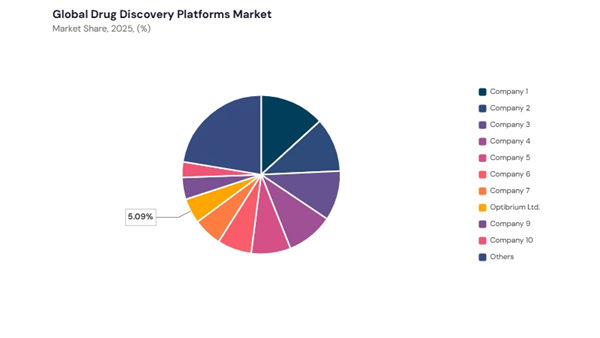
The Drug Discovery Platforms Market exhibits a moderately consolidated structure where the top ten companies collectively account for approximately 77.62% of global market revenue. Schrödinger leads the market with a 13.24% share, followed by Certara and Dassault Systèmes. Other major participants include Thermo Fisher Scientific, Merck KGaA, Insilico Medicine, Genedata, Optibrium, HitGen, and Relay Therapeutics. Competition increasingly revolves around AI-driven discovery capabilities, computational chemistry, biosimulation, bioinformatics, cloud-based scientific research platforms, and integrated pharmaceutical R&D ecosystems. The convergence of artificial intelligence, computational biology, molecular simulations, and multi-omics analytics continues to reshape competitive dynamics globally.
Drug Type Outlook
Based on Drug Type, the market is segmented into Small Molecule and Large Molecule. The Small Molecule market dominated the Global Drug Discovery Platforms Market by Drug Type in 2025, and is expected to continue to be a dominant market till 2033; thereby, achieving a market value of USD 7.13 billion by 2033, growing at a CAGR of 14.6 % during the forecast period. The Large Molecule market is expected to witness a CAGR of 15.6% during 2026-2033.
Small Molecule platforms account for the dominant share due to extensive utilization in traditional pharmaceutical development, high-throughput screening, computational chemistry, and structure-based drug design applications. Large Molecule platforms are experiencing strong growth driven by increasing development of biologics, monoclonal antibodies, peptides, recombinant proteins, cell therapies, and gene therapies. The growing adoption of protein engineering, bioinformatics, and advanced biologics discovery technologies continues to strengthen demand for large molecule discovery platforms.
Application Outlook
Based on Application, the market is segmented into Lead Discovery, Lead Optimization, Target Identification, Preclinical Testing, Target Validation, and Other Applications. The Lead Discovery market dominated the Global Drug Discovery Platforms Market by Application in 2025, and is expected to continue to be a dominant market till 2033; thereby, achieving a market value of USD 2.37 billion by 2033, growing at a CAGR of 13.7 % during the forecast period. The Lead Optimization market is expected to witness a CAGR of 14.6% during 2026-2033.Lead Discovery represents a major segment due to extensive deployment of virtual screening, high-throughput screening, and AI-enabled compound identification technologies. Lead Optimization continues to gain importance through predictive modeling and medicinal chemistry applications. Target Identification and Target Validation are witnessing increased adoption driven by genomics, proteomics, CRISPR-based research, and precision medicine initiatives. Preclinical Testing platforms continue to benefit from increasing use of AI-assisted toxicology prediction and organ-on-chip technologies.
End User Outlook
Based on End Use, the market is segmented into Biopharmaceutical Companies, CROs/CDMOs, and Academic & Research Institutes. The Biopharmaceutical Companies market dominated the Global Drug Discovery Platforms Market by End Use in 2025, and is expected to continue to be a dominant market till 2033; thereby, achieving a market value of USD 5.11 billion by 2033, growing at a CAGR of 14.3 % during the forecast period. The CROs/CDMO market is expected to witness a CAGR of 15.4% during 2026-2033. The Academic and Research Institutes market is expected to witness a CAGR of 15.5% during 2026-2033.Biopharmaceutical Companies account for the largest market share due to extensive investment in R&D, drug pipeline expansion, and AI-enabled drug development initiatives. CROs/CDMOs represent a rapidly growing segment as pharmaceutical companies increasingly outsource discovery and development activities. Academic and Research Institutes continue to play a vital role in target discovery, biomarker identification, and translational research initiatives that support future pharmaceutical innovation.
Therapeutic Area Outlook
Based on Therapeutic Area, the market is segmented into Oncology, Infectious & Immune System Diseases, Neurology, Cardiovascular Diseases, Digestive System Diseases, and Other Therapeutic Areas. Oncology remains the largest segment owing to extensive cancer research, immuno-oncology advancements, precision medicine initiatives, and increasing demand for targeted therapies. Infectious & Immune System Diseases continue to benefit from growing antimicrobial resistance concerns and emerging infectious disease threats. Neurology is witnessing strong growth driven by increasing investment in neurodegenerative disease therapies, while cardiovascular and digestive system disease research continues to generate substantial platform demand.Regional Outlook
Region-wise, the Drug Discovery Platforms Market is analyzed across North America, Europe, Asia Pacific, and LAMEA. The North America market dominated the Global Drug Discovery Platforms Market by Region in 2025, and is expected to continue to be a dominant market till 2033; thereby, achieving a market value of USD 3.93 billion by 2033, growing at a CAGR of 14.2 % during the forecast period. The Europe market is expected to witness a CAGR of 14.4% during 2026-2033. Additionally, the Asia Pacific market is expected to witness a CAGR of 15.8% during 2026-2033.
North America dominates the market due to strong pharmaceutical R&D investments, widespread AI adoption, advanced biotechnology infrastructure, and the presence of leading platform providers. Europe remains a major market supported by strong academic research ecosystems, precision medicine initiatives, and regulatory support for digital health innovation. Asia Pacific is expected to witness the fastest growth due to increasing pharmaceutical manufacturing activities, expanding biotech ecosystems, rising healthcare investments, and government support for life sciences innovation. LAMEA is gradually emerging as a growth region driven by expanding healthcare infrastructure and pharmaceutical research initiatives.
Drug Discovery Platforms Market Coverage
Recent Strategies Deployed in the Market
- Schrödinger expanded its computational drug discovery platform capabilities to strengthen molecular simulation, predictive chemistry, and AI-assisted therapeutic development workflows.
- Insilico Medicine accelerated AI-driven precision medicine and generative AI-powered drug discovery initiatives.
- Thermo Fisher Scientific expanded integrated drug discovery and development platform services supporting biologics and laboratory automation workflows.
- Genedata expanded scientific informatics and automated data analytics solutions for biopharmaceutical research.
- Merck KGaA partnered with Mayo Clinic to strengthen AI-enabled drug development and predictive analytics capabilities.
- Certara expanded its D360 scientific informatics ecosystem to improve interoperability and collaborative pharmaceutical research.
- Insilico Medicine expanded its international presence following its Hong Kong listing, strengthening global adoption of AI-powered drug discovery technologies.
- Industry participants continue investing heavily in generative AI, computational biology, biosimulation, and cloud-native discovery ecosystems.
List of Key Companies Profiled
- Schrödinger, Inc.
- Certara, Inc.
- Dassault Systèmes SE
- Thermo Fisher Scientific Inc.
- Merck KGaA
- Insilico Medicine
- Genedata AG
- Optibrium Ltd.
- HitGen Inc.
- Relay Therapeutics, Inc.
Market Report Segmentation
By Drug Type- Small Molecule
- Large Molecule
- Lead Discovery
- Lead Optimization
- Target Identification
- Preclinical Testing
- Target Validation
- Other Applications
- Biopharmaceutical Companies
- CROs/CDMOs
- Academic & Research Institutes
- Oncology
- Infectious & Immune System Diseases
- Neurology
- Cardiovascular Diseases
- Digestive System Diseases
- Other Therapeutic Areas
- North America
- US
- Canada
- Mexico
- Rest of North America
- Europe
- Germany
- UK
- France
- Russia
- Spain
- Italy
- Rest of Europe
- Asia Pacific
- China
- Japan
- India
- South Korea
- Singapore
- Malaysia
- Rest of Asia Pacific
- LAMEA
- Brazil
- Argentina
- UAE
- Saudi Arabia
- South Africa
- Nigeria
- Rest of LAMEA
Table of Contents
Chapter 1. Research Scope & Methodology
Chapter 2. Market Overview
Chapter 3. Key Factors Impacting Market
Chapter 6. Competition Analysis - Global
Chapter 7. Segmentation By Drug Type
Chapter 8. Segmentation By End Use
Chapter 9. Segmentation By Application
Chapter 10. Segmentation By Therapeutic
Chapter 11. North America Market
Chapter 12. Europe Market
Chapter 13. Asia Pacific Market
Chapter 14. LAMEA Market
Chapter 15. Company Snapshot
Chapter 16. Winning Imperatives of Drug Discovery Platforms Market
Chapter 14. LAMEA Market
Chapter 15. Company Snapshot
Chapter 16. Winning Imperatives of Drug Discovery Platforms Market
Companies Mentioned
• Schrödinger, Inc.• Certara, Inc.
• Dassault Systèmes SE
• Thermo Fisher Scientific Inc.
• Merck KGaA
• Insilico Medicine
• Genedata AG
• Optibrium Ltd.
• HitGen Inc.
• Relay Therapeutics, Inc.


