



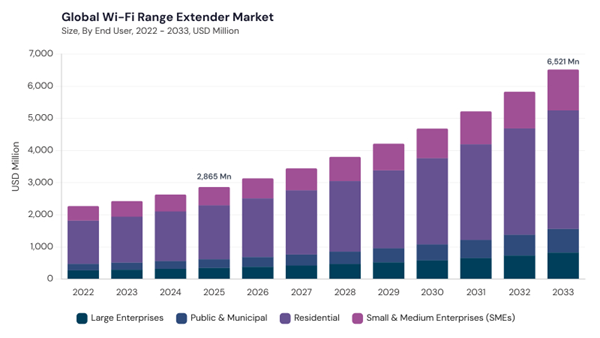
The Global Wi-Fi Range Extender Market size is expected to reach USD 6.52 billion by 2033, rising at a market growth of 10.8% CAGR during the forecast period.
The market growth is driven by increasing demand for uninterrupted wireless connectivity, rising adoption of smart home ecosystems, expansion of remote work and online learning environments, and the growing penetration of connected IoT devices. Consumers and enterprises are increasingly deploying Wi-Fi range extenders to eliminate dead zones, improve signal strength, and support bandwidth-intensive applications such as HD streaming, cloud gaming, video conferencing, and smart automation systems.
The market has evolved from basic wireless repeaters toward intelligent connectivity solutions integrating mesh networking, AI-enabled optimization, cloud-based management, and compatibility with advanced wireless standards such as Wi-Fi 6, Wi-Fi 6E, and Wi-Fi 7. The increasing convergence of wireless networking with smart homes, industrial IoT, and public connectivity infrastructure is further accelerating market expansion globally.
Furthermore, manufacturers are increasingly focusing on advanced antenna technologies, cloud-managed networking, low-latency connectivity, and energy-efficient hardware architectures to strengthen competitive positioning. The integration of smart home compatibility, adaptive Wi-Fi technologies, and enterprise-grade networking capabilities is reshaping long-term industry dynamics across the global market.
TP-Link Technologies Co., Ltd. led the market with 17.65% share owing to its broad consumer networking portfolio, strong global distribution network, and competitive pricing strategy followed by Netgear and D-Link, supported by continuous innovation in Wi-Fi 6 and mesh-compatible solutions.
Other notable market participants include Belkin/Linksys, Huawei, ASUSTeK, Xiaomi, Shenzhen Tenda, Zyxel, and Ubiquiti, each leveraging strong regional presence, ecosystem integration, and smart connectivity capabilities to strengthen market positioning.
The Outdoor Wi-Fi segment is expected to witness strong growth during the forecast period due to increasing deployment of public Wi-Fi infrastructure, smart city projects, industrial campuses, and outdoor surveillance systems requiring reliable long-range connectivity.
Meanwhile, the Mesh Wi-Fi Systems segment is projected to witness robust growth supported by increasing demand for seamless whole-home coverage, uninterrupted roaming, and centralized network management across larger residential and commercial environments.
The Wi-Fi 6 / 6E segment is experiencing rapid adoption driven by demand for improved efficiency, reduced latency, and higher device density support. Meanwhile, Wi-Fi 7 is expected to emerge as a major future growth area owing to ultra-high speeds, low latency, and support for advanced applications such as AR/VR and cloud gaming.
The SME segment is also witnessing steady growth owing to increasing demand for affordable and scalable wireless connectivity solutions that improve operational productivity and cloud connectivity.
Asia Pacific is expected to emerge as one of the fastest-growing regions during the forecast period driven by rapid urbanization, expanding internet user base, rising smartphone penetration, and increasing adoption of connected devices across China, India, Japan, and Southeast Asia.
Strategic partnerships with chipset manufacturers, cloud service providers, and smart home platform developers continue to shape competitive positioning. In addition, investments in energy-efficient designs, cloud-based management platforms, and hybrid wireless solutions are transforming the future competitive landscape of the market.
The market growth is driven by increasing demand for uninterrupted wireless connectivity, rising adoption of smart home ecosystems, expansion of remote work and online learning environments, and the growing penetration of connected IoT devices. Consumers and enterprises are increasingly deploying Wi-Fi range extenders to eliminate dead zones, improve signal strength, and support bandwidth-intensive applications such as HD streaming, cloud gaming, video conferencing, and smart automation systems.
The market has evolved from basic wireless repeaters toward intelligent connectivity solutions integrating mesh networking, AI-enabled optimization, cloud-based management, and compatibility with advanced wireless standards such as Wi-Fi 6, Wi-Fi 6E, and Wi-Fi 7. The increasing convergence of wireless networking with smart homes, industrial IoT, and public connectivity infrastructure is further accelerating market expansion globally.
Key Market Trends & Insights
- North America dominated the Wi-Fi Range Extender Market in 2025 accounting for 38.78% revenue share owing to advanced digital infrastructure and strong smart home adoption.
- The Indoor Wi-Fi segment led the market by Type in 2025 with 73.16% share due to extensive residential deployment and increasing multi-device connectivity needs.
- The Wi-Fi 5 (802.11ac) segment dominated the market by Technology Standard in 2025 with 43.90% share because of its large installed base and cost-effective deployment.
- The Wi-Fi Range Extenders / Repeaters segment accounted for 44.83% revenue share in 2025 owing to affordability and ease of installation.
- The Residential segment dominated the market by End User with 58.47% share in 2025 driven by increasing demand for seamless home connectivity.
- Mesh-compatible extenders, Wi-Fi 7 adoption, hybrid Wi-Fi and 5G integration, and AI-driven network optimization are emerging as key industry trends.
Furthermore, manufacturers are increasingly focusing on advanced antenna technologies, cloud-managed networking, low-latency connectivity, and energy-efficient hardware architectures to strengthen competitive positioning. The integration of smart home compatibility, adaptive Wi-Fi technologies, and enterprise-grade networking capabilities is reshaping long-term industry dynamics across the global market.
Driving and Restraining Factors
Drivers- Expanding demand for enhanced wireless connectivity across residential and commercial environments
- Increasing adoption of smart home and IoT devices globally
- Integration of next-generation wireless technologies such as Wi-Fi 6 and Wi-Fi 7
- Rising complexity of network environments requiring advanced coverage solutions
- Limited network performance due to signal interference and environmental barriers
- High cost and limited value perception among certain consumers
- Strong competition from advanced mesh networking systems
- Development of adaptive AI-enabled Wi-Fi range extenders
- Expansion of Wi-Fi HaLow and Industrial IoT connectivity applications
- Hybrid wireless and wired network extension solutions
- Interoperability and compatibility limitations across diverse network ecosystems
- High energy consumption and limited power efficiency
- Security vulnerabilities and privacy concerns in extended wireless networks
Market Share Analysis
The Wi-Fi Range Extender Market exhibits a moderately consolidated competitive landscape. The top ten companies collectively account for approximately 84.1% of the global market, while regional and niche players continue to maintain competitive presence across emerging markets.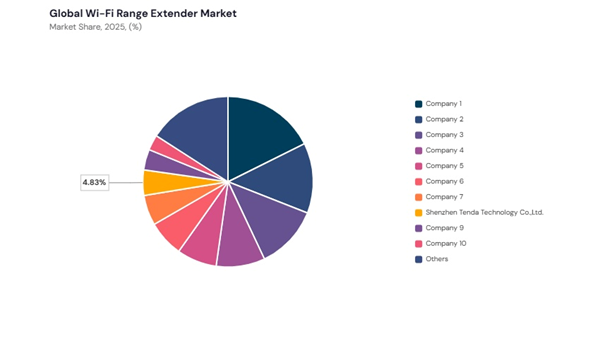
TP-Link Technologies Co., Ltd. led the market with 17.65% share owing to its broad consumer networking portfolio, strong global distribution network, and competitive pricing strategy followed by Netgear and D-Link, supported by continuous innovation in Wi-Fi 6 and mesh-compatible solutions.
Other notable market participants include Belkin/Linksys, Huawei, ASUSTeK, Xiaomi, Shenzhen Tenda, Zyxel, and Ubiquiti, each leveraging strong regional presence, ecosystem integration, and smart connectivity capabilities to strengthen market positioning.
Type Outlook
On the basis of Type, the Wi-Fi Range Extender Market is segmented into Indoor Wi-Fi and Outdoor Wi-Fi. The Indoor Wi-Fi segment dominated the market in 2025 accounting for 73.16% share and is projected to reach USD 4.64 billion by 2033. The growth of this segment is primarily driven by rising smart home adoption, increasing remote work setups, and growing demand for uninterrupted indoor wireless connectivity.The Outdoor Wi-Fi segment is expected to witness strong growth during the forecast period due to increasing deployment of public Wi-Fi infrastructure, smart city projects, industrial campuses, and outdoor surveillance systems requiring reliable long-range connectivity.
Product Outlook
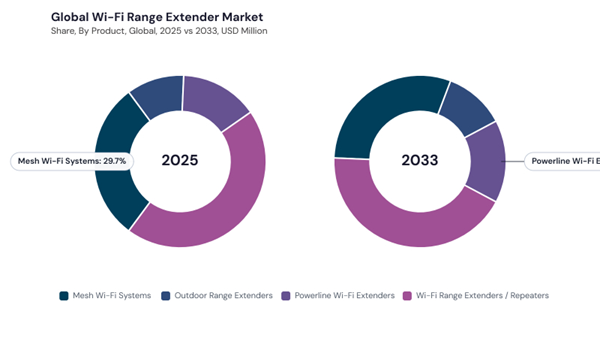
Based on Product, the market is segmented into Wi-Fi Range Extenders / Repeaters, Mesh Wi-Fi Systems, Powerline Wi-Fi Extenders, and Outdoor Range Extenders. The Wi-Fi Range Extenders / Repeaters segment dominated the market in 2025 accounting for 44.83% share owing to their affordability, simplicity, and broad residential adoption.Meanwhile, the Mesh Wi-Fi Systems segment is projected to witness robust growth supported by increasing demand for seamless whole-home coverage, uninterrupted roaming, and centralized network management across larger residential and commercial environments.
Technology Standard Outlook
By Technology Standard, the market is segmented into Wi-Fi 5 (802.11ac), Wi-Fi 6 / 6E (802.11ax), and Wi-Fi 7 (802.11be). The Wi-Fi 5 segment accounted for 43.90% share in 2025 due to its extensive installed base and cost-effective deployment.The Wi-Fi 6 / 6E segment is experiencing rapid adoption driven by demand for improved efficiency, reduced latency, and higher device density support. Meanwhile, Wi-Fi 7 is expected to emerge as a major future growth area owing to ultra-high speeds, low latency, and support for advanced applications such as AR/VR and cloud gaming.
End User Outlook
On the basis of End User, the market is segmented into Residential, Small & Medium Enterprises (SMEs), Large Enterprises, and Public & Municipal. The Residential segment dominated the market in 2025 accounting for 58.47% share due to growing dependence on high-speed internet for streaming, gaming, remote work, and smart home automation.The SME segment is also witnessing steady growth owing to increasing demand for affordable and scalable wireless connectivity solutions that improve operational productivity and cloud connectivity.
Regional Outlook
Region-wise, the market is analyzed across North America, Europe, Asia Pacific, and LAMEA. North America dominated the market in 2025 accounting for 38.78% share owing to high internet penetration, strong adoption of smart home devices, and advanced networking infrastructure across the United States and Canada.Asia Pacific is expected to emerge as one of the fastest-growing regions during the forecast period driven by rapid urbanization, expanding internet user base, rising smartphone penetration, and increasing adoption of connected devices across China, India, Japan, and Southeast Asia.
Market Competition and Attributes
The Wi-Fi Range Extender Market is highly innovation-driven and characterized by intense competition centered around wireless performance, interoperability, pricing strategies, and ecosystem integration. Companies are increasingly differentiating themselves through advanced Wi-Fi standards, mesh networking compatibility, AI-driven optimization, and smart home ecosystem integration.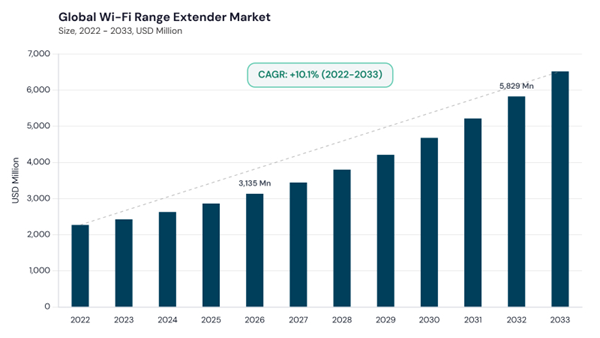
Strategic partnerships with chipset manufacturers, cloud service providers, and smart home platform developers continue to shape competitive positioning. In addition, investments in energy-efficient designs, cloud-based management platforms, and hybrid wireless solutions are transforming the future competitive landscape of the market.
Recent Strategies Deployed in the Market
- Jan-2025: TP-Link expanded its Wi-Fi 7 compatible extender portfolio to strengthen next-generation connectivity offerings.
- Nov-2024: Netgear enhanced mesh-compatible range extenders with improved smart home integration features.
- Sep-2024: D-Link launched advanced AI-enabled Wi-Fi optimization solutions for residential connectivity environments.
- Jul-2024: ASUS strengthened its Wi-Fi 6E networking ecosystem through upgraded extender solutions targeting gamers and smart home users.
- Apr-2024: Huawei expanded enterprise-grade wireless extension solutions supporting hybrid connectivity infrastructure.
List of Key Companies Profiled
- TP-Link Technologies Co., Ltd.
- NETGEAR, Inc.
- D-Link Corporation
- ASUSTek Computer Inc.
- Linksys Holdings, Inc.
- Xiaomi Corporation
- Huawei Technologies Co., Ltd.
- Belkin International, Inc.
- CommScope Holding Company, Inc.
- Zyxel Communications Corp.
Market Report Segmentation
By Type- Indoor Wi-Fi
- Outdoor Wi-Fi
- Wi-Fi Range Extenders / Repeaters
- Mesh Wi-Fi Systems
- Powerline Wi-Fi Extenders
- Outdoor Range Extenders
- Wi-Fi 5 (802.11ac)
- Wi-Fi 6 / 6E (802.11ax)
- Wi-Fi 7 (802.11be)
- Online (E-commerce / Direct-to-Consumer)
- Offline Retail
- B2B / System Integrators
- Residential
- Small & Medium Enterprises (SMEs)
- Large Enterprises
- Public & Municipal
- North America
- US
- Canada
- Mexico
- Rest of North America
- Europe
- Germany
- UK
- France
- Russia
- Spain
- Italy
- Rest of Europe
- Asia Pacific
- China
- Japan
- India
- South Korea
- Singapore
- Malaysia
- Rest of Asia Pacific
- LAMEA
- Brazil
- Argentina
- UAE
- Saudi Arabia
- South Africa
- Nigeria
- Rest of LAMEA
Table of Contents
Chapter 1. Market Overview
Chapter 4. Competition Analysis - Global
Chapter 5. Segmentation By Type
Chapter 6. Segmentation By Product
Chapter 7. Segmentation By Technology Standard
Chapter 8. Segmentation By End User
Chapter 9. Segmentation By Sales Channel
Chapter 10. North America Market
Chapter 11. Europe Market
Chapter 12. Asia Pacific Market
Chapter 13. LAMEA Market
Chapter 14. Company Profiles
Companies Mentioned
- TP-Link Technologies Co., Ltd.
- Netgear, Inc.
- D-Link Corporation
- Belkin/Linksys
- Huawei Technologies Co., Ltd.
- ASUSTeK Computer Inc.
- Xiaomi Corporation
- Shenzhen Tenda Technology Co., Ltd.
- Zyxel Communications Corp.
- Ubiquiti Inc.


