

+353-1-416-8900REST OF WORLD
+44-20-3973-8888REST OF WORLD
1-917-300-0470EAST COAST U.S
1-800-526-8630U.S. (TOLL FREE)

Global Automated and Closed Cell Therapy Processing Systems Market Size, Share & Industry Analysis Report by Type, Scale, Workflow, Regional Outlook and Forecast, 2026-2033

  • PDF Icon

    Report

  • 546 Pages
  • June 2026
  • Marqual IT Solutions Pvt. Ltd (KBV Research)
  • ID: 6276055
The Global Automated and Closed Cell Therapy Processing Systems Market is expected to reach USD 7.0 Billion by 2033, growing at a CAGR of 20.2% during 2026-2033.


The Automated and Closed Cell Therapy Processing Systems Market is expanding as healthcare organizations, biotechnology companies, pharmaceutical manufacturers, CDMOs, hospitals, and research institutes focus on improving efficiency, scalability, safety, and regulatory compliance in cell therapy manufacturing. Rising advancements in regenerative medicine, stem cell therapies, CAR-T cell therapies, personalized medicine, and advanced therapy medicinal products are increasing demand for automated, closed, contamination-free, and standardized processing systems. The market started with manual, labor-intensive, and open processing methods that created risks related to contamination, reproducibility, scalability, and batch consistency. Over time, it evolved into integrated closed-system platforms supporting multiple processing stages within sterile environments.

Key Market Trends & Insights

  • By type, Non Stem Cell Therapy dominated the market in 2025 with USD 943.2 Million and is projected to reach USD 3.9 Billion by 2033, growing at a CAGR of 19.8%.
  • Stem Cell Therapy is expected to grow faster by type, registering a CAGR of 20.7% during 2026-2033, supported by regenerative medicine research and rising clinical development.
  • By scale, Pre-Commercial / R&D Scale dominated the market in 2025 with USD 1.2 Billion and is expected to reach USD 5.0 Billion by 2033, growing at a CAGR of 20.0%.
  • Commercial Scale is projected to grow faster by scale, registering a CAGR of 20.6% during 2026-2033, driven by increasing cell therapy approvals and large-scale manufacturing needs.
  • By workflow, Separation dominated the market in 2025 with USD 507.9 Million and is expected to reach USD 2.0 Billion by 2033, growing at a CAGR of 19.2%.
  • Other Workflow is expected to grow fastest by workflow, registering a CAGR of 21.5% during 2026-2033, followed by Fill-Finish at 21.1% and Cryopreservation at 21.0%.
  • Apheresis is projected to reach USD 1.3 Billion by 2033, growing at a CAGR of 20.8%, supported by rising use of patient-derived and donor-derived cell collection workflows.
  • Regionally, North America dominated the market in 2025 with USD 786.5 Million and is projected to reach USD 3.2 Billion by 2033, while LAMEA is expected to grow fastest with a CAGR of 21.6% during 2026-2033.

The Automated And Closed Cell Therapy Processing Systems Market is witnessing strong expansion as cell therapy developers increasingly shift from manual and semi-automated processes toward closed, automated, and digitally controlled manufacturing platforms. These systems help reduce contamination risk, improve process reproducibility, lower operator dependency, support GMP compliance, and enable better scale-up from clinical trials to commercial production. The market is further supported by increasing cell and gene therapy pipelines, rising commercialization of CAR-T therapies, growing demand for autologous and allogeneic therapies, and the need for cost-efficient, standardized, and scalable manufacturing workflows.

The Automated And Closed Cell Therapy Processing Systems Market is characterized by a moderately consolidated and advanced bioprocessing technology-driven competitive environment. Competition is centered on end-to-end automation, closed-system manufacturing, single-use technologies, process analytics, modularity, regulatory compliance, AI-enabled optimization, and commercial scalability. Global life science and bioprocessing companies compete through broad product portfolios and integrated manufacturing ecosystems, while specialized automation players compete through purpose-built closed platforms, flexible workflows, and advanced digital manufacturing capabilities.

Driving and Restraining Factors

Drivers
  • Advancements in Automation and Digital Integration Driving Market Efficiency
  • Rising Demand for Safety and Quality Compliance in Cell Therapy Processing
  • Escalating Clinical and Commercial Demand for Cell and Gene Therapies
  • Economic Pressures and Innovative Payment Models Encouraging Manufacturing Efficiency
Restraints
  • High Capital and Operational Expenditure Impeding Market Adoption
  • Regulatory Complexity and Validation Challenges Restricting Market Expansion
  • Technical Limitations in Process Integration and Flexibility Curtailing Market Scalability
Opportunities
  • Advanced Integration of Automation and Single-Use Technologies for Enhanced Closed Cell Therapy Processing
  • Leveraging Data-Driven Process Analytics and AI for Predictive Manufacturing Optimization
  • Expansion Through Early-Stage Modular Automation Solutions to Enable Decentralized Manufacturing
Challenges
  • High Capital Investment and Operational Costs
  • Stringent Regulatory and Quality Assurance Requirements
  • Technological Integration and Interoperability Limitations

Market Share Analysis
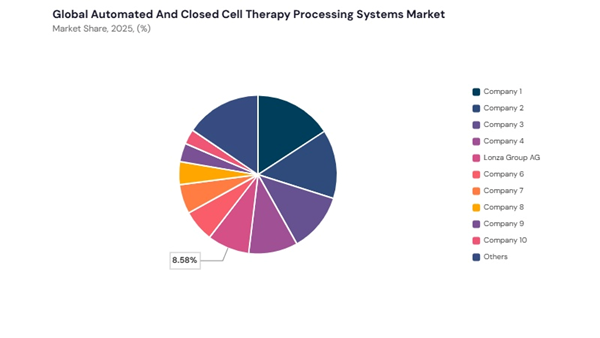


The global Automated And Closed Cell Therapy Processing Systems Market is moderately consolidated, with competition led by life science companies, bioprocess equipment manufacturers, cell therapy automation specialists, and advanced therapy technology providers. Thermo Fisher Scientific Inc. leads the market due to its broad automated cell processing, closed bioprocessing, single-use, analytical, and manufacturing capabilities. Cytiva, Sartorius AG, Miltenyi Biotec, and Lonza Group also hold strong positions through automated processing platforms, closed-system technologies, scalable bioprocessing, and cell therapy manufacturing expertise. Other key players such as Fresenius Kabi, Terumo BCT, Bio-Techne, Cellares, and Merck KGaA strengthen the market through specialized collection, processing, reagents, and automated manufacturing solutions.

Type Outlook


Based on Type, the market is segmented into Non Stem Cell Therapy and Stem Cell Therapy. The Non Stem Cell Therapy market dominated the Global Automated And Closed Cell Therapy Processing Systems Market by Type in 2025, and is expected to continue to be a dominant market till 2033; thereby, achieving a market value of USD 3.9 Billion by 2033, growing at a CAGR of 19.8 % during the forecast period. The Stem Cell Therapy market is expected to witness a CAGR of 20.7% during 2026-2033.

Non Stem Cell Therapy leads the market due to the increasing development and commercialization of immune cell therapies, particularly CAR-T, TCR-based therapies, NK cell therapies, and other engineered cell-based treatments. These therapies require complex processing steps such as cell collection, isolation, activation, expansion, genetic modification, washing, concentration, and final formulation, making automated and closed systems highly valuable. Stem Cell Therapy is also gaining strong traction as regenerative medicine, tissue engineering, autoimmune disease research, neurological applications, orthopedic therapies, cardiovascular repair, and wound healing applications continue to expand. Automated closed systems help improve stem cell viability, purity, potency, reproducibility, and regulatory readiness across research, clinical, and commercial settings.

Scale Outlook

Based on Scale, the market is segmented into Pre-Commercial / R&D Scale and Commercial Scale. The Pre-Commercial / R&D Scale market dominated the Global Automated And Closed Cell Therapy Processing Systems Market by Scale in 2025, and is expected to continue to be a dominant market till 2033; thereby, achieving a market value of USD 5.0 Billion by 2033, growing at a CAGR of 20 % during the forecast period. The Commercial Scale market is expected to witness a CAGR of 20.6% during 2026-2033.

Pre-Commercial / R&D Scale dominates the market as academic institutions, biotechnology startups, research organizations, and early-stage cell therapy developers increasingly rely on flexible automated systems for process development, small-batch manufacturing, clinical trial material production, and protocol optimization. These systems support experimentation across diverse cell types and therapy formats while reducing contamination risk and improving process consistency. Commercial Scale is gaining momentum as more cell therapies move through late-stage clinical trials, regulatory approvals, and commercial manufacturing. At this scale, automated and closed systems support higher throughput, reproducible batch production, traceability, reduced manual labor, and GMP-compliant manufacturing for broader clinical distribution.

Workflow Outlook

Based on Workflow, the market is segmented into Separation, Expansion, Apheresis, Fill-Finish, Cryopreservation, and Other Workflow. The Separation market dominated the Global Automated And Closed Cell Therapy Processing Systems Market by Workflow in 2025, and is expected to continue to be a dominant market till 2033; thereby, achieving a market value of USD 2.0 Billion by 2033, growing at a CAGR of 19.2 % during the forecast period. The Expansion market is expected to witness a CAGR of 19.5% during 2026-2033. Additionally, the Apheresis market is expected to witness highest CAGR of 20.8% during 2026-2033.

Separation leads the market due to its critical role in isolating target cells with high purity, viability, and consistency from complex biological samples such as peripheral blood or bone marrow. Expansion is another major workflow as manufacturers require scalable cell proliferation systems to produce clinically relevant doses while maintaining cell quality and phenotype. Apheresis supports the collection of patient-derived or donor-derived cells for autologous and allogeneic therapies. Fill-Finish is gaining importance as automated aseptic filling improves dose accuracy, sterility, and regulatory compliance. Cryopreservation supports long-term storage, shipment, and treatment scheduling, while Other Workflow includes washing, conditioning, formulation, quality control, and other supportive processing steps that improve overall manufacturing efficiency.

Regional Outlook


Region-wise, the Automated And Closed Cell Therapy Processing Systems Market is analyzed across North America, Europe, Asia Pacific, and LAMEA. The North America market dominated the Global Automated And Closed Cell Therapy Processing Systems Market by Region in 2025, and is expected to continue to be a dominant market till 2033; thereby, achieving a market value of USD 3.2 Billion by 2033, growing at a CAGR of 19.5 % during the forecast period. The Europe market is expected to witness a CAGR of 19.9% during 2026-2033. Additionally, the Asia Pacific market is expected to witness a CAGR of 21.3% during 2026-2033.

North America dominates the market due to strong biopharmaceutical investments, advanced cell therapy manufacturing infrastructure, favorable regulatory support, high clinical trial activity, and increasing commercialization of CAR-T and other advanced therapies. Europe is supported by expanding regenerative medicine research, strong ATMP regulatory frameworks, growing biomanufacturing capacity, and demand for GMP-compliant closed processing technologies. Asia Pacific is witnessing strong growth due to rising biotechnology investments, increasing clinical research, expanding healthcare infrastructure, and growing cell therapy development in China, Japan, South Korea, India, and Singapore. LAMEA holds a smaller but emerging position as investment in advanced therapeutics, clinical research, and automated cell processing gradually increases across Latin America, the Middle East, and Africa.

Recent Strategies Deployed in the Market

  • Thermo Fisher Scientific showcased expanded manufacturing and AI-enabled cell therapy capabilities at BIO International 2026, strengthening its support for process development, analytical workflows, and digital integration in advanced therapy manufacturing.
  • Cytiva continued expanding its Sefia automated cell therapy manufacturing platform in 2025, supporting closed workflow automation for washing, concentration, formulation, and fill operations.
  • Cellares expanded its automated cell therapy manufacturing capabilities through new Smart Factories designed to support industrial-scale production using robotic automation, closed workflows, and digital process monitoring.
  • Cytiva and NecstGen formed a strategic collaboration in 2025 to accelerate automated cell and gene therapy development through advanced manufacturing technologies and scalable closed processing workflows.
  • MiLaboratories and Miltenyi Biotec partnered in April 2024 to integrate computational biology with advanced cell therapy development and manufacturing technologies.
  • Sartorius and Siemens extended their long-term automation collaboration in 2025 to strengthen digital automation, process control, and scalable biopharmaceutical manufacturing technologies.

List of Key Companies Profiled

  • Thermo Fisher Scientific Inc.
  • Cytiva
  • Sartorius AG
  • Miltenyi Biotec B.V. & Co. KG
  • Lonza Group AG
  • Fresenius Kabi AG
  • Terumo BCT, Inc.
  • Bio-Techne Corporation
  • Cellares Corporation
  • Merck KGaA

Market Report Segmentation

By Type
  • Non Stem Cell Therapy
  • Stem Cell Therapy
By Scale
  • Pre-Commercial / R&D Scale
  • Commercial Scale
By Workflow
  • Separation
  • Expansion
  • Apheresis
  • Fill-Finish
  • Cryopreservation
  • Other Workflow
By Geography
  • North America
    • US
    • Canada
    • Mexico
    • Rest of North America

  • Europe
    • Germany
    • UK
    • France
    • Russia
    • Spain
    • Italy
    • Rest of Europe

  • Asia Pacific
    • China
    • Japan
    • India
    • South Korea
    • Australia
    • Rest of Asia Pacific

  • LAMEA
    • Brazil
    • Argentina
    • UAE
    • Saudi Arabia
    • South Africa
    • Nigeria
    • Rest of LAMEA

Table of Contents

Chapter 1. Research Scope & Methodology
1.1 Market Definition
1.2 Analysis Period & Currency
1.3 Segmentation
1.4 Automated And Closed Cell Therapy Processing Systems Market, by Geography
1.5 Research Methodology
Chapter 2. Market Overview
2.1 COVID-19 Impact
2.2 Market Composition and Scenario
Chapter 3. Key Factors Impacting Market
3.1 Market Drivers
3.2 Market Restraints
3.3 Market Opportunities
3.4 Market Challenges
3.5 Market Trends
3.6 State of Competition
3.7 Market Consolidation
3.8 Key Customer Criteria
Chapter 4. Product Life CycleChapter 5. Value Chain Analysis of Automated and Closed Cell Therapy Processing Systems Market
Chapter 6. Competition Analysis - Global
6.1 Market Share Analysis
6.2 Recent Developments - Automated and Closed Cell Therapy Processing Systems Market
6.2.1 Product Launch & Product Expansion
6.2.2 Partnership, Collaboration & Agreements
6.2.3 Geographical Expansion
Chapter 7. Segmentation By Type
7.1 Non Stem Cell Therapy
7.2 Stem Cell Therapy
Chapter 8. Segmentation By Scale
8.1 Pre-Commercial / R&D Scale
8.2 Commercial Scale
Chapter 9. Segmentation By Workflow
9.1 Separation
9.2 Expansion
9.3 Apheresis
9.4 Fill-Finish
9.5 Cryopreservation
9.6 Other Workflow
Chapter 10. North America Market
10.1 Market Overview
10.2 Key Factors Impacting Market
10.2.1 Market Drivers
10.2.2 Market Restraints
10.2.3 Market Opportunities
10.2.4 Market Challenges
10.2.5 Market Trends
10.2.6 State of Competition
10.2.7 Market Consolidation
10.2.8 Key Customer Criteria
10.3 Product Life Cycle
10.4 Segmentation By Type
10.4.1 Non Stem Cell Therapy
10.4.2 Stem Cell Therapy
10.5 Segmentation By Scale
10.5.1 Pre-Commercial / R&D Scale
10.5.2 Commercial Scale
10.6 Segmentation By Workflow
10.6.1 Separation
10.6.2 Expansion
10.6.3 Apheresis
10.6.4 Fill-Finish
10.6.5 Cryopreservation
10.6.6 Other Workflow
10.7 Segmentation By Country
10.7.1 US
10.7.1.1 Segmentation By Type
10.7.1.1.1 Non Stem Cell Therapy
10.7.1.1.2 Stem Cell Therapy
10.7.1.2 Segmentation By Scale
10.7.1.2.1 Pre-Commercial / R&D Scale
10.7.1.2.2 Commercial Scale
10.7.1.3 Segmentation By Workflow
10.7.1.3.1 Separation
10.7.1.3.2 Expansion
10.7.1.3.3 Apheresis
10.7.1.3.4 Fill-Finish
10.7.1.3.5 Cryopreservation
10.7.1.3.6 Other Workflow
10.7.2 Canada
10.7.2.1 Segmentation By Type
10.7.2.1.1 Non Stem Cell Therapy
10.7.2.1.2 Stem Cell Therapy
10.7.2.2 Segmentation By Scale
10.7.2.2.1 Pre-Commercial / R&D Scale
10.7.2.2.2 Commercial Scale
10.7.2.3 Segmentation By Workflow
10.7.2.3.1 Separation
10.7.2.3.2 Expansion
10.7.2.3.3 Apheresis
10.7.2.3.4 Fill-Finish
10.7.2.3.5 Cryopreservation
10.7.2.3.6 Other Workflow
10.7.3 Mexico
10.7.3.1 Segmentation By Type
10.7.3.1.1 Non Stem Cell Therapy
10.7.3.1.2 Stem Cell Therapy
10.7.3.2 Segmentation By Scale
10.7.3.2.1 Pre-Commercial / R&D Scale
10.7.3.2.2 Commercial Scale
10.7.3.3 Segmentation By Workflow
10.7.3.3.1 Separation
10.7.3.3.2 Expansion
10.7.3.3.3 Apheresis
10.7.3.3.4 Fill-Finish
10.7.3.3.5 Cryopreservation
10.7.3.3.6 Other Workflow
10.7.4 Rest of North America
10.7.4.1 Segmentation By Type
10.7.4.1.1 Non Stem Cell Therapy
10.7.4.1.2 Stem Cell Therapy
10.7.4.2 Segmentation By Scale
10.7.4.2.1 Pre-Commercial / R&D Scale
10.7.4.2.2 Commercial Scale
10.7.4.3 Segmentation By Workflow
10.7.4.3.1 Separation
10.7.4.3.2 Expansion
10.7.4.3.3 Apheresis
10.7.4.3.4 Fill-Finish
10.7.4.3.5 Cryopreservation
10.7.4.3.6 Other Workflow
Chapter 11. Europe Market
11.1 Market Overview
11.2 Key Factors Impacting Market
11.2.1 Market Drivers
11.2.2 Market Restraints
11.2.3 Market Opportunities
11.2.4 Market Challenges
11.2.5 Market Trends
11.2.6 State of Competition
11.2.7 Market Consolidation
11.2.8 Key Customer Criteria
11.3 Product Life Cycle
11.4 Segmentation By Type
11.4.1 Non Stem Cell Therapy
11.4.2 Stem Cell Therapy
11.5 Segmentation By Scale
11.5.1 Pre-Commercial / R&D Scale
11.5.2 Commercial Scale
11.6 Segmentation By Workflow
11.6.1 Separation
11.6.2 Expansion
11.6.3 Apheresis
11.6.4 Fill-Finish
11.6.5 Cryopreservation
11.6.6 Other Workflow
11.7 Segmentation By Country
11.7.1 Germany
11.7.1.1 Segmentation By Type
11.7.1.1.1 Non Stem Cell Therapy
11.7.1.1.2 Stem Cell Therapy
11.7.1.2 Segmentation By Scale
11.7.1.2.1 Pre-Commercial / R&D Scale
11.7.1.2.2 Commercial Scale
11.7.1.3 Segmentation By Workflow
11.7.1.3.1 Separation
11.7.1.3.2 Expansion
11.7.1.3.3 Apheresis
11.7.1.3.4 Fill-Finish
11.7.1.3.5 Cryopreservation
11.7.1.3.6 Other Workflow
11.7.2 UK
11.7.2.1 Segmentation By Type
11.7.2.1.1 Non Stem Cell Therapy
11.7.2.1.2 Stem Cell Therapy
11.7.2.2 Segmentation By Scale
11.7.2.2.1 Pre-Commercial / R&D Scale
11.7.2.2.2 Commercial Scale
11.7.2.3 Segmentation By Workflow
11.7.2.3.1 Separation
11.7.2.3.2 Expansion
11.7.2.3.3 Apheresis
11.7.2.3.4 Fill-Finish
11.7.2.3.5 Cryopreservation
11.7.2.3.6 Other Workflow
11.7.3 France
11.7.3.1 Segmentation By Type
11.7.3.1.1 Non Stem Cell Therapy
11.7.3.1.2 Stem Cell Therapy
11.7.3.2 Segmentation By Scale
11.7.3.2.1 Pre-Commercial / R&D Scale
11.7.3.2.2 Commercial Scale
11.7.3.3 Segmentation By Workflow
11.7.3.3.1 Separation
11.7.3.3.2 Expansion
11.7.3.3.3 Apheresis
11.7.3.3.4 Fill-Finish
11.7.3.3.5 Cryopreservation
11.7.3.3.6 Other Workflow
11.7.4 Russia
11.7.4.1 Segmentation By Type
11.7.4.1.1 Non Stem Cell Therapy
11.7.4.1.2 Stem Cell Therapy
11.7.4.2 Segmentation By Scale
11.7.4.2.1 Pre-Commercial / R&D Scale
11.7.4.2.2 Commercial Scale
11.7.4.3 Segmentation By Workflow
11.7.4.3.1 Separation
11.7.4.3.2 Expansion
11.7.4.3.3 Apheresis
11.7.4.3.4 Fill-Finish
11.7.4.3.5 Cryopreservation
11.7.4.3.6 Other Workflow
11.7.5 Spain
11.7.5.1 Segmentation By Type
11.7.5.1.1 Non Stem Cell Therapy
11.7.5.1.2 Stem Cell Therapy
11.7.5.2 Segmentation By Scale
11.7.5.2.1 Pre-Commercial / R&D Scale
11.7.5.2.2 Commercial Scale
11.7.5.3 Segmentation By Workflow
11.7.5.3.1 Separation
11.7.5.3.2 Expansion
11.7.5.3.3 Apheresis
11.7.5.3.4 Fill-Finish
11.7.5.3.5 Cryopreservation
11.7.5.3.6 Other Workflow
11.7.6 Italy
11.7.6.1 Segmentation By Type
11.7.6.1.1 Non Stem Cell Therapy
11.7.6.1.2 Stem Cell Therapy
11.7.6.2 Segmentation By Scale
11.7.6.2.1 Pre-Commercial / R&D Scale
11.7.6.2.2 Commercial Scale
11.7.6.3 Segmentation By Workflow
11.7.6.3.1 Separation
11.7.6.3.2 Expansion
11.7.6.3.3 Apheresis
11.7.6.3.4 Fill-Finish
11.7.6.3.5 Cryopreservation
11.7.6.3.6 Other Workflow
11.7.7 Rest of Europe
11.7.7.1 Segmentation By Type
11.7.7.1.1 Non Stem Cell Therapy
11.7.7.1.2 Stem Cell Therapy
11.7.7.2 Segmentation By Scale
11.7.7.2.1 Pre-Commercial / R&D Scale
11.7.7.2.2 Commercial Scale
11.7.7.3 Segmentation By Workflow
11.7.7.3.1 Separation
11.7.7.3.2 Expansion
11.7.7.3.3 Apheresis
11.7.7.3.4 Fill-Finish
11.7.7.3.5 Cryopreservation
11.7.7.3.6 Other Workflow
Chapter 12. Asia Pacific Market
12.1 Market Overview
12.2 Key Factors Impacting Market
12.2.1 Market Drivers
12.2.2 Market Restraints
12.2.3 Market Opportunities
12.2.4 Market Challenges
12.2.5 Market Trends
12.2.6 State of Competition
12.2.7 Market Consolidation
12.2.8 Key Customer Criteria
12.3 Product Life Cycle
12.4 Segmentation By Type
12.4.1 Non Stem Cell Therapy
12.4.2 Stem Cell Therapy
12.5 Segmentation By Scale
12.5.1 Pre-Commercial / R&D Scale
12.5.2 Commercial Scale
12.6 Segmentation By Workflow
12.6.1 Separation
12.6.2 Expansion
12.6.3 Apheresis
12.6.4 Fill-Finish
12.6.5 Cryopreservation
12.6.6 Other Workflow
12.7 Segmentation By Country
12.7.1 China
12.7.1.1 Segmentation By Type
12.7.1.1.1 Non Stem Cell Therapy
12.7.1.1.2 Stem Cell Therapy
12.7.1.2 Segmentation By Scale
12.7.1.2.1 Pre-Commercial / R&D Scale
12.7.1.2.2 Commercial Scale
12.7.1.3 Segmentation By Workflow
12.7.1.3.1 Separation
12.7.1.3.2 Expansion
12.7.1.3.3 Apheresis
12.7.1.3.4 Fill-Finish
12.7.1.3.5 Cryopreservation
12.7.1.3.6 Other Workflow
12.7.2 Japan
12.7.2.1 Segmentation By Type
12.7.2.1.1 Non Stem Cell Therapy
12.7.2.1.2 Stem Cell Therapy
12.7.2.2 Segmentation By Scale
12.7.2.2.1 Pre-Commercial / R&D Scale
12.7.2.2.2 Commercial Scale
12.7.2.3 Segmentation By Workflow
12.7.2.3.1 Separation
12.7.2.3.2 Expansion
12.7.2.3.3 Apheresis
12.7.2.3.4 Fill-Finish
12.7.2.3.5 Cryopreservation
12.7.2.3.6 Other Workflow
12.7.3 India
12.7.3.1 Segmentation By Type
12.7.3.1.1 Non Stem Cell Therapy
12.7.3.1.2 Stem Cell Therapy
12.7.3.2 Segmentation By Scale
12.7.3.2.1 Pre-Commercial / R&D Scale
12.7.3.2.2 Commercial Scale
12.7.3.3 Segmentation By Workflow
12.7.3.3.1 Separation
12.7.3.3.2 Expansion
12.7.3.3.3 Apheresis
12.7.3.3.4 Fill-Finish
12.7.3.3.5 Cryopreservation
12.7.3.3.6 Other Workflow
12.7.4 South Korea
12.7.4.1 Segmentation By Type
12.7.4.1.1 Non Stem Cell Therapy
12.7.4.1.2 Stem Cell Therapy
12.7.4.2 Segmentation By Scale
12.7.4.2.1 Pre-Commercial / R&D Scale
12.7.4.2.2 Commercial Scale
12.7.4.3 Segmentation By Workflow
12.7.4.3.1 Separation
12.7.4.3.2 Expansion
12.7.4.3.3 Apheresis
12.7.4.3.4 Fill-Finish
12.7.4.3.5 Cryopreservation
12.7.4.3.6 Other Workflow
12.7.5 Singapore
12.7.5.1 Segmentation By Type
12.7.5.1.1 Non Stem Cell Therapy
12.7.5.1.2 Stem Cell Therapy
12.7.5.2 Segmentation By Scale
12.7.5.2.1 Pre-Commercial / R&D Scale
12.7.5.2.2 Commercial Scale
12.7.5.3 Segmentation By Workflow
12.7.5.3.1 Separation
12.7.5.3.2 Expansion
12.7.5.3.3 Apheresis
12.7.5.3.4 Fill-Finish
12.7.5.3.5 Cryopreservation
12.7.5.3.6 Other Workflow
12.7.6 Malaysia
12.7.6.1 Segmentation By Type
12.7.6.1.1 Non Stem Cell Therapy
12.7.6.1.2 Stem Cell Therapy
12.7.6.2 Segmentation By Scale
12.7.6.2.1 Pre-Commercial / R&D Scale
12.7.6.2.2 Commercial Scale
12.7.6.3 Segmentation By Workflow
12.7.6.3.1 Separation
12.7.6.3.2 Expansion
12.7.6.3.3 Apheresis
12.7.6.3.4 Fill-Finish
12.7.6.3.5 Cryopreservation
12.7.6.3.6 Other Workflow
12.7.7 Rest of Asia Pacific
12.7.7.1 Segmentation By Type
12.7.7.1.1 Non Stem Cell Therapy
12.7.7.1.2 Stem Cell Therapy
12.7.7.2 Segmentation By Scale
12.7.7.2.1 Pre-Commercial / R&D Scale
12.7.7.2.2 Commercial Scale
12.7.7.3 Segmentation By Workflow
12.7.7.3.1 Separation
12.7.7.3.2 Expansion
12.7.7.3.3 Apheresis
12.7.7.3.4 Fill-Finish
12.7.7.3.5 Cryopreservation
12.7.7.3.6 Other Workflow
Chapter 13. LAMEA Market
13.1 Market Overview
13.2 Key Factors Impacting Market
13.2.1 Market Drivers
13.2.2 Market Restraints
13.2.3 Market Opportunities
13.2.4 Market Challenges
13.2.5 Market Trends
13.2.6 State of Competition
13.2.7 Market Consolidation
13.2.8 Key Customer Criteria
13.3 Product Life Cycle
13.4 Segmentation By Type
13.4.1 Non Stem Cell Therapy
13.4.2 Stem Cell Therapy
13.5 Segmentation By Scale
13.5.1 Pre-Commercial / R&D Scale
13.5.2 Commercial Scale
13.6 Segmentation By Workflow
13.6.1 Separation
13.6.2 Expansion
13.6.3 Apheresis
13.6.4 Fill-Finish
13.6.5 Cryopreservation
13.6.6 Other Workflow
13.7 Segmentation By Country
13.7.1 Brazil
13.7.1.1 Segmentation By Type
13.7.1.1.1 Non Stem Cell Therapy
13.7.1.1.2 Stem Cell Therapy
13.7.1.2 Segmentation By Scale
13.7.1.2.1 Pre-Commercial / R&D Scale
13.7.1.2.2 Commercial Scale
13.7.1.3 Segmentation By Workflow
13.7.1.3.1 Separation
13.7.1.3.2 Expansion
13.7.1.3.3 Apheresis
13.7.1.3.4 Fill-Finish
13.7.1.3.5 Cryopreservation
13.7.1.3.6 Other Workflow
13.7.2 Argentina
13.7.2.1 Segmentation By Type
13.7.2.1.1 Non Stem Cell Therapy
13.7.2.1.2 Stem Cell Therapy
13.7.2.2 Segmentation By Scale
13.7.2.2.1 Pre-Commercial / R&D Scale
13.7.2.2.2 Commercial Scale
13.7.2.3 Segmentation By Workflow
13.7.2.3.1 Separation
13.7.2.3.2 Expansion
13.7.2.3.3 Apheresis
13.7.2.3.4 Fill-Finish
13.7.2.3.5 Cryopreservation
13.7.2.3.6 Other Workflow
13.7.3 UAE
13.7.3.1 Segmentation By Type
13.7.3.1.1 Non Stem Cell Therapy
13.7.3.1.2 Stem Cell Therapy
13.7.3.2 Segmentation By Scale
13.7.3.2.1 Pre-Commercial / R&D Scale
13.7.3.2.2 Commercial Scale
13.7.3.3 Segmentation By Workflow
13.7.3.3.1 Separation
13.7.3.3.2 Expansion
13.7.3.3.3 Apheresis
13.7.3.3.4 Fill-Finish
13.7.3.3.5 Cryopreservation
13.7.3.3.6 Other Workflow
13.7.4 Saudi Arabia
13.7.4.1 Segmentation By Type
13.7.4.1.1 Non Stem Cell Therapy
13.7.4.1.2 Stem Cell Therapy
13.7.4.2 Segmentation By Scale
13.7.4.2.1 Pre-Commercial / R&D Scale
13.7.4.2.2 Commercial Scale
13.7.4.3 Segmentation By Workflow
13.7.4.3.1 Separation
13.7.4.3.2 Expansion
13.7.4.3.3 Apheresis
13.7.4.3.4 Fill-Finish
13.7.4.3.5 Cryopreservation
13.7.4.3.6 Other Workflow
13.7.5 South Africa
13.7.5.1 Segmentation By Type
13.7.5.1.1 Non Stem Cell Therapy
13.7.5.1.2 Stem Cell Therapy
13.7.5.2 Segmentation By Scale
13.7.5.2.1 Pre-Commercial / R&D Scale
13.7.5.2.2 Commercial Scale
13.7.5.3 Segmentation By Workflow
13.7.5.3.1 Separation
13.7.5.3.2 Expansion
13.7.5.3.3 Apheresis
13.7.5.3.4 Fill-Finish
13.7.5.3.5 Cryopreservation
13.7.5.3.6 Other Workflow
13.7.6 Nigeria
13.7.6.1 Segmentation By Type
13.7.6.1.1 Non Stem Cell Therapy
13.7.6.1.2 Stem Cell Therapy
13.7.6.2 Segmentation By Scale
13.7.6.2.1 Pre-Commercial / R&D Scale
13.7.6.2.2 Commercial Scale
13.7.6.3 Segmentation By Workflow
13.7.6.3.1 Separation
13.7.6.3.2 Expansion
13.7.6.3.3 Apheresis
13.7.6.3.4 Fill-Finish
13.7.6.3.5 Cryopreservation
13.7.6.3.6 Other Workflow
13.7.7 Rest of LAMEA
13.7.7.1 Segmentation By Type
13.7.7.1.1 Non Stem Cell Therapy
13.7.7.1.2 Stem Cell Therapy
13.7.7.2 Segmentation By Scale
13.7.7.2.1 Pre-Commercial / R&D Scale
13.7.7.2.2 Commercial Scale
13.7.7.3 Segmentation By Workflow
13.7.7.3.1 Separation
13.7.7.3.2 Expansion
13.7.7.3.3 Apheresis
13.7.7.3.4 Fill-Finish
13.7.7.3.5 Cryopreservation
13.7.7.3.6 Other Workflow
Chapter 14. Company Snapshots
14.1 Thermo Fisher Scientific Inc.
14.1.1 Business Overview
14.1.2 Key Information
14.1.3 Company Focus on Automated and Closed Cell Therapy Processing Systems Market
14.1.4 Strategic Insights
14.1.5 Strategy Deployed
14.1.6 Product & Service Portfolio
14.1.7 Capability Overview
14.1.8 Technology & Innovation Focus
14.1.9 SWOT Analysis
14.1.10 Customers / End Users
14.1.11 Competitive Positioning
14.1.12 Key Differentiators
14.1.13 Portfolio Matrix
14.1.14 Analyst View
14.1.15 Future Outlook
14.2 Cytiva
14.2.1 Business Overview
14.2.2 Key Information
14.2.3 Company Focus on Automated and Closed Cell Therapy Processing Systems Market
14.2.4 Strategic Insights
14.2.5 Strategy Deployed
14.2.6 Product & Service Portfolio
14.2.7 Representative Products
14.2.8 Capability Overview
14.2.9 Technology & Innovation Focus
14.2.10 SWOT Analysis
14.2.11 Customers / End Users
14.2.12 Competitive Positioning
14.2.13 Key Differentiators
14.2.14 Portfolio Matrix
14.2.15 Analyst View
14.2.16 Future Outlook
14.3 Sartorius AG
14.3.1 Business Overview
14.3.2 Key Information
14.3.3 Company Focus on Automated and Closed Cell Therapy Processing Systems Market
14.3.4 Strategic Insights
14.3.5 Strategy Deployed
14.3.6 Product & Service Portfolio
14.3.7 Representative Products
14.3.8 Capability Overview
14.3.9 Technology & Innovation Focus
14.3.10 SWOT Analysis
14.3.11 Customers / End Users
14.3.12 Competitive Positioning
14.3.13 Key Differentiators
14.3.14 Portfolio Matrix
14.3.15 Analyst View
14.3.16 Future Outlook
14.4 Miltenyi Biotec B.V. & Co. KG
14.4.1 Business Overview
14.4.2 Key Information
14.4.3 Company Focus on Automated and Closed Cell Therapy Processing Systems Market
14.4.4 Strategic Insights
14.4.5 Strategy Deployed
14.4.6 Product & Service Portfolio
14.4.7 Representative Products
14.4.8 Capability Overview
14.4.9 Technology & Innovation Focus
14.4.10 SWOT Analysis
14.4.11 Customers / End Users
14.4.12 Competitive Positioning
14.4.13 Key Differentiators
14.4.14 Portfolio Matrix
14.4.15 Analyst View
14.4.16 Future Outlook
14.5 Lonza Group AG
14.5.1 Business Overview
14.5.2 Key Information
14.5.3 Company Focus on Automated and Closed Cell Therapy Processing Systems Market
14.5.4 Strategic Insights
14.5.5 Strategy Deployed
14.5.6 Product & Service Portfolio
14.5.7 Representative Products
14.5.8 Capability Overview
14.5.9 Technology & Innovation Focus
14.5.10 SWOT Analysis
14.5.11 Customers / End Users
14.5.12 Competitive Positioning
14.5.13 Key Differentiators
14.5.14 Portfolio Matrix
14.5.15 Analyst View
14.5.16 Future Outlook
14.6 Fresenius Kabi AG
14.6.1 Business Overview
14.6.2 Key Information
14.6.3 Company Focus on Automated and Closed Cell Therapy Processing Systems Market
14.6.4 Strategic Insights
14.6.5 Strategy Deployed
14.6.6 Product & Service Portfolio
14.6.7 Representative Products
14.6.8 Capability Overview
14.6.9 Technology & Innovation Focus
14.6.10 SWOT Analysis
14.6.11 Customers / End Users
14.6.12 Competitive Positioning
14.6.13 Key Differentiators
14.6.14 Portfolio Matrix
14.6.15 Analyst View
14.6.16 Future Outlook
14.7 Terumo BCT, Inc.
14.7.1 Business Overview
14.7.2 Key Information
14.7.3 Company Focus on Automated and Closed Cell Therapy Processing Systems Market
14.7.4 Strategic Insights
14.7.5 Strategy Deployed
14.7.6 Product & Service Portfolio
14.7.7 Representative Products
14.7.8 Capability Overview
14.7.9 Technology & Innovation Focus
14.7.10 SWOT Analysis
14.7.11 Customers / End Users
14.7.12 Competitive Positioning
14.7.13 Key Differentiators
14.7.14 Portfolio Matrix
14.7.15 Analyst View
14.7.16 Future Outlook
14.8 Bio-Techne Corporation
14.8.1 Business Overview
14.8.2 Key Information
14.8.3 Company Focus on Automated and Closed Cell Therapy Processing Systems Market
14.8.4 Strategic Insights
14.8.5 Strategy Deployed
14.8.6 Product & Service Portfolio
14.8.7 Representative Products
14.8.8 Capability Overview
14.8.9 Technology & Innovation Focus
14.8.10 SWOT Analysis
14.8.11 Customers / End Users
14.8.12 Competitive Positioning
14.8.13 Key Differentiators
14.8.14 Portfolio Matrix
14.8.15 Analyst View
14.8.16 Future Outlook
14.9 Merck KGaA
14.9.1 Business Overview
14.9.2 Key Information
14.9.3 Company Focus on Automated and Closed Cell Therapy Processing Systems Market
14.9.4 Strategic Insights
14.9.5 Strategy Deployed
14.9.6 Product & Service Portfolio
14.9.7 Representative Products
14.9.8 Capability Overview
14.9.9 Technology & Innovation Focus
14.9.10 SWOT Analysis
14.9.11 Customers / End Users
14.9.12 Competitive Positioning
14.9.13 Key Differentiators
14.9.14 Portfolio Matrix
14.9.15 Analyst View
14.9.16 Future Outlook
14.10 Cellares Corporation
14.10.1 Business Overview
14.10.2 Key Information
14.10.3 Company Focus on Automated and Closed Cell Therapy Processing Systems Market
14.10.4 Strategic Insights
14.10.5 Strategy Deployed
14.10.6 Product & Service Portfolio
14.10.7 Representative Products / Services
14.10.8 Capability Overview
14.10.9 Technology & Innovation Focus
14.10.10 SWOT Analysis
14.10.11 Customers / End Users
14.10.12 Competitive Positioning
14.10.13 Key Differentiators
14.10.14 Portfolio Matrix
14.10.15 Analyst View
14.10.16 Future Outlook
Chapter 15. Winning Imperatives of Automated and Closed Cell Therapy Processing Systems Market
12.2.7 Market Consolidation
12.2.8 Key Customer Criteria
12.3 Product Life Cycle
12.4 Segmentation By Type
12.4.1 Non Stem Cell Therapy
12.4.2 Stem Cell Therapy
12.5 Segmentation By Scale
12.5.1 Pre-Commercial / R&D Scale
12.5.2 Commercial Scale
12.6 Segmentation By Workflow
12.6.1 Separation
12.6.2 Expansion
12.6.3 Apheresis
12.6.4 Fill-Finish
12.6.5 Cryopreservation
12.6.6 Other Workflow
12.7 Segmentation By Country
12.7.1 China
12.7.1.1 Segmentation By Type
12.7.1.1.1 Non Stem Cell Therapy
12.7.1.1.2 Stem Cell Therapy
12.7.1.2 Segmentation By Scale
12.7.1.2.1 Pre-Commercial / R&D Scale
12.7.1.2.2 Commercial Scale
12.7.1.3 Segmentation By Workflow
12.7.1.3.1 Separation
12.7.1.3.2 Expansion
12.7.1.3.3 Apheresis
12.7.1.3.4 Fill-Finish
12.7.1.3.5 Cryopreservation
12.7.1.3.6 Other Workflow
12.7.2 Japan
12.7.2.1 Segmentation By Type
12.7.2.1.1 Non Stem Cell Therapy
12.7.2.1.2 Stem Cell Therapy
12.7.2.2 Segmentation By Scale
12.7.2.2.1 Pre-Commercial / R&D Scale
12.7.2.2.2 Commercial Scale
12.7.2.3 Segmentation By Workflow
12.7.2.3.1 Separation
12.7.2.3.2 Expansion
12.7.2.3.3 Apheresis
12.7.2.3.4 Fill-Finish
12.7.2.3.5 Cryopreservation
12.7.2.3.6 Other Workflow
12.7.3 India
12.7.3.1 Segmentation By Type
12.7.3.1.1 Non Stem Cell Therapy
12.7.3.1.2 Stem Cell Therapy
12.7.3.2 Segmentation By Scale
12.7.3.2.1 Pre-Commercial / R&D Scale
12.7.3.2.2 Commercial Scale
12.7.3.3 Segmentation By Workflow
12.7.3.3.1 Separation
12.7.3.3.2 Expansion
12.7.3.3.3 Apheresis
12.7.3.3.4 Fill-Finish
12.7.3.3.5 Cryopreservation
12.7.3.3.6 Other Workflow
12.7.4 South Korea
12.7.4.1 Segmentation By Type
12.7.4.1.1 Non Stem Cell Therapy
12.7.4.1.2 Stem Cell Therapy
12.7.4.2 Segmentation By Scale
12.7.4.2.1 Pre-Commercial / R&D Scale
12.7.4.2.2 Commercial Scale
12.7.4.3 Segmentation By Workflow
12.7.4.3.1 Separation
12.7.4.3.2 Expansion
12.7.4.3.3 Apheresis
12.7.4.3.4 Fill-Finish
12.7.4.3.5 Cryopreservation
12.7.4.3.6 Other Workflow
12.7.5 Singapore
12.7.5.1 Segmentation By Type
12.7.5.1.1 Non Stem Cell Therapy
12.7.5.1.2 Stem Cell Therapy
12.7.5.2 Segmentation By Scale
12.7.5.2.1 Pre-Commercial / R&D Scale
12.7.5.2.2 Commercial Scale
12.7.5.3 Segmentation By Workflow
12.7.5.3.1 Separation
12.7.5.3.2 Expansion
12.7.5.3.3 Apheresis
12.7.5.3.4 Fill-Finish
12.7.5.3.5 Cryopreservation
12.7.5.3.6 Other Workflow
12.7.6 Malaysia
12.7.6.1 Segmentation By Type
12.7.6.1.1 Non Stem Cell Therapy
12.7.6.1.2 Stem Cell Therapy
12.7.6.2 Segmentation By Scale
12.7.6.2.1 Pre-Commercial / R&D Scale
12.7.6.2.2 Commercial Scale
12.7.6.3 Segmentation By Workflow
12.7.6.3.1 Separation
12.7.6.3.2 Expansion
12.7.6.3.3 Apheresis
12.7.6.3.4 Fill-Finish
12.7.6.3.5 Cryopreservation
12.7.6.3.6 Other Workflow
12.7.7 Rest of Asia Pacific
12.7.7.1 Segmentation By Type
12.7.7.1.1 Non Stem Cell Therapy
12.7.7.1.2 Stem Cell Therapy
12.7.7.2 Segmentation By Scale
12.7.7.2.1 Pre-Commercial / R&D Scale
12.7.7.2.2 Commercial Scale
12.7.7.3 Segmentation By Workflow
12.7.7.3.1 Separation
12.7.7.3.2 Expansion
12.7.7.3.3 Apheresis
12.7.7.3.4 Fill-Finish
12.7.7.3.5 Cryopreservation
12.7.7.3.6 Other Workflow
Chapter 13. LAMEA Market
13.1 Market Overview
13.2 Key Factors Impacting Market
13.2.1 Market Drivers
13.2.2 Market Restraints
13.2.3 Market Opportunities
13.2.4 Market Challenges
13.2.5 Market Trends
13.2.6 State of Competition
13.2.7 Market Consolidation
13.2.8 Key Customer Criteria
13.3 Product Life Cycle
13.4 Segmentation By Type
13.4.1 Non Stem Cell Therapy
13.4.2 Stem Cell Therapy
13.5 Segmentation By Scale
13.5.1 Pre-Commercial / R&D Scale
13.5.2 Commercial Scale
13.6 Segmentation By Workflow
13.6.1 Separation
13.6.2 Expansion
13.6.3 Apheresis
13.6.4 Fill-Finish
13.6.5 Cryopreservation
13.6.6 Other Workflow
13.7 Segmentation By Country
13.7.1 Brazil
13.7.1.1 Segmentation By Type
13.7.1.1.1 Non Stem Cell Therapy
13.7.1.1.2 Stem Cell Therapy
13.7.1.2 Segmentation By Scale
13.7.1.2.1 Pre-Commercial / R&D Scale
13.7.1.2.2 Commercial Scale
13.7.1.3 Segmentation By Workflow
13.7.1.3.1 Separation
13.7.1.3.2 Expansion
13.7.1.3.3 Apheresis
13.7.1.3.4 Fill-Finish
13.7.1.3.5 Cryopreservation
13.7.1.3.6 Other Workflow
13.7.2 Argentina
13.7.2.1 Segmentation By Type
13.7.2.1.1 Non Stem Cell Therapy
13.7.2.1.2 Stem Cell Therapy
13.7.2.2 Segmentation By Scale
13.7.2.2.1 Pre-Commercial / R&D Scale
13.7.2.2.2 Commercial Scale
13.7.2.3 Segmentation By Workflow
13.7.2.3.1 Separation
13.7.2.3.2 Expansion
13.7.2.3.3 Apheresis
13.7.2.3.4 Fill-Finish
13.7.2.3.5 Cryopreservation
13.7.2.3.6 Other Workflow
13.7.3 UAE
13.7.3.1 Segmentation By Type
13.7.3.1.1 Non Stem Cell Therapy
13.7.3.1.2 Stem Cell Therapy
13.7.3.2 Segmentation By Scale
13.7.3.2.1 Pre-Commercial / R&D Scale
13.7.3.2.2 Commercial Scale
13.7.3.3 Segmentation By Workflow
13.7.3.3.1 Separation
13.7.3.3.2 Expansion
13.7.3.3.3 Apheresis
13.7.3.3.4 Fill-Finish
13.7.3.3.5 Cryopreservation
13.7.3.3.6 Other Workflow
13.7.4 Saudi Arabia
13.7.4.1 Segmentation By Type
13.7.4.1.1 Non Stem Cell Therapy
13.7.4.1.2 Stem Cell Therapy
13.7.4.2 Segmentation By Scale
13.7.4.2.1 Pre-Commercial / R&D Scale
13.7.4.2.2 Commercial Scale
13.7.4.3 Segmentation By Workflow
13.7.4.3.1 Separation
13.7.4.3.2 Expansion
13.7.4.3.3 Apheresis
13.7.4.3.4 Fill-Finish
13.7.4.3.5 Cryopreservation
13.7.4.3.6 Other Workflow
13.7.5 South Africa
13.7.5.1 Segmentation By Type
13.7.5.1.1 Non Stem Cell Therapy
13.7.5.1.2 Stem Cell Therapy
13.7.5.2 Segmentation By Scale
13.7.5.2.1 Pre-Commercial / R&D Scale
13.7.5.2.2 Commercial Scale
13.7.5.3 Segmentation By Workflow
13.7.5.3.1 Separation
13.7.5.3.2 Expansion
13.7.5.3.3 Apheresis
13.7.5.3.4 Fill-Finish
13.7.5.3.5 Cryopreservation
13.7.5.3.6 Other Workflow
13.7.6 Nigeria
13.7.6.1 Segmentation By Type
13.7.6.1.1 Non Stem Cell Therapy
13.7.6.1.2 Stem Cell Therapy
13.7.6.2 Segmentation By Scale
13.7.6.2.1 Pre-Commercial / R&D Scale
13.7.6.2.2 Commercial Scale
13.7.6.3 Segmentation By Workflow
13.7.6.3.1 Separation
13.7.6.3.2 Expansion
13.7.6.3.3 Apheresis
13.7.6.3.4 Fill-Finish
13.7.6.3.5 Cryopreservation
13.7.6.3.6 Other Workflow
13.7.7 Rest of LAMEA
13.7.7.1 Segmentation By Type
13.7.7.1.1 Non Stem Cell Therapy
13.7.7.1.2 Stem Cell Therapy
13.7.7.2 Segmentation By Scale
13.7.7.2.1 Pre-Commercial / R&D Scale
13.7.7.2.2 Commercial Scale
13.7.7.3 Segmentation By Workflow
13.7.7.3.1 Separation
13.7.7.3.2 Expansion
13.7.7.3.3 Apheresis
13.7.7.3.4 Fill-Finish
13.7.7.3.5 Cryopreservation
13.7.7.3.6 Other Workflow
Chapter 14. Company Snapshots
14.1 Thermo Fisher Scientific Inc.
14.1.1 Business Overview
14.1.2 Key Information
14.1.3 Company Focus on Automated and Closed Cell Therapy Processing Systems Market
14.1.4 Strategic Insights
14.1.5 Strategy Deployed
14.1.6 Product & Service Portfolio
14.1.7 Capability Overview
14.1.8 Technology & Innovation Focus
14.1.9 SWOT Analysis
14.1.10 Customers / End Users
14.1.11 Competitive Positioning
14.1.12 Key Differentiators
14.1.13 Portfolio Matrix
14.1.14 Analyst View
14.1.15 Future Outlook
14.2 Cytiva
14.2.1 Business Overview
14.2.2 Key Information
14.2.3 Company Focus on Automated and Closed Cell Therapy Processing Systems Market
14.2.4 Strategic Insights
14.2.5 Strategy Deployed
14.2.6 Product & Service Portfolio
14.2.7 Representative Products
14.2.8 Capability Overview
14.2.9 Technology & Innovation Focus
14.2.10 SWOT Analysis
14.2.11 Customers / End Users
14.2.12 Competitive Positioning
14.2.13 Key Differentiators
14.2.14 Portfolio Matrix
14.2.15 Analyst View
14.2.16 Future Outlook
14.3 Sartorius AG
14.3.1 Business Overview
14.3.2 Key Information
14.3.3 Company Focus on Automated and Closed Cell Therapy Processing Systems Market
14.3.4 Strategic Insights
14.3.5 Strategy Deployed
14.3.6 Product & Service Portfolio
14.3.7 Representative Products
14.3.8 Capability Overview
14.3.9 Technology & Innovation Focus
14.3.10 SWOT Analysis
14.3.11 Customers / End Users
14.3.12 Competitive Positioning
14.3.13 Key Differentiators
14.3.14 Portfolio Matrix
14.3.15 Analyst View
14.3.16 Future Outlook
14.4 Miltenyi Biotec B.V. & Co. KG
14.4.1 Business Overview
14.4.2 Key Information
14.4.3 Company Focus on Automated and Closed Cell Therapy Processing Systems Market
14.4.4 Strategic Insights
14.4.5 Strategy Deployed
14.4.6 Product & Service Portfolio
14.4.7 Representative Products
14.4.8 Capability Overview
14.4.9 Technology & Innovation Focus
14.4.10 SWOT Analysis
14.4.11 Customers / End Users
14.4.12 Competitive Positioning
14.4.13 Key Differentiators
14.4.14 Portfolio Matrix
14.4.15 Analyst View
14.4.16 Future Outlook
14.5 Lonza Group AG
14.5.1 Business Overview
14.5.2 Key Information
14.5.3 Company Focus on Automated and Closed Cell Therapy Processing Systems Market
14.5.4 Strategic Insights
14.5.5 Strategy Deployed
14.5.6 Product & Service Portfolio
14.5.7 Representative Products
14.5.8 Capability Overview
14.5.9 Technology & Innovation Focus
14.5.10 SWOT Analysis
14.5.11 Customers / End Users
14.5.12 Competitive Positioning
14.5.13 Key Differentiators
14.5.14 Portfolio Matrix
14.5.15 Analyst View
14.5.16 Future Outlook
14.6 Fresenius Kabi AG
14.6.1 Business Overview
14.6.2 Key Information
14.6.3 Company Focus on Automated and Closed Cell Therapy Processing Systems Market
14.6.4 Strategic Insights
14.6.5 Strategy Deployed
14.6.6 Product & Service Portfolio
14.6.7 Representative Products
14.6.8 Capability Overview
14.6.9 Technology & Innovation Focus
14.6.10 SWOT Analysis
14.6.11 Customers / End Users
14.6.12 Competitive Positioning
14.6.13 Key Differentiators
14.6.14 Portfolio Matrix
14.6.15 Analyst View
14.6.16 Future Outlook
14.7 Terumo BCT, Inc.
14.7.1 Business Overview
14.7.2 Key Information
14.7.3 Company Focus on Automated and Closed Cell Therapy Processing Systems Market
14.7.4 Strategic Insights
14.7.5 Strategy Deployed
14.7.6 Product & Service Portfolio
14.7.7 Representative Products
14.7.8 Capability Overview
14.7.9 Technology & Innovation Focus
14.7.10 SWOT Analysis
14.7.11 Customers / End Users
14.7.12 Competitive Positioning
14.7.13 Key Differentiators
14.7.14 Portfolio Matrix
14.7.15 Analyst View
14.7.16 Future Outlook
14.8 Bio-Techne Corporation
14.8.1 Business Overview
14.8.2 Key Information
14.8.3 Company Focus on Automated and Closed Cell Therapy Processing Systems Market
14.8.4 Strategic Insights
14.8.5 Strategy Deployed
14.8.6 Product & Service Portfolio
14.8.7 Representative Products
14.8.8 Capability Overview
14.8.9 Technology & Innovation Focus
14.8.10 SWOT Analysis
14.8.11 Customers / End Users
14.8.12 Competitive Positioning
14.8.13 Key Differentiators
14.8.14 Portfolio Matrix
14.8.15 Analyst View
14.8.16 Future Outlook
14.9 Merck KGaA
14.9.1 Business Overview
14.9.2 Key Information
14.9.3 Company Focus on Automated and Closed Cell Therapy Processing Systems Market
14.9.4 Strategic Insights
14.9.5 Strategy Deployed
14.9.6 Product & Service Portfolio
14.9.7 Representative Products
14.9.8 Capability Overview
14.9.9 Technology & Innovation Focus
14.9.10 SWOT Analysis
14.9.11 Customers / End Users
14.9.12 Competitive Positioning
14.9.13 Key Differentiators
14.9.14 Portfolio Matrix
14.9.15 Analyst View
14.9.16 Future Outlook
14.10 Cellares Corporation
14.10.1 Business Overview
14.10.2 Key Information
14.10.3 Company Focus on Automated and Closed Cell Therapy Processing Systems Market
14.10.4 Strategic Insights
14.10.5 Strategy Deployed
14.10.6 Product & Service Portfolio
14.10.7 Representative Products / Services
14.10.8 Capability Overview
14.10.9 Technology & Innovation Focus
14.10.10 SWOT Analysis
14.10.11 Customers / End Users
14.10.12 Competitive Positioning
14.10.13 Key Differentiators
14.10.14 Portfolio Matrix
14.10.15 Analyst View
14.10.16 Future Outlook
Chapter 15. Winning Imperatives of Automated and Closed Cell Therapy Processing Systems Market
14.1.14 Analyst View
14.1.15 Future Outlook
14.2 Cytiva
14.2.1 Business Overview
14.2.2 Key Information
14.2.3 Company Focus on Automated and Closed Cell Therapy Processing Systems Market
14.2.4 Strategic Insights
14.2.5 Strategy Deployed
14.2.6 Product & Service Portfolio
14.2.7 Representative Products
14.2.8 Capability Overview
14.2.9 Technology & Innovation Focus
14.2.10 SWOT Analysis
14.2.11 Customers / End Users
14.2.12 Competitive Positioning
14.2.13 Key Differentiators
14.2.14 Portfolio Matrix
14.2.15 Analyst View
14.2.16 Future Outlook
14.3 Sartorius AG
14.3.1 Business Overview
14.3.2 Key Information
14.3.3 Company Focus on Automated and Closed Cell Therapy Processing Systems Market
14.3.4 Strategic Insights
14.3.5 Strategy Deployed
14.3.6 Product & Service Portfolio
14.3.7 Representative Products
14.3.8 Capability Overview
14.3.9 Technology & Innovation Focus
14.3.10 SWOT Analysis
14.3.11 Customers / End Users
14.3.12 Competitive Positioning
14.3.13 Key Differentiators
14.3.14 Portfolio Matrix
14.3.15 Analyst View
14.3.16 Future Outlook
14.4 Miltenyi Biotec B.V. & Co. KG
14.4.1 Business Overview
14.4.2 Key Information
14.4.3 Company Focus on Automated and Closed Cell Therapy Processing Systems Market
14.4.4 Strategic Insights
14.4.5 Strategy Deployed
14.4.6 Product & Service Portfolio
14.4.7 Representative Products
14.4.8 Capability Overview
14.4.9 Technology & Innovation Focus
14.4.10 SWOT Analysis
14.4.11 Customers / End Users
14.4.12 Competitive Positioning
14.4.13 Key Differentiators
14.4.14 Portfolio Matrix
14.4.15 Analyst View
14.4.16 Future Outlook
14.5 Lonza Group AG
14.5.1 Business Overview
14.5.2 Key Information
14.5.3 Company Focus on Automated and Closed Cell Therapy Processing Systems Market
14.5.4 Strategic Insights
14.5.5 Strategy Deployed
14.5.6 Product & Service Portfolio
14.5.7 Representative Products
14.5.8 Capability Overview
14.5.9 Technology & Innovation Focus
14.5.10 SWOT Analysis
14.5.11 Customers / End Users
14.5.12 Competitive Positioning
14.5.13 Key Differentiators
14.5.14 Portfolio Matrix
14.5.15 Analyst View
14.5.16 Future Outlook
14.6 Fresenius Kabi AG
14.6.1 Business Overview
14.6.2 Key Information
14.6.3 Company Focus on Automated and Closed Cell Therapy Processing Systems Market
14.6.4 Strategic Insights
14.6.5 Strategy Deployed
14.6.6 Product & Service Portfolio
14.6.7 Representative Products
14.6.8 Capability Overview
14.6.9 Technology & Innovation Focus
14.6.10 SWOT Analysis
14.6.11 Customers / End Users
14.6.12 Competitive Positioning
14.6.13 Key Differentiators
14.6.14 Portfolio Matrix
14.6.15 Analyst View
14.6.16 Future Outlook
14.7 Terumo BCT, Inc.
14.7.1 Business Overview
14.7.2 Key Information
14.7.3 Company Focus on Automated and Closed Cell Therapy Processing Systems Market
14.7.4 Strategic Insights
14.7.5 Strategy Deployed
14.7.6 Product & Service Portfolio
14.7.7 Representative Products
14.7.8 Capability Overview
14.7.9 Technology & Innovation Focus
14.7.10 SWOT Analysis
14.7.11 Customers / End Users
14.7.12 Competitive Positioning
14.7.13 Key Differentiators
14.7.14 Portfolio Matrix
14.7.15 Analyst View
14.7.16 Future Outlook
14.8 Bio-Techne Corporation
14.8.1 Business Overview
14.8.2 Key Information
14.8.3 Company Focus on Automated and Closed Cell Therapy Processing Systems Market
14.8.4 Strategic Insights
14.8.5 Strategy Deployed
14.8.6 Product & Service Portfolio
14.8.7 Representative Products
14.8.8 Capability Overview
14.8.9 Technology & Innovation Focus
14.8.10 SWOT Analysis
14.8.11 Customers / End Users
14.8.12 Competitive Positioning
14.8.13 Key Differentiators
14.8.14 Portfolio Matrix
14.8.15 Analyst View
14.8.16 Future Outlook
14.9 Merck KGaA
14.9.1 Business Overview
14.9.2 Key Information
14.9.3 Company Focus on Automated and Closed Cell Therapy Processing Systems Market
14.9.4 Strategic Insights
14.9.5 Strategy Deployed
14.9.6 Product & Service Portfolio
14.9.7 Representative Products
14.9.8 Capability Overview
14.9.9 Technology & Innovation Focus
14.9.10 SWOT Analysis
14.9.11 Customers / End Users
14.9.12 Competitive Positioning
14.9.13 Key Differentiators
14.9.14 Portfolio Matrix
14.9.15 Analyst View
14.9.16 Future Outlook
14.10 Cellares Corporation
14.10.1 Business Overview
14.10.2 Key Information
14.10.3 Company Focus on Automated and Closed Cell Therapy Processing Systems Market
14.10.4 Strategic Insights
14.10.5 Strategy Deployed
14.10.6 Product & Service Portfolio
14.10.7 Representative Products / Services
14.10.8 Capability Overview
14.10.9 Technology & Innovation Focus
14.10.10 SWOT Analysis
14.10.11 Customers / End Users
14.10.12 Competitive Positioning
14.10.13 Key Differentiators
14.10.14 Portfolio Matrix
14.10.15 Analyst View
14.10.16 Future Outlook
Chapter 15. Winning Imperatives of Automated and Closed Cell Therapy Processing Systems Market

Companies Mentioned

• Thermo Fisher Scientific Inc.
• Cytiva
• Sartorius AG
• Miltenyi Biotec B.V. & Co. KG
• Lonza Group AG
• Fresenius Kabi AG
• Terumo BCT, Inc.
• Bio-Techne Corporation
• Cellares Corporation
• Merck KGaA