

+353-1-416-8900REST OF WORLD
+44-20-3973-8888REST OF WORLD
1-917-300-0470EAST COAST U.S
1-800-526-8630U.S. (TOLL FREE)

Global Automotive Biometric Market Size, Share & Industry Analysis Report by Vehicle Type, Offering, Technology, Application, Regional Outlook and Forecast, 2026-2033

  • PDF Icon

    Report

  • 688 Pages
  • June 2026
  • Marqual IT Solutions Pvt. Ltd (KBV Research)
  • ID: 6276059
The Global Automotive Biometric Market is expected to reach USD 5.00 billion by 2033, growing at a CAGR of 15.9% during 2026-2033.


The Global Automotive Biometric Market has evolved from a niche vehicle security technology into a critical component of connected, intelligent, and personalized mobility ecosystems. Initially focused on fingerprint-based vehicle access and anti-theft solutions, biometric technologies have expanded significantly to encompass facial recognition, iris scanning, voice authentication, behavioral biometrics, and driver monitoring systems. Advancements in sensor technologies, artificial intelligence, machine learning, and automotive electronics have enabled biometric systems to transition from standalone security features into integrated platforms supporting vehicle access control, driver identification, personalization, safety monitoring, and in-vehicle transactions.

Key Market Trends & Insights

  • Global Automotive Biometric Market is expected to grow from USD 1.59 billion in 2025 to USD 5.00 billion by 2033, at a 15.9% CAGR.
  • Passenger Cars dominated the market in 2025 and will reach USD 3.60 billion by 2033.
  • Commercial Vehicles will grow faster than Passenger Cars, at a 16.7% CAGR.
  • Asia-Pacific was the largest regional market in 2025 and will remain the leader through 2033.
  • LAMEA is projected to be the fastest-growing region, with an 18.2% CAGR.
  • Hardware accounted for the largest share among offerings in 2025.
  • Services will be the fastest-growing offering segment, with a 17.0% CAGR.
  • Fingerprint Recognition was the leading biometric technology in 2025.
  • Voice Recognition is expected to record the highest technology growth rate at 16.6% CAGR.

Driver Monitoring Systems (DMS) remained the largest application segment, while Infotainment & HMI Control is the fastest-growing applicationThe market is witnessing substantial transformation driven by rising concerns regarding vehicle security, growing demand for personalized driving experiences, increasing deployment of connected and autonomous vehicles, and stringent safety regulations promoting driver monitoring technologies. Automotive manufacturers are investing heavily in multimodal biometric systems capable of combining facial recognition, fingerprint authentication, voice recognition, and behavioral analytics to improve accuracy and user convenience.

Competition is driven by authentication accuracy, multimodal capabilities, cybersecurity protection, AI integration, scalability, regulatory compliance, and ease of integration with vehicle architectures. Market participants continue investing in advanced sensing technologies, AI-powered biometric analytics, cloud-enabled identity management platforms, and privacy-focused authentication frameworks to strengthen competitive positioning. Strategic partnerships, acquisitions, regional expansion initiatives, and technology collaborations remain central to market development strategies.

Driving and Restraining Factors

Drivers
  • Enhanced Vehicle Security Through Biometric Authentication Systems
  • Rise in Demand for Driver Monitoring Systems for Safety and Compliance
  • Expansion of Biometric-Enabled In-Car Personalization and Payment Solutions
  • Progress in Semiconductor and Sensor Technologies Driving Market Adoption
Restraints
  • High Implementation and Integration Costs Limiting Market Penetration
  • Stringent Data Privacy and Regulatory Challenges Impeding Adoption
  • Technical Limitations and Reliability Concerns Affecting User Trust and System Efficacy
Opportunities
  • Integration of Advanced AI-Driven Biometric Authentication in Automotive Security Systems
  • Expansion of Biometric Solutions for Autonomous and Connected Vehicles
  • Development of Privacy-Enhancing Biometric Technologies to Address Regulatory and Consumer Concerns
Challenges
  • Technical and Integration Complexities in Automotive Biometric Systems
  • Data Privacy and Security Concerns Restricting Consumer Trust and Regulatory Compliance
  • High Deployment Costs and Infrastructure Limitations Affecting Market Accessibility

Market Share Analysis
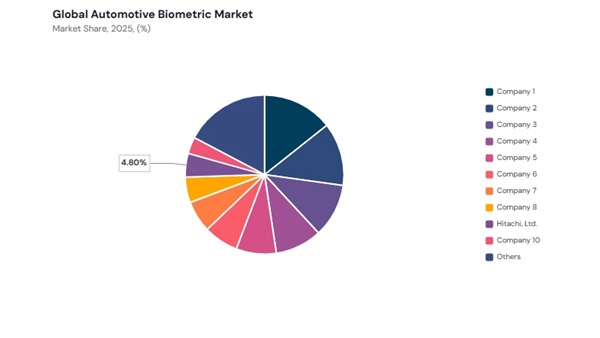


The Automotive Biometric Market exhibits a moderately consolidated competitive landscape led by major automotive electronics and biometric technology providers. Continental AG holds a leading position, supported by extensive capabilities in automotive electronics, in-cabin sensing, driver monitoring technologies, and vehicle security systems. Robert Bosch GmbH and Denso Corporation also maintain strong market positions through their expertise in automotive sensors, connected vehicle technologies, and biometric integration platforms. Other significant participants include Valeo, Gentex Corporation, Fujitsu Limited, Fingerprint Cards AB, Synaptics Incorporated, Hitachi, and Methode Electronics. Competition increasingly focuses on multimodal authentication, AI-powered analytics, cybersecurity capabilities, and seamless integration with connected vehicle ecosystems.

Vehicle Type Outlook


Based on Vehicle Type, the market is segmented into Passenger Cars and Commercial Vehicles. The Passenger Cars market dominated the Global Automotive Biometric Market by Vehicle Type in 2025, and is expected to continue to be a dominant market till 2033; thereby, achieving a market value of USD 3.59 billion by 2033, growing at a CAGR of 15.6 % during the forecast period. The Commercial Vehicles market is expected to witness a CAGR of 16.7% during 2026-2033.

Passenger Cars represent the largest application area due to growing consumer demand for vehicle personalization, enhanced security, smart cockpit experiences, and seamless keyless entry solutions. Biometric technologies such as facial recognition, fingerprint authentication, and voice identification are increasingly integrated into passenger vehicles to support secure access, personalized settings, and advanced user experiences. Commercial Vehicles are witnessing growing adoption driven by fleet management requirements, driver accountability, theft prevention initiatives, and regulatory compliance needs. Biometric systems in commercial vehicles help improve driver verification, cargo security, operational efficiency, and fleet monitoring capabilities.

Offering Outlook

Based on Offering, the market is segmented into Hardware, Software, and Services. The Hardware market dominated the Global Automotive Biometric Market by Offering in 2025, and is expected to continue to be a dominant market till 2033; thereby, achieving a market value of USD 2.82 billion by 2033, growing at a CAGR of 15.5 % during the forecast period. The Software market is expected to witness a CAGR of 16.2% during 2026-2033.

Hardware remains a major component of the market owing to the deployment of biometric sensors including fingerprint scanners, facial recognition cameras, iris scanners, and voice recognition devices. Software solutions play a crucial role in biometric processing, authentication management, behavioral analytics, and AI-driven decision-making capabilities. Services continue gaining importance through system integration, maintenance, cybersecurity management, consulting, analytics, and lifecycle support activities necessary for successful biometric deployment across automotive platforms.

Technology Outlook

Based on Technology, the market is segmented into Fingerprint Recognition, Facial Recognition, Voice Recognition, and Iris Recognition. Fingerprint Recognition remains widely adopted for secure vehicle access and driver authentication applications. Facial Recognition is experiencing significant growth due to increasing deployment within driver monitoring systems, personalized cabin environments, and contactless authentication solutions. Voice Recognition supports hands-free authentication and enhanced human-machine interaction capabilities, while Iris Recognition is gaining attention for high-security automotive applications requiring advanced identity verification and anti-spoofing capabilities.

Application Outlook

Based on Application, the market is segmented into Driver Monitoring Systems (DMS), Vehicle Access Control, Driver Identification & Personalization, Infotainment & HMI Control, and In-Car Payment Authentication. The Driver Monitoring Systems (DMS) market dominated the Global Automotive Biometric Market by Application in 2025, and is expected to continue to be a dominant market till 2033; thereby, achieving a market value of USD 1.53 billion by 2033, growing at a CAGR of 15 % during the forecast period. The Vehicle Access Control market is expected to witness a CAGR of 15.6% during 2026-2033.

Driver Monitoring Systems are emerging as a key application area driven by safety regulations and demand for real-time driver condition monitoring. Vehicle Access Control remains a primary application for biometric authentication, improving security and reducing theft risks. Driver Identification & Personalization enhances user experiences through automated profile settings and customized environments. Infotainment & HMI Control supports secure interaction with connected vehicle systems, while In-Car Payment Authentication is creating new opportunities through secure biometric-enabled transactions within mobility ecosystems.

Regional Outlook


Region-wise, the Automotive Biometric Market is analyzed across North America, Europe, Asia Pacific, and LAMEA. The Asia Pacific market dominated the Global Automotive Biometric Market by Region in 2025, and is expected to continue to be a dominant market till 2033; thereby, achieving a market value of USD 1.95 billion by 2033, growing at a CAGR of 16.3 % during the forecast period.The Europe market is expected to witness a CAGR of 15.2% during 2026-2033. Additionally, the North America market is expected to witness a CAGR of 15.5% during 2026-2033.

North America remains a significant market due to strong adoption of connected vehicles, advanced automotive technologies, and vehicle cybersecurity initiatives. Europe benefits from stringent vehicle safety regulations, growing demand for driver monitoring systems, and strong automotive manufacturing capabilities. Asia Pacific is expected to witness substantial growth driven by expanding automotive production, increasing adoption of connected mobility technologies, and strong investments in vehicle electronics and smart cockpit solutions. LAMEA continues to experience gradual adoption supported by digital transformation initiatives, vehicle security requirements, and modernization of transportation infrastructure.

The Automotive Biometric Market continues evolving through rapid advancements in AI, machine learning, behavioral analytics, multimodal authentication, and connected vehicle technologies. Market participants are increasingly focused on integrating biometrics with autonomous driving systems, smart cockpits, digital identity frameworks, and mobility services. Investments in privacy-enhancing technologies, edge computing architectures, secure biometric processing, and cloud-enabled authentication platforms are reshaping competitive dynamics. As vehicles become more software-defined and connected, biometrics are expected to play a critical role in delivering secure, personalized, and intelligent mobility experiences.

Automotive Biometric Market Coverage:

Recent Strategies Deployed in the Market

  • Robert Bosch GmbH acquired an AI-driven biometric authentication startup to strengthen facial and voice recognition capabilities for automotive applications.
  • Hitachi acquired a behavioral biometric software company focused on AI-powered driver authentication and fatigue detection technologies.
  • Valeo acquired Gestigon GmbH to strengthen gesture recognition and biometric capabilities within smart cockpit systems.
  • Denso launched an advanced driver authentication platform featuring multispectral biometric sensors.
  • Valeo introduced the BioLock biometric vehicle access system integrating fingerprint and facial recognition technologies.
  • Bosch launched a quantum sensor-based biometric module supporting fingerprint and iris authentication.
  • Hitachi launched a multimodal biometric authentication platform combining facial recognition, iris scanning, and voice authentication.
  • Valeo and STMicroelectronics entered a collaboration to develop advanced automotive biometric sensor chips.
  • Bosch partnered with VIA Technologies to develop AI edge-computing solutions supporting automotive biometric processing.
  • Denso established a dedicated automotive biometric research and development center in Asia to accelerate innovation and regional expansion.

List of Key Companies Profiled

  • Continental AG
  • Robert Bosch GmbH
  • Denso Corporation
  • Valeo SA
  • Gentex Corporation
  • Fujitsu Limited
  • Fingerprint Cards AB
  • Synaptics Incorporated
  • Hitachi, Ltd.
  • Methode Electronics, Inc.

Market Report Segmentation

By Vehicle Type
  • Passenger Cars
  • Commercial Vehicles
By Offering
  • Hardware
  • Software
  • Services
By Technology
  • Fingerprint Recognition
  • Facial Recognition
  • Voice Recognition
  • Iris Recognition
By Application
  • Driver Monitoring Systems (DMS)
  • Vehicle Access Control
  • Driver Identification & Personalization
  • Infotainment & HMI Control
  • In-Car Payment Authentication
By Geography
  • North America
    • US
    • Canada
    • Mexico
    • Rest of North America

  • Europe
    • Germany
    • UK
    • France
    • Russia
    • Spain
    • Italy
    • Rest of Europe

  • Asia Pacific
    • China
    • Japan
    • India
    • South Korea
    • Singapore
    • Malaysia
    • Rest of Asia Pacific

  • LAMEA
    • Brazil
    • Argentina
    • UAE
    • Saudi Arabia
    • South Africa
    • Nigeria
    • Rest of LAMEA

Table of Contents

Chapter 1. Research Scope & Methodology
1.1 Market Definition
1.2 Analysis Period & Currency
1.3 Segmentation
1.4 Automotive Biometric Market, by Geography
1.5 Research Methodology
Chapter 2. Market Overview
2.1 COVID-19
2.2 Market Composition and Scenario
Chapter 3. Key Factors Impacting Market
3.1 Market Drivers
3.2 Market Restraints
3.3 Market Opportunities
3.4 Market Challenges
3.5 Market Trends
3.6 State of Competition
3.7 Market Consolidation
3.8 Key Customer Criteria
Chapter 4. Product Life CycleChapter 5. Value chain Analysis of Automotive Biometric Market
Chapter 6. Competition Analysis - Global
6.1 Market Share Analysis
6.2 Recent Development and Strategies
6.2.1 Mergers & Acquisitions
6.2.2 Product Launch & Product Expansion
6.2.3 Partnership, Collaboration & Agreements
6.2.4 Geographical Expansion
Chapter 7. Segmentation By Vehicle Type
7.1 Passenger Cars
7.2 Commercial Vehicles
Chapter 8. Segmentation By Offering
8.1 Hardware
8.2 Software
8.3 Service
Chapter 9. Segmentation By Technology
9.1 Fingerprint Recognition
9.2 Facial Recognition
9.3 Voice Recognition
9.4 Iris Recognition
Chapter 10. Segmentation By Application
10.1 Driver Monitoring Systems (DMS)
10.2 Vehicle Access Control
10.3 Driver Identification & Personalization
10.4 Infotainment & HMI Control
10.5 In-Car Payment Authentication
Chapter 11. North America Market
11.1 Market Overview
11.2 Key Factors Impacting Market
11.2.1 Market Drivers
11.2.2 Market Restraints
11.2.3 Market Opportunities
11.2.4 Market Challenges
11.2.5 Market Trends
11.2.6 State of Competition
11.2.7 Market Consolidation
11.2.8 Key Customer Criteria
11.3 Product Life Cycle
11.4 Segmentation By Vehicle Type
11.4.1 Passenger Cars
11.4.2 Commercial Vehicles
11.5 Segmentation By Offering
11.5.1 Hardware
11.5.2 Software
11.5.3 Service
11.6 Segmentation By Technology
11.6.1 Fingerprint Recognition
11.6.2 Facial Recognition
11.6.3 Voice Recognition
11.6.4 Iris Recognition
11.7 Segmentation By Application
11.7.1 Driver Monitoring Systems (DMS)
11.7.2 Vehicle Access Control
11.7.3 Driver Identification & Personalization
11.7.4 Infotainment & HMI Control
11.7.5 In-Car Payment Authentication
11.8 Segmentation By Country
11.8.1 US
11.8.1.1 Segmentation By Vehicle Type
11.8.1.1.1 Passenger Cars
11.8.1.1.2 Commercial Vehicles
11.8.1.2 Segmentation By Offering
11.8.1.2.1 Hardware
11.8.1.2.2 Software
11.8.1.2.3 Service
11.8.1.3 Segmentation By Technology
11.8.1.3.1 Fingerprint Recognition
11.8.1.3.2 Facial Recognition
11.8.1.3.3 Voice Recognition
11.8.1.3.4 Iris Recognition
11.8.1.4 Segmentation By Application
11.8.1.4.1 Driver Monitoring Systems (DMS)
11.8.1.4.2 Vehicle Access Control
11.8.1.4.3 Driver Identification & Personalization
11.8.1.4.4 Infotainment & HMI Control
11.8.1.4.5 In-Car Payment Authentication
11.8.2 Canada
11.8.2.1 Segmentation By Vehicle Type
11.8.2.1.1 Passenger Cars
11.8.2.1.2 Commercial Vehicles
11.8.2.2 Segmentation By Offering
11.8.2.2.1 Hardware
11.8.2.2.2 Software
11.8.2.2.3 Service
11.8.2.3 Segmentation By Technology
11.8.2.3.1 Fingerprint Recognition
11.8.2.3.2 Facial Recognition
11.8.2.3.3 Voice Recognition
11.8.2.3.4 Iris Recognition
11.8.2.4 Segmentation By Application
11.8.2.4.1 Driver Monitoring Systems (DMS)
11.8.2.4.2 Vehicle Access Control
11.8.2.4.3 Driver Identification & Personalization
11.8.2.4.4 Infotainment & HMI Control
11.8.2.4.5 In-Car Payment Authentication
11.8.3 Mexico
11.8.3.1 Segmentation By Vehicle Type
11.8.3.1.1 Passenger Cars
11.8.3.1.2 Commercial Vehicles
11.8.3.2 Segmentation By Offering
11.8.3.2.1 Hardware
11.8.3.2.2 Software
11.8.3.2.3 Service
11.8.3.3 Segmentation By Technology
11.8.3.3.1 Fingerprint Recognition
11.8.3.3.2 Facial Recognition
11.8.3.3.3 Voice Recognition
11.8.3.3.4 Iris Recognition
11.8.3.4 Segmentation By Application
11.8.3.4.1 Driver Monitoring Systems (DMS)
11.8.3.4.2 Vehicle Access Control
11.8.3.4.3 Driver Identification & Personalization
11.8.3.4.4 Infotainment & HMI Control
11.8.3.4.5 In-Car Payment Authentication
11.8.4 Rest of North America
11.8.4.1 Segmentation By Vehicle Type
11.8.4.1.1 Passenger Cars
11.8.4.1.2 Commercial Vehicles
11.8.4.2 Segmentation By Offering
11.8.4.2.1 Hardware
11.8.4.2.2 Software
11.8.4.2.3 Service
11.8.4.3 Segmentation By Technology
11.8.4.3.1 Fingerprint Recognition
11.8.4.3.2 Facial Recognition
11.8.4.3.3 Voice Recognition
11.8.4.3.4 Iris Recognition
11.8.4.4 Segmentation By Application
11.8.4.4.1 Driver Monitoring Systems (DMS)
11.8.4.4.2 Vehicle Access Control
11.8.4.4.3 Driver Identification & Personalization
11.8.4.4.4 Infotainment & HMI Control
11.8.4.4.5 In-Car Payment Authentication
Chapter 12. Europe Market
12.1 Market Overview
12.2 Key Factors Impacting Market
12.2.1 Market Driver
12.2.2 Market Restraints
12.2.3 Market Opportunities
12.2.4 Market Challenges
12.2.5 Market Trends
12.2.6 State of Competition
12.2.7 Market Consolidation
12.2.8 Key Customer Criteria
12.3 Product Life Cycle
12.4 Segmentation By Vehicle Type
12.4.1 Passenger Cars
12.4.2 Commercial Vehicles
12.5 Segmentation By Offering
12.5.1 Hardware
12.5.2 Software
12.5.3 Service
12.6 Segmentation By Technology
12.6.1 Fingerprint Recognition
12.6.2 Facial Recognition
12.6.3 Voice Recognition
12.6.4 Iris Recognition
12.7 Segmentation By Application
12.7.1 Driver Monitoring Systems (DMS)
12.7.2 Vehicle Access Control
12.7.3 Driver Identification & Personalization
12.7.4 Infotainment & HMI Control
12.7.5 In-Car Payment Authentication
12.8 Segmentation By Country
12.8.1 Germany
12.8.1.1 Segmentation By Vehicle Type
12.8.1.1.1 Passenger Cars
12.8.1.1.2 Commercial Vehicles
12.8.1.2 Segmentation By Offering
12.8.1.2.1 Hardware
12.8.1.2.2 Software
12.8.1.2.3 Service
12.8.1.3 Segmentation By Technology
12.8.1.3.1 Fingerprint Recognition
12.8.1.3.2 Facial Recognition
12.8.1.3.3 Voice Recognition
12.8.1.3.4 Iris Recognition
12.8.1.4 Segmentation By Application
12.8.1.4.1 Driver Monitoring Systems (DMS)
12.8.1.4.2 Vehicle Access Control
12.8.1.4.3 Driver Identification & Personalization
12.8.1.4.4 Infotainment & HMI Control
12.8.1.4.5 In-Car Payment Authentication
12.8.2 UK
12.8.2.1 Segmentation By Vehicle Type
12.8.2.1.1 Passenger Cars
12.8.2.1.2 Commercial Vehicles
12.8.2.2 Segmentation By Offering
12.8.2.2.1 Hardware
12.8.2.2.2 Software
12.8.2.2.3 Service
12.8.2.3 Segmentation By Technology
12.8.2.3.1 Fingerprint Recognition
12.8.2.3.2 Facial Recognition
12.8.2.3.3 Voice Recognition
12.8.2.3.4 Iris Recognition
12.8.2.4 Segmentation By Application
12.8.2.4.1 Driver Monitoring Systems (DMS)
12.8.2.4.2 Vehicle Access Control
12.8.2.4.3 Driver Identification & Personalization
12.8.2.4.4 Infotainment & HMI Control
12.8.2.4.5 In-Car Payment Authentication
12.8.3 France
12.8.3.1 Segmentation By Vehicle Type
12.8.3.1.1 Passenger Cars
12.8.3.1.2 Commercial Vehicles
12.8.3.2 Segmentation By Offering
12.8.3.2.1 Hardware
12.8.3.2.2 Software
12.8.3.2.3 Service
12.8.3.3 Segmentation By Technology
12.8.3.3.1 Fingerprint Recognition
12.8.3.3.2 Facial Recognition
12.8.3.3.3 Voice Recognition
12.8.3.3.4 Iris Recognition
12.8.3.4 Segmentation By Application
12.8.3.4.1 Driver Monitoring Systems (DMS)
12.8.3.4.2 Vehicle Access Control
12.8.3.4.3 Driver Identification & Personalization
12.8.3.4.4 Infotainment & HMI Control
12.8.3.4.5 In-Car Payment Authentication
12.8.4 Russia
12.8.4.1 Segmentation By Vehicle Type
12.8.4.1.1 Passenger Cars
12.8.4.1.2 Commercial Vehicles
12.8.4.2 Segmentation By Offering
12.8.4.2.1 Hardware
12.8.4.2.2 Software
12.8.4.2.3 Service
12.8.4.3 Segmentation By Technology
12.8.4.3.1 Fingerprint Recognition
12.8.4.3.2 Facial Recognition
12.8.4.3.3 Voice Recognition
12.8.4.3.4 Iris Recognition
12.8.4.4 Segmentation By Application
12.8.4.4.1 Driver Monitoring Systems (DMS)
12.8.4.4.2 Vehicle Access Control
12.8.4.4.3 Driver Identification & Personalization
12.8.4.4.4 Infotainment & HMI Control
12.8.4.4.5 In-Car Payment Authentication
12.8.5 Russia
12.8.5.1 Segmentation By Vehicle Type
12.8.5.1.1 Passenger Cars
12.8.5.1.2 Commercial Vehicles
12.8.5.2 Segmentation By Offering
12.8.5.2.1 Hardware
12.8.5.2.2 Software
12.8.5.2.3 Service
12.8.5.3 Segmentation By Technology
12.8.5.3.1 Fingerprint Recognition
12.8.5.3.2 Facial Recognition
12.8.5.3.3 Voice Recognition
12.8.5.3.4 Iris Recognition
12.8.5.4 Segmentation By Application
12.8.5.4.1 Driver Monitoring Systems (DMS)
12.8.5.4.2 Vehicle Access Control
12.8.5.4.3 Driver Identification & Personalization
12.8.5.4.4 Infotainment & HMI Control
12.8.5.4.5 In-Car Payment Authentication
12.8.6 Spain
12.8.6.1 Segmentation By Vehicle Type
12.8.6.1.1 Passenger Cars
12.8.6.1.2 Commercial Vehicles
12.8.6.2 Segmentation By Offering
12.8.6.2.1 Hardware
12.8.6.2.2 Software
12.8.6.2.3 Service
12.8.6.3 Segmentation By Technology
12.8.6.3.1 Fingerprint Recognition
12.8.6.3.2 Facial Recognition
12.8.6.3.3 Voice Recognition
12.8.6.3.4 Iris Recognition
12.8.6.4 Segmentation By Application
12.8.6.4.1 Driver Monitoring Systems (DMS)
12.8.6.4.2 Vehicle Access Control
12.8.6.4.3 Driver Identification & Personalization
12.8.6.4.4 Infotainment & HMI Control
12.8.6.4.5 In-Car Payment Authentication
12.8.7 Italy
12.8.7.1 Segmentation By Vehicle Type
12.8.7.1.1 Passenger Cars
12.8.7.1.2 Commercial Vehicles
12.8.7.2 Segmentation By Offering
12.8.7.2.1 Hardware
12.8.7.2.2 Software
12.8.7.2.3 Service
12.8.7.3 Segmentation By Technology
12.8.7.3.1 Fingerprint Recognition
12.8.7.3.2 Facial Recognition
12.8.7.3.3 Voice Recognition
12.8.7.3.4 Iris Recognition
12.8.7.4 Segmentation By Application
12.8.7.4.1 Driver Monitoring Systems (DMS)
12.8.7.4.2 Vehicle Access Control
12.8.7.4.3 Driver Identification & Personalization
12.8.7.4.4 Infotainment & HMI Control
12.8.7.4.5 In-Car Payment Authentication
12.8.8 Rest of Europe
12.8.8.1 Segmentation By Vehicle Type
12.8.8.1.1 Passenger Cars
12.8.8.1.2 Commercial Vehicles
12.8.8.2 Segmentation By Offering
12.8.8.2.1 Hardware
12.8.8.2.2 Software
12.8.8.2.3 Service
12.8.8.3 Segmentation By Technology
12.8.8.3.1 Fingerprint Recognition
12.8.8.3.2 Facial Recognition
12.8.8.3.3 Voice Recognition
12.8.8.3.4 Iris Recognition
12.8.8.4 Segmentation By Application
12.8.8.4.1 Driver Monitoring Systems (DMS)
12.8.8.4.2 Vehicle Access Control
12.8.8.4.3 Driver Identification & Personalization
12.8.8.4.4 Infotainment & HMI Control
12.8.8.4.5 In-Car Payment Authentication
Chapter 13. Asia Pacific Market
13.1 Market Overview
13.2 Key Factors Impacting Market
13.2.1 Market Drivers
13.2.2 Market Restraints
13.2.3 Market Opportunities
13.2.4 Market Challenges
13.2.5 Market Trends
13.2.6 State of Competition
13.2.7 Market Consolidation
13.2.8 Key Customer Criteria
13.3 Product Life Cycle
13.4 Segmentation By Vehicle
13.4.1 Passenger Cars
13.4.2 Commercial Vehicles
13.5 Segmentation By Offering
13.5.1 Hardware
13.5.2 Software
13.5.3 Service
13.6 Segmentation By Technology
13.6.1 Fingerprint Recognition
13.6.2 Facial Recognition
13.6.3 Voice Recognition
13.6.4 Iris Recognition
13.7 Segmentation By Application
13.7.1 Driver Monitoring Systems (DMS)
13.7.2 Vehicle Access Control
13.7.3 Driver Identification & Personalization
13.7.4 Infotainment & HMI Control
13.7.5 In-Car Payment Authentication
13.8 Segmentation By Country
13.8.1 China
13.8.1.1 Segmentation By Vehicle Type
13.8.1.1.1 Passenger Cars
13.8.1.1.2 Commercial Vehicles
13.8.1.2 Segmentation By Offering
13.8.1.2.1 Hardware
13.8.1.2.2 Software
13.8.1.2.3 Service
13.8.1.3 Segmentation By Technology
13.8.1.3.1 Fingerprint Recognition
13.8.1.3.2 Facial Recognition
13.8.1.3.3 Voice Recognition
13.8.1.3.4 Iris Recognition
13.8.1.4 Segmentation By Application
13.8.1.4.1 Driver Monitoring Systems (DMS)
13.8.1.4.2 Vehicle Access Control
13.8.1.4.3 Driver Identification & Personalization
13.8.1.4.4 Infotainment & HMI Control
13.8.1.4.5 In-Car Payment Authentication
13.8.2 Japan
13.8.2.1 Segmentation By Vehicle Type
13.8.2.1.1 Passenger Cars
13.8.2.1.2 Commercial Vehicles
13.8.2.2 Segmentation By Offering
13.8.2.2.1 Hardware
13.8.2.2.2 Software
13.8.2.2.3 Service
13.8.2.3 Segmentation By Technology
13.8.2.3.1 Fingerprint Recognition
13.8.2.3.2 Facial Recognition
13.8.2.3.3 Voice Recognition
13.8.2.3.4 Iris Recognition
13.8.2.4 Segmentation By Application
13.8.2.4.1 Driver Monitoring Systems (DMS)
13.8.2.4.2 Vehicle Access Control
13.8.2.4.3 Driver Identification & Personalization
13.8.2.4.4 Infotainment & HMI Control
13.8.2.4.5 In-Car Payment Authentication
13.8.3 India
13.8.3.1 Segmentation By Vehicle Type
13.8.3.1.1 Passenger Cars
13.8.3.1.2 Commercial Vehicles
13.8.3.2 Segmentation By Offering
13.8.3.2.1 Hardware
13.8.3.2.2 Software
13.8.3.2.3 Service
13.8.3.3 Segmentation By Technology
13.8.3.3.1 Fingerprint Recognition
13.8.3.3.2 Facial Recognition
13.8.3.3.3 Voice Recognition
13.8.3.3.4 Iris Recognition
13.8.3.4 Segmentation By Application
13.8.3.4.1 Driver Monitoring Systems (DMS)
13.8.3.4.2 Vehicle Access Control
13.8.3.4.3 Driver Identification & Personalization
13.8.3.4.4 Infotainment & HMI Control
13.8.3.4.5 In-Car Payment Authentication
13.8.4 South Korea
13.8.4.1 Segmentation By Vehicle Type
13.8.4.1.1 Passenger Cars
13.8.4.1.2 Commercial Vehicles
13.8.4.2 Segmentation By Offering
13.8.4.2.1 Hardware
13.8.4.2.2 Software
13.8.4.2.3 Service
13.8.4.3 Segmentation By Technology
13.8.4.3.1 Fingerprint Recognition
13.8.4.3.2 Facial Recognition
13.8.4.3.3 Voice Recognition
13.8.4.3.4 Iris Recognition
13.8.4.4 Segmentation By Application
13.8.4.4.1 Driver Monitoring Systems (DMS)
13.8.4.4.2 Vehicle Access Control
13.8.4.4.3 Driver Identification & Personalization
13.8.4.4.4 Infotainment & HMI Control
13.8.4.4.5 In-Car Payment Authentication
13.8.5 Singapore
13.8.5.1 Segmentation By Vehicle Type
13.8.5.1.1 Passenger Cars
13.8.5.1.2 Commercial Vehicles
13.8.5.2 Segmentation By Offering
13.8.5.2.1 Hardware
13.8.5.2.2 Software
13.8.5.2.3 Service
13.8.5.3 Segmentation By Technology
13.8.5.3.1 Fingerprint Recognition
13.8.5.3.2 Facial Recognition
13.8.5.3.3 Voice Recognition
13.8.5.3.4 Iris Recognition
13.8.5.4 Segmentation By Application
13.8.5.4.1 Driver Monitoring Systems (DMS)
13.8.5.4.2 Vehicle Access Control
13.8.5.4.3 Driver Identification & Personalization
13.8.5.4.4 Infotainment & HMI Control
13.8.5.4.5 In-Car Payment Authentication
13.8.6 Malaysia
13.8.6.1 Segmentation By Vehicle Type
13.8.6.1.1 Passenger Cars
13.8.6.1.2 Commercial Vehicles
13.8.6.2 Segmentation By Offering
13.8.6.2.1 Hardware
13.8.6.2.2 Software
13.8.6.2.3 Service
13.8.6.3 Segmentation By Technology
13.8.6.3.1 Fingerprint Recognition
13.8.6.3.2 Facial Recognition
13.8.6.3.3 Voice Recognition
13.8.6.3.4 Iris Recognition
13.8.6.4 Segmentation By Application
13.8.6.4.1 Driver Monitoring Systems (DMS)
13.8.6.4.2 Vehicle Access Control
13.8.6.4.3 Driver Identification & Personalization
13.8.6.4.4 Infotainment & HMI Control
13.8.6.4.5 In-Car Payment Authentication
13.8.7 Rest of Asia Pacific
13.8.7.1 Segmentation By Vehicle Type
13.8.7.1.1 Passenger Cars
13.8.7.1.2 Commercial Vehicles
13.8.7.2 Segmentation By Offering
13.8.7.2.1 Hardware
13.8.7.2.2 Software
13.8.7.2.3 Service
13.8.7.3 Segmentation By Technology
13.8.7.3.1 Fingerprint Recognition
13.8.7.3.2 Facial Recognition
13.8.7.3.3 Voice Recognition
13.8.7.3.4 Iris Recognition
13.8.7.4 Segmentation By Application
13.8.7.4.1 Driver Monitoring Systems (DMS)
13.8.7.4.2 Vehicle Access Control
13.8.7.4.3 Driver Identification & Personalization
13.8.7.4.4 Infotainment & HMI Control
13.8.7.4.5 In-Car Payment Authentication
Chapter 14. LAMEA Market
14.1 Market Overview
14.2 Key Factors Impacting Market
14.2.1 Market Drivers
14.2.2 Market Restraints
14.2.3 Market Opportunities
14.2.4 Market Challenges
14.2.5 Market Trends
14.2.6 State of Competition
14.2.7 Market Consolidation
14.2.8 Key Customer Criteria
14.3 Product Life Cycle
14.4 Segmentation By Vehicle
14.4.1 Passenger Cars
14.4.2 Commercial Vehicles
14.5 Segmentation By Offering
14.5.1 Hardware
14.5.2 Software
14.5.3 Service
14.6 Segmentation By Technology
14.6.1 Fingerprint Recognition
14.6.2 Facial Recognition
14.6.3 Voice Recognition
14.6.4 Iris Recognition
14.7 Segmentation By Application
14.7.1 Driver Monitoring Systems (DMS)
14.7.2 Vehicle Access Control
14.7.3 Driver Identification & Personalization
14.7.4 Infotainment & HMI Control
14.7.5 In-Car Payment Authentication
14.8 Segmentation By Country
14.8.1 Brazil
14.8.1.1 Segmentation By Vehicle Type
14.8.1.1.1 Passenger Cars
14.8.1.1.2 Commercial Vehicles
14.8.1.2 Segmentation By Offering
14.8.1.2.1 Hardware
14.8.1.2.2 Software
14.8.1.2.3 Service
14.8.1.3 Segmentation By Technology
14.8.1.3.1 Fingerprint Recognition
14.8.1.3.2 Facial Recognition
14.8.1.3.3 Voice Recognition
14.8.1.3.4 Iris Recognition
14.8.1.4 Segmentation By Application
14.8.1.4.1 Driver Monitoring Systems (DMS)
14.8.1.4.2 Vehicle Access Control
14.8.1.4.3 Driver Identification & Personalization
14.8.1.4.4 Infotainment & HMI Control
14.8.1.4.5 In-Car Payment Authentication
14.8.2 Argentina
14.8.2.1 Segmentation By Vehicle Type
14.8.2.1.1 Passenger Cars
14.8.2.1.2 Commercial Vehicles
14.8.2.2 Segmentation By Offering
14.8.2.2.1 Hardware
14.8.2.2.2 Software
14.8.2.2.3 Service
14.8.2.3 Segmentation By Technology
14.8.2.3.1 Fingerprint Recognition
14.8.2.3.2 Facial Recognition
14.8.2.3.3 Voice Recognition
14.8.2.3.4 Iris Recognition
14.8.2.4 Segmentation By Application
14.8.2.4.1 Driver Monitoring Systems (DMS)
14.8.2.4.2 Vehicle Access Control
14.8.2.4.3 Driver Identification & Personalization
14.8.2.4.4 Infotainment & HMI Control
14.8.2.4.5 In-Car Payment Authentication
14.8.3 UAE
14.8.3.1 Segmentation By Vehicle Type
14.8.3.1.1 Passenger Cars
14.8.3.1.2 Commercial Vehicles
14.8.3.2 Segmentation By Offering
14.8.3.2.1 Hardware
14.8.3.2.2 Software
14.8.3.2.3 Service
14.8.3.3 Segmentation By Technology
14.8.3.3.1 Fingerprint Recognition
14.8.3.3.2 Facial Recognition
14.8.3.3.3 Voice Recognition
14.8.3.3.4 Iris Recognition
14.8.3.4 Segmentation By Application
14.8.3.4.1 Driver Monitoring Systems (DMS)
14.8.3.4.2 Vehicle Access Control
14.8.3.4.3 Driver Identification & Personalization
14.8.3.4.4 Infotainment & HMI Control
14.8.3.4.5 In-Car Payment Authentication
14.8.4 Saudi Arabia
14.8.4.1 Segmentation By Vehicle Type
14.8.4.1.1 Passenger Cars
14.8.4.1.2 Commercial Vehicles
14.8.4.2 Segmentation By Offering
14.8.4.2.1 Hardware
14.8.4.2.2 Software
14.8.4.2.3 Service
14.8.4.3 Segmentation By Technology
14.8.4.3.1 Fingerprint Recognition
14.8.4.3.2 Facial Recognition
14.8.4.3.3 Voice Recognition
14.8.4.3.4 Iris Recognition
14.8.4.4 Segmentation By Application
14.8.4.4.1 Driver Monitoring Systems (DMS)
14.8.4.4.2 Vehicle Access Control
14.8.4.4.3 Driver Identification & Personalization
14.8.4.4.4 Infotainment & HMI Control
14.8.4.4.5 In-Car Payment Authentication
14.8.5 South Africa
14.8.5.1 Segmentation By Vehicle Type
14.8.5.1.1 Passenger Cars
14.8.5.1.2 Commercial Vehicles
14.8.5.2 Segmentation By Offering
14.8.5.2.1 Hardware
14.8.5.2.2 Software
14.8.5.2.3 Service
14.8.5.3 Segmentation By Technology
14.8.5.3.1 Fingerprint Recognition
14.8.5.3.2 Facial Recognition
14.8.5.3.3 Voice Recognition
14.8.5.3.4 Iris Recognition
14.8.5.4 Segmentation By Application
14.8.5.4.1 Driver Monitoring Systems (DMS)
14.8.5.4.2 Vehicle Access Control
14.8.5.4.3 Driver Identification & Personalization
14.8.5.4.4 Infotainment & HMI Control
14.8.5.4.5 In-Car Payment Authentication
14.8.6 Nigeria
14.8.6.1 Segmentation By Vehicle Type
14.8.6.1.1 Passenger Cars
14.8.6.1.2 Commercial Vehicles
14.8.6.2 Segmentation By Offering
14.8.6.2.1 Hardware
14.8.6.2.2 Software
14.8.6.2.3 Service
14.8.6.3 Segmentation By Technology
14.8.6.3.1 Fingerprint Recognition
14.8.6.3.2 Facial Recognition
14.8.6.3.3 Voice Recognition
14.8.6.3.4 Iris Recognition
14.8.6.4 Segmentation By Application
14.8.6.4.1 Driver Monitoring Systems (DMS)
14.8.6.4.2 Vehicle Access Control
14.8.6.4.3 Driver Identification & Personalization
14.8.6.4.4 Infotainment & HMI Control
14.8.6.4.5 In-Car Payment Authentication
14.8.7 Rest of LAMEA
14.8.7.1 Segmentation By Vehicle Type
14.8.7.1.1 Passenger Cars
14.8.7.1.2 Commercial Vehicles
14.8.7.2 Segmentation By Offering
14.8.7.2.1 Hardware
14.8.7.2.2 Software
14.8.7.2.3 Service
14.8.7.3 Segmentation By Technology
14.8.7.3.1 Fingerprint Recognition
14.8.7.3.2 Facial Recognition
14.8.7.3.3 Voice Recognition
14.8.7.3.4 Iris Recognition
14.8.7.4 Segmentation By Application
14.8.7.4.1 Driver Monitoring Systems (DMS)
14.8.7.4.2 Vehicle Access Control
14.8.7.4.3 Driver Identification & Personalization
14.8.7.4.4 Infotainment & HMI Control
14.8.7.4.5 In-Car Payment Authentication
Chapter 15. Company Snapshot
15.1 Fujitsu Limited
15.1.1 Business Overview
15.1.2 Key Information
15.1.3 Company Focus
15.1.4 Strategic Insights
15.1.5 Strategy Deployed
15.1.6 Product & Service Portfolio
15.1.7 Capability Overview
15.1.8 Technology & Innovation Focus
15.1.9 Customers / End Users
15.1.10 Competitive Positioning
15.1.11 Key Differentiators
15.1.12 Portfolio Matrix
15.1.13 SWOT Analysis
15.1.14 Future Outlook
15.2 Synaptics Incorporated
15.2.1 Business Overview
15.2.2 Key Information
15.2.3 Company Focus
15.2.4 Strategic Insights
15.2.5 Strategy Deployed
15.2.6 Product & Service Portfolio
15.2.7 Capability Overview
15.2.8 Technology & Innovation Focus
15.2.9 Customers / End Users
15.2.10 Competitive Positioning
15.2.11 Key Differentiators
15.2.12 Portfolio Matrix
15.2.13 SWOT Analysis
15.2.14 Future Outlook
15.3 Continental AG
15.3.1 Business Overview
15.3.2 Key Information
15.3.3 Company Focus
15.3.4 Strategic Insights
15.3.5 Strategy Deployed
15.3.6 Product & Service Portfolio
15.3.7 Capability Overview
15.3.8 Technology & Innovation Focus
15.3.9 Customers / End Users
15.3.10 Competitive Positioning
15.3.11 Key Differentiators
15.3.12 Portfolio Matrix
15.3.13 SWOT Analysis
15.3.14 Future Outlook
15.4 Fingerprint Cards AB
15.4.1 Business Overview
15.4.2 Key Information
15.4.3 Company Focus
15.4.4 Strategic Insights
15.4.5 Strategy Deployed
15.4.6 Product & Service Portfolio
15.4.7 Capability Overview
15.4.8 Technology & Innovation Focus
15.4.9 Customers / End Users
15.4.10 Competitive Positioning
15.4.11 Key Differentiators
15.4.12 Portfolio Matrix
15.4.13 SWOT Analysis
15.4.14 Future Outlook
15.5 Hitachi, Ltd.
15.5.1 Business Overview
15.5.2 Key Information
15.5.3 Company Focus
15.5.4 Strategic Insights
15.5.5 Strategy Deployed
15.5.6 Product & Service Portfolio
15.5.7 Capability Overview
15.5.8 Technology & Innovation Focus
15.5.9 Customers / End Users
15.5.10 Competitive Positioning
15.5.11 Key Differentiators
15.5.12 Portfolio Matrix
15.5.13 SWOT Analysis
15.5.14 Future Outlook
15.6 Gentex Corporation
15.6.1 Business Overview
15.6.2 Key Information
15.6.3 Company Focus
15.6.4 Strategic Insights
15.6.5 Strategy Deployed
15.6.6 Product & Service Portfolio
15.6.7 Capability Overview
15.6.8 Technology & Innovation Focus
15.6.9 Customers / End Users
15.6.10 Competitive Positioning
15.6.11 Key Differentiators
15.6.12 Portfolio Matrix
15.6.13 SWOT Analysis
15.6.14 Future Outlook
15.7 Methode Electronics, Inc.
15.7.1 Business Overview
15.7.2 Key Information
15.7.3 Company Focus
15.7.4 Strategic Insights
15.7.5 Strategy Deployed
15.7.6 Product & Service Portfolio
15.7.7 Capability Overview
15.7.8 Technology & Innovation Focus
15.7.9 Customers / End Users
15.7.10 Competitive Positioning
15.7.11 Key Differentiators
15.7.12 Portfolio Matrix
15.7.13 SWOT Analysis
15.7.14 Future Outlook
15.8 Robert Bosch GmbH
15.8.1 Business Overview
15.8.2 Key Information
15.8.3 Company Focus
15.8.4 Strategic Insights
15.8.5 Strategy Deployed
15.8.6 Product & Service Portfolio
15.8.7 Capability Overview
15.8.8 Technology & Innovation Focus
15.8.9 Customers / End Users
15.8.10 Competitive Positioning
15.8.11 Key Differentiators
15.8.12 Portfolio Matrix
15.8.13 SWOT Analysis
15.8.14 Future Outlook
15.9 Denso Corporation
15.9.1 Business Overview
15.9.2 Key Information
15.9.3 Company Focus
15.9.4 Strategic Insights
15.9.5 Strategy Deployed
15.9.6 Product & Service Portfolio
15.9.7 Capability Overview
15.9.8 Technology & Innovation Focus
15.9.9 Customers / End Users
15.9.10 Competitive Positioning
15.9.11 Key Differentiators
15.9.12 Portfolio Matrix
15.9.13 SWOT Analysis
15.9.14 Future Outlook
15.10 Valeo SA
15.10.1 Business Overview
15.10.2 Key Information
15.10.3 Company Focus
15.10.4 Strategic Insights
15.10.5 Strategy Deployed
15.10.6 Product & Service Portfolio
15.10.7 Capability Overview
15.10.8 Technology & Innovation Focus
15.10.9 Customers / End Users
15.10.10 Competitive Positioning
15.10.11 Key Differentiators
15.10.12 Portfolio Matrix
15.10.13 SWOT Analysis
15.10.14 Future Outlook
Chapter 16. Winning Imperatives of Automotive Biometric Market
12.8.4.4.1 Driver Monitoring Systems (DMS)
12.8.4.4.2 Vehicle Access Control
12.8.4.4.3 Driver Identification & Personalization
12.8.4.4.4 Infotainment & HMI Control
12.8.4.4.5 In-Car Payment Authentication
12.8.5 Russia
12.8.5.1 Segmentation By Vehicle Type
12.8.5.1.1 Passenger Cars
12.8.5.1.2 Commercial Vehicles
12.8.5.2 Segmentation By Offering
12.8.5.2.1 Hardware
12.8.5.2.2 Software
12.8.5.2.3 Service
12.8.5.3 Segmentation By Technology
12.8.5.3.1 Fingerprint Recognition
12.8.5.3.2 Facial Recognition
12.8.5.3.3 Voice Recognition
12.8.5.3.4 Iris Recognition
12.8.5.4 Segmentation By Application
12.8.5.4.1 Driver Monitoring Systems (DMS)
12.8.5.4.2 Vehicle Access Control
12.8.5.4.3 Driver Identification & Personalization
12.8.5.4.4 Infotainment & HMI Control
12.8.5.4.5 In-Car Payment Authentication
12.8.6 Spain
12.8.6.1 Segmentation By Vehicle Type
12.8.6.1.1 Passenger Cars
12.8.6.1.2 Commercial Vehicles
12.8.6.2 Segmentation By Offering
12.8.6.2.1 Hardware
12.8.6.2.2 Software
12.8.6.2.3 Service
12.8.6.3 Segmentation By Technology
12.8.6.3.1 Fingerprint Recognition
12.8.6.3.2 Facial Recognition
12.8.6.3.3 Voice Recognition
12.8.6.3.4 Iris Recognition
12.8.6.4 Segmentation By Application
12.8.6.4.1 Driver Monitoring Systems (DMS)
12.8.6.4.2 Vehicle Access Control
12.8.6.4.3 Driver Identification & Personalization
12.8.6.4.4 Infotainment & HMI Control
12.8.6.4.5 In-Car Payment Authentication
12.8.7 Italy
12.8.7.1 Segmentation By Vehicle Type
12.8.7.1.1 Passenger Cars
12.8.7.1.2 Commercial Vehicles
12.8.7.2 Segmentation By Offering
12.8.7.2.1 Hardware
12.8.7.2.2 Software
12.8.7.2.3 Service
12.8.7.3 Segmentation By Technology
12.8.7.3.1 Fingerprint Recognition
12.8.7.3.2 Facial Recognition
12.8.7.3.3 Voice Recognition
12.8.7.3.4 Iris Recognition
12.8.7.4 Segmentation By Application
12.8.7.4.1 Driver Monitoring Systems (DMS)
12.8.7.4.2 Vehicle Access Control
12.8.7.4.3 Driver Identification & Personalization
12.8.7.4.4 Infotainment & HMI Control
12.8.7.4.5 In-Car Payment Authentication
12.8.8 Rest of Europe
12.8.8.1 Segmentation By Vehicle Type
12.8.8.1.1 Passenger Cars
12.8.8.1.2 Commercial Vehicles
12.8.8.2 Segmentation By Offering
12.8.8.2.1 Hardware
12.8.8.2.2 Software
12.8.8.2.3 Service
12.8.8.3 Segmentation By Technology
12.8.8.3.1 Fingerprint Recognition
12.8.8.3.2 Facial Recognition
12.8.8.3.3 Voice Recognition
12.8.8.3.4 Iris Recognition
12.8.8.4 Segmentation By Application
12.8.8.4.1 Driver Monitoring Systems (DMS)
12.8.8.4.2 Vehicle Access Control
12.8.8.4.3 Driver Identification & Personalization
12.8.8.4.4 Infotainment & HMI Control
12.8.8.4.5 In-Car Payment Authentication
Chapter 13. Asia Pacific Market
13.1 Market Overview
13.2 Key Factors Impacting Market
13.2.1 Market Drivers
13.2.2 Market Restraints
13.2.3 Market Opportunities
13.2.4 Market Challenges
13.2.5 Market Trends
13.2.6 State of Competition
13.2.7 Market Consolidation
13.2.8 Key Customer Criteria
13.3 Product Life Cycle
13.4 Segmentation By Vehicle
13.4.1 Passenger Cars
13.4.2 Commercial Vehicles
13.5 Segmentation By Offering
13.5.1 Hardware
13.5.2 Software
13.5.3 Service
13.6 Segmentation By Technology
13.6.1 Fingerprint Recognition
13.6.2 Facial Recognition
13.6.3 Voice Recognition
13.6.4 Iris Recognition
13.7 Segmentation By Application
13.7.1 Driver Monitoring Systems (DMS)
13.7.2 Vehicle Access Control
13.7.3 Driver Identification & Personalization
13.7.4 Infotainment & HMI Control
13.7.5 In-Car Payment Authentication
13.8 Segmentation By Country
13.8.1 China
13.8.1.1 Segmentation By Vehicle Type
13.8.1.1.1 Passenger Cars
13.8.1.1.2 Commercial Vehicles
13.8.1.2 Segmentation By Offering
13.8.1.2.1 Hardware
13.8.1.2.2 Software
13.8.1.2.3 Service
13.8.1.3 Segmentation By Technology
13.8.1.3.1 Fingerprint Recognition
13.8.1.3.2 Facial Recognition
13.8.1.3.3 Voice Recognition
13.8.1.3.4 Iris Recognition
13.8.1.4 Segmentation By Application
13.8.1.4.1 Driver Monitoring Systems (DMS)
13.8.1.4.2 Vehicle Access Control
13.8.1.4.3 Driver Identification & Personalization
13.8.1.4.4 Infotainment & HMI Control
13.8.1.4.5 In-Car Payment Authentication
13.8.2 Japan
13.8.2.1 Segmentation By Vehicle Type
13.8.2.1.1 Passenger Cars
13.8.2.1.2 Commercial Vehicles
13.8.2.2 Segmentation By Offering
13.8.2.2.1 Hardware
13.8.2.2.2 Software
13.8.2.2.3 Service
13.8.2.3 Segmentation By Technology
13.8.2.3.1 Fingerprint Recognition
13.8.2.3.2 Facial Recognition
13.8.2.3.3 Voice Recognition
13.8.2.3.4 Iris Recognition
13.8.2.4 Segmentation By Application
13.8.2.4.1 Driver Monitoring Systems (DMS)
13.8.2.4.2 Vehicle Access Control
13.8.2.4.3 Driver Identification & Personalization
13.8.2.4.4 Infotainment & HMI Control
13.8.2.4.5 In-Car Payment Authentication
13.8.3 India
13.8.3.1 Segmentation By Vehicle Type
13.8.3.1.1 Passenger Cars
13.8.3.1.2 Commercial Vehicles
13.8.3.2 Segmentation By Offering
13.8.3.2.1 Hardware
13.8.3.2.2 Software
13.8.3.2.3 Service
13.8.3.3 Segmentation By Technology
13.8.3.3.1 Fingerprint Recognition
13.8.3.3.2 Facial Recognition
13.8.3.3.3 Voice Recognition
13.8.3.3.4 Iris Recognition
13.8.3.4 Segmentation By Application
13.8.3.4.1 Driver Monitoring Systems (DMS)
13.8.3.4.2 Vehicle Access Control
13.8.3.4.3 Driver Identification & Personalization
13.8.3.4.4 Infotainment & HMI Control
13.8.3.4.5 In-Car Payment Authentication
13.8.4 South Korea
13.8.4.1 Segmentation By Vehicle Type
13.8.4.1.1 Passenger Cars
13.8.4.1.2 Commercial Vehicles
13.8.4.2 Segmentation By Offering
13.8.4.2.1 Hardware
13.8.4.2.2 Software
13.8.4.2.3 Service
13.8.4.3 Segmentation By Technology
13.8.4.3.1 Fingerprint Recognition
13.8.4.3.2 Facial Recognition
13.8.4.3.3 Voice Recognition
13.8.4.3.4 Iris Recognition
13.8.4.4 Segmentation By Application
13.8.4.4.1 Driver Monitoring Systems (DMS)
13.8.4.4.2 Vehicle Access Control
13.8.4.4.3 Driver Identification & Personalization
13.8.4.4.4 Infotainment & HMI Control
13.8.4.4.5 In-Car Payment Authentication
13.8.5 Singapore
13.8.5.1 Segmentation By Vehicle Type
13.8.5.1.1 Passenger Cars
13.8.5.1.2 Commercial Vehicles
13.8.5.2 Segmentation By Offering
13.8.5.2.1 Hardware
13.8.5.2.2 Software
13.8.5.2.3 Service
13.8.5.3 Segmentation By Technology
13.8.5.3.1 Fingerprint Recognition
13.8.5.3.2 Facial Recognition
13.8.5.3.3 Voice Recognition
13.8.5.3.4 Iris Recognition
13.8.5.4 Segmentation By Application
13.8.5.4.1 Driver Monitoring Systems (DMS)
13.8.5.4.2 Vehicle Access Control
13.8.5.4.3 Driver Identification & Personalization
13.8.5.4.4 Infotainment & HMI Control
13.8.5.4.5 In-Car Payment Authentication
13.8.6 Malaysia
13.8.6.1 Segmentation By Vehicle Type
13.8.6.1.1 Passenger Cars
13.8.6.1.2 Commercial Vehicles
13.8.6.2 Segmentation By Offering
13.8.6.2.1 Hardware
13.8.6.2.2 Software
13.8.6.2.3 Service
13.8.6.3 Segmentation By Technology
13.8.6.3.1 Fingerprint Recognition
13.8.6.3.2 Facial Recognition
13.8.6.3.3 Voice Recognition
13.8.6.3.4 Iris Recognition
13.8.6.4 Segmentation By Application
13.8.6.4.1 Driver Monitoring Systems (DMS)
13.8.6.4.2 Vehicle Access Control
13.8.6.4.3 Driver Identification & Personalization
13.8.6.4.4 Infotainment & HMI Control
13.8.6.4.5 In-Car Payment Authentication
13.8.7 Rest of Asia Pacific
13.8.7.1 Segmentation By Vehicle Type
13.8.7.1.1 Passenger Cars
13.8.7.1.2 Commercial Vehicles
13.8.7.2 Segmentation By Offering
13.8.7.2.1 Hardware
13.8.7.2.2 Software
13.8.7.2.3 Service
13.8.7.3 Segmentation By Technology
13.8.7.3.1 Fingerprint Recognition
13.8.7.3.2 Facial Recognition
13.8.7.3.3 Voice Recognition
13.8.7.3.4 Iris Recognition
13.8.7.4 Segmentation By Application
13.8.7.4.1 Driver Monitoring Systems (DMS)
13.8.7.4.2 Vehicle Access Control
13.8.7.4.3 Driver Identification & Personalization
13.8.7.4.4 Infotainment & HMI Control
13.8.7.4.5 In-Car Payment Authentication
Chapter 14. LAMEA Market
14.1 Market Overview
14.2 Key Factors Impacting Market
14.2.1 Market Drivers
14.2.2 Market Restraints
14.2.3 Market Opportunities
14.2.4 Market Challenges
14.2.5 Market Trends
14.2.6 State of Competition
14.2.7 Market Consolidation
14.2.8 Key Customer Criteria
14.3 Product Life Cycle
14.4 Segmentation By Vehicle
14.4.1 Passenger Cars
14.4.2 Commercial Vehicles
14.5 Segmentation By Offering
14.5.1 Hardware
14.5.2 Software
14.5.3 Service
14.6 Segmentation By Technology
14.6.1 Fingerprint Recognition
14.6.2 Facial Recognition
14.6.3 Voice Recognition
14.6.4 Iris Recognition
14.7 Segmentation By Application
14.7.1 Driver Monitoring Systems (DMS)
14.7.2 Vehicle Access Control
14.7.3 Driver Identification & Personalization
14.7.4 Infotainment & HMI Control
14.7.5 In-Car Payment Authentication
14.8 Segmentation By Country
14.8.1 Brazil
14.8.1.1 Segmentation By Vehicle Type
14.8.1.1.1 Passenger Cars
14.8.1.1.2 Commercial Vehicles
14.8.1.2 Segmentation By Offering
14.8.1.2.1 Hardware
14.8.1.2.2 Software
14.8.1.2.3 Service
14.8.1.3 Segmentation By Technology
14.8.1.3.1 Fingerprint Recognition
14.8.1.3.2 Facial Recognition
14.8.1.3.3 Voice Recognition
14.8.1.3.4 Iris Recognition
14.8.1.4 Segmentation By Application
14.8.1.4.1 Driver Monitoring Systems (DMS)
14.8.1.4.2 Vehicle Access Control
14.8.1.4.3 Driver Identification & Personalization
14.8.1.4.4 Infotainment & HMI Control
14.8.1.4.5 In-Car Payment Authentication
14.8.2 Argentina
14.8.2.1 Segmentation By Vehicle Type
14.8.2.1.1 Passenger Cars
14.8.2.1.2 Commercial Vehicles
14.8.2.2 Segmentation By Offering
14.8.2.2.1 Hardware
14.8.2.2.2 Software
14.8.2.2.3 Service
14.8.2.3 Segmentation By Technology
14.8.2.3.1 Fingerprint Recognition
14.8.2.3.2 Facial Recognition
14.8.2.3.3 Voice Recognition
14.8.2.3.4 Iris Recognition
14.8.2.4 Segmentation By Application
14.8.2.4.1 Driver Monitoring Systems (DMS)
14.8.2.4.2 Vehicle Access Control
14.8.2.4.3 Driver Identification & Personalization
14.8.2.4.4 Infotainment & HMI Control
14.8.2.4.5 In-Car Payment Authentication
14.8.3 UAE
14.8.3.1 Segmentation By Vehicle Type
14.8.3.1.1 Passenger Cars
14.8.3.1.2 Commercial Vehicles
14.8.3.2 Segmentation By Offering
14.8.3.2.1 Hardware
14.8.3.2.2 Software
14.8.3.2.3 Service
14.8.3.3 Segmentation By Technology
14.8.3.3.1 Fingerprint Recognition
14.8.3.3.2 Facial Recognition
14.8.3.3.3 Voice Recognition
14.8.3.3.4 Iris Recognition
14.8.3.4 Segmentation By Application
14.8.3.4.1 Driver Monitoring Systems (DMS)
14.8.3.4.2 Vehicle Access Control
14.8.3.4.3 Driver Identification & Personalization
14.8.3.4.4 Infotainment & HMI Control
14.8.3.4.5 In-Car Payment Authentication
14.8.4 Saudi Arabia
14.8.4.1 Segmentation By Vehicle Type
14.8.4.1.1 Passenger Cars
14.8.4.1.2 Commercial Vehicles
14.8.4.2 Segmentation By Offering
14.8.4.2.1 Hardware
14.8.4.2.2 Software
14.8.4.2.3 Service
14.8.4.3 Segmentation By Technology
14.8.4.3.1 Fingerprint Recognition
14.8.4.3.2 Facial Recognition
14.8.4.3.3 Voice Recognition
14.8.4.3.4 Iris Recognition
14.8.4.4 Segmentation By Application
14.8.4.4.1 Driver Monitoring Systems (DMS)
14.8.4.4.2 Vehicle Access Control
14.8.4.4.3 Driver Identification & Personalization
14.8.4.4.4 Infotainment & HMI Control
14.8.4.4.5 In-Car Payment Authentication
14.8.5 South Africa
14.8.5.1 Segmentation By Vehicle Type
14.8.5.1.1 Passenger Cars
14.8.5.1.2 Commercial Vehicles
14.8.5.2 Segmentation By Offering
14.8.5.2.1 Hardware
14.8.5.2.2 Software
14.8.5.2.3 Service
14.8.5.3 Segmentation By Technology
14.8.5.3.1 Fingerprint Recognition
14.8.5.3.2 Facial Recognition
14.8.5.3.3 Voice Recognition
14.8.5.3.4 Iris Recognition
14.8.5.4 Segmentation By Application
14.8.5.4.1 Driver Monitoring Systems (DMS)
14.8.5.4.2 Vehicle Access Control
14.8.5.4.3 Driver Identification & Personalization
14.8.5.4.4 Infotainment & HMI Control
14.8.5.4.5 In-Car Payment Authentication
14.8.6 Nigeria
14.8.6.1 Segmentation By Vehicle Type
14.8.6.1.1 Passenger Cars
14.8.6.1.2 Commercial Vehicles
14.8.6.2 Segmentation By Offering
14.8.6.2.1 Hardware
14.8.6.2.2 Software
14.8.6.2.3 Service
14.8.6.3 Segmentation By Technology
14.8.6.3.1 Fingerprint Recognition
14.8.6.3.2 Facial Recognition
14.8.6.3.3 Voice Recognition
14.8.6.3.4 Iris Recognition
14.8.6.4 Segmentation By Application
14.8.6.4.1 Driver Monitoring Systems (DMS)
14.8.6.4.2 Vehicle Access Control
14.8.6.4.3 Driver Identification & Personalization
14.8.6.4.4 Infotainment & HMI Control
14.8.6.4.5 In-Car Payment Authentication
14.8.7 Rest of LAMEA
14.8.7.1 Segmentation By Vehicle Type
14.8.7.1.1 Passenger Cars
14.8.7.1.2 Commercial Vehicles
14.8.7.2 Segmentation By Offering
14.8.7.2.1 Hardware
14.8.7.2.2 Software
14.8.7.2.3 Service
14.8.7.3 Segmentation By Technology
14.8.7.3.1 Fingerprint Recognition
14.8.7.3.2 Facial Recognition
14.8.7.3.3 Voice Recognition
14.8.7.3.4 Iris Recognition
14.8.7.4 Segmentation By Application
14.8.7.4.1 Driver Monitoring Systems (DMS)
14.8.7.4.2 Vehicle Access Control
14.8.7.4.3 Driver Identification & Personalization
14.8.7.4.4 Infotainment & HMI Control
14.8.7.4.5 In-Car Payment Authentication
Chapter 15. Company Snapshot
15.1 Fujitsu Limited
15.1.1 Business Overview
15.1.2 Key Information
15.1.3 Company Focus
15.1.4 Strategic Insights
15.1.5 Strategy Deployed
15.1.6 Product & Service Portfolio
15.1.7 Capability Overview
15.1.8 Technology & Innovation Focus
15.1.9 Customers / End Users
15.1.10 Competitive Positioning
15.1.11 Key Differentiators
15.1.12 Portfolio Matrix
15.1.13 SWOT Analysis
15.1.14 Future Outlook
15.2 Synaptics Incorporated
15.2.1 Business Overview
15.2.2 Key Information
15.2.3 Company Focus
15.2.4 Strategic Insights
15.2.5 Strategy Deployed
15.2.6 Product & Service Portfolio
15.2.7 Capability Overview
15.2.8 Technology & Innovation Focus
15.2.9 Customers / End Users
15.2.10 Competitive Positioning
15.2.11 Key Differentiators
15.2.12 Portfolio Matrix
15.2.13 SWOT Analysis
15.2.14 Future Outlook
15.3 Continental AG
15.3.1 Business Overview
15.3.2 Key Information
15.3.3 Company Focus
15.3.4 Strategic Insights
15.3.5 Strategy Deployed
15.3.6 Product & Service Portfolio
15.3.7 Capability Overview
15.3.8 Technology & Innovation Focus
15.3.9 Customers / End Users
15.3.10 Competitive Positioning
15.3.11 Key Differentiators
15.3.12 Portfolio Matrix
15.3.13 SWOT Analysis
15.3.14 Future Outlook
15.4 Fingerprint Cards AB
15.4.1 Business Overview
15.4.2 Key Information
15.4.3 Company Focus
15.4.4 Strategic Insights
15.4.5 Strategy Deployed
15.4.6 Product & Service Portfolio
15.4.7 Capability Overview
15.4.8 Technology & Innovation Focus
15.4.9 Customers / End Users
15.4.10 Competitive Positioning
15.4.11 Key Differentiators
15.4.12 Portfolio Matrix
15.4.13 SWOT Analysis
15.4.14 Future Outlook
15.5 Hitachi, Ltd.
15.5.1 Business Overview
15.5.2 Key Information
15.5.3 Company Focus
15.5.4 Strategic Insights
15.5.5 Strategy Deployed
15.5.6 Product & Service Portfolio
15.5.7 Capability Overview
15.5.8 Technology & Innovation Focus
15.5.9 Customers / End Users
15.5.10 Competitive Positioning
15.5.11 Key Differentiators
15.5.12 Portfolio Matrix
15.5.13 SWOT Analysis
15.5.14 Future Outlook
15.6 Gentex Corporation
15.6.1 Business Overview
15.6.2 Key Information
15.6.3 Company Focus
15.6.4 Strategic Insights
15.6.5 Strategy Deployed
15.6.6 Product & Service Portfolio
15.6.7 Capability Overview
15.6.8 Technology & Innovation Focus
15.6.9 Customers / End Users
15.6.10 Competitive Positioning
15.6.11 Key Differentiators
15.6.12 Portfolio Matrix
15.6.13 SWOT Analysis
15.6.14 Future Outlook
15.7 Methode Electronics, Inc.
15.7.1 Business Overview
15.7.2 Key Information
15.7.3 Company Focus
15.7.4 Strategic Insights
15.7.5 Strategy Deployed
15.7.6 Product & Service Portfolio
15.7.7 Capability Overview
15.7.8 Technology & Innovation Focus
15.7.9 Customers / End Users
15.7.10 Competitive Positioning
15.7.11 Key Differentiators
15.7.12 Portfolio Matrix
15.7.13 SWOT Analysis
15.7.14 Future Outlook
15.8 Robert Bosch GmbH
15.8.1 Business Overview
15.8.2 Key Information
15.8.3 Company Focus
15.8.4 Strategic Insights
15.8.5 Strategy Deployed
15.8.6 Product & Service Portfolio
15.8.7 Capability Overview
15.8.8 Technology & Innovation Focus
15.8.9 Customers / End Users
15.8.10 Competitive Positioning
15.8.11 Key Differentiators
15.8.12 Portfolio Matrix
15.8.13 SWOT Analysis
15.8.14 Future Outlook
15.9 Denso Corporation
15.9.1 Business Overview
15.9.2 Key Information
15.9.3 Company Focus
15.9.4 Strategic Insights
15.9.5 Strategy Deployed
15.9.6 Product & Service Portfolio
15.9.7 Capability Overview
15.9.8 Technology & Innovation Focus
15.9.9 Customers / End Users
15.9.10 Competitive Positioning
15.9.11 Key Differentiators
15.9.12 Portfolio Matrix
15.9.13 SWOT Analysis
15.9.14 Future Outlook
15.10 Valeo SA
15.10.1 Business Overview
15.10.2 Key Information
15.10.3 Company Focus
15.10.4 Strategic Insights
15.10.5 Strategy Deployed
15.10.6 Product & Service Portfolio
15.10.7 Capability Overview
15.10.8 Technology & Innovation Focus
15.10.9 Customers / End Users
15.10.10 Competitive Positioning
15.10.11 Key Differentiators
15.10.12 Portfolio Matrix
15.10.13 SWOT Analysis
15.10.14 Future Outlook
Chapter 16. Winning Imperatives of Automotive Biometric Market
14.2.7 Market Consolidation
14.2.8 Key Customer Criteria
14.3 Product Life Cycle
14.4 Segmentation By Vehicle
14.4.1 Passenger Cars
14.4.2 Commercial Vehicles
14.5 Segmentation By Offering
14.5.1 Hardware
14.5.2 Software
14.5.3 Service
14.6 Segmentation By Technology
14.6.1 Fingerprint Recognition
14.6.2 Facial Recognition
14.6.3 Voice Recognition
14.6.4 Iris Recognition
14.7 Segmentation By Application
14.7.1 Driver Monitoring Systems (DMS)
14.7.2 Vehicle Access Control
14.7.3 Driver Identification & Personalization
14.7.4 Infotainment & HMI Control
14.7.5 In-Car Payment Authentication
14.8 Segmentation By Country
14.8.1 Brazil
14.8.1.1 Segmentation By Vehicle Type
14.8.1.1.1 Passenger Cars
14.8.1.1.2 Commercial Vehicles
14.8.1.2 Segmentation By Offering
14.8.1.2.1 Hardware
14.8.1.2.2 Software
14.8.1.2.3 Service
14.8.1.3 Segmentation By Technology
14.8.1.3.1 Fingerprint Recognition
14.8.1.3.2 Facial Recognition
14.8.1.3.3 Voice Recognition
14.8.1.3.4 Iris Recognition
14.8.1.4 Segmentation By Application
14.8.1.4.1 Driver Monitoring Systems (DMS)
14.8.1.4.2 Vehicle Access Control
14.8.1.4.3 Driver Identification & Personalization
14.8.1.4.4 Infotainment & HMI Control
14.8.1.4.5 In-Car Payment Authentication
14.8.2 Argentina
14.8.2.1 Segmentation By Vehicle Type
14.8.2.1.1 Passenger Cars
14.8.2.1.2 Commercial Vehicles
14.8.2.2 Segmentation By Offering
14.8.2.2.1 Hardware
14.8.2.2.2 Software
14.8.2.2.3 Service
14.8.2.3 Segmentation By Technology
14.8.2.3.1 Fingerprint Recognition
14.8.2.3.2 Facial Recognition
14.8.2.3.3 Voice Recognition
14.8.2.3.4 Iris Recognition
14.8.2.4 Segmentation By Application
14.8.2.4.1 Driver Monitoring Systems (DMS)
14.8.2.4.2 Vehicle Access Control
14.8.2.4.3 Driver Identification & Personalization
14.8.2.4.4 Infotainment & HMI Control
14.8.2.4.5 In-Car Payment Authentication
14.8.3 UAE
14.8.3.1 Segmentation By Vehicle Type
14.8.3.1.1 Passenger Cars
14.8.3.1.2 Commercial Vehicles
14.8.3.2 Segmentation By Offering
14.8.3.2.1 Hardware
14.8.3.2.2 Software
14.8.3.2.3 Service
14.8.3.3 Segmentation By Technology
14.8.3.3.1 Fingerprint Recognition
14.8.3.3.2 Facial Recognition
14.8.3.3.3 Voice Recognition
14.8.3.3.4 Iris Recognition
14.8.3.4 Segmentation By Application
14.8.3.4.1 Driver Monitoring Systems (DMS)
14.8.3.4.2 Vehicle Access Control
14.8.3.4.3 Driver Identification & Personalization
14.8.3.4.4 Infotainment & HMI Control
14.8.3.4.5 In-Car Payment Authentication
14.8.4 Saudi Arabia
14.8.4.1 Segmentation By Vehicle Type
14.8.4.1.1 Passenger Cars
14.8.4.1.2 Commercial Vehicles
14.8.4.2 Segmentation By Offering
14.8.4.2.1 Hardware
14.8.4.2.2 Software
14.8.4.2.3 Service
14.8.4.3 Segmentation By Technology
14.8.4.3.1 Fingerprint Recognition
14.8.4.3.2 Facial Recognition
14.8.4.3.3 Voice Recognition
14.8.4.3.4 Iris Recognition
14.8.4.4 Segmentation By Application
14.8.4.4.1 Driver Monitoring Systems (DMS)
14.8.4.4.2 Vehicle Access Control
14.8.4.4.3 Driver Identification & Personalization
14.8.4.4.4 Infotainment & HMI Control
14.8.4.4.5 In-Car Payment Authentication
14.8.5 South Africa
14.8.5.1 Segmentation By Vehicle Type
14.8.5.1.1 Passenger Cars
14.8.5.1.2 Commercial Vehicles
14.8.5.2 Segmentation By Offering
14.8.5.2.1 Hardware
14.8.5.2.2 Software
14.8.5.2.3 Service
14.8.5.3 Segmentation By Technology
14.8.5.3.1 Fingerprint Recognition
14.8.5.3.2 Facial Recognition
14.8.5.3.3 Voice Recognition
14.8.5.3.4 Iris Recognition
14.8.5.4 Segmentation By Application
14.8.5.4.1 Driver Monitoring Systems (DMS)
14.8.5.4.2 Vehicle Access Control
14.8.5.4.3 Driver Identification & Personalization
14.8.5.4.4 Infotainment & HMI Control
14.8.5.4.5 In-Car Payment Authentication
14.8.6 Nigeria
14.8.6.1 Segmentation By Vehicle Type
14.8.6.1.1 Passenger Cars
14.8.6.1.2 Commercial Vehicles
14.8.6.2 Segmentation By Offering
14.8.6.2.1 Hardware
14.8.6.2.2 Software
14.8.6.2.3 Service
14.8.6.3 Segmentation By Technology
14.8.6.3.1 Fingerprint Recognition
14.8.6.3.2 Facial Recognition
14.8.6.3.3 Voice Recognition
14.8.6.3.4 Iris Recognition
14.8.6.4 Segmentation By Application
14.8.6.4.1 Driver Monitoring Systems (DMS)
14.8.6.4.2 Vehicle Access Control
14.8.6.4.3 Driver Identification & Personalization
14.8.6.4.4 Infotainment & HMI Control
14.8.6.4.5 In-Car Payment Authentication
14.8.7 Rest of LAMEA
14.8.7.1 Segmentation By Vehicle Type
14.8.7.1.1 Passenger Cars
14.8.7.1.2 Commercial Vehicles
14.8.7.2 Segmentation By Offering
14.8.7.2.1 Hardware
14.8.7.2.2 Software
14.8.7.2.3 Service
14.8.7.3 Segmentation By Technology
14.8.7.3.1 Fingerprint Recognition
14.8.7.3.2 Facial Recognition
14.8.7.3.3 Voice Recognition
14.8.7.3.4 Iris Recognition
14.8.7.4 Segmentation By Application
14.8.7.4.1 Driver Monitoring Systems (DMS)
14.8.7.4.2 Vehicle Access Control
14.8.7.4.3 Driver Identification & Personalization
14.8.7.4.4 Infotainment & HMI Control
14.8.7.4.5 In-Car Payment Authentication
Chapter 15. Company Snapshot
15.1 Fujitsu Limited
15.1.1 Business Overview
15.1.2 Key Information
15.1.3 Company Focus
15.1.4 Strategic Insights
15.1.5 Strategy Deployed
15.1.6 Product & Service Portfolio
15.1.7 Capability Overview
15.1.8 Technology & Innovation Focus
15.1.9 Customers / End Users
15.1.10 Competitive Positioning
15.1.11 Key Differentiators
15.1.12 Portfolio Matrix
15.1.13 SWOT Analysis
15.1.14 Future Outlook
15.2 Synaptics Incorporated
15.2.1 Business Overview
15.2.2 Key Information
15.2.3 Company Focus
15.2.4 Strategic Insights
15.2.5 Strategy Deployed
15.2.6 Product & Service Portfolio
15.2.7 Capability Overview
15.2.8 Technology & Innovation Focus
15.2.9 Customers / End Users
15.2.10 Competitive Positioning
15.2.11 Key Differentiators
15.2.12 Portfolio Matrix
15.2.13 SWOT Analysis
15.2.14 Future Outlook
15.3 Continental AG
15.3.1 Business Overview
15.3.2 Key Information
15.3.3 Company Focus
15.3.4 Strategic Insights
15.3.5 Strategy Deployed
15.3.6 Product & Service Portfolio
15.3.7 Capability Overview
15.3.8 Technology & Innovation Focus
15.3.9 Customers / End Users
15.3.10 Competitive Positioning
15.3.11 Key Differentiators
15.3.12 Portfolio Matrix
15.3.13 SWOT Analysis
15.3.14 Future Outlook
15.4 Fingerprint Cards AB
15.4.1 Business Overview
15.4.2 Key Information
15.4.3 Company Focus
15.4.4 Strategic Insights
15.4.5 Strategy Deployed
15.4.6 Product & Service Portfolio
15.4.7 Capability Overview
15.4.8 Technology & Innovation Focus
15.4.9 Customers / End Users
15.4.10 Competitive Positioning
15.4.11 Key Differentiators
15.4.12 Portfolio Matrix
15.4.13 SWOT Analysis
15.4.14 Future Outlook
15.5 Hitachi, Ltd.
15.5.1 Business Overview
15.5.2 Key Information
15.5.3 Company Focus
15.5.4 Strategic Insights
15.5.5 Strategy Deployed
15.5.6 Product & Service Portfolio
15.5.7 Capability Overview
15.5.8 Technology & Innovation Focus
15.5.9 Customers / End Users
15.5.10 Competitive Positioning
15.5.11 Key Differentiators
15.5.12 Portfolio Matrix
15.5.13 SWOT Analysis
15.5.14 Future Outlook
15.6 Gentex Corporation
15.6.1 Business Overview
15.6.2 Key Information
15.6.3 Company Focus
15.6.4 Strategic Insights
15.6.5 Strategy Deployed
15.6.6 Product & Service Portfolio
15.6.7 Capability Overview
15.6.8 Technology & Innovation Focus
15.6.9 Customers / End Users
15.6.10 Competitive Positioning
15.6.11 Key Differentiators
15.6.12 Portfolio Matrix
15.6.13 SWOT Analysis
15.6.14 Future Outlook
15.7 Methode Electronics, Inc.
15.7.1 Business Overview
15.7.2 Key Information
15.7.3 Company Focus
15.7.4 Strategic Insights
15.7.5 Strategy Deployed
15.7.6 Product & Service Portfolio
15.7.7 Capability Overview
15.7.8 Technology & Innovation Focus
15.7.9 Customers / End Users
15.7.10 Competitive Positioning
15.7.11 Key Differentiators
15.7.12 Portfolio Matrix
15.7.13 SWOT Analysis
15.7.14 Future Outlook
15.8 Robert Bosch GmbH
15.8.1 Business Overview
15.8.2 Key Information
15.8.3 Company Focus
15.8.4 Strategic Insights
15.8.5 Strategy Deployed
15.8.6 Product & Service Portfolio
15.8.7 Capability Overview
15.8.8 Technology & Innovation Focus
15.8.9 Customers / End Users
15.8.10 Competitive Positioning
15.8.11 Key Differentiators
15.8.12 Portfolio Matrix
15.8.13 SWOT Analysis
15.8.14 Future Outlook
15.9 Denso Corporation
15.9.1 Business Overview
15.9.2 Key Information
15.9.3 Company Focus
15.9.4 Strategic Insights
15.9.5 Strategy Deployed
15.9.6 Product & Service Portfolio
15.9.7 Capability Overview
15.9.8 Technology & Innovation Focus
15.9.9 Customers / End Users
15.9.10 Competitive Positioning
15.9.11 Key Differentiators
15.9.12 Portfolio Matrix
15.9.13 SWOT Analysis
15.9.14 Future Outlook
15.10 Valeo SA
15.10.1 Business Overview
15.10.2 Key Information
15.10.3 Company Focus
15.10.4 Strategic Insights
15.10.5 Strategy Deployed
15.10.6 Product & Service Portfolio
15.10.7 Capability Overview
15.10.8 Technology & Innovation Focus
15.10.9 Customers / End Users
15.10.10 Competitive Positioning
15.10.11 Key Differentiators
15.10.12 Portfolio Matrix
15.10.13 SWOT Analysis
15.10.14 Future Outlook
Chapter 16. Winning Imperatives of Automotive Biometric Market
15.7.8 Technology & Innovation Focus
15.7.9 Customers / End Users
15.7.10 Competitive Positioning
15.7.11 Key Differentiators
15.7.12 Portfolio Matrix
15.7.13 SWOT Analysis
15.7.14 Future Outlook
15.8 Robert Bosch GmbH
15.8.1 Business Overview
15.8.2 Key Information
15.8.3 Company Focus
15.8.4 Strategic Insights
15.8.5 Strategy Deployed
15.8.6 Product & Service Portfolio
15.8.7 Capability Overview
15.8.8 Technology & Innovation Focus
15.8.9 Customers / End Users
15.8.10 Competitive Positioning
15.8.11 Key Differentiators
15.8.12 Portfolio Matrix
15.8.13 SWOT Analysis
15.8.14 Future Outlook
15.9 Denso Corporation
15.9.1 Business Overview
15.9.2 Key Information
15.9.3 Company Focus
15.9.4 Strategic Insights
15.9.5 Strategy Deployed
15.9.6 Product & Service Portfolio
15.9.7 Capability Overview
15.9.8 Technology & Innovation Focus
15.9.9 Customers / End Users
15.9.10 Competitive Positioning
15.9.11 Key Differentiators
15.9.12 Portfolio Matrix
15.9.13 SWOT Analysis
15.9.14 Future Outlook
15.10 Valeo SA
15.10.1 Business Overview
15.10.2 Key Information
15.10.3 Company Focus
15.10.4 Strategic Insights
15.10.5 Strategy Deployed
15.10.6 Product & Service Portfolio
15.10.7 Capability Overview
15.10.8 Technology & Innovation Focus
15.10.9 Customers / End Users
15.10.10 Competitive Positioning
15.10.11 Key Differentiators
15.10.12 Portfolio Matrix
15.10.13 SWOT Analysis
15.10.14 Future Outlook
Chapter 16. Winning Imperatives of Automotive Biometric Market

Companies Mentioned

• Continental AG
• Robert Bosch GmbH
• Denso Corporation
• Valeo SA
• Gentex Corporation
• Fujitsu Limited
• Fingerprint Cards AB
• Synaptics Incorporated
• Hitachi, Ltd.
• Methode Electronics, Inc.