



The Global X-ray Vehicle Scanner Market is expected to reach USD 4.3 Billion by 2033, growing at a CAGR of 9.4% during 2026-2033.
The Global X-ray Vehicle Scanner Market is witnessing steady growth, driven by rising security concerns, increasing border inspection requirements, customs modernization, and growing demand for non-intrusive vehicle screening technologies. The market originated from the broader use of X-ray imaging in security and inspection applications, where scanners were developed to detect contraband, explosives, weapons, narcotics, hazardous materials, and concealed objects inside vehicles without physical dismantling. Early vehicle scanning systems relied on basic transmission X-ray methods with limited resolution and slower inspection capability, while modern systems now integrate advanced imaging, automated analysis, remote monitoring, and artificial intelligence-enabled threat detection.
The X-ray Vehicle Scanner Market is expanding as governments, customs authorities, defense organizations, transportation agencies, and private security operators increasingly require efficient non-intrusive inspection systems. These scanners help accelerate vehicle inspections while reducing manual search dependency and improving detection of concealed threats. The market is also benefiting from artificial intelligence-enabled image interpretation, advanced X-ray sources, digital detectors, automated threat recognition, and three-dimensional visualization technologies that improve accuracy and reduce operator fatigue. At the same time, rising geopolitical risks, illegal trafficking, terrorism threats, and cross-border smuggling concerns are encouraging investment in integrated vehicle inspection infrastructure across ports, border crossings, logistics centers, and critical facilities.
The X-ray Vehicle Scanner Market is characterized by a moderately consolidated and security-infrastructure-driven competitive environment consisting of cargo inspection system manufacturers, border security technology providers, customs screening equipment suppliers, specialized X-ray imaging companies, and regional system integrators. Competition is centered on imaging performance, detection accuracy, scanning throughput, safety compliance, service support, artificial intelligence integration, software analytics, system reliability, and interoperability with broader security platforms. Established vendors compete through proven deployment histories, strong government relationships, advanced imaging portfolios, and global service networks, while specialized providers compete through customized solutions, localized support, niche inspection capabilities, and cost-competitive systems.
The X-ray Vehicle Scanner Market exhibits a relatively concentrated and security-infrastructure-driven competitive structure, with established screening technology providers holding strong positions alongside specialized and regional participants. Nuctech Company Limited leads the market, supported by its broad installed base of vehicle and cargo inspection systems, extensive deployment across customs agencies, border crossings, ports, and critical infrastructure facilities, and strong presence across emerging security markets. Leidos maintains a strong position through its homeland security, border protection, and defense-related screening technologies. Smiths Detection Group and LINEV Systems also represent major participants, supported by broad inspection portfolios, global service networks, high-energy vehicle inspection systems, and customs-focused screening solutions.
Based on Component, the market is segmented into Product and Services. The Product market dominated the Global X-ray Vehicle Scanner Market by Component in 2025, and is expected to continue to be a dominant market till 2033; thereby, achieving a market value of USD 3.4 Billion by 2033, growing at a CAGR of 9.1 % during the forecast period. The Services market is expected to witness a CAGR of 10.8% during 2026-2033.
Demand for product systems is supported by the need for high-resolution imaging, automated detection, radiation safety controls, centralized monitoring, and reliable non-intrusive inspection. Services are also gaining importance as vehicle scanners require installation, calibration, maintenance, operator training, software upgrades, remote diagnostics, integration support, and performance validation to maintain operational continuity and compliance. Product systems form the core of the market as they enable inspection of cars, trucks, buses, cargo vehicles, and other transport vehicles without physical disassembly. Buyers prioritize imaging clarity, scan speed, penetration capability, system reliability, safety compliance, and threat detection performance. Services support long-term system efficiency by ensuring scanners remain calibrated, compliant, updated, and fully operational in mission-critical security environments.
These systems are preferred where high throughput, advanced imaging capability, and integration with traffic control and security platforms are essential. Portable scanners are witnessing rising adoption due to their mobility, rapid deployment capability, and suitability for temporary checkpoints, remote inspections, military missions, emergency response, and large-event security operations. Fixed X-ray vehicle scanners support continuous inspection in high-traffic environments and are often integrated with automated barriers, surveillance systems, command centers, and data management platforms. These systems offer strong imaging performance and are suitable for long-term infrastructure-based security operations. Portable scanners provide operational flexibility in locations where permanent infrastructure is unavailable or where fast deployment is required.
Government and Critical Infrastructure Protection represents the leading application segment due to rising investments in border security, customs inspection, military facilities, anti-smuggling initiatives, counter-terrorism operations, and protection of strategic national assets. These users require reliable, high-throughput, compliant, and accurate scanning systems capable of supporting non-intrusive inspections under strict security protocols. The Private segment is gaining adoption among logistics operators, commercial cargo facilities, industrial sites, and high-security premises seeking improved access control, cargo verification, and risk management. Government and critical infrastructure users rely on X-ray vehicle scanners to detect concealed weapons, explosives, narcotics, contraband, hazardous materials, and illegal goods across high-risk sites. Their demand is influenced by security regulations, national infrastructure protection programs, and public-sector inspection modernization. Private users prioritize cost-efficient, scalable, and operationally reliable systems that help protect supply chains, reduce cargo risks, and support compliance with trade and facility security requirements.
Region-wise, the X-ray Vehicle Scanner Market is analyzed across North America, Europe, Asia Pacific, and LAMEA. The North America market dominated the Global X-ray Vehicle Scanner Market by Region in 2025, and is expected to continue to be a dominant market till 2033; thereby, achieving a market value of USD 1.5 Billion by 2033, growing at a CAGR of 8.8 % during the forecast period. The Asia Pacific market is expected to witness a CAGR of 9.9% during 2026-2033. Additionally, the Europe market is expected to witness a CAGR of 9.2% during 2026-2033.
North America represents the leading regional market due to strong investment in border security, critical infrastructure protection, customs modernization, and advanced screening technologies. Asia Pacific is witnessing strong adoption due to expanding trade corridors, rising cross-border cargo movement, port modernization, and growing security infrastructure investments. Europe remains a major market due to strict regulatory frameworks, advanced customs systems, and strong demand for secure transportation infrastructure. LAMEA is gradually emerging due to border security modernization, infrastructure development, port expansion, and increasing investment in anti-smuggling and national security initiatives.
The Global X-ray Vehicle Scanner Market is witnessing steady growth, driven by rising security concerns, increasing border inspection requirements, customs modernization, and growing demand for non-intrusive vehicle screening technologies. The market originated from the broader use of X-ray imaging in security and inspection applications, where scanners were developed to detect contraband, explosives, weapons, narcotics, hazardous materials, and concealed objects inside vehicles without physical dismantling. Early vehicle scanning systems relied on basic transmission X-ray methods with limited resolution and slower inspection capability, while modern systems now integrate advanced imaging, automated analysis, remote monitoring, and artificial intelligence-enabled threat detection.
Key Market Trends & Insights
- By component, Product dominated the market in 2025 with USD 1.8 Billion and is projected to remain dominant through 2033, reaching USD 3.4 Billion.
- Services is expected to grow faster than Product, recording a CAGR of 10.8% during 2026-2033, compared to 9.1% for Product.
- By type, fixed scanners led the market in 2025 with USD 1.5 Billion and are projected to reach USD 3.0 Billion by 2033.
- The Portable segment is expected to grow faster by type, registering a CAGR of 10.1% during 2026-2033.
- By application, Government / Critical Infrastructure Protection dominated the market in 2025 with USD 1.8 Billion and is expected to reach USD 3.6 Billion by 2033.
- The Private application segment is expected to grow faster, with a CAGR of 10.4% during 2026-2033, compared to 9.3% for Government / Critical Infrastructure Protection.
- Regionally, North America dominated the market in 2025 with USD 751.5 million and is projected to maintain its lead through 2033, reaching USD 1.5 Billion.
- LAMEA is expected to be the fastest-growing region, with a CAGR of 10.8% during 2026-2033, increasing from USD 165.8 million in 2026 to USD 339.5 million by 2033.
The X-ray Vehicle Scanner Market is expanding as governments, customs authorities, defense organizations, transportation agencies, and private security operators increasingly require efficient non-intrusive inspection systems. These scanners help accelerate vehicle inspections while reducing manual search dependency and improving detection of concealed threats. The market is also benefiting from artificial intelligence-enabled image interpretation, advanced X-ray sources, digital detectors, automated threat recognition, and three-dimensional visualization technologies that improve accuracy and reduce operator fatigue. At the same time, rising geopolitical risks, illegal trafficking, terrorism threats, and cross-border smuggling concerns are encouraging investment in integrated vehicle inspection infrastructure across ports, border crossings, logistics centers, and critical facilities.
The X-ray Vehicle Scanner Market is characterized by a moderately consolidated and security-infrastructure-driven competitive environment consisting of cargo inspection system manufacturers, border security technology providers, customs screening equipment suppliers, specialized X-ray imaging companies, and regional system integrators. Competition is centered on imaging performance, detection accuracy, scanning throughput, safety compliance, service support, artificial intelligence integration, software analytics, system reliability, and interoperability with broader security platforms. Established vendors compete through proven deployment histories, strong government relationships, advanced imaging portfolios, and global service networks, while specialized providers compete through customized solutions, localized support, niche inspection capabilities, and cost-competitive systems.
Driving and Restraining Factors
Drivers- Integration of Artificial Intelligence Enhances Operational Efficiency and Accuracy in Vehicle Scanning
- Stringent Security Regulations and Heightened Threat Perception Propel Demand Growth
- Mobile and Portable X-ray Scanners Facilitate Flexible Deployment for Field Operations
- Growing Application of Advanced Material Filtering and Imaging Technologies Enhances Scanning Capabilities
- High Capital Investment and Operational Costs Restrict Market Penetration
- Complex Regulatory Compliance and Security Standards Hinder Market Expansion
- Technical Limitations Related to Imaging Resolution and Throughput Affect Market Effectiveness
- Integration of Artificial Intelligence and Advanced Imaging in X-ray Vehicle Scanners
- Expansion into Emerging Markets Fueled by Heightened Security Concerns
- Focus on Sustainable and Energy-Efficient Scanner Technologies
- High Capital Expenditure and Cost-Prohibitive Technology
- Stringent Regulatory Compliance and Safety Concerns
- Technological Integration and Data Interoperability Issues
Market Share Analysis
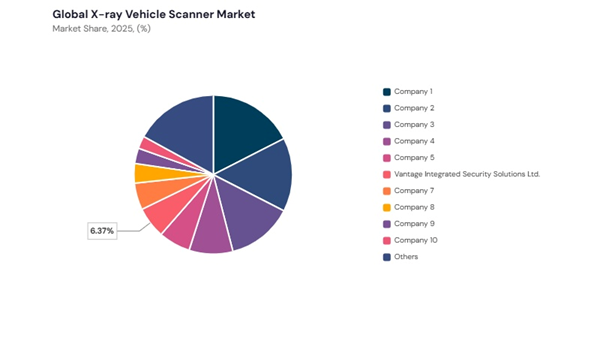
The X-ray Vehicle Scanner Market exhibits a relatively concentrated and security-infrastructure-driven competitive structure, with established screening technology providers holding strong positions alongside specialized and regional participants. Nuctech Company Limited leads the market, supported by its broad installed base of vehicle and cargo inspection systems, extensive deployment across customs agencies, border crossings, ports, and critical infrastructure facilities, and strong presence across emerging security markets. Leidos maintains a strong position through its homeland security, border protection, and defense-related screening technologies. Smiths Detection Group and LINEV Systems also represent major participants, supported by broad inspection portfolios, global service networks, high-energy vehicle inspection systems, and customs-focused screening solutions.
Component Outlook
Based on Component, the market is segmented into Product and Services. The Product market dominated the Global X-ray Vehicle Scanner Market by Component in 2025, and is expected to continue to be a dominant market till 2033; thereby, achieving a market value of USD 3.4 Billion by 2033, growing at a CAGR of 9.1 % during the forecast period. The Services market is expected to witness a CAGR of 10.8% during 2026-2033.
Demand for product systems is supported by the need for high-resolution imaging, automated detection, radiation safety controls, centralized monitoring, and reliable non-intrusive inspection. Services are also gaining importance as vehicle scanners require installation, calibration, maintenance, operator training, software upgrades, remote diagnostics, integration support, and performance validation to maintain operational continuity and compliance. Product systems form the core of the market as they enable inspection of cars, trucks, buses, cargo vehicles, and other transport vehicles without physical disassembly. Buyers prioritize imaging clarity, scan speed, penetration capability, system reliability, safety compliance, and threat detection performance. Services support long-term system efficiency by ensuring scanners remain calibrated, compliant, updated, and fully operational in mission-critical security environments.
Type Outlook
Based on Type, the market is segmented into Fixed and Portable. The Fixed market dominated the Global X-ray Vehicle Scanner Market by Type in 2025, and is expected to continue to be a dominant market till 2033; thereby, achieving a market value of USD 3.0 Billion by 2033, growing at a CAGR of 9.2 % during the forecast period. The Portable market is expected to witness a CAGR of 10.1% during 2026-2033.These systems are preferred where high throughput, advanced imaging capability, and integration with traffic control and security platforms are essential. Portable scanners are witnessing rising adoption due to their mobility, rapid deployment capability, and suitability for temporary checkpoints, remote inspections, military missions, emergency response, and large-event security operations. Fixed X-ray vehicle scanners support continuous inspection in high-traffic environments and are often integrated with automated barriers, surveillance systems, command centers, and data management platforms. These systems offer strong imaging performance and are suitable for long-term infrastructure-based security operations. Portable scanners provide operational flexibility in locations where permanent infrastructure is unavailable or where fast deployment is required.
Application Outlook
Based on Application, the market is segmented into Government and Critical Infrastructure Protection, and Private. The Government / Critical Infrastructure Protection market dominated the Global X-ray Vehicle Scanner Market by Application in 2025, and is expected to continue to be a dominant market till 2033; thereby, achieving a market value of USD 3.6 Billion by 2033, growing at a CAGR of 9.3 % during the forecast period. The Private market is expected to witness a CAGR of 10.4% during 2026-2033.Government and Critical Infrastructure Protection represents the leading application segment due to rising investments in border security, customs inspection, military facilities, anti-smuggling initiatives, counter-terrorism operations, and protection of strategic national assets. These users require reliable, high-throughput, compliant, and accurate scanning systems capable of supporting non-intrusive inspections under strict security protocols. The Private segment is gaining adoption among logistics operators, commercial cargo facilities, industrial sites, and high-security premises seeking improved access control, cargo verification, and risk management. Government and critical infrastructure users rely on X-ray vehicle scanners to detect concealed weapons, explosives, narcotics, contraband, hazardous materials, and illegal goods across high-risk sites. Their demand is influenced by security regulations, national infrastructure protection programs, and public-sector inspection modernization. Private users prioritize cost-efficient, scalable, and operationally reliable systems that help protect supply chains, reduce cargo risks, and support compliance with trade and facility security requirements.
Regional Outlook
Region-wise, the X-ray Vehicle Scanner Market is analyzed across North America, Europe, Asia Pacific, and LAMEA. The North America market dominated the Global X-ray Vehicle Scanner Market by Region in 2025, and is expected to continue to be a dominant market till 2033; thereby, achieving a market value of USD 1.5 Billion by 2033, growing at a CAGR of 8.8 % during the forecast period. The Asia Pacific market is expected to witness a CAGR of 9.9% during 2026-2033. Additionally, the Europe market is expected to witness a CAGR of 9.2% during 2026-2033.
North America represents the leading regional market due to strong investment in border security, critical infrastructure protection, customs modernization, and advanced screening technologies. Asia Pacific is witnessing strong adoption due to expanding trade corridors, rising cross-border cargo movement, port modernization, and growing security infrastructure investments. Europe remains a major market due to strict regulatory frameworks, advanced customs systems, and strong demand for secure transportation infrastructure. LAMEA is gradually emerging due to border security modernization, infrastructure development, port expansion, and increasing investment in anti-smuggling and national security initiatives.
Recent Strategies Deployed in the Market
- Rapiscan Systems expanded its high-energy X-ray vehicle scanning solutions designed for border checkpoints, ports, and critical infrastructure security applications.
- Nuctech expanded its intelligent inspection technology portfolio through advanced X-ray vehicle scanning systems for customs inspection, cargo screening, and transportation security applications.
- Leidos strengthened its security and detection technology portfolio through advanced scanning systems supporting transportation security, critical infrastructure protection, and border inspection applications.
- X-ray vehicle scanner manufacturers collaborated with governments, customs agencies, and transportation authorities to modernize border inspection infrastructure through advanced non-intrusive inspection technologies.
- Security equipment manufacturers expanded partnerships with artificial intelligence software developers, analytics providers, and infrastructure integrators to improve automated threat detection capabilities.
- Deployment of X-ray vehicle scanning systems expanded across emerging border security projects and logistics infrastructure developments across developing transportation and customs markets.
- Vendors continued investing in artificial intelligence-enabled image analysis, digital detector systems, remote monitoring, centralized control, energy-efficient scanner design, and regulatory-compliant inspection platforms.
List of Key Companies Profiled
- Nuctech Company Limited
- Leidos
- Smiths Detection Group
- LINEV Systems
- Astrophysics
- Vantage Integrated Security Solutions
- CGN Group
- PKI ELECTRONIC INTELLIGENCE
- Tudor Scan Tech
- Three-D-X-RAY
Market Report Segmentation
By Component- Product
- Services
- Fixed
- Portable
- Government and Critical Infrastructure Protection
- Private
- North America
- US
- Canada
- Mexico
- Rest of North America
- Europe
- Germany
- UK
- France
- Russia
- Spain
- Italy
- Rest of Europe
- Asia Pacific
- China
- Japan
- India
- South Korea
- Singapore
- Malaysia
- Rest of Asia Pacific
- LAMEA
- Brazil
- Argentina
- UAE
- Saudi Arabia
- South Africa
- Nigeria
- Rest of LAMEA
Table of Contents
Chapter 1. Research Scope & Methodology
Chapter 2. Market Overview
Chapter 3. Key Factors Impacting Market
Chapter 6. Competition Analysis - Global
Chapter 7. Segmentation By Component
Chapter 8. Segmentation By Type
Chapter 9. Segmentation By Application
Chapter 10. North America Market
Chapter 11. Europe Market
Chapter 12. Asia Pacific Market
Chapter 13. LAMEA Market
Chapter 14. Company Snapshot
Chapter 15. Winning Imperatives of X-ray Vehicle Scanner Market
Companies Mentioned
• Nuctech Company Limited• Leidos
• Smiths Detection Group
• LINEV Systems
• Astrophysics
• Vantage Integrated Security Solutions
• CGN Group
• PKI ELECTRONIC INTELLIGENCE
• Tudor Scan Tech
• Three-D-X-RAY


