

+353-1-416-8900REST OF WORLD
+44-20-3973-8888REST OF WORLD
1-917-300-0470EAST COAST U.S
1-800-526-8630U.S. (TOLL FREE)

Global Anti-Chafing Products Market Size, Share & Industry Analysis Report by Distribution Channel, Product Type, End User, Application, Regional Outlook and Forecast, 2026-2033

  • PDF Icon

    Report

  • 645 Pages
  • June 2026
  • Marqual IT Solutions Pvt. Ltd (KBV Research)
  • ID: 6276072
The Global Anti-Chafing Products Market is expected to reach USD 1.19 billion by 2033, growing at a CAGR of 6.4% during 2026-2033.


The Global Anti-Chafing Products Market is witnessing steady growth, supported by rising awareness of skin health, hygiene, comfort, and preventive personal care. Demand is increasing across sports, fitness, healthcare, outdoor recreation, occupational use, and daily body-comfort applications. The market is gaining traction due to active lifestyle adoption, endurance activities, and growing need for specialized skincare solutions. Product innovation in sweat-resistant formulas, natural ingredients, hypoallergenic claims, and long-lasting protection is further supporting adoption. Earlier limited to powders, ointments, and basic creams, the market has evolved into barrier creams, balms, sticks, and multifunctional skincare formats. Clean-label preferences, e-commerce growth, sustainable packaging, and dermatologically tested products are strengthening its position as an everyday preventive skincare category.

Key Market Trends & Insights

  • By distribution channel, Offline dominated the market in 2025 with USD 385.0 Million and is projected to reach USD 607.8 Million by 2033, growing at a CAGR of 6.0%.
  • Online distribution is expected to grow faster than offline, reaching USD 584.2 Million by 2033 and registering a CAGR of 6.8% during 2026-2033.
  • By product type, Balms & Sticks dominated the market in 2025 with USD 348.2 Million and are expected to remain dominant through 2033, reaching USD 542.4 Million.
  • Other Product Type is expected to be the fastest-growing product segment, recording a CAGR of 7.5% during 2026-2033, followed by Powders at 7.2%.
  • By end user, Men dominated the market in 2025 with USD 286.8 Million and are projected to reach USD 425.2 Million by 2033, growing at a CAGR of 5.2%.
  • Other End User is projected to grow fastest by end user, registering a CAGR of 8.0% during 2026-2033, followed by Children at 7.7%.
  • By application, Sports & Fitness dominated the market in 2025 with USD 282.1 Million and is expected to reach USD 435.1 Million by 2033.
  • Regionally, North America dominated the market in 2025 with USD 282.7 Million, while LAMEA is expected to be the fastest-growing region with a CAGR of 7.9% during 2026-2033.

The Anti-Chafing Products Market is witnessing sustained expansion as consumers increasingly shift from reactive irritation treatment to preventive skincare and comfort-focused personal care routines. Anti-chafing products help reduce skin-to-skin and skin-to-fabric friction, manage moisture, improve comfort during physical activity, and support daily movement in warm or high-friction conditions. Demand is expanding across athletes, runners, cyclists, gym users, outdoor workers, travelers, plus-size consumers, parents, elderly individuals, and users with sensitive skin. The market is also benefiting from digital product discovery, influencer-led awareness, body positivity movements, broader acceptance of body-care solutions, and growing preference for natural, cruelty-free, vegan, fragrance-free, and dermatologically tested formulations.

The Anti-Chafing Products Market is characterized by a highly fragmented and consumer wellness-driven competitive environment consisting of specialized anti-chafing brands, personal care companies, sports skincare manufacturers, cycling-focused product providers, private-label suppliers, and regional skincare players. Competition is centered on formulation efficacy, skin compatibility, application convenience, ingredient transparency, brand trust, portability, natural positioning, price accessibility, and performance during sweat-heavy or long-duration activities. Specialist brands compete through category expertise and athlete-focused positioning, while beauty-led and personal care brands expand adoption by presenting anti-chafing products as everyday body-comfort essentials. Private-label and substitute products continue to intensify competition, making innovation, retail visibility, e-commerce presence, and consumer education important competitive factors.

Driving and Restraining Factors

Drivers
  • Rising Participation in Endurance and Outdoor Activities Driving Demand
  • Increasing Consumer Awareness and Personal Care Investment
  • Innovation in Product Formulation and Delivery Mechanisms
  • Growing Emphasis on Comfort and Skin Health in Apparel and Activewear
Restraints
  • Regulatory and Safety Compliance Challenges in Product Formulation
  • High Cost Sensitivity and Limited Consumer Willingness to Pay Premium Prices
  • Limited Consumer Awareness and Inadequate Educational Outreach
Opportunities
  • Expansion Through Dermatologically Tested Natural Formulations
  • Integration of Anti-Chafing Solutions with Active and Outdoor Lifestyle Apparel
  • Customization and Personalization Through Digital Health and AI-driven Solutions
Challenges
  • Formulation and Skin Sensitivity Challenges
  • High Cost and Pricing Sensitivity
  • Consumer Awareness and Behavioral Adoption Constraints

Market Share Analysis
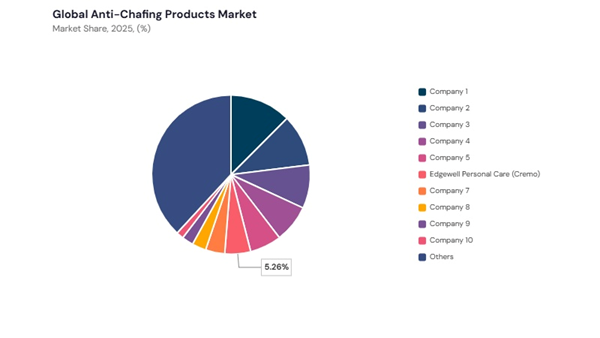


The Anti-Chafing Products Market exhibits a highly fragmented competitive structure, with Body Glide LLC emerging as a leading branded participant due to its dedicated anti-chafing product portfolio, strong recognition among runners, cyclists, hikers, military personnel, and everyday consumers, and broad availability across sporting goods, pharmacy, and e-commerce channels. Megababe, LLC maintains a strong position through its Thigh Rescue anti-friction stick and body-positive positioning that has helped expand anti-chafing products beyond sports into beauty, wellness, and daily personal care. Prestige Consumer Healthcare, Inc. through Monistat and Chamois Butt’r also hold important positions, supported by pharmacy-led women’s health credibility and cycling-focused performance skincare recognition.

Distribution Channel Outlook


Based on Distribution Channel, the market is segmented into Offline and Online. The Offline market dominated the Global Anti-Chafing Products Market by Distribution Channel in 2025, and is expected to continue to be a dominant market till 2033; thereby, achieving a market value of USD 607.8 Million by 2033, growing at a CAGR of 6 % during the forecast period. The Online market is expected to witness a CAGR of 6.8% during 2026-2033.

Offline distribution dominated the Global Anti-Chafing Products Market in 2025 and remains important through pharmacies, supermarkets, drugstores, sporting goods stores, specialty retailers, and convenience outlets. These channels support immediate product access, physical evaluation, trusted retail visibility, and urgent purchase needs. Online channels are growing through e-commerce platforms, digital pharmacies, brand websites, and online marketplaces. Consumers use online channels to compare ingredients, reviews, prices, product formats, sensitive-skin claims, and natural formulations. Digital marketing, influencer recommendations, subscriptions, personalized suggestions, and discreet shopping are strengthening online adoption.

Product Type Outlook

Based on Product Type, the market is segmented into Balms & Sticks, Creams & Lotions, Powders, and Other Product Type. The Balms & Sticks market dominated the Global Anti-Chafing Products Market by Product Type in 2025, and is expected to continue to be a dominant market till 2033; thereby, achieving a market value of USD 542.4 Million by 2033, growing at a CAGR of 5.9 % during the forecast period. The Creams & Lotions market is expected to witness a CAGR of 6.6% during 2026-2033. The Other Product Type market is expected to witness a CAGR of 7.5% during 2026-2033.

Balms & Sticks dominated the Global Anti-Chafing Products Market in 2025 due to easy application, portability, targeted use, and long-lasting friction protection. These products are widely used on thighs, underarms, feet, waistlines, bra areas, groin zones, and clothing-friction points. Their compact format makes them popular among runners, cyclists, hikers, travelers, athletes, commuters, and daily users. Creams & Lotions are also important due to their soothing texture, moisturizing benefits, and ability to protect larger body areas. Powders support comfort by absorbing moisture and reducing sweat-related friction, especially in humid environments. Other formats such as gels, sprays, wipes, tapes, patches, and anti-friction wearables serve niche needs across travel, sports, hygiene, medical comfort, and quick on-the-go use.

End User Outlook

Based on End User, the market is segmented into Men, Women, Children, and Other End User. The Men market dominated the Global Anti-Chafing Products Market by End User in 2025, and is expected to continue to be a dominant market till 2033; thereby, achieving a market value of USD 425.2 Million by 2033, growing at a CAGR of 5.2 % during the forecast period. The Women market is expected to witness a CAGR of 6.6% during 2026-2033. Additionally, the Children market is expected to witness highest CAGR of 7.7% during 2026-2033.

Men represented the leading end-user segment in 2025, supported by growing participation in sports, gym training, cycling, running, outdoor work, and recreational activities. Male consumers commonly use anti-chafing products for thighs, groin areas, underarms, feet, waistlines, and sportswear contact points. Women also show strong adoption for daily comfort, Activewear, walking, running, travel, maternity comfort, bra-line friction, and sensitive skin protection. Children remain a smaller but relevant segment, supported by school activities, outdoor play, sports, diaper-area comfort, and pediatric-friendly formulations. Other users include elderly individuals, plus-size consumers, travelers, outdoor workers, healthcare users, and people needing specialized skin protection. Overall, anti-chafing products are becoming part of mainstream comfort-focused skincare.

Application Outlook

Based on Application, the market is segmented into Sports & Fitness, Daily Use, Medical, and Other Application. The Sports & Fitness market dominated the Global Anti-Chafing Products Market by Application in 2025, and is expected to continue to be a dominant market till 2033; thereby, achieving a market value of USD 435.1 Million by 2033, growing at a CAGR of 5.7 % during the forecast period. The Daily Use market is expected to witness a CAGR of 6.6% during 2026-2033. Additionally, the Medical market is expected to witness highest CAGR of 7.4% during 2026-2033.

Sports & Fitness dominated the Global Anti-Chafing Products Market in 2025, supported by running, cycling, gym workouts, hiking, endurance events, team sports, and outdoor recreation. Users prefer sweat-resistant, long-lasting, non-greasy, and easy-to-reapply products that prevent irritation from movement, moisture, and performance clothing. Daily Use is also a major application area as consumers add anti-chafing products to regular personal care routines. These products support comfort during commuting, walking, work, travel, warm weather, tight clothing, uniforms, dresses, activewear, and footwear use. Medical applications include skin-fold irritation, mobility-related friction, recovery support, sensitive skin care, and comfort for users with health needs. Other applications include outdoor work, maternity comfort, festivals, training, travel, and specialized personal care situations.
Free Valuable Insights: [external URL]

Regional Outlook


Region-wise, the Anti-Chafing Products Market is analyzed across North America, Europe, Asia Pacific, and LAMEA. The North America market dominated the Global Anti-Chafing Products Market by Region in 2025, and is expected to continue to be a dominant market till 2033; thereby, achieving a market value of USD 441.9 Million by 2033, growing at a CAGR of 5.9 % during the forecast period. The Asia Pacific market is expected to witness a CAGR of 7% during 2026-2033. Additionally, the Europe market is expected to witness a CAGR of 6% during 2026-2033.

North America dominated the Global Anti-Chafing Products Market in 2025, supported by high consumer awareness, active lifestyles, established brands, strong retail networks, and mature e-commerce channels. Europe is growing through sports participation, pharmacy-led skincare purchases, wellness awareness, walking and cycling culture, and sensitive-skin preferences. Asia Pacific is witnessing strong demand due to rising incomes, fitness participation, urbanization, e-commerce growth, and increasing personal care awareness. LAMEA is developing steadily as skin protection awareness, fitness activities, retail access, and online availability improve. Across all regions, anti-chafing products are expanding from sports-focused use to daily comfort, family care, occupational protection, and preventive body-care routines.

Recent Strategies Deployed in the Market

  • Megababe expanded consumer visibility of its Thigh Rescue anti-chafing stick, strengthening adoption among everyday users seeking portable friction-prevention body-care products.
  • Chamois Butt’r expanded product education and ingredient transparency for cycling-focused anti-chafing creams, supporting demand among endurance athletes and performance skincare users.
  • Chamois Butt’r expanded its portable product portfolio with the GoStik anti-chafing solution, emphasizing convenience, portability, and on-the-go use for active consumers.
  • Extra UK and Cyclex announced a distribution partnership involving Chamois Butt’r products to improve retail availability and cycling market penetration.
  • Anti-chafing brands expanded collaborations with athletes, fitness influencers, runners, cyclists, and wellness-focused digital creators to improve social media visibility and consumer awareness.
  • Anti-chafing sports skincare products expanded across global athletic and wellness markets through e-commerce platforms, sports retailers, and digital wellness communities.

List of Key Companies Profiled

  • Body Glide LLC
  • Megababe, LLC
  • Prestige Consumer Healthcare, Inc.
  • Chamois Butt’r
  • Squirrel’s Nut Butter
  • Edgewell Personal Care
  • MEDI-DYNE Healthcare Products, Ltd.
  • Blue Steel Sports
  • DZ-Nuts
  • Zealios

Market Report Segmentation

By Distribution Channel
  • Offline
  • Online
By Product Type
  • Balms & Sticks
  • Creams & Lotions
  • Powders
  • Other Product Type
By End User
  • Men
  • Women
  • Children
  • Other End User
By Application
  • Sports & Fitness
  • Daily Use
  • Medical
  • Other Application
By Geography
  • North America
    • US
    • Canada
    • Mexico
    • Rest of North America

  • Europe
    • Germany
    • UK
    • France
    • Russia
    • Spain
    • Italy
    • Rest of Europe

  • Asia Pacific
    • China
    • Japan
    • India
    • South Korea
    • Australia
    • Rest of Asia Pacific

  • LAMEA
    • Brazil
    • Argentina
    • UAE
    • Saudi Arabia
    • South Africa
    • Nigeria
    • Rest of LAMEA

Table of Contents

Chapter 1. Research Scope & Methodology
1.1 Market Definition
1.2 Analysis Period & Currency
1.3 Segmentation
1.4 Anti-Chafing Products Market, by Geography
1.5 Research Methodology
Chapter 2. Market Overview
2.1 COVID-19
2.2 Market Composition and Scenario
Chapter 3. Key Factors Impacting Market
3.1 Market Drivers
3.2 Market Restraints
3.3 Market Opportunities
3.4 Market Challenges
3.5 Market Trends
3.6 State of Competition
3.7 Market Consolidation
3.8 Key Customer Criteria
Chapter 4. Product Life CycleChapter 5. Value Chain Analysis of Anti-Chafing Products Market
Chapter 6. Competition Analysis - Global
6.1 Market Share Analysis
6.2 Recent Developments and Strategies
6.2.1 Product Launch & Product Expansion
6.2.2 Partnership, Collaboration & Agreements
6.2.3 Geographical Expansion
Chapter 7. Segmentation By Distribution Channel
7.1 Offline
7.2 Online
Chapter 8. Segmentation By Product Type
8.1 Balms & Sticks
8.2 Creams & Lotions
8.3 Powders
8.4 Other Product Type
Chapter 9. Segmentation By End User
9.1 Men
9.2 Women
9.3 Children
9.4 Other End Users
Chapter 10. Segmentation By Application
10.1 Sports & Fitness
10.2 Daily Use
10.3 Medical
10.4 Other Applications
Chapter 11. North America Market
11.1 Market Overview
11.2 Key Factors Impacting Market
11.2.1 Market Drivers
11.2.2 Market Restraints
11.2.3 Market Opportunities
11.2.4 Market Challenges
11.2.5 Market Trends
11.2.6 State of Competition
11.2.7 Market Consolidation
11.2.8 Key Customer Criteria
11.3 Product Life Cycle
11.4 Segmentation By Distribution Channel
11.4.1 Offline
11.4.2 Online
11.5 Segmentation By Product Type
11.5.1 Balms & Sticks
11.5.2 Creams & Lotions
11.5.3 Powders
11.5.4 Other Product Type
11.6 Segmentation By End User
11.6.1 Men
11.6.2 Women
11.6.3 Children
11.6.4 Other End Users
11.7 Segmentation By Application
11.7.1 Sports & Fitness
11.7.2 Daily Use
11.7.3 Medical
11.7.4 Other Application
11.8 Segmentation By Country
11.8.1 US
11.8.1.1 Segmentation By Distribution Channel
11.8.1.1.1 Offline
11.8.1.1.2 Online
11.8.1.2 Segmentation By Product Type
11.8.1.2.1 Balms & Sticks
11.8.1.2.2 Creams & Lotions
11.8.1.2.3 Powders
11.8.1.2.4 Other Product Type
11.8.1.3 Segmentation By End User
11.8.1.3.1 Men
11.8.1.3.2 Women
11.8.1.3.3 Children
11.8.1.3.4 Other End Users
11.8.1.4 Segmentation By Application
11.8.1.4.1 Sports & Fitness
11.8.1.4.2 Daily Use
11.8.1.4.3 Medical
11.8.1.4.4 Other Application
11.8.2 Canada
11.8.2.1 Segmentation By Distribution Channel
11.8.2.1.1 Offline
11.8.2.1.2 Online
11.8.2.2 Segmentation By Product Type
11.8.2.2.1 Balms & Sticks
11.8.2.2.2 Creams & Lotions
11.8.2.2.3 Powders
11.8.2.2.4 Other Product Type
11.8.2.3 Segmentation By End User
11.8.2.3.1 Men
11.8.2.3.2 Women
11.8.2.3.3 Children
11.8.2.3.4 Other End Users
11.8.2.4 Segmentation By Application
11.8.2.4.1 Sports & Fitness
11.8.2.4.2 Daily Use
11.8.2.4.3 Medical
11.8.2.4.4 Other Application
11.8.3 Mexico
11.8.3.1 Segmentation By Distribution Channel
11.8.3.1.1 Offline
11.8.3.1.2 Online
11.8.3.2 Segmentation By Product Type
11.8.3.2.1 Balms & Sticks
11.8.3.2.2 Creams & Lotions
11.8.3.2.3 Powders
11.8.3.2.4 Other Product Type
11.8.3.3 Segmentation By End User
11.8.3.3.1 Men
11.8.3.3.2 Women
11.8.3.3.3 Children
11.8.3.3.4 Other End Users
11.8.3.4 Segmentation By Application
11.8.3.4.1 Sports & Fitness
11.8.3.4.2 Daily Use
11.8.3.4.3 Medical
11.8.3.4.4 Other Application
11.8.4 Rest of North America
11.8.4.1 Segmentation By Distribution Channel
11.8.4.1.1 Offline
11.8.4.1.2 Online
11.8.4.2 Segmentation By Product Type
11.8.4.2.1 Balms & Sticks
11.8.4.2.2 Creams & Lotions
11.8.4.2.3 Powders
11.8.4.2.4 Other Product Type
11.8.4.3 Segmentation By End User
11.8.4.3.1 Men
11.8.4.3.2 Women
11.8.4.3.3 Children
11.8.4.3.4 Other End Users
11.8.4.4 Segmentation By Application
11.8.4.4.1 Sports & Fitness
11.8.4.4.2 Daily Use
11.8.4.4.3 Medical
11.8.4.4.4 Other Application
Chapter 12. Europe Market
12.1 Market Overview
12.2 Key Factors Impacting Market
12.2.1 Market Drivers
12.2.2 Market Restraints
12.2.3 Market Opportunities
12.2.4 Market Challenges
12.2.5 Market Trends
12.2.6 State of Competition
12.2.7 Market Consolidation
12.2.8 Key Customer Criteria
12.3 Product Life Cycle
12.4 Segmentation By Distribution Channel
12.4.1 Offline
12.4.2 Online
12.5 Segmentation By Product Type
12.5.1 Balms & Sticks
12.5.2 Creams & Lotions
12.5.3 Powders
12.5.4 Other Product Type
12.6 Segmentation By End User
12.6.1 Men
12.6.2 Women
12.6.3 Children
12.6.4 Other End User
12.7 Segmentation By Application
12.7.1 Sports & Fitness
12.7.2 Daily Use
12.7.3 Medical
12.7.4 Other Application
12.8 Segmentation By Country
12.8.1 Germany
12.8.1.1 Segmentation By Distribution Channel
12.8.1.1.1 Offline
12.8.1.1.2 Online
12.8.1.2 Segmentation By Product Type
12.8.1.2.1 Balms & Sticks
12.8.1.2.2 Creams & Lotions
12.8.1.2.3 Powders
12.8.1.2.4 Other Product Type
12.8.1.3 Segmentation By End User
12.8.1.3.1 Men
12.8.1.3.2 Women
12.8.1.3.3 Children
12.8.1.3.4 Other End Users
12.8.1.4 Segmentation By Application
12.8.1.4.1 Sports & Fitness
12.8.1.4.2 Daily Use
12.8.1.4.3 Medical
12.8.1.4.4 Other Application
12.8.2 UK
12.8.2.1 Segmentation By Distribution Channel
12.8.2.1.1 Offline
12.8.2.1.2 Online
12.8.2.2 Segmentation By Product Type
12.8.2.2.1 Balms & Sticks
12.8.2.2.2 Creams & Lotions
12.8.2.2.3 Powders
12.8.2.2.4 Other Product Type
12.8.2.3 Segmentation By End User
12.8.2.3.1 Men
12.8.2.3.2 Women
12.8.2.3.3 Children
12.8.2.3.4 Other End Users
12.8.2.4 Segmentation By Application
12.8.2.4.1 Sports & Fitness
12.8.2.4.2 Daily Use
12.8.2.4.3 Medical
12.8.2.4.4 Other Application
12.8.3 France
12.8.3.1 Segmentation By Distribution Channel
12.8.3.1.1 Offline
12.8.3.1.2 Online
12.8.3.2 Segmentation By Product Type
12.8.3.2.1 Balms & Sticks
12.8.3.2.2 Creams & Lotions
12.8.3.2.3 Powders
12.8.3.2.4 Other Product Type
12.8.3.3 Segmentation By End User
12.8.3.3.1 Men
12.8.3.3.2 Women
12.8.3.3.3 Children
12.8.3.3.4 Other End Users
12.8.3.4 Segmentation By Application
12.8.3.4.1 Sports & Fitness
12.8.3.4.2 Daily Use
12.8.3.4.3 Medical
12.8.3.4.4 Other Application
12.8.4 Russia
12.8.4.1 Segmentation By Distribution Channel
12.8.4.1.1 Offline
12.8.4.1.2 Online
12.8.4.2 Segmentation By Product Type
12.8.4.2.1 Balms & Sticks
12.8.4.2.2 Creams & Lotions
12.8.4.2.3 Powders
12.8.4.2.4 Other Product Type
12.8.4.3 Segmentation By End User
12.8.4.3.1 Men
12.8.4.3.2 Women
12.8.4.3.3 Children
12.8.4.3.4 Other End Users
12.8.4.4 Segmentation By Application
12.8.4.4.1 Sports & Fitness
12.8.4.4.2 Daily Use
12.8.4.4.3 Medical
12.8.4.4.4 Other Application
12.8.5 Spain
12.8.5.1 Segmentation By Distribution Channel
12.8.5.1.1 Offline
12.8.5.1.2 Online
12.8.5.2 Segmentation By Product Type
12.8.5.2.1 Balms & Sticks
12.8.5.2.2 Creams & Lotions
12.8.5.2.3 Powders
12.8.5.2.4 Other Product Type
12.8.5.3 Segmentation By End User
12.8.5.3.1 Men
12.8.5.3.2 Women
12.8.5.3.3 Children
12.8.5.3.4 Other End Users
12.8.5.4 Segmentation By Application
12.8.5.4.1 Sports & Fitness
12.8.5.4.2 Daily Use
12.8.5.4.3 Medical
12.8.5.4.4 Other Application
12.8.6 Italy
12.8.6.1 Segmentation By Distribution Channel
12.8.6.1.1 Offline
12.8.6.1.2 Online
12.8.6.2 Segmentation By Product Type
12.8.6.2.1 Balms & Sticks
12.8.6.2.2 Creams & Lotions
12.8.6.2.3 Powders
12.8.6.2.4 Other Product Type
12.8.6.3 Segmentation By End User
12.8.6.3.1 Men
12.8.6.3.2 Women
12.8.6.3.3 Children
12.8.6.3.4 Other End Users
12.8.6.4 Segmentation By Application
12.8.6.4.1 Sports & Fitness
12.8.6.4.2 Daily Use
12.8.6.4.3 Medical
12.8.6.4.4 Other Application
12.8.7 Rest of Europe
12.8.7.1 Segmentation By Distribution Channel
12.8.7.1.1 Offline
12.8.7.1.2 Online
12.8.7.2 Segmentation By Product Type
12.8.7.2.1 Balms & Sticks
12.8.7.2.2 Creams & Lotions
12.8.7.2.3 Powders
12.8.7.2.4 Other Product Type
12.8.7.3 Segmentation By End User
12.8.7.3.1 Men
12.8.7.3.2 Women
12.8.7.3.3 Children
12.8.7.3.4 Other End Users
12.8.7.4 Segmentation By Application
12.8.7.4.1 Sports & Fitness
12.8.7.4.2 Daily Use
12.8.7.4.3 Medical
12.8.7.4.4 Other Application
Chapter 13. Asia Pacific Market
13.1 Market Overview
13.2 Key Factors Impacting Market
13.2.1 Market Drivers
13.2.2 Market Restraints
13.2.3 Market Opportunities
13.2.4 Market Challenges
13.2.5 Market Trends
13.2.6 State of Competition
13.2.7 Market Consolidation
13.2.8 Key Customer Criteria
13.3 Product Life Cycle
13.4 Segmentation By Distribution Channel
13.4.1 Offline
13.4.2 Online
13.5 Segmentation By Product Type
13.5.1 Balms & Sticks
13.5.2 Creams & Lotions
13.5.3 Powders
13.5.4 Other Product Type
13.6 Segmentation By End User
13.6.1 Men
13.6.2 Women
13.6.3 Children
13.6.4 Other End Users
13.7 Segmentation By Application
13.7.1 Sports & Fitness
13.7.2 Daily Use
13.7.3 Medical
13.7.4 Other Application
13.8 Segmentation By Country
13.8.1 China
13.8.1.1 Segmentation By Distribution Channel
13.8.1.1.1 Offline
13.8.1.1.2 Online
13.8.1.2 Segmentation By Product Type
13.8.1.2.1 Balms & Sticks
13.8.1.2.2 Creams & Lotions
13.8.1.2.3 Powders
13.8.1.2.4 Other Product Type
13.8.1.3 Segmentation By End User
13.8.1.3.1 Men
13.8.1.3.2 Women
13.8.1.3.3 Children
13.8.1.3.4 Other End Users
13.8.1.4 Segmentation By Application
13.8.1.4.1 Sports & Fitness
13.8.1.4.2 Daily Use
13.8.1.4.3 Medical
13.8.1.4.4 Other Application
13.8.2 Japan
13.8.2.1 Segmentation By Distribution Channel
13.8.2.1.1 Offline
13.8.2.1.2 Online
13.8.2.2 Segmentation By Product Type
13.8.2.2.1 Balms & Sticks
13.8.2.2.2 Creams & Lotions
13.8.2.2.3 Powders
13.8.2.2.4 Other Product Type
13.8.2.3 Segmentation By End User
13.8.2.3.1 Men
13.8.2.3.2 Women
13.8.2.3.3 Children
13.8.2.3.4 Other End Users
13.8.2.4 Segmentation By Application
13.8.2.4.1 Sports & Fitness
13.8.2.4.2 Daily Use
13.8.2.4.3 Medical
13.8.2.4.4 Other Application
13.8.3 India
13.8.3.1 Segmentation By Distribution Channel
13.8.3.1.1 Offline
13.8.3.1.2 Online
13.8.3.2 Segmentation By Product Type
13.8.3.2.1 Balms & Sticks
13.8.3.2.2 Creams & Lotions
13.8.3.2.3 Powders
13.8.3.2.4 Other Product Type
13.8.3.3 Segmentation By End User
13.8.3.3.1 Men
13.8.3.3.2 Women
13.8.3.3.3 Children
13.8.3.3.4 Other End Users
13.8.3.4 Segmentation By Application
13.8.3.4.1 Sports & Fitness
13.8.3.4.2 Daily Use
13.8.3.4.3 Medical
13.8.3.4.4 Other Application
13.8.4 South Korea
13.8.4.1 Segmentation By Distribution Channel
13.8.4.1.1 Offline
13.8.4.1.2 Online
13.8.4.2 Segmentation By Product Type
13.8.4.2.1 Balms & Sticks
13.8.4.2.2 Creams & Lotions
13.8.4.2.3 Powders
13.8.4.2.4 Other Product Type
13.8.4.3 Segmentation By End User
13.8.4.3.1 Men
13.8.4.3.2 Women
13.8.4.3.3 Children
13.8.4.3.4 Other End Users
13.8.4.4 Segmentation By Application
13.8.4.4.1 Sports & Fitness
13.8.4.4.2 Daily Use
13.8.4.4.3 Medical
13.8.4.4.4 Other Application
13.8.5 Australia
13.8.5.1 Segmentation By Distribution Channel
13.8.5.1.1 Offline
13.8.5.1.2 Online
13.8.5.2 Segmentation By Product Type
13.8.5.2.1 Balms & Sticks
13.8.5.2.2 Creams & Lotions
13.8.5.2.3 Powders
13.8.5.2.4 Other Product Type
13.8.5.3 Segmentation By End User
13.8.5.3.1 Men
13.8.5.3.2 Women
13.8.5.3.3 Children
13.8.5.3.4 Other End Users
13.8.5.4 Segmentation By Application
13.8.5.4.1 Sports & Fitness
13.8.5.4.2 Daily Use
13.8.5.4.3 Medical
13.8.5.4.4 Other Application
13.8.6 Malaysia
13.8.6.1 Segmentation By Distribution Channel
13.8.6.1.1 Offline
13.8.6.1.2 Online
13.8.6.2 Segmentation By Product Type
13.8.6.2.1 Balms & Sticks
13.8.6.2.2 Creams & Lotions
13.8.6.2.3 Powders
13.8.6.2.4 Other Product Type
13.8.6.3 Segmentation By End User
13.8.6.3.1 Men
13.8.6.3.2 Women
13.8.6.3.3 Children
13.8.6.3.4 Other End Users
13.8.6.4 Segmentation By Application
13.8.6.4.1 Sports & Fitness
13.8.6.4.2 Daily Use
13.8.6.4.3 Medical
13.8.6.4.4 Other Application
13.8.7 Rest of Asia Pacific
13.8.7.1 Segmentation By Distribution Channel
13.8.7.1.1 Offline
13.8.7.1.2 Online
13.8.7.2 Segmentation By Product Type
13.8.7.2.1 Balms & Sticks
13.8.7.2.2 Creams & Lotions
13.8.7.2.3 Powders
13.8.7.2.4 Other Product Type
13.8.7.3 Segmentation By End User
13.8.7.3.1 Men
13.8.7.3.2 Women
13.8.7.3.3 Children
13.8.7.3.4 Other End Users
13.8.7.4 Segmentation By Application
13.8.7.4.1 Sports & Fitness
13.8.7.4.2 Daily Use
13.8.7.4.3 Medical
13.8.7.4.4 Other Application
Chapter 14. LAMEA Market
14.1 Market Overview
14.2 Key Factors Impacting Market
14.2.1 Market Drivers
14.2.2 Market Restraints
14.2.3 Market Opportunities
14.2.4 Market Challenges
14.2.5 Market Trends
14.2.6 State of Competition
14.2.7 Market Consolidation
14.2.8 Key Customer Criteria
14.3 Product Life Cycle
14.4 Segmentation By Distribution Channel
14.4.1 Offline
14.4.2 Online
14.5 Segmentation By Product Type
14.5.1 Balms & Sticks
14.5.2 Creams & Lotions
14.5.3 Powders
14.5.4 Other Product Type
14.6 Segmentation By End User
14.6.1 Men
14.6.2 Women
14.6.3 Children
14.6.4 Other End User
14.7 Segmentation By Application
14.7.1 Sports & Fitness
14.7.2 Daily Use
14.7.3 Medical
14.7.4 Other Application
14.8 Segmentation By Country
14.8.1 Brazil
14.8.1.1 Segmentation By Distribution Channel
14.8.1.1.1 Offline
14.8.1.1.2 Online
14.8.1.2 Segmentation By Product Type
14.8.1.2.1 Balms & Sticks
14.8.1.2.2 Creams & Lotions
14.8.1.2.3 Powders
14.8.1.2.4 Other Product Type
14.8.1.3 Segmentation By End User
14.8.1.3.1 Men
14.8.1.3.2 Women
14.8.1.3.3 Children
14.8.1.3.4 Other End Users
14.8.1.4 Segmentation By Application
14.8.1.4.1 Sports & Fitness
14.8.1.4.2 Daily Use
14.8.1.4.3 Medical
14.8.1.4.4 Other Application
14.8.2 Argentina
14.8.2.1 Segmentation By Distribution Channel
14.8.2.1.1 Offline
14.8.2.1.2 Online
14.8.2.2 Segmentation By Product Type
14.8.2.2.1 Balms & Sticks
14.8.2.2.2 Creams & Lotions
14.8.2.2.3 Powders
14.8.2.2.4 Other Product Type
14.8.2.3 Segmentation By End User
14.8.2.3.1 Men
14.8.2.3.2 Women
14.8.2.3.3 Children
14.8.2.3.4 Other End Users
14.8.2.4 Segmentation By Application
14.8.2.4.1 Sports & Fitness
14.8.2.4.2 Daily Use
14.8.2.4.3 Medical
14.8.2.4.4 Other Application
14.8.3 UAE
14.8.3.1 Segmentation By Distribution Channel
14.8.3.1.1 Offline
14.8.3.1.2 Online
14.8.3.2 Segmentation By Product Type
14.8.3.2.1 Balms & Sticks
14.8.3.2.2 Creams & Lotions
14.8.3.2.3 Powders
14.8.3.2.4 Other Product Type
14.8.3.3 Segmentation By End User
14.8.3.3.1 Men
14.8.3.3.2 Women
14.8.3.3.3 Children
14.8.3.3.4 Other End Users
14.8.3.4 Segmentation By Application
14.8.3.4.1 Sports & Fitness
14.8.3.4.2 Daily Use
14.8.3.4.3 Medical
14.8.3.4.4 Other Application
14.8.4 Saudi Arabia
14.8.4.1 Segmentation By Distribution Channel
14.8.4.1.1 Offline
14.8.4.1.2 Online
14.8.4.2 Segmentation By Product Type
14.8.4.2.1 Balms & Sticks
14.8.4.2.2 Creams & Lotions
14.8.4.2.3 Powders
14.8.4.2.4 Other Product Type
14.8.4.3 Segmentation By End User
14.8.4.3.1 Men
14.8.4.3.2 Women
14.8.4.3.3 Children
14.8.4.3.4 Other End Users
14.8.4.4 Segmentation By Application
14.8.4.4.1 Sports & Fitness
14.8.4.4.2 Daily Use
14.8.4.4.3 Medical
14.8.4.4.4 Other Application
14.8.5 South Africa
14.8.5.1 Segmentation By Distribution Channel
14.8.5.1.1 Offline
14.8.5.1.2 Online
14.8.5.2 Segmentation By Product Type
14.8.5.2.1 Balms & Sticks
14.8.5.2.2 Creams & Lotions
14.8.5.2.3 Powders
14.8.5.2.4 Other Product Type
14.8.5.3 Segmentation By End User
14.8.5.3.1 Men
14.8.5.3.2 Women
14.8.5.3.3 Children
14.8.5.3.4 Other End Users
14.8.5.4 Segmentation By Application
14.8.5.4.1 Sports & Fitness
14.8.5.4.2 Daily Use
14.8.5.4.3 Medical
14.8.5.4.4 Other Application
14.8.6 Nigeria
14.8.6.1 Segmentation By Distribution Channel
14.8.6.1.1 Offline
14.8.6.1.2 Online
14.8.6.2 Segmentation By Product Type
14.8.6.2.1 Balms & Sticks
14.8.6.2.2 Creams & Lotions
14.8.6.2.3 Powders
14.8.6.2.4 Other Product Type
14.8.6.3 Segmentation By End User
14.8.6.3.1 Men
14.8.6.3.2 Women
14.8.6.3.3 Children
14.8.6.3.4 Other End Users
14.8.6.4 Segmentation By Application
14.8.6.4.1 Sports & Fitness
14.8.6.4.2 Daily Use
14.8.6.4.3 Medical
14.8.6.4.4 Other Application
14.8.7 Rest of LAMEA
14.8.7.1 Segmentation By Distribution Channel
14.8.7.1.1 Offline
14.8.7.1.2 Online
14.8.7.2 Segmentation By Product Type
14.8.7.2.1 Balms & Sticks
14.8.7.2.2 Creams & Lotions
14.8.7.2.3 Powders
14.8.7.2.4 Other Product Type
14.8.7.3 Segmentation By End User
14.8.7.3.1 Men
14.8.7.3.2 Women
14.8.7.3.3 Children
14.8.7.3.4 Other End Users
14.8.7.4 Segmentation By Application
14.8.7.4.1 Sports & Fitness
14.8.7.4.2 Daily Use
14.8.7.4.3 Medical
14.8.7.4.4 Other Application
Chapter 15. Company Snapshot
15.1 Body Glide LLC
15.1.1 Business Overview
15.1.2 Key Information
15.1.3 Company Focus
15.1.4 Strategic Insights
15.1.5 Strategy Deployed
15.1.6 Product & Service Portfolio
15.1.7 Capability Overview
15.1.8 Technology & Innovation Focus
15.1.9 Customers / End Users
15.1.10 Competitive Positioning
15.1.11 Key Differentiators
15.1.12 Portfolio Matrix
15.1.13 SWOT Analysis
15.1.14 Future Outlook
15.2 Megababe, LLC
15.2.1 Business Overview
15.2.2 Key Information
15.2.3 Company Focus
15.2.4 Strategic Insights
15.2.5 Strategy Deployed
15.2.6 Product & Service Portfolio
15.2.7 Capability Overview
15.2.8 Technology & Innovation Focus
15.2.9 Customers / End Users
15.2.10 Competitive Positioning
15.2.11 Key Differentiators
15.2.12 Portfolio Matrix
15.2.13 SWOT Analysis
15.2.14 Future Outlook
15.3 Prestige Consumer Healthcare, Inc. (Monistat)
15.3.1 Business Overview
15.3.2 Key Information
15.3.3 Company Focus
15.3.4 Strategic Insights
15.3.5 Strategy Deployed
15.3.6 Product & Service Portfolio
15.3.7 Capability Overview
15.3.8 Technology & Innovation Focus
15.3.9 Customers / End Users
15.3.10 Competitive Positioning
15.3.11 Key Differentiators
15.3.12 Portfolio Matrix
15.3.13 SWOT Analysis
15.3.14 Future Outlook
15.4 Squirrel's Nut Butter
15.4.1 Business Overview
15.4.2 Key Information
15.4.3 Company Focus
15.4.4 Strategic Insights
15.4.5 Strategy Deployed
15.4.6 Product & Service Portfolio
15.4.7 Capability Overview
15.4.8 Technology & Innovation Focus
15.4.9 Customers / End Users
15.4.10 Competitive Positioning
15.4.11 Key Differentiators
15.4.12 Portfolio Matrix
15.4.13 SWOT Analysis
15.4.14 Future Outlook
15.5 Chamois Butt'r
15.5.1 Business Overview
15.5.2 Key Information
15.5.3 Company Focus
15.5.4 Strategic Insights
15.5.5 Strategy Deployed
15.5.6 Product & Service Portfolio
15.5.7 Capability Overview
15.5.8 Technology & Innovation Focus
15.5.9 Customers / End Users
15.5.10 Competitive Positioning
15.5.11 Key Differentiators
15.5.12 Portfolio Matrix
15.5.13 SWOT Analysis
15.5.14 Future Outlook
15.6 MEDI-DYNE HEALTHCARE PRODUCTS, LTD.
15.6.1 Business Overview
15.6.2 Key Information
15.6.3 Company Focus
15.6.4 Strategic Insights
15.6.5 Strategy Deployed
15.6.6 Product & Service Portfolio
15.6.7 Capability Overview
15.6.8 Technology & Innovation Focus
15.6.9 Customers / End Users
15.6.10 Competitive Positioning
15.6.11 Key Differentiators
15.6.12 Portfolio Matrix
15.6.13 SWOT Analysis
15.6.14 Future Outlook
15.7 Blue Steel Sports
15.7.1 Business Overview
15.7.2 Key Information
15.7.3 Company Focus
15.7.4 Strategic Insights
15.7.5 Strategy Deployed
15.7.6 Product & Service Portfolio
15.7.7 Capability Overview
15.7.8 Technology & Innovation Focus
15.7.9 Customers / End Users
15.7.10 Competitive Positioning
15.7.11 Key Differentiators
15.7.12 Portfolio Matrix
15.7.13 SWOT Analysis
15.7.14 Future Outlook
15.8 Edgewell Personal Care (Cremo)
15.8.1 Business Overview
15.8.2 Key Information
15.8.3 Company Focus
15.8.4 Strategic Insights
15.8.5 Strategy Deployed
15.8.6 Product & Service Portfolio
15.8.7 Capability Overview
15.8.8 Technology & Innovation Focus
15.8.9 Customers / End Users
15.8.10 Competitive Positioning
15.8.11 Key Differentiators
15.8.12 Portfolio Matrix
15.8.13 SWOT Analysis
15.8.14 Future Outlook
15.9 DZ-Nuts
15.9.1 Business Overview
15.9.2 Key Information
15.9.3 Company Focus
15.9.4 Strategic Insights
15.9.5 Strategy Deployed
15.9.6 Product & Service Portfolio
15.9.7 Capability Overview
15.9.8 Technology & Innovation Focus
15.9.9 Customers / End Users
15.9.10 Competitive Positioning
15.9.11 Key Differentiators
15.9.12 Portfolio Matrix
15.9.13 SWOT Analysis
15.9.14 Future Outlook
15.10 Zealios
15.10.1 Business Overview
15.10.2 Key Information
15.10.3 Company Focus
15.10.4 Strategic Insights
15.10.5 Strategy Deployed
15.10.6 Product & Service Portfolio
15.10.7 Capability Overview
15.10.8 Technology & Innovation Focus
15.10.9 Customers / End Users
15.10.10 Competitive Positioning
15.10.11 Key Differentiators
15.10.12 Portfolio Matrix
15.10.13 SWOT Analysis
15.10.14 Future Outlook
Chapter 16. Winning Imperatives of Anti-Chafing Products Market
12.8.4.4.1 Sports & Fitness
12.8.4.4.2 Daily Use
12.8.4.4.3 Medical
12.8.4.4.4 Other Application
12.8.5 Spain
12.8.5.1 Segmentation By Distribution Channel
12.8.5.1.1 Offline
12.8.5.1.2 Online
12.8.5.2 Segmentation By Product Type
12.8.5.2.1 Balms & Sticks
12.8.5.2.2 Creams & Lotions
12.8.5.2.3 Powders
12.8.5.2.4 Other Product Type
12.8.5.3 Segmentation By End User
12.8.5.3.1 Men
12.8.5.3.2 Women
12.8.5.3.3 Children
12.8.5.3.4 Other End Users
12.8.5.4 Segmentation By Application
12.8.5.4.1 Sports & Fitness
12.8.5.4.2 Daily Use
12.8.5.4.3 Medical
12.8.5.4.4 Other Application
12.8.6 Italy
12.8.6.1 Segmentation By Distribution Channel
12.8.6.1.1 Offline
12.8.6.1.2 Online
12.8.6.2 Segmentation By Product Type
12.8.6.2.1 Balms & Sticks
12.8.6.2.2 Creams & Lotions
12.8.6.2.3 Powders
12.8.6.2.4 Other Product Type
12.8.6.3 Segmentation By End User
12.8.6.3.1 Men
12.8.6.3.2 Women
12.8.6.3.3 Children
12.8.6.3.4 Other End Users
12.8.6.4 Segmentation By Application
12.8.6.4.1 Sports & Fitness
12.8.6.4.2 Daily Use
12.8.6.4.3 Medical
12.8.6.4.4 Other Application
12.8.7 Rest of Europe
12.8.7.1 Segmentation By Distribution Channel
12.8.7.1.1 Offline
12.8.7.1.2 Online
12.8.7.2 Segmentation By Product Type
12.8.7.2.1 Balms & Sticks
12.8.7.2.2 Creams & Lotions
12.8.7.2.3 Powders
12.8.7.2.4 Other Product Type
12.8.7.3 Segmentation By End User
12.8.7.3.1 Men
12.8.7.3.2 Women
12.8.7.3.3 Children
12.8.7.3.4 Other End Users
12.8.7.4 Segmentation By Application
12.8.7.4.1 Sports & Fitness
12.8.7.4.2 Daily Use
12.8.7.4.3 Medical
12.8.7.4.4 Other Application
Chapter 13. Asia Pacific Market
13.1 Market Overview
13.2 Key Factors Impacting Market
13.2.1 Market Drivers
13.2.2 Market Restraints
13.2.3 Market Opportunities
13.2.4 Market Challenges
13.2.5 Market Trends
13.2.6 State of Competition
13.2.7 Market Consolidation
13.2.8 Key Customer Criteria
13.3 Product Life Cycle
13.4 Segmentation By Distribution Channel
13.4.1 Offline
13.4.2 Online
13.5 Segmentation By Product Type
13.5.1 Balms & Sticks
13.5.2 Creams & Lotions
13.5.3 Powders
13.5.4 Other Product Type
13.6 Segmentation By End User
13.6.1 Men
13.6.2 Women
13.6.3 Children
13.6.4 Other End Users
13.7 Segmentation By Application
13.7.1 Sports & Fitness
13.7.2 Daily Use
13.7.3 Medical
13.7.4 Other Application
13.8 Segmentation By Country
13.8.1 China
13.8.1.1 Segmentation By Distribution Channel
13.8.1.1.1 Offline
13.8.1.1.2 Online
13.8.1.2 Segmentation By Product Type
13.8.1.2.1 Balms & Sticks
13.8.1.2.2 Creams & Lotions
13.8.1.2.3 Powders
13.8.1.2.4 Other Product Type
13.8.1.3 Segmentation By End User
13.8.1.3.1 Men
13.8.1.3.2 Women
13.8.1.3.3 Children
13.8.1.3.4 Other End Users
13.8.1.4 Segmentation By Application
13.8.1.4.1 Sports & Fitness
13.8.1.4.2 Daily Use
13.8.1.4.3 Medical
13.8.1.4.4 Other Application
13.8.2 Japan
13.8.2.1 Segmentation By Distribution Channel
13.8.2.1.1 Offline
13.8.2.1.2 Online
13.8.2.2 Segmentation By Product Type
13.8.2.2.1 Balms & Sticks
13.8.2.2.2 Creams & Lotions
13.8.2.2.3 Powders
13.8.2.2.4 Other Product Type
13.8.2.3 Segmentation By End User
13.8.2.3.1 Men
13.8.2.3.2 Women
13.8.2.3.3 Children
13.8.2.3.4 Other End Users
13.8.2.4 Segmentation By Application
13.8.2.4.1 Sports & Fitness
13.8.2.4.2 Daily Use
13.8.2.4.3 Medical
13.8.2.4.4 Other Application
13.8.3 India
13.8.3.1 Segmentation By Distribution Channel
13.8.3.1.1 Offline
13.8.3.1.2 Online
13.8.3.2 Segmentation By Product Type
13.8.3.2.1 Balms & Sticks
13.8.3.2.2 Creams & Lotions
13.8.3.2.3 Powders
13.8.3.2.4 Other Product Type
13.8.3.3 Segmentation By End User
13.8.3.3.1 Men
13.8.3.3.2 Women
13.8.3.3.3 Children
13.8.3.3.4 Other End Users
13.8.3.4 Segmentation By Application
13.8.3.4.1 Sports & Fitness
13.8.3.4.2 Daily Use
13.8.3.4.3 Medical
13.8.3.4.4 Other Application
13.8.4 South Korea
13.8.4.1 Segmentation By Distribution Channel
13.8.4.1.1 Offline
13.8.4.1.2 Online
13.8.4.2 Segmentation By Product Type
13.8.4.2.1 Balms & Sticks
13.8.4.2.2 Creams & Lotions
13.8.4.2.3 Powders
13.8.4.2.4 Other Product Type
13.8.4.3 Segmentation By End User
13.8.4.3.1 Men
13.8.4.3.2 Women
13.8.4.3.3 Children
13.8.4.3.4 Other End Users
13.8.4.4 Segmentation By Application
13.8.4.4.1 Sports & Fitness
13.8.4.4.2 Daily Use
13.8.4.4.3 Medical
13.8.4.4.4 Other Application
13.8.5 Australia
13.8.5.1 Segmentation By Distribution Channel
13.8.5.1.1 Offline
13.8.5.1.2 Online
13.8.5.2 Segmentation By Product Type
13.8.5.2.1 Balms & Sticks
13.8.5.2.2 Creams & Lotions
13.8.5.2.3 Powders
13.8.5.2.4 Other Product Type
13.8.5.3 Segmentation By End User
13.8.5.3.1 Men
13.8.5.3.2 Women
13.8.5.3.3 Children
13.8.5.3.4 Other End Users
13.8.5.4 Segmentation By Application
13.8.5.4.1 Sports & Fitness
13.8.5.4.2 Daily Use
13.8.5.4.3 Medical
13.8.5.4.4 Other Application
13.8.6 Malaysia
13.8.6.1 Segmentation By Distribution Channel
13.8.6.1.1 Offline
13.8.6.1.2 Online
13.8.6.2 Segmentation By Product Type
13.8.6.2.1 Balms & Sticks
13.8.6.2.2 Creams & Lotions
13.8.6.2.3 Powders
13.8.6.2.4 Other Product Type
13.8.6.3 Segmentation By End User
13.8.6.3.1 Men
13.8.6.3.2 Women
13.8.6.3.3 Children
13.8.6.3.4 Other End Users
13.8.6.4 Segmentation By Application
13.8.6.4.1 Sports & Fitness
13.8.6.4.2 Daily Use
13.8.6.4.3 Medical
13.8.6.4.4 Other Application
13.8.7 Rest of Asia Pacific
13.8.7.1 Segmentation By Distribution Channel
13.8.7.1.1 Offline
13.8.7.1.2 Online
13.8.7.2 Segmentation By Product Type
13.8.7.2.1 Balms & Sticks
13.8.7.2.2 Creams & Lotions
13.8.7.2.3 Powders
13.8.7.2.4 Other Product Type
13.8.7.3 Segmentation By End User
13.8.7.3.1 Men
13.8.7.3.2 Women
13.8.7.3.3 Children
13.8.7.3.4 Other End Users
13.8.7.4 Segmentation By Application
13.8.7.4.1 Sports & Fitness
13.8.7.4.2 Daily Use
13.8.7.4.3 Medical
13.8.7.4.4 Other Application
Chapter 14. LAMEA Market
14.1 Market Overview
14.2 Key Factors Impacting Market
14.2.1 Market Drivers
14.2.2 Market Restraints
14.2.3 Market Opportunities
14.2.4 Market Challenges
14.2.5 Market Trends
14.2.6 State of Competition
14.2.7 Market Consolidation
14.2.8 Key Customer Criteria
14.3 Product Life Cycle
14.4 Segmentation By Distribution Channel
14.4.1 Offline
14.4.2 Online
14.5 Segmentation By Product Type
14.5.1 Balms & Sticks
14.5.2 Creams & Lotions
14.5.3 Powders
14.5.4 Other Product Type
14.6 Segmentation By End User
14.6.1 Men
14.6.2 Women
14.6.3 Children
14.6.4 Other End User
14.7 Segmentation By Application
14.7.1 Sports & Fitness
14.7.2 Daily Use
14.7.3 Medical
14.7.4 Other Application
14.8 Segmentation By Country
14.8.1 Brazil
14.8.1.1 Segmentation By Distribution Channel
14.8.1.1.1 Offline
14.8.1.1.2 Online
14.8.1.2 Segmentation By Product Type
14.8.1.2.1 Balms & Sticks
14.8.1.2.2 Creams & Lotions
14.8.1.2.3 Powders
14.8.1.2.4 Other Product Type
14.8.1.3 Segmentation By End User
14.8.1.3.1 Men
14.8.1.3.2 Women
14.8.1.3.3 Children
14.8.1.3.4 Other End Users
14.8.1.4 Segmentation By Application
14.8.1.4.1 Sports & Fitness
14.8.1.4.2 Daily Use
14.8.1.4.3 Medical
14.8.1.4.4 Other Application
14.8.2 Argentina
14.8.2.1 Segmentation By Distribution Channel
14.8.2.1.1 Offline
14.8.2.1.2 Online
14.8.2.2 Segmentation By Product Type
14.8.2.2.1 Balms & Sticks
14.8.2.2.2 Creams & Lotions
14.8.2.2.3 Powders
14.8.2.2.4 Other Product Type
14.8.2.3 Segmentation By End User
14.8.2.3.1 Men
14.8.2.3.2 Women
14.8.2.3.3 Children
14.8.2.3.4 Other End Users
14.8.2.4 Segmentation By Application
14.8.2.4.1 Sports & Fitness
14.8.2.4.2 Daily Use
14.8.2.4.3 Medical
14.8.2.4.4 Other Application
14.8.3 UAE
14.8.3.1 Segmentation By Distribution Channel
14.8.3.1.1 Offline
14.8.3.1.2 Online
14.8.3.2 Segmentation By Product Type
14.8.3.2.1 Balms & Sticks
14.8.3.2.2 Creams & Lotions
14.8.3.2.3 Powders
14.8.3.2.4 Other Product Type
14.8.3.3 Segmentation By End User
14.8.3.3.1 Men
14.8.3.3.2 Women
14.8.3.3.3 Children
14.8.3.3.4 Other End Users
14.8.3.4 Segmentation By Application
14.8.3.4.1 Sports & Fitness
14.8.3.4.2 Daily Use
14.8.3.4.3 Medical
14.8.3.4.4 Other Application
14.8.4 Saudi Arabia
14.8.4.1 Segmentation By Distribution Channel
14.8.4.1.1 Offline
14.8.4.1.2 Online
14.8.4.2 Segmentation By Product Type
14.8.4.2.1 Balms & Sticks
14.8.4.2.2 Creams & Lotions
14.8.4.2.3 Powders
14.8.4.2.4 Other Product Type
14.8.4.3 Segmentation By End User
14.8.4.3.1 Men
14.8.4.3.2 Women
14.8.4.3.3 Children
14.8.4.3.4 Other End Users
14.8.4.4 Segmentation By Application
14.8.4.4.1 Sports & Fitness
14.8.4.4.2 Daily Use
14.8.4.4.3 Medical
14.8.4.4.4 Other Application
14.8.5 South Africa
14.8.5.1 Segmentation By Distribution Channel
14.8.5.1.1 Offline
14.8.5.1.2 Online
14.8.5.2 Segmentation By Product Type
14.8.5.2.1 Balms & Sticks
14.8.5.2.2 Creams & Lotions
14.8.5.2.3 Powders
14.8.5.2.4 Other Product Type
14.8.5.3 Segmentation By End User
14.8.5.3.1 Men
14.8.5.3.2 Women
14.8.5.3.3 Children
14.8.5.3.4 Other End Users
14.8.5.4 Segmentation By Application
14.8.5.4.1 Sports & Fitness
14.8.5.4.2 Daily Use
14.8.5.4.3 Medical
14.8.5.4.4 Other Application
14.8.6 Nigeria
14.8.6.1 Segmentation By Distribution Channel
14.8.6.1.1 Offline
14.8.6.1.2 Online
14.8.6.2 Segmentation By Product Type
14.8.6.2.1 Balms & Sticks
14.8.6.2.2 Creams & Lotions
14.8.6.2.3 Powders
14.8.6.2.4 Other Product Type
14.8.6.3 Segmentation By End User
14.8.6.3.1 Men
14.8.6.3.2 Women
14.8.6.3.3 Children
14.8.6.3.4 Other End Users
14.8.6.4 Segmentation By Application
14.8.6.4.1 Sports & Fitness
14.8.6.4.2 Daily Use
14.8.6.4.3 Medical
14.8.6.4.4 Other Application
14.8.7 Rest of LAMEA
14.8.7.1 Segmentation By Distribution Channel
14.8.7.1.1 Offline
14.8.7.1.2 Online
14.8.7.2 Segmentation By Product Type
14.8.7.2.1 Balms & Sticks
14.8.7.2.2 Creams & Lotions
14.8.7.2.3 Powders
14.8.7.2.4 Other Product Type
14.8.7.3 Segmentation By End User
14.8.7.3.1 Men
14.8.7.3.2 Women
14.8.7.3.3 Children
14.8.7.3.4 Other End Users
14.8.7.4 Segmentation By Application
14.8.7.4.1 Sports & Fitness
14.8.7.4.2 Daily Use
14.8.7.4.3 Medical
14.8.7.4.4 Other Application
Chapter 15. Company Snapshot
15.1 Body Glide LLC
15.1.1 Business Overview
15.1.2 Key Information
15.1.3 Company Focus
15.1.4 Strategic Insights
15.1.5 Strategy Deployed
15.1.6 Product & Service Portfolio
15.1.7 Capability Overview
15.1.8 Technology & Innovation Focus
15.1.9 Customers / End Users
15.1.10 Competitive Positioning
15.1.11 Key Differentiators
15.1.12 Portfolio Matrix
15.1.13 SWOT Analysis
15.1.14 Future Outlook
15.2 Megababe, LLC
15.2.1 Business Overview
15.2.2 Key Information
15.2.3 Company Focus
15.2.4 Strategic Insights
15.2.5 Strategy Deployed
15.2.6 Product & Service Portfolio
15.2.7 Capability Overview
15.2.8 Technology & Innovation Focus
15.2.9 Customers / End Users
15.2.10 Competitive Positioning
15.2.11 Key Differentiators
15.2.12 Portfolio Matrix
15.2.13 SWOT Analysis
15.2.14 Future Outlook
15.3 Prestige Consumer Healthcare, Inc. (Monistat)
15.3.1 Business Overview
15.3.2 Key Information
15.3.3 Company Focus
15.3.4 Strategic Insights
15.3.5 Strategy Deployed
15.3.6 Product & Service Portfolio
15.3.7 Capability Overview
15.3.8 Technology & Innovation Focus
15.3.9 Customers / End Users
15.3.10 Competitive Positioning
15.3.11 Key Differentiators
15.3.12 Portfolio Matrix
15.3.13 SWOT Analysis
15.3.14 Future Outlook
15.4 Squirrel's Nut Butter
15.4.1 Business Overview
15.4.2 Key Information
15.4.3 Company Focus
15.4.4 Strategic Insights
15.4.5 Strategy Deployed
15.4.6 Product & Service Portfolio
15.4.7 Capability Overview
15.4.8 Technology & Innovation Focus
15.4.9 Customers / End Users
15.4.10 Competitive Positioning
15.4.11 Key Differentiators
15.4.12 Portfolio Matrix
15.4.13 SWOT Analysis
15.4.14 Future Outlook
15.5 Chamois Butt'r
15.5.1 Business Overview
15.5.2 Key Information
15.5.3 Company Focus
15.5.4 Strategic Insights
15.5.5 Strategy Deployed
15.5.6 Product & Service Portfolio
15.5.7 Capability Overview
15.5.8 Technology & Innovation Focus
15.5.9 Customers / End Users
15.5.10 Competitive Positioning
15.5.11 Key Differentiators
15.5.12 Portfolio Matrix
15.5.13 SWOT Analysis
15.5.14 Future Outlook
15.6 MEDI-DYNE HEALTHCARE PRODUCTS, LTD.
15.6.1 Business Overview
15.6.2 Key Information
15.6.3 Company Focus
15.6.4 Strategic Insights
15.6.5 Strategy Deployed
15.6.6 Product & Service Portfolio
15.6.7 Capability Overview
15.6.8 Technology & Innovation Focus
15.6.9 Customers / End Users
15.6.10 Competitive Positioning
15.6.11 Key Differentiators
15.6.12 Portfolio Matrix
15.6.13 SWOT Analysis
15.6.14 Future Outlook
15.7 Blue Steel Sports
15.7.1 Business Overview
15.7.2 Key Information
15.7.3 Company Focus
15.7.4 Strategic Insights
15.7.5 Strategy Deployed
15.7.6 Product & Service Portfolio
15.7.7 Capability Overview
15.7.8 Technology & Innovation Focus
15.7.9 Customers / End Users
15.7.10 Competitive Positioning
15.7.11 Key Differentiators
15.7.12 Portfolio Matrix
15.7.13 SWOT Analysis
15.7.14 Future Outlook
15.8 Edgewell Personal Care (Cremo)
15.8.1 Business Overview
15.8.2 Key Information
15.8.3 Company Focus
15.8.4 Strategic Insights
15.8.5 Strategy Deployed
15.8.6 Product & Service Portfolio
15.8.7 Capability Overview
15.8.8 Technology & Innovation Focus
15.8.9 Customers / End Users
15.8.10 Competitive Positioning
15.8.11 Key Differentiators
15.8.12 Portfolio Matrix
15.8.13 SWOT Analysis
15.8.14 Future Outlook
15.9 DZ-Nuts
15.9.1 Business Overview
15.9.2 Key Information
15.9.3 Company Focus
15.9.4 Strategic Insights
15.9.5 Strategy Deployed
15.9.6 Product & Service Portfolio
15.9.7 Capability Overview
15.9.8 Technology & Innovation Focus
15.9.9 Customers / End Users
15.9.10 Competitive Positioning
15.9.11 Key Differentiators
15.9.12 Portfolio Matrix
15.9.13 SWOT Analysis
15.9.14 Future Outlook
15.10 Zealios
15.10.1 Business Overview
15.10.2 Key Information
15.10.3 Company Focus
15.10.4 Strategic Insights
15.10.5 Strategy Deployed
15.10.6 Product & Service Portfolio
15.10.7 Capability Overview
15.10.8 Technology & Innovation Focus
15.10.9 Customers / End Users
15.10.10 Competitive Positioning
15.10.11 Key Differentiators
15.10.12 Portfolio Matrix
15.10.13 SWOT Analysis
15.10.14 Future Outlook
Chapter 16. Winning Imperatives of Anti-Chafing Products Market
14.7.4 Other Application
14.8 Segmentation By Country
14.8.1 Brazil
14.8.1.1 Segmentation By Distribution Channel
14.8.1.1.1 Offline
14.8.1.1.2 Online
14.8.1.2 Segmentation By Product Type
14.8.1.2.1 Balms & Sticks
14.8.1.2.2 Creams & Lotions
14.8.1.2.3 Powders
14.8.1.2.4 Other Product Type
14.8.1.3 Segmentation By End User
14.8.1.3.1 Men
14.8.1.3.2 Women
14.8.1.3.3 Children
14.8.1.3.4 Other End Users
14.8.1.4 Segmentation By Application
14.8.1.4.1 Sports & Fitness
14.8.1.4.2 Daily Use
14.8.1.4.3 Medical
14.8.1.4.4 Other Application
14.8.2 Argentina
14.8.2.1 Segmentation By Distribution Channel
14.8.2.1.1 Offline
14.8.2.1.2 Online
14.8.2.2 Segmentation By Product Type
14.8.2.2.1 Balms & Sticks
14.8.2.2.2 Creams & Lotions
14.8.2.2.3 Powders
14.8.2.2.4 Other Product Type
14.8.2.3 Segmentation By End User
14.8.2.3.1 Men
14.8.2.3.2 Women
14.8.2.3.3 Children
14.8.2.3.4 Other End Users
14.8.2.4 Segmentation By Application
14.8.2.4.1 Sports & Fitness
14.8.2.4.2 Daily Use
14.8.2.4.3 Medical
14.8.2.4.4 Other Application
14.8.3 UAE
14.8.3.1 Segmentation By Distribution Channel
14.8.3.1.1 Offline
14.8.3.1.2 Online
14.8.3.2 Segmentation By Product Type
14.8.3.2.1 Balms & Sticks
14.8.3.2.2 Creams & Lotions
14.8.3.2.3 Powders
14.8.3.2.4 Other Product Type
14.8.3.3 Segmentation By End User
14.8.3.3.1 Men
14.8.3.3.2 Women
14.8.3.3.3 Children
14.8.3.3.4 Other End Users
14.8.3.4 Segmentation By Application
14.8.3.4.1 Sports & Fitness
14.8.3.4.2 Daily Use
14.8.3.4.3 Medical
14.8.3.4.4 Other Application
14.8.4 Saudi Arabia
14.8.4.1 Segmentation By Distribution Channel
14.8.4.1.1 Offline
14.8.4.1.2 Online
14.8.4.2 Segmentation By Product Type
14.8.4.2.1 Balms & Sticks
14.8.4.2.2 Creams & Lotions
14.8.4.2.3 Powders
14.8.4.2.4 Other Product Type
14.8.4.3 Segmentation By End User
14.8.4.3.1 Men
14.8.4.3.2 Women
14.8.4.3.3 Children
14.8.4.3.4 Other End Users
14.8.4.4 Segmentation By Application
14.8.4.4.1 Sports & Fitness
14.8.4.4.2 Daily Use
14.8.4.4.3 Medical
14.8.4.4.4 Other Application
14.8.5 South Africa
14.8.5.1 Segmentation By Distribution Channel
14.8.5.1.1 Offline
14.8.5.1.2 Online
14.8.5.2 Segmentation By Product Type
14.8.5.2.1 Balms & Sticks
14.8.5.2.2 Creams & Lotions
14.8.5.2.3 Powders
14.8.5.2.4 Other Product Type
14.8.5.3 Segmentation By End User
14.8.5.3.1 Men
14.8.5.3.2 Women
14.8.5.3.3 Children
14.8.5.3.4 Other End Users
14.8.5.4 Segmentation By Application
14.8.5.4.1 Sports & Fitness
14.8.5.4.2 Daily Use
14.8.5.4.3 Medical
14.8.5.4.4 Other Application
14.8.6 Nigeria
14.8.6.1 Segmentation By Distribution Channel
14.8.6.1.1 Offline
14.8.6.1.2 Online
14.8.6.2 Segmentation By Product Type
14.8.6.2.1 Balms & Sticks
14.8.6.2.2 Creams & Lotions
14.8.6.2.3 Powders
14.8.6.2.4 Other Product Type
14.8.6.3 Segmentation By End User
14.8.6.3.1 Men
14.8.6.3.2 Women
14.8.6.3.3 Children
14.8.6.3.4 Other End Users
14.8.6.4 Segmentation By Application
14.8.6.4.1 Sports & Fitness
14.8.6.4.2 Daily Use
14.8.6.4.3 Medical
14.8.6.4.4 Other Application
14.8.7 Rest of LAMEA
14.8.7.1 Segmentation By Distribution Channel
14.8.7.1.1 Offline
14.8.7.1.2 Online
14.8.7.2 Segmentation By Product Type
14.8.7.2.1 Balms & Sticks
14.8.7.2.2 Creams & Lotions
14.8.7.2.3 Powders
14.8.7.2.4 Other Product Type
14.8.7.3 Segmentation By End User
14.8.7.3.1 Men
14.8.7.3.2 Women
14.8.7.3.3 Children
14.8.7.3.4 Other End Users
14.8.7.4 Segmentation By Application
14.8.7.4.1 Sports & Fitness
14.8.7.4.2 Daily Use
14.8.7.4.3 Medical
14.8.7.4.4 Other Application
Chapter 15. Company Snapshot
15.1 Body Glide LLC
15.1.1 Business Overview
15.1.2 Key Information
15.1.3 Company Focus
15.1.4 Strategic Insights
15.1.5 Strategy Deployed
15.1.6 Product & Service Portfolio
15.1.7 Capability Overview
15.1.8 Technology & Innovation Focus
15.1.9 Customers / End Users
15.1.10 Competitive Positioning
15.1.11 Key Differentiators
15.1.12 Portfolio Matrix
15.1.13 SWOT Analysis
15.1.14 Future Outlook
15.2 Megababe, LLC
15.2.1 Business Overview
15.2.2 Key Information
15.2.3 Company Focus
15.2.4 Strategic Insights
15.2.5 Strategy Deployed
15.2.6 Product & Service Portfolio
15.2.7 Capability Overview
15.2.8 Technology & Innovation Focus
15.2.9 Customers / End Users
15.2.10 Competitive Positioning
15.2.11 Key Differentiators
15.2.12 Portfolio Matrix
15.2.13 SWOT Analysis
15.2.14 Future Outlook
15.3 Prestige Consumer Healthcare, Inc. (Monistat)
15.3.1 Business Overview
15.3.2 Key Information
15.3.3 Company Focus
15.3.4 Strategic Insights
15.3.5 Strategy Deployed
15.3.6 Product & Service Portfolio
15.3.7 Capability Overview
15.3.8 Technology & Innovation Focus
15.3.9 Customers / End Users
15.3.10 Competitive Positioning
15.3.11 Key Differentiators
15.3.12 Portfolio Matrix
15.3.13 SWOT Analysis
15.3.14 Future Outlook
15.4 Squirrel's Nut Butter
15.4.1 Business Overview
15.4.2 Key Information
15.4.3 Company Focus
15.4.4 Strategic Insights
15.4.5 Strategy Deployed
15.4.6 Product & Service Portfolio
15.4.7 Capability Overview
15.4.8 Technology & Innovation Focus
15.4.9 Customers / End Users
15.4.10 Competitive Positioning
15.4.11 Key Differentiators
15.4.12 Portfolio Matrix
15.4.13 SWOT Analysis
15.4.14 Future Outlook
15.5 Chamois Butt'r
15.5.1 Business Overview
15.5.2 Key Information
15.5.3 Company Focus
15.5.4 Strategic Insights
15.5.5 Strategy Deployed
15.5.6 Product & Service Portfolio
15.5.7 Capability Overview
15.5.8 Technology & Innovation Focus
15.5.9 Customers / End Users
15.5.10 Competitive Positioning
15.5.11 Key Differentiators
15.5.12 Portfolio Matrix
15.5.13 SWOT Analysis
15.5.14 Future Outlook
15.6 MEDI-DYNE HEALTHCARE PRODUCTS, LTD.
15.6.1 Business Overview
15.6.2 Key Information
15.6.3 Company Focus
15.6.4 Strategic Insights
15.6.5 Strategy Deployed
15.6.6 Product & Service Portfolio
15.6.7 Capability Overview
15.6.8 Technology & Innovation Focus
15.6.9 Customers / End Users
15.6.10 Competitive Positioning
15.6.11 Key Differentiators
15.6.12 Portfolio Matrix
15.6.13 SWOT Analysis
15.6.14 Future Outlook
15.7 Blue Steel Sports
15.7.1 Business Overview
15.7.2 Key Information
15.7.3 Company Focus
15.7.4 Strategic Insights
15.7.5 Strategy Deployed
15.7.6 Product & Service Portfolio
15.7.7 Capability Overview
15.7.8 Technology & Innovation Focus
15.7.9 Customers / End Users
15.7.10 Competitive Positioning
15.7.11 Key Differentiators
15.7.12 Portfolio Matrix
15.7.13 SWOT Analysis
15.7.14 Future Outlook
15.8 Edgewell Personal Care (Cremo)
15.8.1 Business Overview
15.8.2 Key Information
15.8.3 Company Focus
15.8.4 Strategic Insights
15.8.5 Strategy Deployed
15.8.6 Product & Service Portfolio
15.8.7 Capability Overview
15.8.8 Technology & Innovation Focus
15.8.9 Customers / End Users
15.8.10 Competitive Positioning
15.8.11 Key Differentiators
15.8.12 Portfolio Matrix
15.8.13 SWOT Analysis
15.8.14 Future Outlook
15.9 DZ-Nuts
15.9.1 Business Overview
15.9.2 Key Information
15.9.3 Company Focus
15.9.4 Strategic Insights
15.9.5 Strategy Deployed
15.9.6 Product & Service Portfolio
15.9.7 Capability Overview
15.9.8 Technology & Innovation Focus
15.9.9 Customers / End Users
15.9.10 Competitive Positioning
15.9.11 Key Differentiators
15.9.12 Portfolio Matrix
15.9.13 SWOT Analysis
15.9.14 Future Outlook
15.10 Zealios
15.10.1 Business Overview
15.10.2 Key Information
15.10.3 Company Focus
15.10.4 Strategic Insights
15.10.5 Strategy Deployed
15.10.6 Product & Service Portfolio
15.10.7 Capability Overview
15.10.8 Technology & Innovation Focus
15.10.9 Customers / End Users
15.10.10 Competitive Positioning
15.10.11 Key Differentiators
15.10.12 Portfolio Matrix
15.10.13 SWOT Analysis
15.10.14 Future Outlook
Chapter 16. Winning Imperatives of Anti-Chafing Products Market
15.8.13 SWOT Analysis
15.8.14 Future Outlook
15.9 DZ-Nuts
15.9.1 Business Overview
15.9.2 Key Information
15.9.3 Company Focus
15.9.4 Strategic Insights
15.9.5 Strategy Deployed
15.9.6 Product & Service Portfolio
15.9.7 Capability Overview
15.9.8 Technology & Innovation Focus
15.9.9 Customers / End Users
15.9.10 Competitive Positioning
15.9.11 Key Differentiators
15.9.12 Portfolio Matrix
15.9.13 SWOT Analysis
15.9.14 Future Outlook
15.10 Zealios
15.10.1 Business Overview
15.10.2 Key Information
15.10.3 Company Focus
15.10.4 Strategic Insights
15.10.5 Strategy Deployed
15.10.6 Product & Service Portfolio
15.10.7 Capability Overview
15.10.8 Technology & Innovation Focus
15.10.9 Customers / End Users
15.10.10 Competitive Positioning
15.10.11 Key Differentiators
15.10.12 Portfolio Matrix
15.10.13 SWOT Analysis
15.10.14 Future Outlook
Chapter 16. Winning Imperatives of Anti-Chafing Products Market

Companies Mentioned

• Body Glide LLC
• Megababe, LLC
• Prestige Consumer Healthcare, Inc.
• Chamois Butt’r
• Squirrel’s Nut Butter
• Edgewell Personal Care
• MEDI-DYNE Healthcare Products, Ltd.
• Blue Steel Sports
• DZ-Nuts
• Zealios