



The Global Data Encryption Market is expected to reach USD 36.2 Billion by 2033, growing at a CAGR of 11.6% during 2026-2033.
The Data Encryption Market is growing as organizations prioritize protecting sensitive information from cyberattacks, data leaks, unauthorized access, and privacy breaches. The rise of cloud computing, digital payments, remote work, connected devices, and enterprise data sharing drives demand for secure data storage and transmission. Initially focused on securing confidential data for government, defense, and enterprise communications, encryption has evolved from basic cryptographic methods to include advanced encryption, public key infrastructure, cloud encryption, and automated key management. Currently, the market is influenced by cloud-native security, zero-trust frameworks, AI-powered encryption management, post-quantum cryptography, and stricter data protection regulations.
The Data Encryption Market is witnessing strong expansion as enterprises increasingly treat encryption as a core layer of cybersecurity, risk management, and compliance strategy. Encryption helps protect data at rest, data in transit, and data in use across cloud platforms, endpoints, databases, enterprise applications, networks, and communication systems. The market is also benefiting from the rising adoption of hybrid cloud environments, cloud-native applications, remote work infrastructure, digital transactions, and privacy-focused data governance. Growing concerns around ransomware, data breaches, regulatory penalties, and unauthorized access continue to make encryption an essential part of modern enterprise security.
The Data Encryption Market is characterized by a moderately consolidated and cybersecurity-driven competitive environment consisting of enterprise software vendors, cloud service providers, cybersecurity companies, infrastructure technology firms, and digital security specialists. Competition is centered on encryption strength, key lifecycle management, cloud compatibility, regulatory compliance, identity integration, endpoint protection, confidential computing, data sovereignty support, interoperability, and quantum-safe readiness. Global technology firms compete through broad security ecosystems and cloud-native platforms, while specialized encryption providers compete through advanced cryptographic tools, industry-specific compliance capabilities, and focused data protection solutions.
The global Data Encryption Market exhibits a moderately consolidated and cybersecurity-driven competitive structure, led by major enterprise software vendors, cloud infrastructure providers, cybersecurity companies, digital security specialists, and infrastructure technology firms. Microsoft Corporation holds a leading position in the market, supported by encryption capabilities across Azure, Microsoft 365, Windows, SQL Server, Microsoft Purview, BitLocker, Microsoft Defender, and Azure Key Vault. IBM Corporation also maintains a strong position through its data security, key management, IBM Guardium, cloud security, hardware security module, and quantum-safe cryptography capabilities. Thales S.A., Broadcom Inc., Cisco Systems, Oracle Corporation, Amazon Web Services, Google LLC, Fortinet, and Dell Technologies also represent important participants in the market.
Based on Component, the market is segmented into Solution and Services. The Solution market dominated the Global Data Encryption Market by Component in 2025, and is expected to continue to be a dominant market till 2033; thereby, achieving a market value of USD 26.1 Billion by 2033, growing at a CAGR of 11.2 % during the forecast period. The Services market is expected to witness a CAGR of 12.6% during 2026-2033.
Solution forms the core of the Data Encryption Market as organizations use encryption platforms, software-based tools, hardware security modules, key management systems, and integrated cryptographic solutions to secure databases, files, endpoints, cloud workloads, communication systems, applications, and enterprise data repositories. These solutions help businesses protect data confidentiality, reduce breach exposure, strengthen access control, and meet regulatory compliance needs across complex digital environments. Services are also gaining importance as enterprises require consulting, integration, managed encryption, compliance support, key management assistance, and lifecycle maintenance. As encryption deployments become more complex across hybrid and multi-cloud environments, service providers are helping organizations address skill gaps, maintain secure configurations, and improve long-term encryption governance.
Cloud deployment is gaining strong momentum as enterprises increasingly move workloads, applications, and sensitive information to public, private, hybrid, and multi-cloud environments. Cloud encryption supports scalable data protection, centralized policy management, faster deployment, flexible key management, and integration with cloud-native security platforms. On-premises deployment remains important for organizations that require direct control over encryption infrastructure, data residency, internal governance, and cryptographic key ownership. Government, defense, BFSI, healthcare, and highly regulated enterprises continue to rely on on-premises encryption for sensitive workloads, legacy systems, private networks, and mission-critical databases.
Large enterprises lead the market due to their large volumes of sensitive business data, complex IT infrastructure, strict regulatory obligations, and higher exposure to cyber threats. These organizations use encryption solutions to secure databases, cloud workloads, endpoints, communication networks, financial records, customer information, and enterprise applications. Small & Medium-Sized Enterprises (SMEs) are also witnessing strong adoption as cyberattacks increasingly target smaller businesses and digital operations. Cloud-based encryption, managed security services, simplified key management, and cost-effective data protection platforms are helping SMEs improve security, meet compliance needs, and protect customer and business information.
IT & telecom is a major end-use area as the sector handles large volumes of data traffic, cloud infrastructure, communication networks, data centers, and connected services that require continuous encryption. BFSI uses encryption to protect financial transactions, digital banking platforms, customer records, payment systems, and confidential enterprise information. Government & defense organizations rely on encryption to secure classified data, citizen records, critical infrastructure, and confidential communications. Healthcare & life science users adopt encryption to protect patient information, electronic health records, telemedicine platforms, research data, and connected medical systems. Manufacturing, education, media, retail, and other industries are also increasing encryption adoption to protect intellectual property, digital content, customer information, operational data, and sensitive business communications.
Region-wise, the Data Encryption Market is analyzed across North America, Europe, Asia Pacific, and LAMEA. The North America market dominated the Global Data Encryption Market by Region in 2025, and is expected to continue to be a dominant market till 2033; thereby, achieving a market value of USD 13.9 Billion by 2033, growing at a CAGR of 11.1 % during the forecast period. The Asia Pacific market is expected to witness a CAGR of 12.2% during 2026-2033. Additionally, the Europe market is expected to witness a CAGR of 11.4% during 2026-2033.
North America is supported by mature cybersecurity infrastructure, strong cloud adoption, advanced enterprise IT spending, strict regulatory compliance, and the presence of major technology and cybersecurity vendors. Europe is driven by GDPR-led data privacy requirements, digital sovereignty initiatives, privacy-enhancing technologies, and demand for compliant encryption solutions across regulated sectors. Asia Pacific is witnessing strong growth due to rapid digital transformation, expanding cloud infrastructure, rising cyber threats, data localization rules, and growing adoption of encryption across BFSI, government, telecom, e-commerce, and digital services. LAMEA is gradually expanding as digital payment adoption, cloud infrastructure, cybersecurity awareness, government security initiatives, and regional data protection regulations strengthen demand for encryption solutions.
The Data Encryption Market is growing as organizations prioritize protecting sensitive information from cyberattacks, data leaks, unauthorized access, and privacy breaches. The rise of cloud computing, digital payments, remote work, connected devices, and enterprise data sharing drives demand for secure data storage and transmission. Initially focused on securing confidential data for government, defense, and enterprise communications, encryption has evolved from basic cryptographic methods to include advanced encryption, public key infrastructure, cloud encryption, and automated key management. Currently, the market is influenced by cloud-native security, zero-trust frameworks, AI-powered encryption management, post-quantum cryptography, and stricter data protection regulations.
Key Market Trends & Insights
- By component, Solution dominated the market in 2025 with USD 11.3 Billion and is projected to reach USD 26.1 Billion by 2033, growing at a CAGR of 11.2%.
- Services is expected to grow faster by component, registering a CAGR of 12.6% during 2026-2033, supported by rising demand for consulting, integration, managed encryption, and compliance support.
- By deployment, Cloud dominated the market in 2025 with USD 9.2 Billion and is projected to reach USD 22.2 Billion by 2033, growing at a CAGR of 11.7%.
- On-premises deployment is expected to reach USD 14.0 Billion by 2033, growing at a CAGR of 11.4%, driven by demand from regulated industries requiring direct control over encryption infrastructure.
- By organization size, Large Enterprises dominated the market in 2025 with USD 9.6 Billion and are expected to reach USD 22.3 Billion by 2033, growing at a CAGR of 11.3%.
- Small & Medium-Sized Enterprises (SMEs) are expected to grow faster by organization size, registering a CAGR of 12.0% during 2026-2033, supported by cloud-based and managed encryption adoption.
- By end use, BFSI dominated the market in 2025 with USD 4.0 Billion and is projected to reach USD 8.2 Billion by 2033, growing at a CAGR of 9.6%.
- Regionally, North America dominated the market in 2025 with USD 6.0 Billion and is projected to reach USD 13.9 Billion by 2033, while LAMEA is expected to grow fastest with a CAGR of 12.5% during 2026-2033.
The Data Encryption Market is witnessing strong expansion as enterprises increasingly treat encryption as a core layer of cybersecurity, risk management, and compliance strategy. Encryption helps protect data at rest, data in transit, and data in use across cloud platforms, endpoints, databases, enterprise applications, networks, and communication systems. The market is also benefiting from the rising adoption of hybrid cloud environments, cloud-native applications, remote work infrastructure, digital transactions, and privacy-focused data governance. Growing concerns around ransomware, data breaches, regulatory penalties, and unauthorized access continue to make encryption an essential part of modern enterprise security.
The Data Encryption Market is characterized by a moderately consolidated and cybersecurity-driven competitive environment consisting of enterprise software vendors, cloud service providers, cybersecurity companies, infrastructure technology firms, and digital security specialists. Competition is centered on encryption strength, key lifecycle management, cloud compatibility, regulatory compliance, identity integration, endpoint protection, confidential computing, data sovereignty support, interoperability, and quantum-safe readiness. Global technology firms compete through broad security ecosystems and cloud-native platforms, while specialized encryption providers compete through advanced cryptographic tools, industry-specific compliance capabilities, and focused data protection solutions.
Driving and Restraining Factors
Drivers- Enhanced Regulatory Compliance Driving Heightened Encryption Adoption
- Rising Sophistication of Cyber Threats Necessitating Advanced Encryption Solutions
- Digital Transformation and Cloud Adoption Amplifying Encryption Necessity
- Emergence of Quantum Computing and AI Catalyzing Next-Generation Encryption Innovation
- High Implementation Costs and Complexity of Encryption Solutions
- Inconsistent Regulatory Frameworks and Compliance Challenges
- Performance Limitations and Operational Impact on Systems
- Advancement in Quantum-Resistant Encryption Algorithms
- Expansion of Cloud-Native Encryption Solutions for Hybrid and Multi-Cloud Environments
- Integration of Artificial Intelligence and Machine Learning in Encryption Management and Threat Detection
- Complex Regulatory Compliance Amid Evolving Global Privacy Standards
- High Computational Overheads and Performance Trade-offs in Encryption Deployment
- Persistent Challenges in Encryption Key Management and Security
Market Share Analysis
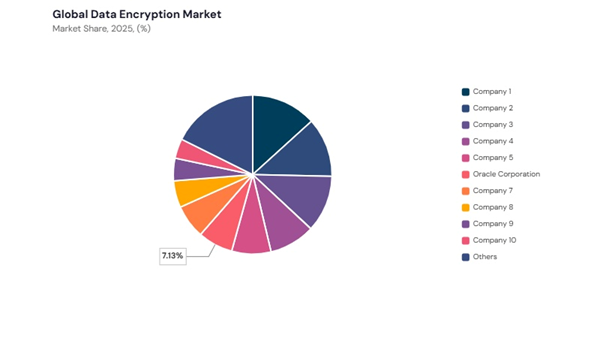
The global Data Encryption Market exhibits a moderately consolidated and cybersecurity-driven competitive structure, led by major enterprise software vendors, cloud infrastructure providers, cybersecurity companies, digital security specialists, and infrastructure technology firms. Microsoft Corporation holds a leading position in the market, supported by encryption capabilities across Azure, Microsoft 365, Windows, SQL Server, Microsoft Purview, BitLocker, Microsoft Defender, and Azure Key Vault. IBM Corporation also maintains a strong position through its data security, key management, IBM Guardium, cloud security, hardware security module, and quantum-safe cryptography capabilities. Thales S.A., Broadcom Inc., Cisco Systems, Oracle Corporation, Amazon Web Services, Google LLC, Fortinet, and Dell Technologies also represent important participants in the market.
Component Outlook
Based on Component, the market is segmented into Solution and Services. The Solution market dominated the Global Data Encryption Market by Component in 2025, and is expected to continue to be a dominant market till 2033; thereby, achieving a market value of USD 26.1 Billion by 2033, growing at a CAGR of 11.2 % during the forecast period. The Services market is expected to witness a CAGR of 12.6% during 2026-2033.
Solution forms the core of the Data Encryption Market as organizations use encryption platforms, software-based tools, hardware security modules, key management systems, and integrated cryptographic solutions to secure databases, files, endpoints, cloud workloads, communication systems, applications, and enterprise data repositories. These solutions help businesses protect data confidentiality, reduce breach exposure, strengthen access control, and meet regulatory compliance needs across complex digital environments. Services are also gaining importance as enterprises require consulting, integration, managed encryption, compliance support, key management assistance, and lifecycle maintenance. As encryption deployments become more complex across hybrid and multi-cloud environments, service providers are helping organizations address skill gaps, maintain secure configurations, and improve long-term encryption governance.
Deployment Outlook
Based on Deployment, the market is segmented into Cloud and On-premises. The Cloud market dominated the Global Data Encryption Market by Deployment in 2025, and is expected to continue to be a dominant market till 2033; thereby, achieving a market value of USD 22.2 Billion by 2033, growing at a CAGR of 11.7 % during the forecast period. The On-premises market is expected to witness a CAGR of 11.4% during 2026-2033.Cloud deployment is gaining strong momentum as enterprises increasingly move workloads, applications, and sensitive information to public, private, hybrid, and multi-cloud environments. Cloud encryption supports scalable data protection, centralized policy management, faster deployment, flexible key management, and integration with cloud-native security platforms. On-premises deployment remains important for organizations that require direct control over encryption infrastructure, data residency, internal governance, and cryptographic key ownership. Government, defense, BFSI, healthcare, and highly regulated enterprises continue to rely on on-premises encryption for sensitive workloads, legacy systems, private networks, and mission-critical databases.
Organization Size Outlook
Based on Organization Size, the market is segmented into Large Enterprises, and Small & Medium-Sized Enterprises (SMEs). The Large Enterprises market dominated the Global Data Encryption Market by Organization Size in 2025, and is expected to continue to be a dominant market till 2033; thereby, achieving a market value of USD 22.3 Billion by 2033, growing at a CAGR of 11.3 % during the forecast period. The Small & Medium-Sized Enterprises (SMEs) market is expected to witness a CAGR of 12% during 2026-2033.Large enterprises lead the market due to their large volumes of sensitive business data, complex IT infrastructure, strict regulatory obligations, and higher exposure to cyber threats. These organizations use encryption solutions to secure databases, cloud workloads, endpoints, communication networks, financial records, customer information, and enterprise applications. Small & Medium-Sized Enterprises (SMEs) are also witnessing strong adoption as cyberattacks increasingly target smaller businesses and digital operations. Cloud-based encryption, managed security services, simplified key management, and cost-effective data protection platforms are helping SMEs improve security, meet compliance needs, and protect customer and business information.
End Use Outlook
Based on End Use, the market is segmented into IT & Telecom, BFSI, Government & Defense, Healthcare & Life Science, Manufacturing, Education & Research, Media & Entertainment, Retail, and Other End Use. The BFSI market dominated the Global Data Encryption Market by End Use in 2025, and is expected to continue to be a dominant market till 2033; thereby, achieving a market value of USD 8.2 Billion by 2033, growing at a CAGR of 9.6 % during the forecast period. The IT & Telecommunications market is expected to witness a CAGR of 10.5% during 2026-2033. Additionally, the Government & Defense market is expected to witness highest CAGR of 11% during 2026-2033.IT & telecom is a major end-use area as the sector handles large volumes of data traffic, cloud infrastructure, communication networks, data centers, and connected services that require continuous encryption. BFSI uses encryption to protect financial transactions, digital banking platforms, customer records, payment systems, and confidential enterprise information. Government & defense organizations rely on encryption to secure classified data, citizen records, critical infrastructure, and confidential communications. Healthcare & life science users adopt encryption to protect patient information, electronic health records, telemedicine platforms, research data, and connected medical systems. Manufacturing, education, media, retail, and other industries are also increasing encryption adoption to protect intellectual property, digital content, customer information, operational data, and sensitive business communications.
Region-wise, the Data Encryption Market is analyzed across North America, Europe, Asia Pacific, and LAMEA. The North America market dominated the Global Data Encryption Market by Region in 2025, and is expected to continue to be a dominant market till 2033; thereby, achieving a market value of USD 13.9 Billion by 2033, growing at a CAGR of 11.1 % during the forecast period. The Asia Pacific market is expected to witness a CAGR of 12.2% during 2026-2033. Additionally, the Europe market is expected to witness a CAGR of 11.4% during 2026-2033.
North America is supported by mature cybersecurity infrastructure, strong cloud adoption, advanced enterprise IT spending, strict regulatory compliance, and the presence of major technology and cybersecurity vendors. Europe is driven by GDPR-led data privacy requirements, digital sovereignty initiatives, privacy-enhancing technologies, and demand for compliant encryption solutions across regulated sectors. Asia Pacific is witnessing strong growth due to rapid digital transformation, expanding cloud infrastructure, rising cyber threats, data localization rules, and growing adoption of encryption across BFSI, government, telecom, e-commerce, and digital services. LAMEA is gradually expanding as digital payment adoption, cloud infrastructure, cybersecurity awareness, government security initiatives, and regional data protection regulations strengthen demand for encryption solutions.
Recent Strategies Deployed in the Market
- Cisco launched AI Defense to secure enterprise AI applications through encryption-based data protection, secure model access, runtime security, and policy enforcement.
- Cisco introduced a secure network architecture for AI workplaces to strengthen encrypted connectivity, identity verification, and policy enforcement across hybrid enterprise environments.
- IBM introduced homomorphic encryption capabilities to enable secure computation on encrypted data without exposing underlying sensitive information.
- IBM and Entrust expanded post-quantum cryptography capabilities to help organizations transition toward quantum-resistant encryption and modern cryptographic security.
- IBM partnered with Entrust to accelerate post-quantum cryptography adoption through cryptographic assessment, identity security, key management, and enterprise migration support.
- Equinix and Cisco expanded their global cybersecurity collaboration to support secure and encrypted networking across cloud and digital infrastructure environments.
List of Key Companies Profiled
- Microsoft Corporation
- IBM Corporation
- Thales S.A.
- Broadcom Inc.
- Cisco Systems, Inc.
- Oracle Corporation
- Amazon Web Services, Inc.
- Google LLC
- Fortinet, Inc.
- Dell Technologies Inc.
Market Report Segmentation
By Component- Solution
- Services
- Cloud
- On-premises
- Large Enterprises
- Small & Medium-Sized Enterprises (SMEs)
- IT & Telecom
- BFSI
- Government & Defense
- Healthcare & Life Science
- Manufacturing
- Education & Research
- Media & Entertainment
- Retail
- Other End Use
- North America
- US
- Canada
- Mexico
- Rest of North America
- Europe
- Germany
- UK
- France
- Russia
- Spain
- Italy
- Rest of Europe
- Asia Pacific
- China
- Japan
- India
- South Korea
- Singapore
- Malaysia
- Rest of Asia Pacific
- LAMEA
- Brazil
- Argentina
- UAE
- Saudi Arabia
- South Africa
- Nigeria
- Rest of LAMEA
Table of Contents
Chapter 1. Research Scope & Methodology
Chapter 2. Market Overview
Chapter 3. Key Factors Impacting Market
Chapter 6. Competition Analysis - Global
Chapter 7. Segmentation By Component
Chapter 8. Segmentation By Deployment
Chapter 9. Segmentation By Organization Size
Chapter 10. Segmentation By End Use
Chapter 11. North America Market
Chapter 12. Europe Market
Chapter 13. Asia Pacific Market
Chapter 14. LAMEA Market
Chapter 15. Company Snapshots
Chapter 16. Winning Imperatives - Data Encryption Market
Chapter 15. Company Snapshots
Chapter 16. Winning Imperatives - Data Encryption Market
Companies Mentioned
• Microsoft Corporation• IBM Corporation
• Thales S.A.
• Broadcom Inc.
• Cisco Systems, Inc.
• Oracle Corporation
• Amazon Web Services, Inc.
• Google LLC
• Fortinet, Inc.
• Dell Technologies Inc.


