+353-1-416-8900REST OF WORLD
+44-20-3973-8888REST OF WORLD
1-917-300-0470EAST COAST U.S
1-800-526-8630U.S. (TOLL FREE)

Global Electrical Bushing Market Size, Share & Industry Analysis Report by Type, Insulation, Voltage, Application, Regional Outlook and Forecast, 2026-2033

  • PDF Icon

    Report

  • 617 Pages
  • May 2026
  • Marqual IT Solutions Pvt. Ltd (KBV Research)
  • ID: 6276089
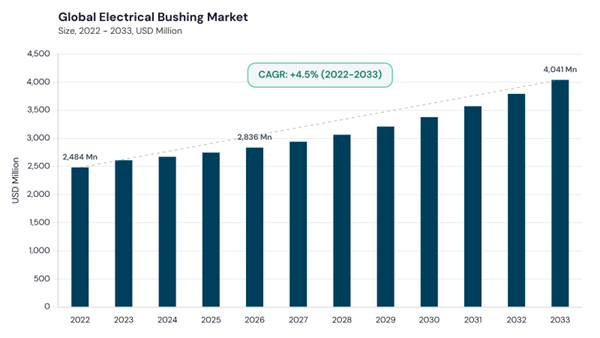
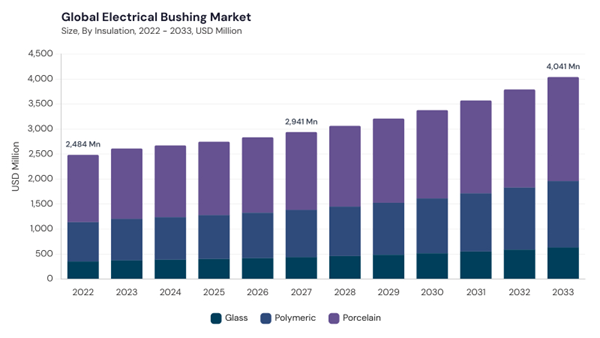
The Global Electrical Bushing Market size is expected to reach USD 4.04 billion by 2033, rising at a market growth of 5.2% CAGR during the forecast period.


Growth in the Electrical Bushing market is driven by increasing investments in renewable energy integration, expansion of transmission & distribution infrastructure, and modernization of aging power grids worldwide. Rising deployment of high-voltage transformers, smart substations, and electrification projects across industrial and utility sectors is accelerating demand for advanced insulation solutions, supporting strong market expansion from 2026-2033.

Key Market Trends & Insights:

  • The Asia Pacific Electrical Bushing market dominated the Global Market in 2025, accounting for a 38.99% revenue share in 2025.
  • The China Electrical Bushing market generated a revenue of USD 0.83 Billion in 2025 and is expected to continue its dominance in Asia Pacific region thereby reaching USD 1.47 Billion by 2033.
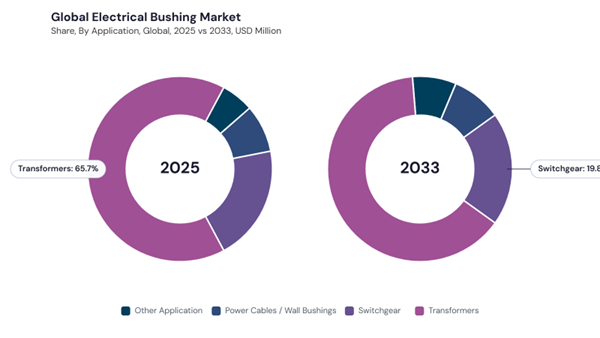
  • Among the various application segments, Transformers dominated the global market contributing a revenue share of 65.71% in 2025.
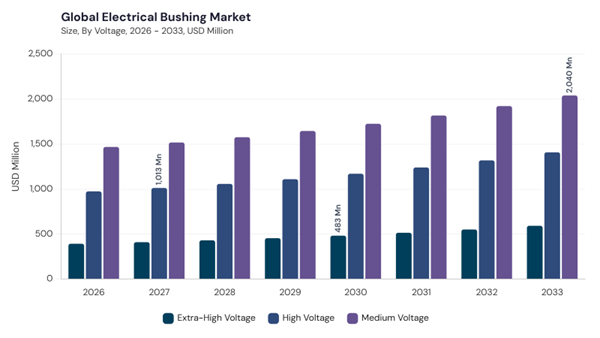
  • In terms of Voltage segmentation, the Medium Voltage segment captured 51.93% revenue share in 2025 and is projected to continue its dominance during the forecast period.
  • Oil Impregnated Paper (OIP) led the Type segment in 2025, capturing a 55.10% revenue share due to its extensive usage in transformers and substations.
The Global Electrical Bushing Market has evolved significantly from conventional porcelain-based insulation systems into highly advanced and digitally integrated electrical infrastructure components. Electrical bushings are critical interfaces that safely transfer electrical energy through grounded barriers in transformers, switchgear, and substations while maintaining insulation integrity under high-voltage conditions. Historically, the market was dominated by porcelain insulators and oil-based insulation technologies; however, rapid electrification, renewable energy integration, and growing demand for grid reliability have accelerated the adoption of advanced resin-impregnated paper (RIP), polymeric, and composite bushing technologies.

Today, the market is increasingly influenced by developments in smart grid infrastructure, AI-enabled predictive maintenance, IIoT-based condition monitoring, and sustainable insulation materials. Utilities and industrial operators are prioritizing advanced bushings equipped with real-time monitoring sensors to reduce downtime, optimize maintenance schedules, and improve asset reliability. In parallel, renewable energy projects, HVDC transmission systems, and ultra-high-voltage networks are creating demand for high-performance bushings capable of operating in extreme environmental and electrical conditions. As governments worldwide continue investing in power infrastructure modernization and grid expansion, the Electrical Bushing Market is becoming an essential pillar supporting reliable electricity transmission and future-ready energy ecosystems.


The major strategies followed by market participants are Product Innovation, Strategic Partnerships, and Regional Expansion as the key developmental strategies to strengthen their market position. For instance, ABB Ltd. expanded its smart transformer bushing portfolio integrated with real-time monitoring and predictive maintenance systems for grid modernization projects. Additionally, Siemens Energy strengthened its IEC-compliant bushing solutions for renewable integration and smart substations, while Hitachi Energy introduced advanced Resin-Impregnated Paper (RIP) bushings with improved insulation reliability and environmental sustainability.

Driving and Restraining Factors

Drivers
  • Increasing Demand from Renewable Energy Integration and Grid Modernization
  • Advancements in Materials and Insulation Technologies
  • Implementation of Predictive Maintenance Technologies Enabled by AI and IIoT
  • Stringent Environmental and Regulatory Compliance Demands
Restraints
  • High Cost of Raw Materials and Its Impact on Electrical Bushing Manufacturing
  • Stringent Regulatory Standards and Their Impediment to Market Expansion
  • Technical Challenges in Enhancing Electrical Bushing Performance
Opportunities
  • Advanced Thermal Management Innovations in Electrical Bushings
  • Intelligent Monitoring and Predictive Maintenance for Transformer Bushings
  • Expansion into Sustainable and Environmentally Resilient Bushing Solutions
Challenges
  • Insufficient Integration of Advanced Monitoring Technologies
  • High Material and Manufacturing Cost Pressures
  • Regulatory and Safety Compliance Complexities

Market Share Analysis

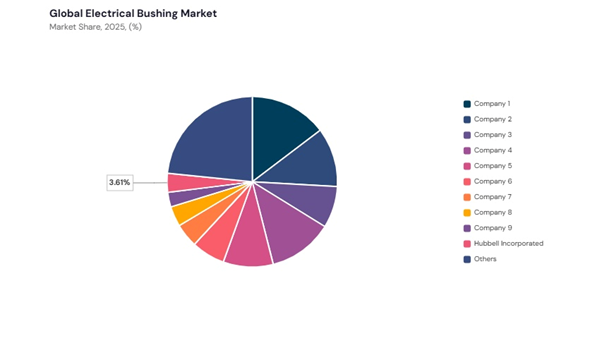
The leading players in the market are competing with advanced insulation technologies, smart monitoring systems, and sustainable material innovations to strengthen their market positions. The above illustration shows the percentage of revenue shared by some of the leading companies in the market.


ABB Ltd. is one of the leading participants in the Electrical Bushing Market due to its strong transformer component portfolio, advanced HVDC solutions, and global utility partnerships. The company continues focusing on smart transformer bushings integrated with predictive maintenance and real-time monitoring systems for grid modernization projects.

Siemens Energy maintains a strong market presence through its high-voltage transmission infrastructure capabilities and renewable energy integration projects. The company’s IEC-compliant bushing solutions and investments in sustainable insulation technologies continue strengthening its competitive position globally. The major market participants are actively investing in R&D, partnerships with utilities and transformer manufacturers, and regional manufacturing expansion to meet growing global demand. The key developmental strategies adopted in the market are Product Launches, Partnerships & Collaborations, and Geographic Expansion.

Type Outlook

On the basis of type, the Electrical Bushing Market is classified into Oil Impregnated Paper (OIP), Resin Impregnated Paper (RIP), and Other Type. The Oil Impregnated Paper (OIP) segment acquired the largest revenue share in the Electrical Bushing Market in 2025. The segment accounted for 55.108% of the overall market due to its extensive use in transformers and substations. OIP bushings are widely preferred because of their high dielectric strength, reliability, and cost-effectiveness in high-voltage applications.

Insulation Outlook

Based on insulation, the Electrical Bushing Market is segmented into Porcelain, Polymeric, and Glass. The Porcelain segment recorded 53.41% revenue share in 2025. Porcelain-insulated bushings continue to dominate the market owing to their excellent mechanical strength, durability, and resistance to environmental conditions in outdoor installations.

Voltage Outlook

Based on voltage, the Electrical Bushing Market is classified into Medium Voltage, High Voltage, and Extra-High Voltage. The Medium Voltage segment acquired the largest revenue share in the Electrical Bushing Market in 2025. This segment accounted for 51.93% of the overall market, driven by its extensive use in distribution networks, industrial applications, and commercial infrastructure.

Application Outlook

Based on application, the Electrical Bushing Market is classified into Transformers, Switchgear, Power Cables / Wall Bushings, and Other Applications. The Transformers segment acquired the largest revenue share in 2025. The segment accounted for 65.71% share due to extensive use of bushings in power and distribution transformers for efficient and safe electricity transmission.

Regional Outlook

Region-wise, the Electrical Bushing Market is analyzed across North America, Europe, Asia Pacific, and LAMEA. The Asia Pacific segment recorded the highest revenue share of 38.99% in 2025. Rapid industrialization, transmission infrastructure expansion, renewable energy investments, and increasing power demand across China and India are supporting regional market growth.


North America continues witnessing strong growth driven by grid modernization, replacement of aging electrical infrastructure, and adoption of smart grid technologies. Europe remains focused on renewable energy integration, sustainability initiatives, and modernization of high-voltage networks. Meanwhile, LAMEA is gradually emerging due to improving electrification infrastructure and increasing investments in reliable energy systems.
Market Competition and Attributes

The Electrical Bushing Market is moderately competitive and characterized by strong technological innovation focused on insulation performance, durability, smart diagnostics, and environmental compliance. Competition centers on the ability to deliver advanced insulation solutions with high operational reliability, predictive maintenance capabilities, and sustainability benefits. Vendors differentiate themselves through advanced materials, compact designs, AI-enabled monitoring systems, and compliance with IEC, ANSI, and ISO standards. Integration with smart substations, renewable energy systems, and digital grid infrastructure further shapes competitive positioning.

Recent Strategies Deployed in the Market

  • ABB Ltd. expanded its smart transformer bushing portfolio integrated with real-time monitoring and predictive maintenance systems for grid modernization projects.
  • Siemens Energy strengthened its IEC-compliant bushing solutions for renewable integration and smart substations.
  • Hitachi Energy introduced advanced Resin-Impregnated Paper (RIP) bushings with improved insulation reliability and environmental sustainability.
  • Schneider Electric enhanced its distributed energy and smart grid systems using advanced high-voltage bushing technologies.
  • Eaton Corporation developed bushings optimized for decentralized energy systems and microgrid applications.

List of Key Companies Profiled

  • ABB Ltd.
  • Siemens Energy
  • Hitachi Energy
  • Schneider Electric SE
  • Eaton Corporation PLC
  • Mitsubishi Electric Corporation
  • Hyundai Electric
  • GE Grid Solutions
  • Suzuki Electric Industry
  • Jubang Group

Market Report Segmentation

By Type
  • Oil Impregnated Paper (OIP)
  • Resin Impregnated Paper (RIP)
  • Other Type
By Insulation
  • Porcelain
  • Polymeric
  • Glass
By Voltage
  • Medium Voltage
  • High Voltage
  • Extra-High Voltage
By Application
  • Transformers
  • Switchgear
  • Power Cables / Wall Bushings
  • Other Application
By Geography
  • North America
    • US
    • Canada
    • Mexico
    • Rest of North America

  • Europe
    • Germany
    • UK
    • France
    • Russia
    • Spain
    • Italy
    • Rest of Europe

  • Asia Pacific
    • China
    • Japan
    • India
    • South Korea
    • Singapore
    • Malaysia
    • Rest of Asia Pacific

  • LAMEA
    • Brazil
    • Argentina
    • UAE
    • Saudi Arabia
    • South Africa
    • Nigeria
    • Rest of LAMEA

Table of Contents

Chapter 1. Market Overview
1.1 COVID-19 Impact
1.2 Market Composition and Scenario
Chapter 2. Key Factors Impacting Market
2.1 Market Drivers
2.2 Market Restraints
2.3 Market Opportunities
2.4 Market Challenges
2.5 Market Trends
2.6 State of Competition
2.7 Market Consolidation
2.8 Key Customer Criteria
Chapter 3. Product Life CycleChapter 4. Value Chain Analysis of Electrical Bushing Market
Chapter 5. Competition Analysis
5.1 Market Share Analysis
5.2 Recent Strategies Deployed in Electrical Bushing Market
5.3 Porter Five Forces Analysis
Chapter 6. Segmentation By Type
6.1 Oil Impregnated Paper (OIP)
6.2 Resin Impregnated Paper (RIP)
6.3 Other Type
Chapter 7. Segmentation By Insulation
7.1 Porcelain
7.2 Polymeric
7.3 Glass
Chapter 8. Segmentation By Voltage
8.1 Medium Voltage
8.2 High Voltage
8.3 Extra-High Voltage
Chapter 9. Segmentation By Application
9.1 Transformers
9.2 Switchgear
9.3 Power Cables / Wall Bushings
9.4 Other Application
Chapter 10. North America Market
10.1 Market Overview
10.2 Key Factors Impacting Market
10.2.1 Market Drivers
10.2.2 Market Restraints
10.2.3 Market Opportunities
10.2.4 Market Challenges
10.2.5 Market Trends
10.2.6 State of Competition
10.2.7 Market Consolidation
10.2.8 Key Customer Criteria
10.3 Product Life Cycle
10.4 Segmentation By Type Analysis
10.4.1 Oil Impregnated Paper (OIP)
10.4.2 Resin Impregnated Paper (RIP)
10.4.3 Other Type
10.5 Segmentation By Insulation
10.5.1 Porcelain
10.5.2 Polymeric
10.5.3 Glass
10.6 Segmentation By Voltage
10.6.1 Medium Voltage
10.6.2 High Voltage
10.6.3 Extra-High Voltage
10.7 Segmentation By Application
10.7.1 Transformers
10.7.2 Switchgear
10.7.3 Power Cables / Wall Bushings
10.7.4 Other Application
10.8 Segmentation By Country
10.8.1 United States
10.8.1.1 Segmentation By Type Analysis
10.8.1.1.1 Oil Impregnated Paper (OIP)
10.8.1.1.2 Resin Impregnated Paper (RIP)
10.8.1.1.3 Other Type
10.8.1.2 Segmentation By Insulation
10.8.1.2.1 Porcelain
10.8.1.2.2 Polymeric
10.8.1.2.3 Glass
10.8.1.3 Segmentation By Voltage
10.8.1.3.1 Medium Voltage
10.8.1.3.2 High Voltage
10.8.1.3.3 Extra-High Voltage
10.8.1.4 Segmentation By Application
10.8.1.4.1 Transformers
10.8.1.4.2 Switchgear
10.8.1.4.3 Power Cables / Wall Bushings
10.8.1.4.4 Other Application
10.8.2 Canada
10.8.2.1 Segmentation By Type Analysis
10.8.2.1.1 Oil Impregnated Paper (OIP)
10.8.2.1.2 Resin Impregnated Paper (RIP)
10.8.2.1.3 Other Type
10.8.2.2 Segmentation By Insulation
10.8.2.2.1 Porcelain
10.8.2.2.2 Polymeric
10.8.2.2.3 Glass
10.8.2.3 Segmentation By Voltage
10.8.2.3.1 Medium Voltage
10.8.2.3.2 High Voltage
10.8.2.3.3 Extra-High Voltage
10.8.2.4 Segmentation By Application
10.8.2.4.1 Transformers
10.8.2.4.2 Switchgear
10.8.2.4.3 Power Cables / Wall Bushings
10.8.2.4.4 Other Application
10.8.3 Mexico
10.8.3.1 Segmentation By Type Analysis
10.8.3.1.1 Oil Impregnated Paper (OIP)
10.8.3.1.2 Resin Impregnated Paper (RIP)
10.8.3.1.3 Other Type
10.8.3.2 Segmentation By Insulation
10.8.3.2.1 Porcelain
10.8.3.2.2 Polymeric
10.8.3.2.3 Glass
10.8.3.3 Segmentation By Voltage
10.8.3.3.1 Medium Voltage
10.8.3.3.2 High Voltage
10.8.3.3.3 Extra-High Voltage
10.8.3.4 Segmentation By Application
10.8.3.4.1 Transformers
10.8.3.4.2 Switchgear
10.8.3.4.3 Power Cables / Wall Bushings
10.8.3.4.4 Other Application
10.8.4 Rest of North America
10.8.4.1 Segmentation By Type Analysis
10.8.4.1.1 Oil Impregnated Paper (OIP)
10.8.4.1.2 Resin Impregnated Paper (RIP)
10.8.4.1.3 Other Type
10.8.4.2 Segmentation By Insulation
10.8.4.2.1 Porcelain
10.8.4.2.2 Polymeric
10.8.4.2.3 Glass
10.8.4.3 Segmentation By Voltage
10.8.4.3.1 Medium Voltage
10.8.4.3.2 High Voltage
10.8.4.3.3 Extra-High Voltage
10.8.4.4 Segmentation By Application
10.8.4.4.1 Transformers
10.8.4.4.2 Switchgear
10.8.4.4.3 Power Cables / Wall Bushings
10.8.4.4.4 Other Application
Chapter 11. Europe Market
11.1 Market Overview
11.2 Key Factors Impacting Market
11.2.1 Market Drivers
11.2.2 Market Restraints
11.2.3 Market Opportunities
11.2.4 Market Challenges
11.2.5 Market Trends
11.2.6 State of Competition
11.2.7 Market Consolidation
11.2.8 Key Customer Criteria
11.3 Product Life Cycle
11.4 Segmentation By Type
11.4.1 Oil-Impregnated Paper (OIP)
11.4.2 Resin Impregnated Paper (RIP)
11.4.3 Other Type
11.5 Segmentation By Insulation
11.5.1 Porcelain
11.5.2 Polymeric
11.5.3 Glass
11.6 Segmentation By Voltage
11.6.1 Medium Voltage
11.6.2 High Voltage
11.6.3 Extra-High Voltage
11.7 Segmentation By Application
11.7.1 Transformers
11.7.2 Switchgear
11.7.3 Power Cables / Wall Bushings
11.7.4 Other Application
11.8 Segmentation By Country
11.8.1 Germany
11.8.1.1 Segmentation By Type Analysis
11.8.1.1.1 Oil Impregnated Paper (OIP)
11.8.1.1.2 Resin Impregnated Paper (RIP)
11.8.1.1.3 Other Type
11.8.1.2 Segmentation By Insulation
11.8.1.2.1 Porcelain
11.8.1.2.2 Polymeric
11.8.1.2.3 Glass
11.8.1.3 Segmentation By Voltage
11.8.1.3.1 Medium Voltage
11.8.1.3.2 High Voltage
11.8.1.3.3 Extra-High Voltage
11.8.1.4 Segmentation By Application
11.8.1.4.1 Transformers
11.8.1.4.2 Switchgear
11.8.1.4.3 Power Cables / Wall Bushings
11.8.1.4.4 Other Application
11.8.2 United Kingdom
11.8.2.1 Segmentation By Type Analysis
11.8.2.1.1 Oil Impregnated Paper (OIP)
11.8.2.1.2 Resin Impregnated Paper (RIP)
11.8.2.1.3 Other Type
11.8.2.2 Segmentation By Insulation
11.8.2.2.1 Porcelain
11.8.2.2.2 Polymeric
11.8.2.2.3 Glass
11.8.2.3 Segmentation By Voltage
11.8.2.3.1 Medium Voltage
11.8.2.3.2 High Voltage
11.8.2.3.3 Extra-High Voltage
11.8.2.4 Segmentation By Application
11.8.2.4.1 Transformers
11.8.2.4.2 Switchgear
11.8.2.4.3 Power Cables / Wall Bushings
11.8.2.4.4 Other Application
11.8.3 France
11.8.3.1 Segmentation By Type Analysis
11.8.3.1.1 Oil Impregnated Paper (OIP)
11.8.3.1.2 Resin Impregnated Paper (RIP)
11.8.3.1.3 Other Type
11.8.3.2 Segmentation By Insulation
11.8.3.2.1 Porcelain
11.8.3.2.2 Polymeric
11.8.3.2.3 Glass
11.8.3.3 Segmentation By Voltage
11.8.3.3.1 Medium Voltage
11.8.3.3.2 High Voltage
11.8.3.3.3 Extra-High Voltage
11.8.3.4 Segmentation By Application
11.8.3.4.1 Transformers
11.8.3.4.2 Switchgear
11.8.3.4.3 Power Cables / Wall Bushings
11.8.3.4.4 Other Application
11.8.4 Russia
11.8.4.1 Segmentation By Type Analysis
11.8.4.1.1 Oil Impregnated Paper (OIP)
11.8.4.1.2 Resin Impregnated Paper (RIP)
11.8.4.1.3 Other Type
11.8.4.2 Segmentation By Insulation
11.8.4.2.1 Porcelain
11.8.4.2.2 Polymeric
11.8.4.2.3 Glass
11.8.4.3 Segmentation By Voltage
11.8.4.3.1 Medium Voltage
11.8.4.3.2 High Voltage
11.8.4.3.3 Extra-High Voltage
11.8.4.4 Segmentation By Application
11.8.4.4.1 Transformers
11.8.4.4.2 Switchgear
11.8.4.4.3 Power Cables / Wall Bushings
11.8.4.4.4 Other Application
11.8.5 Spain
11.8.5.1 Segmentation By Type Analysis
11.8.5.1.1 Oil Impregnated Paper (OIP)
11.8.5.1.2 Resin Impregnated Paper (RIP)
11.8.5.1.3 Other Type
11.8.5.2 Segmentation By Insulation
11.8.5.2.1 Porcelain
11.8.5.2.2 Polymeric
11.8.5.2.3 Glass
11.8.5.3 Segmentation By Voltage
11.8.5.3.1 Medium Voltage
11.8.5.3.2 High Voltage
11.8.5.3.3 Extra-High Voltage
11.8.5.4 Segmentation By Application
11.8.5.4.1 Transformers
11.8.5.4.2 Switchgear
11.8.5.4.3 Power Cables / Wall Bushings
11.8.5.4.4 Other Application
11.8.6 Italy
11.8.6.1 Segmentation By Type Analysis
11.8.6.1.1 Oil Impregnated Paper (OIP)
11.8.6.1.2 Resin Impregnated Paper (RIP)
11.8.6.1.3 Other Type
11.8.6.2 Segmentation By Insulation
11.8.6.2.1 Porcelain
11.8.6.2.2 Polymeric
11.8.6.2.3 Glass
11.8.6.3 Segmentation By Voltage
11.8.6.3.1 Medium Voltage
11.8.6.3.2 High Voltage
11.8.6.3.3 Extra-High Voltage
11.8.6.4 Segmentation By Application
11.8.6.4.1 Transformers
11.8.6.4.2 Switchgear
11.8.6.4.3 Power Cables / Wall Bushings
11.8.6.4.4 Other Application
11.8.7 Rest of Europe
11.8.7.1 Segmentation By Type Analysis
11.8.7.1.1 Oil Impregnated Paper (OIP)
11.8.7.1.2 Resin Impregnated Paper (RIP)
11.8.7.1.3 Other Type
11.8.7.2 Segmentation By Insulation
11.8.7.2.1 Porcelain
11.8.7.2.2 Polymeric
11.8.7.2.3 Glass
11.8.7.3 Segmentation By Voltage
11.8.7.3.1 Medium Voltage
11.8.7.3.2 High Voltage
11.8.7.3.3 Extra-High Voltage
11.8.7.4 Segmentation By Application
11.8.7.4.1 Transformers
11.8.7.4.2 Switchgear
11.8.7.4.3 Power Cables / Wall Bushings
11.8.7.4.4 Other Application
Chapter 12. Asia Pacific Market
12.1 Market Overview
12.2 Key Factors Impacting Market
12.2.1 Market Drivers
12.2.2 Market Restraints
12.2.3 Market Opportunities
12.2.4 Market Challenges
12.2.5 Market Trends
12.2.6 State of Competition
12.2.7 Market Consolidation
12.2.8 Key Customer Criteria
12.3 Product Life Cycle
12.4 Segmentation By Type
12.4.1 Oil Impregnated Paper (OIP)
12.4.2 Resin Impregnated Paper (RIP)
12.4.3 Other Type
12.5 Segmentation By Insulation
12.5.1 Porcelain
12.5.2 Polymeric
12.5.3 Glass
12.6 Segmentation By Voltage
12.6.1 Medium Voltage
12.6.2 High Voltage
12.6.3 Extra-High Voltage
12.7 Segmentation By Application
12.7.1 Transformers
12.7.2 Switchgear
12.7.3 Power Cables / Wall Bushings
12.7.4 Other Application
12.8 Segmentation By Country
12.8.1 China
12.8.1.1 Segmentation By Type Analysis
12.8.1.1.1 Oil Impregnated Paper (OIP)
12.8.1.1.2 Resin Impregnated Paper (RIP)
12.8.1.1.3 Other Type
12.8.1.2 Segmentation By Insulation
12.8.1.2.1 Porcelain
12.8.1.2.2 Polymeric
12.8.1.2.3 Glass
12.8.1.3 Segmentation By Voltage
12.8.1.3.1 Medium Voltage
12.8.1.3.2 High Voltage
12.8.1.3.3 Extra-High Voltage
12.8.1.4 Segmentation By Application
12.8.1.4.1 Transformers
12.8.1.4.2 Switchgear
12.8.1.4.3 Power Cables / Wall Bushings
12.8.1.4.4 Other Application
12.8.2 Japan
12.8.2.1 Segmentation By Type Analysis
12.8.2.1.1 Oil Impregnated Paper (OIP)
12.8.2.1.2 Resin Impregnated Paper (RIP)
12.8.2.1.3 Other Type
12.8.2.2 Segmentation By Insulation
12.8.2.2.1 Porcelain
12.8.2.2.2 Polymeric
12.8.2.2.3 Glass
12.8.2.3 Segmentation By Voltage
12.8.2.3.1 Medium Voltage
12.8.2.3.2 High Voltage
12.8.2.3.3 Extra-High Voltage
12.8.2.4 Segmentation By Application
12.8.2.4.1 Transformers
12.8.2.4.2 Switchgear
12.8.2.4.3 Power Cables / Wall Bushings
12.8.2.4.4 Other Application
12.8.3 India
12.8.3.1 Segmentation By Type Analysis
12.8.3.1.1 Oil Impregnated Paper (OIP)
12.8.3.1.2 Resin Impregnated Paper (RIP)
12.8.3.1.3 Other Type
12.8.3.2 Segmentation By Insulation
12.8.3.2.1 Porcelain
12.8.3.2.2 Polymeric
12.8.3.2.3 Glass
12.8.3.3 Segmentation By Voltage
12.8.3.3.1 Medium Voltage
12.8.3.3.2 High Voltage
12.8.3.3.3 Extra-High Voltage
12.8.3.4 Segmentation By Application
12.8.3.4.1 Transformers
12.8.3.4.2 Switchgear
12.8.3.4.3 Power Cables / Wall Bushings
12.8.3.4.4 Other Application
12.8.4 South Korea
12.8.4.1 Segmentation By Type Analysis
12.8.4.1.1 Oil Impregnated Paper (OIP)
12.8.4.1.2 Resin Impregnated Paper (RIP)
12.8.4.1.3 Other Type
12.8.4.2 Segmentation By Insulation
12.8.4.2.1 Porcelain
12.8.4.2.2 Polymeric
12.8.4.2.3 Glass
12.8.4.3 Segmentation By Voltage
12.8.4.3.1 Medium Voltage
12.8.4.3.2 High Voltage
12.8.4.3.3 Extra-High Voltage
12.8.4.4 Segmentation By Application
12.8.4.4.1 Transformers
12.8.4.4.2 Switchgear
12.8.4.4.3 Power Cables / Wall Bushings
12.8.4.4.4 Other Application
12.8.5 Singapore
12.8.5.1 Segmentation By Type Analysis
12.8.5.1.1 Oil Impregnated Paper (OIP)
12.8.5.1.2 Resin Impregnated Paper (RIP)
12.8.5.1.3 Other Type
12.8.5.2 Segmentation By Insulation
12.8.5.2.1 Porcelain
12.8.5.2.2 Polymeric
12.8.5.2.3 Glass
12.8.5.3 Segmentation By Voltage
12.8.5.3.1 Medium Voltage
12.8.5.3.2 High Voltage
12.8.5.3.3 Extra-High Voltage
12.8.5.4 Segmentation By Application
12.8.5.4.1 Transformers
12.8.5.4.2 Switchgear
12.8.5.4.3 Power Cables / Wall Bushings
12.8.5.4.4 Other Application
12.8.6 Malaysia
12.8.6.1 Segmentation By Type Analysis
12.8.6.1.1 Oil Impregnated Paper (OIP)
12.8.6.1.2 Resin Impregnated Paper (RIP)
12.8.6.1.3 Other Type
12.8.6.2 Segmentation By Insulation
12.8.6.2.1 Porcelain
12.8.6.2.2 Polymeric
12.8.6.2.3 Glass
12.8.6.3 Segmentation By Voltage
12.8.6.3.1 Medium Voltage
12.8.6.3.2 High Voltage
12.8.6.3.3 Extra-High Voltage
12.8.6.4 Segmentation By Application
12.8.6.4.1 Transformers
12.8.6.4.2 Switchgear
12.8.6.4.3 Power Cables / Wall Bushings
12.8.6.4.4 Other Application
12.8.7 Rest of Asia Pacific
12.8.7.1 Segmentation By Type Analysis
12.8.7.1.1 Oil Impregnated Paper (OIP)
12.8.7.1.2 Resin Impregnated Paper (RIP)
12.8.7.1.3 Other Type
12.8.7.2 Segmentation By Insulation
12.8.7.2.1 Porcelain
12.8.7.2.2 Polymeric
12.8.7.2.3 Glass
12.8.7.3 Segmentation By Voltage
12.8.7.3.1 Medium Voltage
12.8.7.3.2 High Voltage
12.8.7.3.3 Extra-High Voltage
12.8.7.4 Segmentation By Application
12.8.7.4.1 Transformers
12.8.7.4.2 Switchgear
12.8.7.4.3 Power Cables / Wall Bushings
12.8.7.4.4 Other Application
Chapter 13. LAMEA Market
13.1 Market Overview
13.2 Key Factors Impacting Market
13.2.1 Market Drivers
13.2.2 Market Restraints
13.2.3 Market Opportunities
13.2.4 Market Challenges
13.2.5 Market Trends
13.2.6 State of Competition
13.2.7 Market Consolidation
13.2.8 Key Customer Criteria
13.3 Product Life Cycle
13.4 Segmentation By Type
13.4.1 Oil Impregnated Paper (OIP)
13.4.2 Resin Impregnated Paper (RIP)
13.4.3 Other Type
13.5 Segmentation By Insulation
13.5.1 Porcelain
13.5.2 Polymeric
13.5.3 Glass
13.6 Segment Analysis By Voltage
13.6.1 Medium Voltage
13.6.2 High Voltage
13.6.3 Extra-High Voltage
13.7 Segmentation By Application
13.7.1 Transformers
13.7.2 Switchgear
13.7.3 Power Cables / Wall Bushings
13.7.4 Other Application
13.8 Segmentation By Country
13.8.1 Brazil
13.8.1.1 Segmentation By Type Analysis
13.8.1.1.1 Oil Impregnated Paper (OIP)
13.8.1.1.2 Resin Impregnated Paper (RIP)
13.8.1.1.3 Other Type
13.8.1.2 Segmentation By Insulation
13.8.1.2.1 Porcelain
13.8.1.2.2 Polymeric
13.8.1.2.3 Glass
13.8.1.3 Segmentation By Voltage
13.8.1.3.1 Medium Voltage
13.8.1.3.2 High Voltage
13.8.1.3.3 Extra-High Voltage
13.8.1.4 Segmentation By Application
13.8.1.4.1 Transformers
13.8.1.4.2 Switchgear
13.8.1.4.3 Power Cables / Wall Bushings
13.8.1.4.4 Other Application
13.8.2 Argentina
13.8.2.1 Segmentation By Type Analysis
13.8.2.1.1 Oil Impregnated Paper (OIP)
13.8.2.1.2 Resin Impregnated Paper (RIP)
13.8.2.1.3 Other Type
13.8.2.2 Segmentation By Insulation
13.8.2.2.1 Porcelain
13.8.2.2.2 Polymeric
13.8.2.2.3 Glass
13.8.2.3 Segmentation By Voltage
13.8.2.3.1 Medium Voltage
13.8.2.3.2 High Voltage
13.8.2.3.3 Extra-High Voltage
13.8.2.4 Segmentation By Application
13.8.2.4.1 Transformers
13.8.2.4.2 Switchgear
13.8.2.4.3 Power Cables / Wall Bushings
13.8.2.4.4 Other Application
13.8.3 UAE
13.8.3.1 Segmentation By Type Analysis
13.8.3.1.1 Oil Impregnated Paper (OIP)
13.8.3.1.2 Resin Impregnated Paper (RIP)
13.8.3.1.3 Other Type
13.8.3.2 Segmentation By Insulation
13.8.3.2.1 Porcelain
13.8.3.2.2 Polymeric
13.8.3.2.3 Glass
13.8.3.3 Segmentation By Voltage
13.8.3.3.1 Medium Voltage
13.8.3.3.2 High Voltage
13.8.3.3.3 Extra-High Voltage
13.8.3.4 Segmentation By Application
13.8.3.4.1 Transformers
13.8.3.4.2 Switchgear
13.8.3.4.3 Power Cables / Wall Bushings
13.8.3.4.4 Other Application
13.8.4 Saudi Arabia
13.8.4.1 Segmentation By Type Analysis
13.8.4.1.1 Oil Impregnated Paper (OIP)
13.8.4.1.2 Resin Impregnated Paper (RIP)
13.8.4.1.3 Other Type
13.8.4.2 Segmentation By Insulation
13.8.4.2.1 Porcelain
13.8.4.2.2 Polymeric
13.8.4.2.3 Glass
13.8.4.3 Segmentation By Voltage
13.8.4.3.1 Medium Voltage
13.8.4.3.2 High Voltage
13.8.4.3.3 Extra-High Voltage
13.8.4.4 Segmentation By Application
13.8.4.4.1 Transformers
13.8.4.4.2 Switchgear
13.8.4.4.3 Power Cables / Wall Bushings
13.8.4.4.4 Other Application
13.8.5 South Africa
13.8.5.1 Segmentation By Type Analysis
13.8.5.1.1 Oil Impregnated Paper (OIP)
13.8.5.1.2 Resin Impregnated Paper (RIP)
13.8.5.1.3 Other Type
13.8.5.2 Segmentation By Insulation
13.8.5.2.1 Porcelain
13.8.5.2.2 Polymeric
13.8.5.2.3 Glass
13.8.5.3 Segmentation By Voltage
13.8.5.3.1 Medium Voltage
13.8.5.3.2 High Voltage
13.8.5.3.3 Extra-High Voltage
13.8.5.4 Segmentation By Application
13.8.5.4.1 Transformers
13.8.5.4.2 Switchgear
13.8.5.4.3 Power Cables / Wall Bushings
13.8.5.4.4 Other Application
13.8.6 Nigeria
13.8.6.1 Segmentation By Type Analysis
13.8.6.1.1 Oil Impregnated Paper (OIP)
13.8.6.1.2 Resin Impregnated Paper (RIP)
13.8.6.1.3 Other Type
13.8.6.2 Segmentation By Insulation
13.8.6.2.1 Porcelain
13.8.6.2.2 Polymeric
13.8.6.2.3 Glass
13.8.6.3 Segmentation By Voltage
13.8.6.3.1 Medium Voltage
13.8.6.3.2 High Voltage
13.8.6.3.3 Extra-High Voltage
13.8.6.4 Segmentation By Application
13.8.6.4.1 Transformers
13.8.6.4.2 Switchgear
13.8.6.4.3 Power Cables / Wall Bushings
13.8.6.4.4 Other Application
13.8.7 Rest of LAMEA
13.8.7.1 Segmentation By Type Analysis
13.8.7.1.1 Oil Impregnated Paper (OIP)
13.8.7.1.2 Resin Impregnated Paper (RIP)
13.8.7.1.3 Other Type
13.8.7.2 Segmentation By Insulation
13.8.7.2.1 Porcelain
13.8.7.2.2 Polymeric
13.8.7.2.3 Glass
13.8.7.3 Segmentation By Voltage
13.8.7.3.1 Medium Voltage
13.8.7.3.2 High Voltage
13.8.7.3.3 Extra-High Voltage
13.8.7.4 Segmentation By Application
13.8.7.4.1 Transformers
13.8.7.4.2 Switchgear
13.8.7.4.3 Power Cables / Wall Bushings
13.8.7.4.4 Other Application
Chapter 14. Company Profiles
14.1 ABB Ltd.
14.1.1 Company Overview
14.1.14 Recent Strategies and Developments
14.1.14.1 Geographical Expansions
14.1.3 Company Focus
14.1.14 Strategic Insights
14.1.5 Strategy Deployed
14.1.6 SWOT Analysis
14.1.7 Future Outlook
14.14 Siemens AG
14.14.1 Company Overview
14.14.14 Financial Analysis
14.14.3 Segmental and Regional Analysis
14.14.14 Research & Development Expense
14.14.5 Company Focus
14.14.6 Strategic Insights
14.14.7 Strategy Deployed
14.14.8 SWOT Analysis
14.14.9 Future Outlook
14.3 Eaton Corporation PLC
14.3.1 Company Overview
14.3.14 Financial Analysis
14.3.3 Segmental and Regional Analysis
14.3.14 Research & Development Expense
14.3.5 Company Focus
14.3.6 Strategic Insights
14.3.7 Strategy Deployed
14.3.8 SWOT Analysis
14.3.9 Future Outlook
14.14 Hitachi Energy Ltd. (Hitachi Ltd.)
14.14.1 Company Overview
14.14.14 Financial Analysis
14.14.3 Regional Analysis
14.14.14 Recent Strategies and Developments
14.14.14.1 Geographical Expansions
14.14.5 Company Focus
14.14.6 Strategic Insights
14.14.7 Strategy Deployed
14.14.8 SWOT Analysis
14.14.9 Future Outlook
14.5 GE Vernova Group
14.5.1 Company Overview
14.5.14 Financial Analysis
14.5.3 Segmental and Regional Analysis
14.5.14 Research & Development Expenses
14.5.5 Recent Strategies and Developments
14.5.5.1 Acquisition and Mergers
14.5.5.14 Geographical Expansions
14.5.6 Company Focus
14.5.7 Strategic Insights
14.5.8 Strategy Deployed
14.5.9 SWOT Analysis
14.5.10 Future Outlook
14.6 Nexans S.A.
14.6.1 Company Overview
14.6.14 Financial Analysis
14.6.3 Segmental and Regional Analysis
14.6.14 Research & Development Expense
14.6.5 Company Focus
14.6.6 Strategic Insights
14.6.7 Strategy Deployed
14.6.8 SWOT Analysis
14.6.9 Future Outlook
14.7 Bharat Heavy Electricals Ltd.
14.7.1 Company Overview
14.7.14 Financial Analysis
14.7.3 Segmental and Regional Analysis
14.7.14 Company Focus
14.7.5 Strategic Insights
14.7.6 Strategy Deployed
14.7.7 SWOT Analysis
14.7.8 Future Outlook
14.8 CG Power & Industrial Solutions Ltd. (Murugappa Group)
14.8.1 Company Overview
14.8.14 Financial Analysis
14.8.3 Segmental and Regional Analysis
14.8.14 Recent Strategies and Developments
14.8.14.1 Geographical Expansions
14.8.5 Company Focus
14.8.6 Strategic Insights
14.8.7 Strategy Deployed
14.8.8 SWOT Analysis
14.8.9 Future Outlook
14.9 RHM International, LLC
14.9.1 Company Overview
14.9.14 Company Focus
14.9.3 Strategic Insights
14.9.14 Strategy Deployed
14.9.5 SWOT Analysis
14.9.6 Future Outlook
14.1 Hubbell Incorporated
14.10.1 Company Overview
14.10.14 Financial Analysis
14.10.3 Segmental and Regional Analysis
14.10.14 Research & Development Expenses
14.10.5 Company Focus
14.10.6 Strategic Insights
14.10.7 Strategy Deployed
14.10.8 SWOT Analysis
14.10.9 Future Outlook
Chapter 15. Winning Imperatives of Electrical Bushing Market

Companies Mentioned

  • ABB Ltd.
  • Siemens Energy
  • Hitachi Energy
  • Schneider Electric SE
  • Eaton Corporation PLC
  • Mitsubishi Electric Corporation
  • Hyundai Electric
  • GE Grid Solutions
  • Suzuki Electric Industry
  • Jubang Group