

+353-1-416-8900REST OF WORLD
+44-20-3973-8888REST OF WORLD
1-917-300-0470EAST COAST U.S
1-800-526-8630U.S. (TOLL FREE)

Global License Management Market Size, Share & Industry Analysis Report by Component, Deployment, Enterprise Size, Application, End Use, Regional Outlook and Forecast, 2026-2033

  • PDF Icon

    Report

  • 822 Pages
  • June 2026
  • Marqual IT Solutions Pvt. Ltd (KBV Research)
  • ID: 6276092
The Global License Management Market is expected to reach USD 3.5 Billion by 2033, growing at a CAGR of 12% during 2026-2033.


The License Management Market is expanding as organizations focus on optimizing software usage, reducing compliance risks, improving audit readiness, and controlling rising IT costs. Growing adoption of cloud applications, SaaS platforms, hybrid IT environments, and multi-vendor software ecosystems is increasing the need for accurate license tracking and usage monitoring. The market started with manual tracking methods, spreadsheets, and basic inventory tools used to manage software licenses and avoid expiry or piracy risks. Over time, it evolved into centralized platforms capable of tracking entitlements, renewals, usage metrics, and compliance status across departments. Presently, the market is shaped by AI-driven analytics, automated license reconciliation, cloud-native license governance, and Software Asset Management, IT Asset Management, SaaS Management, and FinOps integration.

Key Market Trends & Insights

  • By component, Software dominated the market in 2025 with USD 884.7 Million and is expected to reach USD 2.1 Billion by 2033, growing at a CAGR of 11.8%.
  • Services is expected to grow faster by component, registering a CAGR of 12.4% during 2026-2033, supported by rising demand for consulting, implementation, integration, audit support, and managed license services.
  • By deployment, Cloud dominated the market in 2025 with USD 817.1 Million and is projected to reach USD 2.0 Billion by 2033, growing at a CAGR of 12.2%.
  • On-premises deployment is expected to reach USD 1.5 Billion by 2033, growing at a CAGR of 11.9%, driven by demand from organizations requiring higher control over licensing data and internal IT infrastructure.
  • By enterprise size, Large Enterprises dominated the market in 2025 with USD 942.2 Million and are expected to reach USD 2.2 Billion by 2033, growing at a CAGR of 11.6%.
  • Small & Medium Enterprises (SMEs) are expected to grow faster by enterprise size, registering a CAGR of 12.8% during 2026-2033, supported by affordable cloud-based license management adoption.
  • By application, Compliance Management dominated the market in 2025 with USD 391.3 Million and is projected to reach USD 844.2 Million by 2033, while Other Application is expected to grow fastest at a CAGR of 14.9%.
  • Regionally, North America dominated the market in 2025 with USD 554.4 Million and is projected to reach USD 1.2 Billion by 2033, while LAMEA is expected to grow fastest with a CAGR of 13.8% during 2026-2033.

The License Management Market is witnessing steady expansion as organizations increasingly recognize license governance as a strategic function within IT operations, financial management, and enterprise risk control. License management solutions help businesses monitor software entitlements, prevent unauthorized usage, optimize software spend, prepare for audits, manage renewals, and improve visibility across cloud, SaaS, on-premises, and hybrid software environments. The market is further supported by increasing enterprise software spending, growing SaaS subscription complexity, rising vendor audits, expanding cloud migration, and the need to reduce underutilized or redundant software licenses.

The License Management Market is characterized by a moderately consolidated and enterprise software-driven competitive environment consisting of Software Asset Management providers, IT Asset Management vendors, enterprise workflow platforms, cloud management companies, software license optimization specialists, and consulting-led solution providers. Competition is centered on automation, AI-driven analytics, license optimization, cloud compatibility, compliance reporting, SaaS visibility, FinOps integration, workflow automation, and multi-vendor license governance. Global players compete through comprehensive platforms and ecosystem partnerships, while specialized vendors compete through niche software usage analytics, regional expertise, and vendor-specific license optimization capabilities.

Driving and Restraining Factors

Drivers
  • Enhanced Regulatory Compliance and Risk Mitigation Demanding Advanced License Management Solutions
  • Growing Complexity of Software Ecosystems Necessitates Scalable and Automated License Management
  • Increasing Adoption of Digital Identity and Mobile Credentials Driving License Management Innovation
  • Rising Demand for Cost Optimization and Software Utilization Efficiency Catalyzing License Management Adoption
Restraints
  • High Cost of Implementation and Ongoing Management
  • Fragmented Licensing Ecosystem and Lack of Centralized Visibility
  • Regulatory Complexity and Compliance Challenges
Opportunities
  • Enhanced Adoption of Usage-Based Licensing Models Driven by SaaS Expansion
  • Integration of Artificial Intelligence for Automated License Compliance and Optimization
  • Expansion into Regulated Industries through Tailored License Compliance Solutions
Challenges
  • Complex License Compliance Due to Fragmented and Evolving Regulatory Frameworks
  • Inefficiencies Arising from Lack of Centralized License Management and Data Transparency
  • High Implementation and Operational Costs Limit Adoption and Market Penetration

Market Share Analysis
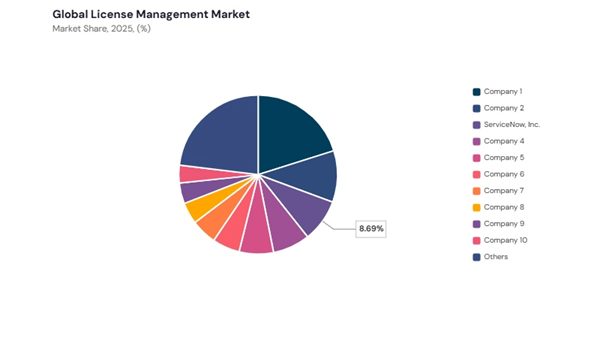


The global License Management Market is moderately consolidated, with competition led by Software Asset Management, IT Asset Management, SaaS management, and cloud license optimization providers. Flexera Software LLC, including Snow Software AB, leads the market due to its strong SAM, SaaS Management, FinOps, and cloud license governance capabilities. USU Software AG, ServiceNow, IBM, and Microsoft also hold strong positions through enterprise IT management, workflow automation, compliance, and cloud subscription ecosystems. Other players such as Certero, Open iT, Lansweeper, Ivanti, and Matrix42 strengthen the market through specialized license analytics, IT discovery, and software visibility solutions. Future competition is expected to depend on AI-driven license optimization, SaaS governance, FinOps integration, audit readiness, and hybrid cloud license management.

Component Outlook


Based on Component, the market is segmented into Software and Services. The Software market dominated the Global License Management Market by Component in 2025, and is expected to continue to be a dominant market till 2033; thereby, achieving a market value of USD 2.1 Billion by 2033, growing at a CAGR of 11.8 % during the forecast period. The Services market is expected to witness a CAGR of 12.4% during 2026-2033.

Software forms the backbone of the License Management Market by providing digital frameworks, automation engines, and license tracking platforms, cloud-based license servers, software asset management tools, entitlement management systems, and compliance reporting solutions. These platforms help organizations monitor software usage, optimize license allocation, reduce overspending, prevent unauthorized deployment, and maintain audit readiness across on-premises, cloud, SaaS, and hybrid environments. Services are also gaining importance as organizations require consulting, implementation, integration, training, managed license monitoring, compliance support, and optimization advisory. As software portfolios become more complex, services help enterprises navigate vendor-specific licensing terms, reduce audit exposure, and improve software cost governance.

Deployment Outlook

Based on Deployment, the market is segmented into Cloud and On-premises. The Cloud market dominated the Global License Management Market by Deployment in 2025, and is expected to continue to be a dominant market till 2033; thereby, achieving a market value of USD 2.0 Billion by 2033, growing at a CAGR of 12.2 % during the forecast period. The On-premises market is expected to witness a CAGR of 11.9% during 2026-2033.

Cloud deployment leads the market as enterprises increasingly adopt SaaS applications, distributed work models, hybrid IT environments, and subscription-based software portfolios. Cloud-based license management platforms support real-time monitoring, centralized dashboards, automated reporting, scalable deployment, and continuous updates without heavy internal infrastructure requirements. On-premises deployment remains relevant among organizations that require greater control over licensing data, internal governance, data sovereignty, customization, and integration with legacy IT environments. Highly regulated sectors such as BFSI, government, healthcare, and defense continue to use on-premises solutions for sensitive license data and compliance-critical workloads.

Enterprise Size Outlook

Based on Enterprise Size, the market is segmented into Large Enterprises and Small & Medium Enterprises (SMEs). The Large Enterprises market dominated the Global License Management Market by Enterprise Size in 2025, and is expected to continue to be a dominant market till 2033; thereby, achieving a market value of USD 2.3 Billion by 2033, growing at a CAGR of 11.6 % during the forecast period. The Small & Medium Enterprises (SMEs) market is expected to witness a CAGR of 12.8% during 2026-2033.

Large enterprises dominate the market due to their extensive software portfolios, multi-vendor environments, global operations, higher IT budgets, and strict compliance obligations. These organizations require advanced license management platforms that can handle enterprise applications, cloud subscriptions, virtualization licenses, SaaS tools, and complex renewal cycles across multiple departments and geographies. Small & Medium Enterprises are also witnessing rising adoption as affordable cloud-based license management solutions help them reduce software costs, avoid compliance penalties, and improve operational efficiency. SMEs prefer simplified dashboards, subscription pricing, automated tracking, and low-maintenance platforms that can scale as their software usage expands.

Application Outlook

Based on Application, the market is segmented into Compliance Management, License Entitlement and Optimization, Operation & Analytics, Audit Services, Advisory Services, and Other Application. The Compliance Management market dominated the Global License Management Market by Application in 2025, and is expected to continue to be a dominant market till 2033; thereby, achieving a market value of USD 844.2 Million by 2033, growing at a CAGR of 10.2 % during the forecast period. The License Entitlement and Optimization market is expected to witness a CAGR of 11.8% during 2026-2033. Additionally, the Operation & Analytics market is expected to witness highest CAGR of 12.4% during 2026-2033.

Compliance Management leads the market as organizations increasingly use license management tools to meet software licensing rules, avoid audit penalties, and maintain contractual compliance. License Entitlement and Optimization is gaining strong relevance as enterprises focus on maximizing software utilization, reclaiming unused licenses, and improving vendor negotiations. Operation & Analytics supports real-time usage monitoring, forecasting, budgeting, and software consumption insights. Audit Services help organizations prepare for software vendor audits, identify compliance gaps, and manage documentation. Advisory Services support licensing strategy, policy design, contract negotiation, and portfolio optimization. Other applications include specialized license workflows, ERP integration, IoT-related software licensing, and industry-specific license governance requirements.

End Use Outlook

Based on End Use, the market is segmented into IT & Telecom, BFSI, Government & Defense, Healthcare & Life Science, Manufacturing, Education & Research, Media & Entertainment, Retail, and Other End Use. The IT & Telecom market dominated the Global License Management Market by End Use in 2025, and is expected to continue to be a dominant market till 2033; thereby, achieving a market value of USD 591.7 Million by 2033, growing at a CAGR of 9.4 % during the forecast period. The BFSI market is expected to witness a CAGR of 10.8% during 2026-2033. Additionally, the Government & Defense market is expected to witness highest CAGR of 11.6% during 2026-2033.

IT & Telecom leads the market due to extensive software deployment, cloud migration, complex IT infrastructure, frequent software updates, and growing need for efficient license administration. BFSI uses license management solutions to maintain audit readiness, manage secure software portfolios, and support regulatory compliance. Government & Defense organizations rely on license governance to control software usage, manage public-sector IT assets, and ensure secure compliance tracking. Healthcare & Life Science users require license management for EHR systems, diagnostic software, research applications, and digital healthcare platforms. Manufacturing, Education & Research, Media & Entertainment, Retail, and other industries are also adopting license management solutions to improve software governance, reduce costs, support digital transformation, and avoid compliance-related risks.

Regional Outlook


Region-wise, the License Management Market is analyzed across North America, Europe, Asia Pacific, and LAMEA. The North America market dominated the Global License Management Market by Region in 2025, and is expected to continue to be a dominant market till 2033; thereby, achieving a market value of USD 1.3 Billion by 2033, growing at a CAGR of 11.3 % during the forecast period. The Asia Pacific market is expected to witness a CAGR of 12.9% during 2026-2033. Additionally, the Europe market is expected to witness a CAGR of 11.6% during 2026-2033.

North America dominates the market due to high enterprise software adoption, mature IT infrastructure, widespread SaaS usage, strong regulatory compliance requirements, and the presence of major technology vendors. Europe is supported by strong software governance practices, GDPR-driven compliance needs, IT asset management maturity, and rising adoption of cloud-based license optimization tools. Asia Pacific is witnessing strong demand due to rapid enterprise digitalization, expanding cloud adoption, growing software spending, and increasing awareness of license compliance across large and mid-sized enterprises. LAMEA is gradually expanding as organizations invest in digital transformation, enterprise software management, cloud applications, and centralized software governance platforms.

Recent Strategies Deployed in the Market

  • USU expanded SAP License Management capabilities within its IT Asset Management portfolio to support automated license measurement, user classification, compliance monitoring, optimization recommendations, and SAP audit readiness.
  • Open iT expanded its SaaS license optimization solution to help organizations monitor software utilization, optimize subscription licenses, automate usage analytics, and improve software cost governance.
  • Microsoft enhanced Microsoft 365 license management and administration capabilities to support Copilot adoption, user assignment, subscription utilization visibility, security governance, and enterprise license optimization.
  • Ivanti enhanced enterprise license management capabilities within Ivanti Service Manager, including improved license allocation, entitlement management, compliance tracking, and software asset governance.
  • ServiceNow and Royal Cyber expanded collaboration around AI-driven IT Asset Management services, supporting license management through AI-assisted automation, workflow optimization, and centralized software asset governance.

List of Key Companies Profiled

  • Flexera Software LLC
  • USU Software AG
  • ServiceNow, Inc.
  • IBM Corporation
  • Microsoft Corporation
  • Certero Ltd.
  • Open iT, Inc.
  • Lansweeper NV
  • Ivanti, Inc.
  • Matrix42 GmbH

Market Report Segmentation

By Component
  • Software
  • Services
By Deployment
  • Cloud
  • On-premises
By Enterprise Size
  • Large Enterprises
  • Small & Medium Enterprises (SMEs)
By Application
  • Compliance Management
  • License Entitlement and Optimization
  • Operation & Analytics
  • Audit Services
  • Advisory Services
  • Other Application
By End Use
  • IT & Telecom
  • BFSI
  • Government & Defense
  • Healthcare & Life Science
  • Manufacturing
  • Education & Research
  • Media & Entertainment
  • Retail
  • Other End Use
By Geography
  • North America
    • US
    • Canada
    • Mexico
    • Rest of North America

  • Europe
    • Germany
    • UK
    • France
    • Russia
    • Spain
    • Italy
    • Rest of Europe

  • Asia Pacific
    • China
    • Japan
    • India
    • South Korea
    • Australia
    • Rest of Asia Pacific

  • LAMEA
    • Brazil
    • Argentina
    • UAE
    • Saudi Arabia
    • South Africa
    • Nigeria
    • Rest of LAMEA

Table of Contents

Chapter 1. Research Scope & Methodology
1.1 Market Definition
1.2 Analysis Period & Currency
1.3 Segmentation
1.4 License Management Market, by Geography
1.5 Research Methodology
Chapter 2. Market Overview
2.1 COVID-19 Impact
2.2 Market Composition and Scenario
Chapter 3. Key Factors Impacting Market
3.1 Market Drivers
3.2 Market Restraints
3.3 Market Opportunities
3.4 Market Challenges
3.5 Market Trends
3.6 State of Competition
3.7 Market Consolidation
3.8 Key Customer Criteria
Chapter 4. Product Life CycleChapter 5. Value Chain Analysis of License Management Market
Chapter 6. Competition Analysis - Global
6.1 Market Share Analysis
6.2 Recent Developments - License Management Market
6.2.1 Product Launch & Product Expansion
6.2.2 Partnership, Collaboration & Agreements
Chapter 7. Segmentation By Component
7.1 Software
7.2 Services
Chapter 8. Segmentation By Deployment
8.1 Cloud
8.2 On-Premises
Chapter 9. Segmentation By Enterprise Size
9.1 Large Enterprises
9.2 Small & Medium Enterprises (SMEs)
Chapter 10. Segmentation By Application
10.1 Compliance Management
10.2 License Entitlement and Optimization
10.3 Operation & Analytics
10.4 Audit Services
10.5 Advisory Services
10.6 Other Application
Chapter 11. Segmentation By End Use
11.1 IT & Telecom
11.2 BFSI
11.3 Government & Defense
11.4 Healthcare & Life Science
11.5 Manufacturing
11.6 Education & Research
11.7 Media & Entertainment
11.8 Retail
11.9 Other End Use
Chapter 12. North America Market
12.1 Market Overview
12.2 Key Factors Impacting Market
12.2.1 Market Drivers
12.2.2 Market Restraints
12.2.3 Market Opportunities
12.2.4 Market Challenges
12.2.5 Market Trends
12.2.6 State of Competition
12.2.7 Market Consolidation
12.2.8 Key Customer Criteria
12.3 Product Life Cycle
12.4 Segmentation By Component
12.4.1 Software
12.4.2 Services
12.5 Segmentation By Deployment
12.5.1 Cloud
12.5.2 On-premises
12.6 Segmentation By Enterprise Size
12.6.1 Large Enterprises
12.6.2 Small & Medium Enterprises (SMEs)
12.7 Segmentation By Application
12.7.1 Compliance Management
12.7.2 License Entitlement and Optimization
12.7.3 Operation & Analytics
12.7.4 Audit Services
12.7.5 Advisory Services
12.7.6 Other Application
12.8 Segmentation By End Use
12.8.1 IT & Telecom
12.8.2 BFSI
12.8.3 Government & Defense
12.8.4 Healthcare & Life Science
12.8.5 Manufacturing
12.8.6 Education & Research
12.8.7 Media & Entertainment
12.8.8 Retail
12.8.9 Other End Use
12.9 Segmentation By Country
12.9.1 US
12.9.1.1 Segmentation By Component
12.9.1.1.1 Software
12.9.1.1.2 Services
12.9.1.2 Segmentation By Deployment
12.9.1.2.1 Cloud
12.9.1.2.2 On-Premises
12.9.1.3 Segmentation By Enterprise
12.9.1.3.1 Large Enterprises
12.9.1.3.2 Small & Medium Enterprises (SMEs)
12.9.1.4 Segmentation By Application
12.9.1.4.1 Compliance Management
12.9.1.4.2 License Entitlement and Optimization
12.9.1.4.3 Operation & Analytics
12.9.1.4.4 Audit Services
12.9.1.4.5 Advisory Services
12.9.1.4.6 Other Application
12.9.1.5 Segmentation By End Use
12.9.1.5.1 IT & Telecom
12.9.1.5.2 BFSI
12.9.1.5.3 Government & Defense
12.9.1.5.4 Healthcare & Life Science
12.9.1.5.5 Manufacturing
12.9.1.5.6 Education & Research
12.9.1.5.7 Media & Entertainment
12.9.1.5.8 Retail
12.9.1.5.9 Other End Use
12.9.2 Canada
12.9.2.1 Segmentation By Component
12.9.2.1.1 Software
12.9.2.1.2 Services
12.9.2.2 Segmentation By Deployment
12.9.2.2.1 Cloud
12.9.2.2.2 On-Premises
12.9.2.3 Segmentation By Enterprise
12.9.2.3.1 Large Enterprises
12.9.2.3.2 Small & Medium Enterprises (SMEs)
12.9.2.4 Segmentation By Application
12.9.2.4.1 Compliance Management
12.9.2.4.2 License Entitlement and Optimization
12.9.2.4.3 Operation & Analytics
12.9.2.4.4 Audit Services
12.9.2.4.5 Advisory Services
12.9.2.4.6 Other Application
12.9.2.5 Segmentation By End Use
12.9.2.5.1 IT & Telecom
12.9.2.5.2 BFSI
12.9.2.5.3 Government & Defense
12.9.2.5.4 Healthcare & Life Science
12.9.2.5.5 Manufacturing
12.9.2.5.6 Education & Research
12.9.2.5.7 Media & Entertainment
12.9.2.5.8 Retail
12.9.2.5.9 Other End Use
12.9.3 Mexico
12.9.3.1 Segmentation By Component
12.9.3.1.1 Software
12.9.3.1.2 Services
12.9.3.2 Segmentation By Deployment
12.9.3.2.1 Cloud
12.9.3.2.2 On-Premises
12.9.3.3 Segmentation By Enterprise
12.9.3.3.1 Large Enterprises
12.9.3.3.2 Small & Medium Enterprises (SMEs)
12.9.3.4 Segmentation By Application
12.9.3.4.1 Compliance Management
12.9.3.4.2 License Entitlement and Optimization
12.9.3.4.3 Operation & Analytics
12.9.3.4.4 Audit Services
12.9.3.4.5 Advisory Services
12.9.3.4.6 Other Application
12.9.3.5 Segmentation By End Use
12.9.3.5.1 IT & Telecom
12.9.3.5.2 BFSI
12.9.3.5.3 Government & Defense
12.9.3.5.4 Healthcare & Life Science
12.9.3.5.5 Manufacturing
12.9.3.5.6 Education & Research
12.9.3.5.7 Media & Entertainment
12.9.3.5.8 Retail
12.9.3.5.9 Other End Use
12.9.4 Rest of North America
12.9.4.1 Segmentation By Component
12.9.4.1.1 Software
12.9.4.1.2 Services
12.9.4.2 Segmentation By Deployment
12.9.4.2.1 Cloud
12.9.4.2.2 On-Premises
12.9.4.3 Segmentation By Enterprise
12.9.4.3.1 Large Enterprises
12.9.4.3.2 Small & Medium Enterprises (SMEs)
12.9.4.4 Segmentation By Application
12.9.4.4.1 Compliance Management
12.9.4.4.2 License Entitlement and Optimization
12.9.4.4.3 Operation & Analytics
12.9.4.4.4 Audit Services
12.9.4.4.5 Advisory Services
12.9.4.4.6 Other Application
12.9.4.5 Segmentation By End Use
12.9.4.5.1 IT & Telecom
12.9.4.5.2 BFSI
12.9.4.5.3 Government & Defense
12.9.4.5.4 Healthcare & Life Science
12.9.4.5.5 Manufacturing
12.9.4.5.6 Education & Research
12.9.4.5.7 Media & Entertainment
12.9.4.5.8 Retail
12.9.4.5.9 Other End Use
Chapter 13. Europe Market
13.1 Market Overview
13.2 Key Factors Impacting Market
13.2.1 Market Drivers
13.2.2 Market Restraints
13.2.3 Market Opportunities
13.2.4 Market Challenges
13.2.5 Market Trends
13.2.6 State of Competition
13.2.7 Market Consolidation
13.2.8 Key Customer Criteria
13.3 Product Life Cycle
13.4 Segmentation By Component
13.4.1 Software
13.4.2 Services
13.5 Segmentation By Deployment
13.5.1 Cloud
13.5.2 On-Premises
13.6 Segmentation By Enterprise Size
13.6.1 Large Enterprises
13.6.2 Small & Medium Enterprises (SMEs)
13.7 Segmentation By Application
13.7.1 Compliance Management
13.7.2 License Entitlement and Optimization
13.7.3 Operation & Analytics
13.7.4 Audit Services
13.7.5 Advisory Services
13.7.6 Other Application
13.8 Segmentation By End Use
13.8.1 IT & Telecom
13.8.2 BFSI
13.8.3 Government & Defense
13.8.4 Healthcare & Life Science
13.8.5 Manufacturing
13.8.6 Education & Research
13.8.7 Media & Entertainment
13.8.8 Retail
13.8.9 Other End Use
13.9 Segmentation By Country
13.9.1 Germany
13.9.1.1 Segmentation By Component
13.9.1.1.1 Software
13.9.1.1.2 Services
13.9.1.2 Segmentation By Deployment
13.9.1.2.1 Cloud
13.9.1.2.2 On-Premises
13.9.1.3 Segmentation By Enterprise
13.9.1.3.1 Large Enterprises
13.9.1.3.2 Small & Medium Enterprises (SMEs)
13.9.1.4 Segmentation By Application
13.9.1.4.1 Compliance Management
13.9.1.4.2 License Entitlement and Optimization
13.9.1.4.3 Operation & Analytics
13.9.1.4.4 Audit Services
13.9.1.4.5 Advisory Services
13.9.1.4.6 Other Application
13.9.1.5 Segmentation By End Use
13.9.1.5.1 IT & Telecom
13.9.1.5.2 BFSI
13.9.1.5.3 Government & Defense
13.9.1.5.4 Healthcare & Life Science
13.9.1.5.5 Manufacturing
13.9.1.5.6 Education & Research
13.9.1.5.7 Media & Entertainment
13.9.1.5.8 Retail
13.9.1.5.9 Other End Use
13.9.2 UK
13.9.2.1 Segmentation By Component
13.9.2.1.1 Software
13.9.2.1.2 Services
13.9.2.2 Segmentation By Deployment
13.9.2.2.1 Cloud
13.9.2.2.2 On-Premises
13.9.2.3 Segmentation By Enterprise
13.9.2.3.1 Large Enterprises
13.9.2.3.2 Small & Medium Enterprises (SMEs)
13.9.2.4 Segmentation By Application
13.9.2.4.1 Compliance Management
13.9.2.4.2 License Entitlement and Optimization
13.9.2.4.3 Operation & Analytics
13.9.2.4.4 Audit Services
13.9.2.4.5 Advisory Services
13.9.2.4.6 Other Application
13.9.2.5 Segmentation By End Use
13.9.2.5.1 IT & Telecom
13.9.2.5.2 BFSI
13.9.2.5.3 Government & Defense
13.9.2.5.4 Healthcare & Life Science
13.9.2.5.5 Manufacturing
13.9.2.5.6 Education & Research
13.9.2.5.7 Media & Entertainment
13.9.2.5.8 Retail
13.9.2.5.9 Other End Use
13.9.3 France
13.9.3.1 Segmentation By Component
13.9.3.1.1 Software
13.9.3.1.2 Services
13.9.3.2 Segmentation By Deployment
13.9.3.2.1 Cloud
13.9.3.2.2 On-Premises
13.9.3.3 Segmentation By Enterprise
13.9.3.3.1 Large Enterprises
13.9.3.3.2 Small & Medium Enterprises (SMEs)
13.9.3.4 Segmentation By Application
13.9.3.4.1 Compliance Management
13.9.3.4.2 License Entitlement and Optimization
13.9.3.4.3 Operation & Analytics
13.9.3.4.4 Audit Services
13.9.3.4.5 Advisory Services
13.9.3.4.6 Other Application
13.9.3.5 Segmentation By End Use
13.9.3.5.1 IT & Telecom
13.9.3.5.2 BFSI
13.9.3.5.3 Government & Defense
13.9.3.5.4 Healthcare & Life Science
13.9.3.5.5 Manufacturing
13.9.3.5.6 Education & Research
13.9.3.5.7 Media & Entertainment
13.9.3.5.8 Retail
13.9.3.5.9 Other End Use
13.9.4 Russia
13.9.4.1 Segmentation By Component
13.9.4.1.1 Software
13.9.4.1.2 Services
13.9.4.2 Segmentation By Deployment
13.9.4.2.1 Cloud
13.9.4.2.2 On-Premises
13.9.4.3 Segmentation By Enterprise
13.9.4.3.1 Large Enterprises
13.9.4.3.2 Small & Medium Enterprises (SMEs)
13.9.4.4 Segmentation By Application
13.9.4.4.1 Compliance Management
13.9.4.4.2 License Entitlement and Optimization
13.9.4.4.3 Operation & Analytics
13.9.4.4.4 Audit Services
13.9.4.4.5 Advisory Services
13.9.4.4.6 Other Application
13.9.4.5 Segmentation By End Use
13.9.4.5.1 IT & Telecom
13.9.4.5.2 BFSI
13.9.4.5.3 Government & Defense
13.9.4.5.4 Healthcare & Life Science
13.9.4.5.5 Manufacturing
13.9.4.5.6 Education & Research
13.9.4.5.7 Media & Entertainment
13.9.4.5.8 Retail
13.9.4.5.9 Other End Use
13.9.5 Spain
13.9.5.1 Segmentation By Component
13.9.5.1.1 Software
13.9.5.1.2 Services
13.9.5.2 Segmentation By Deployment
13.9.5.2.1 Cloud
13.9.5.2.2 On-Premises
13.9.5.3 Segmentation By Enterprise
13.9.5.3.1 Large Enterprises
13.9.5.3.2 Small & Medium Enterprises (SMEs)
13.9.5.4 Segmentation By Application
13.9.5.4.1 Compliance Management
13.9.5.4.2 License Entitlement and Optimization
13.9.5.4.3 Operation & Analytics
13.9.5.4.4 Audit Services
13.9.5.4.5 Advisory Services
13.9.5.4.6 Other Application
13.9.5.5 Segmentation By End Use
13.9.5.5.1 IT & Telecom
13.9.5.5.2 BFSI
13.9.5.5.3 Government & Defense
13.9.5.5.4 Healthcare & Life Science
13.9.5.5.5 Manufacturing
13.9.5.5.6 Education & Research
13.9.5.5.7 Media & Entertainment
13.9.5.5.8 Retail
13.9.5.5.9 Other End Use
13.9.6 Italy
13.9.6.1 Segmentation By Component
13.9.6.1.1 Software
13.9.6.1.2 Services
13.9.6.2 Segmentation By Deployment
13.9.6.2.1 Cloud
13.9.6.2.2 On-Premises
13.9.6.3 Segmentation By Enterprise
13.9.6.3.1 Large Enterprises
13.9.6.3.2 Small & Medium Enterprises (SMEs)
13.9.6.4 Segmentation By Application
13.9.6.4.1 Compliance Management
13.9.6.4.2 License Entitlement and Optimization
13.9.6.4.3 Operation & Analytics
13.9.6.4.4 Audit Services
13.9.6.4.5 Advisory Services
13.9.6.4.6 Other Application
13.9.6.5 Segmentation By End Use
13.9.6.5.1 IT & Telecom
13.9.6.5.2 BFSI
13.9.6.5.3 Government & Defense
13.9.6.5.4 Healthcare & Life Science
13.9.6.5.5 Manufacturing
13.9.6.5.6 Education & Research
13.9.6.5.7 Media & Entertainment
13.9.6.5.8 Retail
13.9.6.5.9 Other End Use
13.9.7 Rest of Europe
13.9.7.1 Segmentation By Component
13.9.7.1.1 Software
13.9.7.1.2 Services
13.9.7.2 Segmentation By Deployment
13.9.7.2.1 Cloud
13.9.7.2.2 On-Premises
13.9.7.3 Segmentation By Enterprise
13.9.7.3.1 Large Enterprises
13.9.7.3.2 Small & Medium Enterprises (SMEs)
13.9.7.4 Segmentation By Application
13.9.7.4.1 Compliance Management
13.9.7.4.2 License Entitlement and Optimization
13.9.7.4.3 Operation & Analytics
13.9.7.4.4 Audit Services
13.9.7.4.5 Advisory Services
13.9.7.4.6 Other Application
13.9.7.5 Segmentation By End Use
13.9.7.5.1 IT & Telecom
13.9.7.5.2 BFSI
13.9.7.5.3 Government & Defense
13.9.7.5.4 Healthcare & Life Science
13.9.7.5.5 Manufacturing
13.9.7.5.6 Education & Research
13.9.7.5.7 Media & Entertainment
13.9.7.5.8 Retail
13.9.7.5.9 Other End Use
13.9.1.5 Segmentation By End Use
13.9.1.5.1 IT & Telecom
13.9.1.5.2 BFSI
13.9.1.5.3 Government & Defense
13.9.1.5.4 Healthcare & Life Science
13.9.1.5.5 Manufacturing
13.9.1.5.6 Education & Research
13.9.1.5.7 Media & Entertainment
13.9.1.5.8 Retail
13.9.1.5.9 Other End Use
13.9.2 UK
13.9.2.1 Segmentation By Component
13.9.2.1.1 Software
13.9.2.1.2 Services
13.9.2.2 Segmentation By Deployment
13.9.2.2.1 Cloud
13.9.2.2.2 On-Premises
13.9.2.3 Segmentation By Enterprise
13.9.2.3.1 Large Enterprises
13.9.2.3.2 Small & Medium Enterprises (SMEs)
13.9.2.4 Segmentation By Application
13.9.2.4.1 Compliance Management
13.9.2.4.2 License Entitlement and Optimization
13.9.2.4.3 Operation & Analytics
13.9.2.4.4 Audit Services
13.9.2.4.5 Advisory Services
13.9.2.4.6 Other Application
13.9.2.5 Segmentation By End Use
13.9.2.5.1 IT & Telecom
13.9.2.5.2 BFSI
13.9.2.5.3 Government & Defense
13.9.2.5.4 Healthcare & Life Science
13.9.2.5.5 Manufacturing
13.9.2.5.6 Education & Research
13.9.2.5.7 Media & Entertainment
13.9.2.5.8 Retail
13.9.2.5.9 Other End Use
13.9.3 France
13.9.3.1 Segmentation By Component
13.9.3.1.1 Software
13.9.3.1.2 Services
13.9.3.2 Segmentation By Deployment
13.9.3.2.1 Cloud
13.9.3.2.2 On-Premises
13.9.3.3 Segmentation By Enterprise
13.9.3.3.1 Large Enterprises
13.9.3.3.2 Small & Medium Enterprises (SMEs)
13.9.3.4 Segmentation By Application
13.9.3.4.1 Compliance Management
13.9.3.4.2 License Entitlement and Optimization
13.9.3.4.3 Operation & Analytics
13.9.3.4.4 Audit Services
13.9.3.4.5 Advisory Services
13.9.3.4.6 Other Application
13.9.3.5 Segmentation By End Use
13.9.3.5.1 IT & Telecom
13.9.3.5.2 BFSI
13.9.3.5.3 Government & Defense
13.9.3.5.4 Healthcare & Life Science
13.9.3.5.5 Manufacturing
13.9.3.5.6 Education & Research
13.9.3.5.7 Media & Entertainment
13.9.3.5.8 Retail
13.9.3.5.9 Other End Use
13.9.4 Russia
13.9.4.1 Segmentation By Component
13.9.4.1.1 Software
13.9.4.1.2 Services
13.9.4.2 Segmentation By Deployment
13.9.4.2.1 Cloud
13.9.4.2.2 On-Premises
13.9.4.3 Segmentation By Enterprise
13.9.4.3.1 Large Enterprises
13.9.4.3.2 Small & Medium Enterprises (SMEs)
13.9.4.4 Segmentation By Application
13.9.4.4.1 Compliance Management
13.9.4.4.2 License Entitlement and Optimization
13.9.4.4.3 Operation & Analytics
13.9.4.4.4 Audit Services
13.9.4.4.5 Advisory Services
13.9.4.4.6 Other Application
13.9.4.5 Segmentation By End Use
13.9.4.5.1 IT & Telecom
13.9.4.5.2 BFSI
13.9.4.5.3 Government & Defense
13.9.4.5.4 Healthcare & Life Science
13.9.4.5.5 Manufacturing
13.9.4.5.6 Education & Research
13.9.4.5.7 Media & Entertainment
13.9.4.5.8 Retail
13.9.4.5.9 Other End Use
13.9.5 Spain
13.9.5.1 Segmentation By Component
13.9.5.1.1 Software
13.9.5.1.2 Services
13.9.5.2 Segmentation By Deployment
13.9.5.2.1 Cloud
13.9.5.2.2 On-Premises
13.9.5.3 Segmentation By Enterprise
13.9.5.3.1 Large Enterprises
13.9.5.3.2 Small & Medium Enterprises (SMEs)
13.9.5.4 Segmentation By Application
13.9.5.4.1 Compliance Management
13.9.5.4.2 License Entitlement and Optimization
13.9.5.4.3 Operation & Analytics
13.9.5.4.4 Audit Services
13.9.5.4.5 Advisory Services
13.9.5.4.6 Other Application
13.9.5.5 Segmentation By End Use
13.9.5.5.1 IT & Telecom
13.9.5.5.2 BFSI
13.9.5.5.3 Government & Defense
13.9.5.5.4 Healthcare & Life Science
13.9.5.5.5 Manufacturing
13.9.5.5.6 Education & Research
13.9.5.5.7 Media & Entertainment
13.9.5.5.8 Retail
13.9.5.5.9 Other End Use
13.9.6 Italy
13.9.6.1 Segmentation By Component
13.9.6.1.1 Software
13.9.6.1.2 Services
13.9.6.2 Segmentation By Deployment
13.9.6.2.1 Cloud
13.9.6.2.2 On-Premises
13.9.6.3 Segmentation By Enterprise
13.9.6.3.1 Large Enterprises
13.9.6.3.2 Small & Medium Enterprises (SMEs)
13.9.6.4 Segmentation By Application
13.9.6.4.1 Compliance Management
13.9.6.4.2 License Entitlement and Optimization
13.9.6.4.3 Operation & Analytics
13.9.6.4.4 Audit Services
13.9.6.4.5 Advisory Services
13.9.6.4.6 Other Application
13.9.6.5 Segmentation By End Use
13.9.6.5.1 IT & Telecom
13.9.6.5.2 BFSI
13.9.6.5.3 Government & Defense
13.9.6.5.4 Healthcare & Life Science
13.9.6.5.5 Manufacturing
13.9.6.5.6 Education & Research
13.9.6.5.7 Media & Entertainment
13.9.6.5.8 Retail
13.9.6.5.9 Other End Use
13.9.7 Rest of Europe
13.9.7.1 Segmentation By Component
13.9.7.1.1 Software
13.9.7.1.2 Services
13.9.7.2 Segmentation By Deployment
13.9.7.2.1 Cloud
13.9.7.2.2 On-Premises
13.9.7.3 Segmentation By Enterprise
13.9.7.3.1 Large Enterprises
13.9.7.3.2 Small & Medium Enterprises (SMEs)
13.9.7.4 Segmentation By Application
13.9.7.4.1 Compliance Management
13.9.7.4.2 License Entitlement and Optimization
13.9.7.4.3 Operation & Analytics
13.9.7.4.4 Audit Services
13.9.7.4.5 Advisory Services
13.9.7.4.6 Other Application
13.9.7.5 Segmentation By End Use
13.9.7.5.1 IT & Telecom
13.9.7.5.2 BFSI
13.9.7.5.3 Government & Defense
13.9.7.5.4 Healthcare & Life Science
13.9.7.5.5 Manufacturing
13.9.7.5.6 Education & Research
13.9.7.5.7 Media & Entertainment
13.9.7.5.8 Retail
13.9.7.5.9 Other End Use
Chapter 14. Asia Pacific Market
14.1 Market Overview
14.2 Key Factors Impacting Market
14.2.1 Market Drivers
14.2.2 Market Restraints
14.2.3 Market Opportunities
14.2.4 Market Challenges
14.2.5 Market Trends
14.2.6 State of Competition
14.2.7 Market Consolidation
14.2.8 Key Customer Criteria
14.3 Product Life Cycle
14.4 Segmentation By Component
14.4.1 Software
14.4.2 Services
14.5 Segmentation By Deployment
14.5.1 Cloud
14.5.2 On-Premises
14.6 Segmentation By Enterprise Size
14.6.1 Large Enterprises
14.6.2 Small & Medium Enterprises (SMEs)
14.7 Segmentation By Application
14.7.1 Compliance Management
14.7.2 License Entitlement and Optimization
14.7.3 Operation & Analytics
14.7.4 Audit Services
14.7.5 Advisory Services
14.7.6 Other Application
14.8 Segmentation By End Use
14.8.1 IT & Telecom
14.8.2 BFSI
14.8.3 Government & Defense
14.8.4 Healthcare & Life Science
14.8.5 Manufacturing
14.8.6 Education & Research
14.8.7 Media & Entertainment
14.8.8 Retail
14.8.9 Other End Use
14.9 Segmentation By Country
14.9.1 China
14.9.1.1 Segmentation By Component
14.9.1.1.1 Software
14.9.1.1.2 Services
14.9.1.2 Segmentation By Deployment
14.9.1.2.1 Cloud
14.9.1.2.2 On-Premises
14.9.1.3 Segmentation By Enterprise
14.9.1.3.1 Large Enterprises
14.9.1.3.2 Small & Medium Enterprises (SMEs)
14.9.1.4 Segmentation By Application
14.9.1.4.1 Compliance Management
14.9.1.4.2 License Entitlement and Optimization
14.9.1.4.3 Operation & Analytics
14.9.1.4.4 Audit Services
14.9.1.4.5 Advisory Services
14.9.1.4.6 Other Application
14.9.1.5 Segmentation By End Use
14.9.1.5.1 IT & Telecom
14.9.1.5.2 BFSI
14.9.1.5.3 Government & Defense
14.9.1.5.4 Healthcare & Life Science
14.9.1.5.5 Manufacturing
14.9.1.5.6 Education & Research
14.9.1.5.7 Media & Entertainment
14.9.1.5.8 Retail
14.9.1.5.9 Other End Use
14.9.2 Japan
14.9.2.1 Segmentation By Component
14.9.2.1.1 Software
14.9.2.1.2 Services
14.9.2.2 Segmentation By Deployment
14.9.2.2.1 Cloud
14.9.2.2.2 On-Premises
14.9.2.3 Segmentation By Enterprise
14.9.2.3.1 Large Enterprises
14.9.2.3.2 Small & Medium Enterprises (SMEs)
14.9.2.4 Segmentation By Application
14.9.2.4.1 Compliance Management
14.9.2.4.2 License Entitlement and Optimization
14.9.2.4.3 Operation & Analytics
14.9.2.4.4 Audit Services
14.9.2.4.5 Advisory Services
14.9.2.4.6 Other Application
14.9.2.5 Segmentation By End Use
14.9.2.5.1 IT & Telecom
14.9.2.5.2 BFSI
14.9.2.5.3 Government & Defense
14.9.2.5.4 Healthcare & Life Science
14.9.2.5.5 Manufacturing
14.9.2.5.6 Education & Research
14.9.2.5.7 Media & Entertainment
14.9.2.5.8 Retail
14.9.2.5.9 Other End Use
14.9.3 India
14.9.3.1 Segmentation By Component
14.9.3.1.1 Software
14.9.3.1.2 Services
14.9.3.2 Segmentation By Deployment
14.9.3.2.1 Cloud
14.9.3.2.2 On-Premises
14.9.3.3 Segmentation By Enterprise
14.9.3.3.1 Large Enterprises
14.9.3.3.2 Small & Medium Enterprises (SMEs)
14.9.3.4 Segmentation By Application
14.9.3.4.1 Compliance Management
14.9.3.4.2 License Entitlement and Optimization
14.9.3.4.3 Operation & Analytics
14.9.3.4.4 Audit Services
14.9.3.4.5 Advisory Services
14.9.3.4.6 Other Application
14.9.3.5 Segmentation By End Use
14.9.3.5.1 IT & Telecom
14.9.3.5.2 BFSI
14.9.3.5.3 Government & Defense
14.9.3.5.4 Healthcare & Life Science
14.9.3.5.5 Manufacturing
14.9.3.5.6 Education & Research
14.9.3.5.7 Media & Entertainment
14.9.3.5.8 Retail
14.9.3.5.9 Other End Use
14.9.4 South Korea
14.9.4.1 Segmentation By Component
14.9.4.1.1 Software
14.9.4.1.2 Services
14.9.4.2 Segmentation By Deployment
14.9.4.2.1 Cloud
14.9.4.2.2 On-Premises
14.9.4.3 Segmentation By Enterprise
14.9.4.3.1 Large Enterprises
14.9.4.3.2 Small & Medium Enterprises (SMEs)
14.9.4.4 Segmentation By Application
14.9.4.4.1 Compliance Management
14.9.4.4.2 License Entitlement and Optimization
14.9.4.4.3 Operation & Analytics
14.9.4.4.4 Audit Services
14.9.4.4.5 Advisory Services
14.9.4.4.6 Other Application
14.9.4.5 Segmentation By End Use
14.9.4.5.1 IT & Telecom
14.9.4.5.2 BFSI
14.9.4.5.3 Government & Defense
14.9.4.5.4 Healthcare & Life Science
14.9.4.5.5 Manufacturing
14.9.4.5.6 Education & Research
14.9.4.5.7 Media & Entertainment
14.9.4.5.8 Retail
14.9.4.5.9 Other End Use
14.9.5 Singapore
14.9.5.1 Segmentation By Component
14.9.5.1.1 Software
14.9.5.1.2 Services
14.9.5.2 Segmentation By Deployment
14.9.5.2.1 Cloud
14.9.5.2.2 On-Premises
14.9.5.3 Segmentation By Enterprise
14.9.5.3.1 Large Enterprises
14.9.5.3.2 Small & Medium Enterprises (SMEs)
14.9.5.4 Segmentation By Application
14.9.5.4.1 Compliance Management
14.9.5.4.2 License Entitlement and Optimization
14.9.5.4.3 Operation & Analytics
14.9.5.4.4 Audit Services
14.9.5.4.5 Advisory Services
14.9.5.4.6 Other Application
14.9.5.5 Segmentation By End Use
14.9.5.5.1 IT & Telecom
14.9.5.5.2 BFSI
14.9.5.5.3 Government & Defense
14.9.5.5.4 Healthcare & Life Science
14.9.5.5.5 Manufacturing
14.9.5.5.6 Education & Research
14.9.5.5.7 Media & Entertainment
14.9.5.5.8 Retail
14.9.5.5.9 Other End Use
14.9.6 Malaysia
14.9.6.1 Segmentation By Component
14.9.6.1.1 Software
14.9.6.1.2 Services
14.9.6.2 Segmentation By Deployment
14.9.6.2.1 Cloud
14.9.6.2.2 On-Premises
14.9.6.3 Segmentation By Enterprise
14.9.6.3.1 Large Enterprises
14.9.6.3.2 Small & Medium Enterprises (SMEs)
14.9.6.4 Segmentation By Application
14.9.6.4.1 Compliance Management
14.9.6.4.2 License Entitlement and Optimization
14.9.6.4.3 Operation & Analytics
14.9.6.4.4 Audit Services
14.9.6.4.5 Advisory Services
14.9.6.4.6 Other Application
14.9.6.5 Segmentation By End Use
14.9.6.5.1 IT & Telecom
14.9.6.5.2 BFSI
14.9.6.5.3 Government & Defense
14.9.6.5.4 Healthcare & Life Science
14.9.6.5.5 Manufacturing
14.9.6.5.6 Education & Research
14.9.6.5.7 Media & Entertainment
14.9.6.5.8 Retail
14.9.6.5.9 Other End Use
14.9.7 Rest of Asia Pacific
14.9.7.1 Segmentation By Component
14.9.7.1.1 Software
14.9.7.1.2 Services
14.9.7.2 Segmentation By Deployment
14.9.7.2.1 Cloud
14.9.7.2.2 On-Premises
14.9.7.3 Segmentation By Enterprise
14.9.7.3.1 Large Enterprises
14.9.7.3.2 Small & Medium Enterprises (SMEs)
14.9.7.4 Segmentation By Application
14.9.7.4.1 Compliance Management
14.9.7.4.2 License Entitlement and Optimization
14.9.7.4.3 Operation & Analytics
14.9.7.4.4 Audit Services
14.9.7.4.5 Advisory Services
14.9.7.4.6 Other Application
14.9.7.5 Segmentation By End Use
14.9.7.5.1 IT & Telecom
14.9.7.5.2 BFSI
14.9.7.5.3 Government & Defense
14.9.7.5.4 Healthcare & Life Science
14.9.7.5.5 Manufacturing
14.9.7.5.6 Education & Research
14.9.7.5.7 Media & Entertainment
14.9.7.5.8 Retail
14.9.7.5.9 Other End Use
Chapter 15. LAMEA Market
15.1 Market Overview
15.2 Key Factors Impacting Market
15.2.1 Market Drivers
15.2.2 Market Restraints
15.2.3 Market Opportunities
15.2.4 Market Challenges
15.2.5 Market Trends
15.2.6 State of Competition
15.2.7 Market Consolidation
15.2.8 Key Customer Criteria
15.3 Product Life Cycle
15.4 Segmentation By Component
15.4.1 Software
15.4.2 Services
15.5 Segmentation By Deployment
15.5.1 Cloud
15.5.2 On-Premises
15.6 Segmentation By Enterprise Size
15.6.1 Large Enterprises
15.6.2 Small & Medium Enterprises (SMEs)
15.7 Segmentation By Application
15.7.1 Compliance Management
15.7.2 License Entitlement and Optimization
15.7.3 Operation & Analytics
15.7.4 Audit Services
15.7.5 Advisory Services
15.7.6 Other Application
15.8 Segmentation By End Use
15.8.1 IT & Telecom
15.8.2 BFSI
15.8.3 Government & Defense
15.8.4 Healthcare & Life Science
15.8.5 Manufacturing
15.8.6 Education & Research
15.8.7 Media & Entertainment
15.8.8 Retail
15.8.9 Other End Use
15.9 Segmentation By Country
15.9.1 Brazil
15.9.1.1 Segmentation By Component
15.9.1.1.1 Software
15.9.1.1.2 Services
15.9.1.2 Segmentation By Deployment
15.9.1.2.1 Cloud
15.9.1.2.2 On-Premises
15.9.1.3 Segmentation By Enterprise
15.9.1.3.1 Large Enterprises
15.9.1.3.2 Small & Medium Enterprises (SMEs)
15.9.1.4 Segmentation By Application
15.9.1.4.1 Compliance Management
15.9.1.4.2 License Entitlement and Optimization
15.9.1.4.3 Operation & Analytics
15.9.1.4.4 Audit Services
15.9.1.4.5 Advisory Services
15.9.1.4.6 Other Application
15.9.1.5 Segmentation By End Use
15.9.1.5.1 IT & Telecom
15.9.1.5.2 BFSI
15.9.1.5.3 Government & Defense
15.9.1.5.4 Healthcare & Life Science
15.9.1.5.5 Manufacturing
15.9.1.5.6 Education & Research
15.9.1.5.7 Media & Entertainment
15.9.1.5.8 Retail
15.9.1.5.9 Other End Use
15.9.2 Argentina
15.9.2.1 Segmentation By Component
15.9.2.1.1 Software
15.9.2.1.2 Services
15.9.2.2 Segmentation By Deployment
15.9.2.2.1 Cloud
15.9.2.2.2 On-Premises
15.9.2.3 Segmentation By Enterprise
15.9.2.3.1 Large Enterprises
15.9.2.3.2 Small & Medium Enterprises (SMEs)
15.9.2.4 Segmentation By Application
15.9.2.4.1 Compliance Management
15.9.2.4.2 License Entitlement and Optimization
15.9.2.4.3 Operation & Analytics
15.9.2.4.4 Audit Services
15.9.2.4.5 Advisory Services
15.9.2.4.6 Other Application
15.9.2.5 Segmentation By End Use
15.9.2.5.1 IT & Telecom
15.9.2.5.2 BFSI
15.9.2.5.3 Government & Defense
15.9.2.5.4 Healthcare & Life Science
15.9.2.5.5 Manufacturing
15.9.2.5.6 Education & Research
15.9.2.5.7 Media & Entertainment
15.9.2.5.8 Retail
15.9.2.5.9 Other End Use
15.9.3 UAE
15.9.3.1 Segmentation By Component
15.9.3.1.1 Software
15.9.3.1.2 Services
15.9.3.2 Segmentation By Deployment
15.9.3.2.1 Cloud
15.9.3.2.2 On-Premises
15.9.3.3 Segmentation By Enterprise
15.9.3.3.1 Large Enterprises
15.9.3.3.2 Small & Medium Enterprises (SMEs)
15.9.3.4 Segmentation By Application
15.9.3.4.1 Compliance Management
15.9.3.4.2 License Entitlement and Optimization
15.9.3.4.3 Operation & Analytics
15.9.3.4.4 Audit Services
15.9.3.4.5 Advisory Services
15.9.3.4.6 Other Application
15.9.3.5 Segmentation By End Use
15.9.3.5.1 IT & Telecom
15.9.3.5.2 BFSI
15.9.3.5.3 Government & Defense
15.9.3.5.4 Healthcare & Life Science
15.9.3.5.5 Manufacturing
15.9.3.5.6 Education & Research
15.9.3.5.7 Media & Entertainment
15.9.3.5.8 Retail
15.9.3.5.9 Other End Use
15.9.4 Saudi Arabia
15.9.4.1 Segmentation By Component
15.9.4.1.1 Software
15.9.4.1.2 Services
15.9.4.2 Segmentation By Deployment
15.9.4.2.1 Cloud
15.9.4.2.2 On-Premises
15.9.4.3 Segmentation By Enterprise
15.9.4.3.1 Large Enterprises
15.9.4.3.2 Small & Medium Enterprises (SMEs)
15.9.4.4 Segmentation By Application
15.9.4.4.1 Compliance Management
15.9.4.4.2 License Entitlement and Optimization
15.9.4.4.3 Operation & Analytics
15.9.4.4.4 Audit Services
15.9.4.4.5 Advisory Services
15.9.4.4.6 Other Application
15.9.4.5 Segmentation By End Use
15.9.4.5.1 IT & Telecom
15.9.4.5.2 BFSI
15.9.4.5.3 Government & Defense
15.9.4.5.4 Healthcare & Life Science
15.9.4.5.5 Manufacturing
15.9.4.5.6 Education & Research
15.9.4.5.7 Media & Entertainment
15.9.4.5.8 Retail
15.9.4.5.9 Other End Use
15.9.5 South Africa
15.9.5.1 Segmentation By Component
15.9.5.1.1 Software
15.9.5.1.2 Services
15.9.5.2 Segmentation By Deployment
15.9.5.2.1 Cloud
15.9.5.2.2 On-Premises
15.9.5.3 Segmentation By Enterprise
15.9.5.3.1 Large Enterprises
15.9.5.3.2 Small & Medium Enterprises (SMEs)
15.9.5.4 Segmentation By Application
15.9.5.4.1 Compliance Management
15.9.5.4.2 License Entitlement and Optimization
15.9.5.4.3 Operation & Analytics
15.9.5.4.4 Audit Services
15.9.5.4.5 Advisory Services
15.9.5.4.6 Other Application
15.9.5.5 Segmentation By End Use
15.9.5.5.1 IT & Telecom
15.9.5.5.2 BFSI
15.9.5.5.3 Government & Defense
15.9.5.5.4 Healthcare & Life Science
15.9.5.5.5 Manufacturing
15.9.5.5.6 Education & Research
15.9.5.5.7 Media & Entertainment
15.9.5.5.8 Retail
15.9.5.5.9 Other End Use
15.9.6 Nigeria
15.9.6.1 Segmentation By Component
15.9.6.1.1 Software
15.9.6.1.2 Services
15.9.6.2 Segmentation By Deployment
15.9.6.2.1 Cloud
15.9.6.2.2 On-Premises
15.9.6.3 Segmentation By Enterprise
15.9.6.3.1 Large Enterprises
15.9.6.3.2 Small & Medium Enterprises (SMEs)
15.9.6.4 Segmentation By Application
15.9.6.4.1 Compliance Management
15.9.6.4.2 License Entitlement and Optimization
15.9.6.4.3 Operation & Analytics
15.9.6.4.4 Audit Services
15.9.6.4.5 Advisory Services
15.9.6.4.6 Other Application
15.9.6.5 Segmentation By End Use
15.9.6.5.1 IT & Telecom
15.9.6.5.2 BFSI
15.9.6.5.3 Government & Defense
15.9.6.5.4 Healthcare & Life Science
15.9.6.5.5 Manufacturing
15.9.6.5.6 Education & Research
15.9.6.5.7 Media & Entertainment
15.9.6.5.8 Retail
15.9.6.5.9 Other End Use
15.9.7 Rest of LAMEA
15.9.7.1 Segmentation By Component
15.9.7.1.1 Software
15.9.7.1.2 Services
15.9.7.2 Segmentation By Deployment
15.9.7.2.1 Cloud
15.9.7.2.2 On-Premises
15.9.7.3 Segmentation By Enterprise
15.9.7.3.1 Large Enterprises
15.9.7.3.2 Small & Medium Enterprises (SMEs)
15.9.7.4 Segmentation By Application
15.9.7.4.1 Compliance Management
15.9.7.4.2 License Entitlement and Optimization
15.9.7.4.3 Operation & Analytics
15.9.7.4.4 Audit Services
15.9.7.4.5 Advisory Services
15.9.7.4.6 Other Application
15.9.7.5 Segmentation By End Use
15.9.7.5.1 IT & Telecom
15.9.7.5.2 BFSI
15.9.7.5.3 Government & Defense
15.9.7.5.4 Healthcare & Life Science
15.9.7.5.5 Manufacturing
15.9.7.5.6 Education & Research
15.9.7.5.7 Media & Entertainment
15.9.7.5.8 Retail
15.9.7.5.9 Other End Use
Chapter 16. Company Snapshots
16.1 USU Software AG
16.1.1 Business Overview
16.1.2 Key Information
16.1.3 Company Focus on the License Management Market
16.1.4 Strategic Insights
16.1.5 Strategy Deployed
16.1.6 Product & Service Portfolio
16.1.7 Capability Overview
16.1.8 Technology & Innovation Focus
16.1.9 SWOT Analysis
16.1.10 Customers / End Users
16.1.11 Competitive Positioning
16.1.12 Key Differentiators
16.1.13 Portfolio Matrix
16.1.14 Analyst View
16.1.15 Future Outlook
16.2 Microsoft Corporation
16.2.1 Business Overview
16.2.2 Key Information
16.2.3 Company Focus on the License Management Market
16.2.4 Strategic Insights
16.2.5 Strategy Deployed
16.2.6 Product & Service Portfolio
16.2.7 Capability Overview
16.2.8 Technology & Innovation Focus
16.2.9 SWOT Analysis
16.2.10 Customers / End Users
16.2.11 Competitive Positioning
16.2.12 Key Differentiators
16.2.13 Portfolio Matrix
16.2.14 Analyst View
16.2.15 Future Outlook
16.3 Certero Ltd.
16.3.1 Business Overview
16.3.2 Key Information
16.3.3 Company Focus on the License Management Market
16.3.4 Strategic Insights
16.3.5 Strategy Deployed
16.3.6 Product & Service Portfolio
16.3.7 Capability Overview
16.3.8 Technology & Innovation Focus
16.3.9 SWOT Analysis
16.3.10 Customers / End Users
16.3.11 Competitive Positioning
16.3.12 Key Differentiators
16.3.13 Portfolio Matrix
16.3.14 Analyst View
16.3.15 Future Outlook
16.4 Open iT, Inc.
16.4.1 Business Overview
16.4.2 Key Information
16.4.3 Company Focus on the License Management Market
16.4.4 Strategic Insights
16.4.5 Strategy Deployed
16.4.6 Product & Service Portfolio
16.4.7 Capability Overview
16.4.8 Technology & Innovation Focus
16.4.9 SWOT Analysis
16.4.10 Customers / End Users
16.4.11 Competitive Positioning
16.4.12 Key Differentiators
16.4.13 Portfolio Matrix
16.4.14 Analyst View
16.4.15 Future Outlook
16.5 Lansweeper NV
16.5.1 Business Overview
16.5.2 Key Information
16.5.3 Company Focus on the License Management Market
16.5.4 Strategic Insights
16.5.5 Strategy Deployed
16.5.6 Product & Service Portfolio
16.5.7 Capability Overview
16.5.8 Technology & Innovation Focus
16.5.9 SWOT Analysis
16.5.10 Customers / End Users
16.5.11 Competitive Positioning
16.5.12 Key Differentiators
16.5.13 Portfolio Matrix
16.5.14 Analyst View
16.5.15 Future Outlook
16.6 Matrix42 GmbH
16.6.1 Business Overview
16.6.2 Key Information
16.6.3 Company Focus on the License Management Market
16.6.4 Strategic Insights
16.6.5 Strategy Deployed
16.6.6 Product & Service Portfolio
16.6.7 Capability Overview
16.6.8 Technology & Innovation Focus
16.6.9 SWOT Analysis
16.6.10 Customers / End Users
16.6.11 Competitive Positioning
16.6.12 Key Differentiators
16.6.13 Portfolio Matrix
16.6.14 Analyst View
16.6.15 Future Outlook
16.7 Flexera Software LLC
16.7.1 Business Overview
16.7.2 Key Information
16.7.3 Company Focus on the License Management Market
16.7.4 Strategic Insights
16.7.5 Strategy Deployed
16.7.6 Product & Service Portfolio
16.7.7 Capability Overview
16.7.8 Technology & Innovation Focus
16.7.9 SWOT Analysis
16.7.10 Customers / End Users
16.7.11 Competitive Positioning
16.7.12 Key Differentiators
16.7.13 Portfolio Matrix
16.7.14 Analyst View
16.7.15 Future Outlook
16.8 Ivanti, Inc.
16.8.1 Business Overview
16.8.2 Key Information
16.8.3 Company Focus on the License Management Market
16.8.4 Strategic Insights
16.8.5 Strategy Deployed
16.8.6 Product & Service Portfolio
16.8.7 Capability Overview
16.8.8 Technology & Innovation Focus
16.8.9 SWOT Analysis
16.8.10 Customers / End Users
16.8.11 Competitive Positioning
16.8.12 Key Differentiators
16.8.13 Portfolio Matrix
16.8.14 Analyst View
16.8.15 Future Outlook
16.9 ServiceNow, Inc.
16.9.1 Business Overview
16.9.2 Key Information
16.9.3 Company Focus on the License Management Market
16.9.4 Strategic Insights
16.9.5 Strategy Deployed
16.9.6 Product & Service Portfolio
16.9.7 Capability Overview
16.9.8 Technology & Innovation Focus
16.9.9 SWOT Analysis
16.9.10 Customers / End Users
16.9.11 Competitive Positioning
16.9.12 Key Differentiators
16.9.13 Portfolio Matrix
16.9.14 Analyst View
16.9.15 Future Outlook
16.10 IBM Corporation
16.10.1 Business Overview
16.10.2 Key Information
16.10.3 Company Focus on the License Management Market
16.10.4 Strategic Insights
16.10.5 Strategy Deployed
16.10.6 Product & Service Portfolio
16.10.7 Capability Overview
16.10.8 Technology & Innovation Focus
16.10.9 SWOT Analysis
16.10.10 Customers / End Users
16.10.11 Competitive Positioning
16.10.12 Key Differentiators
16.10.13 Portfolio Matrix
16.10.14 Analyst View
16.10.15 Future Outlook
Chapter 17. Winning Imperatives
14.9.2.4.6 Other Application
14.9.2.5 Segmentation By End Use
14.9.2.5.1 IT & Telecom
14.9.2.5.2 BFSI
14.9.2.5.3 Government & Defense
14.9.2.5.4 Healthcare & Life Science
14.9.2.5.5 Manufacturing
14.9.2.5.6 Education & Research
14.9.2.5.7 Media & Entertainment
14.9.2.5.8 Retail
14.9.2.5.9 Other End Use
14.9.3 India
14.9.3.1 Segmentation By Component
14.9.3.1.1 Software
14.9.3.1.2 Services
14.9.3.2 Segmentation By Deployment
14.9.3.2.1 Cloud
14.9.3.2.2 On-Premises
14.9.3.3 Segmentation By Enterprise
14.9.3.3.1 Large Enterprises
14.9.3.3.2 Small & Medium Enterprises (SMEs)
14.9.3.4 Segmentation By Application
14.9.3.4.1 Compliance Management
14.9.3.4.2 License Entitlement and Optimization
14.9.3.4.3 Operation & Analytics
14.9.3.4.4 Audit Services
14.9.3.4.5 Advisory Services
14.9.3.4.6 Other Application
14.9.3.5 Segmentation By End Use
14.9.3.5.1 IT & Telecom
14.9.3.5.2 BFSI
14.9.3.5.3 Government & Defense
14.9.3.5.4 Healthcare & Life Science
14.9.3.5.5 Manufacturing
14.9.3.5.6 Education & Research
14.9.3.5.7 Media & Entertainment
14.9.3.5.8 Retail
14.9.3.5.9 Other End Use
14.9.4 South Korea
14.9.4.1 Segmentation By Component
14.9.4.1.1 Software
14.9.4.1.2 Services
14.9.4.2 Segmentation By Deployment
14.9.4.2.1 Cloud
14.9.4.2.2 On-Premises
14.9.4.3 Segmentation By Enterprise
14.9.4.3.1 Large Enterprises
14.9.4.3.2 Small & Medium Enterprises (SMEs)
14.9.4.4 Segmentation By Application
14.9.4.4.1 Compliance Management
14.9.4.4.2 License Entitlement and Optimization
14.9.4.4.3 Operation & Analytics
14.9.4.4.4 Audit Services
14.9.4.4.5 Advisory Services
14.9.4.4.6 Other Application
14.9.4.5 Segmentation By End Use
14.9.4.5.1 IT & Telecom
14.9.4.5.2 BFSI
14.9.4.5.3 Government & Defense
14.9.4.5.4 Healthcare & Life Science
14.9.4.5.5 Manufacturing
14.9.4.5.6 Education & Research
14.9.4.5.7 Media & Entertainment
14.9.4.5.8 Retail
14.9.4.5.9 Other End Use
14.9.5 Singapore
14.9.5.1 Segmentation By Component
14.9.5.1.1 Software
14.9.5.1.2 Services
14.9.5.2 Segmentation By Deployment
14.9.5.2.1 Cloud
14.9.5.2.2 On-Premises
14.9.5.3 Segmentation By Enterprise
14.9.5.3.1 Large Enterprises
14.9.5.3.2 Small & Medium Enterprises (SMEs)
14.9.5.4 Segmentation By Application
14.9.5.4.1 Compliance Management
14.9.5.4.2 License Entitlement and Optimization
14.9.5.4.3 Operation & Analytics
14.9.5.4.4 Audit Services
14.9.5.4.5 Advisory Services
14.9.5.4.6 Other Application
14.9.5.5 Segmentation By End Use
14.9.5.5.1 IT & Telecom
14.9.5.5.2 BFSI
14.9.5.5.3 Government & Defense
14.9.5.5.4 Healthcare & Life Science
14.9.5.5.5 Manufacturing
14.9.5.5.6 Education & Research
14.9.5.5.7 Media & Entertainment
14.9.5.5.8 Retail
14.9.5.5.9 Other End Use
14.9.6 Malaysia
14.9.6.1 Segmentation By Component
14.9.6.1.1 Software
14.9.6.1.2 Services
14.9.6.2 Segmentation By Deployment
14.9.6.2.1 Cloud
14.9.6.2.2 On-Premises
14.9.6.3 Segmentation By Enterprise
14.9.6.3.1 Large Enterprises
14.9.6.3.2 Small & Medium Enterprises (SMEs)
14.9.6.4 Segmentation By Application
14.9.6.4.1 Compliance Management
14.9.6.4.2 License Entitlement and Optimization
14.9.6.4.3 Operation & Analytics
14.9.6.4.4 Audit Services
14.9.6.4.5 Advisory Services
14.9.6.4.6 Other Application
14.9.6.5 Segmentation By End Use
14.9.6.5.1 IT & Telecom
14.9.6.5.2 BFSI
14.9.6.5.3 Government & Defense
14.9.6.5.4 Healthcare & Life Science
14.9.6.5.5 Manufacturing
14.9.6.5.6 Education & Research
14.9.6.5.7 Media & Entertainment
14.9.6.5.8 Retail
14.9.6.5.9 Other End Use
14.9.7 Rest of Asia Pacific
14.9.7.1 Segmentation By Component
14.9.7.1.1 Software
14.9.7.1.2 Services
14.9.7.2 Segmentation By Deployment
14.9.7.2.1 Cloud
14.9.7.2.2 On-Premises
14.9.7.3 Segmentation By Enterprise
14.9.7.3.1 Large Enterprises
14.9.7.3.2 Small & Medium Enterprises (SMEs)
14.9.7.4 Segmentation By Application
14.9.7.4.1 Compliance Management
14.9.7.4.2 License Entitlement and Optimization
14.9.7.4.3 Operation & Analytics
14.9.7.4.4 Audit Services
14.9.7.4.5 Advisory Services
14.9.7.4.6 Other Application
14.9.7.5 Segmentation By End Use
14.9.7.5.1 IT & Telecom
14.9.7.5.2 BFSI
14.9.7.5.3 Government & Defense
14.9.7.5.4 Healthcare & Life Science
14.9.7.5.5 Manufacturing
14.9.7.5.6 Education & Research
14.9.7.5.7 Media & Entertainment
14.9.7.5.8 Retail
14.9.7.5.9 Other End Use
Chapter 15. LAMEA Market
15.1 Market Overview
15.2 Key Factors Impacting Market
15.2.1 Market Drivers
15.2.2 Market Restraints
15.2.3 Market Opportunities
15.2.4 Market Challenges
15.2.5 Market Trends
15.2.6 State of Competition
15.2.7 Market Consolidation
15.2.8 Key Customer Criteria
15.3 Product Life Cycle
15.4 Segmentation By Component
15.4.1 Software
15.4.2 Services
15.5 Segmentation By Deployment
15.5.1 Cloud
15.5.2 On-Premises
15.6 Segmentation By Enterprise Size
15.6.1 Large Enterprises
15.6.2 Small & Medium Enterprises (SMEs)
15.7 Segmentation By Application
15.7.1 Compliance Management
15.7.2 License Entitlement and Optimization
15.7.3 Operation & Analytics
15.7.4 Audit Services
15.7.5 Advisory Services
15.7.6 Other Application
15.8 Segmentation By End Use
15.8.1 IT & Telecom
15.8.2 BFSI
15.8.3 Government & Defense
15.8.4 Healthcare & Life Science
15.8.5 Manufacturing
15.8.6 Education & Research
15.8.7 Media & Entertainment
15.8.8 Retail
15.8.9 Other End Use
15.9 Segmentation By Country
15.9.1 Brazil
15.9.1.1 Segmentation By Component
15.9.1.1.1 Software
15.9.1.1.2 Services
15.9.1.2 Segmentation By Deployment
15.9.1.2.1 Cloud
15.9.1.2.2 On-Premises
15.9.1.3 Segmentation By Enterprise
15.9.1.3.1 Large Enterprises
15.9.1.3.2 Small & Medium Enterprises (SMEs)
15.9.1.4 Segmentation By Application
15.9.1.4.1 Compliance Management
15.9.1.4.2 License Entitlement and Optimization
15.9.1.4.3 Operation & Analytics
15.9.1.4.4 Audit Services
15.9.1.4.5 Advisory Services
15.9.1.4.6 Other Application
15.9.1.5 Segmentation By End Use
15.9.1.5.1 IT & Telecom
15.9.1.5.2 BFSI
15.9.1.5.3 Government & Defense
15.9.1.5.4 Healthcare & Life Science
15.9.1.5.5 Manufacturing
15.9.1.5.6 Education & Research
15.9.1.5.7 Media & Entertainment
15.9.1.5.8 Retail
15.9.1.5.9 Other End Use
15.9.2 Argentina
15.9.2.1 Segmentation By Component
15.9.2.1.1 Software
15.9.2.1.2 Services
15.9.2.2 Segmentation By Deployment
15.9.2.2.1 Cloud
15.9.2.2.2 On-Premises
15.9.2.3 Segmentation By Enterprise
15.9.2.3.1 Large Enterprises
15.9.2.3.2 Small & Medium Enterprises (SMEs)
15.9.2.4 Segmentation By Application
15.9.2.4.1 Compliance Management
15.9.2.4.2 License Entitlement and Optimization
15.9.2.4.3 Operation & Analytics
15.9.2.4.4 Audit Services
15.9.2.4.5 Advisory Services
15.9.2.4.6 Other Application
15.9.2.5 Segmentation By End Use
15.9.2.5.1 IT & Telecom
15.9.2.5.2 BFSI
15.9.2.5.3 Government & Defense
15.9.2.5.4 Healthcare & Life Science
15.9.2.5.5 Manufacturing
15.9.2.5.6 Education & Research
15.9.2.5.7 Media & Entertainment
15.9.2.5.8 Retail
15.9.2.5.9 Other End Use
15.9.3 UAE
15.9.3.1 Segmentation By Component
15.9.3.1.1 Software
15.9.3.1.2 Services
15.9.3.2 Segmentation By Deployment
15.9.3.2.1 Cloud
15.9.3.2.2 On-Premises
15.9.3.3 Segmentation By Enterprise
15.9.3.3.1 Large Enterprises
15.9.3.3.2 Small & Medium Enterprises (SMEs)
15.9.3.4 Segmentation By Application
15.9.3.4.1 Compliance Management
15.9.3.4.2 License Entitlement and Optimization
15.9.3.4.3 Operation & Analytics
15.9.3.4.4 Audit Services
15.9.3.4.5 Advisory Services
15.9.3.4.6 Other Application
15.9.3.5 Segmentation By End Use
15.9.3.5.1 IT & Telecom
15.9.3.5.2 BFSI
15.9.3.5.3 Government & Defense
15.9.3.5.4 Healthcare & Life Science
15.9.3.5.5 Manufacturing
15.9.3.5.6 Education & Research
15.9.3.5.7 Media & Entertainment
15.9.3.5.8 Retail
15.9.3.5.9 Other End Use
15.9.4 Saudi Arabia
15.9.4.1 Segmentation By Component
15.9.4.1.1 Software
15.9.4.1.2 Services
15.9.4.2 Segmentation By Deployment
15.9.4.2.1 Cloud
15.9.4.2.2 On-Premises
15.9.4.3 Segmentation By Enterprise
15.9.4.3.1 Large Enterprises
15.9.4.3.2 Small & Medium Enterprises (SMEs)
15.9.4.4 Segmentation By Application
15.9.4.4.1 Compliance Management
15.9.4.4.2 License Entitlement and Optimization
15.9.4.4.3 Operation & Analytics
15.9.4.4.4 Audit Services
15.9.4.4.5 Advisory Services
15.9.4.4.6 Other Application
15.9.4.5 Segmentation By End Use
15.9.4.5.1 IT & Telecom
15.9.4.5.2 BFSI
15.9.4.5.3 Government & Defense
15.9.4.5.4 Healthcare & Life Science
15.9.4.5.5 Manufacturing
15.9.4.5.6 Education & Research
15.9.4.5.7 Media & Entertainment
15.9.4.5.8 Retail
15.9.4.5.9 Other End Use
15.9.5 South Africa
15.9.5.1 Segmentation By Component
15.9.5.1.1 Software
15.9.5.1.2 Services
15.9.5.2 Segmentation By Deployment
15.9.5.2.1 Cloud
15.9.5.2.2 On-Premises
15.9.5.3 Segmentation By Enterprise
15.9.5.3.1 Large Enterprises
15.9.5.3.2 Small & Medium Enterprises (SMEs)
15.9.5.4 Segmentation By Application
15.9.5.4.1 Compliance Management
15.9.5.4.2 License Entitlement and Optimization
15.9.5.4.3 Operation & Analytics
15.9.5.4.4 Audit Services
15.9.5.4.5 Advisory Services
15.9.5.4.6 Other Application
15.9.5.5 Segmentation By End Use
15.9.5.5.1 IT & Telecom
15.9.5.5.2 BFSI
15.9.5.5.3 Government & Defense
15.9.5.5.4 Healthcare & Life Science
15.9.5.5.5 Manufacturing
15.9.5.5.6 Education & Research
15.9.5.5.7 Media & Entertainment
15.9.5.5.8 Retail
15.9.5.5.9 Other End Use
15.9.6 Nigeria
15.9.6.1 Segmentation By Component
15.9.6.1.1 Software
15.9.6.1.2 Services
15.9.6.2 Segmentation By Deployment
15.9.6.2.1 Cloud
15.9.6.2.2 On-Premises
15.9.6.3 Segmentation By Enterprise
15.9.6.3.1 Large Enterprises
15.9.6.3.2 Small & Medium Enterprises (SMEs)
15.9.6.4 Segmentation By Application
15.9.6.4.1 Compliance Management
15.9.6.4.2 License Entitlement and Optimization
15.9.6.4.3 Operation & Analytics
15.9.6.4.4 Audit Services
15.9.6.4.5 Advisory Services
15.9.6.4.6 Other Application
15.9.6.5 Segmentation By End Use
15.9.6.5.1 IT & Telecom
15.9.6.5.2 BFSI
15.9.6.5.3 Government & Defense
15.9.6.5.4 Healthcare & Life Science
15.9.6.5.5 Manufacturing
15.9.6.5.6 Education & Research
15.9.6.5.7 Media & Entertainment
15.9.6.5.8 Retail
15.9.6.5.9 Other End Use
15.9.7 Rest of LAMEA
15.9.7.1 Segmentation By Component
15.9.7.1.1 Software
15.9.7.1.2 Services
15.9.7.2 Segmentation By Deployment
15.9.7.2.1 Cloud
15.9.7.2.2 On-Premises
15.9.7.3 Segmentation By Enterprise
15.9.7.3.1 Large Enterprises
15.9.7.3.2 Small & Medium Enterprises (SMEs)
15.9.7.4 Segmentation By Application
15.9.7.4.1 Compliance Management
15.9.7.4.2 License Entitlement and Optimization
15.9.7.4.3 Operation & Analytics
15.9.7.4.4 Audit Services
15.9.7.4.5 Advisory Services
15.9.7.4.6 Other Application
15.9.7.5 Segmentation By End Use
15.9.7.5.1 IT & Telecom
15.9.7.5.2 BFSI
15.9.7.5.3 Government & Defense
15.9.7.5.4 Healthcare & Life Science
15.9.7.5.5 Manufacturing
15.9.7.5.6 Education & Research
15.9.7.5.7 Media & Entertainment
15.9.7.5.8 Retail
15.9.7.5.9 Other End Use
Chapter 16. Company Snapshots
16.1 USU Software AG
16.1.1 Business Overview
16.1.2 Key Information
16.1.3 Company Focus on the License Management Market
16.1.4 Strategic Insights
16.1.5 Strategy Deployed
16.1.6 Product & Service Portfolio
16.1.7 Capability Overview
16.1.8 Technology & Innovation Focus
16.1.9 SWOT Analysis
16.1.10 Customers / End Users
16.1.11 Competitive Positioning
16.1.12 Key Differentiators
16.1.13 Portfolio Matrix
16.1.14 Analyst View
16.1.15 Future Outlook
16.2 Microsoft Corporation
16.2.1 Business Overview
16.2.2 Key Information
16.2.3 Company Focus on the License Management Market
16.2.4 Strategic Insights
16.2.5 Strategy Deployed
16.2.6 Product & Service Portfolio
16.2.7 Capability Overview
16.2.8 Technology & Innovation Focus
16.2.9 SWOT Analysis
16.2.10 Customers / End Users
16.2.11 Competitive Positioning
16.2.12 Key Differentiators
16.2.13 Portfolio Matrix
16.2.14 Analyst View
16.2.15 Future Outlook
16.3 Certero Ltd.
16.3.1 Business Overview
16.3.2 Key Information
16.3.3 Company Focus on the License Management Market
16.3.4 Strategic Insights
16.3.5 Strategy Deployed
16.3.6 Product & Service Portfolio
16.3.7 Capability Overview
16.3.8 Technology & Innovation Focus
16.3.9 SWOT Analysis
16.3.10 Customers / End Users
16.3.11 Competitive Positioning
16.3.12 Key Differentiators
16.3.13 Portfolio Matrix
16.3.14 Analyst View
16.3.15 Future Outlook
16.4 Open iT, Inc.
16.4.1 Business Overview
16.4.2 Key Information
16.4.3 Company Focus on the License Management Market
16.4.4 Strategic Insights
16.4.5 Strategy Deployed
16.4.6 Product & Service Portfolio
16.4.7 Capability Overview
16.4.8 Technology & Innovation Focus
16.4.9 SWOT Analysis
16.4.10 Customers / End Users
16.4.11 Competitive Positioning
16.4.12 Key Differentiators
16.4.13 Portfolio Matrix
16.4.14 Analyst View
16.4.15 Future Outlook
16.5 Lansweeper NV
16.5.1 Business Overview
16.5.2 Key Information
16.5.3 Company Focus on the License Management Market
16.5.4 Strategic Insights
16.5.5 Strategy Deployed
16.5.6 Product & Service Portfolio
16.5.7 Capability Overview
16.5.8 Technology & Innovation Focus
16.5.9 SWOT Analysis
16.5.10 Customers / End Users
16.5.11 Competitive Positioning
16.5.12 Key Differentiators
16.5.13 Portfolio Matrix
16.5.14 Analyst View
16.5.15 Future Outlook
16.6 Matrix42 GmbH
16.6.1 Business Overview
16.6.2 Key Information
16.6.3 Company Focus on the License Management Market
16.6.4 Strategic Insights
16.6.5 Strategy Deployed
16.6.6 Product & Service Portfolio
16.6.7 Capability Overview
16.6.8 Technology & Innovation Focus
16.6.9 SWOT Analysis
16.6.10 Customers / End Users
16.6.11 Competitive Positioning
16.6.12 Key Differentiators
16.6.13 Portfolio Matrix
16.6.14 Analyst View
16.6.15 Future Outlook
16.7 Flexera Software LLC
16.7.1 Business Overview
16.7.2 Key Information
16.7.3 Company Focus on the License Management Market
16.7.4 Strategic Insights
16.7.5 Strategy Deployed
16.7.6 Product & Service Portfolio
16.7.7 Capability Overview
16.7.8 Technology & Innovation Focus
16.7.9 SWOT Analysis
16.7.10 Customers / End Users
16.7.11 Competitive Positioning
16.7.12 Key Differentiators
16.7.13 Portfolio Matrix
16.7.14 Analyst View
16.7.15 Future Outlook
16.8 Ivanti, Inc.
16.8.1 Business Overview
16.8.2 Key Information
16.8.3 Company Focus on the License Management Market
16.8.4 Strategic Insights
16.8.5 Strategy Deployed
16.8.6 Product & Service Portfolio
16.8.7 Capability Overview
16.8.8 Technology & Innovation Focus
16.8.9 SWOT Analysis
16.8.10 Customers / End Users
16.8.11 Competitive Positioning
16.8.12 Key Differentiators
16.8.13 Portfolio Matrix
16.8.14 Analyst View
16.8.15 Future Outlook
16.9 ServiceNow, Inc.
16.9.1 Business Overview
16.9.2 Key Information
16.9.3 Company Focus on the License Management Market
16.9.4 Strategic Insights
16.9.5 Strategy Deployed
16.9.6 Product & Service Portfolio
16.9.7 Capability Overview
16.9.8 Technology & Innovation Focus
16.9.9 SWOT Analysis
16.9.10 Customers / End Users
16.9.11 Competitive Positioning
16.9.12 Key Differentiators
16.9.13 Portfolio Matrix
16.9.14 Analyst View
16.9.15 Future Outlook
16.10 IBM Corporation
16.10.1 Business Overview
16.10.2 Key Information
16.10.3 Company Focus on the License Management Market
16.10.4 Strategic Insights
16.10.5 Strategy Deployed
16.10.6 Product & Service Portfolio
16.10.7 Capability Overview
16.10.8 Technology & Innovation Focus
16.10.9 SWOT Analysis
16.10.10 Customers / End Users
16.10.11 Competitive Positioning
16.10.12 Key Differentiators
16.10.13 Portfolio Matrix
16.10.14 Analyst View
16.10.15 Future Outlook
Chapter 17. Winning Imperatives
15.9.3.4.5 Advisory Services
15.9.3.4.6 Other Application
15.9.3.5 Segmentation By End Use
15.9.3.5.1 IT & Telecom
15.9.3.5.2 BFSI
15.9.3.5.3 Government & Defense
15.9.3.5.4 Healthcare & Life Science
15.9.3.5.5 Manufacturing
15.9.3.5.6 Education & Research
15.9.3.5.7 Media & Entertainment
15.9.3.5.8 Retail
15.9.3.5.9 Other End Use
15.9.4 Saudi Arabia
15.9.4.1 Segmentation By Component
15.9.4.1.1 Software
15.9.4.1.2 Services
15.9.4.2 Segmentation By Deployment
15.9.4.2.1 Cloud
15.9.4.2.2 On-Premises
15.9.4.3 Segmentation By Enterprise
15.9.4.3.1 Large Enterprises
15.9.4.3.2 Small & Medium Enterprises (SMEs)
15.9.4.4 Segmentation By Application
15.9.4.4.1 Compliance Management
15.9.4.4.2 License Entitlement and Optimization
15.9.4.4.3 Operation & Analytics
15.9.4.4.4 Audit Services
15.9.4.4.5 Advisory Services
15.9.4.4.6 Other Application
15.9.4.5 Segmentation By End Use
15.9.4.5.1 IT & Telecom
15.9.4.5.2 BFSI
15.9.4.5.3 Government & Defense
15.9.4.5.4 Healthcare & Life Science
15.9.4.5.5 Manufacturing
15.9.4.5.6 Education & Research
15.9.4.5.7 Media & Entertainment
15.9.4.5.8 Retail
15.9.4.5.9 Other End Use
15.9.5 South Africa
15.9.5.1 Segmentation By Component
15.9.5.1.1 Software
15.9.5.1.2 Services
15.9.5.2 Segmentation By Deployment
15.9.5.2.1 Cloud
15.9.5.2.2 On-Premises
15.9.5.3 Segmentation By Enterprise
15.9.5.3.1 Large Enterprises
15.9.5.3.2 Small & Medium Enterprises (SMEs)
15.9.5.4 Segmentation By Application
15.9.5.4.1 Compliance Management
15.9.5.4.2 License Entitlement and Optimization
15.9.5.4.3 Operation & Analytics
15.9.5.4.4 Audit Services
15.9.5.4.5 Advisory Services
15.9.5.4.6 Other Application
15.9.5.5 Segmentation By End Use
15.9.5.5.1 IT & Telecom
15.9.5.5.2 BFSI
15.9.5.5.3 Government & Defense
15.9.5.5.4 Healthcare & Life Science
15.9.5.5.5 Manufacturing
15.9.5.5.6 Education & Research
15.9.5.5.7 Media & Entertainment
15.9.5.5.8 Retail
15.9.5.5.9 Other End Use
15.9.6 Nigeria
15.9.6.1 Segmentation By Component
15.9.6.1.1 Software
15.9.6.1.2 Services
15.9.6.2 Segmentation By Deployment
15.9.6.2.1 Cloud
15.9.6.2.2 On-Premises
15.9.6.3 Segmentation By Enterprise
15.9.6.3.1 Large Enterprises
15.9.6.3.2 Small & Medium Enterprises (SMEs)
15.9.6.4 Segmentation By Application
15.9.6.4.1 Compliance Management
15.9.6.4.2 License Entitlement and Optimization
15.9.6.4.3 Operation & Analytics
15.9.6.4.4 Audit Services
15.9.6.4.5 Advisory Services
15.9.6.4.6 Other Application
15.9.6.5 Segmentation By End Use
15.9.6.5.1 IT & Telecom
15.9.6.5.2 BFSI
15.9.6.5.3 Government & Defense
15.9.6.5.4 Healthcare & Life Science
15.9.6.5.5 Manufacturing
15.9.6.5.6 Education & Research
15.9.6.5.7 Media & Entertainment
15.9.6.5.8 Retail
15.9.6.5.9 Other End Use
15.9.7 Rest of LAMEA
15.9.7.1 Segmentation By Component
15.9.7.1.1 Software
15.9.7.1.2 Services
15.9.7.2 Segmentation By Deployment
15.9.7.2.1 Cloud
15.9.7.2.2 On-Premises
15.9.7.3 Segmentation By Enterprise
15.9.7.3.1 Large Enterprises
15.9.7.3.2 Small & Medium Enterprises (SMEs)
15.9.7.4 Segmentation By Application
15.9.7.4.1 Compliance Management
15.9.7.4.2 License Entitlement and Optimization
15.9.7.4.3 Operation & Analytics
15.9.7.4.4 Audit Services
15.9.7.4.5 Advisory Services
15.9.7.4.6 Other Application
15.9.7.5 Segmentation By End Use
15.9.7.5.1 IT & Telecom
15.9.7.5.2 BFSI
15.9.7.5.3 Government & Defense
15.9.7.5.4 Healthcare & Life Science
15.9.7.5.5 Manufacturing
15.9.7.5.6 Education & Research
15.9.7.5.7 Media & Entertainment
15.9.7.5.8 Retail
15.9.7.5.9 Other End Use
Chapter 16. Company Snapshots
16.1 USU Software AG
16.1.1 Business Overview
16.1.2 Key Information
16.1.3 Company Focus on the License Management Market
16.1.4 Strategic Insights
16.1.5 Strategy Deployed
16.1.6 Product & Service Portfolio
16.1.7 Capability Overview
16.1.8 Technology & Innovation Focus
16.1.9 SWOT Analysis
16.1.10 Customers / End Users
16.1.11 Competitive Positioning
16.1.12 Key Differentiators
16.1.13 Portfolio Matrix
16.1.14 Analyst View
16.1.15 Future Outlook
16.2 Microsoft Corporation
16.2.1 Business Overview
16.2.2 Key Information
16.2.3 Company Focus on the License Management Market
16.2.4 Strategic Insights
16.2.5 Strategy Deployed
16.2.6 Product & Service Portfolio
16.2.7 Capability Overview
16.2.8 Technology & Innovation Focus
16.2.9 SWOT Analysis
16.2.10 Customers / End Users
16.2.11 Competitive Positioning
16.2.12 Key Differentiators
16.2.13 Portfolio Matrix
16.2.14 Analyst View
16.2.15 Future Outlook
16.3 Certero Ltd.
16.3.1 Business Overview
16.3.2 Key Information
16.3.3 Company Focus on the License Management Market
16.3.4 Strategic Insights
16.3.5 Strategy Deployed
16.3.6 Product & Service Portfolio
16.3.7 Capability Overview
16.3.8 Technology & Innovation Focus
16.3.9 SWOT Analysis
16.3.10 Customers / End Users
16.3.11 Competitive Positioning
16.3.12 Key Differentiators
16.3.13 Portfolio Matrix
16.3.14 Analyst View
16.3.15 Future Outlook
16.4 Open iT, Inc.
16.4.1 Business Overview
16.4.2 Key Information
16.4.3 Company Focus on the License Management Market
16.4.4 Strategic Insights
16.4.5 Strategy Deployed
16.4.6 Product & Service Portfolio
16.4.7 Capability Overview
16.4.8 Technology & Innovation Focus
16.4.9 SWOT Analysis
16.4.10 Customers / End Users
16.4.11 Competitive Positioning
16.4.12 Key Differentiators
16.4.13 Portfolio Matrix
16.4.14 Analyst View
16.4.15 Future Outlook
16.5 Lansweeper NV
16.5.1 Business Overview
16.5.2 Key Information
16.5.3 Company Focus on the License Management Market
16.5.4 Strategic Insights
16.5.5 Strategy Deployed
16.5.6 Product & Service Portfolio
16.5.7 Capability Overview
16.5.8 Technology & Innovation Focus
16.5.9 SWOT Analysis
16.5.10 Customers / End Users
16.5.11 Competitive Positioning
16.5.12 Key Differentiators
16.5.13 Portfolio Matrix
16.5.14 Analyst View
16.5.15 Future Outlook
16.6 Matrix42 GmbH
16.6.1 Business Overview
16.6.2 Key Information
16.6.3 Company Focus on the License Management Market
16.6.4 Strategic Insights
16.6.5 Strategy Deployed
16.6.6 Product & Service Portfolio
16.6.7 Capability Overview
16.6.8 Technology & Innovation Focus
16.6.9 SWOT Analysis
16.6.10 Customers / End Users
16.6.11 Competitive Positioning
16.6.12 Key Differentiators
16.6.13 Portfolio Matrix
16.6.14 Analyst View
16.6.15 Future Outlook
16.7 Flexera Software LLC
16.7.1 Business Overview
16.7.2 Key Information
16.7.3 Company Focus on the License Management Market
16.7.4 Strategic Insights
16.7.5 Strategy Deployed
16.7.6 Product & Service Portfolio
16.7.7 Capability Overview
16.7.8 Technology & Innovation Focus
16.7.9 SWOT Analysis
16.7.10 Customers / End Users
16.7.11 Competitive Positioning
16.7.12 Key Differentiators
16.7.13 Portfolio Matrix
16.7.14 Analyst View
16.7.15 Future Outlook
16.8 Ivanti, Inc.
16.8.1 Business Overview
16.8.2 Key Information
16.8.3 Company Focus on the License Management Market
16.8.4 Strategic Insights
16.8.5 Strategy Deployed
16.8.6 Product & Service Portfolio
16.8.7 Capability Overview
16.8.8 Technology & Innovation Focus
16.8.9 SWOT Analysis
16.8.10 Customers / End Users
16.8.11 Competitive Positioning
16.8.12 Key Differentiators
16.8.13 Portfolio Matrix
16.8.14 Analyst View
16.8.15 Future Outlook
16.9 ServiceNow, Inc.
16.9.1 Business Overview
16.9.2 Key Information
16.9.3 Company Focus on the License Management Market
16.9.4 Strategic Insights
16.9.5 Strategy Deployed
16.9.6 Product & Service Portfolio
16.9.7 Capability Overview
16.9.8 Technology & Innovation Focus
16.9.9 SWOT Analysis
16.9.10 Customers / End Users
16.9.11 Competitive Positioning
16.9.12 Key Differentiators
16.9.13 Portfolio Matrix
16.9.14 Analyst View
16.9.15 Future Outlook
16.10 IBM Corporation
16.10.1 Business Overview
16.10.2 Key Information
16.10.3 Company Focus on the License Management Market
16.10.4 Strategic Insights
16.10.5 Strategy Deployed
16.10.6 Product & Service Portfolio
16.10.7 Capability Overview
16.10.8 Technology & Innovation Focus
16.10.9 SWOT Analysis
16.10.10 Customers / End Users
16.10.11 Competitive Positioning
16.10.12 Key Differentiators
16.10.13 Portfolio Matrix
16.10.14 Analyst View
16.10.15 Future Outlook
Chapter 17. Winning Imperatives
16.9.5 Strategy Deployed
16.9.6 Product & Service Portfolio
16.9.7 Capability Overview
16.9.8 Technology & Innovation Focus
16.9.9 SWOT Analysis
16.9.10 Customers / End Users
16.9.11 Competitive Positioning
16.9.12 Key Differentiators
16.9.13 Portfolio Matrix
16.9.14 Analyst View
16.9.15 Future Outlook
16.10 IBM Corporation
16.10.1 Business Overview
16.10.2 Key Information
16.10.3 Company Focus on the License Management Market
16.10.4 Strategic Insights
16.10.5 Strategy Deployed
16.10.6 Product & Service Portfolio
16.10.7 Capability Overview
16.10.8 Technology & Innovation Focus
16.10.9 SWOT Analysis
16.10.10 Customers / End Users
16.10.11 Competitive Positioning
16.10.12 Key Differentiators
16.10.13 Portfolio Matrix
16.10.14 Analyst View
16.10.15 Future Outlook
Chapter 17. Winning Imperatives

Companies Mentioned

• Flexera Software LLC
• USU Software AG
• ServiceNow, Inc.
• IBM Corporation
• Microsoft Corporation
• Certero Ltd.
• Open iT, Inc.
• Lansweeper NV
• Ivanti, Inc.
• Matrix42 GmbH