+353-1-416-8900REST OF WORLD
+44-20-3973-8888REST OF WORLD
1-917-300-0470EAST COAST U.S
1-800-526-8630U.S. (TOLL FREE)

Global Data Center Fabric Market Size, Share & Industry Analysis Report by Fabric Type, End User, Deployment Type, Solution, Application, Regional Outlook and Forecast, 2026-2033

  • PDF Icon

    Report

  • 752 Pages
  • May 2026
  • Marqual IT Solutions Pvt. Ltd (KBV Research)
  • ID: 6276096
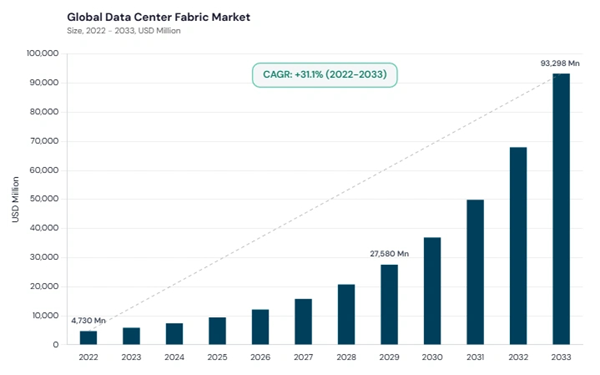
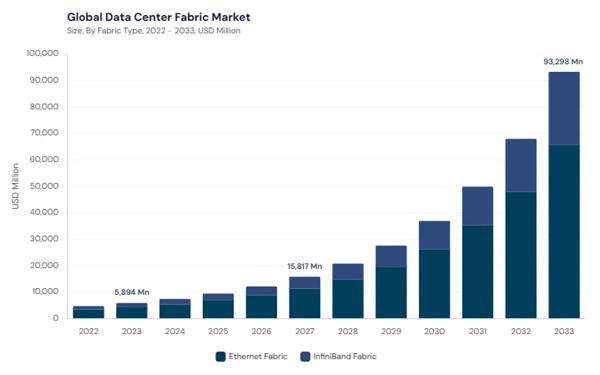
The Global Data Centre Fabric Market size is expected to reach USD 93.29 billion by 2033, rising at a market growth of 33.8% CAGR during the forecast period.


Growth in the Data Centre Fabric Market is being propelled by the rapid expansion of hyperscale cloud infrastructure, where leading cloud providers are investing in high-capacity, fabric-based architectures to efficiently manage massive east-west data traffic. The surge in AI and machine learning workloads is further intensifying demand for high-bandwidth, low-latency interconnects that can support data-intensive processing across distributed compute environments. Additionally, modern applications such as real-time analytics and edge computing require ultra-low latency and seamless data flow, driving the adoption of advanced fabric solutions. Organizations are also prioritizing scalability, as data centre fabrics enable flexible and modular network expansion without performance bottlenecks.

Key Market Trends & Insights:

  • The North America Data Centre Fabric market dominated the Global Market in 2025, accounting for a 37.21% revenue share in 2025.
  • The US Data Centre Fabric market is expected to continue its dominance in North America region thereby reaching a market size of USD 24.45 billion by 2033.
  • Among the various end user segments, Cloud Service Providers dominated the global market contributing a revenue share of 42.64% in 2025.
  • In terms of the Deployment Type segmentation, the On-premises segment is projected to dominate the global market with the projected revenue share of 54.50% in 2033.
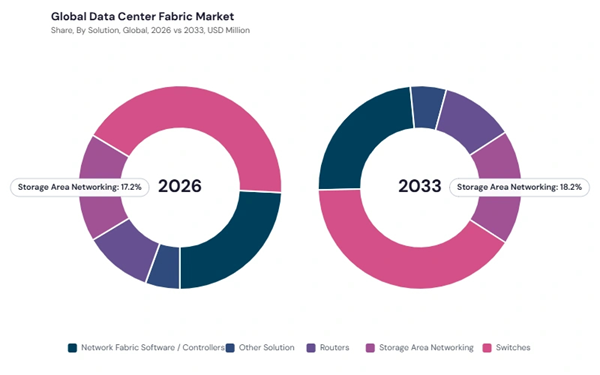
  • Switches led the Solution segments in 2025, capturing a 42.42% revenue share and is projected to continue its dominance during projected period.
The Global Data Centre Fabric Market has moved from conventional, hardware-centric networking into a more integrated and intelligent environment built for high-throughput data movement across modern data centres. Early growth came from the rise of cloud computing, virtualization, and the need to remove bottlenecks created by older three-tier architectures. As workloads became more dynamic and data volumes increased, operators adopted flatter fabric designs supported by software-defined networking, automation, and higher-speed Ethernet. This shift made fabrics more important for improving agility, resilience, and large-scale east-west traffic handling across enterprise and hyperscale environments.

Today, artificial intelligence, edge computing, and multi-cloud strategies are shaping the market’s next phase. Operators are looking for fabrics that support low latency, automated traffic management, stronger visibility, and better energy efficiency. Vendors are responding with AI-driven orchestration, programmable architectures, and more scalable switching and controller layers. As a result, data centre fabric has become a core part of digital infrastructure planning rather than just a networking upgrade, supporting cloud providers, telecom operators, enterprises, and colocation facilities as they modernize operations.

The market is structured around an ecosystem of switching hardware, routers, storage networking, software-defined controllers, and orchestration layers that enable scalable and resilient connectivity inside data centre environments. Major participants include networking vendors, software providers, systems integrators, cloud operators, telecom service providers, enterprises, and colocation facilities. Demand is shaped by the need to support high-bandwidth traffic, virtualization, AI workloads, and hybrid infrastructure models while reducing complexity and improving operational flexibility.

The major strategies followed by the market participants are Product Launches and Partnerships as the key developmental strategies to keep pace with the changing demands of end users. For instance, in March 2026, Huawei Technologies Co., Ltd. launched Xinghe AI Fabric 2.0 to improve AI workload performance, fault detection, and intelligent network management. Additionally, in December 2025, Hewlett Packard Enterprise and NVIDIA Corporation collaborated to build AI-ready data centre fabrics that combine accelerated compute with scalable high-performance networking infrastructure.

COVID-19 Impact Analysis

The COVID-19 pandemic had a mild negative impact on the Data Centre Fabric Market. Supply chain disruptions affected the availability of switches, connectors, and integrated hardware, while site access restrictions slowed installation, maintenance, and testing activity. Some expansion projects were delayed as enterprises reassessed budgets. At the same time, the acceleration of remote work, cloud-native architectures, and digital transformation increased demand for scalable and resilient networking. This combination caused near-term operational pressure but reinforced the long-term need for automated, low-latency, and cloud-ready fabric infrastructure.

Driving and Restraining Factors

Drivers
  • Scalability and flexibility requirements in data center infrastructure
  • Proliferation of artificial intelligence and data-intensive applications
  • Energy efficiency and sustainability imperatives
  • Acceleration of modular and mega-scale data center development
Restraints
  • High capital expenditure and operational costs
  • Regulatory and environmental compliance challenges
  • Technical complexity and integration barriers
Opportunities
  • Intelligent data centre fabric integration for AI-driven workloads
  • Expansion of energy-efficient and sustainable fabric solutions
  • Hybrid and multi-cloud optimized data centre fabric architectures
Challenges
  • High implementation and operating cost framework
  • Interoperability and integration complexity
  • Energy efficiency and sustainability constraints

Market Share Analysis


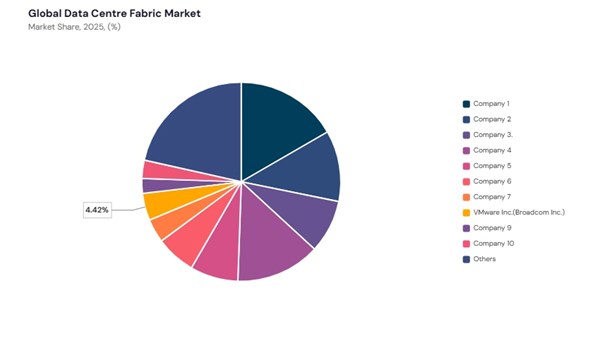
The leading players in the market are competing with diverse innovative offerings to remain competitive in the market. The top ten companies collectively account for approximately 78.49% of the global market, while the remaining 21.51% is held by other players. Cisco Systems, Inc. leads with around 16.64%, followed by Huawei Technologies Co., Ltd. at Arista Networks, Inc. and Juniper Networks, Inc. at 8.67%. Dell Technologies, Inc. and NVIDIA Corporation also maintain important positions through enterprise integration and AI-focused networking. The key developmental strategies in the market are Product Launches, Partnerships & Collaborations, and expansion of AI-ready and software-defined infrastructure capabilities.

Deployment Outlook

On the basis of Deployment Type, the market is classified into On-premises and Cloud. The On-premises segment recorded the largest revenue share in the Data Centre Fabric Market in 2025. On-premises deployment remains important because it supports stronger control over latency, security, and infrastructure customization, especially for enterprises, government users, and performance-intensive workloads. Cloud deployment is also gaining momentum as organizations seek flexible scaling, faster provisioning, and more distributed operating models across hybrid environments.

Solution Outlook


Based on solution, the market is classified into Switches, Network Fabric Software / Controllers, Storage Area Networking, Routers, and Other Solution. Globally, the Switches segment recorded the highest revenue share in 2025. Switches remain the foundational layer of data centre fabric because they handle high-speed data movement across compute and storage resources. At the same time, network controllers and software layers are becoming more important as operators prioritize orchestration, automation, and visibility in increasingly complex environments.

Application Outlook

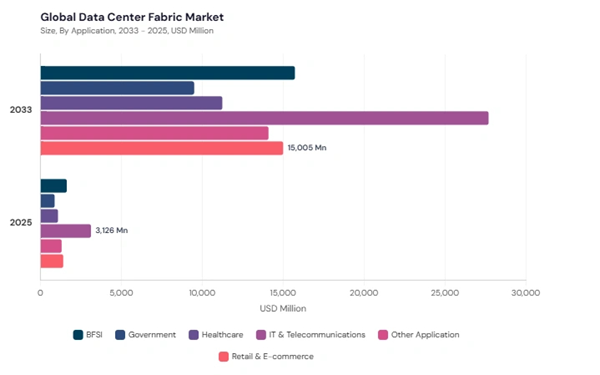
By application, the market is divided into IT & Telecommunications, BFSI, Retail & E-commerce, Healthcare, Government, and Other Application. The IT & Telecommunications segment recorded the largest revenue share in 2025. The segment continues to lead because telecom operators and digital infrastructure providers require scalable, low-latency networking to support cloud services, virtualization, and traffic-heavy environments. Growth across BFSI, retail, healthcare, and government is also increasing as organizations modernize data handling and real-time service delivery.

End User Outlook

By end user, the market is segmented into Cloud Service Providers, Telecom Service Providers, Enterprises, and Colocation Providers. The Cloud Service Providers segment recorded the largest revenue share in 2025. This leadership is supported by the expansion of hyperscale capacity, large-scale cloud workloads, and the need for efficient east-west traffic management. Telecom service providers, enterprises, and colocation providers are also expanding adoption as they invest in agile, programmable, and more resilient data centre networking frameworks.

Regional Outlook

Region-wise, the Data Centre Fabric Market is analyzed across North America, Europe, Asia Pacific, and LAMEA. The North America segment recorded the largest revenue share in 2025. North America and Europe benefit from mature cloud ecosystems, stronger enterprise modernization activity, and close partnerships between technology vendors and data centre operators. Asia Pacific and LAMEA are emerging as fast-growing markets as governments, telecom providers, and enterprises invest more actively in digital infrastructure, AI-ready capacity, and scalable cloud-linked network environments.

Market Competition and Attributes

The Data Centre Fabric market is highly competitive and characterized by rapid technological innovation and performance-led differentiation. Competition centers on the ability to deliver low-latency, high-bandwidth, and programmable fabric architectures using artificial intelligence, software-defined controls, and advanced automation. Vendors differentiate themselves through switching performance, orchestration depth, integration with cloud and AI stacks, and support for interoperability across complex environments. Pricing flexibility, energy efficiency, and strong ecosystem partnerships further shape competitive positioning.


Based on the Analysis presented in the report, Cisco Systems, Inc. is the forerunner in the Data Centre Fabric Market. Companies such as Huawei Technologies Co., Ltd., Arista Networks, Inc., and Juniper Networks, Inc. are some of the key innovators in Data Centre Fabric Market. The market remains technology-driven and moderately consolidated, with leading vendors competing through high-performance switching, AI-enabled network management, software-defined orchestration, and stronger integration with hyperscale, cloud, and AI infrastructure environments.
Recent Strategies Deployed in the Market

  • Mar-2026: Huawei Technologies Co., Ltd. launched Xinghe AI Fabric 2.0 for intelligent data centre networking, integrating AI-driven traffic optimization, intelligent fault detection, and automated network management capabilities.
  • Oct-2025: Oracle Corporation launched an AI data platform to support fabric-based data centre architectures and large-scale AI-enabled analytics environments.
  • Dec-2025: Hewlett Packard Enterprise partnered with NVIDIA Corporation to build AI-ready data centre fabrics for secure AI factories and advanced accelerated infrastructure.
  • Jun-2025: Nokia Corporation introduced an AI-driven autonomous network fabric for telecom data centres and cloud environments with self-optimizing and self-healing capabilities.
  • Mar-2026: Hyperscale data centre expansion accelerated globally to support fabric-based architectures for AI, cloud computing, and high-performance networking workloads.

List of Key Companies Profiled

  • Cisco Systems, Inc.
  • Arista Networks, Inc.
  • Juniper Networks, Inc.
  • Huawei Technologies Co., Ltd.
  • Dell Technologies, Inc.
  • NVIDIA Corporation
  • Extreme Networks, Inc.
  • VMware, Inc.
  • Oracle Corporation
  • Nokia Corporation

Market Report Segmentation

By Solution
  • Switches
  • Routers
  • Storage Area Networking
  • Network Fabric Software / Controllers
  • Other Solution
By Application
  • IT & Telecommunications
  • BFSI
  • Healthcare
  • Retail & E-commerce
  • Government
  • Other Application
By End User
  • Cloud Service Providers
  • Telecom Service Providers
  • Enterprises
  • Colocation Providers
By Fabric Type
  • Ethernet Fabric
  • InfiniBand Fabric
By Region
  • North America
    • US
    • Canada
    • Mexico
    • Rest of North America

  • Europe
    • Germany
    • UK
    • France
    • Russia
    • Spain
    • Italy
    • Rest of Europe

  • Asia Pacific
    • Japan
    • China
    • India
    • South Korea
    • Singapore
    • Malaysia
    • Rest of Asia Pacific

  • LAMEA
    • Brazil
    • Argentina
    • UAE
    • Saudi Arabia
    • South Africa
    • Nigeria
    • Rest of LAMEA
By Geography
  • North America
    • US
    • Canada
    • Mexico
    • Rest of North America

  • Europe
    • Germany
    • UK
    • France
    • Russia
    • Spain
    • Italy
    • Rest of Europe

  • Asia Pacific
    • China
    • Japan
    • India
    • South Korea
    • Singapore
    • Malaysia
    • Rest of Asia Pacific

  • LAMEA
    • Brazil
    • Argentina
    • UAE
    • Saudi Arabia
    • South Africa
    • Nigeria
    • Rest of LAMEA

Table of Contents

Chapter 1. Market Overview
1.1 COVID-19 Impact
1.2 Market Composition and Scenario
Chapter 2. Key Factors Impacting Market
2.1 Market Drivers
2.2 Market Restraints
2.3 Market Opportunities
2.4 Market Challenges
2.5 Market Trends
2.6 State of Competition
2.7 Market Consolidation
2.8 Key Customer Criteria
Chapter 3. Product Life CycleChapter 4. Value Chain Analysis of Data Centre Fabric Market
Chapter 5. Competition Analysis - Global
5.1 Market Share Analysis
5.2 Recent Development and Strategies
5.2.1 Product Launch & Product Expansion
5.2.2 Partnership, Collaboration & Agreements
5.2.3 Geographical Expansion
Chapter 6. Segmentation By Solution
6.1 Switches
6.2 Routers
6.3 Storage Area Networking
6.4 Network Fabric Software / Controllers
6.5 Other Solution
Chapter 7. Segmentation By Application
7.1 IT & Telecommunications
7.2 BFSI
7.3 Healthcare
7.4 Retail & E-commerce
7.5 Government
7.6 Other Application
Chapter 8. Segmentation By End User
8.1 Cloud Service Providers
8.2 Telecom Service Providers
8.3 Enterprises
8.4 Colocation Providers
Chapter 9. Segmentation By Fabric Type
9.1 Ethernet Fabric
9.2 InfiniBand Fabric
Chapter 10. Segmentation By Deployment Type
10.1 On-Premise
10.2 Cloud-Based
Chapter 11. North America Market
11.1 Market Overview
11.2 Key Factors Impacting Market
11.2.1 Market Drivers
11.2.2 Market Restraints
11.2.3 Market Opportunities
11.2.4 Market Challenges
11.2.5 Market Trends
11.2.6 State of Competition
11.2.7 Market Consolidation
11.2.8 Key Customer Criteria
11.3 Product Life Cycle
11.4 Segmentation By Solution
11.4.1 Switches
11.4.2 Routers
11.4.3 Storage Area Networking
11.4.4 Network Fabric Software / Controllers
11.4.5 Other Solution
11.5 Segmentation By Application
11.5.1 IT & Telecommunications
11.5.2 BFSI
11.5.3 Healthcare
11.5.4 Retail & E-commerce
11.5.5 Government
11.5.6 Other Application
11.6 Segmentation By End User
11.6.1 Cloud Service Providers
11.6.2 Telecom Service Providers
11.6.3 Enterprises
11.6.4 Colocation Providers
11.7 Segmentation By Fabric Type
11.7.1 Ethernet Fabric
11.7.2 InfiniBand Fabric
11.8 Segmentation By Deployment Type
11.8.1 On-Premise
11.8.2 Cloud-Based
11.9 Segmentation By Country
11.9.1 US
11.9.1.1 Segmentation By Fabric Type
11.9.1.1.1 Ethernet Fabric
11.9.1.1.2 InfiniBand Fabric
11.9.1.1.3 Cloud Service Providers
11.9.1.1.4 Telecom Service Providers
11.9.1.1.5 Enterprises
11.9.1.1.6 Colocation Providers
11.9.1.2 Segmentation By Deployment Type
11.9.1.2.1 On-premises
11.9.1.2.2 Cloud
11.9.1.2.3 Switches
11.9.1.2.4 Network Fabric Software / Controllers
11.9.1.2.5 Storage Area Networking
11.9.1.2.6 Routers
11.9.1.2.7 Other Solution
11.9.1.2.8 IT & Telecommunications
11.9.1.2.9 BFSI
11.9.1.2.10 Retail & E-commerce
11.9.1.2.11 Healthcare
11.9.1.2.12 Government
11.9.1.2.13 Other Application
11.9.2 Canada
11.9.2.1 Segmentation By Fabric Type
11.9.2.1.1 Ethernet Fabric
11.9.2.1.2 InfiniBand Fabric
11.9.2.1.3 Cloud Service Providers
11.9.2.1.4 Telecom Service Providers
11.9.2.1.5 Enterprises
11.9.2.1.6 Colocation Providers
11.9.2.2 Segmentation By Deployment Type
11.9.2.2.1 On-premises
11.9.2.2.2 Cloud
11.9.2.2.3 Switches
11.9.2.2.4 Network Fabric Software / Controllers
11.9.2.2.5 Storage Area Networking
11.9.2.2.6 Routers
11.9.2.2.7 Other Solution
11.9.2.2.8 IT & Telecommunications
11.9.2.2.9 BFSI
11.9.2.2.10 Retail & E-commerce
11.9.2.2.11 Healthcare
11.9.2.2.12 Government
11.9.2.2.13 Other Application
11.9.3 Mexico
11.9.3.1 Segmentation By Fabric Type
11.9.3.1.1 Ethernet Fabric
11.9.3.1.2 InfiniBand Fabric
11.9.3.1.3 Cloud Service Providers
11.9.3.1.4 Telecom Service Providers
11.9.3.1.5 Enterprises
11.9.3.1.6 Colocation Providers
11.9.3.2 Segmentation By Deployment Type
11.9.3.2.1 On-premises
11.9.3.2.2 Cloud
11.9.3.2.3 Switches
11.9.3.2.4 Network Fabric Software / Controllers
11.9.3.2.5 Storage Area Networking
11.9.3.2.6 Routers
11.9.3.2.7 Other Solution
11.9.3.2.8 IT & Telecommunications
11.9.3.2.9 BFSI
11.9.3.2.10 Retail & E-commerce
11.9.3.2.11 Healthcare
11.9.3.2.12 Government
11.9.3.2.13 Other Application
11.9.4 Rest of North America
11.9.4.1 Segmentation By Fabric Type
11.9.4.1.1 Ethernet Fabric
11.9.4.1.2 InfiniBand Fabric
11.9.4.1.3 Cloud Service Providers
11.9.4.1.4 Telecom Service Providers
11.9.4.1.5 Enterprises
11.9.4.1.6 Colocation Providers
11.9.4.2 Segmentation By Deployment Type
11.9.4.2.1 On-premises
11.9.4.2.2 Cloud
11.9.4.2.3 Switches
11.9.4.2.4 Network Fabric Software / Controllers
11.9.4.2.5 Storage Area Networking
11.9.4.2.6 Routers
11.9.4.2.7 Other Solution
11.9.4.2.8 IT & Telecommunications
11.9.4.2.9 BFSI
11.9.4.2.10 Retail & E-commerce
11.9.4.2.11 Healthcare
11.9.4.2.12 Government
11.9.4.2.13 Other Application
Chapter 12. Europe Market
12.1 Market Overview
12.2 Key Factors Impacting Market
12.2.1 Market Drivers
12.2.2 Market Restraints
12.2.3 Market Opportunities
12.2.4 Market Challenges
12.2.5 Market Trends
12.2.6 State of Competition
12.2.7 Market Consolidation
12.2.8 Key Customer Criteria
12.3 Product Life Cycle
12.4 Segmentation By Solution
12.4.1 Switches
12.4.2 Routers
12.4.3 Storage Area Networking
12.4.4 Network Fabric Software / Controllers
12.4.5 Other Solution
12.5 Segmentation By Application
12.5.1 IT & Telecommunications
12.5.2 BFSI
12.5.3 Healthcare
12.5.4 Retail & E-commerce
12.5.5 Government
12.5.6 Other Application
12.6 Segmentation By End User
12.6.1 Cloud Service Providers
12.6.2 Telecom Service Providers
12.6.3 Enterprises
12.6.4 Colocation Providers
12.7 Segmentation By Fabric Type
12.7.1 Ethernet Fabric
12.7.2 InfiniBand Fabric
12.8 Segmentation By Deployment Type
12.8.1 On-Premise
12.8.2 Cloud-Based
12.9 Segmentation By Country
12.9.1 Germany
12.9.1.1 Segmentation By Fabric Type
12.9.1.1.1 Ethernet Fabric
12.9.1.1.2 InfiniBand Fabric
12.9.1.1.3 Cloud Service Providers
12.9.1.1.4 Telecom Service Providers
12.9.1.1.5 Enterprises
12.9.1.1.6 Colocation Providers
12.9.1.2 Segmentation By Deployment Type
12.9.1.2.1 On-premises
12.9.1.2.2 Cloud
12.9.1.2.3 Switches
12.9.1.2.4 Network Fabric Software / Controllers
12.9.1.2.5 Storage Area Networking
12.9.1.2.6 Routers
12.9.1.2.7 Other Solution
12.9.1.2.8 IT & Telecommunications
12.9.1.2.9 BFSI
12.9.1.2.10 Retail & E-commerce
12.9.1.2.11 Healthcare
12.9.1.2.12 Government
12.9.1.2.13 Other Application
12.9.2 UK
12.9.2.1 Segmentation By Fabric Type
12.9.2.1.1 Ethernet Fabric
12.9.2.1.2 InfiniBand Fabric
12.9.2.1.3 Cloud Service Providers
12.9.2.1.4 Telecom Service Providers
12.9.2.1.5 Enterprises
12.9.2.1.6 Colocation Providers
12.9.2.2 Segmentation By Deployment Type
12.9.2.2.1 On-premises
12.9.2.2.2 Cloud
12.9.2.2.3 Switches
12.9.2.2.4 Network Fabric Software / Controllers
12.9.2.2.5 Storage Area Networking
12.9.2.2.6 Routers
12.9.2.2.7 Other Solution
12.9.2.2.8 IT & Telecommunications
12.9.2.2.9 BFSI
12.9.2.2.10 Retail & E-commerce
12.9.2.2.11 Healthcare
12.9.2.2.12 Government
12.9.2.2.13 Other Application
12.9.3 France
12.9.3.1 Segmentation By Fabric Type
12.9.3.1.1 Ethernet Fabric
12.9.3.1.2 InfiniBand Fabric
12.9.3.1.3 Cloud Service Providers
12.9.3.1.4 Telecom Service Providers
12.9.3.1.5 Enterprises
12.9.3.1.6 Colocation Providers
12.9.3.2 Segmentation By Deployment Type
12.9.3.2.1 On-premises
12.9.3.2.2 Cloud
12.9.3.2.3 Switches
12.9.3.2.4 Network Fabric Software / Controllers
12.9.3.2.5 Storage Area Networking
12.9.3.2.6 Routers
12.9.3.2.7 Other Solution
12.9.3.2.8 IT & Telecommunications
12.9.3.2.9 BFSI
12.9.3.2.10 Retail & E-commerce
12.9.3.2.11 Healthcare
12.9.3.2.12 Government
12.9.3.2.13 Other Application
12.9.4 Russia
12.9.4.1 Segmentation By Fabric Type
12.9.4.1.1 Ethernet Fabric
12.9.4.1.2 InfiniBand Fabric
12.9.4.1.3 Cloud Service Providers
12.9.4.1.4 Telecom Service Providers
12.9.4.1.5 Enterprises
12.9.4.1.6 Colocation Providers
12.9.4.2 Segmentation By Deployment Type
12.9.4.2.1 On-premises
12.9.4.2.2 Cloud
12.9.4.2.3 Switches
12.9.4.2.4 Network Fabric Software / Controllers
12.9.4.2.5 Storage Area Networking
12.9.4.2.6 Routers
12.9.4.2.7 Other Solution
12.9.4.2.8 IT & Telecommunications
12.9.4.2.9 BFSI
12.9.4.2.10 Retail & E-commerce
12.9.4.2.11 Healthcare
12.9.4.2.12 Government
12.9.4.2.13 Other Application
12.9.5 Spain
12.9.5.1 Segmentation By Fabric Type
12.9.5.1.1 Ethernet Fabric
12.9.5.1.2 InfiniBand Fabric
12.9.5.1.3 Cloud Service Providers
12.9.5.1.4 Telecom Service Providers
12.9.5.1.5 Enterprises
12.9.5.1.6 Colocation Providers
12.9.5.2 Segmentation By Deployment Type
12.9.5.2.1 On-premises
12.9.5.2.2 Cloud
12.9.5.2.3 Switches
12.9.5.2.4 Network Fabric Software / Controllers
12.9.5.2.5 Storage Area Networking
12.9.5.2.6 Routers
12.9.5.2.7 Other Solution
12.9.5.2.8 IT & Telecommunications
12.9.5.2.9 BFSI
12.9.5.2.10 Retail & E-commerce
12.9.5.2.11 Healthcare
12.9.5.2.12 Government
12.9.5.2.13 Other Application
12.9.6 Italy
12.9.6.1 Segmentation By Fabric Type
12.9.6.1.1 Ethernet Fabric
12.9.6.1.2 InfiniBand Fabric
12.9.6.1.3 Cloud Service Providers
12.9.6.1.4 Telecom Service Providers
12.9.6.1.5 Enterprises
12.9.6.1.6 Colocation Providers
12.9.6.2 Segmentation By Deployment Type
12.9.6.2.1 On-premises
12.9.6.2.2 Cloud
12.9.6.2.3 Switches
12.9.6.2.4 Network Fabric Software / Controllers
12.9.6.2.5 Storage Area Networking
12.9.6.2.6 Routers
12.9.6.2.7 Other Solution
12.9.6.2.8 IT & Telecommunications
12.9.6.2.9 BFSI
12.9.6.2.10 Retail & E-commerce
12.9.6.2.11 Healthcare
12.9.6.2.12 Government
12.9.6.2.13 Other Application
12.9.7 Rest of Europe
12.9.7.1 Segmentation By Fabric Type
12.9.7.1.1 Ethernet Fabric
12.9.7.1.2 InfiniBand Fabric
12.9.7.1.3 Cloud Service Providers
12.9.7.1.4 Telecom Service Providers
12.9.7.1.5 Enterprises
12.9.7.1.6 Colocation Providers
12.9.7.2 Segmentation By Deployment Type
12.9.7.2.1 On-premises
12.9.7.2.2 Cloud
12.9.7.2.3 Switches
12.9.7.2.4 Network Fabric Software / Controllers
12.9.7.2.5 Storage Area Networking
12.9.7.2.6 Routers
12.9.7.2.7 Other Solution
12.9.7.2.8 IT & Telecommunications
12.9.7.2.9 BFSI
12.9.7.2.10 Retail & E-commerce
12.9.7.2.11 Healthcare
12.9.7.2.12 Government
12.9.7.2.13 Other Application
Chapter 13. Asia Pacific Market
13.1 Market Overview
13.2 Key Factors Impacting Market
13.2.1 Market Drivers
13.2.2 Market Restraints
13.2.3 Market Opportunities
13.2.4 Market Challenges
13.2.5 Market Trends
13.2.6 State of Competition
13.2.7 Market Consolidation
13.2.8 Key Customer Criteria
13.3 Product Life Cycle
13.4 Segmentation By Solution
13.4.1 Switches
13.4.2 Routers
13.4.3 Storage Area Networking
13.4.4 Network Fabric Software / Controllers
13.4.5 Other Solution
13.5 Segmentation By Application Analysis
13.5.1 IT & Telecommunications
13.5.2 BFSI
13.5.3 Healthcare
13.5.4 Retail & E-commerce
13.5.5 Government
13.5.6 Other Application
13.6 Segmentation By End User
13.6.1 Cloud Service Providers
13.6.2 Telecom Service Providers
13.6.3 Enterprises
13.6.4 Colocation Providers
13.7 Segmentation By Fabric Type
13.7.1 Ethernet Fabric
13.7.2 InfiniBand Fabric
13.8 Segmentation By Deployment Type
13.8.1 On-Premise
13.8.2 Cloud-Based
13.9 Segmentation By Country
13.9.1 China
13.9.1.1 Segmentation By Fabric Type
13.9.1.1.1 Ethernet Fabric
13.9.1.1.2 InfiniBand Fabric
13.9.1.1.3 Cloud Service Providers
13.9.1.1.4 Telecom Service Providers
13.9.1.1.5 Enterprises
13.9.1.1.6 Colocation Providers
13.9.1.2 Segmentation By Deployment Type
13.9.1.2.1 On-premises
13.9.1.2.2 Cloud
13.9.1.2.3 Switches
13.9.1.2.4 Network Fabric Software / Controllers
13.9.1.2.5 Storage Area Networking
13.9.1.2.6 Routers
13.9.1.2.7 Other Solution
13.9.1.2.8 IT & Telecommunications
13.9.1.2.9 BFSI
13.9.1.2.10 Retail & E-commerce
13.9.1.2.11 Healthcare
13.9.1.2.12 Government
13.9.1.2.13 Other Application
13.9.2 Japan
13.9.2.1 Segmentation By Fabric Type
13.9.2.1.1 Ethernet Fabric
13.9.2.1.2 InfiniBand Fabric
13.9.2.1.3 Cloud Service Providers
13.9.2.1.4 Telecom Service Providers
13.9.2.1.5 Enterprises
13.9.2.1.6 Colocation Providers
13.9.2.2 Segmentation By Deployment Type
13.9.2.2.1 On-premises
13.9.2.2.2 Cloud
13.9.2.2.3 Switches
13.9.2.2.4 Network Fabric Software / Controllers
13.9.2.2.5 Storage Area Networking
13.9.2.2.6 Routers
13.9.2.2.7 Other Solution
13.9.2.2.8 IT & Telecommunications
13.9.2.2.9 BFSI
13.9.2.2.10 Retail & E-commerce
13.9.2.2.11 Healthcare
13.9.2.2.12 Government
13.9.2.2.13 Other Application
13.9.3 India
13.9.3.1 Segmentation By Fabric Type
13.9.3.1.1 Ethernet Fabric
13.9.3.1.2 InfiniBand Fabric
13.9.3.1.3 Cloud Service Providers
13.9.3.1.4 Telecom Service Providers
13.9.3.1.5 Enterprises
13.9.3.1.6 Colocation Providers
13.9.3.2 Segmentation By Deployment Type
13.9.3.2.1 On-premises
13.9.3.2.2 Cloud
13.9.3.2.3 Switches
13.9.3.2.4 Network Fabric Software / Controllers
13.9.3.2.5 Storage Area Networking
13.9.3.2.6 Routers
13.9.3.2.7 Other Solution
13.9.3.2.8 IT & Telecommunications
13.9.3.2.9 BFSI
13.9.3.2.10 Retail & E-commerce
13.9.3.2.11 Healthcare
13.9.3.2.12 Government
13.9.3.2.13 Other Application
13.9.4 South Korea
13.9.4.1 Segmentation By Fabric Type
13.9.4.1.1 Ethernet Fabric
13.9.4.1.2 InfiniBand Fabric
13.9.4.1.3 Cloud Service Providers
13.9.4.1.4 Telecom Service Providers
13.9.4.1.5 Enterprises
13.9.4.1.6 Colocation Providers
13.9.4.2 Segmentation By Deployment Type
13.9.4.2.1 On-premises
13.9.4.2.2 Cloud
13.9.4.2.3 Switches
13.9.4.2.4 Network Fabric Software / Controllers
13.9.4.2.5 Storage Area Networking
13.9.4.2.6 Routers
13.9.4.2.7 Other Solution
13.9.4.2.8 IT & Telecommunications
13.9.4.2.9 BFSI
13.9.4.2.10 Retail & E-commerce
13.9.4.2.11 Healthcare
13.9.4.2.12 Government
13.9.4.2.13 Other Application
13.9.5 Singapore
13.9.5.1 Segmentation By Fabric Type
13.9.5.1.1 Ethernet Fabric
13.9.5.1.2 InfiniBand Fabric
13.9.5.1.3 Cloud Service Providers
13.9.5.1.4 Telecom Service Providers
13.9.5.1.5 Enterprises
13.9.5.1.6 Colocation Providers
13.9.5.2 Segmentation By Deployment Type
13.9.5.2.1 On-premises
13.9.5.2.2 Cloud
13.9.5.2.3 Switches
13.9.5.2.4 Network Fabric Software / Controllers
13.9.5.2.5 Storage Area Networking
13.9.5.2.6 Routers
13.9.5.2.7 Other Solution
13.9.5.2.8 IT & Telecommunications
13.9.5.2.9 BFSI
13.9.5.2.10 Retail & E-commerce
13.9.5.2.11 Healthcare
13.9.5.2.12 Government
13.9.5.2.13 Other Application
13.9.6 Malaysia
13.9.6.1 Segmentation By Fabric Type
13.9.6.1.1 Ethernet Fabric
13.9.6.1.2 InfiniBand Fabric
13.9.6.1.3 Cloud Service Providers
13.9.6.1.4 Telecom Service Providers
13.9.6.1.5 Enterprises
13.9.6.1.6 Colocation Providers
13.9.6.2 Segmentation By Deployment Type
13.9.6.2.1 On-premises
13.9.6.2.2 Cloud
13.9.6.2.3 Switches
13.9.6.2.4 Network Fabric Software / Controllers
13.9.6.2.5 Storage Area Networking
13.9.6.2.6 Routers
13.9.6.2.7 Other Solution
13.9.6.2.8 IT & Telecommunications
13.9.6.2.9 BFSI
13.9.6.2.10 Retail & E-commerce
13.9.6.2.11 Healthcare
13.9.6.2.12 Government
13.9.6.2.13 Other Application
13.9.7 Rest of Asia Pacific
13.9.7.1 Segmentation By Fabric Type
13.9.7.1.1 Ethernet Fabric
13.9.7.1.2 InfiniBand Fabric
13.9.7.1.3 Cloud Service Providers
13.9.7.1.4 Telecom Service Providers
13.9.7.1.5 Enterprises
13.9.7.1.6 Colocation Providers
13.9.7.2 Segmentation By Deployment Type
13.9.7.2.1 On-premises
13.9.7.2.2 Cloud
13.9.7.2.3 Switches
13.9.7.2.4 Network Fabric Software / Controllers
13.9.7.2.5 Storage Area Networking
13.9.7.2.6 Routers
13.9.7.2.7 Other Solution
13.9.7.2.8 IT & Telecommunications
13.9.7.2.9 BFSI
13.9.7.2.10 Retail & E-commerce
13.9.7.2.11 Healthcare
13.9.7.2.12 Government
13.9.7.2.13 Other Application
Chapter 14. LAMEA Market
14.1 Market Overview
14.2 Key Factors Impacting Market
14.2.1 Market Drivers
14.2.2 Market Restraints
14.2.3 Market Opportunities
14.2.4 Market Challenges
14.2.5 Market Trends
14.2.6 State of Competition
14.2.7 Market Consolidation
14.2.8 Key Customer Criteria
14.3 Product Life Cycle
14.4 Segmentation By Solution
14.4.1 Switches
14.4.2 Routers
14.4.3 Storage Area Networking
14.4.4 Network Fabric Software / Controllers
14.4.5 Other Solution
14.5 Segmentation By Application
14.5.1 IT & Telecommunications
14.5.2 BFSI
14.5.3 Healthcare
14.5.4 Retail & E-commerce
14.5.5 Government
14.5.6 Other Application
14.6 Segmentation By End User
14.6.1 Cloud Service Providers
14.6.2 Telecom Service Providers
14.6.3 Enterprises
14.6.4 Colocation Providers
14.7 Segmentation By Fabric Type
14.7.1 Ethernet Fabric
14.7.2 InfiniBand Fabric
14.8 Segmentation By Deployment Type
14.8.1 On-Premise
14.8.2 Cloud-Based
14.9 Segmentation By Country
14.9.1 Brazil
14.9.1.1 Segmentation By Fabric Type
14.9.1.1.1 Ethernet Fabric
14.9.1.1.2 InfiniBand Fabric
14.9.1.1.3 Cloud Service Providers
14.9.1.1.4 Telecom Service Providers
14.9.1.1.5 Enterprises
14.9.1.1.6 Colocation Providers
14.9.1.2 Segmentation By Deployment Type
14.9.1.2.1 On-premises
14.9.1.2.2 Cloud
14.9.1.2.3 Switches
14.9.1.2.4 Network Fabric Software / Controllers
14.9.1.2.5 Storage Area Networking
14.9.1.2.6 Routers
14.9.1.2.7 Other Solution
14.9.1.2.8 IT & Telecommunications
14.9.1.2.9 BFSI
14.9.1.2.10 Retail & E-commerce
14.9.1.2.11 Healthcare
14.9.1.2.12 Government
14.9.1.2.13 Other Application
14.9.2 Argentina
14.9.2.1 Segmentation By Fabric Type
14.9.2.1.1 Ethernet Fabric
14.9.2.1.2 InfiniBand Fabric
14.9.2.1.3 Cloud Service Providers
14.9.2.1.4 Telecom Service Providers
14.9.2.1.5 Enterprises
14.9.2.1.6 Colocation Providers
14.9.2.2 Segmentation By Deployment Type
14.9.2.2.1 On-premises
14.9.2.2.2 Cloud
14.9.2.2.3 Switches
14.9.2.2.4 Network Fabric Software / Controllers
14.9.2.2.5 Storage Area Networking
14.9.2.2.6 Routers
14.9.2.2.7 Other Solution
14.9.2.2.8 IT & Telecommunications
14.9.2.2.9 BFSI
14.9.2.2.10 Retail & E-commerce
14.9.2.2.11 Healthcare
14.9.2.2.12 Government
14.9.2.2.13 Other Application
14.9.3 UAE
14.9.3.1 Segmentation By Fabric Type
14.9.3.1.1 Ethernet Fabric
14.9.3.1.2 InfiniBand Fabric
14.9.3.1.3 Cloud Service Providers
14.9.3.1.4 Telecom Service Providers
14.9.3.1.5 Enterprises
14.9.3.1.6 Colocation Providers
14.9.3.2 Segmentation By Deployment Type
14.9.3.2.1 On-premises
14.9.3.2.2 Cloud
14.9.3.2.3 Switches
14.9.3.2.4 Network Fabric Software / Controllers
14.9.3.2.5 Storage Area Networking
14.9.3.2.6 Routers
14.9.3.2.7 Other Solution
14.9.3.2.8 IT & Telecommunications
14.9.3.2.9 BFSI
14.9.3.2.10 Retail & E-commerce
14.9.3.2.11 Healthcare
14.9.3.2.12 Government
14.9.3.2.13 Other Application
14.9.4 Saudi Arabia
14.9.4.1 Segmentation By Fabric Type
14.9.4.1.1 Ethernet Fabric
14.9.4.1.2 InfiniBand Fabric
14.9.4.1.3 Cloud Service Providers
14.9.4.1.4 Telecom Service Providers
14.9.4.1.5 Enterprises
14.9.4.1.6 Colocation Providers
14.9.4.2 Segmentation By Deployment Type
14.9.4.2.1 On-premises
14.9.4.2.2 Cloud
14.9.4.2.3 Switches
14.9.4.2.4 Network Fabric Software / Controllers
14.9.4.2.5 Storage Area Networking
14.9.4.2.6 Routers
14.9.4.2.7 Other Solution
14.9.4.2.8 IT & Telecommunications
14.9.4.2.9 BFSI
14.9.4.2.10 Retail & E-commerce
14.9.4.2.11 Healthcare
14.9.4.2.12 Government
14.9.4.2.13 Other Application
14.9.5 South Africa
14.9.5.1 Segmentation By Fabric Type
14.9.5.1.1 Ethernet Fabric
14.9.5.1.2 InfiniBand Fabric
14.9.5.1.3 Cloud Service Providers
14.9.5.1.4 Telecom Service Providers
14.9.5.1.5 Enterprises
14.9.5.1.6 Colocation Providers
14.9.5.2 Segmentation By Deployment Type
14.9.5.2.1 On-premises
14.9.5.2.2 Cloud
14.9.5.2.3 Switches
14.9.5.2.4 Network Fabric Software / Controllers
14.9.5.2.5 Storage Area Networking
14.9.5.2.6 Routers
14.9.5.2.7 Other Solution
14.9.5.2.8 IT & Telecommunications
14.9.5.2.9 BFSI
14.9.5.2.10 Retail & E-commerce
14.9.5.2.11 Healthcare
14.9.5.2.12 Government
14.9.5.2.13 Other Application
14.9.6 Nigeria
14.9.6.1 Segmentation By Fabric Type
14.9.6.1.1 Ethernet Fabric
14.9.6.1.2 InfiniBand Fabric
14.9.6.1.3 Cloud Service Providers
14.9.6.1.4 Telecom Service Providers
14.9.6.1.5 Enterprises
14.9.6.1.6 Colocation Providers
14.9.6.2 Segmentation By Deployment Type
14.9.6.2.1 On-premises
14.9.6.2.2 Cloud
14.9.6.2.3 Switches
14.9.6.2.4 Network Fabric Software / Controllers
14.9.6.2.5 Storage Area Networking
14.9.6.2.6 Routers
14.9.6.2.7 Other Solution
14.9.6.2.8 IT & Telecommunications
14.9.6.2.9 BFSI
14.9.6.2.10 Retail & E-commerce
14.9.6.2.11 Healthcare
14.9.6.2.12 Government
14.9.6.2.13 Other Application
14.9.7 Rest of LAMEA
14.9.7.1 Segmentation By Fabric Type
14.9.7.1.1 Ethernet Fabric
14.9.7.1.2 InfiniBand Fabric
14.9.7.1.3 Cloud Service Providers
14.9.7.1.4 Telecom Service Providers
14.9.7.1.5 Enterprises
14.9.7.1.6 Colocation Providers
14.9.7.2 Segmentation By Deployment Type
14.9.7.2.1 On-premises
14.9.7.2.2 Cloud
14.9.7.2.3 Switches
14.9.7.2.4 Network Fabric Software / Controllers
14.9.7.2.5 Storage Area Networking
14.9.7.2.6 Routers
14.9.7.2.7 Other Solution
14.9.7.2.8 IT & Telecommunications
14.9.7.2.9 BFSI
14.9.7.2.10 Retail & E-commerce
14.9.7.2.11 Healthcare
14.9.7.2.12 Government
14.9.7.2.13 Other Application
Chapter 15. Company Snapshot
15.1 Cisco Systems, Inc.
15.1.1 Business Overview
15.1.2 Key Information
15.1.3 Company Focus on Data Centre Fabric Market
15.1.4 Strategic Insights on Data Centre Fabric Market
15.1.5 Strategy Deployed for Data Centre Fabric Market
15.1.6 Product & Service Portfolio
15.1.7 Key Products / Services (Representative)
15.1.8 Capability Overview
15.1.9 SWOT Analysis (Data Centre Fabric Market)
15.1.10 Customers / End Users
15.1.11 Competitive Positioning
15.1.12 Key Differentiators
15.1.13 Portfolio Matrix
15.1.14 Analyst View
15.1.15 Future Outlook for Data Centre Fabric Market
15.2 Arista Networks, Inc.
15.2.1 Business Overview
15.2.2 Key Information
15.2.3 Company Focus on Data Centre Fabric Market
15.2.4 Strategic Insights on Data Centre Fabric Market
15.2.5 Strategy Deployed for Data Centre Fabric Market
15.2.6 Product & Service Portfolio
15.2.7 Portfolio Categories
15.2.8 Key Products / Services (Representative)
15.2.9 Capability Overview
15.2.10 Technology & Innovation Focus
15.2.11 SWOT Analysis (Data Centre Fabric Market)
15.2.12 Customers / End Users
15.2.13 Competitive Positioning
15.2.14 Key Differentiators
15.2.15 Portfolio Matrix
15.2.16 Analyst View
15.2.17 Future Outlook for Data Centre Fabric Market
15.3 Juniper Networks, Inc.
15.3.1 Business Overview
15.3.2 Key Information
15.3.3 Company Focus on Data Centre Fabric Market
15.3.4 Strategic Insights on Data Centre Fabric Market
15.3.5 Strategy Deployed for Data Centre Fabric Market
15.3.6 Product & Service Portfolio
15.3.7 Key Products / Services (Representative)
15.3.8 Capability Overview
15.3.9 SWOT Analysis (Data Centre Fabric Market)
15.3.10 Customers / End Users
15.3.11 Competitive Positioning
15.3.12 Key Differentiators
15.3.13 Portfolio Matrix
15.3.14 Analyst View
15.3.15 Future Outlook for Data Centre Fabric Market
15.4 Huawei Technologies Co., Ltd.
15.4.1 Business Overview
15.4.2 Key Information
15.4.3 Company Focus on Data Centre Fabric Market
15.4.4 Strategic Insights on Data Centre Fabric Market
15.4.5 Strategy Deployed for Data Centre Fabric Market
15.4.6 Product & Service Portfolio
15.4.7 Key Products / Services (Representative)
15.4.8 Capability Overview
15.4.9 SWOT Analysis (Data Centre Fabric Market)
15.4.10 Customers / End Users
15.4.11 Competitive Positioning
15.4.12 Key Differentiators
15.4.13 Portfolio Matrix
15.4.14 Analyst View
15.4.15 Future Outlook for Data Centre Fabric Market
15.5 Dell Technologies, Inc.
15.5.1 Business Overview
15.5.2 Key Information
15.5.3 Company Focus on Data Centre Fabric Market
15.5.4 Strategic Insights on Data Centre Fabric Market
15.5.5 Strategy Deployed for Data Centre Fabric Market
15.5.6 Product & Service Portfolio
15.5.7 Key Products / Services (Representative)
15.5.8 Capability Overview
15.5.9 Technology & Innovation Focus
15.5.10 SWOT Analysis (Data Centre Fabric Market)
15.5.11 Customers / End Users
15.5.12 Competitive Positioning
15.5.13 Key Differentiators
15.5.14 Portfolio Matrix
15.5.15 Analyst View
15.5.16 Future Outlook for Data Centre Fabric Market
15.6 NVIDIA Corporation
15.6.1 Business Overview
15.6.2 Key Information
15.6.3 Company Focus on Data Centre Fabric Market
15.6.4 Strategic Insights on Data Centre Fabric Market
15.6.5 Strategy Deployed for Data Centre Fabric Market
15.6.6 Product & Service Portfolio
15.6.7 Key Products / Services (Representative)
15.6.8 Capability Overview
15.6.9 SWOT Analysis (Data Centre Fabric Market)
15.6.10 Customers / End Users
15.6.11 Competitive Positioning
15.6.12 Key Differentiators
15.6.13 Portfolio Matrix
15.6.14 Analyst View
15.6.15 Future Outlook for Data Centre Fabric Market
15.7 Extreme Networks, Inc.
15.7.1 Business Overview
15.7.2 Key Information
15.7.3 Company Focus on Data Centre Fabric Market
15.7.4 Strategic Insights on Data Centre Fabric Market
15.7.5 Strategy Deployed for Data Centre Fabric Market
15.7.6 Product & Service Portfolio
15.7.7 Key Products / Services (Representative)
15.7.8 Technology & Innovation Focus
15.7.9 SWOT Analysis (Data Centre Fabric Market)
15.7.10 Customers / End Users
15.7.11 Competitive Positioning
15.7.12 Key Differentiators
15.7.13 Portfolio Matrix
15.7.14 Analyst View
15.7.15 Future Outlook for Data Centre Fabric Market
15.8 VMware, Inc.
15.8.1 Business Overview
15.8.2 Key Information
15.8.3 Company Focus on Data Centre Fabric Market
15.8.4 Strategic Insights on Data Centre Fabric Market
15.8.5 Strategy Deployed for Data Centre Fabric Market
15.8.6 Product & Service Portfolio
15.8.7 Key Products / Services (Representative)
15.8.8 Capability Overview
15.8.9 Technology & Innovation Focus
15.8.10 SWOT Analysis (Data Centre Fabric Market)
15.8.11 Customers / End Users
15.8.12 Competitive Positioning
15.8.13 Key Differentiators
15.8.14 Portfolio Matrix
15.8.15 Analyst View
15.8.16 Future Outlook for Data Centre Fabric Market
15.9 Oracle Corporation
15.9.1 Business Overview
15.9.2 Key Information
15.9.3 Company Focus on Data Centre Fabric Market
15.9.4 Strategic Insights on Data Centre Fabric Market
15.9.5 Strategy Deployed for Data Centre Fabric Market
15.9.6 Product & Service Portfolio
15.9.7 Key Products / Services (Representative)
15.9.8 Capability Overview
15.9.9 SWOT Analysis (Data Centre Fabric Market)
15.9.10 Customers / End Users
15.9.11 Competitive Positioning
15.9.12 Key Differentiators
15.9.13 Portfolio Matrix
15.9.14 Analyst View
15.9.15 Future Outlook for Data Centre Fabric Market
15.10 Nokia Corporation
15.10.1 Business Overview
15.10.2 Key Information
15.10.3 Company Focus on Data Centre Fabric Market
15.10.4 Strategic Insights on Data Centre Fabric Market
15.10.5 Strategy Deployed for Data Centre Fabric Market
15.10.6 Product & Service Portfolio
15.10.7 Key Products / Services (Representative)
15.10.8 Capability Overview
15.10.9 Technology & Innovation Focus
15.10.10 SWOT Analysis (Data Centre Fabric Market)
15.10.11 Customers / End Users
15.10.12 Competitive Positioning
15.10.13 Key Differentiators
15.10.14 Portfolio Matrix
15.10.15 Analyst View
15.10.16 Future Outlook for Data Centre Fabric Market
Chapter 16. Winning Imperatives of Data Centre Fabric Market

Companies Mentioned

  • Cisco Systems, Inc.
  • Arista Networks, Inc.
  • Juniper Networks, Inc.
  • Huawei Technologies Co., Ltd.
  • Dell Technologies, Inc.
  • NVIDIA Corporation
  • Extreme Networks, Inc.
  • VMware, Inc.
  • Oracle Corporation
  • Nokia Corporation