+353-1-416-8900REST OF WORLD
+44-20-3973-8888REST OF WORLD
1-917-300-0470EAST COAST U.S
1-800-526-8630U.S. (TOLL FREE)

Global Industrial Control Systems Security Market Size, Share & Industry Analysis Report by Component, Security Type, End Use, Solution, Regional Outlook and Forecast, 2026-2033

  • PDF Icon

    Report

  • 821 Pages
  • May 2026
  • Marqual IT Solutions Pvt. Ltd (KBV Research)
  • ID: 6276110
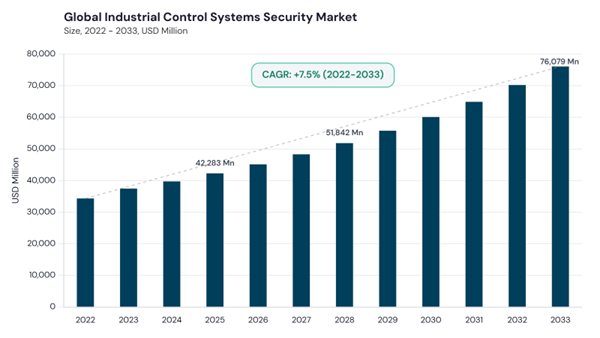
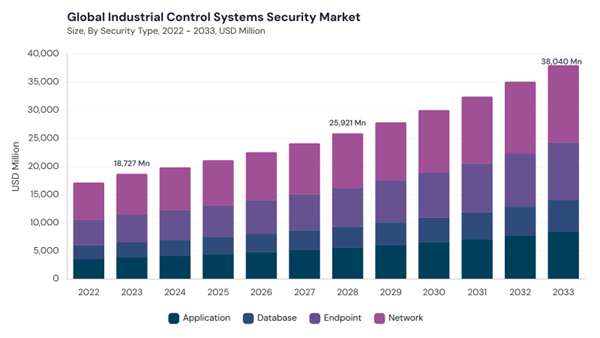
The Global Industrial Control Systems Security Market size is expected to reach USD 38.03 Billion by 2033, rising at a market growth of 7.7% CAGR during the forecast period.


The increasing frequency of cyberattacks targeting critical infrastructure is accelerating demand for industrial cybersecurity solutions across manufacturing, energy, transportation, and utility sectors. The growing convergence of IT and operational technology (OT), along with rising industrial automation adoption, is further driving investments in advanced ICS security platforms.

Key Market Trends & Insights:

  • The North America Industrial Control Systems Security market dominated the Global Market in 2025, accounting for a 35.92% revenue share in 2025.
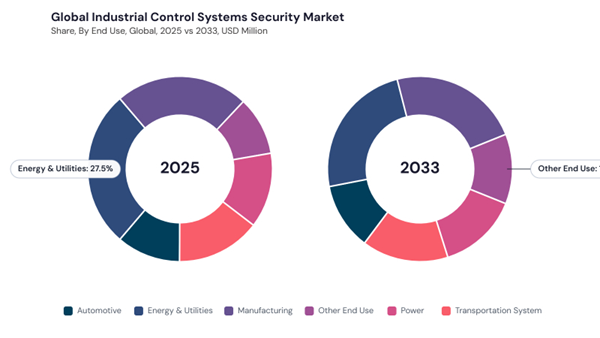
  • Among the various end use segments, Energy & Utilities dominated the global market contributing a revenue share of 27.47% in 2025.
  • In terms of the Security Type segmentation, the Network segment dominated the global market with a revenue share of 38.14% in 2025.
  • Solution led the Component segment in 2025, capturing a 69.10% revenue share and is projected to continue its dominance during the forecast period.
The Global Industrial Control Systems Security Market has evolved significantly with the expansion of connected industrial environments and digital transformation initiatives across critical industries. Earlier industrial systems were designed primarily for operational efficiency with limited cybersecurity capabilities. However, the increasing integration of industrial control systems with enterprise IT networks has heightened cybersecurity risks, driving demand for specialized security solutions.


Organizations across manufacturing, energy & utilities, transportation, and automotive industries are increasingly adopting advanced security frameworks to protect operational continuity and critical infrastructure. The market is witnessing strong adoption of AI-enabled threat detection, zero-trust architectures, cloud-integrated monitoring, and real-time incident response solutions to strengthen industrial cybersecurity resilience.

The major strategies followed by the market participants are Partnerships, Collaborations, and Product Launches as the key developmental strategies to strengthen industrial cybersecurity capabilities and expand operational technology security ecosystems. For instance, in February 2025, Fortinet expanded its OT security portfolio with enhanced AI-powered industrial threat detection capabilities for critical infrastructure protection. Additionally, in May 2024, Schneider Electric strengthened its partnership ecosystem to improve OT cybersecurity interoperability and cloud-based industrial monitoring solutions across industrial environments.

COVID-19 Impact Analysis

The COVID-19 pandemic negatively impacted the Industrial Control Systems Security Market due to disruptions in industrial operations, delayed infrastructure projects, and reduced capital expenditure across several industries. Lockdowns and workforce limitations restricted on-site maintenance and deployment activities, delaying implementation of cybersecurity solutions within industrial environments. Supply chain disruptions also affected the procurement of critical security hardware and industrial networking equipment.

However, the pandemic accelerated digital transformation and remote monitoring initiatives across industrial sectors, increasing the need for secure remote access, cloud-based industrial monitoring, and advanced OT cybersecurity frameworks. Organizations prioritized cybersecurity resilience to address growing cyber threats targeting remote industrial operations. Thus, while the pandemic initially slowed market growth, it also reinforced the long-term importance of industrial cybersecurity investments.

Driving and Restraining Factors

Drivers
  • Escalating Sophistication and Frequency of Cyberattacks Targeting Industrial Control Systems
  • Regulatory Pressures and Compliance Mandates in Critical Infrastructure Sectors
  • Integration of Advanced Technologies for Proactive Industrial Cybersecurity
  • Increasing Adoption of Industrial Automation and Digitalization in Manufacturing
Restraints
  • Legacy Operational Technology Infrastructure and Integration Challenges
  • High Cost and Complexity of Implementing Comprehensive ICS Security Solutions
  • Regulatory and Compliance Challenges in Industrial Control Systems Security
Opportunities
  • Advancing Integration of Artificial Intelligence and Machine Learning for Predictive ICS Security
  • Expansion of Collaborative Security Frameworks and Interoperability Standards in ICS Environments
  • Addressing the Security Needs of Industry 4.0 and IIoT-Driven ICS Deployments
Challenges
  • Integration Complexity and Legacy Infrastructure Limitations
  • Regulatory Ambiguity and Compliance Burdens
  • Shortage of Skilled Cybersecurity Professionals Specialized in ICS

Market Share Analysis

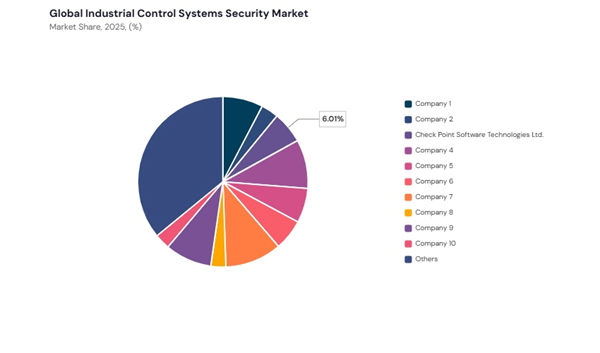
The Industrial Control Systems Security Market demonstrates a moderately consolidated competitive structure with several global cybersecurity and industrial automation companies accounting for a significant portion of total market revenue. Siemens AG emerged as one of the leading players in the market, accounting for approximately 11.8% market share in 2025, supported by its extensive industrial automation portfolio, integrated cybersecurity solutions, and strong presence across manufacturing and critical infrastructure industries. Companies such as Honeywell International Inc., Schneider Electric SE, ABB Ltd., Fortinet, Inc., and Palo Alto Networks, Inc. also maintain strong market positions through continuous investments in AI-enabled threat intelligence, OT security platforms, and industrial network protection solutions.


Market participants are increasingly focusing on strengthening interoperability between IT and OT environments, expanding cloud-based industrial monitoring capabilities, and enhancing real-time threat detection technologies to improve operational resilience. Strategic collaborations, acquisitions, and expansion of managed security services are further intensifying competition across the market. In addition, mid-tier and niche cybersecurity vendors are gaining traction by offering specialized solutions for industrial protocol security, anomaly detection, vulnerability management, and regulatory compliance support. The competitive landscape is expected to evolve further with increasing adoption of Industry 4.0 technologies, connected industrial systems, and AI-driven cybersecurity frameworks across critical infrastructure sectors.

Component Outlook

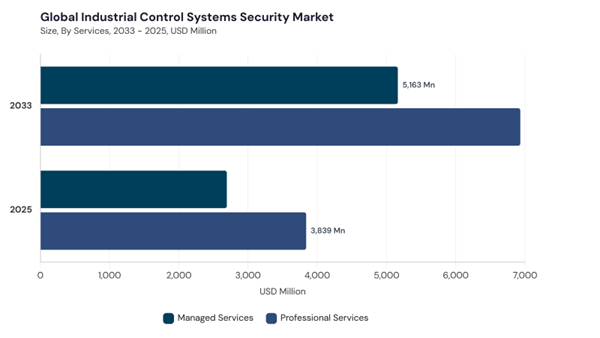
On the basis of component, the Industrial Control Systems Security market is classified into Solution and Services. The Solution segment acquired the largest revenue share in the market in 2025. The increasing need for advanced cybersecurity tools such as firewalls, intrusion detection systems, SIEM platforms, and encryption solutions to protect industrial infrastructure from sophisticated cyber threats is driving the growth of this segment. Organizations across manufacturing, energy, and transportation sectors are increasingly investing in integrated security solutions to strengthen operational resilience.

Security Type Outlook

Based on security type, the Industrial Control Systems Security market is classified into Network, Endpoint, Application, and Database. The Network segment dominated the market in 2025 owing to the growing need to secure industrial communication networks and protect operational technology systems from cyberattacks. Rising deployment of connected industrial devices and increasing integration of IT and OT systems are further driving demand for network security solutions across industrial environments.

End-use Outlook

By end use, the Industrial Control Systems Security market is divided into Energy & Utilities, Manufacturing, Transportation Systems, Power, Automotive, and Other End Use. The Energy & Utilities segment acquired the largest revenue share in the market in 2025. Critical infrastructure facilities such as power grids, oil & gas facilities, and utility networks are increasingly vulnerable to cyber threats, driving substantial investments in industrial cybersecurity solutions to ensure operational continuity and infrastructure protection.

Regional Outlook

Region-wise, the Industrial Control Systems Security Market is analyzed across North America, Europe, Asia Pacific, and LAMEA. The North America segment recorded the largest revenue share in the market in 2025. The dominance of the region is driven by advanced industrial infrastructure, early adoption of digital technologies, strong regulatory frameworks, and increasing cybersecurity investments across critical infrastructure sectors including manufacturing, utilities, and transportation.


Europe continues to witness strong market growth supported by stringent cybersecurity regulations and growing investments in industrial automation security. Meanwhile, Asia Pacific is emerging as a fast-growing region due to rapid industrialization, expansion of manufacturing capabilities, and increasing adoption of Industry 4.0 technologies across countries such as China, India, and Japan.

Market Competition and Attributes

The Industrial Control Systems Security market is highly competitive and characterized by increasing adoption of AI-powered threat detection, automation, and integrated IT-OT cybersecurity frameworks. Vendors are differentiating themselves through advanced industrial monitoring capabilities, real-time anomaly detection, and scalable cybersecurity architectures designed specifically for operational technology environments.

Strategic partnerships between cybersecurity providers, industrial automation companies, and cloud platform vendors are strengthening integrated security ecosystems across industrial sectors. Flexible deployment models, cloud-enabled industrial monitoring, and interoperability with legacy infrastructure are also becoming important competitive differentiators influencing customer adoption decisions.
Recent Strategies Deployed in the Market

  • Feb-2025: Fortinet, Inc. expanded its OT security portfolio with enhanced AI-powered industrial threat detection capabilities to strengthen critical infrastructure cybersecurity.
  • Nov-2024: Honeywell International Inc. introduced an advanced industrial cybersecurity platform integrating real-time monitoring and automated incident response technologies.
  • Aug-2024: Siemens AG expanded cybersecurity solutions for industrial automation systems with enhanced zero-trust security capabilities.
  • May-2024: Schneider Electric SE strengthened its partnership ecosystem to improve OT cybersecurity interoperability and cloud-based industrial monitoring.
  • Jan-2024: ABB Ltd. enhanced its industrial cybersecurity services portfolio focusing on secure remote operations and infrastructure resilience.

List of Key Companies Profiled

  • Siemens AG
  • Honeywell International Inc.
  • Schneider Electric SE
  • ABB Ltd.
  • Fortinet, Inc.
  • Palo Alto Networks, Inc.
  • Cisco Systems, Inc.
  • Check Point Software Technologies Ltd.
  • Broadcom Inc.
  • Microsoft Corporation

Market Report Segmentation

By Component
  • Solution
    • Firewall
    • IAM
    • IDS/IPS
    • Anti-malware/Antivirus
    • Security & Vulnerability Management
    • SIEM
    • Encryption
    • DDoS
    • Other Solution

  • Services
    • Professional Services
    • Managed Services
By Security Type
  • Network
  • Endpoint
  • Application
  • Database
By End Use
  • Energy & Utilities
  • Manufacturing
  • Transportation Systems
  • Power
  • Automotive
  • Other End Use
By Geography
  • North America
    • US
    • Canada
    • Mexico
    • Rest of North America

  • Europe
    • Germany
    • UK
    • France
    • Russia
    • Spain
    • Italy
    • Rest of Europe

  • Asia Pacific
    • China
    • Japan
    • India
    • South Korea
    • Singapore
    • Malaysia
    • Rest of Asia Pacific

  • LAMEA
    • Brazil
    • Argentina
    • UAE
    • Saudi Arabia
    • South Africa
    • Nigeria
    • Rest of LAMEA

Table of Contents

Chapter 1. Global Market Overview
1.1 COVID-19 Impact
1.2 Market Composition and Scenario
Chapter 2. Key Factors Impacting Market
2.1 Market Drivers
2.2 Market Restraints
2.3 Market Opportunities
2.4 Market Challenges
2.5 Market Trends
2.6 State of Competition
2.7 Market Consolidation
2.8 Key Customer Criteria
Chapter 3. Product Life CycleChapter 4. Value Chain Analysis of Industrial Control Systems Security Market
Chapter 5. Competition Analysis - Global
5.1 The Cardinal Matrix
5.2 Recent Industry Wide Strategic Developments
5.3 Product Launches and Product Expansions
5.4 Acquisition and Mergers
5.5 Market Share Analysis
5.6 Top Winning Strategies
5.6.1 Key Leading Strategies: Percentage Distribution (2020-2024)
5.6.2 Key Strategic Move: (Mergers & Acquisition: 2023, Jul - 2025, Feb) Leading Players
Chapter 6. Segmentation By Component
6.1 Solution
6.1.1 Anti-malware/Antivirus
6.1.2 Firewall
6.1.3 Encryption
6.1.4 Identity and Access Management (IAM)
6.1.5 Security and Vulnerability Management
6.1.6 Security Information and Event Management (SIEM)
6.1.7 Distributed Denial-of-Service (DDoS)
6.1.8 Intrusion Detection Systems (IDS)/Intrusion Prevention Systems (IPS)
6.1.9 Other Solution
6.2 Services
6.2.1 Professional Services
6.2.2 Managed Services
Chapter 7. Segmentation By Security Type
7.1 Network
7.2 Endpoint
7.3 Application
7.4 Database
Chapter 8. Segmentation By End Use
8.1 Energy & Utilities
8.2 Manufacturing
8.3 Power
8.4 Transportation Systems
8.5 Automotive
8.6 Other End Use
Chapter 9. North America Market
9.1 Market Overview
9.2 Key Factors Impacting Market
9.2.1 Market Drivers
9.2.2 Market Restraints
9.2.3 Market Opportunities
9.2.4 Market Challenges
9.2.5 Market Trends
9.2.6 State of Competition
9.2.7 Market Consolidation
9.2.8 Key Customer Criteria
9.3 Product Life Cycle
9.4 Segmentation By Component
9.4.1 Solution
9.4.1.1 Anti-malware/Antivirus
9.4.1.2 Firewall
9.4.1.3 Encryption
9.4.1.4 Identity and Access Management (IAM)
9.4.1.5 Security and Vulnerability Management
9.4.1.6 Security Information and Event Management (SIEM)
9.4.1.7 Distributed Denial-of-Service (DDoS)
9.4.1.8 Intrusion Detection Systems (IDS)/Intrusion Prevention Systems (IPS)
9.4.1.9 Other Solution
9.4.2 Services
9.4.2.1 Professional Services
9.4.2.2 Managed Services
9.5 Segmentation By Security Type
9.5.1 Network
9.5.2 Endpoint
9.5.3 Application
9.5.4 Database
9.6 Segmentation By End Use
9.6.1 Energy & Utilities
9.6.2 Manufacturing
9.6.3 Power
9.6.4 Transportation Systems
9.6.5 Automotive
9.6.6 Other End Use
9.7 Segmentation By Country
9.7.1 United States
9.7.1.1 Segmentation By Component
9.7.1.1.1 Solution
9.7.1.1.1.1 Anti-malware/Antivirus
9.7.1.1.1.2 Firewall
9.7.1.1.1.3 Encryption
9.7.1.1.1.4 Identity and Access Management (IAM)
9.7.1.1.1.5 Security and Vulnerability Management
9.7.1.1.1.6 Security Information and Event Management (SIEM)
9.7.1.1.1.7 Distributed Denial-of-Service (DDoS)
9.7.1.1.1.8 Intrusion Detection Systems (IDS)/Intrusion Prevention Systems (IPS)
9.7.1.1.1.9 Other Solution
9.7.1.2 Services
9.7.1.2.1.1 Professional Services
9.7.1.2.1.2 Managed Services
9.7.1.3 Segmentation By Security Type
9.7.1.3.1 Network
9.7.1.3.2 Endpoint
9.7.1.3.3 Application
9.7.1.3.4 Database
9.7.1.4 Segmentation By End Use
9.7.1.4.1 Energy & Utilities
9.7.1.4.2 Manufacturing
9.7.1.4.3 Power
9.7.1.4.4 Transportation Systems
9.7.1.4.5 Automotive
9.7.1.4.6 Other End Use
9.7.2 Canada
9.7.2.1 Segmentation By Component
9.7.2.1.1 Solution
9.7.2.1.1.1 Anti-malware/Antivirus
9.7.2.1.1.2 Firewall
9.7.2.1.1.3 Encryption
9.7.2.1.1.4 Identity and Access Management (IAM)
9.7.2.1.1.5 Security and Vulnerability Management
9.7.2.1.1.6 Security Information and Event Management (SIEM)
9.7.2.1.1.7 Distributed Denial-of-Service (DDoS)
9.7.2.1.1.8 Intrusion Detection Systems (IDS)/Intrusion Prevention Systems (IPS)
9.7.2.1.1.9 Other Solution
9.7.2.2 Services
9.7.2.2.1.1 Professional Services
9.7.2.2.1.2 Managed Services
9.7.2.3 Segmentation By Security Type
9.7.2.3.1 Network
9.7.2.3.2 Endpoint
9.7.2.3.3 Application
9.7.2.3.4 Database
9.7.2.4 Segmentation By End Use
9.7.2.4.1 Energy & Utilities
9.7.2.4.2 Manufacturing
9.7.2.4.3 Power
9.7.2.4.4 Transportation Systems
9.7.2.4.5 Automotive
9.7.2.4.6 Other End Use
9.7.3 Mexico
9.7.3.1 Segmentation By Component
9.7.3.1.1 Solution
9.7.3.1.1.1 Anti-malware/Antivirus
9.7.3.1.1.2 Firewall
9.7.3.1.1.3 Encryption
9.7.3.1.1.4 Identity and Access Management (IAM)
9.7.3.1.1.5 Security and Vulnerability Management
9.7.3.1.1.6 Security Information and Event Management (SIEM)
9.7.3.1.1.7 Distributed Denial-of-Service (DDoS)
9.7.3.1.1.8 Intrusion Detection Systems (IDS)/Intrusion Prevention Systems (IPS)
9.7.3.1.1.9 Other Solution
9.7.3.2 Services
9.7.3.2.1.1 Professional Services
9.7.3.2.1.2 Managed Services
9.7.3.3 Segmentation By Security Type
9.7.3.3.1 Network
9.7.3.3.2 Endpoint
9.7.3.3.3 Application
9.7.3.3.4 Database
9.7.3.4 Segmentation By End Use
9.7.3.4.1 Energy & Utilities
9.7.3.4.2 Manufacturing
9.7.3.4.3 Power
9.7.3.4.4 Transportation Systems
9.7.3.4.5 Automotive
9.7.3.4.6 Other End Use
9.7.4 Rest of North America
9.7.4.1 Segmentation By Component
9.7.4.1.1 Solution
9.7.4.1.1.1 Anti-malware/Antivirus
9.7.4.1.1.2 Firewall
9.7.4.1.1.3 Encryption
9.7.4.1.1.4 Identity and Access Management (IAM)
9.7.4.1.1.5 Security and Vulnerability Management
9.7.4.1.1.6 Security Information and Event Management (SIEM)
9.7.4.1.1.7 Distributed Denial-of-Service (DDoS)
9.7.4.1.1.8 Intrusion Detection Systems (IDS)/Intrusion Prevention Systems (IPS)
9.7.4.1.1.9 Other Solution
9.7.4.2 Services
9.7.4.2.1.1 Professional Services
9.7.4.2.1.2 Managed Services
9.7.4.3 Segmentation By Security Type
9.7.4.3.1 Network
9.7.4.3.2 Endpoint
9.7.4.3.3 Application
9.7.4.3.4 Database
9.7.4.4 Segmentation By End Use
9.7.4.4.1 Energy & Utilities
9.7.4.4.2 Manufacturing
9.7.4.4.3 Power
9.7.4.4.4 Transportation Systems
9.7.4.4.5 Automotive
9.7.4.4.6 Other End Use
Chapter 10. Europe Market
10.1 Market Overview
10.2 Key Factors Impacting Market
10.2.1 Market Drivers
10.2.2 Market Restraints
10.2.3 Market Opportunities
10.2.4 Market Challenges
10.2.5 Market Trends
10.2.6 State of Competition
10.2.7 Market Consolidation
10.2.8 Key Customer Criteria
10.3 Product Life Cycle
10.4 Segmentation By Component
10.4.1 Solution
10.4.1.1 Anti-malware/Antivirus
10.4.1.2 Firewall
10.4.1.3 Encryption
10.4.1.4 Identity and Access Management (IAM)
10.4.1.5 Security and Vulnerability Management
10.4.1.6 Security Information and Event Management (SIEM)
10.4.1.7 Distributed Denial-of-Service (DDoS)
10.4.1.8 Intrusion Detection Systems (IDS)/Intrusion Prevention Systems (IPS)
10.4.1.9 Other Solution
10.4.2 Services
10.4.2.1 Professional Services
10.4.2.2 Managed Services
10.5 Segmentation By Security Type
10.5.1 Network
10.5.2 Endpoint
10.5.3 Application
10.5.4 Database
10.6 Segmentation By End Use
10.6.1 Energy & Utilities
10.6.2 Manufacturing
10.6.3 Transportation Systems
10.6.4 Power
10.6.5 Automotive
10.6.6 Other End Use
10.7 Segmentation By Country
10.7.1 Germany
10.7.1.1 Segmentation By Component
10.7.1.1.1 Solution
10.7.1.1.1.1 Anti-malware/Antivirus
10.7.1.1.1.2 Firewall
10.7.1.1.1.3 Encryption
10.7.1.1.1.4 Identity and Access Management (IAM)
10.7.1.1.1.5 Security and Vulnerability Management
10.7.1.1.1.6 Security Information and Event Management (SIEM)
10.7.1.1.1.7 Distributed Denial-of-Service (DDoS)
10.7.1.1.1.8 Intrusion Detection Systems (IDS)/Intrusion Prevention Systems (IPS)
10.7.1.1.1.9 Other Solution
10.7.1.2 Services
10.7.1.2.1.1 Professional Services
10.7.1.2.1.2 Managed Services
10.7.1.3 Segmentation By Security Type
10.7.1.3.1 Network
10.7.1.3.2 Endpoint
10.7.1.3.3 Application
10.7.1.3.4 Database
10.7.1.4 Segmentation By End Use
10.7.1.4.1 Energy & Utilities
10.7.1.4.2 Manufacturing
10.7.1.4.3 Power
10.7.1.4.4 Transportation Systems
10.7.1.4.5 Automotive
10.7.1.4.6 Other End Use
10.7.2 United Kingdom
10.7.2.1 Segmentation By Component
10.7.2.1.1 Solution
10.7.2.1.1.1 Anti-malware/Antivirus
10.7.2.1.1.2 Firewall
10.7.2.1.1.3 Encryption
10.7.2.1.1.4 Identity and Access Management (IAM)
10.7.2.1.1.5 Security and Vulnerability Management
10.7.2.1.1.6 Security Information and Event Management (SIEM)
10.7.2.1.1.7 Distributed Denial-of-Service (DDoS)
10.7.2.1.1.8 Intrusion Detection Systems (IDS)/Intrusion Prevention Systems (IPS)
10.7.2.1.1.9 Other Solution
10.7.2.2 Services
10.7.2.2.1.1 Professional Services
10.7.2.2.1.2 Managed Services
10.7.2.3 Segmentation By Security Type
10.7.2.3.1 Network
10.7.2.3.2 Endpoint
10.7.2.3.3 Application
10.7.2.3.4 Database
10.7.2.4 Segmentation By End Use
10.7.2.4.1 Energy & Utilities
10.7.2.4.2 Manufacturing
10.7.2.4.3 Power
10.7.2.4.4 Transportation Systems
10.7.2.4.5 Automotive
10.7.2.4.6 Other End Use
10.7.3 France
10.7.3.1 Segmentation By Component
10.7.3.1.1 Solution
10.7.3.1.1.1 Anti-malware/Antivirus
10.7.3.1.1.2 Firewall
10.7.3.1.1.3 Encryption
10.7.3.1.1.4 Identity and Access Management (IAM)
10.7.3.1.1.5 Security and Vulnerability Management
10.7.3.1.1.6 Security Information and Event Management (SIEM)
10.7.3.1.1.7 Distributed Denial-of-Service (DDoS)
10.7.3.1.1.8 Intrusion Detection Systems (IDS)/Intrusion Prevention Systems (IPS)
10.7.3.1.1.9 Other Solution
10.7.3.2 Services
10.7.3.2.1.1 Professional Services
10.7.3.2.1.2 Managed Services
10.7.3.3 Segmentation By Security Type
10.7.3.3.1 Network
10.7.3.3.2 Endpoint
10.7.3.3.3 Application
10.7.3.3.4 Database
10.7.3.4 Segmentation By End Use
10.7.3.4.1 Energy & Utilities
10.7.3.4.2 Manufacturing
10.7.3.4.3 Power
10.7.3.4.4 Transportation Systems
10.7.3.4.5 Automotive
10.7.3.4.6 Other End Use
10.7.4 Russia
10.7.4.1 Segmentation By Component
10.7.4.1.1 Solution
10.7.4.1.1.1 Anti-malware/Antivirus
10.7.4.1.1.2 Firewall
10.7.4.1.1.3 Encryption
10.7.4.1.1.4 Identity and Access Management (IAM)
10.7.4.1.1.5 Security and Vulnerability Management
10.7.4.1.1.6 Security Information and Event Management (SIEM)
10.7.4.1.1.7 Distributed Denial-of-Service (DDoS)
10.7.4.1.1.8 Intrusion Detection Systems (IDS)/Intrusion Prevention Systems (IPS)
10.7.4.1.1.9 Other Solution
10.7.4.2 Services
10.7.4.2.1.1 Professional Services
10.7.4.2.1.2 Managed Services
10.7.4.3 Segmentation By Security Type
10.7.4.3.1 Network
10.7.4.3.2 Endpoint
10.7.4.3.3 Application
10.7.4.3.4 Database
10.7.4.4 Segmentation By End Use
10.7.4.4.1 Energy & Utilities
10.7.4.4.2 Manufacturing
10.7.4.4.3 Power
10.7.4.4.4 Transportation Systems
10.7.4.4.5 Automotive
10.7.4.4.6 Other End Use
10.7.5 Spain
10.7.5.1 Segmentation By Component
10.7.5.1.1 Solution
10.7.5.1.1.1 Anti-malware/Antivirus
10.7.5.1.1.2 Firewall
10.7.5.1.1.3 Encryption
10.7.5.1.1.4 Identity and Access Management (IAM)
10.7.5.1.1.5 Security and Vulnerability Management
10.7.5.1.1.6 Security Information and Event Management (SIEM)
10.7.5.1.1.7 Distributed Denial-of-Service (DDoS)
10.7.5.1.1.8 Intrusion Detection Systems (IDS)/Intrusion Prevention Systems (IPS)
10.7.5.1.1.9 Other Solution
10.7.5.2 Services
10.7.5.2.1.1 Professional Services
10.7.5.2.1.2 Managed Services
10.7.5.3 Segmentation By Security Type
10.7.5.3.1 Network
10.7.5.3.2 Endpoint
10.7.5.3.3 Application
10.7.5.3.4 Database
10.7.5.4 Segmentation By End Use
10.7.5.4.1 Energy & Utilities
10.7.5.4.2 Manufacturing
10.7.5.4.3 Power
10.7.5.4.4 Transportation Systems
10.7.5.4.5 Automotive
10.7.5.4.6 Other End Use
10.7.6 Italy
10.7.6.1 Segmentation By Component
10.7.6.1.1 Solution
10.7.6.1.1.1 Anti-malware/Antivirus
10.7.6.1.1.2 Firewall
10.7.6.1.1.3 Encryption
10.7.6.1.1.4 Identity and Access Management (IAM)
10.7.6.1.1.5 Security and Vulnerability Management
10.7.6.1.1.6 Security Information and Event Management (SIEM)
10.7.6.1.1.7 Distributed Denial-of-Service (DDoS)
10.7.6.1.1.8 Intrusion Detection Systems (IDS)/Intrusion Prevention Systems (IPS)
10.7.6.1.1.9 Other Solution
10.7.6.2 Services
10.7.6.2.1.1 Professional Services
10.7.6.2.1.2 Managed Services
10.7.6.3 Segmentation By Security Type
10.7.6.3.1 Network
10.7.6.3.2 Endpoint
10.7.6.3.3 Application
10.7.6.3.4 Database
10.7.6.4 Segmentation By End Use
10.7.6.4.1 Energy & Utilities
10.7.6.4.2 Manufacturing
10.7.6.4.3 Power
10.7.6.4.4 Transportation Systems
10.7.6.4.5 Automotive
10.7.6.4.6 Other End Use
10.7.7 Rest of Europe
10.7.7.1 Segmentation By Component
10.7.7.1.1 Solution
10.7.7.1.1.1 Anti-malware/Antivirus
10.7.7.1.1.2 Firewall
10.7.7.1.1.3 Encryption
10.7.7.1.1.4 Identity and Access Management (IAM)
10.7.7.1.1.5 Security and Vulnerability Management
10.7.7.1.1.6 Security Information and Event Management (SIEM)
10.7.7.1.1.7 Distributed Denial-of-Service (DDoS)
10.7.7.1.1.8 Intrusion Detection Systems (IDS)/Intrusion Prevention Systems (IPS)
10.7.7.1.1.9 Other Solution
10.7.7.2 Services
10.7.7.2.1.1 Professional Services
10.7.7.2.1.2 Managed Services
10.7.7.3 Segmentation By Security Type
10.7.7.3.1 Network
10.7.7.3.2 Endpoint
10.7.7.3.3 Application
10.7.7.3.4 Database
10.7.7.4 Segmentation By End Use
10.7.7.4.1 Energy & Utilities
10.7.7.4.2 Manufacturing
10.7.7.4.3 Power
10.7.7.4.4 Transportation Systems
10.7.7.4.5 Automotive
10.7.7.4.6 Other End Use
Chapter 11. Asia Pacific Market
11.1 Market Overview
11.2 Key Factors Impacting Market
11.2.1 Market Drivers
11.2.2 Market Restraints
11.2.3 Market Opportunities
11.2.4 Market Challenges
11.2.5 Market Trends
11.2.6 State of Competition
11.2.7 Market Consolidation
11.2.8 Key Customer Criteria
11.3 Product Life Cycle
11.4 Segmentation By Component
11.4.1 Solutions
11.4.1.1 Anti-malware/Antivirus
11.4.1.2 Firewall
11.4.1.3 Encryption
11.4.1.4 Identity and Access Management (IAM)
11.4.1.5 Security and Vulnerability Management
11.4.1.6 Security Information and Event Management (SIEM)
11.4.1.7 Distributed Denial-of-Service (DDoS)
11.4.1.8 Intrusion Detection Systems (IDS)/Intrusion Prevention Systems (IPS)
11.4.1.9 Other Solution
11.4.2 Services
11.4.2.1 Professional Services
11.4.2.2 Managed Services
11.5 Segmentation By Security Type
11.5.1 Network
11.5.2 Endpoint
11.5.3 Database
11.5.4 Application
11.6 Segmentation By End Use
11.6.1 Energy & Utilities
11.6.2 Manufacturing
11.6.3 Power
11.6.4 Transportation Systems
11.6.5 Automotive
11.6.6 Other End Use
11.7 Segmentation By Country
11.7.1 China
11.7.1.1 Segmentation By Component
11.7.1.1.1 Solution
11.7.1.1.1.1 Anti-malware/Antivirus
11.7.1.1.1.2 Firewall
11.7.1.1.1.3 Encryption
11.7.1.1.1.4 Identity and Access Management (IAM)
11.7.1.1.1.5 Security and Vulnerability Management
11.7.1.1.1.6 Security Information and Event Management (SIEM)
11.7.1.1.1.7 Distributed Denial-of-Service (DDoS)
11.7.1.1.1.8 Intrusion Detection Systems (IDS)/Intrusion Prevention Systems (IPS)
11.7.1.1.1.9 Other Solution
11.7.1.2 Services
11.7.1.2.1.1 Professional Services
11.7.1.2.1.2 Managed Services
11.7.1.3 Segmentation By Security Type
11.7.1.3.1 Network
11.7.1.3.2 Endpoint
11.7.1.3.3 Application
11.7.1.3.4 Database
11.7.1.4 Segmentation By End Use
11.7.1.4.1 Energy & Utilities
11.7.1.4.2 Manufacturing
11.7.1.4.3 Power
11.7.1.4.4 Transportation Systems
11.7.1.4.5 Automotive
11.7.1.4.6 Other End Use
11.7.2 Japan
11.7.2.1 Segmentation By Component
11.7.2.1.1 Solution
11.7.2.1.1.1 Anti-malware/Antivirus
11.7.2.1.1.2 Firewall
11.7.2.1.1.3 Encryption
11.7.2.1.1.4 Identity and Access Management (IAM)
11.7.2.1.1.5 Security and Vulnerability Management
11.7.2.1.1.6 Security Information and Event Management (SIEM)
11.7.2.1.1.7 Distributed Denial-of-Service (DDoS)
11.7.2.1.1.8 Intrusion Detection Systems (IDS)/Intrusion Prevention Systems (IPS)
11.7.2.1.1.9 Other Solution
11.7.2.2 Services
11.7.2.2.1.1 Professional Services
11.7.2.2.1.2 Managed Services
11.7.2.3 Segmentation By Security Type
11.7.2.3.1 Network
11.7.2.3.2 Endpoint
11.7.2.3.3 Application
11.7.2.3.4 Database
11.7.2.4 Segmentation By End Use
11.7.2.4.1 Energy & Utilities
11.7.2.4.2 Manufacturing
11.7.2.4.3 Power
11.7.2.4.4 Transportation Systems
11.7.2.4.5 Automotive
11.7.2.4.6 Other End Use
11.7.3 India
11.7.3.1 Segmentation By Component
11.7.3.1.1 Solution
11.7.3.1.1.1 Anti-malware/Antivirus
11.7.3.1.1.2 Firewall
11.7.3.1.1.3 Encryption
11.7.3.1.1.4 Identity and Access Management (IAM)
11.7.3.1.1.5 Security and Vulnerability Management
11.7.3.1.1.6 Security Information and Event Management (SIEM)
11.7.3.1.1.7 Distributed Denial-of-Service (DDoS)
11.7.3.1.1.8 Intrusion Detection Systems (IDS)/Intrusion Prevention Systems (IPS)
11.7.3.1.1.9 Other Solution
11.7.3.2 Services
11.7.3.2.1.1 Professional Services
11.7.3.2.1.2 Managed Services
11.7.3.3 Segmentation By Security Type
11.7.3.3.1 Network
11.7.3.3.2 Endpoint
11.7.3.3.3 Application
11.7.3.3.4 Database
11.7.3.4 Segmentation By End Use
11.7.3.4.1 Energy & Utilities
11.7.3.4.2 Manufacturing
11.7.3.4.3 Power
11.7.3.4.4 Transportation Systems
11.7.3.4.5 Automotive
11.7.3.4.6 Other End Use
11.7.4 South Korea
11.7.4.1 Segmentation By Component
11.7.4.1.1 Solution
11.7.4.1.1.1 Anti-malware/Antivirus
11.7.4.1.1.2 Firewall
11.7.4.1.1.3 Encryption
11.7.4.1.1.4 Identity and Access Management (IAM)
11.7.4.1.1.5 Security and Vulnerability Management
11.7.4.1.1.6 Security Information and Event Management (SIEM)
11.7.4.1.1.7 Distributed Denial-of-Service (DDoS)
11.7.4.1.1.8 Intrusion Detection Systems (IDS)/Intrusion Prevention Systems (IPS)
11.7.4.1.1.9 Other Solution
11.7.4.2 Services
11.7.4.2.1.1 Professional Services
11.7.4.2.1.2 Managed Services
11.7.4.3 Segmentation By Security Type
11.7.4.3.1 Network
11.7.4.3.2 Endpoint
11.7.4.3.3 Application
11.7.4.3.4 Database
11.7.4.4 Segmentation By End Use
11.7.4.4.1 Energy & Utilities
11.7.4.4.2 Manufacturing
11.7.4.4.3 Power
11.7.4.4.4 Transportation Systems
11.7.4.4.5 Automotive
11.7.4.4.6 Other End Use
11.7.5 Singapore
11.7.5.1 Segmentation By Component
11.7.5.1.1 Solution
11.7.5.1.1.1 Anti-malware/Antivirus
11.7.5.1.1.2 Firewall
11.7.5.1.1.3 Encryption
11.7.5.1.1.4 Identity and Access Management (IAM)
11.7.5.1.1.5 Security and Vulnerability Management
11.7.5.1.1.6 Security Information and Event Management (SIEM)
11.7.5.1.1.7 Distributed Denial-of-Service (DDoS)
11.7.5.1.1.8 Intrusion Detection Systems (IDS)/Intrusion Prevention Systems (IPS)
11.7.5.1.1.9 Other Solution
11.7.5.2 Services
11.7.5.2.1.1 Professional Services
11.7.5.2.1.2 Managed Services
11.7.5.3 Segmentation By Security Type
11.7.5.3.1 Network
11.7.5.3.2 Endpoint
11.7.5.3.3 Application
11.7.5.3.4 Database
11.7.5.4 Segmentation By End Use
11.7.5.4.1 Energy & Utilities
11.7.5.4.2 Manufacturing
11.7.5.4.3 Power
11.7.5.4.4 Transportation Systems
11.7.5.4.5 Automotive
11.7.5.4.6 Other End Use
11.7.6 Malaysia
11.7.6.1 Segmentation By Component
11.7.6.1.1 Solution
11.7.6.1.1.1 Anti-malware/Antivirus
11.7.6.1.1.2 Firewall
11.7.6.1.1.3 Encryption
11.7.6.1.1.4 Identity and Access Management (IAM)
11.7.6.1.1.5 Security and Vulnerability Management
11.7.6.1.1.6 Security Information and Event Management (SIEM)
11.7.6.1.1.7 Distributed Denial-of-Service (DDoS)
11.7.6.1.1.8 Intrusion Detection Systems (IDS)/Intrusion Prevention Systems (IPS)
11.7.6.1.1.9 Other Solution
11.7.6.2 Services
11.7.6.2.1.1 Professional Services
11.7.6.2.1.2 Managed Services
11.7.6.3 Segmentation By Security Type
11.7.6.3.1 Network
11.7.6.3.2 Endpoint
11.7.6.3.3 Application
11.7.6.3.4 Database
11.7.6.4 Segmentation By End Use
11.7.6.4.1 Energy & Utilities
11.7.6.4.2 Manufacturing
11.7.6.4.3 Power
11.7.6.4.4 Transportation Systems
11.7.6.4.5 Automotive
11.7.6.4.6 Other End Use
11.7.7 Rest of Asia Pacific
11.7.7.1 Segmentation By Component
11.7.7.1.1 Solution
11.7.7.1.1.1 Anti-malware/Antivirus
11.7.7.1.1.2 Firewall
11.7.7.1.1.3 Encryption
11.7.7.1.1.4 Identity and Access Management (IAM)
11.7.7.1.1.5 Security and Vulnerability Management
11.7.7.1.1.6 Security Information and Event Management (SIEM)
11.7.7.1.1.7 Distributed Denial-of-Service (DDoS)
11.7.7.1.1.8 Intrusion Detection Systems (IDS)/Intrusion Prevention Systems (IPS)
11.7.7.1.1.9 Other Solution
11.7.7.2 Services
11.7.7.2.1.1 Professional Services
11.7.7.2.1.2 Managed Services
11.7.7.3 Segmentation By Security Type
11.7.7.3.1 Network
11.7.7.3.2 Endpoint
11.7.7.3.3 Application
11.7.7.3.4 Database
11.7.7.4 Segmentation By End Use
11.7.7.4.1 Energy & Utilities
11.7.7.4.2 Manufacturing
11.7.7.4.3 Power
11.7.7.4.4 Transportation Systems
11.7.7.4.5 Automotive
11.7.7.4.6 Other End Use
Chapter 12. LAMEA MARKET
12.1 Market Overview
12.2 Key Factors Impacting Market
12.2.1 Market Drivers
12.2.2 Market Restraints
12.2.3 Market Opportunities
12.2.4 Market Challenges
12.2.5 Market Trends
12.2.6 State of Competition
12.2.7 Market Consolidation
12.2.8 Key Customer Criteria
12.3 Product Life Cycle
12.4 Segmentation By Component
12.4.1 Solution
12.4.1.1 Anti-malware/Antivirus
12.4.1.2 Firewall
12.4.1.3 Encryption
12.4.1.4 Identity and Access Management (IAM)
12.4.1.5 Security and Vulnerability Management
12.4.1.6 Security Information and Event Management (SIEM)
12.4.1.7 Distributed Denial-of-Service (DDoS)
12.4.1.8 Intrusion Detection Systems (IDS)/Intrusion Prevention System (IPS)
12.4.1.9 Other Solution
12.4.2 Services
12.4.2.1 Professional Services
12.4.2.2 Managed Services
12.5 Segmentation By Security Type
12.5.1 Network
12.5.2 Endpoint
12.5.3 Application
12.5.4 Database
12.6 Segmentation By End Use
12.6.1 Energy & Utilities
12.6.2 Manufacturing
12.6.3 Power
12.6.4 Transportation Systems
12.6.5 Automotive
12.6.6 Other End Use
12.7 Segmentation By Country
12.7.1 Brazil
12.7.1.1 Segmentation By Component
12.7.1.1.1 Solution
12.7.1.1.1.1 Anti-malware/Antivirus
12.7.1.1.1.2 Firewall
12.7.1.1.1.3 Encryption
12.7.1.1.1.4 Identity and Access Management (IAM)
12.7.1.1.1.5 Security and Vulnerability Management
12.7.1.1.1.6 Security Information and Event Management (SIEM)
12.7.1.1.1.7 Distributed Denial-of-Service (DDoS)
12.7.1.1.1.8 Intrusion Detection Systems (IDS)/Intrusion Prevention Systems (IPS)
12.7.1.1.1.9 Other Solution
12.7.1.2 Services
12.7.1.2.1.1 Professional Services
12.7.1.2.1.2 Managed Services
12.7.1.3 Segmentation By Security Type
12.7.1.3.1 Network
12.7.1.3.2 Endpoint
12.7.1.3.3 Application
12.7.1.3.4 Database
12.7.1.4 Segmentation By End Use
12.7.1.4.1 Energy & Utilities
12.7.1.4.2 Manufacturing
12.7.1.4.3 Power
12.7.1.4.4 Transportation Systems
12.7.1.4.5 Automotive
12.7.1.4.6 Other End Use
12.7.2 Argentina
12.7.2.1 Segmentation By Component
12.7.2.1.1 Solution
12.7.2.1.1.1 Anti-malware/Antivirus
12.7.2.1.1.2 Firewall
12.7.2.1.1.3 Encryption
12.7.2.1.1.4 Identity and Access Management (IAM)
12.7.2.1.1.5 Security and Vulnerability Management
12.7.2.1.1.6 Security Information and Event Management (SIEM)
12.7.2.1.1.7 Distributed Denial-of-Service (DDoS)
12.7.2.1.1.8 Intrusion Detection Systems (IDS)/Intrusion Prevention Systems (IPS)
12.7.2.1.1.9 Other Solution
12.7.2.2 Services
12.7.2.2.1.1 Professional Services
12.7.2.2.1.2 Managed Services
12.7.2.3 Segmentation By Security Type
12.7.2.3.1 Network
12.7.2.3.2 Endpoint
12.7.2.3.3 Application
12.7.2.3.4 Database
12.7.2.4 Segmentation By End Use
12.7.2.4.1 Energy & Utilities
12.7.2.4.2 Manufacturing
12.7.2.4.3 Power
12.7.2.4.4 Transportation Systems
12.7.2.4.5 Automotive
12.7.2.4.6 Other End Use
12.7.3 UAE
12.7.3.1 Segmentation By Component
12.7.3.1.1 Solution
12.7.3.1.1.1 Anti-malware/Antivirus
12.7.3.1.1.2 Firewall
12.7.3.1.1.3 Encryption
12.7.3.1.1.4 Identity and Access Management (IAM)
12.7.3.1.1.5 Security and Vulnerability Management
12.7.3.1.1.6 Security Information and Event Management (SIEM)
12.7.3.1.1.7 Distributed Denial-of-Service (DDoS)
12.7.3.1.1.8 Intrusion Detection Systems (IDS)/Intrusion Prevention Systems (IPS)
12.7.3.1.1.9 Other Solution
12.7.3.2 Services
12.7.3.2.1.1 Professional Services
12.7.3.2.1.2 Managed Services
12.7.3.3 Segmentation By Security Type
12.7.3.3.1 Network
12.7.3.3.2 Endpoint
12.7.3.3.3 Application
12.7.3.3.4 Database
12.7.3.4 Segmentation By End Use
12.7.3.4.1 Energy & Utilities
12.7.3.4.2 Manufacturing
12.7.3.4.3 Power
12.7.3.4.4 Transportation Systems
12.7.3.4.5 Automotive
12.7.3.4.6 Other End Use
12.7.4 Saudi Arabia
12.7.4.1 Segmentation By Component
12.7.4.1.1 Solution
12.7.4.1.1.1 Anti-malware/Antivirus
12.7.4.1.1.2 Firewall
12.7.4.1.1.3 Encryption
12.7.4.1.1.4 Identity and Access Management (IAM)
12.7.4.1.1.5 Security and Vulnerability Management
12.7.4.1.1.6 Security Information and Event Management (SIEM)
12.7.4.1.1.7 Distributed Denial-of-Service (DDoS)
12.7.4.1.1.8 Intrusion Detection Systems (IDS)/Intrusion Prevention Systems (IPS)
12.7.4.1.1.9 Other Solution
12.7.4.2 Services
12.7.4.2.1.1 Professional Services
12.7.4.2.1.2 Managed Services
12.7.4.3 Segmentation By Security Type
12.7.4.3.1 Network
12.7.4.3.2 Endpoint
12.7.4.3.3 Application
12.7.4.3.4 Database
12.7.4.4 Segmentation By End Use
12.7.4.4.1 Energy & Utilities
12.7.4.4.2 Manufacturing
12.7.4.4.3 Power
12.7.4.4.4 Transportation Systems
12.7.4.4.5 Automotive
12.7.4.4.6 Other End Use
12.7.5 South Africa
12.7.5.1 Segmentation By Component
12.7.5.1.1 Solution
12.7.5.1.1.1 Anti-malware/Antivirus
12.7.5.1.1.2 Firewall
12.7.5.1.1.3 Encryption
12.7.5.1.1.4 Identity and Access Management (IAM)
12.7.5.1.1.5 Security and Vulnerability Management
12.7.5.1.1.6 Security Information and Event Management (SIEM)
12.7.5.1.1.7 Distributed Denial-of-Service (DDoS)
12.7.5.1.1.8 Intrusion Detection Systems (IDS)/Intrusion Prevention Systems (IPS)
12.7.5.1.1.9 Other Solution
12.7.5.2 Services
12.7.5.2.1.1 Professional Services
12.7.5.2.1.2 Managed Services
12.7.5.3 Segmentation By Security Type
12.7.5.3.1 Network
12.7.5.3.2 Endpoint
12.7.5.3.3 Application
12.7.5.3.4 Database
12.7.5.4 Segmentation By End Use
12.7.5.4.1 Energy & Utilities
12.7.5.4.2 Manufacturing
12.7.5.4.3 Power
12.7.5.4.4 Transportation Systems
12.7.5.4.5 Automotive
12.7.5.4.6 Other End Use
12.7.6 Nigeria
12.7.6.1 Segmentation By Component
12.7.6.1.1 Solution
12.7.6.1.1.1 Anti-malware/Antivirus
12.7.6.1.1.2 Firewall
12.7.6.1.1.3 Encryption
12.7.6.1.1.4 Identity and Access Management (IAM)
12.7.6.1.1.5 Security and Vulnerability Management
12.7.6.1.1.6 Security Information and Event Management (SIEM)
12.7.6.1.1.7 Distributed Denial-of-Service (DDoS)
12.7.6.1.1.8 Intrusion Detection Systems (IDS)/Intrusion Prevention Systems (IPS)
12.7.6.1.1.9 Other Solution
12.7.6.2 Services
12.7.6.2.1.1 Professional Services
12.7.6.2.1.2 Managed Services
12.7.6.3 Segmentation By Security Type
12.7.6.3.1 Network
12.7.6.3.2 Endpoint
12.7.6.3.3 Application
12.7.6.3.4 Database
12.7.6.4 Segmentation By End Use
12.7.6.4.1 Energy & Utilities
12.7.6.4.2 Manufacturing
12.7.6.4.3 Power
12.7.6.4.4 Transportation Systems
12.7.6.4.5 Automotive
12.7.6.4.6 Other End Use
12.7.7 Rest of LAMEA
12.7.7.1 Segmentation By Component
12.7.7.1.1 Solution
12.7.7.1.1.1 Anti-malware/Antivirus
12.7.7.1.1.2 Firewall
12.7.7.1.1.3 Encryption
12.7.7.1.1.4 Identity and Access Management (IAM)
12.7.7.1.1.5 Security and Vulnerability Management
12.7.7.1.1.6 Security Information and Event Management (SIEM)
12.7.7.1.1.7 Distributed Denial-of-Service (DDoS)
12.7.7.1.1.8 Intrusion Detection Systems (IDS)/Intrusion Prevention Systems (IPS)
12.7.7.1.1.9 Other Solution
12.7.7.2 Services
12.7.7.2.1.1 Professional Services
12.7.7.2.1.2 Managed Services
12.7.7.3 Segmentation By Security Type
12.7.7.3.1 Network
12.7.7.3.2 Endpoint
12.7.7.3.3 Application
12.7.7.3.4 Database
12.7.7.4 Segmentation By End Use
12.7.7.4.1 Energy & Utilities
12.7.7.4.2 Manufacturing
12.7.7.4.3 Power
12.7.7.4.4 Transportation Systems
12.7.7.4.5 Automotive
12.7.7.4.6 Other End Use
Chapter 13. Company Profiles
13.1 ABB Ltd.
13.1.1 Company Overview
13.1.2 Recent Strategies and Developments
13.1.2.1 Product Launches and Product Expansions
13.1.3 Company Focus
13.1.13 Strategic Insights
13.1.5 Strategy Deployed
13.1.6 SWOT Analysis
13.1.7 Future Outlook
13.2 Schneider Electric SE
13.2.1 Company Overview
13.2.2 Financial Analysis
13.2.3 Segmental and Regional Analysis
13.2.13 Research & Development Expense
13.2.5 Recent Strategies and Developments
13.2.5.1 Product Launches and Product Expansions
13.2.5.2 Geographical Expansions
13.2.6 Company Focus
13.2.7 Strategic Insights
13.2.8 Strategy Deployed
13.2.9 SWOT Analysis
13.2.10 Future Outlook
13.3 Siemens AG
13.3.1 Company Overview
13.3.2 Financial Analysis
13.3.3 Segmental and Regional Analysis
13.3.13 Research & Development Expense
13.3.5 Recent Strategies and Developments
13.3.5.1 Partnerships, Collaborations, and Agreements
13.3.6 Company Focus
13.3.7 Strategic Insights
13.3.8 Strategy Deployed
13.3.9 SWOT Analysis
13.3.10 Future Outlook
13.13 Eaton Corporation PLC
13.13.1 Company Overview
13.13.2 Financial Analysis
13.13.3 Segmental and Regional Analysis
13.13.13 Research & Development Expense
13.13.5 Company Focus
13.13.6 Strategic Insights
13.13.7 Strategy Deployed
13.13.8 SWOT Analysis
13.13.9 Future Outlook
13.5 Mitsubishi Electric Corporation
13.5.1 Company Overview
13.5.2 Financial Analysis
13.5.3 Segmental and Regional Analysis
13.5.13 Research & Development Expense
13.5.5 Recent Strategies and Developments
13.5.5.1 Partnerships, Collaborations, and Agreements
13.5.5.2 Product Launches and Product Expansions
13.5.6 Company Focus
13.5.7 Strategic Insights
13.5.8 Strategy Deployed
13.5.9 SWOT Analysis
13.5.10 Future Outlook
13.6 Legrand S.A. (Legrand Group)
13.6.1 Company Overview
13.6.2 Financial Analysis
13.6.3 Regional Analysis
13.6.13 Research & Development Expense
13.6.5 Recent Strategies and Developments
13.6.5.1 Product Launches and Product Expansions
13.6.6 Company Focus
13.6.7 Strategic Insights
13.6.8 Strategy Deployed
13.6.9 SWOT Analysis
13.6.10 Future Outlook
13.7 General Electric Company
13.7.1 Company Overview
13.7.2 Company Focus
13.7.3 Strategic Insights
13.7.13 Strategy Deployed
13.7.5 SWOT Analysis
13.7.6 Future Outlook
13.8 Hager Group
13.8.1 Company Overview
13.8.2 Company Focus
13.8.3 Strategic Insights
13.8.13 Strategy Deployed
13.8.5 SWOT Analysis
13.8.6 Future Outlook
13.9 Fuji Electric Co. Ltd.
13.9.1 Company Overview
13.9.2 Financial Analysis
13.9.3 Segmental and Regional Analysis
13.9.13 Research & Development Expense
13.9.5 Company Focus
13.9.6 Strategic Insights
13.9.7 Strategy Deployed
13.9.8 SWOT Analysis
13.9.9 Future Outlook
13.1 CHINT Group Co., Ltd.
13.10.1 Company Overview
13.10.2 Recent Strategies and Developments
13.10.2.1 Partnerships, Collaborations, and Agreements
13.10.2.2 Geographical Expansions
13.10.3 Company Focus
13.10.13 Strategic Insights
13.10.5 Strategy Deployed
13.10.6 SWOT Analysis
13.10.7 Future Outlook
Chapter 14. Winning Imperatives of Industrial Control Systems Security Market

Companies Mentioned

  • Siemens AG
  • Honeywell International Inc.
  • Schneider Electric SE
  • ABB Ltd.
  • Fortinet, Inc.
  • Palo Alto Networks, Inc.
  • Cisco Systems, Inc.
  • Check Point Software Technologies Ltd.
  • Broadcom Inc.
  • Microsoft Corporation