

+353-1-416-8900REST OF WORLD
+44-20-3973-8888REST OF WORLD
1-917-300-0470EAST COAST U.S
1-800-526-8630U.S. (TOLL FREE)

Global SLI Battery Market Size, Share & Industry Analysis Report by Application, Type, Capacity, Regional Outlook and Forecast, 2026-2033

  • PDF Icon

    Report

  • 647 Pages
  • June 2026
  • Marqual IT Solutions Pvt. Ltd (KBV Research)
  • ID: 6276111
The Global SLI Battery Market is expected to reach USD 59.8 Billion by 2033, growing at a CAGR of 2.9% during 2026-2033.


The SLI Battery Market is expanding as automotive manufacturers, fleet operators, aftermarket distributors, and industrial users continue to demand reliable batteries for vehicle starting, lighting, ignition, backup power, and auxiliary electrical functions. Rising vehicle production, replacement battery demand, maintenance-free battery adoption, and advanced lead-acid battery usage are supporting market growth globally. The market originated alongside the early automotive industry, where lead-acid batteries became essential for engine ignition and vehicle electrical support.

Key Market Trends & Insights

  • By application, Automotive dominated the market in 2025 with USD 32.0 Billion and is expected to reach USD 38.4 Billion by 2033, growing at a CAGR of 2.4%.
  • Energy Storage Systems is expected to grow fastest by application, registering a CAGR of 4.6% during 2026-2033, supported by rising backup power, off-grid, and energy reliability applications.
  • By type, Lead-acid Batteries dominated the market in 2025 with USD 42.6 Billion and are projected to reach USD 51.7 Billion by 2033, growing at a CAGR of 2.6%.
  • Polymer Batteries and Nickel-cadmium Batteries are expected to grow fastest by type, each registering a CAGR of 5.7% during 2026-2033, driven by niche industrial, and compact, and specialized battery applications.
  • By capacity, 51-100 Ah dominated the market in 2025 with USD 21.4 Billion and is expected to reach USD 25.4 Billion by 2033, growing at a CAGR of 2.3%.
  • Over 100 Ah is projected to grow fastest by capacity, registering a CAGR of 3.6% during 2026-2033, supported by demand from heavy commercial vehicles, buses, trucks, industrial machinery, and backup power systems.
  • Regionally, Asia Pacific dominated the market in 2025 with USD 20.7 Billion and is projected to reach USD 26.3 Billion by 2033, growing at a CAGR of 3.2%.
  • LAMEA is expected to grow strongly with a CAGR of 3.1% during 2026-2033, while North America and Europe are projected to reach USD 13.8 Billion and USD 12.5 Billion by 2033, respectively.

The SLI Battery Market is witnessing steady expansion as vehicles continue to depend on reliable starting power and stable electrical support. SLI batteries remain important across conventional vehicles, hybrid systems, commercial fleets, backup power units, and selected industrial applications. The market is further supported by replacement cycles, expanding vehicle parc, start-stop systems, low-maintenance batteries, and demand for longer service life. Growth is also shaped by sustainability efforts, recycling improvements, and battery technologies that improve charge acceptance and cold-cranking performance.

The SLI Battery Market is moderately consolidated and automotive-driven, with competition led by large battery manufacturers, lead-acid battery specialists, aftermarket suppliers, and regional producers. Competition is centered on battery life, cold-cranking amps, cost efficiency, OEM relationships, aftermarket reach, recycling capabilities, and AGM/EFB technology adoption. Global players compete through manufacturing scale and distribution strength, while regional firms compete through localized supply, pricing, and replacement-market service.

Driving and Restraining Factors

Drivers
  • Rising Demand for Reliable Automotive Power Solutions
  • Transition Towards Environmentally Sustainable and Compliant Battery Technologies
  • Advancements and Integration of Alternative Battery Technologies
  • Growth in Secondary Battery Markets and Expanding Automotive Electrification
Restraints
  • Regulatory Compliance Challenges and Their Impact on Market Expansion
  • High Production and Material Costs Restricting Market Growth
  • Technological Limitations Hindering Performance Enhancement and Market Penetration
Opportunities
  • Expansion of SLI Battery Applications in Emerging Electric Vehicle Segments
  • Integration of Digital Battery Passport Systems to Enhance Lifecycle Transparency and Compliance
  • Leveraging Renewable Energy Growth to Drive Demand for SLI Batteries in Backup and Off-Grid Applications
Challenges
  • Degradation and Failure Modes Limiting SLI Battery Reliability and Lifecycle
  • Stringent Regulatory Compliance and Classification Complexities Hindering Market Expansion
  • High Production and Recycling Costs Restricting Affordability and Sustainable Market Penetration

Market Share Analysis
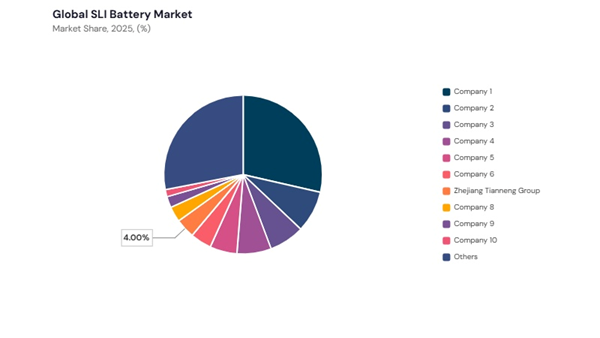


The global SLI Battery Market is moderately consolidated, with competition led by CLARIOS, LLC, East Penn Manufacturing Co., Exide Technologies Energy Solutions Ltd., EnerSys, and Camel Group Co., Ltd. CLARIOS leads the market due to its global automotive battery scale, strong OEM relationships, aftermarket distribution, and lead-acid technology expertise. Amara Raja Energy & Mobility, Zhejiang Tianneng Group, Banner GmbH, Crown Battery Manufacturing, and CDN Energy and Power Corp. further strengthen the market through regional supply networks, automotive replacement batteries, commercial vehicle batteries, and industrial power solutions.

Application Outlook


Based on Application, the market is segmented into Automotive, Electric Vehicles, Uninterruptible Power Supplies, Energy Storage Systems, and Power Tools. The Automotive market dominated the Global SLI Battery Market by Application in 2025, and is expected to continue to be a dominant market till 2033; thereby, achieving a market value of USD 38.4 Billion by 2033, growing at a CAGR of 2.4 % during the forecast period. The Electric vehicles market is expected to witness a CAGR of 3.2% during 2026-2033. The Power tools market is expected to witness a CAGR of 3.5% during 2026-2033.

Automotive leads the market as SLI batteries are widely used for engine starting, lighting, ignition, and electrical stabilization in passenger and commercial vehicles. Replacement battery demand, vehicle ownership growth, and durable lead-acid battery adoption support this segment. Electric Vehicles are creating rising demand for auxiliary low-voltage batteries that support onboard electronics, lighting, control modules, and safety systems. UPS and energy storage applications use SLI batteries for backup power and short-duration reliability, while power tools rely on compact and durable battery solutions for portable equipment.

Type Outlook

Based on Type, the market is segmented into Lead-acid Batteries, Lithium-ion Batteries, Polymer Batteries, and Nickel-cadmium Batteries. The Lead-acid batteries market dominated the Global SLI Battery Market by Type in 2025, and is expected to continue to be a dominant market till 2033; thereby, achieving a market value of USD 51.7 Billion by 2033, growing at a CAGR of 2.6 % during the forecast period. The Lithium-ion batteries market is expected to witness a CAGR of 3.8% during 2026-2033. Additionally, the Polymer batteries market is expected to witness highest CAGR of 5.7% during 2026-2033.

Lead-acid Batteries dominate the market due to their low cost, proven reliability, mature production ecosystem, strong recycling infrastructure, and widespread use in automotive starting applications. AGM and enhanced flooded lead-acid batteries are strengthening the segment by supporting start-stop systems and demanding vehicle electrical loads. Lithium-ion Batteries are gaining attention due to lighter weight, higher energy density, longer cycle life, and suitability for advanced vehicle systems. Polymer and nickel-cadmium batteries remain smaller categories, serving specialized needs where design, flexibility, durability compact, or harsh-condition performance is required.

Capacity Outlook

Based on Capacity, the market is segmented into 51-100 Ah, 21-50 Ah, Over 100 Ah, and Under 20 Ah. The 51-100 Ah market dominated the Global SLI Battery Market by Capacity in 2025, and is expected to continue to be a dominant market till 2033; thereby, achieving a market value of USD 25.4 Billion by 2033, growing at a CAGR of 2.3 % during the forecast period. The 21-50 Ah market is expected to witness a CAGR of 3.1% during 2026-2033. Additionally, the Over 100 Ah market is expected to witness highest CAGR of 3.6% during 2026-2033.

The 51-100 Ah segment leads the market because it is widely used in passenger cars, SUVs, light commercial vehicles, and industrial applications that require balanced power output and reliable starting capability. The 21-50 Ah segment supports compact cars, motorcycles, small vehicles, and moderate-power equipment. Over 100 Ah batteries serve heavy commercial vehicles, trucks, buses, industrial machinery, and backup systems that require higher reserve capacity. Under 20 Ah batteries are used in small vehicles, portable equipment, compact systems, and low-power auxiliary applications.

Regional Outlook


Region-wise, the SLI Battery Market is analyzed across North America, Europe, Asia Pacific, and LAMEA. The Asia Pacific market dominated the Global SLI Battery Market by Region in 2025, and is expected to continue to be a dominant market till 2033; thereby, achieving a market value of USD 26.3 Billion by 2033, growing at a CAGR of 3.2 % during the forecast period. The North America market is expected to witness a CAGR of 2.4% during 2026-2033. Additionally, the Europe market is expected to witness a CAGR of 2.6% during 2026-2033.

Asia Pacific dominates the market due to its large automotive production base, growing vehicle fleet, expanding industrial sector, and rising investments in energy infrastructure. North America is supported by strong replacement battery demand, advanced transportation networks, and reliable backup power adoption. Europe benefits from established automotive manufacturing, vehicle electrification, strict quality standards, and sustainability-led battery innovation. LAMEA is expanding gradually due to rising automotive ownership, transportation infrastructure development, and growing adoption of dependable power backup solutions.

Recent Strategies Deployed in the Market

  • Exide Technologies launched the Sprinter Pure Power battery range in Germany to improve reliability, energy efficiency, and operational performance across industrial and backup power applications.
  • LG Innotek advanced automotive energy and lighting innovation in South Korea and supporting vehicle electrification, power efficiency, and next-generation automotive electrical systems.
  • CATL began mass production of sodium-ion batteries in China, supporting diversification of automotive battery technologies and broader energy storage applications.
  • Crown Battery expanded renewable energy storage and lead-acid battery solutions in the United States, strengthening its role across industrial, backup power, and energy resilience applications.
  • Amara Raja announced a technology collaboration with GIB in India to strengthen battery innovation, manufacturing efficiency, and advanced energy storage capabilities.

List of Key Companies Profiled

  • CLARIOS, LLC
  • East Penn Manufacturing Co.
  • Exide Technologies Energy Solutions Ltd.
  • EnerSys
  • Camel Group Co., Ltd.
  • Amara Raja Energy & Mobility Limited
  • Zhejiang Tianneng Group
  • Banner GmbH
  • Crown Battery Manufacturing Company
  • CDN Energy and Power Corp.

Market Report Segmentation

By Application
  • Automotive
  • Electric Vehicles
  • Uninterruptible Power Supplies
  • Energy Storage Systems
  • Power Tools
By Type
  • Lead-acid Batteries
  • Lithium-ion Batteries
  • Polymer Batteries
  • Nickel-cadmium Batteries
By Capacity
  • 51-100 Ah
  • 21-50 Ah
  • Over 100 Ah
  • Under 20 Ah
By Geography
  • North America
    • US
    • Canada
    • Mexico
    • Rest of North America

  • Europe
    • Germany
    • UK
    • France
    • Russia
    • Spain
    • Italy
    • Rest of Europe

  • Asia Pacific
    • China
    • Japan
    • India
    • South Korea
    • Australia
    • Malaysia
    • Rest of Asia Pacific

  • LAMEA
    • Brazil
    • Argentina
    • UAE
    • Saudi Arabia
    • South Africa
    • Nigeria
    • Rest of LAMEA

Table of Contents

Chapter 1. Research Scope & Methodology
1.1 Market Definition
1.2 Analysis Period & Currency
1.3 Segmentation
1.4 SLI Battery Market, by Geography
1.5 Research Methodology
Chapter 2. Market Overview
2.1 COVID-19 Impact
2.2 Market Composition and Scenario
Chapter 3. Key Factors Impacting Market
3.1 Market Drivers
3.2 Market Restraints
3.3 Market Opportunities
3.4 Market Challenges
3.5 Market Trends
3.6 State of Competition
3.7 Market Consolidation
3.8 Key Customer Criteria
Chapter 4. Product Life CycleChapter 5. Value Chain Analysis
Chapter 6. Competition Analysis - Global
6.1 Market Share Analysis
6.2 Recent Developments and Strategies
6.2.1 Product Launch & Product Expansion
6.2.2 Partnership, Collaboration & Agreements
6.2.3 Geographical Expansion
Chapter 7. Segmentation By Application
7.1 Automotive
7.2 Electric Vehicles
7.3 Uninterruptible Power Supplies
7.4 Power Tools
7.5 Energy Storage Systems
Chapter 8. Segmentation By Type
8.1 Lead-acid Batteries
8.2 Lithium-ion Batteries
8.3 Polymer Batteries
8.4 Nickel-cadmium Batteries
Chapter 9. Segmentation By Capacity
9.1 Under 20 Ah
9.2 -50 Ah
9.3 -100 Ah
9.4 Over 100 Ah
Chapter 10. North America Market
10.1 Market Overview
10.2 Key Factors Impacting Market
10.2.1 Market Drivers
10.2.2 Market Restraints
10.2.3 Market Opportunities
10.2.4 Market Challenges
10.2.5 Market Trends
10.2.6 State of Competition
10.2.7 Market Consolidation
10.2.8 Key Customer Criteria
10.3 Product Life Cycle
10.4 Segmentation By Application
10.4.1 Automotive
10.4.2 Electric Vehicles
10.4.3 Uninterruptible Power Supplies
10.4.4 Energy Storage Systems
10.4.5 Power Tools
10.5 Segmentation By Type
10.5.1 Lead-acid Batteries
10.5.2 Lithium-ion Batteries
10.5.3 Polymer Batteries
10.5.4 Nickel-cadmium Batteries
10.6 Segmentation By Capacity
10.6.1 Under 20 Ah
10.6.2 -50 Ah
10.6.3 -100 Ah
10.6.4 Over 100 Ah
10.7 Segmentation By Country
10.7.1 US
10.7.1.1 Segmentation By Application
10.7.1.1.1 Automotive
10.7.1.1.2 Electric Vehicles
10.7.1.1.3 Uninterruptible Power Supplies
10.7.1.1.4 Energy Storage Systems
10.7.1.1.5 Power Tools
10.7.1.2 Segmentation By Type
10.7.1.2.1 Lead-acid Batteries
10.7.1.2.2 Lithium-ion Batteries
10.7.1.2.3 Polymer Batteries
10.7.1.2.4 Nickel-cadmium Batteries
10.7.1.3 Segmentation By Capacity
10.7.1.3.1 Under 20 Ah
10.7.1.3.2 -50 Ah
10.7.1.3.3 -100 Ah
10.7.1.3.4 Over 100 Ah
10.7.2 Canada
10.7.2.1 Segmentation By Application
10.7.2.1.1 Automotive
10.7.2.1.2 Electric Vehicles
10.7.2.1.3 Uninterruptible Power Supplies
10.7.2.1.4 Energy Storage Systems
10.7.2.1.5 Power Tools
10.7.2.2 Segmentation By Type
10.7.2.2.1 Lead-acid Batteries
10.7.2.2.2 Lithium-ion Batteries
10.7.2.2.3 Polymer Batteries
10.7.2.2.4 Nickel-cadmium Batteries
10.7.2.3 Segmentation By Capacity
10.7.2.3.1 Under 20 Ah
10.7.2.3.2 -50 Ah
10.7.2.3.3 -100 Ah
10.7.2.3.4 Over 100 Ah
10.7.3 Mexico
10.7.3.1 Segmentation By Application
10.7.3.1.1 Automotive
10.7.3.1.2 Electric Vehicles
10.7.3.1.3 Uninterruptible Power Supplies
10.7.3.1.4 Energy Storage Systems
10.7.3.1.5 Power Tools
10.7.3.2 Segmentation By Type
10.7.3.2.1 Lead-acid Batteries
10.7.3.2.2 Lithium-ion Batteries
10.7.3.2.3 Polymer Batteries
10.7.3.2.4 Nickel-cadmium Batteries
10.7.3.3 Segmentation By Capacity
10.7.3.3.1 Under 20 Ah
10.7.3.3.2 -50 Ah
10.7.3.3.3 -100 Ah
10.7.3.3.4 Over 100 Ah
10.7.4 Rest of North America
10.7.4.1 Segmentation By Application
10.7.4.1.1 Automotive
10.7.4.1.2 Electric Vehicles
10.7.4.1.3 Uninterruptible Power Supplies
10.7.4.1.4 Energy Storage Systems
10.7.4.1.5 Power Tools
10.7.4.2 Segmentation By Type
10.7.4.2.1 Lead-acid Batteries
10.7.4.2.2 Lithium-ion Batteries
10.7.4.2.3 Polymer Batteries
10.7.4.2.4 Nickel-cadmium Batteries
10.7.4.3 Segmentation By Capacity
10.7.4.3.1 Under 20 Ah
10.7.4.3.2 -50 Ah
10.7.4.3.3 -100 Ah
10.7.4.3.4 Over 100 Ah
Chapter 11. Europe market
11.1 Market Overview
11.2 Key Factors Impacting Market
11.2.1 Market Drivers
11.2.2 Market Restraints
11.2.3 Market Opportunities
11.2.4 Market Challenges
11.2.5 Market Trends
11.2.6 State of Competition
11.2.7 Market Consolidation
11.2.8 Key Customer Criteria
11.3 Product Life Cycle
11.4 Segmentation By Application
11.4.1 Automotive
11.4.2 Uninterruptible Power Supplies
11.4.3 Electric Vehicles
11.4.4 Energy Storage Systems
11.4.5 Power Tools
11.5 Segmentation By Type
11.5.1 Lead-Acid Batteries
11.5.2 Lithium-Ion Batteries
11.5.3 Nickel-Cadmium Batteries
11.5.4 Polymer Batteries
11.6 Segmentation By Capacity
11.6.1 Under 20 Ah
11.6.2 -50 Ah
11.6.3 -100 Ah
11.6.4 Over 100 Ah
11.7 Segmentation By Country
11.7.1 Germany
11.7.1.1 Segmentation By Application
11.7.1.1.1 Automotive
11.7.1.1.2 Electric Vehicles
11.7.1.1.3 Uninterruptible Power Supplies
11.7.1.1.4 Energy Storage Systems
11.7.1.1.5 Power Tools
11.7.1.2 Segmentation By Type
11.7.1.2.1 Lead-acid Batteries
11.7.1.2.2 Lithium-ion Batteries
11.7.1.2.3 Polymer Batteries
11.7.1.2.4 Nickel-cadmium Batteries
11.7.1.3 Segmentation By Capacity
11.7.1.3.1 Under 20 Ah
11.7.1.3.2 -50 Ah
11.7.1.3.3 -100 Ah
11.7.1.3.4 Over 100 Ah
11.7.2 UK
11.7.2.1 Segmentation By Application
11.7.2.1.1 Automotive
11.7.2.1.2 Electric Vehicles
11.7.2.1.3 Uninterruptible Power Supplies
11.7.2.1.4 Energy Storage Systems
11.7.2.1.5 Power Tools
11.7.2.2 Segmentation By Type
11.7.2.2.1 Lead-acid Batteries
11.7.2.2.2 Lithium-ion Batteries
11.7.2.2.3 Polymer Batteries
11.7.2.2.4 Nickel-cadmium Batteries
11.7.2.3 Segmentation By Capacity
11.7.2.3.1 Under 20 Ah
11.7.2.3.2 -50 Ah
11.7.2.3.3 -100 Ah
11.7.2.3.4 Over 100 Ah
11.7.3 France
11.7.3.1 Segmentation By Application
11.7.3.1.1 Automotive
11.7.3.1.2 Electric Vehicles
11.7.3.1.3 Uninterruptible Power Supplies
11.7.3.1.4 Energy Storage Systems
11.7.3.1.5 Power Tools
11.7.3.2 Segmentation By Type
11.7.3.2.1 Lead-acid Batteries
11.7.3.2.2 Lithium-ion Batteries
11.7.3.2.3 Polymer Batteries
11.7.3.2.4 Nickel-cadmium Batteries
11.7.3.3 Segmentation By Capacity
11.7.3.3.1 Under 20 Ah
11.7.3.3.2 -50 Ah
11.7.3.3.3 -100 Ah
11.7.3.3.4 Over 100 Ah
11.7.4 Russia
11.7.4.1 Segmentation By Application
11.7.4.1.1 Automotive
11.7.4.1.2 Electric Vehicles
11.7.4.1.3 Uninterruptible Power Supplies
11.7.4.1.4 Energy Storage Systems
11.7.4.1.5 Power Tools
11.7.4.2 Segmentation By Type
11.7.4.2.1 Lead-acid Batteries
11.7.4.2.2 Lithium-ion Batteries
11.7.4.2.3 Polymer Batteries
11.7.4.2.4 Nickel-cadmium Batteries
11.7.4.3 Segmentation By Capacity
11.7.4.3.1 Under 20 Ah
11.7.4.3.2 -50 Ah
11.7.4.3.3 -100 Ah
11.7.4.3.4 Over 100 Ah
11.7.5 Spain
11.7.5.1 Segmentation By Application
11.7.5.1.1 Automotive
11.7.5.1.2 Electric Vehicles
11.7.5.1.3 Uninterruptible Power Supplies
11.7.5.1.4 Energy Storage Systems
11.7.5.1.5 Power Tools
11.7.5.2 Segmentation By Type
11.7.5.2.1 Lead-acid Batteries
11.7.5.2.2 Lithium-ion Batteries
11.7.5.2.3 Polymer Batteries
11.7.5.2.4 Nickel-cadmium Batteries
11.7.5.3 Segmentation By Capacity
11.7.5.3.1 Under 20 Ah
11.7.5.3.2 -50 Ah
11.7.5.3.3 -100 Ah
11.7.5.3.4 Over 100 Ah
11.7.6 Italy
11.7.6.1 Segmentation By Application
11.7.6.1.1 Automotive
11.7.6.1.2 Electric Vehicles
11.7.6.1.3 Uninterruptible Power Supplies
11.7.6.1.4 Energy Storage Systems
11.7.6.1.5 Power Tools
11.7.6.2 Segmentation By Type
11.7.6.2.1 Lead-acid Batteries
11.7.6.2.2 Lithium-ion Batteries
11.7.6.2.3 Polymer Batteries
11.7.6.2.4 Nickel-cadmium Batteries
11.7.6.3 Segmentation By Capacity
11.7.6.3.1 Under 20 Ah
11.7.6.3.2 -50 Ah
11.7.6.3.3 -100 Ah
11.7.6.3.4 Over 100 Ah
11.7.7 Rest of Europe
11.7.7.1 Segmentation By Application
11.7.7.1.1 Automotive
11.7.7.1.2 Electric Vehicles
11.7.7.1.3 Uninterruptible Power Supplies
11.7.7.1.4 Energy Storage Systems
11.7.7.1.5 Power Tools
11.7.7.2 Segmentation By Type
11.7.7.2.1 Lead-acid Batteries
11.7.7.2.2 Lithium-ion Batteries
11.7.7.2.3 Polymer Batteries
11.7.7.2.4 Nickel-cadmium Batteries
11.7.7.3 Segmentation By Capacity
11.7.7.3.1 Under 20 Ah
11.7.7.3.2 -50 Ah
11.7.7.3.3 -100 Ah
11.7.7.3.4 Over 100 Ah
Chapter 12. Asia Pacific Market
12.1 Market Overview
12.2 Key Factors Impacting Market
12.2.1 Market Drivers
12.2.2 Market Restraints
12.2.3 Market Opportunities
12.2.4 Market Challenges
12.2.5 Market Trends
12.2.6 State of Competition
12.2.7 Market Consolidation
12.2.8 Key Customer Criteria
12.3 Product Life Cycle
12.4 Segmentation By Application
12.4.1 Automotive
12.4.2 Uninterruptible Power Supplies
12.4.3 Energy Storage Systems
12.4.4 Electric Vehicles
12.4.5 Power Tools
12.5 Segmentation By Type
12.5.1 Lead-acid Batteries
12.5.2 Lithium-ion Batteries
12.5.3 Polymer Batteries
12.5.4 Nickel-cadmium Batteries
12.6 Segmentation By Capacity
12.6.1 Under 20 Ah
12.6.2 -50 Ah
12.6.3 -100 Ah
12.6.4 Over 100 Ah
12.7 Segmentation By Country
12.7.1 China
12.7.1.1 Segmentation By Application
12.7.1.1.1 Automotive
12.7.1.1.2 Electric Vehicles
12.7.1.1.3 Uninterruptible Power Supplies
12.7.1.1.4 Energy Storage Systems
12.7.1.1.5 Power Tools
12.7.1.2 Segmentation By Type
12.7.1.2.1 Lead-acid Batteries
12.7.1.2.2 Lithium-ion Batteries
12.7.1.2.3 Polymer Batteries
12.7.1.2.4 Nickel-cadmium Batteries
12.7.1.3 Segmentation By Capacity
12.7.1.3.1 Under 20 Ah
12.7.1.3.2 -50 Ah
12.7.1.3.3 -100 Ah
12.7.1.3.4 Over 100 Ah
12.7.2 Japan
12.7.2.1 Segmentation By Application
12.7.2.1.1 Automotive
12.7.2.1.2 Electric Vehicles
12.7.2.1.3 Uninterruptible Power Supplies
12.7.2.1.4 Energy Storage Systems
12.7.2.1.5 Power Tools
12.7.2.2 Segmentation By Type
12.7.2.2.1 Lead-acid Batteries
12.7.2.2.2 Lithium-ion Batteries
12.7.2.2.3 Polymer Batteries
12.7.2.2.4 Nickel-cadmium Batteries
12.7.2.3 Segmentation By Capacity
12.7.2.3.1 Under 20 Ah
12.7.2.3.2 -50 Ah
12.7.2.3.3 -100 Ah
12.7.2.3.4 Over 100 Ah
12.7.3 India
12.7.3.1 Segmentation By Application
12.7.3.1.1 Automotive
12.7.3.1.2 Electric Vehicles
12.7.3.1.3 Uninterruptible Power Supplies
12.7.3.1.4 Energy Storage Systems
12.7.3.1.5 Power Tools
12.7.3.2 Segmentation By Type
12.7.3.2.1 Lead-acid Batteries
12.7.3.2.2 Lithium-ion Batteries
12.7.3.2.3 Polymer Batteries
12.7.3.2.4 Nickel-cadmium Batteries
12.7.3.3 Segmentation By Capacity
12.7.3.3.1 Under 20 Ah
12.7.3.3.2 -50 Ah
12.7.3.3.3 -100 Ah
12.7.3.3.4 Over 100 Ah
12.7.4 South Korea
12.7.4.1 Segmentation By Application
12.7.4.1.1 Automotive
12.7.4.1.2 Electric Vehicles
12.7.4.1.3 Uninterruptible Power Supplies
12.7.4.1.4 Energy Storage Systems
12.7.4.1.5 Power Tools
12.7.4.2 Segmentation By Type
12.7.4.2.1 Lead-acid Batteries
12.7.4.2.2 Lithium-ion Batteries
12.7.4.2.3 Polymer Batteries
12.7.4.2.4 Nickel-cadmium Batteries
12.7.4.3 Segmentation By Capacity
12.7.4.3.1 Under 20 Ah
12.7.4.3.2 -50 Ah
12.7.4.3.3 -100 Ah
12.7.4.3.4 Over 100 Ah
12.7.5 Australia
12.7.5.1 Segmentation By Application
12.7.5.1.1 Automotive
12.7.5.1.2 Electric Vehicles
12.7.5.1.3 Uninterruptible Power Supplies
12.7.5.1.4 Energy Storage Systems
12.7.5.1.5 Power Tools
12.7.5.2 Segmentation By Type
12.7.5.2.1 Lead-acid Batteries
12.7.5.2.2 Lithium-ion Batteries
12.7.5.2.3 Polymer Batteries
12.7.5.2.4 Nickel-cadmium Batteries
12.7.5.3 Segmentation By Capacity
12.7.5.3.1 Under 20 Ah
12.7.5.3.2 -50 Ah
12.7.5.3.3 -100 Ah
12.7.5.3.4 Over 100 Ah
12.7.6 Rest of Asia Pacific
12.7.6.1 Segmentation By Application
12.7.6.1.1 Automotive
12.7.6.1.2 Electric Vehicles
12.7.6.1.3 Uninterruptible Power Supplies
12.7.6.1.4 Energy Storage Systems
12.7.6.1.5 Power Tools
12.7.6.2 Segmentation By Type
12.7.6.2.1 Lead-acid Batteries
12.7.6.2.2 Lithium-ion Batteries
12.7.6.2.3 Polymer Batteries
12.7.6.2.4 Nickel-cadmium Batteries
12.7.6.3 Segmentation By Capacity
12.7.6.3.1 Under 20 Ah
12.7.6.3.2 -50 Ah
12.7.6.3.3 -100 Ah
12.7.6.3.4 Over 100 Ah
Chapter 13. LAMEA Market
13.1 Market Overview
13.2 Key Factors Impacting Market
13.2.1 Market Drivers
13.2.2 Market Restraints
13.2.3 Market Opportunities
13.2.4 Market Challenges
13.2.5 Market Trends
13.2.6 State of Competition
13.2.7 Market Consolidation
13.2.8 Key Customer Criteria
13.3 Product Life Cycle
13.4 Segmentation By Application
13.4.1 Automotive
13.4.2 Electric Vehicles
13.4.3 Uninterruptible Power Supplies
13.4.4 Electric Vehicles
13.4.5 Power Tools
13.5 Segmentation By Type
13.5.1 Lead-acid Batteries
13.5.2 Lithium-ion Batteries
13.5.3 Polymer Batteries
13.5.4 Nickel-cadmium Batteries
13.6 Segmentation By Capacity
13.6.1 Under 20 Ah
13.6.2 -50 Ah
13.6.3 -100 Ah
13.6.4 Over 100 Ah
13.7 Segmentation By Country
13.7.1 Brazil
13.7.1.1 Segmentation By Application
13.7.1.1.1 Automotive
13.7.1.1.2 Electric Vehicles
13.7.1.1.3 Uninterruptible Power Supplies
13.7.1.1.4 Energy Storage Systems
13.7.1.1.5 Power Tools
13.7.1.2 Segmentation By Type
13.7.1.2.1 Lead-acid Batteries
13.7.1.2.2 Lithium-ion Batteries
13.7.1.2.3 Polymer Batteries
13.7.1.2.4 Nickel-cadmium Batteries
13.7.1.3 Segmentation By Capacity
13.7.1.3.1 Under 20 Ah
13.7.1.3.2 -50 Ah
13.7.1.3.3 -100 Ah
13.7.1.3.4 Over 100 Ah
13.7.2 Argentina
13.7.2.1 Segmentation By Application
13.7.2.1.1 Automotive
13.7.2.1.2 Electric Vehicles
13.7.2.1.3 Uninterruptible Power Supplies
13.7.2.1.4 Energy Storage Systems
13.7.2.1.5 Power Tools
13.7.2.2 Segmentation By Type
13.7.2.2.1 Lead-acid Batteries
13.7.2.2.2 Lithium-ion Batteries
13.7.2.2.3 Polymer Batteries
13.7.2.2.4 Nickel-cadmium Batteries
13.7.2.3 Segmentation By Capacity
13.7.2.3.1 Under 20 Ah
13.7.2.3.2 -50 Ah
13.7.2.3.3 -100 Ah
13.7.2.3.4 Over 100 Ah
13.7.3 UAE
13.7.3.1 Segmentation By Application
13.7.3.1.1 Automotive
13.7.3.1.2 Electric Vehicles
13.7.3.1.3 Uninterruptible Power Supplies
13.7.3.1.4 Energy Storage Systems
13.7.3.1.5 Power Tools
13.7.3.2 Segmentation By Type
13.7.3.2.1 Lead-acid Batteries
13.7.3.2.2 Lithium-ion Batteries
13.7.3.2.3 Polymer Batteries
13.7.3.2.4 Nickel-cadmium Batteries
13.7.3.3 Segmentation By Capacity
13.7.3.3.1 Under 20 Ah
13.7.3.3.2 -50 Ah
13.7.3.3.3 -100 Ah
13.7.3.3.4 Over 100 Ah
13.7.4 Saudi Arabia
13.7.4.1 Segmentation By Application
13.7.4.1.1 Automotive
13.7.4.1.2 Electric Vehicles
13.7.4.1.3 Uninterruptible Power Supplies
13.7.4.1.4 Energy Storage Systems
13.7.4.1.5 Power Tools
13.7.4.2 Segmentation By Type
13.7.4.2.1 Lead-acid Batteries
13.7.4.2.2 Lithium-ion Batteries
13.7.4.2.3 Polymer Batteries
13.7.4.2.4 Nickel-cadmium Batteries
13.7.4.3 Segmentation By Capacity
13.7.4.3.1 Under 20 Ah
13.7.4.3.2 -50 Ah
13.7.4.3.3 -100 Ah
13.7.4.3.4 Over 100 Ah
13.7.5 South Africa
13.7.5.1 Segmentation By Application
13.7.5.1.1 Automotive
13.7.5.1.2 Electric Vehicles
13.7.5.1.3 Uninterruptible Power Supplies
13.7.5.1.4 Energy Storage Systems
13.7.5.1.5 Power Tools
13.7.5.2 Segmentation By Type
13.7.5.2.1 Lead-acid Batteries
13.7.5.2.2 Lithium-ion Batteries
13.7.5.2.3 Polymer Batteries
13.7.5.2.4 Nickel-cadmium Batteries
13.7.5.3 Segmentation By Capacity
13.7.5.3.1 Under 20 Ah
13.7.5.3.2 -50 Ah
13.7.5.3.3 -100 Ah
13.7.5.3.4 Over 100 Ah
13.7.6 Nigeria
13.7.6.1 Segmentation By Application
13.7.6.1.1 Automotive
13.7.6.1.2 Electric Vehicles
13.7.6.1.3 Uninterruptible Power Supplies
13.7.6.1.4 Energy Storage Systems
13.7.6.1.5 Power Tools
13.7.6.2 Segmentation By Type
13.7.6.2.1 Lead-acid Batteries
13.7.6.2.2 Lithium-ion Batteries
13.7.6.2.3 Polymer Batteries
13.7.6.2.4 Nickel-cadmium Batteries
13.7.6.3 Segmentation By Capacity
13.7.6.3.1 Under 20 Ah
13.7.6.3.2 -50 Ah
13.7.6.3.3 -100 Ah
13.7.6.3.4 Over 100 Ah
13.7.7 Rest of LAMEA
13.7.7.1 Segmentation By Application
13.7.7.1.1 Automotive
13.7.7.1.2 Electric Vehicles
13.7.7.1.3 Uninterruptible Power Supplies
13.7.7.1.4 Energy Storage Systems
13.7.7.1.5 Power Tools
13.7.7.2 Segmentation By Type
13.7.7.2.1 Lead-acid Batteries
13.7.7.2.2 Lithium-ion Batteries
13.7.7.2.3 Polymer Batteries
13.7.7.2.4 Nickel-cadmium Batteries
13.7.7.3 Segmentation By Capacity
13.7.7.3.1 Under 20 Ah
13.7.7.3.2 -50 Ah
13.7.7.3.3 -100 Ah
13.7.7.3.4 Over 100 Ah
11.7.6.1 Segmentation By Application
11.7.6.1.1 Automotive
11.7.6.1.2 Electric Vehicles
11.7.6.1.3 Uninterruptible Power Supplies
11.7.6.1.4 Energy Storage Systems
11.7.6.1.5 Power Tools
11.7.6.2 Segmentation By Type
11.7.6.2.1 Lead-acid Batteries
11.7.6.2.2 Lithium-ion Batteries
11.7.6.2.3 Polymer Batteries
11.7.6.2.4 Nickel-cadmium Batteries
11.7.6.3 Segmentation By Capacity
11.7.6.3.1 Under 20 Ah
11.7.6.3.2 -50 Ah
11.7.6.3.3 -100 Ah
11.7.6.3.4 Over 100 Ah
11.7.7 Rest of Europe
11.7.7.1 Segmentation By Application
11.7.7.1.1 Automotive
11.7.7.1.2 Electric Vehicles
11.7.7.1.3 Uninterruptible Power Supplies
11.7.7.1.4 Energy Storage Systems
11.7.7.1.5 Power Tools
11.7.7.2 Segmentation By Type
11.7.7.2.1 Lead-acid Batteries
11.7.7.2.2 Lithium-ion Batteries
11.7.7.2.3 Polymer Batteries
11.7.7.2.4 Nickel-cadmium Batteries
11.7.7.3 Segmentation By Capacity
11.7.7.3.1 Under 20 Ah
11.7.7.3.2 -50 Ah
11.7.7.3.3 -100 Ah
11.7.7.3.4 Over 100 Ah
Chapter 12. Asia Pacific Market
12.1 Market Overview
12.2 Key Factors Impacting Market
12.2.1 Market Drivers
12.2.2 Market Restraints
12.2.3 Market Opportunities
12.2.4 Market Challenges
12.2.5 Market Trends
12.2.6 State of Competition
12.2.7 Market Consolidation
12.2.8 Key Customer Criteria
12.3 Product Life Cycle
12.4 Segmentation By Application
12.4.1 Automotive
12.4.2 Uninterruptible Power Supplies
12.4.3 Energy Storage Systems
12.4.4 Electric Vehicles
12.4.5 Power Tools
12.5 Segmentation By Type
12.5.1 Lead-acid Batteries
12.5.2 Lithium-ion Batteries
12.5.3 Polymer Batteries
12.5.4 Nickel-cadmium Batteries
12.6 Segmentation By Capacity
12.6.1 Under 20 Ah
12.6.2 -50 Ah
12.6.3 -100 Ah
12.6.4 Over 100 Ah
12.7 Segmentation By Country
12.7.1 China
12.7.1.1 Segmentation By Application
12.7.1.1.1 Automotive
12.7.1.1.2 Electric Vehicles
12.7.1.1.3 Uninterruptible Power Supplies
12.7.1.1.4 Energy Storage Systems
12.7.1.1.5 Power Tools
12.7.1.2 Segmentation By Type
12.7.1.2.1 Lead-acid Batteries
12.7.1.2.2 Lithium-ion Batteries
12.7.1.2.3 Polymer Batteries
12.7.1.2.4 Nickel-cadmium Batteries
12.7.1.3 Segmentation By Capacity
12.7.1.3.1 Under 20 Ah
12.7.1.3.2 -50 Ah
12.7.1.3.3 -100 Ah
12.7.1.3.4 Over 100 Ah
12.7.2 Japan
12.7.2.1 Segmentation By Application
12.7.2.1.1 Automotive
12.7.2.1.2 Electric Vehicles
12.7.2.1.3 Uninterruptible Power Supplies
12.7.2.1.4 Energy Storage Systems
12.7.2.1.5 Power Tools
12.7.2.2 Segmentation By Type
12.7.2.2.1 Lead-acid Batteries
12.7.2.2.2 Lithium-ion Batteries
12.7.2.2.3 Polymer Batteries
12.7.2.2.4 Nickel-cadmium Batteries
12.7.2.3 Segmentation By Capacity
12.7.2.3.1 Under 20 Ah
12.7.2.3.2 -50 Ah
12.7.2.3.3 -100 Ah
12.7.2.3.4 Over 100 Ah
12.7.3 India
12.7.3.1 Segmentation By Application
12.7.3.1.1 Automotive
12.7.3.1.2 Electric Vehicles
12.7.3.1.3 Uninterruptible Power Supplies
12.7.3.1.4 Energy Storage Systems
12.7.3.1.5 Power Tools
12.7.3.2 Segmentation By Type
12.7.3.2.1 Lead-acid Batteries
12.7.3.2.2 Lithium-ion Batteries
12.7.3.2.3 Polymer Batteries
12.7.3.2.4 Nickel-cadmium Batteries
12.7.3.3 Segmentation By Capacity
12.7.3.3.1 Under 20 Ah
12.7.3.3.2 -50 Ah
12.7.3.3.3 -100 Ah
12.7.3.3.4 Over 100 Ah
12.7.4 South Korea
12.7.4.1 Segmentation By Application
12.7.4.1.1 Automotive
12.7.4.1.2 Electric Vehicles
12.7.4.1.3 Uninterruptible Power Supplies
12.7.4.1.4 Energy Storage Systems
12.7.4.1.5 Power Tools
12.7.4.2 Segmentation By Type
12.7.4.2.1 Lead-acid Batteries
12.7.4.2.2 Lithium-ion Batteries
12.7.4.2.3 Polymer Batteries
12.7.4.2.4 Nickel-cadmium Batteries
12.7.4.3 Segmentation By Capacity
12.7.4.3.1 Under 20 Ah
12.7.4.3.2 -50 Ah
12.7.4.3.3 -100 Ah
12.7.4.3.4 Over 100 Ah
12.7.5 Australia
12.7.5.1 Segmentation By Application
12.7.5.1.1 Automotive
12.7.5.1.2 Electric Vehicles
12.7.5.1.3 Uninterruptible Power Supplies
12.7.5.1.4 Energy Storage Systems
12.7.5.1.5 Power Tools
12.7.5.2 Segmentation By Type
12.7.5.2.1 Lead-acid Batteries
12.7.5.2.2 Lithium-ion Batteries
12.7.5.2.3 Polymer Batteries
12.7.5.2.4 Nickel-cadmium Batteries
12.7.5.3 Segmentation By Capacity
12.7.5.3.1 Under 20 Ah
12.7.5.3.2 -50 Ah
12.7.5.3.3 -100 Ah
12.7.5.3.4 Over 100 Ah
12.7.6 Rest of Asia Pacific
12.7.6.1 Segmentation By Application
12.7.6.1.1 Automotive
12.7.6.1.2 Electric Vehicles
12.7.6.1.3 Uninterruptible Power Supplies
12.7.6.1.4 Energy Storage Systems
12.7.6.1.5 Power Tools
12.7.6.2 Segmentation By Type
12.7.6.2.1 Lead-acid Batteries
12.7.6.2.2 Lithium-ion Batteries
12.7.6.2.3 Polymer Batteries
12.7.6.2.4 Nickel-cadmium Batteries
12.7.6.3 Segmentation By Capacity
12.7.6.3.1 Under 20 Ah
12.7.6.3.2 -50 Ah
12.7.6.3.3 -100 Ah
12.7.6.3.4 Over 100 Ah
Chapter 13. LAMEA Market
13.1 Market Overview
13.2 Key Factors Impacting Market
13.2.1 Market Drivers
13.2.2 Market Restraints
13.2.3 Market Opportunities
13.2.4 Market Challenges
13.2.5 Market Trends
13.2.6 State of Competition
13.2.7 Market Consolidation
13.2.8 Key Customer Criteria
13.3 Product Life Cycle
13.4 Segmentation By Application
13.4.1 Automotive
13.4.2 Electric Vehicles
13.4.3 Uninterruptible Power Supplies
13.4.4 Electric Vehicles
13.4.5 Power Tools
13.5 Segmentation By Type
13.5.1 Lead-acid Batteries
13.5.2 Lithium-ion Batteries
13.5.3 Polymer Batteries
13.5.4 Nickel-cadmium Batteries
13.6 Segmentation By Capacity
13.6.1 Under 20 Ah
13.6.2 -50 Ah
13.6.3 -100 Ah
13.6.4 Over 100 Ah
13.7 Segmentation By Country
13.7.1 Brazil
13.7.1.1 Segmentation By Application
13.7.1.1.1 Automotive
13.7.1.1.2 Electric Vehicles
13.7.1.1.3 Uninterruptible Power Supplies
13.7.1.1.4 Energy Storage Systems
13.7.1.1.5 Power Tools
13.7.1.2 Segmentation By Type
13.7.1.2.1 Lead-acid Batteries
13.7.1.2.2 Lithium-ion Batteries
13.7.1.2.3 Polymer Batteries
13.7.1.2.4 Nickel-cadmium Batteries
13.7.1.3 Segmentation By Capacity
13.7.1.3.1 Under 20 Ah
13.7.1.3.2 -50 Ah
13.7.1.3.3 -100 Ah
13.7.1.3.4 Over 100 Ah
13.7.2 Argentina
13.7.2.1 Segmentation By Application
13.7.2.1.1 Automotive
13.7.2.1.2 Electric Vehicles
13.7.2.1.3 Uninterruptible Power Supplies
13.7.2.1.4 Energy Storage Systems
13.7.2.1.5 Power Tools
13.7.2.2 Segmentation By Type
13.7.2.2.1 Lead-acid Batteries
13.7.2.2.2 Lithium-ion Batteries
13.7.2.2.3 Polymer Batteries
13.7.2.2.4 Nickel-cadmium Batteries
13.7.2.3 Segmentation By Capacity
13.7.2.3.1 Under 20 Ah
13.7.2.3.2 -50 Ah
13.7.2.3.3 -100 Ah
13.7.2.3.4 Over 100 Ah
13.7.3 UAE
13.7.3.1 Segmentation By Application
13.7.3.1.1 Automotive
13.7.3.1.2 Electric Vehicles
13.7.3.1.3 Uninterruptible Power Supplies
13.7.3.1.4 Energy Storage Systems
13.7.3.1.5 Power Tools
13.7.3.2 Segmentation By Type
13.7.3.2.1 Lead-acid Batteries
13.7.3.2.2 Lithium-ion Batteries
13.7.3.2.3 Polymer Batteries
13.7.3.2.4 Nickel-cadmium Batteries
13.7.3.3 Segmentation By Capacity
13.7.3.3.1 Under 20 Ah
13.7.3.3.2 -50 Ah
13.7.3.3.3 -100 Ah
13.7.3.3.4 Over 100 Ah
13.7.4 Saudi Arabia
13.7.4.1 Segmentation By Application
13.7.4.1.1 Automotive
13.7.4.1.2 Electric Vehicles
13.7.4.1.3 Uninterruptible Power Supplies
13.7.4.1.4 Energy Storage Systems
13.7.4.1.5 Power Tools
13.7.4.2 Segmentation By Type
13.7.4.2.1 Lead-acid Batteries
13.7.4.2.2 Lithium-ion Batteries
13.7.4.2.3 Polymer Batteries
13.7.4.2.4 Nickel-cadmium Batteries
13.7.4.3 Segmentation By Capacity
13.7.4.3.1 Under 20 Ah
13.7.4.3.2 -50 Ah
13.7.4.3.3 -100 Ah
13.7.4.3.4 Over 100 Ah
13.7.5 South Africa
13.7.5.1 Segmentation By Application
13.7.5.1.1 Automotive
13.7.5.1.2 Electric Vehicles
13.7.5.1.3 Uninterruptible Power Supplies
13.7.5.1.4 Energy Storage Systems
13.7.5.1.5 Power Tools
13.7.5.2 Segmentation By Type
13.7.5.2.1 Lead-acid Batteries
13.7.5.2.2 Lithium-ion Batteries
13.7.5.2.3 Polymer Batteries
13.7.5.2.4 Nickel-cadmium Batteries
13.7.5.3 Segmentation By Capacity
13.7.5.3.1 Under 20 Ah
13.7.5.3.2 -50 Ah
13.7.5.3.3 -100 Ah
13.7.5.3.4 Over 100 Ah
13.7.6 Nigeria
13.7.6.1 Segmentation By Application
13.7.6.1.1 Automotive
13.7.6.1.2 Electric Vehicles
13.7.6.1.3 Uninterruptible Power Supplies
13.7.6.1.4 Energy Storage Systems
13.7.6.1.5 Power Tools
13.7.6.2 Segmentation By Type
13.7.6.2.1 Lead-acid Batteries
13.7.6.2.2 Lithium-ion Batteries
13.7.6.2.3 Polymer Batteries
13.7.6.2.4 Nickel-cadmium Batteries
13.7.6.3 Segmentation By Capacity
13.7.6.3.1 Under 20 Ah
13.7.6.3.2 -50 Ah
13.7.6.3.3 -100 Ah
13.7.6.3.4 Over 100 Ah
13.7.7 Rest of LAMEA
13.7.7.1 Segmentation By Application
13.7.7.1.1 Automotive
13.7.7.1.2 Electric Vehicles
13.7.7.1.3 Uninterruptible Power Supplies
13.7.7.1.4 Energy Storage Systems
13.7.7.1.5 Power Tools
13.7.7.2 Segmentation By Type
13.7.7.2.1 Lead-acid Batteries
13.7.7.2.2 Lithium-ion Batteries
13.7.7.2.3 Polymer Batteries
13.7.7.2.4 Nickel-cadmium Batteries
13.7.7.3 Segmentation By Capacity
13.7.7.3.1 Under 20 Ah
13.7.7.3.2 -50 Ah
13.7.7.3.3 -100 Ah
13.7.7.3.4 Over 100 Ah
Chapter 14. Company Snapshot
14.1 CLARIOS, LLC
14.1.1 Business Overview
14.1.2 Key Information
14.1.3 Company Focus
14.1.4 Strategic Insights
14.1.5 Strategy Deployed
14.1.6 Product & Service Portfolio
14.1.7 Capability Overview
14.1.8 Technology & Innovation Focus
14.1.9 Customers / End Users
14.1.10 Competitive Positioning
14.1.11 Key Differentiators
14.1.12 Portfolio Matrix
14.1.13 SWOT Analysis
14.1.14 Future Outlook
14.2 Banner GmbH
14.2.1 Business Overview
14.2.2 Key Information
14.2.3 Company Focus
14.2.4 Strategic Insights
14.2.5 Strategy Deployed
14.2.6 Product & Service Portfolio
14.2.7 Capability Overview
14.2.8 Technology & Innovation Focus
14.2.9 Customers / End Users
14.2.10 Competitive Positioning
14.2.11 Key Differentiators
14.2.12 Portfolio Matrix
14.2.13 SWOT Analysis
14.2.14 Future Outlook
14.3 Camel Group Co.,Ltd.
14.3.1 Business Overview
14.3.2 Key Information
14.3.3 Company Focus
14.3.4 Strategic Insights
14.3.5 Strategy Deployed
14.3.6 Product & Service Portfolio
14.3.7 Capability Overview
14.3.8 Technology & Innovation Focus
14.3.9 Customers / End Users
14.3.10 Competitive Positioning
14.3.11 Key Differentiators
14.3.12 Portfolio Matrix
14.3.13 SWOT Analysis
14.3.14 Future Outlook
14.4 Crown Battery Manufacturing Company
14.4.1 Business Overview
14.4.2 Key Information
14.4.3 Company Focus
14.4.4 Strategic Insights
14.4.5 Strategy Deployed
14.4.6 Product & Service Portfolio
14.4.7 Capability Overview
14.4.8 Technology & Innovation Focus
14.4.9 Customers / End Users
14.4.10 Competitive Positioning
14.4.11 Key Differentiators
14.4.12 Portfolio Matrix
14.4.13 SWOT Analysis
14.4.14 Future Outlook
14.5 CDN Energy and Power Corp.
14.5.1 Business Overview
14.5.2 Key Information
14.5.3 Company Focus
14.5.4 Strategic Insights
14.5.5 Strategy Deployed
14.5.6 Product & Service Portfolio
14.5.7 Capability Overview
14.5.8 Technology & Innovation Focus
14.5.9 Customers / End Users
14.5.10 Competitive Positioning
14.5.11 Key Differentiators
14.5.12 Portfolio Matrix
14.5.13 SWOT Analysis
14.5.14 Future Outlook
14.6 East Penn Manufacturing Co.
14.6.1 Business Overview
14.6.2 Key Information
14.6.3 Company Focus
14.6.4 Strategic Insights
14.6.5 Strategy Deployed
14.6.6 Product & Service Portfolio
14.6.7 Capability Overview
14.6.8 Technology & Innovation Focus
14.6.9 Customers / End Users
14.6.10 Competitive Positioning
14.6.11 Key Differentiators
14.6.12 Portfolio Matrix
14.6.13 SWOT Analysis
14.6.14 Future Outlook
14.7 EnerSys
14.7.1 Business Overview
14.7.2 Key Information
14.7.3 Company Focus
14.7.4 Strategic Insights
14.7.5 Strategy Deployed
14.7.6 Product & Service Portfolio
14.7.7 Capability Overview
14.7.8 Technology & Innovation Focus
14.7.9 Customers / End Users
14.7.10 Competitive Positioning
14.7.11 Key Differentiators
14.7.12 Portfolio Matrix
14.7.13 SWOT Analysis
14.7.14 Future Outlook
14.8 Exide Technologies Energy Solutions Ltd
14.8.1 Business Overview
14.8.2 Key Information
14.8.3 Company Focus
14.8.4 Strategic Insights
14.8.5 Strategy Deployed
14.8.6 Product & Service Portfolio
14.8.7 Capability Overview
14.8.8 Technology & Innovation Focus
14.8.9 Customers / End Users
14.8.10 Competitive Positioning
14.8.11 Key Differentiators
14.8.12 Portfolio Matrix
14.8.13 SWOT Analysis
14.8.14 Future Outlook
14.9 Amara Raja Energy & Mobility Limited
14.9.1 Business Overview
14.9.2 Key Information
14.9.3 Company Focus
14.9.4 Strategic Insights
14.9.5 Strategy Deployed
14.9.6 Product & Service Portfolio
14.9.7 Capability Overview
14.9.8 Technology & Innovation Focus
14.9.9 Customers / End Users
14.9.10 Competitive Positioning
14.9.11 Key Differentiators
14.9.12 Portfolio Matrix
14.9.13 SWOT Analysis
14.9.14 Future Outlook
14.10 Zhejiang Tianneng Group
14.10.1 Business Overview
14.10.2 Key Information
14.10.3 Company Focus
14.10.4 Strategic Insights
14.10.5 Strategy Deployed
14.10.6 Product & Service Portfolio
14.10.7 Capability Overview
14.10.8 Technology & Innovation Focus
14.10.9 Customers / End Users
14.10.10 Competitive Positioning
14.10.11 Key Differentiators
14.10.12 Portfolio Matrix
14.10.13 SWOT Analysis
14.10.14 Future Outlook
Chapter 15. Winning Imperatives of SLI Battery Market
14.8 Exide Technologies Energy Solutions Ltd
14.8.1 Business Overview
14.8.2 Key Information
14.8.3 Company Focus
14.8.4 Strategic Insights
14.8.5 Strategy Deployed
14.8.6 Product & Service Portfolio
14.8.7 Capability Overview
14.8.8 Technology & Innovation Focus
14.8.9 Customers / End Users
14.8.10 Competitive Positioning
14.8.11 Key Differentiators
14.8.12 Portfolio Matrix
14.8.13 SWOT Analysis
14.8.14 Future Outlook
14.9 Amara Raja Energy & Mobility Limited
14.9.1 Business Overview
14.9.2 Key Information
14.9.3 Company Focus
14.9.4 Strategic Insights
14.9.5 Strategy Deployed
14.9.6 Product & Service Portfolio
14.9.7 Capability Overview
14.9.8 Technology & Innovation Focus
14.9.9 Customers / End Users
14.9.10 Competitive Positioning
14.9.11 Key Differentiators
14.9.12 Portfolio Matrix
14.9.13 SWOT Analysis
14.9.14 Future Outlook
14.10 Zhejiang Tianneng Group
14.10.1 Business Overview
14.10.2 Key Information
14.10.3 Company Focus
14.10.4 Strategic Insights
14.10.5 Strategy Deployed
14.10.6 Product & Service Portfolio
14.10.7 Capability Overview
14.10.8 Technology & Innovation Focus
14.10.9 Customers / End Users
14.10.10 Competitive Positioning
14.10.11 Key Differentiators
14.10.12 Portfolio Matrix
14.10.13 SWOT Analysis
14.10.14 Future Outlook
Chapter 15. Winning Imperatives of SLI Battery Market

Companies Mentioned

• CLARIOS, LLC
• East Penn Manufacturing Co.
• Exide Technologies Energy Solutions Ltd.
• EnerSys
• Camel Group Co., Ltd.
• Amara Raja Energy & Mobility Limited
• Zhejiang Tianneng Group
• Banner GmbH
• Crown Battery Manufacturing Company
• CDN Energy and Power Corp.