+353-1-416-8900REST OF WORLD
+44-20-3973-8888REST OF WORLD
1-917-300-0470EAST COAST U.S
1-800-526-8630U.S. (TOLL FREE)

Global Walk-in Cooler and Freezer Market Size, Share & Industry Analysis Report by Type, Installation Type, Application, End Use, Regional Outlook and Forecast, 2026-2033

  • PDF Icon

    Report

  • 668 Pages
  • May 2026
  • Marqual IT Solutions Pvt. Ltd (KBV Research)
  • ID: 6276112
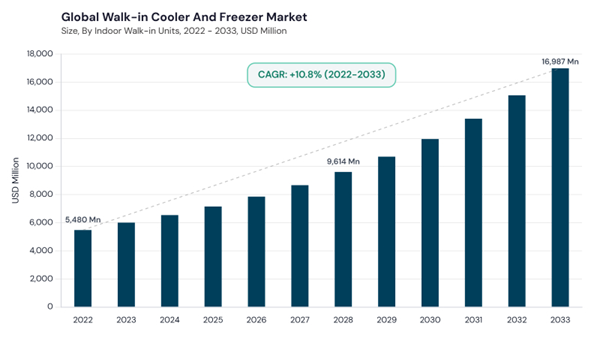
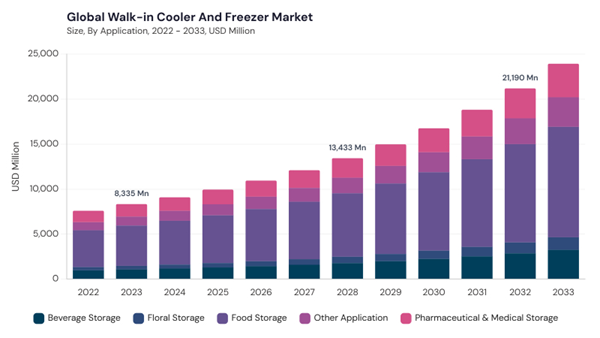
The Global Walk-in Cooler And Freezer Market size is expected to reach USD 23.92 billion by 2033, rising at a market growth of 11.8% CAGR during the forecast period.


The market is witnessing strong growth due to increasing demand for cold chain infrastructure across foodservice, retail, pharmaceuticals, and logistics industries. Rising adoption of energy-efficient refrigeration systems, smart monitoring technologies, and sustainable cooling solutions is further supporting market expansion globally.

Key Market Trends & Insights:

  • The North America Walk-in Cooler And Freezer market dominated the Global Market in 2025, accounting for a 34.86% revenue share in 2025.
  • The US Walk-in Cooler And Freezer market is expected to continue its dominance in North America region thereby reaching a significant market size by 2033.
  • Among the various type segments, Walk-in Coolers dominated the global market contributing a revenue share of 61.05% in 2025.
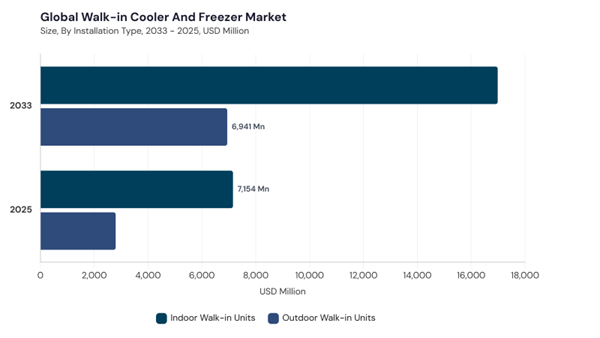
  • In terms of the Installation Type segmentation, the Indoor Walk-in Units segment dominated the global market with a revenue share of 71.89% in 2025.
  • Food Storage led the Application segments in 2025, capturing a 53.22% revenue share and is projected to continue its dominance during the forecast period.
The Global Walk-in Cooler And Freezer Market has evolved significantly with the expansion of global cold chain infrastructure and increasing demand for temperature-controlled storage solutions. Initially focused on food preservation and commercial refrigeration, the market has expanded into pharmaceuticals, biotechnology, beverage storage, and logistics applications. Rising urbanization, organized retail expansion, and growth in frozen and packaged food consumption continue to accelerate market demand globally.

Today, technologies such as IoT-enabled monitoring systems, energy-efficient refrigeration technologies, modular cooling units, and environmentally friendly refrigerants are transforming the market landscape. Businesses across foodservice, healthcare, and industrial sectors are increasingly investing in advanced walk-in cooling systems to improve operational efficiency, maintain product quality, and comply with evolving food safety and environmental regulations.


The major strategies followed by the market participants are Product Innovation and Expansion as the key developmental strategies to strengthen market positioning and expand cold chain capabilities. For instance, in March 2025, Carrier Global Corporation expanded its energy-efficient commercial refrigeration portfolio with advanced smart monitoring capabilities to improve cold storage performance and operational efficiency. Additionally, in September 2024, Hussmann Corporation launched eco-friendly refrigeration systems utilizing low-global-warming-potential refrigerants to strengthen sustainability compliance and energy efficiency across commercial cold storage environments.

Driving and Restraining Factors

Drivers
  • Rising Demand for Fresh and Frozen Food Storage Solutions
  • Expansion of Cold Chain Logistics and Organized Retail Infrastructure
  • Increasing Adoption of Energy-Efficient Refrigeration Systems
  • Growth of Pharmaceutical and Healthcare Cold Storage Applications
Restraints
  • High Initial Installation and Operational Costs
  • Stringent Environmental and Refrigerant Regulations
  • Infrastructure and Power Supply Limitations in Developing Regions
Opportunities
  • Adoption of Sustainable Refrigerants and Green Cooling Technologies
  • Expansion of Pharmaceutical and Biotech Cold Storage Infrastructure
  • Increasing Integration of IoT and Smart Refrigeration Systems
Challenges
  • Maintaining Temperature Consistency and Cold Chain Integrity
  • Rising Energy Efficiency and Sustainability Requirements
  • High Maintenance and Infrastructure Management Costs

Market Share Analysis

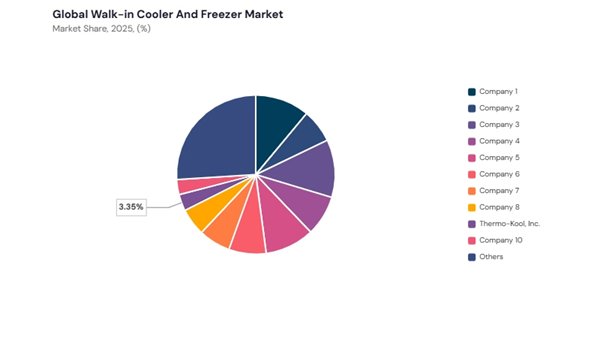
The global Walk-in Cooler And Freezer Market is moderately consolidated with leading refrigeration and HVAC companies accounting for a significant share of total market revenue. Carrier Global Corporation emerged as one of the leading players in the market with an estimated market share of 11.76% in 2025, supported by its broad refrigeration portfolio, global distribution network, and strong technological capabilities. Hussmann Corporation and Daikin Industries Ltd. also maintain strong market positions driven by energy-efficient refrigeration systems and integrated cold chain solutions.


The market is witnessing growing investments in smart refrigeration technologies, cloud-based monitoring systems, predictive maintenance capabilities, and environmentally sustainable cooling solutions. Mid-sized and regional players continue to compete through customized refrigeration offerings, strong local distribution networks, and specialized cold storage solutions. Future competition is expected to intensify with increasing demand for energy optimization, cold chain modernization, and pharmaceutical storage infrastructure globally.

Type Outlook

On the basis of type, the walk-in cooler and freezer market is classified into Walk-in Coolers and Walk-in Freezers. The Walk-in Coolers segment acquired the largest revenue share in the market in 2025. The dominance of this segment is driven by increasing demand from restaurants, supermarkets, foodservice establishments, and retail outlets requiring efficient short- and medium-term cold storage solutions for perishable products.

Installation Type Outlook

Based on installation type, the walk-in cooler and freezer market is classified into Indoor Walk-in Units and Outdoor Walk-in Units. The Indoor Walk-in Units segment acquired the largest revenue share in 2025 owing to extensive deployment across restaurants, healthcare facilities, supermarkets, and food processing environments. Indoor systems offer operational convenience, improved temperature management, and efficient utilization of commercial space.

Application Outlook

By application, the walk-in cooler and freezer market is divided into Food Storage, Pharmaceutical & Medical Storage, Beverage Storage, Floral Storage, and Other Application. The Food Storage segment recorded the largest revenue share in 2025 due to increasing demand for fresh produce, dairy products, frozen foods, meat, and seafood storage solutions globally. Pharmaceutical & Medical Storage is also witnessing strong growth due to increasing vaccine distribution and biologics storage requirements.

End Use Outlook

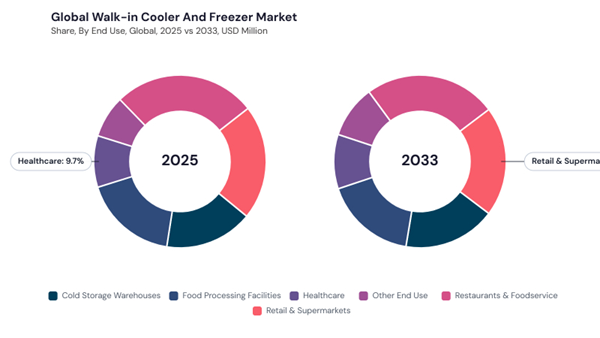
On the basis of end use, the walk-in cooler and freezer market is segmented into Restaurants & Foodservice, Retail & Supermarkets, Food Processing Facilities, Cold Storage Warehouses, Healthcare, and Other End Use. The Restaurants & Foodservice segment acquired the largest revenue share in 2025 owing to the rapid expansion of foodservice operations, quick-service restaurants, and commercial kitchens globally. Growing focus on food safety compliance and operational efficiency is further supporting segment growth.

Regional Outlook

Region-wise, the Walk-in Cooler And Freezer Market is analyzed across North America, Europe, Asia Pacific, and LAMEA. The North America segment recorded the largest revenue share in 2025 due to advanced cold chain infrastructure, strong foodservice industry presence, and increasing investments in energy-efficient refrigeration systems.

Asia Pacific is projected to witness significant growth during the forecast period driven by rapid urbanization, expansion of organized retail, rising food consumption, and increasing investments in cold chain logistics infrastructure across China, India, Japan, and Southeast Asia. Europe also continues to witness steady growth supported by stringent food safety regulations and rising adoption of sustainable refrigeration technologies.

Market Competition and Attributes

The Walk-in Cooler And Freezer Market is highly competitive and characterized by increasing focus on energy-efficient refrigeration systems, smart monitoring technologies, and sustainable cooling solutions. Competition is primarily centered on product reliability, cooling performance, operational efficiency, and compliance with evolving environmental regulations. Companies are increasingly investing in IoT-enabled refrigeration systems, predictive maintenance capabilities, and cloud-connected monitoring platforms to improve operational performance and customer engagement.


The market includes large HVAC and refrigeration system manufacturers along with several regional and niche players competing across different cold storage applications. Strategic collaborations with cold chain service providers, technology companies, and component suppliers continue to influence competitive positioning and long-term market expansion strategies.
Recent Strategies Deployed in the Market

  • Mar-2025: Carrier Global Corporation expanded its energy-efficient commercial refrigeration portfolio with advanced smart monitoring capabilities to improve cold storage performance and operational efficiency.
  • Jan-2025: Danfoss Group introduced next-generation refrigeration controllers designed to improve energy optimization and predictive maintenance capabilities in commercial cold storage systems.
  • Sep-2024: Hussmann Corporation launched new eco-friendly refrigeration systems utilizing low-global-warming-potential refrigerants to strengthen sustainability compliance.
  • Jun-2024: Emerson Electric Co. enhanced its cloud-connected refrigeration monitoring platform to support real-time diagnostics and cold chain visibility.
  • Feb-2024: Daikin Industries Ltd. expanded its modular refrigeration solutions portfolio targeting foodservice and retail cold storage applications across Asia Pacific.
  • Oct-2023: Johnson Controls International PLC partnered with cold chain technology providers to strengthen smart refrigeration integration and energy management solutions.

List of Key Companies Profiled

  • Hussmann Corporation (Panasonic Holdings Corporation)
  • The Danfoss Group
  • Carrier Global Corporation
  • Emerson Electric Co.
  • Daikin Industries Ltd.
  • Johnson Controls International PLC
  • Trane Technologies PLC
  • Norlake, Inc.
  • Thermo-Kool, Inc.
  • Bally Refrigerated Boxes, Inc.

Market Report Segmentation

By Type
  • Walk-in Coolers
  • Walk-in Freezers
  • By Installation Type
  • Indoor Walk-in Units
  • Outdoor Walk-in Units
By Application
  • Food Storage
  • Pharmaceutical & Medical Storage
  • Beverage Storage
  • Floral Storage
  • Other Application
By End Use
  • Restaurants & Foodservice
  • Retail & Supermarkets
  • Food Processing Facilities
  • Cold Storage Warehouses
  • Healthcare
  • Other End Use
By Geography
  • North America
    • US
    • Canada
    • Mexico
    • Rest of North America

  • Europe
    • Germany
    • UK
    • France
    • Russia
    • Spain
    • Italy
    • Rest of Europe

  • Asia Pacific
    • China
    • Japan
    • India
    • South Korea
    • Singapore
    • Malaysia
    • Rest of Asia Pacific

  • LAMEA
    • Brazil
    • Argentina
    • UAE
    • Saudi Arabia
    • South Africa
    • Nigeria
    • Rest of LAMEA

Table of Contents

Chapter 1. Market Overview
1.1 COVID-19 Impact
1.2 Market Composition and Scenario
Chapter 2. Key Factors Impacting Market
2.1 Market Drivers
2.2 Market Restraints
2.3 Market Opportunities
2.4 Market Challenges
2.5 Market Trends
2.6 State of Competition
2.7 Market Consolidation
2.8 Key Customer Criteria
Chapter 3. Product Life CycleChapter 4. Value Chain Analysis of Walk-in Cooler And Freezer MarketChapter 5. Market Share Analysis
Chapter 6. Segmentation By Type
6.1 Walk-in Coolers
6.2 Walk-in Freezers
Chapter 7. Segmentation By Installation Type
7.1 Indoor Walk-in Units
7.2 Outdoor Walk-in Units
Chapter 8. Segmentation By Application
8.1 Food Storage
8.2 Beverage Storage
8.3 Pharmaceutical & Medical Storage
8.4 Floral Storage
8.5 Other Application
Chapter 9. Segmentation By End Use
9.1 Restaurants & Foodservice
9.2 Retail & Supermarkets
9.3 Food Processing Facilities
9.4 Cold Storage Warehouses
9.5 Healthcare
9.6 Other End Use
Chapter 10. North America Market
10.1 Market Overview
10.2 Key Factors Impacting Market
10.2.1 Market Drivers
10.2.2 Market Restraints
10.2.3 Market Opportunities
10.2.4 Market Challenges
10.2.5 Market Trends
10.2.6 State of Competition
10.2.7 Market Consolidation
10.2.8 Key Customer Criteria
10.3 Product Life Cycle
10.4 Segmentation By Type
10.4.1 Walk-in Coolers
10.4.2 Walk-in Freezers
10.5 Segmentation By Installation Type
10.5.1 Indoor Walk-in Units
10.5.2 Outdoor Walk-in Units
10.6 Segmentation By Application
10.6.1 Food Storage
10.6.2 Beverage Storage
10.6.3 Pharmaceutical & Medical Storage
10.6.4 Floral Storage
10.6.5 Other Application
10.7 Segmentation By End Use
10.7.1 Restaurants & Foodservice
10.7.2 Retail & Supermarkets
10.7.3 Food Processing Facilities
10.7.4 Cold Storage Warehouses
10.7.5 Healthcare
10.7.6 Other End Use
10.8 Segmentation By Country
10.8.1 US
10.8.1.1 Segmentation By Type
10.8.1.1.1 Walk-in Coolers
10.8.1.1.2 Walk-in Freezers
10.8.1.2 Segmentation By Installation Type
10.8.1.2.1 Indoor Walk-in Units
10.8.1.2.2 Outdoor Walk-in Units
10.8.1.3 Segmentation By Application
10.8.1.3.1 Food Storage
10.8.1.3.2 Pharmaceutical & Medical Storage
10.8.1.3.3 Beverage Storage
10.8.1.3.4 Floral Storage
10.8.1.3.5 Other Application
10.8.1.4 Segmentation By End Use
10.8.1.4.1 Restaurants & Foodservice
10.8.1.4.2 Retail & Supermarkets
10.8.1.4.3 Food Processing Facilities
10.8.1.4.4 Cold Storage Warehouses
10.8.1.4.5 Healthcare
10.8.1.4.6 Other End Use
10.8.2 Canada
10.8.2.1 Segmentation By Type
10.8.2.1.1 Walk-in Coolers
10.8.2.1.2 Walk-in Freezers
10.8.2.2 Segmentation By Installation Type
10.8.2.2.1 Indoor Walk-in Units
10.8.2.2.2 Outdoor Walk-in Units
10.8.2.3 Segmentation By Application
10.8.2.3.1 Food Storage
10.8.2.3.2 Pharmaceutical & Medical Storage
10.8.2.3.3 Beverage Storage
10.8.2.3.4 Floral Storage
10.8.2.3.5 Other Application
10.8.2.4 Segmentation By End Use
10.8.2.4.1 Restaurants & Foodservice
10.8.2.4.2 Retail & Supermarkets
10.8.2.4.3 Food Processing Facilities
10.8.2.4.4 Cold Storage Warehouses
10.8.2.4.5 Healthcare
10.8.2.4.6 Other End Use
10.8.3 Mexico
10.8.3.1 Segmentation By Type
10.8.3.1.1 Walk-in Coolers
10.8.3.1.2 Walk-in Freezers
10.8.3.2 Segmentation By Installation Type
10.8.3.2.1 Indoor Walk-in Units
10.8.3.2.2 Outdoor Walk-in Units
10.8.3.3 Segmentation By Application
10.8.3.3.1 Food Storage
10.8.3.3.2 Pharmaceutical & Medical Storage
10.8.3.3.3 Beverage Storage
10.8.3.3.4 Floral Storage
10.8.3.3.5 Other Application
10.8.3.4 Segmentation By End Use
10.8.3.4.1 Restaurants & Foodservice
10.8.3.4.2 Retail & Supermarkets
10.8.3.4.3 Food Processing Facilities
10.8.3.4.4 Cold Storage Warehouses
10.8.3.4.5 Healthcare
10.8.3.4.6 Other End Use
10.8.4 Rest of North America
10.8.4.1 Segmentation By Type
10.8.4.1.1 Walk-in Coolers
10.8.4.1.2 Walk-in Freezers
10.8.4.2 Segmentation By Installation Type
10.8.4.2.1 Indoor Walk-in Units
10.8.4.2.2 Outdoor Walk-in Units
10.8.4.3 Segmentation By Application
10.8.4.3.1 Food Storage
10.8.4.3.2 Pharmaceutical & Medical Storage
10.8.4.3.3 Beverage Storage
10.8.4.3.4 Floral Storage
10.8.4.3.5 Other Application
10.8.4.4 Segmentation By End Use
10.8.4.4.1 Restaurants & Foodservice
10.8.4.4.2 Retail & Supermarkets
10.8.4.4.3 Food Processing Facilities
10.8.4.4.4 Cold Storage Warehouses
10.8.4.4.5 Healthcare
10.8.4.4.6 Other End Use
Chapter 11. Europe Market
11.1 Market Overview
11.2 Key Factors Impacting Market
11.2.1 Market Drivers
11.2.2 Market Restraints
11.2.3 Market Opportunities
11.2.4 Market Challenges
11.2.5 Market Trends
11.2.6 State of Competition
11.2.7 Market Consolidation
11.2.8 Key Customer Criteria
11.3 Product Life Cycle
11.4 Segmentation By Type
11.4.1 Walk-in Coolers
11.4.2 Walk-in Freezers
11.5 Segmentation By Installation Type
11.5.1 Indoor Walk-in Units
11.5.2 Outdoor Walk-in Units
11.6 Segmentation By Application
11.6.1 Food Storage
11.6.2 Beverage Storage
11.6.3 Pharmaceutical & Medical Storage
11.6.4 Floral Storage
11.6.5 Other Application
11.7 Segmentation By End Use
11.7.1 Restaurants & Foodservice
11.7.2 Retail & Supermarkets
11.7.3 Food Processing Facilities
11.7.4 Cold Storage Warehouses
11.7.5 Healthcare
11.7.6 Other End Use
11.8 Segmentation By Country
11.8.1 Germany
11.8.1.1 Segmentation By Type
11.8.1.1.1 Walk-in Coolers
11.8.1.1.2 Walk-in Freezers
11.8.1.2 Segmentation By Installation Type
11.8.1.2.1 Indoor Walk-in Units
11.8.1.2.2 Outdoor Walk-in Units
11.8.1.3 Segmentation By Application
11.8.1.3.1 Food Storage
11.8.1.3.2 Pharmaceutical & Medical Storage
11.8.1.3.3 Beverage Storage
11.8.1.3.4 Floral Storage
11.8.1.3.5 Other Application
11.8.1.4 Segmentation By End Use
11.8.1.4.1 Restaurants & Foodservice
11.8.1.4.2 Retail & Supermarkets
11.8.1.4.3 Food Processing Facilities
11.8.1.4.4 Cold Storage Warehouses
11.8.1.4.5 Healthcare
11.8.1.4.6 Other End Use
11.8.2 UK
11.8.2.1 Segmentation By Type
11.8.2.1.1 Walk-in Coolers
11.8.2.1.2 Walk-in Freezers
11.8.2.2 Segmentation By Installation Type
11.8.2.2.1 Indoor Walk-in Units
11.8.2.2.2 Outdoor Walk-in Units
11.8.2.3 Segmentation By Application
11.8.2.3.1 Food Storage
11.8.2.3.2 Pharmaceutical & Medical Storage
11.8.2.3.3 Beverage Storage
11.8.2.3.4 Floral Storage
11.8.2.3.5 Other Application
11.8.2.4 Segmentation By End Use
11.8.2.4.1 Restaurants & Foodservice
11.8.2.4.2 Retail & Supermarkets
11.8.2.4.3 Food Processing Facilities
11.8.2.4.4 Cold Storage Warehouses
11.8.2.4.5 Healthcare
11.8.2.4.6 Other End Use
11.8.3 France
11.8.3.1 Segmentation By Type
11.8.3.1.1 Walk-in Coolers
11.8.3.1.2 Walk-in Freezers
11.8.3.2 Segmentation By Installation Type
11.8.3.2.1 Indoor Walk-in Units
11.8.3.2.2 Outdoor Walk-in Units
11.8.3.3 Segmentation By Application
11.8.3.3.1 Food Storage
11.8.3.3.2 Pharmaceutical & Medical Storage
11.8.3.3.3 Beverage Storage
11.8.3.3.4 Floral Storage
11.8.3.3.5 Other Application
11.8.3.4 Segmentation By End Use
11.8.3.4.1 Restaurants & Foodservice
11.8.3.4.2 Retail & Supermarkets
11.8.3.4.3 Food Processing Facilities
11.8.3.4.4 Cold Storage Warehouses
11.8.3.4.5 Healthcare
11.8.3.4.6 Other End Use
11.8.4 Russia
11.8.4.1 Segmentation By Type
11.8.4.1.1 Walk-in Coolers
11.8.4.1.2 Walk-in Freezers
11.8.4.2 Segmentation By Installation Type
11.8.4.2.1 Indoor Walk-in Units
11.8.4.2.2 Outdoor Walk-in Units
11.8.4.3 Segmentation By Application
11.8.4.3.1 Food Storage
11.8.4.3.2 Pharmaceutical & Medical Storage
11.8.4.3.3 Beverage Storage
11.8.4.3.4 Floral Storage
11.8.4.3.5 Other Application
11.8.4.4 Segmentation By End Use
11.8.4.4.1 Restaurants & Foodservice
11.8.4.4.2 Retail & Supermarkets
11.8.4.4.3 Food Processing Facilities
11.8.4.4.4 Cold Storage Warehouses
11.8.4.4.5 Healthcare
11.8.4.4.6 Other End Use
11.8.5 Spain
11.8.5.1 Segmentation By Type
11.8.5.1.1 Walk-in Coolers
11.8.5.1.2 Walk-in Freezers
11.8.5.2 Segmentation By Installation Type
11.8.5.2.1 Indoor Walk-in Units
11.8.5.2.2 Outdoor Walk-in Units
11.8.5.3 Segmentation By Application
11.8.5.3.1 Food Storage
11.8.5.3.2 Pharmaceutical & Medical Storage
11.8.5.3.3 Beverage Storage
11.8.5.3.4 Floral Storage
11.8.5.3.5 Other Application
11.8.5.4 Segmentation By End Use
11.8.5.4.1 Restaurants & Foodservice
11.8.5.4.2 Retail & Supermarkets
11.8.5.4.3 Food Processing Facilities
11.8.5.4.4 Cold Storage Warehouses
11.8.5.4.5 Healthcare
11.8.5.4.6 Other End Use
11.8.6 Italy
11.8.6.1 Segmentation By Type
11.8.6.1.1 Walk-in Coolers
11.8.6.1.2 Walk-in Freezers
11.8.6.2 Segmentation By Installation Type
11.8.6.2.1 Indoor Walk-in Units
11.8.6.2.2 Outdoor Walk-in Units
11.8.6.3 Segmentation By Application
11.8.6.3.1 Food Storage
11.8.6.3.2 Pharmaceutical & Medical Storage
11.8.6.3.3 Beverage Storage
11.8.6.3.4 Floral Storage
11.8.6.3.5 Other Application
11.8.6.4 Segmentation By End Use
11.8.6.4.1 Restaurants & Foodservice
11.8.6.4.2 Retail & Supermarkets
11.8.6.4.3 Food Processing Facilities
11.8.6.4.4 Cold Storage Warehouses
11.8.6.4.5 Healthcare
11.8.6.4.6 Other End Use
11.8.7 Rest of Europe
11.8.7.1 Segmentation By Type
11.8.7.1.1 Walk-in Coolers
11.8.7.1.2 Walk-in Freezers
11.8.7.2 Segmentation By Installation Type
11.8.7.2.1 Indoor Walk-in Units
11.8.7.2.2 Outdoor Walk-in Units
11.8.7.3 Segmentation By Application
11.8.7.3.1 Food Storage
11.8.7.3.2 Pharmaceutical & Medical Storage
11.8.7.3.3 Beverage Storage
11.8.7.3.4 Floral Storage
11.8.7.3.5 Other Application
11.8.7.4 Segmentation By End Use
11.8.7.4.1 Restaurants & Foodservice
11.8.7.4.2 Retail & Supermarkets
11.8.7.4.3 Food Processing Facilities
11.8.7.4.4 Cold Storage Warehouses
11.8.7.4.5 Healthcare
11.8.7.4.6 Other End Use
Chapter 12. Asia Pacific Market
12.1 Market Overview
12.2 Key Factors Impacting Market
12.2.1 Market Drivers
12.2.2 Market Restraints
12.2.3 Market Opportunities
12.2.4 Market Challenges
12.2.5 Market Trends
12.2.6 State of Competition
12.2.7 Market Consolidation
12.2.8 Key Customer Criteria
12.3 Product Life Cycle
12.4 Segmentation By Type
12.4.1 Walk-in Coolers
12.4.2 Walk-in Freezers
12.5 Segmentation By Installation Type
12.5.1 Indoor Walk-in Units
12.5.2 Outdoor Walk-in Units
12.6 Segmentation By Application
12.6.1 Food Storage
12.6.2 Beverage Storage
12.6.3 Pharmaceutical & Medical Storage
12.6.4 Floral Storage
12.6.5 Other Application
12.7 Segmentation By End Use
12.7.1 Restaurants & Foodservice
12.7.2 Retail & Supermarkets
12.7.3 Food Processing Facilities
12.7.4 Cold Storage Warehouses
12.7.5 Healthcare
12.7.6 Other End Use
12.8 Segmentation By Country
12.8.1 China
12.8.1.1 Segmentation By Type
12.8.1.1.1 Walk-in Coolers
12.8.1.1.2 Walk-in Freezers
12.8.1.2 Segmentation By Installation Type
12.8.1.2.1 Indoor Walk-in Units
12.8.1.2.2 Outdoor Walk-in Units
12.8.1.3 Segmentation By Application
12.8.1.3.1 Food Storage
12.8.1.3.2 Pharmaceutical & Medical Storage
12.8.1.3.3 Beverage Storage
12.8.1.3.4 Floral Storage
12.8.1.3.5 Other Application
12.8.1.4 Segmentation By End Use
12.8.1.4.1 Restaurants & Foodservice
12.8.1.4.2 Retail & Supermarkets
12.8.1.4.3 Food Processing Facilities
12.8.1.4.4 Cold Storage Warehouses
12.8.1.4.5 Healthcare
12.8.1.4.6 Other End Use
12.8.2 Japan
12.8.2.1 Segmentation By Type
12.8.2.1.1 Walk-in Coolers
12.8.2.1.2 Walk-in Freezers
12.8.2.2 Segmentation By Installation Type
12.8.2.2.1 Indoor Walk-in Units
12.8.2.2.2 Outdoor Walk-in Units
12.8.2.3 Segmentation By Application
12.8.2.3.1 Food Storage
12.8.2.3.2 Pharmaceutical & Medical Storage
12.8.2.3.3 Beverage Storage
12.8.2.3.4 Floral Storage
12.8.2.3.5 Other Application
12.8.2.4 Segmentation By End Use
12.8.2.4.1 Restaurants & Foodservice
12.8.2.4.2 Retail & Supermarkets
12.8.2.4.3 Food Processing Facilities
12.8.2.4.4 Cold Storage Warehouses
12.8.2.4.5 Healthcare
12.8.2.4.6 Other End Use
12.8.3 India
12.8.3.1 Segmentation By Type
12.8.3.1.1 Walk-in Coolers
12.8.3.1.2 Walk-in Freezers
12.8.3.2 Segmentation By Installation Type
12.8.3.2.1 Indoor Walk-in Units
12.8.3.2.2 Outdoor Walk-in Units
12.8.3.3 Segmentation By Application
12.8.3.3.1 Food Storage
12.8.3.3.2 Pharmaceutical & Medical Storage
12.8.3.3.3 Beverage Storage
12.8.3.3.4 Floral Storage
12.8.3.3.5 Other Application
12.8.3.4 Segmentation By End Use
12.8.3.4.1 Restaurants & Foodservice
12.8.3.4.2 Retail & Supermarkets
12.8.3.4.3 Food Processing Facilities
12.8.3.4.4 Cold Storage Warehouses
12.8.3.4.5 Healthcare
12.8.3.4.6 Other End Use
12.8.4 South Korea
12.8.4.1 Segmentation By Type
12.8.4.1.1 Walk-in Coolers
12.8.4.1.2 Walk-in Freezers
12.8.4.2 Segmentation By Installation Type
12.8.4.2.1 Indoor Walk-in Units
12.8.4.2.2 Outdoor Walk-in Units
12.8.4.3 Segmentation By Application
12.8.4.3.1 Food Storage
12.8.4.3.2 Pharmaceutical & Medical Storage
12.8.4.3.3 Beverage Storage
12.8.4.3.4 Floral Storage
12.8.4.3.5 Other Application
12.8.4.4 Segmentation By End Use
12.8.4.4.1 Restaurants & Foodservice
12.8.4.4.2 Retail & Supermarkets
12.8.4.4.3 Food Processing Facilities
12.8.4.4.4 Cold Storage Warehouses
12.8.4.4.5 Healthcare
12.8.4.4.6 Other End Use
12.8.5 Singapore
12.8.5.1 Segmentation By Type
12.8.5.1.1 Walk-in Coolers
12.8.5.1.2 Walk-in Freezers
12.8.5.2 Segmentation By Installation Type
12.8.5.2.1 Indoor Walk-in Units
12.8.5.2.2 Outdoor Walk-in Units
12.8.5.3 Segmentation By Application
12.8.5.3.1 Food Storage
12.8.5.3.2 Pharmaceutical & Medical Storage
12.8.5.3.3 Beverage Storage
12.8.5.3.4 Floral Storage
12.8.5.3.5 Other Application
12.8.5.4 Segmentation By End Use
12.8.5.4.1 Restaurants & Foodservice
12.8.5.4.2 Retail & Supermarkets
12.8.5.4.3 Food Processing Facilities
12.8.5.4.4 Cold Storage Warehouses
12.8.5.4.5 Healthcare
12.8.5.4.6 Other End Use
12.8.6 Malaysia
12.8.6.1 Segmentation By Type
12.8.6.1.1 Walk-in Coolers
12.8.6.1.2 Walk-in Freezers
12.8.6.2 Segmentation By Installation Type
12.8.6.2.1 Indoor Walk-in Units
12.8.6.2.2 Outdoor Walk-in Units
12.8.6.3 Segmentation By Application
12.8.6.3.1 Food Storage
12.8.6.3.2 Pharmaceutical & Medical Storage
12.8.6.3.3 Beverage Storage
12.8.6.3.4 Floral Storage
12.8.6.3.5 Other Application
12.8.6.4 Segmentation By End Use
12.8.6.4.1 Restaurants & Foodservice
12.8.6.4.2 Retail & Supermarkets
12.8.6.4.3 Food Processing Facilities
12.8.6.4.4 Cold Storage Warehouses
12.8.6.4.5 Healthcare
12.8.6.4.6 Other End Use
12.8.7 Rest of Asia Pacific
12.8.7.1 Segmentation By Type
12.8.7.1.1 Walk-in Coolers
12.8.7.1.2 Walk-in Freezers
12.8.7.2 Segmentation By Installation Type
12.8.7.2.1 Indoor Walk-in Units
12.8.7.2.2 Outdoor Walk-in Units
12.8.7.3 Segmentation By Application
12.8.7.3.1 Food Storage
12.8.7.3.2 Pharmaceutical & Medical Storage
12.8.7.3.3 Beverage Storage
12.8.7.3.4 Floral Storage
12.8.7.3.5 Other Application
12.8.7.4 Segmentation By End Use
12.8.7.4.1 Restaurants & Foodservice
12.8.7.4.2 Retail & Supermarkets
12.8.7.4.3 Food Processing Facilities
12.8.7.4.4 Cold Storage Warehouses
12.8.7.4.5 Healthcare
12.8.7.4.6 Other End Use
Chapter 13. LAMEA Market
13.1 Market Overview
13.2 Key Factors Impacting Market
13.2.1 Market Drivers
13.2.2 Market Restraints
13.2.3 Market Opportunities
13.2.4 Market Challenges
13.2.5 Market Trends
13.2.6 State of Competition
13.2.7 Market Consolidation
13.2.8 Key Customer Criteria
13.3 Product Life Cycle
13.4 Segmentation By Type
13.4.1 Walk-in Coolers
13.4.2 Walk-in Freezers
13.5 Segmentation By Installation Type
13.5.1 Indoor Walk-in Units
13.5.2 Outdoor Walk-in Units
13.6 Segmentation By Application
13.6.1 Food Storage
13.6.2 Beverage Storage
13.6.3 Pharmaceutical & Medical Storage
13.6.4 Floral Storage
13.6.5 Other Application
13.7 Segmentation By End Use
13.7.1 Restaurants & Foodservice
13.7.2 Retail & Supermarkets
13.7.3 Food Processing Facilities
13.7.4 Cold Storage Warehouses
13.7.5 Healthcare
13.7.6 Other End Use
13.8 Segmentation By Country
13.8.1 Brazil
13.8.1.1 Segmentation By Type
13.8.1.1.1 Walk-in Coolers
13.8.1.1.2 Walk-in Freezers
13.8.1.2 Segmentation By Installation Type
13.8.1.2.1 Indoor Walk-in Units
13.8.1.2.2 Outdoor Walk-in Units
13.8.1.3 Segmentation By Application
13.8.1.3.1 Food Storage
13.8.1.3.2 Pharmaceutical & Medical Storage
13.8.1.3.3 Beverage Storage
13.8.1.3.4 Floral Storage
13.8.1.3.5 Other Application
13.8.1.4 Segmentation By End Use
13.8.1.4.1 Restaurants & Foodservice
13.8.1.4.2 Retail & Supermarkets
13.8.1.4.3 Food Processing Facilities
13.8.1.4.4 Cold Storage Warehouses
13.8.1.4.5 Healthcare
13.8.1.4.6 Other End Use
13.8.2 Argentina
13.8.2.1 Segmentation By Type
13.8.2.1.1 Walk-in Coolers
13.8.2.1.2 Walk-in Freezers
13.8.2.2 Segmentation By Installation Type
13.8.2.2.1 Indoor Walk-in Units
13.8.2.2.2 Outdoor Walk-in Units
13.8.2.3 Segmentation By Application
13.8.2.3.1 Food Storage
13.8.2.3.2 Pharmaceutical & Medical Storage
13.8.2.3.3 Beverage Storage
13.8.2.3.4 Floral Storage
13.8.2.3.5 Other Application
13.8.2.4 Segmentation By End Use
13.8.2.4.1 Restaurants & Foodservice
13.8.2.4.2 Retail & Supermarkets
13.8.2.4.3 Food Processing Facilities
13.8.2.4.4 Cold Storage Warehouses
13.8.2.4.5 Healthcare
13.8.2.4.6 Other End Use
13.8.3 UAE
13.8.3.1 Segmentation By Type
13.8.3.1.1 Walk-in Coolers
13.8.3.1.2 Walk-in Freezers
13.8.3.2 Segmentation By Installation Type
13.8.3.2.1 Indoor Walk-in Units
13.8.3.2.2 Outdoor Walk-in Units
13.8.3.3 Segmentation By Application
13.8.3.3.1 Food Storage
13.8.3.3.2 Pharmaceutical & Medical Storage
13.8.3.3.3 Beverage Storage
13.8.3.3.4 Floral Storage
13.8.3.3.5 Other Application
13.8.3.4 Segmentation By End Use
13.8.3.4.1 Restaurants & Foodservice
13.8.3.4.2 Retail & Supermarkets
13.8.3.4.3 Food Processing Facilities
13.8.3.4.4 Cold Storage Warehouses
13.8.3.4.5 Healthcare
13.8.3.4.6 Other End Use
13.8.4 Saudi Arabia
13.8.4.1 Segmentation By Type
13.8.4.1.1 Walk-in Coolers
13.8.4.1.2 Walk-in Freezers
13.8.4.2 Segmentation By Installation Type
13.8.4.2.1 Indoor Walk-in Units
13.8.4.2.2 Outdoor Walk-in Units
13.8.4.3 Segmentation By Application
13.8.4.3.1 Food Storage
13.8.4.3.2 Pharmaceutical & Medical Storage
13.8.4.3.3 Beverage Storage
13.8.4.3.4 Floral Storage
13.8.4.3.5 Other Application
13.8.4.4 Segmentation By End Use
13.8.4.4.1 Restaurants & Foodservice
13.8.4.4.2 Retail & Supermarkets
13.8.4.4.3 Food Processing Facilities
13.8.4.4.4 Cold Storage Warehouses
13.8.4.4.5 Healthcare
13.8.4.4.6 Other End Use
13.8.5 South Africa
13.8.5.1 Segmentation By Type
13.8.5.1.1 Walk-in Coolers
13.8.5.1.2 Walk-in Freezers
13.8.5.2 Segmentation By Installation Type
13.8.5.2.1 Indoor Walk-in Units
13.8.5.2.2 Outdoor Walk-in Units
13.8.5.3 Segmentation By Application
13.8.5.3.1 Food Storage
13.8.5.3.2 Pharmaceutical & Medical Storage
13.8.5.3.3 Beverage Storage
13.8.5.3.4 Floral Storage
13.8.5.3.5 Other Application
13.8.5.4 Segmentation By End Use
13.8.5.4.1 Restaurants & Foodservice
13.8.5.4.2 Retail & Supermarkets
13.8.5.4.3 Food Processing Facilities
13.8.5.4.4 Cold Storage Warehouses
13.8.5.4.5 Healthcare
13.8.5.4.6 Other End Use
13.8.6 Nigeria
13.8.6.1 Segmentation By Type
13.8.6.1.1 Walk-in Coolers
13.8.6.1.2 Walk-in Freezers
13.8.6.2 Segmentation By Installation Type
13.8.6.2.1 Indoor Walk-in Units
13.8.6.2.2 Outdoor Walk-in Units
13.8.6.3 Segmentation By Application
13.8.6.3.1 Food Storage
13.8.6.3.2 Pharmaceutical & Medical Storage
13.8.6.3.3 Beverage Storage
13.8.6.3.4 Floral Storage
13.8.6.3.5 Other Application
13.8.6.4 Segmentation By End Use
13.8.6.4.1 Restaurants & Foodservice
13.8.6.4.2 Retail & Supermarkets
13.8.6.4.3 Food Processing Facilities
13.8.6.4.4 Cold Storage Warehouses
13.8.6.4.5 Healthcare
13.8.6.4.6 Other End Use
13.8.7 Rest of LAMEA
13.8.7.1 Segmentation By Type
13.8.7.1.1 Walk-in Coolers
13.8.7.1.2 Walk-in Freezers
13.8.7.2 Segmentation By Installation Type
13.8.7.2.1 Indoor Walk-in Units
13.8.7.2.2 Outdoor Walk-in Units
13.8.7.3 Segmentation By Application
13.8.7.3.1 Food Storage
13.8.7.3.2 Pharmaceutical & Medical Storage
13.8.7.3.3 Beverage Storage
13.8.7.3.4 Floral Storage
13.8.7.3.5 Other Application
13.8.7.4 Segmentation By End Use
13.8.7.4.1 Restaurants & Foodservice
13.8.7.4.2 Retail & Supermarkets
13.8.7.4.3 Food Processing Facilities
13.8.7.4.4 Cold Storage Warehouses
13.8.7.4.5 Healthcare
13.8.7.4.6 Other End Use
Chapter 14. Company Snapshot
14.1 Hussmann Corporation (Panasonic Holdings Corporation)
14.1.1 Business Overview
14.1.2 Key Information
14.1.3 Company Focus
14.1.4 Strategic Insights
14.1.5 Strategy Deployed
14.1.6 Product & Service Portfolio
14.1.7 Capability Overview
14.1.8 Technology & Innovation Focus
14.1.9 Customers / End Users
14.1.10 Competitive Positioning
14.1.11 Key Differentiators
14.1.12 Portfolio Matrix
14.1.13 SWOT Analysis
14.1.14 Future Outlook
14.2 The Danfoss Group
14.2.1 Business Overview
14.2.2 Key Information
14.2.3 Company Focus
14.2.4 Strategic Insights
14.2.5 Strategy Deployed
14.2.6 Product & Service Portfolio
14.2.7 Capability Overview
14.2.8 Technology & Innovation Focus
14.2.9 Customers / End Users
14.2.10 Competitive Positioning
14.2.11 Key Differentiators
14.2.12 Portfolio Matrix
14.2.13 SWOT Analysis
14.2.14 Future Outlook
14.3 Carrier Global Corporation
14.3.1 Business Overview
14.3.2 Key Information
14.3.3 Company Focus
14.3.4 Strategic Insights
14.3.5 Strategy Deployed
14.3.6 Product & Service Portfolio
14.3.7 Capability Overview
14.3.8 Technology & Innovation Focus
14.3.9 Customers / End Users
14.3.10 Competitive Positioning
14.3.11 Key Differentiators
14.3.12 Portfolio Matrix
14.3.13 SWOT Analysis
14.3.14 Future Outlook
14.4 Emerson Electric Co.
14.4.1 Business Overview
14.4.2 Key Information
14.4.3 Company Focus
14.4.4 Strategic Insights
14.4.5 Strategy Deployed
14.4.6 Product & Service Portfolio
14.4.7 Capability Overview
14.4.8 Technology & Innovation Focus
14.4.9 Customers / End Users
14.4.10 Competitive Positioning
14.4.11 Key Differentiators
14.4.12 Portfolio Matrix
14.4.13 SWOT Analysis
14.4.14 Future Outlook
14.5 Daikin Industries Ltd.
14.5.1 Business Overview
14.5.2 Key Information
14.5.3 Company Focus
14.5.4 Strategic Insights
14.5.5 Strategy Deployed
14.5.6 Product & Service Portfolio
14.5.7 Capability Overview
14.5.8 Technology & Innovation Focus
14.5.9 Customers / End Users
14.5.10 Competitive Positioning
14.5.11 Key Differentiators
14.5.12 Portfolio Matrix
14.5.13 SWOT Analysis
14.5.14 Future Outlook
14.6 Johnson Controls International PLC
14.6.1 Business Overview
14.6.2 Key Information
14.6.3 Company Focus
14.6.4 Strategic Insights
14.6.5 Strategy Deployed
14.6.6 Product & Service Portfolio
14.6.7 Capability Overview
14.6.8 Technology & Innovation Focus
14.6.9 Customers / End Users
14.6.10 Competitive Positioning
14.6.11 Key Differentiators
14.6.12 Portfolio Matrix
14.6.13 SWOT Analysis
14.6.14 Future Outlook
14.7 Trane Technologies PLC
14.7.1 Business Overview
14.7.2 Key Information
14.7.3 Company Focus
14.7.4 Strategic Insights
14.7.5 Strategy Deployed
14.7.6 Product & Service Portfolio
14.7.7 Capability Overview
14.7.8 Technology & Innovation Focus
14.7.9 Customers / End Users
14.7.10 Competitive Positioning
14.7.11 Key Differentiators
14.7.12 Portfolio Matrix
14.7.13 SWOT Analysis
14.7.14 Future Outlook
14.8 Norlake, Inc.
14.8.1 Business Overview
14.8.2 Key Information
14.8.3 Company Focus
14.8.4 Strategic Insights
14.8.5 Strategy Deployed
14.8.6 Product & Service Portfolio
14.8.7 Capability Overview
14.8.8 Technology & Innovation Focus
14.8.9 Customers / End Users
14.8.10 Competitive Positioning
14.8.11 Key Differentiators
14.8.12 Portfolio Matrix
14.8.13 SWOT Analysis
14.8.14 Future Outlook
14.9 Thermo-Kool, Inc.
14.9.1 Business Overview
14.9.2 Key Information
14.9.3 Company Focus
14.9.4 Strategic Insights
14.9.5 Strategy Deployed
14.9.6 Product & Service Portfolio
14.9.7 Capability Overview
14.9.8 Technology & Innovation Focus
14.9.9 Customers / End Users
14.9.10 Competitive Positioning
14.9.11 Key Differentiators
14.9.12 Portfolio Matrix
14.9.13 SWOT Analysis
14.9.14 Future Outlook
14.10 Bally Refrigerated Boxes, Inc.
14.10.1 Business Overview
14.10.2 Key Information
14.10.3 Company Focus
14.10.4 Strategic Insights
14.10.5 Strategy Deployed
14.10.6 Product & Service Portfolio
14.10.7 Capability Overview
14.10.8 Technology & Innovation Focus
14.10.9 Customers / End Users
14.10.10 Competitive Positioning
14.10.11 Key Differentiators
14.10.12 Portfolio Matrix
14.10.13 SWOT Analysis
14.10.14 Future Outlook
Chapter 15. Winning Imperatives of Walk-in Cooler And Freezer Market

Companies Mentioned

  • Hussmann Corporation (Panasonic Holdings Corporation)
  • The Danfoss Group
  • Carrier Global Corporation
  • Emerson Electric Co.
  • Daikin Industries Ltd.
  • Johnson Controls International PLC
  • Trane Technologies PLC
  • Norlake, Inc.
  • Thermo-Kool, Inc.
  • Bally Refrigerated Boxes, Inc.