



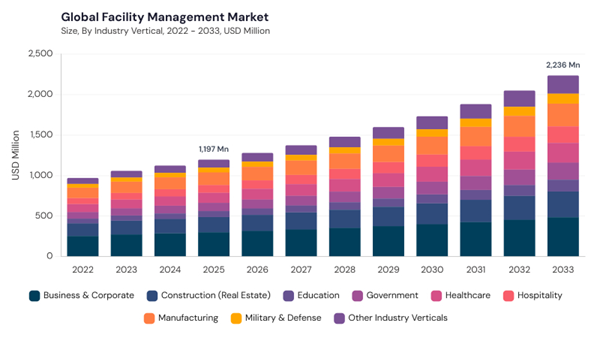
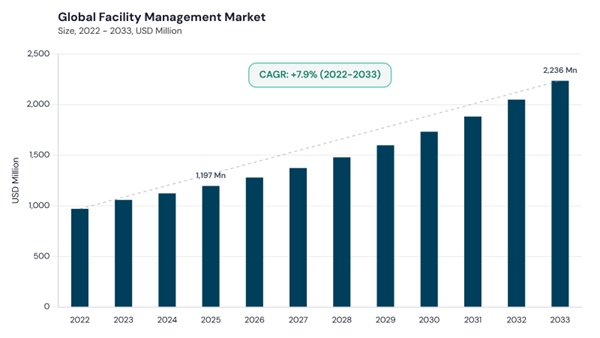
The Global Facility Management Market size is expected to reach USD 2.23 billion by 2033, rising at a market growth of 8.3% CAGR during the forecast period.
The market growth is driven by the increasing adoption of integrated facility management solutions, rapid digital transformation across commercial infrastructure, and rising emphasis on operational efficiency, sustainability, and smart building technologies. Organizations are increasingly deploying facility management solutions to optimize workplace operations, reduce maintenance costs, improve asset lifecycle management, and enhance occupant experience. In addition, the growing integration of IoT-enabled systems, predictive maintenance platforms, AI-driven analytics, and cloud-based facility management ecosystems is transforming traditional facility operations into intelligent, data-driven environments.
The market has evolved from fragmented manual maintenance operations toward integrated technology-enabled ecosystems combining hard services, soft services, building automation, predictive maintenance, and sustainability management. Increasing demand for outsourced facility management services, rising smart building adoption, and growing focus on ESG compliance and net-zero initiatives are further supporting market expansion globally.
Furthermore, rising emphasis on ESG compliance, carbon footprint reduction, workplace safety, and net-zero building initiatives is encouraging enterprises to invest in sustainable facility management strategies. The integration of predictive maintenance technologies, AI-powered monitoring systems, digital twins, and cloud-enabled workforce coordination platforms is transforming facility management into a strategic and data-driven business function, thereby supporting long-term market expansion across developed and emerging economies.
Sodexo S.A. accounted for approximately 10.6% market share in 2025, supported by its strong outsourced service portfolio and global operational footprint. ISS A/S and Aramark Corporation collectively reinforced the dominance of large-scale integrated service providers in outsourced facility management operations. Technology-focused players such as Johnson Controls International PLC, IBM Corporation, Oracle Corporation, and SAP SE are increasingly influencing market dynamics through smart building infrastructure, enterprise facility platforms, predictive maintenance systems, and integrated workplace management solutions.
The In-House segment recorded a significant market share in 2025 accounting for 42.24% share. Organizations operating in highly regulated sectors continue to prefer in-house facility management to maintain direct operational control, ensure compliance adherence, and protect sensitive operational data.
The Single segment continues to witness stable demand among enterprises requiring targeted and specialized facility services without adopting fully integrated management models. Businesses often prefer single-service contracts to retain flexibility and maintain focused operational management.
The Hard Services segment continues to witness strong growth supported by increasing demand for HVAC management, electrical maintenance, plumbing systems, fire safety management, and building infrastructure maintenance solutions. Growing smart building adoption and predictive maintenance integration are further supporting segment expansion.
The Construction (Real Estate) segment accounted for 15.650% share in 2025 driven by expanding residential and commercial infrastructure projects globally. The Manufacturing segment captured 13.068% share owing to increasing demand for maintenance-intensive industrial operations and infrastructure optimization services. Meanwhile, Healthcare, Government, Hospitality, Education, and Military & Defense sectors continue to adopt advanced facility management services to ensure safety, compliance, operational continuity, and sustainability.
Asia Pacific accounted for 29.54% share and is expected to witness strong growth supported by rapid urbanization, infrastructure development, smart city initiatives, and increasing investments in commercial real estate. Europe captured 27.57% share driven by sustainability regulations, green building adoption, and increasing deployment of integrated facility management solutions. Meanwhile, the LAMEA region continues to expand steadily owing to growing infrastructure development and increasing awareness regarding operational efficiency and workplace modernization.
Companies are differentiating themselves through IoT-enabled building management systems, AI-powered maintenance solutions, cloud-based facility management platforms, and ESG-focused operational strategies. Strategic partnerships, acquisitions, outsourcing contracts, and regional expansion initiatives remain core competitive strategies among major market participants. Additionally, the convergence of facility services with enterprise software platforms and digital infrastructure management is reshaping long-term competitive dynamics across the industry.
The market growth is driven by the increasing adoption of integrated facility management solutions, rapid digital transformation across commercial infrastructure, and rising emphasis on operational efficiency, sustainability, and smart building technologies. Organizations are increasingly deploying facility management solutions to optimize workplace operations, reduce maintenance costs, improve asset lifecycle management, and enhance occupant experience. In addition, the growing integration of IoT-enabled systems, predictive maintenance platforms, AI-driven analytics, and cloud-based facility management ecosystems is transforming traditional facility operations into intelligent, data-driven environments.
The market has evolved from fragmented manual maintenance operations toward integrated technology-enabled ecosystems combining hard services, soft services, building automation, predictive maintenance, and sustainability management. Increasing demand for outsourced facility management services, rising smart building adoption, and growing focus on ESG compliance and net-zero initiatives are further supporting market expansion globally.
Key Market Trends & Insights
- The North America Facility Management Market dominated the Global Market in 2025 accounting for 35.60% revenue share owing to strong adoption of outsourced and technology-enabled facility services.
- The Outsourced segment led the market by Offering in 2025 with 57.758% share and is projected to reach USD 1.21 billion by 2033.
- The Bundled segment dominated the Outsourced category in 2025 with 60.408% share due to increasing enterprise preference for integrated facility management contracts.
- The Soft Services segment is expected to attain USD 1.18 billion by 2033 driven by rising demand for cleaning, hygiene, catering, and security services.
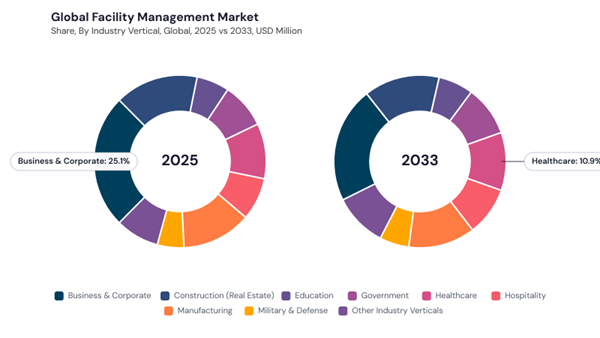
- The Business & Corporate segment accounted for 25.128% revenue share in 2025 owing to growing commercial infrastructure and workplace modernization initiatives.
- Asia Pacific is expected to witness the fastest CAGR of 9.4% during 2026-2033 supported by rapid urbanization and smart city investments.
- Increasing adoption of IoT-enabled predictive maintenance, AI-driven workplace analytics, and sustainability-focused building management solutions are emerging as major market growth accelerators.
Furthermore, rising emphasis on ESG compliance, carbon footprint reduction, workplace safety, and net-zero building initiatives is encouraging enterprises to invest in sustainable facility management strategies. The integration of predictive maintenance technologies, AI-powered monitoring systems, digital twins, and cloud-enabled workforce coordination platforms is transforming facility management into a strategic and data-driven business function, thereby supporting long-term market expansion across developed and emerging economies.
Driving and Restraining Factors
Drivers- Integration of smart technologies enhancing operational efficiency
- Rising emphasis on sustainability and environmental compliance
- Workforce management transformation and digital service coordination
- Growing demand for integrated facility management and outsourcing solutions
- High implementation and operational costs of advanced technologies
- Regulatory compliance complexity across regions
- Workforce skill gaps and resistance to technological change
- Adoption of digital twin technology for predictive facility management
- Integration of augmented reality for operational efficiency and workforce training
- Expansion of integrated facility management (IFM) models
- Technological integration and interoperability constraints
- Budgetary restrictions and cost management pressures
- Regulatory compliance and risk management complexities
Market Share Analysis
The Facility Management Market is characterized by moderate consolidation at the top level and significant fragmentation across regional and niche service providers. Global leaders compete through integrated service portfolios, digital building technologies, AI-enabled maintenance platforms, and sustainability-focused operational models.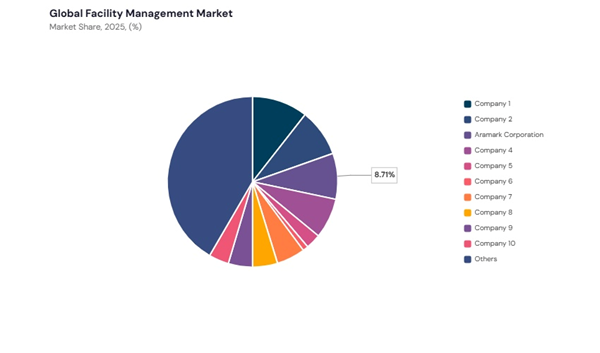
Sodexo S.A. accounted for approximately 10.6% market share in 2025, supported by its strong outsourced service portfolio and global operational footprint. ISS A/S and Aramark Corporation collectively reinforced the dominance of large-scale integrated service providers in outsourced facility management operations. Technology-focused players such as Johnson Controls International PLC, IBM Corporation, Oracle Corporation, and SAP SE are increasingly influencing market dynamics through smart building infrastructure, enterprise facility platforms, predictive maintenance systems, and integrated workplace management solutions.
Offering Outlook
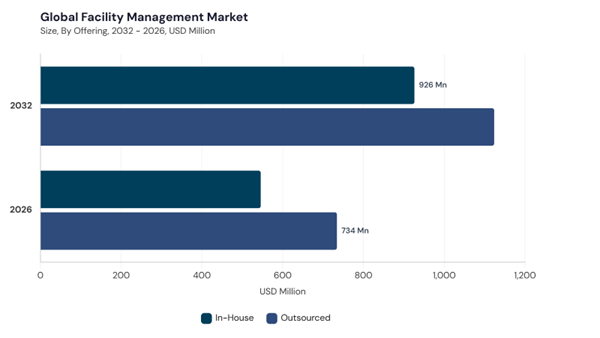
On the basis of Offering, the Facility Management Market is classified into Outsourced and In-House. The Outsourced segment acquired the largest revenue share in 2025 accounting for 57.758% of the global market and is projected to reach USD 1.21 billion by 2033. The growth of this segment is driven by increasing preference among organizations to outsource non-core operational activities in order to improve efficiency, optimize costs, and access specialized expertise.The In-House segment recorded a significant market share in 2025 accounting for 42.24% share. Organizations operating in highly regulated sectors continue to prefer in-house facility management to maintain direct operational control, ensure compliance adherence, and protect sensitive operational data.
Outsourced Outlook
Based on Outsourced services, the market is segmented into Bundled and Single. The Bundled segment dominated the market in 2025 accounting for 60.408% share owing to increasing demand for integrated facility management solutions delivered under unified contracts. Organizations are increasingly adopting bundled services to streamline vendor management, improve operational coordination, and achieve long-term cost efficiencies.The Single segment continues to witness stable demand among enterprises requiring targeted and specialized facility services without adopting fully integrated management models. Businesses often prefer single-service contracts to retain flexibility and maintain focused operational management.
Service Type Outlook
By Service Type, the Facility Management Market is segmented into Soft Services and Hard Services. The Soft Services segment dominated the market in 2025 accounting for 53.910% share and is projected to reach USD 1.18 billion by 2033. The segment growth is driven by rising demand for cleaning, security, catering, landscaping, waste management, and workplace hygiene services.The Hard Services segment continues to witness strong growth supported by increasing demand for HVAC management, electrical maintenance, plumbing systems, fire safety management, and building infrastructure maintenance solutions. Growing smart building adoption and predictive maintenance integration are further supporting segment expansion.
Industry Vertical Outlook
Based on Industry Vertical, the market is segmented into Business & Corporate, Construction (Real Estate), Manufacturing, Healthcare, Government, Hospitality, Education, Military & Defense, and Other Industry Verticals. The Business & Corporate segment dominated the market in 2025 accounting for 25.128% share due to the growing number of corporate offices and commercial workspaces requiring integrated facility management solutions.The Construction (Real Estate) segment accounted for 15.650% share in 2025 driven by expanding residential and commercial infrastructure projects globally. The Manufacturing segment captured 13.068% share owing to increasing demand for maintenance-intensive industrial operations and infrastructure optimization services. Meanwhile, Healthcare, Government, Hospitality, Education, and Military & Defense sectors continue to adopt advanced facility management services to ensure safety, compliance, operational continuity, and sustainability.
Regional Outlook
Region-wise, the Facility Management Market is analyzed across North America, Europe, Asia Pacific, and LAMEA. North America dominated the market in 2025 accounting for 35.60% share due to strong adoption of outsourced facility management services, smart building technologies, and integrated workplace management platforms.Asia Pacific accounted for 29.54% share and is expected to witness strong growth supported by rapid urbanization, infrastructure development, smart city initiatives, and increasing investments in commercial real estate. Europe captured 27.57% share driven by sustainability regulations, green building adoption, and increasing deployment of integrated facility management solutions. Meanwhile, the LAMEA region continues to expand steadily owing to growing infrastructure development and increasing awareness regarding operational efficiency and workplace modernization.
Market Competition and Attributes
The Facility Management Market is innovation-driven and highly service-intensive. Competition is increasingly centered around smart building integration, predictive maintenance capabilities, workplace analytics, sustainability-focused operations, and digitally enabled facility ecosystems.Companies are differentiating themselves through IoT-enabled building management systems, AI-powered maintenance solutions, cloud-based facility management platforms, and ESG-focused operational strategies. Strategic partnerships, acquisitions, outsourcing contracts, and regional expansion initiatives remain core competitive strategies among major market participants. Additionally, the convergence of facility services with enterprise software platforms and digital infrastructure management is reshaping long-term competitive dynamics across the industry.
List of Key Companies Profiled
- CBRE Group, Inc.
- Jones Lang LaSalle Incorporated (JLL)
- Sodexo
- ISS A/S
- Compass Group PLC
- Cushman & Wakefield plc
- Aramark Corporation
- Johnson Controls International plc
- Siemens AG
- Honeywell International Inc.
Market Report Segmentation
By Offering- In-House
- Outsourced
- Single
- Bundled
- Hard Services
- Soft Services
- Business & Corporate
- Construction (Real Estate)
- Manufacturing
- Healthcare
- Government
- Hospitality
- Education
- Military & Defense
- Other Industry Verticals
- North America
- US
- Canada
- Mexico
- Rest of North America
- Europe
- Germany
- UK
- France
- Russia
- Spain
- Italy
- Rest of Europe
- Asia Pacific
- China
- Japan
- India
- South Korea
- Singapore
- Malaysia
- Rest of Asia Pacific
- LAMEA
- Brazil
- Argentina
- UAE
- Saudi Arabia
- South Africa
- Nigeria
- Rest of LAMEA
Table of Contents
Chapter 1. Global Market Overview
Chapter 2. Key Factors Impacting Market
Chapter 5. Competition Analysis
Chapter 6. Segmentation By Offering
Chapter 7. Segmentation By Service Type
Chapter 8. Segmentation By Industry Vertical
Chapter 9. North America Market
Chapter 10. Europe Market
Chapter 11. Asia Pacific Market
Chapter 12. LAMEA Market
Chapter 13. Company Profiles
Companies Mentioned
- CBRE Group, Inc.
- Jones Lang LaSalle Incorporated (JLL)
- Sodexo
- ISS A/S
- Compass Group PLC
- Cushman & Wakefield plc
- Aramark Corporation
- Johnson Controls International plc
- Siemens AG
- Honeywell International Inc.


