



The Global Luxury Watch Market is expected to reach USD 23.66 billion by 2033, growing at a CAGR of 5% during 2026-2033.
The Global Luxury Watch Market continues to evolve as a premium segment within the luxury goods industry, driven by craftsmanship, exclusivity, technological advancement, and strong brand heritage. Luxury watches have transformed from traditional timekeeping instruments into symbols of prestige, personal achievement, and long-term value. The market is supported by growing consumer interest in collectible timepieces, limited-edition collections, and bespoke watchmaking services, while manufacturers continue to strengthen product differentiation through advanced materials, innovative complications, and superior craftsmanship.
The industry is also witnessing significant transformation through digitalization and sustainability initiatives. Luxury watchmakers are increasingly investing in blockchain authentication, digital ownership verification, AI-powered customer engagement, and omnichannel retail capabilities to enhance customer experiences and strengthen trust. At the same time, ethical sourcing, responsible manufacturing, and transparent supply chains are becoming increasingly important as consumers place greater emphasis on sustainability and brand accountability.
The leading players in the market are competing with diverse luxury portfolios, strong brand heritage, and continuous product innovation to maintain their competitive positions. Market participants continue to strengthen their presence through technological advancements, limited-edition launches, manufacturing investments, digital engagement initiatives, and strategic partnerships. The leading players of the market are adopting various strategies to address evolving consumer preferences and strengthen their global luxury positioning. The key developmental strategies in the market are Product Launches, Partnerships & Collaborations, Geographical Expansion, and Manufacturing Investments.
On the basis of product mode, the luxury watch market is classified into Mechanical and Electronic.
The Electronic market dominated the Global Luxury Watch Market by Product Mode in 2025, and is expected to continue to be a dominant market till 2033; thereby, achieving a market value of USD 14.72 billion by 2033, growing at a CAGR of 4.6 % during the forecast period. Additionally, the Mechanical market is expected to witness highest CAGR of 5.7% during 2026-2033.
Mechanical watches continue to represent the foundation of the luxury watch industry owing to their strong association with craftsmanship, exclusivity, heritage, and long-term value retention. These timepieces remain highly desirable among collectors and affluent consumers seeking precision engineering and artisanal excellence. Meanwhile, electronic luxury watches are gaining increasing acceptance as manufacturers integrate premium aesthetics with advanced digital functionalities, connectivity solutions, health monitoring capabilities, and personalized user experiences. Growing consumer preference for technologically enhanced luxury products continues to support innovation across both segments.
The Offline market dominated the Global Luxury Watch Market by Distribution Channel in 2025, and is expected to continue to be a dominant market till 2033; thereby, achieving a market value of USD 16.77 billion by 2033, growing at a CAGR of 4.6 % during the forecast period. Additionally, the Online market is expected to witness highest CAGR of 5.9% during 2026-2033.
Offline channels continue to play a critical role due to the importance of personalized consultations, physical product evaluation, authentication assurance, and immersive luxury retail experiences. Brand boutiques, authorized retailers, and premium department stores remain essential for customer acquisition and long-term relationship management. At the same time, online channels are experiencing strong momentum as luxury brands expand e-commerce capabilities, virtual consultations, digital authentication solutions, and omnichannel retail strategies to enhance accessibility and customer engagement.
Region-wise, the Luxury Watch Market is analyzed across North America, Europe, Asia Pacific, and LAMEA.
The North America market dominated the Global Luxury Watch Market by Region in 2025, and is expected to continue to be a dominant market till 2033; thereby, achieving a market value of USD 7.61 billion by 2033, growing at a CAGR of 4.4 % during the forecast period. The Europe market is expected to witness a CAGR of 4.8% during 2026-2033. Additionally, the Asia Pacific market is expected to witness a CAGR of 5.5% during 2026-2033.
North America remains a significant market supported by strong consumer spending on premium lifestyle products and an established luxury retail ecosystem. Europe continues to maintain a strong position due to its rich watchmaking heritage, concentration of leading manufacturers, and appreciation for craftsmanship and engineering excellence. Asia Pacific is emerging as a highly influential market driven by rising disposable incomes, expanding affluent populations, growing brand consciousness, and increasing luxury consumption. Meanwhile, LAMEA continues to present new growth opportunities supported by urbanization, improving economic conditions, expanding luxury retail infrastructure, and rising awareness of international luxury brands.
Luxury Watch Market Coverage:
The Global Luxury Watch Market continues to evolve as a premium segment within the luxury goods industry, driven by craftsmanship, exclusivity, technological advancement, and strong brand heritage. Luxury watches have transformed from traditional timekeeping instruments into symbols of prestige, personal achievement, and long-term value. The market is supported by growing consumer interest in collectible timepieces, limited-edition collections, and bespoke watchmaking services, while manufacturers continue to strengthen product differentiation through advanced materials, innovative complications, and superior craftsmanship.
Key Market Trends & Insights
- Growing demand for luxury watches as collectible and investment-oriented assets.
- Rising adoption of blockchain-enabled authentication and ownership verification technologies.
- Increasing popularity of certified pre-owned luxury watch programs.
- Expansion of personalized and bespoke luxury watchmaking services.
- Growing integration of advanced digital technologies within luxury retail experiences.
- Rising focus on sustainability, ethical sourcing, and supply chain transparency.
- Increasing investments in omnichannel retail and direct-to-consumer initiatives.
- Strong consumer interest in limited-edition and exclusive watch collections.
The industry is also witnessing significant transformation through digitalization and sustainability initiatives. Luxury watchmakers are increasingly investing in blockchain authentication, digital ownership verification, AI-powered customer engagement, and omnichannel retail capabilities to enhance customer experiences and strengthen trust. At the same time, ethical sourcing, responsible manufacturing, and transparent supply chains are becoming increasingly important as consumers place greater emphasis on sustainability and brand accountability.
Driving and Restraining Factors
Drivers- Integration of Digital and Blockchain Technologies Enhancing Authenticity and Customer Engagement
- Rising Demand from Younger Demographics Reframes Market Dynamics and Expands Investment Appeal
- Impact of Economic and Market Stabilization Enhances Predictability and Investor Confidence
- Expansion of Customized and Experiential Luxury Services Deepens Consumer Loyalty and Market Differentiation
- High Production and Operational Costs Limiting Market Expansion
- Regulatory and Authentication Challenges Impeding Market Trust and Expansion
- Digital Transformation Barriers Due to Consumer Behavior and Technological Integration
- Integration of Blockchain for Authenticity and Digital Ownership in Luxury Watches
- Expansion of Certified Pre-Owned Luxury Watches to Capture Investment-Minded Consumers
- Leveraging Personalized Digital Experiences to Enhance Customer Engagement and Brand Differentiation
- Authentication Complexity and Counterfeiting Risks
- Sustainability and Ethical Supply Chain Integration
- Advanced Digital Integration and Consumer Experience Personalization
Market Share Analysis
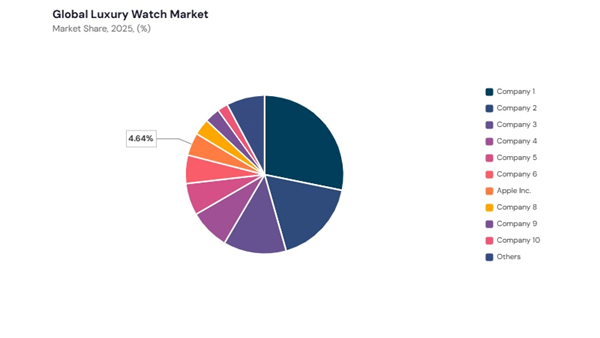
The leading players in the market are competing with diverse luxury portfolios, strong brand heritage, and continuous product innovation to maintain their competitive positions. Market participants continue to strengthen their presence through technological advancements, limited-edition launches, manufacturing investments, digital engagement initiatives, and strategic partnerships. The leading players of the market are adopting various strategies to address evolving consumer preferences and strengthen their global luxury positioning. The key developmental strategies in the market are Product Launches, Partnerships & Collaborations, Geographical Expansion, and Manufacturing Investments.
Product Mode Outlook
On the basis of product mode, the luxury watch market is classified into Mechanical and Electronic.
The Electronic market dominated the Global Luxury Watch Market by Product Mode in 2025, and is expected to continue to be a dominant market till 2033; thereby, achieving a market value of USD 14.72 billion by 2033, growing at a CAGR of 4.6 % during the forecast period. Additionally, the Mechanical market is expected to witness highest CAGR of 5.7% during 2026-2033.
Mechanical watches continue to represent the foundation of the luxury watch industry owing to their strong association with craftsmanship, exclusivity, heritage, and long-term value retention. These timepieces remain highly desirable among collectors and affluent consumers seeking precision engineering and artisanal excellence. Meanwhile, electronic luxury watches are gaining increasing acceptance as manufacturers integrate premium aesthetics with advanced digital functionalities, connectivity solutions, health monitoring capabilities, and personalized user experiences. Growing consumer preference for technologically enhanced luxury products continues to support innovation across both segments.
Distribution Channel Outlook
By distribution channel, the luxury watch market is divided into Online and Offline.The Offline market dominated the Global Luxury Watch Market by Distribution Channel in 2025, and is expected to continue to be a dominant market till 2033; thereby, achieving a market value of USD 16.77 billion by 2033, growing at a CAGR of 4.6 % during the forecast period. Additionally, the Online market is expected to witness highest CAGR of 5.9% during 2026-2033.
Offline channels continue to play a critical role due to the importance of personalized consultations, physical product evaluation, authentication assurance, and immersive luxury retail experiences. Brand boutiques, authorized retailers, and premium department stores remain essential for customer acquisition and long-term relationship management. At the same time, online channels are experiencing strong momentum as luxury brands expand e-commerce capabilities, virtual consultations, digital authentication solutions, and omnichannel retail strategies to enhance accessibility and customer engagement.
Regional Outlook
Region-wise, the Luxury Watch Market is analyzed across North America, Europe, Asia Pacific, and LAMEA.
The North America market dominated the Global Luxury Watch Market by Region in 2025, and is expected to continue to be a dominant market till 2033; thereby, achieving a market value of USD 7.61 billion by 2033, growing at a CAGR of 4.4 % during the forecast period. The Europe market is expected to witness a CAGR of 4.8% during 2026-2033. Additionally, the Asia Pacific market is expected to witness a CAGR of 5.5% during 2026-2033.
North America remains a significant market supported by strong consumer spending on premium lifestyle products and an established luxury retail ecosystem. Europe continues to maintain a strong position due to its rich watchmaking heritage, concentration of leading manufacturers, and appreciation for craftsmanship and engineering excellence. Asia Pacific is emerging as a highly influential market driven by rising disposable incomes, expanding affluent populations, growing brand consciousness, and increasing luxury consumption. Meanwhile, LAMEA continues to present new growth opportunities supported by urbanization, improving economic conditions, expanding luxury retail infrastructure, and rising awareness of international luxury brands.
Luxury Watch Market Coverage:
Recent Strategies Deployed in the Market
- Richemont continued strengthening its luxury watch and jewelry portfolio through strategic investments and operational optimization initiatives.
- Audemars Piguet announced the opening of an advanced manufacturing facility designed to improve precision watchmaking efficiency and production innovation.
- Audemars Piguet introduced new watchmaking innovations and commemorative collections to celebrate its historical heritage and strengthen collector engagement.
- LVMH expanded investments in AI-powered personalization, digital customer engagement technologies, and luxury retail innovation across its premium watch portfolio.
- Richard Mille strengthened its luxury lifestyle positioning through partnerships with prestigious sporting and luxury events.
- Audemars Piguet expanded its after-sales service infrastructure through the establishment of a regional service center aimed at improving customer support capabilities.
List of Key Companies Profiled
- Rolex SA
- Compagnie Financière Richemont SA
- The Swatch Group Ltd.
- LVMH
- Patek Philippe
- Audemars Piguet
- Apple Inc.
- Richard Mille
- Breitling SA
- Chopard Group
Market Report Segmentation
By Product Mode- Mechanical
- Electronic
- Online
- Offline
- North America
- US
- Canada
- Mexico
- Rest of North America
- Europe
- Germany
- UK
- France
- Russia
- Spain
- Italy
- Rest of Europe
- Asia Pacific
- China
- Japan
- India
- South Korea
- Singapore
- Malaysia
- Rest of Asia Pacific
- LAMEA
- Brazil
- Argentina
- UAE
- Saudi Arabia
- South Africa
- Nigeria
- Rest of LAMEA
Table of Contents
Chapter 1. Research Scope & Methodology
Chapter 2. Market Overview
Chapter 3. Key Factors Impacting Market
Chapter 4. Competition Analysis - Global
Chapter 5. Segmentation By Product Mode
Chapter 6. Segmentation By Distribution Channel
Chapter 7. North America Market
Chapter 8. Europe Market
Chapter 9. Asia Pacific Market
Chapter 10. LAMEA Market
Chapter 11. Company Snapshot
Companies Mentioned
• Rolex SA• Compagnie Financière Richemont SA
• The Swatch Group Ltd.
• LVMH
• Patek Philippe
• Audemars Piguet
• Apple Inc.
• Richard Mille
• Breitling SA
• Chopard Group


