



The Asia Pacific AI Code Assistants Market would reach USD 6.46 billion by 2030, growing at a CAGR of 22.5% during the forecast period.
The China market dominated the Asia Pacific AI Code Assistants Market by country in 2025 and is expected to continue to be a dominant market till 2030, thereby achieving a market value of USD 1.70 billion by 2030. The Japan market is expected to witness a CAGR of 21.6% during the forecast period. Additionally, the India market is expected to witness a CAGR of 23.2% during the forecast period.
The Asia Pacific AI Code Assistants Market is witnessing rapid growth owing to increasing adoption of AI-powered software development tools across enterprises, startups, and developer communities. The growing digital transformation initiatives across major economies such as China, Japan, India, South Korea, Singapore, and Malaysia are accelerating demand for intelligent coding solutions capable of improving productivity, reducing software development cycles, and enhancing code quality.
The market is also benefiting from rising investments in cloud infrastructure, increasing adoption of DevOps methodologies, and expansion of software outsourcing industries throughout the region. Governments across Asia Pacific are supporting AI innovation through national AI strategies, digital economy initiatives, and investments in next-generation computing technologies.
Japan is witnessing substantial growth driven by enterprise modernization, automation initiatives, and increasing adoption of AI-driven software engineering tools across industrial and corporate sectors. India is emerging as one of the fastest-growing markets owing to its expanding software development industry, large developer base, and rising adoption of generative AI technologies.
The China market dominated the Asia Pacific AI Code Assistants Market by country in 2025 and is expected to continue to be a dominant market till 2030, thereby achieving a market value of USD 1.70 billion by 2030. The Japan market is expected to witness a CAGR of 21.6% during the forecast period. Additionally, the India market is expected to witness a CAGR of 23.2% during the forecast period.
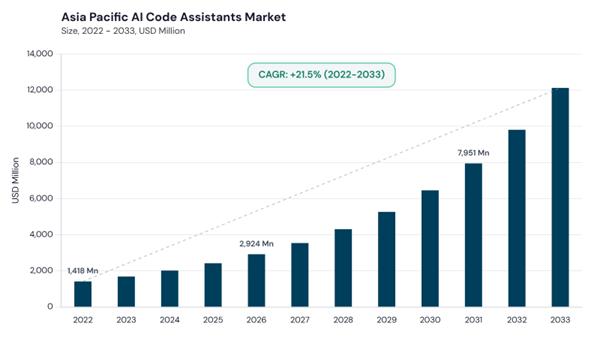
The Asia Pacific AI Code Assistants Market is witnessing rapid growth owing to increasing adoption of AI-powered software development tools across enterprises, startups, and developer communities. The growing digital transformation initiatives across major economies such as China, Japan, India, South Korea, Singapore, and Malaysia are accelerating demand for intelligent coding solutions capable of improving productivity, reducing software development cycles, and enhancing code quality.
The market is also benefiting from rising investments in cloud infrastructure, increasing adoption of DevOps methodologies, and expansion of software outsourcing industries throughout the region. Governments across Asia Pacific are supporting AI innovation through national AI strategies, digital economy initiatives, and investments in next-generation computing technologies.
Component Outlook
Based on Component, the market is segmented into Software and Services. The Software segment dominated the Asia Pacific AI Code Assistants Market with a market value of USD 1.90 billion in 2025 owing to increasing deployment of AI-powered coding platforms and automation tools across enterprises. Meanwhile, the Services segment is expected to witness a CAGR of 23.6% during the forecast period due to growing demand for consulting, deployment, support, and integration services.End-User Outlook
Based on End-User, the market is segmented into Large Enterprises, Small & Medium Enterprises, and Individual Developers. The Large Enterprises segment dominated the market with a market value of USD 1.45 billion in 2025 due to strong investments in enterprise AI transformation and software automation initiatives. Meanwhile, the Individual Developers segment is expected to witness a CAGR of 23.6% during the forecast period owing to increasing use of AI coding assistants among freelancers and independent programmers.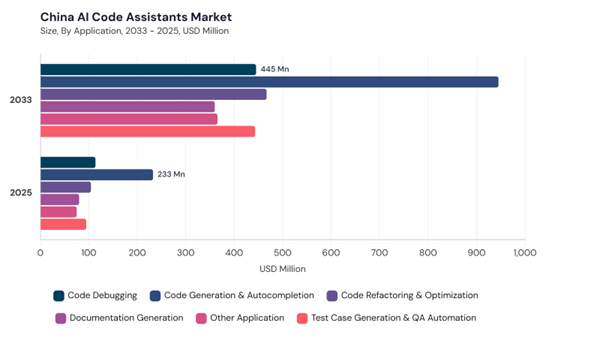
Deployment Mode Outlook
Based on Deployment Mode, the market is segmented into Cloud-Based and On-Premises. The Cloud-Based segment dominated the Asia Pacific AI Code Assistants Market with a market share of 73.1% in 2025 owing to rising adoption of SaaS-based development platforms and scalable cloud infrastructure. However, the On-Premises segment is expected to witness a CAGR of 23.2% during the forecast period due to increasing concerns regarding data privacy and enterprise security compliance.Application Outlook
Based on Application, the market is segmented into Code Generation & Autocompletion, Code Debugging, Code Refactoring & Optimization, Test Case Generation & QA Automation, Documentation Generation, and Other Applications. The Code Generation & Autocompletion segment dominated the market with a market value of USD 809.75 million in 2025 owing to increasing utilization of generative AI for software development acceleration. Meanwhile, the Other Applications segment is expected to witness the highest CAGR of 24.4% during the forecast period due to expanding AI integration across advanced software engineering processes.Country Outlook
China continues to dominate the Asia Pacific AI Code Assistants Market due to rapid AI adoption, expanding cloud computing infrastructure, and increasing investments in intelligent software development ecosystems. The country’s growing technology sector and strong government support for AI innovation are significantly contributing to market expansion.Japan is witnessing substantial growth driven by enterprise modernization, automation initiatives, and increasing adoption of AI-driven software engineering tools across industrial and corporate sectors. India is emerging as one of the fastest-growing markets owing to its expanding software development industry, large developer base, and rising adoption of generative AI technologies.
List of Key Companies Profiled
- Microsoft Corporation
- GitHub, Inc.
- Amazon Web Services, Inc.
- Google LLC
- IBM Corporation
- OpenAI, LLC
- Tabnine Ltd.
- Replit, Inc.
- Sourcegraph, Inc.
- JetBrains s.r.o.
Market Report Segmentation
By Component- Software
- Services
- Large Enterprises
- Small & Medium Enterprises
- Individual Developers
- Cloud-Based
- On-Premises
- Code Generation & Autocompletion
- Code Debugging
- Code Refactoring & Optimization
- Test Case Generation & QA Automation
- Documentation Generation
- Other Applications
- China
- Japan
- India
- South Korea
- Singapore
- Malaysia
- Rest of Asia Pacific
Table of Contents
Chapter 1. Asia Pacific Market1.1 Market Overview
1.2 Key Factors Impacting Market
1.2.1 Market Drivers
1.2.2 Market Restraints
1.2.3 Market Opportunities
1.2.4 Market Challenges
1.2.5 Market Trends
1.2.6 State of Competition
1.2.7 Market Consolidation
1.2.8 Key Customer Criteria
1.3 Product Life Cycle
1.4 Segmentation By Component
1.4.1 Software
1.4.2 Services
1.5 Segmentation By Deployment Mode
1.5.1 Cloud-Based
1.5.2 On-Premises
1.6 Segmentation By Application
1.6.1 Code Generation & Autocompletion
1.6.2 Code Debugging
1.6.3 Test Case Generation & QA Automation
1.6.4 Documentation Generation
1.6.5 Code Refactoring & Optimization
1.6.6 Other Application
1.7 Segmentation By End-User
1.7.1 Large Enterprises
1.7.2 Small & Medium Enterprises
1.7.3 Individual Developers
1.8 Segmentation By Country
1.8.1 China
1.8.1.1 Segmentation By Component
1.8.1.1.1 Software
1.8.1.1.2 Services
1.8.1.2 Segmentation By End-User
1.8.1.2.1 Large Enterprises
1.8.1.2.2 Small & Medium Enterprises
1.8.1.2.3 Individual Developers
1.8.1.3 Segmentation By Deployment Mode
1.8.1.3.1 Cloud-Based
1.8.1.3.2 On-Premises
1.8.1.3.3 Segmentation By Application
1.8.1.3.4 Code Generation & Autocompletion
1.8.1.3.5 Code Debugging
1.8.1.3.6 Code Refactoring & Optimization
1.8.1.3.7 Test Case Generation & QA Automation
1.8.1.3.8 Documentation Generation
1.8.1.3.9 Other Application
1.8.2 Japan
1.8.2.1 Segmentation By Component
1.8.2.1.1 Software
1.8.2.1.2 Services
1.8.2.2 Segmentation By End-User
1.8.2.2.1 Large Enterprises
1.8.2.2.2 Small & Medium Enterprises
1.8.2.2.3 Individual Developers
1.8.2.3 Segmentation By Deployment Mode
1.8.2.3.1 Cloud-Based
1.8.2.3.2 On-Premises
1.8.2.3.3 Segmentation By Application
1.8.2.3.4 Code Generation & Autocompletion
1.8.2.3.5 Code Debugging
1.8.2.3.6 Code Refactoring & Optimization
1.8.2.3.7 Test Case Generation & QA Automation
1.8.2.3.8 Documentation Generation
1.8.2.3.9 Other Application
1.8.3 India
1.8.3.1 Segmentation By Component
1.8.3.1.1 Software
1.8.3.1.2 Services
1.8.3.2 Segmentation By End-User
1.8.3.2.1 Large Enterprises
1.8.3.2.2 Small & Medium Enterprises
1.8.3.2.3 Individual Developers
1.8.3.3 Segmentation By Deployment Mode
1.8.3.3.1 Cloud-Based
1.8.3.3.2 On-Premises
1.8.3.3.3 Segmentation By Application
1.8.3.3.4 Code Generation & Autocompletion
1.8.3.3.5 Code Debugging
1.8.3.3.6 Code Refactoring & Optimization
1.8.3.3.7 Test Case Generation & QA Automation
1.8.3.3.8 Documentation Generation
1.8.3.3.9 Other Application
1.8.4 South Korea
1.8.4.1 Segmentation By Component
1.8.4.1.1 Software
1.8.4.1.2 Services
1.8.4.2 Segmentation By End-User
1.8.4.2.1 Large Enterprises
1.8.4.2.2 Small & Medium Enterprises
1.8.4.2.3 Individual Developers
1.8.4.3 Segmentation By Deployment Mode
1.8.4.3.1 Cloud-Based
1.8.4.3.2 On-Premises
1.8.4.3.3 Segmentation By Application
1.8.4.3.4 Code Generation & Autocompletion
1.8.4.3.5 Code Debugging
1.8.4.3.6 Code Refactoring & Optimization
1.8.4.3.7 Test Case Generation & QA Automation
1.8.4.3.8 Documentation Generation
1.8.4.3.9 Other Application
1.8.5 Singapore
1.8.5.1 Segmentation By Component
1.8.5.1.1 Software
1.8.5.1.2 Services
1.8.5.2 Segmentation By End-User
1.8.5.2.1 Large Enterprises
1.8.5.2.2 Small & Medium Enterprises
1.8.5.2.3 Individual Developers
1.8.5.3 Segmentation By Deployment Mode
1.8.5.3.1 Cloud-Based
1.8.5.3.2 On-Premises
1.8.5.3.3 Segmentation By Application
1.8.5.3.4 Code Generation & Autocompletion
1.8.5.3.5 Code Debugging
1.8.5.3.6 Code Refactoring & Optimization
1.8.5.3.7 Test Case Generation & QA Automation
1.8.5.3.8 Documentation Generation
1.8.5.3.9 Other Application
1.8.6 Malaysia
1.8.6.1 Segmentation By Component
1.8.6.1.1 Software
1.8.6.1.2 Services
1.8.6.2 Segmentation By End-User
1.8.6.2.1 Large Enterprises
1.8.6.2.2 Small & Medium Enterprises
1.8.6.2.3 Individual Developers
1.8.6.3 Segmentation By Deployment Mode
1.8.6.3.1 Cloud-Based
1.8.6.3.2 On-Premises
1.8.6.3.3 Segmentation By Application
1.8.6.3.4 Code Generation & Autocompletion
1.8.6.3.5 Code Debugging
1.8.6.3.6 Code Refactoring & Optimization
1.8.6.3.7 Test Case Generation & QA Automation
1.8.6.3.8 Documentation Generation
1.8.6.3.9 Other Application
1.8.7 Rest of Asia Pacific
1.8.7.1 Segmentation By Component
1.8.7.1.1 Software
1.8.7.1.2 Services
1.8.7.2 Segmentation By End-User
1.8.7.2.1 Large Enterprises
1.8.7.2.2 Small & Medium Enterprises
1.8.7.2.3 Individual Developers
1.8.7.3 Segmentation By Deployment Mode
1.8.7.3.1 Cloud-Based
1.8.7.3.2 On-Premises
1.8.7.3.3 Segmentation By Application
1.8.7.3.4 Code Generation & Autocompletion
1.8.7.3.5 Code Debugging
1.8.7.3.6 Code Refactoring & Optimization
1.8.7.3.7 Test Case Generation & QA Automation
1.8.7.3.8 Documentation Generation
1.8.7.3.9 Other Application
Chapter 2. Company Snapshot
2.1 Microsoft Corporation
2.1.1 Business Overview
2.1.2 Company Profile
2.1.3 Company Focus on AI Code Assistants Market
2.1.4 Strategic Insights on AI Code Assistants Market
2.1.5 Strategy Deployed for AI Code Assistants Market
2.1.6 Product & Service Portfolio
2.1.7 Capability Overview
2.1.8 Technology & Innovation Focus
2.1.9 Customers / End Users
2.1.10 Competitive Positioning
2.1.11 Key Differentiators
2.1.12 Portfolio Matrix
2.1.13 SWOT Analysis (AI Code Assistants Market)
2.1.14 Future Outlook for AI Code Assistants Market
2.2 OpenAI, LLC
2.2.1 Business Overview
2.2.2 Company Profile
2.2.3 Company Focus on AI Code Assistants Market
2.2.4 Strategic Insights on AI Code Assistants Market
2.2.5 Strategy Deployed for AI Code Assistants Market
2.2.6 Product & Service Portfolio
2.2.7 Capability Overview
2.2.8 Technology & Innovation Focus
2.2.9 Customers / End Users
2.2.10 Competitive Positioning
2.2.11 Key Differentiators
2.2.12 Portfolio Matrix
2.2.13 SWOT Analysis (AI Code Assistants Market)
2.2.14 Future Outlook for AI Code Assistants Market
2.3 Google LLC (Alphabet Inc.)
2.3.1 Business Overview
2.3.2 Company Profile
2.3.3 Company Focus on AI Code Assistants Market
2.3.4 Strategic Insights on AI Code Assistants Market
2.3.5 Strategy Deployed for AI Code Assistants Market
2.3.6 Product & Service Portfolio
2.3.7 Capability Overview
2.3.8 Technology & Innovation Focus
2.3.9 Customers / End Users
2.3.10 Competitive Positioning
2.3.11 Key Differentiators
2.3.12 Portfolio Matrix
2.3.13 SWOT Analysis (AI Code Assistants Market)
2.3.14 Future Outlook for AI Code Assistants Market
2.4 Amazon Web Services, Inc. (Amazon.com, Inc.)
2.4.1 Business Overview
2.4.2 Company Profile
2.4.3 Company Focus on AI Code Assistants Market
2.4.4 Strategic Insights on AI Code Assistants Market
2.4.5 Strategy Deployed for AI Code Assistants Market
2.4.6 Product & Service Portfolio
2.4.7 Capability Overview
2.4.8 Technology & Innovation Focus
2.4.9 Customers / End Users
2.4.10 Competitive Positioning
2.4.11 Key Differentiators
2.4.12 Portfolio Matrix
2.4.13 SWOT Analysis (AI Code Assistants Market)
2.4.14 Future Outlook for AI Code Assistants Market
2.5 Anthropic PBC
2.5.1 Business Overview
2.5.2 Company Profile
2.5.3 Company Focus on AI Code Assistants Market
2.5.4 Strategic Insights on AI Code Assistants Market
2.5.5 Strategy Deployed for AI Code Assistants Market
2.5.6 Product & Service Portfolio
2.5.7 Capability Overview
2.5.8 Technology & Innovation Focus
2.5.9 Customers / End Users
2.5.10 Competitive Positioning
2.5.11 Key Differentiators
2.5.12 Portfolio Matrix
2.5.13 SWOT Analysis (AI Code Assistants Market)
2.5.14 Future Outlook for AI Code Assistants Market
2.6 Anysphere, Inc.
2.6.1 Company Profile
2.6.2 Company Focus on AI Code Assistants Market
2.6.3 Strategic Insights on AI Code Assistants Market
2.6.4 Strategy Deployed for AI Code Assistants Market
2.6.5 Product & Service Portfolio
2.6.6 Capability Overview
2.6.7 Technology & Innovation Focus
2.6.8 Customers / End Users
2.6.9 Competitive Positioning
2.6.10 Key Differentiators
2.6.11 Portfolio Matrix
2.6.12 SWOT Analysis (AI Code Assistants Market)
2.6.13 Future Outlook for AI Code Assistants Market
2.7 Tabnine Ltd.
2.7.1 Business Overview
2.7.2 Company Profile
2.7.3 Company Focus on AI Code Assistants Market
2.7.4 Strategic Insights on AI Code Assistants Market
2.7.5 Strategy Deployed for AI Code Assistants Market
2.7.6 Product & Service Portfolio
2.7.7 Capability Overview
2.7.8 Technology & Innovation Focus
2.7.9 Customers / End Users
2.7.10 Competitive Positioning
2.7.11 Key Differentiators
2.7.12 Portfolio Matrix
2.7.13 SWOT Analysis (AI Code Assistants Market)
2.7.14 Future Outlook for AI Code Assistants Market
2.8 Replit, Inc.
2.8.1 Business Overview
2.8.2 Company Profile
2.8.3 Company Focus on AI Code Assistants Market
2.8.4 Strategic Insights on AI Code Assistants Market
2.8.5 Strategy Deployed for AI Code Assistants Market
2.8.6 Product & Service Portfolio
2.8.7 Capability Overview
2.8.8 Technology & Innovation Focus
2.8.9 Customers / End Users
2.8.10 Competitive Positioning
2.8.11 Key Differentiators
2.8.12 Portfolio Matrix
2.8.13 SWOT Analysis (AI Code Assistants Market)
2.8.14 Future Outlook for AI Code Assistants Market
2.9 Cognition AI, Inc.
2.9.1 Business Overview
2.9.2 Company Profile
2.9.3 Company Focus on AI Code Assistants Market
2.9.4 Strategic Insights on AI Code Assistants Market
2.9.5 Strategy Deployed for AI Code Assistants Market
2.9.6 Product & Service Portfolio
2.9.7 Capability Overview
2.9.8 Technology & Innovation Focus
2.9.9 Customers / End Users
2.9.10 Competitive Positioning
2.9.11 Key Differentiators
2.9.12 Portfolio Matrix
2.9.13 SWOT Analysis (AI Code Assistants Market)
2.9.14 Future Outlook for AI Code Assistants Market
2.10 Alibaba Cloud (Alibaba Group Holding Limited)
2.10.1 Business Overview
2.10.2 Company Profile
2.10.3 Company Focus on AI Code Assistants Market
2.10.4 Strategic Insights on AI Code Assistants Market
2.10.5 Strategy Deployed for AI Code Assistants Market
2.10.6 Product & Service Portfolio
2.10.7 Capability Overview
2.10.8 Technology & Innovation Focus
2.10.9 Customers / End Users
2.10.10 Competitive Positioning
2.10.11 Key Differentiators
2.10.12 Portfolio Matrix
2.10.13 SWOT Analysis (AI Code Assistants Market)
2.10.14 Future Outlook for AI Code Assistants Market
Companies Mentioned
- Microsoft Corporation
- GitHub, Inc.
- Amazon Web Services, Inc.
- Google LLC
- IBM Corporation
- OpenAI, LLC
- Tabnine Ltd.
- Replit, Inc.
- Sourcegraph, Inc.
- JetBrains s.r.o.


