



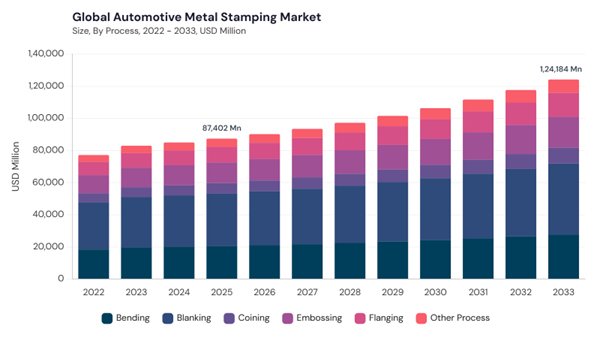
The Global Automotive Metal Stamping Market is expected to reach USD 124.18 billion by 2033, growing at a CAGR of 4.7% during the forecast period.
The market growth is driven by increasing automotive production, rising demand for lightweight vehicle structures, and growing adoption of advanced high-strength steel and aluminum stamping technologies. Automotive manufacturers are increasingly utilizing precision stamping processes to improve structural integrity, reduce vehicle weight, and comply with stringent fuel efficiency and emission regulations. In addition, the rapid expansion of electric vehicle manufacturing is accelerating demand for stamped battery enclosures, lightweight chassis systems, and structural body components globally.
The market has evolved significantly from conventional press-based component manufacturing toward highly automated and digitally integrated stamping ecosystems. Manufacturers are increasingly integrating robotics, servo presses, CAD/CAM-enabled die systems, AI-based predictive maintenance, and Industry 4.0 manufacturing technologies to improve operational efficiency, precision, and production scalability. Growing investments in hot stamping, lightweight materials, and sustainable metal forming technologies are further transforming the competitive landscape of the automotive metal stamping industry.
Technological advancements such as automation, AI-enabled process monitoring, servo press integration, digital twin simulation, and predictive maintenance platforms are enabling manufacturers to improve productivity, reduce material waste, and enhance manufacturing flexibility. The integration of advanced high-strength steel, aluminum alloys, and sustainable manufacturing technologies is also strengthening the market’s position within the broader automotive manufacturing ecosystem.
Magna International led the market with approximately 12.64% market share owing to its extensive global manufacturing footprint, advanced structural component capabilities, and strong OEM partnerships followed by Gestamp supported by its expertise in lightweight body structures, hot stamping technologies, and advanced vehicle safety components. AISIN Corporation accounted for more than 5% market share due to its diversified automotive component manufacturing capabilities and strong OEM relationships.
Other major participants include Benteler Group, Martinrea International, Voestalpine AG, Minth Group, Thyssenkrupp AG, Hirotec Corporation, and Autokiniton Global Group. These companies continue investing heavily in robotics, high-strength alloy processing, EV structural systems, and automation technologies to strengthen long-term market positioning.
The region is expected to reach USD 47.92 billion by 2033. Europe accounted for a significant market share and is anticipated to witness a CAGR of 4.3% during 2026-2033 driven by strong adoption of lightweight vehicle structures, sustainability regulations, and EV production growth. Meanwhile, the LAMEA market is expected to register the highest CAGR of 6.2% during the forecast period supported by increasing automotive assembly operations and infrastructure development activities.
Technological innovation in servo press systems, predictive maintenance, digital manufacturing platforms, and sustainable metal forming technologies is increasingly becoming a major competitive differentiator. Strategic collaborations with automotive OEMs, alloy suppliers, EV manufacturers, and industrial automation companies are also shaping the future competitive landscape of the market.
The market growth is driven by increasing automotive production, rising demand for lightweight vehicle structures, and growing adoption of advanced high-strength steel and aluminum stamping technologies. Automotive manufacturers are increasingly utilizing precision stamping processes to improve structural integrity, reduce vehicle weight, and comply with stringent fuel efficiency and emission regulations. In addition, the rapid expansion of electric vehicle manufacturing is accelerating demand for stamped battery enclosures, lightweight chassis systems, and structural body components globally.
The market has evolved significantly from conventional press-based component manufacturing toward highly automated and digitally integrated stamping ecosystems. Manufacturers are increasingly integrating robotics, servo presses, CAD/CAM-enabled die systems, AI-based predictive maintenance, and Industry 4.0 manufacturing technologies to improve operational efficiency, precision, and production scalability. Growing investments in hot stamping, lightweight materials, and sustainable metal forming technologies are further transforming the competitive landscape of the automotive metal stamping industry.
Key Market Trends & Insights
- Asia Pacific dominated the Automotive Metal Stamping Market in 2025 accounting for 37.45% revenue share.
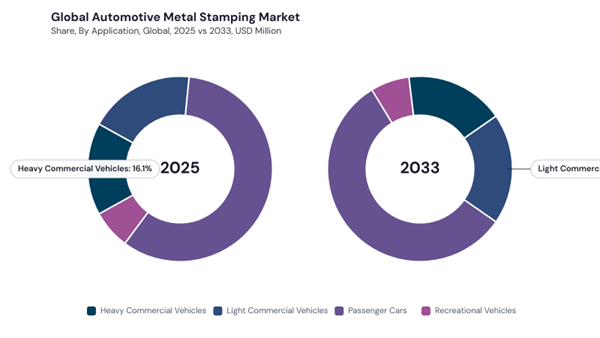
- The Passenger Cars segment emerged as the leading Application segment with 58.57% revenue share in 2025.
- The Blanking segment dominated the Process segmentation with 37.42% market share in 2025.
- North America is projected to reach USD 28.14 billion by 2033.
- The Heavy Commercial Vehicles segment is expected to register a CAGR of 5.6% during 2026-2033.
- Automation-enabled stamping systems, lightweight materials, and EV component manufacturing are emerging as major industry trends.
Technological advancements such as automation, AI-enabled process monitoring, servo press integration, digital twin simulation, and predictive maintenance platforms are enabling manufacturers to improve productivity, reduce material waste, and enhance manufacturing flexibility. The integration of advanced high-strength steel, aluminum alloys, and sustainable manufacturing technologies is also strengthening the market’s position within the broader automotive manufacturing ecosystem.
Driving and Restraining Factors
Drivers- Increasing automotive production and vehicle electrification
- Rising demand for lightweight and fuel-efficient vehicle structures
- Growing adoption of automation and Industry 4.0 manufacturing systems
- Advancements in high-strength steel and aluminum forming technologies
- High capital investment associated with advanced stamping systems
- Volatility in raw material pricing and supply chains
- Complex die manufacturing and maintenance requirements
- Expansion of electric vehicle manufacturing globally
- Increasing adoption of lightweight aluminum stamped components
- Growth in automated and AI-enabled stamping technologies
- Maintaining dimensional accuracy in lightweight materials
- Rising energy consumption and operational costs
- Managing complex supply chains for automotive-grade metals
Market Share Analysis
The Automotive Metal Stamping Market demonstrates a moderately fragmented competitive landscape characterized by the presence of global automotive component manufacturers, regional stamping companies, and specialized precision metal forming providers. Companies are competing aggressively through automation adoption, lightweight material expertise, advanced die technologies, and long-term OEM supply agreements.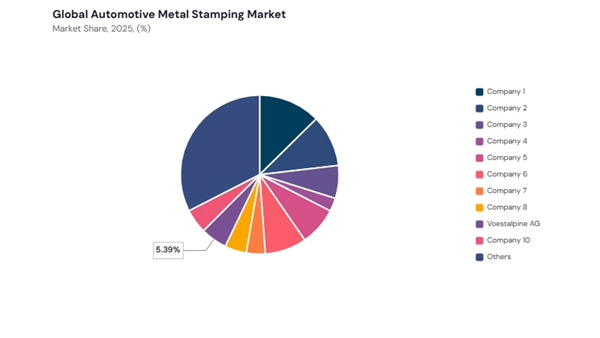
Magna International led the market with approximately 12.64% market share owing to its extensive global manufacturing footprint, advanced structural component capabilities, and strong OEM partnerships followed by Gestamp supported by its expertise in lightweight body structures, hot stamping technologies, and advanced vehicle safety components. AISIN Corporation accounted for more than 5% market share due to its diversified automotive component manufacturing capabilities and strong OEM relationships.
Other major participants include Benteler Group, Martinrea International, Voestalpine AG, Minth Group, Thyssenkrupp AG, Hirotec Corporation, and Autokiniton Global Group. These companies continue investing heavily in robotics, high-strength alloy processing, EV structural systems, and automation technologies to strengthen long-term market positioning.
Application Outlook
Based on Application, the market is segmented into Passenger Cars, Light Commercial Vehicles, Heavy Commercial Vehicles, and Recreational Vehicles. The Passenger Cars segment dominated the market in 2025 with 58.57% revenue share owing to rising global passenger vehicle production and increasing use of lightweight stamped structural components. The segment is expected to reach USD 70.33 billion by 2033. Meanwhile, the Light Commercial Vehicles segment is anticipated to witness a CAGR of 5.2% during the forecast period supported by increasing logistics and e-commerce transportation demand. Additionally, the Heavy Commercial Vehicles segment is projected to register the highest CAGR of 5.6% during 2026-2033 due to expanding infrastructure development and freight transportation activities globally.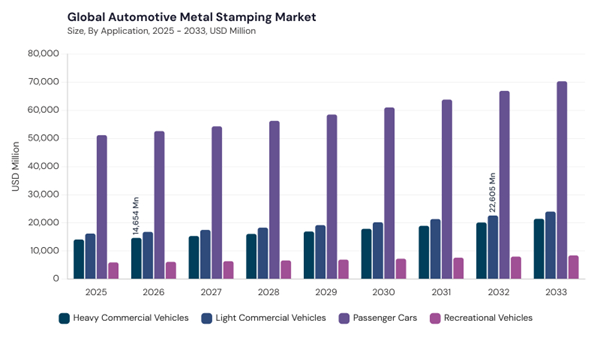
Process Outlook
Based on Process, the market is segmented into Blanking, Bending, Embossing, Flanging, Coining, and Other Process. The Blanking segment accounted for the highest revenue share of 37.42% in 2025 due to strong demand for precision sheet cutting and high-volume automotive manufacturing operations. The segment is projected to reach USD 44.06 billion by 2033. The Bending segment is anticipated to witness a CAGR of 4.0% during the forecast period due to growing complexity in vehicle body structures and chassis reinforcement applications. Meanwhile, the Embossing segment is expected to register a CAGR of 5.4% during 2026-2033 owing to rising adoption of component rigidity enhancement and lightweight reinforcement technologies.Regional Outlook
Region-wise, the market is analyzed across North America, Europe, Asia Pacific, and LAMEA. Asia Pacific dominated the Automotive Metal Stamping Market in 2025 accounting for 37.45% revenue share due to rapid automotive manufacturing expansion, increasing industrial automation, and strong presence of automotive OEMs across China, Japan, India, and South Korea.The region is expected to reach USD 47.92 billion by 2033. Europe accounted for a significant market share and is anticipated to witness a CAGR of 4.3% during 2026-2033 driven by strong adoption of lightweight vehicle structures, sustainability regulations, and EV production growth. Meanwhile, the LAMEA market is expected to register the highest CAGR of 6.2% during the forecast period supported by increasing automotive assembly operations and infrastructure development activities.
Market Competition and Attributes
The Automotive Metal Stamping Market is highly technology-driven and manufacturing-intensive. Competition is centered around lightweight materials, automation integration, die precision, EV structural component capabilities, and large-scale manufacturing efficiency. Manufacturers are focusing heavily on robotic stamping systems, hot stamping technologies, AI-enabled production monitoring, and advanced alloy processing to strengthen operational productivity and OEM relationships.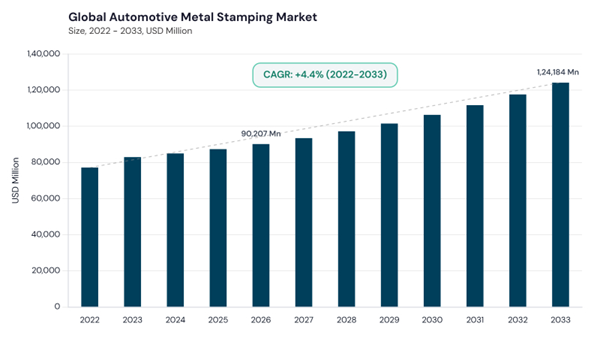
Technological innovation in servo press systems, predictive maintenance, digital manufacturing platforms, and sustainable metal forming technologies is increasingly becoming a major competitive differentiator. Strategic collaborations with automotive OEMs, alloy suppliers, EV manufacturers, and industrial automation companies are also shaping the future competitive landscape of the market.
Recent Strategies Deployed in the Market
- Mar-2026: Gestamp expanded hot stamping production capacity targeting lightweight EV body structures.
- Jan-2026: Magna International strengthened robotic stamping operations across North American facilities.
- Nov-2025: Benteler Group introduced advanced aluminum structural stamping solutions for EV platforms.
- Aug-2025: AISIN Corporation enhanced automation-enabled precision metal forming technologies.
- June-2025: Martinrea International expanded lightweight chassis component manufacturing capabilities for electric vehicles.
List of Key Companies Profiled
- Magna International Inc.
- Gestamp Automoción S.A.
- AISIN Corporation
- Benteler International AG
- Martinrea International Inc.
- Voestalpine AG
- Minth Group Limited
- Thyssenkrupp AG
- Hirotec Corporation
- Autokiniton Global Group
Market Report Segmentation
By Application- Passenger Cars
- Light Commercial Vehicles
- Heavy Commercial Vehicles
- Recreational Vehicles
- Blanking
- Bending
- Embossing
- Flanging
- Coining
- Other Process
- North America
- US
- Canada
- Mexico
- Rest of North America
- Europe
- Germany
- UK
- France
- Italy
- Spain
- Rest of Europe
- Asia Pacific
- China
- Japan
- India
- South Korea
- Australia
- Rest of Asia Pacific
- LAMEA
- Brazil
- UAE
- Saudi Arabia
- South Africa
- Rest of LAMEA
Table of Contents
Chapter 1. Market Overview
Chapter 2. Key Factors Impacting Market
Chapter 6. Segmentation By Process
Chapter 7. Segmentation By Application
Chapter 8. North America Market
Chapter 9. Europe Market
Chapter 10. Asia Pacific Market
Chapter 11. LAMEA Market
Chapter 12. Company Snapshot
Companies Mentioned
- Magna International Inc.
- Gestamp Automoción S.A.
- AISIN Corporation
- Benteler International AG
- Martinrea International Inc.
- Voestalpine AG
- Minth Group Limited
- Thyssenkrupp AG
- Hirotec Corporation
- Autokiniton Global Group


