



The Asia Pacific Compliance as a Service Market size is expected to reach USD 2.79 billion by 2030, rising at a market growth of 10.4% CAGR during the forecast period.
The China market dominated the Asia Pacific Compliance as a Service Market by country in 2025, and is expected to continue to be a dominant market till 2030; thereby, achieving a market value of USD 683.9 million by 2030. The Japan market is expected to witness a CAGR of 9.6% during 2025-2030. Additionally, the India market is expected to witness a CAGR of 11.1% during 2025-2030.
The Asia Pacific Compliance as a Service market has evolved rapidly due to the region’s increasing digital transformation, rising cybersecurity threats, and expanding regulatory complexity across multiple jurisdictions. Initially, organizations relied heavily on manual compliance processes and localized regulatory management frameworks.
AI-powered compliance monitoring, cloud-based governance platforms, and automated regulatory reporting systems are becoming increasingly prominent across the region. Organizations are increasingly utilizing predictive analytics, machine learning, and real-time monitoring tools to streamline risk management, reduce operational complexity, and strengthen regulatory adherence. The BFSI, healthcare, telecommunications, manufacturing, and retail sectors are major adopters of compliance as a service solutions due to growing pressure to maintain operational transparency, secure customer data, and comply with evolving regulatory mandates.
The Private Cloud market is expected to witness a CAGR of 11.0% during 2025-2030 due to increasing concerns regarding data sovereignty, cybersecurity, and operational control. Enterprises operating in highly regulated sectors such as BFSI, healthcare, and government are increasingly investing in private cloud compliance environments to strengthen data protection and regulatory transparency.
The Hybrid Cloud segment is anticipated to witness strong growth throughout the forecast period owing to its ability to provide scalability, operational flexibility, and enhanced security across distributed enterprise environments.
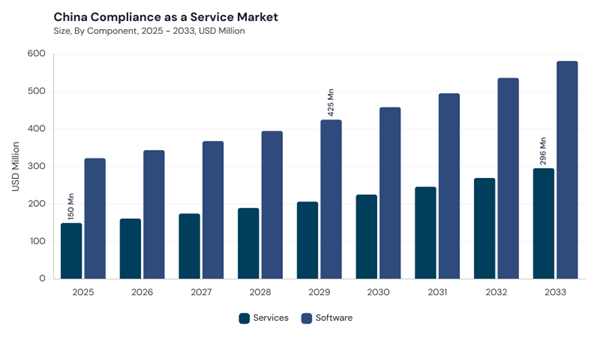
The Services market is expected to witness a CAGR of 11.2% during 2025-2030 due to increasing demand for managed compliance services, implementation support, consulting, and regulatory advisory solutions.
The Small & Medium Enterprises (SMEs) segment is expected to witness a CAGR of 11% during 2025-2030 owing to rising awareness regarding cybersecurity, data privacy, and affordable cloud-based compliance solutions.
The Regulatory Compliance market dominated the Asia Pacific Compliance as a Service Market by Type in 2025 due to increasing regulatory complexity across industries including BFSI, manufacturing, healthcare, and telecommunications.
The Data Protection & Privacy Compliance segment is expected to witness a CAGR of 10.2% during 2025-2030 due to rising concerns regarding data security, digital privacy regulations, and cybersecurity mandates across APAC countries.
The BFSI segment dominated the Asia Pacific Compliance as a Service Market by End Use in 2025 due to increasing financial regulations, digital banking expansion, fraud prevention requirements, and cybersecurity compliance mandates.
The IT & Telecom segment is expected to witness a CAGR of 9.2% during 2025-2030 due to increasing cloud adoption, data privacy regulations, AI governance requirements, and growing cybersecurity investments.
Japan is witnessing strong adoption of compliance as a service solutions due to increasing investments in AI governance, financial compliance automation, and cybersecurity modernization. Enterprises are increasingly focusing on predictive analytics, cloud-based compliance systems, and operational risk management frameworks.
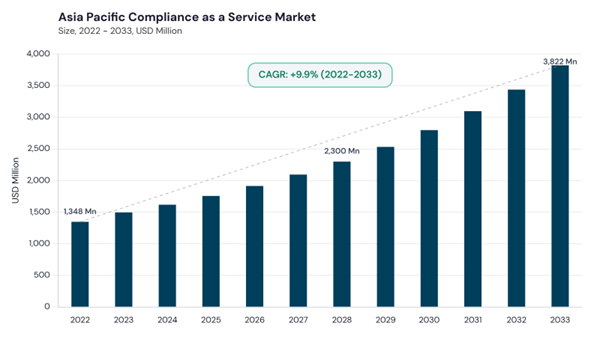
The China market dominated the Asia Pacific Compliance as a Service Market by country in 2025, and is expected to continue to be a dominant market till 2030; thereby, achieving a market value of USD 683.9 million by 2030. The Japan market is expected to witness a CAGR of 9.6% during 2025-2030. Additionally, the India market is expected to witness a CAGR of 11.1% during 2025-2030.
The Asia Pacific Compliance as a Service market has evolved rapidly due to the region’s increasing digital transformation, rising cybersecurity threats, and expanding regulatory complexity across multiple jurisdictions. Initially, organizations relied heavily on manual compliance processes and localized regulatory management frameworks.
AI-powered compliance monitoring, cloud-based governance platforms, and automated regulatory reporting systems are becoming increasingly prominent across the region. Organizations are increasingly utilizing predictive analytics, machine learning, and real-time monitoring tools to streamline risk management, reduce operational complexity, and strengthen regulatory adherence. The BFSI, healthcare, telecommunications, manufacturing, and retail sectors are major adopters of compliance as a service solutions due to growing pressure to maintain operational transparency, secure customer data, and comply with evolving regulatory mandates.
Deployment Outlook
Based on Deployment Mode, the market is segmented into Public Cloud, Private Cloud, and Hybrid Cloud. The Public Cloud market dominated the Asia Pacific Compliance as a Service Market by Deployment Mode in 2025 due to increasing adoption of scalable cloud infrastructure, rising enterprise digitalization, and growing demand for cost-efficient compliance management systems.The Private Cloud market is expected to witness a CAGR of 11.0% during 2025-2030 due to increasing concerns regarding data sovereignty, cybersecurity, and operational control. Enterprises operating in highly regulated sectors such as BFSI, healthcare, and government are increasingly investing in private cloud compliance environments to strengthen data protection and regulatory transparency.
The Hybrid Cloud segment is anticipated to witness strong growth throughout the forecast period owing to its ability to provide scalability, operational flexibility, and enhanced security across distributed enterprise environments.
Component Outlook
Based on Component, the market is segmented into Software and Services. The Software market dominated the Asia Pacific Compliance as a Service Market by Component in 2025 owing to increasing implementation of AI-powered compliance automation software, predictive risk analytics, cloud-native governance systems, and real-time regulatory intelligence platforms.The Services market is expected to witness a CAGR of 11.2% during 2025-2030 due to increasing demand for managed compliance services, implementation support, consulting, and regulatory advisory solutions.
Enterprise Size Outlook
Based on Enterprise Size, the market is segmented into Large Enterprises and Small & Medium Enterprises (SMEs). The Large Enterprises market dominated the Asia Pacific Compliance as a Service Market by Enterprise Size in 2025 due to increasing investments in enterprise-wide governance frameworks, AI-driven compliance automation, and cross-border regulatory management systems.The Small & Medium Enterprises (SMEs) segment is expected to witness a CAGR of 11% during 2025-2030 owing to rising awareness regarding cybersecurity, data privacy, and affordable cloud-based compliance solutions.
Type Outlook
Based on Type, the market is segmented into Regulatory Compliance, Data Protection & Privacy Compliance, Financial Compliance, Risk & Corporate Governance Compliance, and Other Type.The Regulatory Compliance market dominated the Asia Pacific Compliance as a Service Market by Type in 2025 due to increasing regulatory complexity across industries including BFSI, manufacturing, healthcare, and telecommunications.
The Data Protection & Privacy Compliance segment is expected to witness a CAGR of 10.2% during 2025-2030 due to rising concerns regarding data security, digital privacy regulations, and cybersecurity mandates across APAC countries.
End Use Outlook
Based on End Use, the market is segmented into BFSI, IT & Telecom, Healthcare, Government & Public Sector, Retail & E-commerce, Manufacturing, Energy & Utilities, and Other End Uses.The BFSI segment dominated the Asia Pacific Compliance as a Service Market by End Use in 2025 due to increasing financial regulations, digital banking expansion, fraud prevention requirements, and cybersecurity compliance mandates.
The IT & Telecom segment is expected to witness a CAGR of 9.2% during 2025-2030 due to increasing cloud adoption, data privacy regulations, AI governance requirements, and growing cybersecurity investments.
Country Outlook
China represents the largest market for Compliance as a Service in Asia Pacific due to rapid enterprise digitalization, increasing cybersecurity regulations, and expanding cloud infrastructure investments. Organizations across BFSI, telecommunications, manufacturing, and e-commerce sectors are increasingly implementing AI-powered compliance management platforms to strengthen governance and improve operational transparency.Japan is witnessing strong adoption of compliance as a service solutions due to increasing investments in AI governance, financial compliance automation, and cybersecurity modernization. Enterprises are increasingly focusing on predictive analytics, cloud-based compliance systems, and operational risk management frameworks.
List of Key Companies Profiled
- IBM Corporation
- Oracle Corporation
- SAP SE
- Microsoft Corporation
- Salesforce, Inc.
- Thomson Reuters Corporation
- Wolters Kluwer N.V.
- Deloitte Touche Tohmatsu Limited
- Accenture PLC
- Ernst & Young Global Limited
Market Report Segmentation
By Component- Software
- Services
- Public Cloud
- Private Cloud
- Hybrid Cloud
- Large Enterprises
- Small & Medium Enterprises (SMEs)
- Regulatory Compliance
- Data Protection & Privacy Compliance
- Financial Compliance
- Risk & Corporate Governance Compliance
- Other Type
- BFSI
- IT & Telecom
- Healthcare
- Government & Public Sector
- Retail & E-commerce
- Manufacturing
- Energy & Utilities
- Other End Uses
- China
- Japan
- India
- South Korea
- Singapore
- Malaysia
- Rest of Asia Pacific
Table of Contents
Chapter 1. Asia Pacific Market1.1 Market Overview
1.2 Key Factors Impacting Market
1.2.1 Market Drivers
1.2.2 Market Restraints
1.2.3 Market Opportunities
1.2.4 Market Challenges
1.2.5 Market Trends
1.2.6 State of Competition
1.2.7 Market Consolidation
1.2.8 Key Customer Criteria
1.3 Product Life Cycle
1.4 Segmentation By Component
1.4.1 Software
1.4.2 Services
1.5 Segmentation By Type
1.5.1 Regulatory Compliance
1.5.2 Data Protection & Privacy Compliance
1.6 Financial Compliance
1.6.1 Risk & Corporate Governance Compliance
1.6.2 Other Type
1.7 Segmentation By Deployment Mode
1.7.1 Public Cloud
1.8 Private Cloud
1.8.1 Hybrid Cloud
1.9 Segmentation By Enterprise Size
1.9.1 Small & Medium Enterprises (SMEs)
1.9.2 Large Enterprises
1.10 Segmentation By End Use
1.10.1 BFSI
1.10.2 Retail & E-commerce
1.10.3 Healthcare
1.10.4 IT & Telecom
1.10.5 Government & Public Sector
1.10.6 Manufacturing
1.10.7 Energy & Utilities
1.10.8 Other End Use
1.11 Segmentation By Country
1.11.1 China
1.11.1.1 Segmentation By Component
1.11.1.1.1 Software
1.11.1.1.2 Services
1.11.1.2 Segmentation By Type
1.11.1.2.1 Regulatory Compliance
1.11.1.2.2 Data Protection & Privacy Compliance
1.11.1.2.3 Financial Compliance
1.11.1.2.4 Risk & Corporate Governance Compliance
1.11.1.2.5 Other Type
1.11.1.3 Segmentation By Deployment Mode
1.11.1.3.1 Public Cloud
1.11.1.3.2 Private Cloud
1.11.1.3.3 Hybrid Cloud
1.11.1.4 Segmentation By Enterprise Size
1.11.1.4.1 Small & Medium Enterprises (SMEs)
1.11.1.4.2 Large Enterprises
1.11.1.5 Segmentation By End Use
1.11.1.5.1 BFSI
1.11.1.5.2 Retail & E-commerce
1.11.1.5.3 Healthcare
1.11.1.5.4 IT & Telecom
1.11.1.5.5 Government & Public Sector
1.11.1.5.6 Manufacturing
1.11.1.5.7 Energy & Utilities
1.11.1.5.8 Other End Uses
1.11.2 Japan
1.11.2.1 Segmentation By Component
1.11.2.1.1 Software
1.11.2.1.2 Services
1.11.2.2 Segmentation By Type
1.11.2.2.1 Regulatory Compliance
1.11.2.2.2 Data Protection & Privacy Compliance
1.11.2.2.3 Financial Compliance
1.11.2.2.4 Risk & Corporate Governance Compliance
1.11.2.2.5 Other Type
1.11.2.3 Segmentation By Deployment Mode
1.11.2.3.1 Public Cloud
1.11.2.3.2 Private Cloud
1.11.2.3.3 Hybrid Cloud
1.11.2.4 Segmentation By Enterprise Size
1.11.2.4.1 Small & Medium Enterprises (SMEs)
1.11.2.4.2 Large Enterprises
1.11.2.5 Segmentation By End Use
1.11.2.5.1 BFSI
1.11.2.5.2 Retail & E-commerce
1.11.2.5.3 Healthcare
1.11.2.5.4 IT & Telecom
1.11.2.5.5 Government & Public Sector
1.11.2.5.6 Manufacturing
1.11.2.5.7 Energy & Utilities
1.11.2.5.8 Other End Uses
1.11.3 India
1.11.3.1 Segmentation By Component
1.11.3.1.1 Software
1.11.3.1.2 Services
1.11.3.2 Segmentation By Type
1.11.3.2.1 Regulatory Compliance
1.11.3.2.2 Data Protection & Privacy Compliance
1.11.3.2.3 Financial Compliance
1.11.3.2.4 Risk & Corporate Governance Compliance
1.11.3.2.5 Other Type
1.11.3.3 Segmentation By Deployment Mode
1.11.3.3.1 Public Cloud
1.11.3.3.2 Private Cloud
1.11.3.3.3 Hybrid Cloud
1.11.3.4 Segmentation By Enterprise Size
1.11.3.4.1 Small & Medium Enterprises (SMEs)
1.11.3.4.2 Large Enterprises
1.11.3.5 Segmentation By End Use
1.11.3.5.1 BFSI
1.11.3.5.2 Retail & E-commerce
1.11.3.5.3 Healthcare
1.11.3.5.4 IT & Telecom
1.11.3.5.5 Government & Public Sector
1.11.3.5.6 Manufacturing
1.11.3.5.7 Energy & Utilities
1.11.3.5.8 Other End Uses
1.11.4 South Korea
1.11.4.1 Segmentation By Component
1.11.4.1.1 Software
1.11.4.1.2 Services
1.11.4.2 Segmentation By Type
1.11.4.2.1 Regulatory Compliance
1.11.4.2.2 Data Protection & Privacy Compliance
1.11.4.2.3 Financial Compliance
1.11.4.2.4 Risk & Corporate Governance Compliance
1.11.4.2.5 Other Type
1.11.4.3 Segmentation By Deployment Mode
1.11.4.3.1 Public Cloud
1.11.4.3.2 Private Cloud
1.11.4.3.3 Hybrid Cloud
1.11.4.4 Segmentation By Enterprise Size
1.11.4.4.1 Small & Medium Enterprises (SMEs)
1.11.4.4.2 Large Enterprises
1.11.4.5 Segmentation By End Use
1.11.4.5.1 BFSI
1.11.4.5.2 Retail & E-commerce
1.11.4.5.3 Healthcare
1.11.4.5.4 IT & Telecom
1.11.4.5.5 Government & Public Sector
1.11.4.5.6 Manufacturing
1.11.4.5.7 Energy & Utilities
1.11.4.5.8 Other End Uses
1.11.5 Singapore
1.11.5.1 Segmentation By Component
1.11.5.1.1 Software
1.11.5.1.2 Services
1.11.5.2 Segmentation By Type
1.11.5.2.1 Regulatory Compliance
1.11.5.2.2 Data Protection & Privacy Compliance
1.11.5.2.3 Financial Compliance
1.11.5.2.4 Risk & Corporate Governance Compliance
1.11.5.2.5 Other Type
1.11.5.3 Segmentation By Deployment Mode
1.11.5.3.1 Public Cloud
1.11.5.3.2 Private Cloud
1.11.5.3.3 Hybrid Cloud
1.11.5.4 Segmentation By Enterprise Size
1.11.5.4.1 Small & Medium Enterprises (SMEs)
1.11.5.4.2 Large Enterprises
1.11.5.5 Segmentation By End Use
1.11.5.5.1 BFSI
1.11.5.5.2 Retail & E-commerce
1.11.5.5.3 Healthcare
1.11.5.5.4 IT & Telecom
1.11.5.5.5 Government & Public Sector
1.11.5.5.6 Manufacturing
1.11.5.5.7 Energy & Utilities
1.11.5.5.8 Other End Uses
1.11.6 Malaysia
1.11.6.1 Segmentation By Component
1.11.6.1.1 Software
1.11.6.1.2 Services
1.11.6.2 Segmentation By Type
1.11.6.2.1 Regulatory Compliance
1.11.6.2.2 Data Protection & Privacy Compliance
1.11.6.2.3 Financial Compliance
1.11.6.2.4 Risk & Corporate Governance Compliance
1.11.6.2.5 Other Type
1.11.6.3 Segmentation By Deployment Mode
1.11.6.3.1 Public Cloud
1.11.6.3.2 Private Cloud
1.11.6.3.3 Hybrid Cloud
1.11.6.4 Segmentation By Enterprise Size
1.11.6.4.1 Small & Medium Enterprises (SMEs)
1.11.6.4.2 Large Enterprises
1.11.6.5 Segmentation By End Use
1.11.6.5.1 BFSI
1.11.6.5.2 Retail & E-commerce
1.11.6.5.3 Healthcare
1.11.6.5.4 IT & Telecom
1.11.6.5.5 Government & Public Sector
1.11.6.5.6 Manufacturing
1.11.6.5.7 Energy & Utilities
1.11.6.5.8 Other End Uses
1.11.7 Rest of Asia Pacific
1.11.7.1 Segmentation By Component
1.11.7.1.1 Software
1.11.7.1.2 Services
1.11.7.2 Segmentation By Type
1.11.7.2.1 Regulatory Compliance
1.11.7.2.2 Data Protection & Privacy Compliance
1.11.7.2.3 Financial Compliance
1.11.7.2.4 Risk & Corporate Governance Compliance
1.11.7.2.5 Other Type
1.11.7.3 Segmentation By Deployment Mode
1.11.7.3.1 Public Cloud
1.11.7.3.2 Private Cloud
1.11.7.3.3 Hybrid Cloud
1.11.7.4 Segmentation By Enterprise Size
1.11.7.4.1 Small & Medium Enterprises (SMEs)
1.11.7.4.2 Large Enterprises
1.11.7.5 Segmentation By End Use
1.11.7.5.1 BFSI
1.11.7.5.2 Retail & E-commerce
1.11.7.5.3 Healthcare
1.11.7.5.4 IT & Telecom
1.11.7.5.5 Government & Public Sector
1.11.7.5.6 Manufacturing
1.11.7.5.7 Energy & Utilities
1.11.7.5.8 Other End Uses
Chapter 2. Company Profiles
2.1 IBM Corporation
2.1.1 Company Overview
2.1.2 Financial Analysis
2.1.3 Segmental and Regional Analysis
2.1.2 Research & Development Expenses
2.1.5 Company Focus
2.1.6 Strategic Insights
2.1.7 Strategy Deployed
2.1.8 SWOT Analysis
2.1.9 Future Outlook
2.2 Microsoft Corporation
2.2.1 Company Overview
2.2.2 Financial Analysis
2.2.3 Segmental and Regional Analysis
2.2.2 Research & Development Expenses
2.2.5 Recent Strategies and Developments
2.2.5.1 Product Launches and Product Expansions
2.2.6 Company Focus
2.2.7 Strategic Insights
2.2.8 Strategy Deployed
2.2.9 SWOT Analysis
2.2.10 Future Outlook
2.3 Oracle Corporation
2.3.1 Company Overview
2.3.2 Financial Analysis
2.3.3 Segmental and Regional Analysis
2.3.2 Research & Development Expenses
2.3.5 Recent Strategies and Developments
2.3.5.1 Product Launches and Product Expansions
2.3.6 Company Focus
2.3.7 Strategic Insights
2.3.8 Strategy Deployed
2.3.9 SWOT Analysis
2.3.10 Future Outlook
2.2 SAP SE
2.2.1 Company Overview
2.2.2 Financial Analysis
2.2.3 Segmental and Regional Analysis
2.2.2 Research & Development Expenses
2.2.5 Company Focus
2.2.6 Strategic Insights
2.2.7 Strategy Deployed
2.2.8 SWOT Analysis
2.2.9 Future Outlook
2.5 Thomson Reuters Corporation
2.5.1 Company Overview
2.5.2 Financial Analysis
2.5.3 Segmental and Regional Analysis
2.5.2 Recent Strategies and Developments
2.5.2.1 Partnerships, Collaborations, and Agreements
2.5.2.2 Product Launches and Product Expansions
2.5.5 Company Focus
2.5.6 Strategic Insights
2.5.7 Strategy Deployed
2.5.8 SWOT Analysis
2.5.9 Future Outlook
2.6 Deloitte Touche Tohmatsu Limited
2.6.1 Company Overview
2.6.2 Company Focus
2.6.3 Strategic Insights
2.6.2 Strategy Deployed
2.6.5 SWOT Analysis
2.6.6 Future Outlook
2.7 PricewaterhouseCoopers AG
2.7.1 Company Overview
2.7.2 Company Focus
2.7.3 Strategic Insights
2.7.2 Strategy Deployed
2.7.5 SWOT Analysis
2.7.6 Future Outlook
2.8 KPMG International Limited
2.8.1 Company Overview
2.8.2 Company Focus
2.8.3 Strategic Insights
2.8.2 Strategy Deployed
2.8.5 SWOT Analysis
2.8.6 Future Outlook
2.9 Ernst & Young Global Limited
2.9.1 Company Overview
2.9.2 Recent Strategies and Developments
2.9.2.1 Partnerships, Collaborations, and Agreements
2.9.3 Company Focus
2.9.2 Strategic Insights
2.9.5 Strategy Deployed
2.9.6 SWOT Analysis
2.9.7 Future Outlook
2.1 ServiceNow, Inc.
2.10.1 Company Overview
2.10.2 Financial Analysis
2.10.3 Segmental and Regional Analysis
2.10.2 Research & Development Expenses
2.10.5 Company Focus
2.10.6 Strategic Insights
2.10.7 Strategy Deployed
2.10.8 SWOT Analysis
2.10.9 Future Outlook
Companies Mentioned
- IBM Corporation
- Oracle Corporation
- SAP SE
- Microsoft Corporation
- Salesforce, Inc.
- Thomson Reuters Corporation
- Wolters Kluwer N.V.
- Deloitte Touche Tohmatsu Limited
- Accenture PLC
- Ernst & Young Global Limited


