



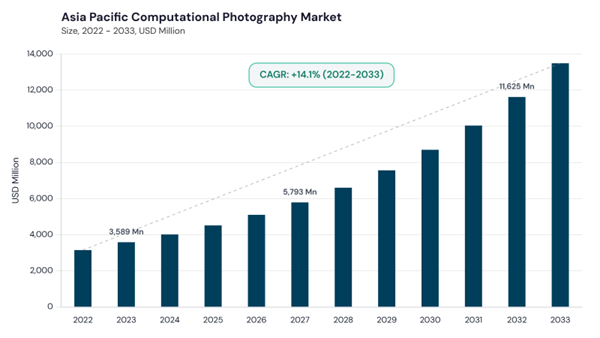
The Asia Pacific Computational Photography Market size is projected to reach USD 8.70 billion by 2030, rising at a market growth of 14.9% CAGR during the forecast period.
The China market dominated the Asia Pacific Computational Photography Market by country in 2025 and is expected to continue to be a dominant market till 2031. The Japan market is expected to witness substantial growth during the forecast period. Additionally, the India market is expected to witness the highest CAGR during 2026-2033. South Korea, Singapore, Malaysia, and Rest of Asia Pacific are also emerging as promising markets due to rapid adoption of AI-enabled imaging technologies, strong smartphone penetration, and expanding investments in immersive digital ecosystems.
The Asia Pacific computational photography market is experiencing strong growth driven by the rapid adoption of advanced imaging technologies across smartphones, consumer electronics, automotive systems, industrial automation, surveillance solutions, and immersive digital platforms. The region has emerged as a global hub for computational imaging innovation due to its strong electronics manufacturing ecosystem, rising AI adoption, and increasing consumer demand for high-quality digital imaging experiences. Computational photography technologies are increasingly being integrated into devices and applications to enhance image quality, improve low-light performance, support depth sensing, and enable advanced AI-powered visual processing.
Asia Pacific is also witnessing growing deployment of computational photography technologies across automotive, industrial, surveillance, and healthcare sectors. In automotive applications, computational imaging supports advanced driver assistance systems (ADAS), autonomous vehicle technologies, and enhanced situational awareness systems. Industrial sectors are increasingly utilizing machine vision systems integrated with computational photography for quality inspection, robotics, automation, and defect detection. Surveillance systems are leveraging AI-powered imaging for smart city initiatives, real-time monitoring, and intelligent threat detection applications.
The 16-Lens Camera segment is expected to witness significant growth during the forecast period owing to rising interest in high-end imaging systems, advanced depth sensing capabilities, and specialized imaging applications requiring superior image detail and multi-angle processing. The Other Architecture segment is also emerging steadily with increasing investments in next-generation computational imaging technologies and advanced camera architectures.
The Machine Vision segment is witnessing strong adoption across industrial automation and manufacturing sectors, particularly in countries with advanced industrial ecosystems. Meanwhile, the AR/VR/Immersive Devices segment is expected to register rapid growth due to increasing demand for immersive technologies in gaming, enterprise applications, education, and healthcare. Computational photography plays a critical role in enabling realistic rendering, environment mapping, and spatial interaction capabilities in immersive devices.
The 3D Imaging segment is experiencing strong growth driven by increasing demand for depth sensing and advanced imaging technologies across consumer electronics, industrial automation, and healthcare applications. The Augmented Reality, Virtual Reality, and Mixed Reality segments are also witnessing increasing adoption as organizations and consumers embrace immersive digital experiences and interactive visualization technologies across Asia Pacific.
The Automotive segment is expected to witness strong expansion owing to increasing deployment of computational imaging technologies in autonomous vehicles, ADAS platforms, and intelligent transportation systems. The Security & Surveillance segment is also experiencing robust growth due to rising smart city initiatives and increasing demand for intelligent monitoring systems. Additionally, healthcare and industrial sectors are increasingly adopting computational imaging technologies for diagnostics, inspection, robotics, and process optimization applications.
The China market dominated the Asia Pacific Computational Photography Market by country in 2025 and is expected to continue to be a dominant market till 2031. The Japan market is expected to witness substantial growth during the forecast period. Additionally, the India market is expected to witness the highest CAGR during 2026-2033. South Korea, Singapore, Malaysia, and Rest of Asia Pacific are also emerging as promising markets due to rapid adoption of AI-enabled imaging technologies, strong smartphone penetration, and expanding investments in immersive digital ecosystems.
The Asia Pacific computational photography market is experiencing strong growth driven by the rapid adoption of advanced imaging technologies across smartphones, consumer electronics, automotive systems, industrial automation, surveillance solutions, and immersive digital platforms. The region has emerged as a global hub for computational imaging innovation due to its strong electronics manufacturing ecosystem, rising AI adoption, and increasing consumer demand for high-quality digital imaging experiences. Computational photography technologies are increasingly being integrated into devices and applications to enhance image quality, improve low-light performance, support depth sensing, and enable advanced AI-powered visual processing.
Asia Pacific is also witnessing growing deployment of computational photography technologies across automotive, industrial, surveillance, and healthcare sectors. In automotive applications, computational imaging supports advanced driver assistance systems (ADAS), autonomous vehicle technologies, and enhanced situational awareness systems. Industrial sectors are increasingly utilizing machine vision systems integrated with computational photography for quality inspection, robotics, automation, and defect detection. Surveillance systems are leveraging AI-powered imaging for smart city initiatives, real-time monitoring, and intelligent threat detection applications.
Architecture Outlook
Based on Architecture, the market is segmented into Single & Dual-Lens Camera, 16-Lens Camera, and Other Architecture. The Single & Dual-Lens Camera segment dominated the Asia Pacific Computational Photography Market by Architecture in 2025 and is expected to continue to maintain its dominance till 2031 due to the widespread adoption of smartphones across major Asia Pacific countries including China, India, Japan, and South Korea. These camera systems leverage computational photography to enhance image quality, improve low-light performance, and enable advanced imaging features such as HDR and portrait mode.The 16-Lens Camera segment is expected to witness significant growth during the forecast period owing to rising interest in high-end imaging systems, advanced depth sensing capabilities, and specialized imaging applications requiring superior image detail and multi-angle processing. The Other Architecture segment is also emerging steadily with increasing investments in next-generation computational imaging technologies and advanced camera architectures.
Product Outlook
Based on Product, the market is segmented into Smartphone Cameras, Machine Vision, AR/VR/Immersive Devices, and Digital Cameras. The Smartphone Cameras segment dominated the Asia Pacific Computational Photography Market by Product in 2025 owing to strong smartphone penetration and increasing consumer demand for AI-powered photography features. Manufacturers across the region are integrating advanced imaging algorithms, real-time processing capabilities, and multi-camera configurations to improve user experience and product differentiation.The Machine Vision segment is witnessing strong adoption across industrial automation and manufacturing sectors, particularly in countries with advanced industrial ecosystems. Meanwhile, the AR/VR/Immersive Devices segment is expected to register rapid growth due to increasing demand for immersive technologies in gaming, enterprise applications, education, and healthcare. Computational photography plays a critical role in enabling realistic rendering, environment mapping, and spatial interaction capabilities in immersive devices.
Application Outlook
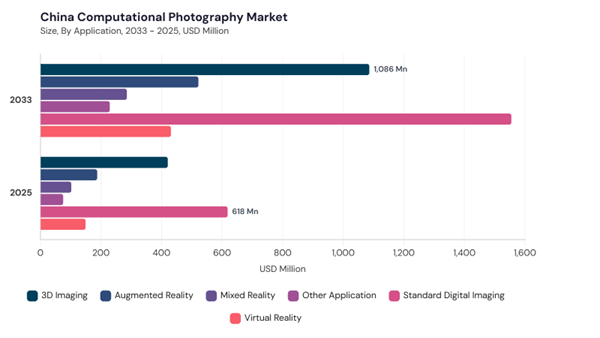
Based on Application, the market is segmented into Standard Digital Imaging, 3D Imaging, Augmented Reality, Virtual Reality, Mixed Reality, and Other Application. The Standard Digital Imaging segment dominated the Asia Pacific Computational Photography Market by Application in 2025 due to the widespread use of computational photography technologies across smartphones, cameras, and consumer imaging devices. Advanced image processing capabilities are significantly improving visual quality and user experiences.The 3D Imaging segment is experiencing strong growth driven by increasing demand for depth sensing and advanced imaging technologies across consumer electronics, industrial automation, and healthcare applications. The Augmented Reality, Virtual Reality, and Mixed Reality segments are also witnessing increasing adoption as organizations and consumers embrace immersive digital experiences and interactive visualization technologies across Asia Pacific.
Vertical Outlook
Based on Vertical, the market is segmented into Consumer Electronics, Automotive, Security & Surveillance, Media, Entertainment & Content Creation, Industrial, Healthcare, and Other Vertical. The Consumer Electronics segment dominated the Asia Pacific Computational Photography Market by Vertical in 2025 due to the strong presence of electronics manufacturing hubs and rising demand for advanced imaging capabilities in smartphones and wearable devices. Continuous innovation in AI-enabled imaging and mobile photography is further supporting segment growth.The Automotive segment is expected to witness strong expansion owing to increasing deployment of computational imaging technologies in autonomous vehicles, ADAS platforms, and intelligent transportation systems. The Security & Surveillance segment is also experiencing robust growth due to rising smart city initiatives and increasing demand for intelligent monitoring systems. Additionally, healthcare and industrial sectors are increasingly adopting computational imaging technologies for diagnostics, inspection, robotics, and process optimization applications.
List of Key Companies Profiled
- Apple, Inc.
- Samsung Electronics Co., Ltd.
- Sony Group Corporation
- Google LLC (Alphabet Inc.)
- Qualcomm Incorporated
- NVIDIA Corporation
- Huawei Technologies Co., Ltd.
- Xiaomi Corporation
- Canon Inc.
- Intel Corporation
Market Report Segmentation
By Architecture- Single & Dual-Lens Camera
- 16-Lens Camera
- Other Architecture
- Smartphone Cameras
- Machine Vision
- AR/VR/Immersive Devices
- Digital Cameras
- Standard Digital Imaging
- 3D Imaging
- Augmented Reality
- Virtual Reality
- Mixed Reality
- Other Application
- Consumer Electronics
- Automotive
- Security & Surveillance
- Media, Entertainment & Content Creation
- Industrial
- Healthcare
- Other Vertical
- China
- Japan
- India
- South Korea
- Singapore
- Malaysia
- Rest of Asia Pacific
Table of Contents
Chapter 1. Asia Pacific Market1.1 Market Overview
1.2 Key Factors Impacting Market
1.2.1 Market Drivers
1.2.2 Market Restraints
1.2.3 Market Opportunities
1.2.4 Market Challenges
1.2.5 Market Trends
1.2.6 State of Competition
1.2.7 Market Consolidation
1.2.8 Key Customer Criteria
1.3 Product Life Cycle
1.4 Segmentation By Product
1.4.1 Smartphone Cameras
1.4.2 Digital Cameras
1.4.3 Machine Vision
1.4.4 AR/VR/Immersive Devices
1.5 Segmentation By Architecture
1.5.1 Single & Dual-Lens Camera
1.5.2 16-Lens Camera
1.5.3 Other Architecture
1.6 Segmentation By Vertical
1.6.1 Security & Surveillance
1.6.2 Automotive
1.6.3 Consumer Electronics
1.6.4 Industrial
1.6.5 Healthcare
1.6.6 Media, Entertainment & Content Creation
1.6.7 Other Vertical
1.7 Segmentation By Application
1.7.1 3D Imaging
1.7.2 Virtual Reality
1.7.3 Augmented Reality
1.7.4 Mixed Reality
1.7.5 Standard Digital Imaging
1.7.6 Other Application
1.8 Segmentation By Country
1.8.1 China
1.8.1.1 Segmentation By Product
1.8.1.1.1 Smartphone Cameras
1.8.1.1.2 Digital Cameras
1.8.1.1.3 Machine Vision
1.8.1.1.4 AR/VR/Immersive Devices
1.8.1.2 Segmentation By Architecture
1.8.1.2.1 Single & Dual-Lens Camera
1.8.1.2.2 16-Lens Camera
1.8.1.2.3 Other Architecture
1.8.1.3 Segmentation By Vertical
1.8.1.3.1 Security & Surveillance
1.8.1.3.2 Automotive
1.8.1.3.3 Consumer Electronics
1.8.1.3.4 Industrial
1.8.1.3.5 Healthcare
1.8.1.3.6 Media, Entertainment & Content Creation
1.8.1.3.7 Other Vertical
1.8.1.4 Segmentation By Application
1.8.1.4.1 3D Imaging
1.8.1.4.2 Virtual Reality
1.8.1.4.3 Augmented Reality
1.8.1.4.4 Mixed Reality
1.8.1.4.5 Standard Digital Imaging
1.8.1.4.6 Other Application
1.8.2 Japan
1.8.2.1 Segmentation By Product
1.8.2.1.1 Smartphone Cameras
1.8.2.1.2 Digital Cameras
1.8.2.1.3 Machine Vision
1.8.2.1.4 AR/VR/Immersive Devices
1.8.2.2 Segmentation By Architecture
1.8.2.2.1 Single & Dual-Lens Camera
1.8.2.2.2 16-Lens Camera
1.8.2.2.3 Other Architecture
1.8.2.3 Segmentation By Vertical
1.8.2.3.1 Security & Surveillance
1.8.2.3.2 Automotive
1.8.2.3.3 Consumer Electronics
1.8.2.3.4 Industrial
1.8.2.3.5 Healthcare
1.8.2.3.6 Media, Entertainment & Content Creation
1.8.2.3.7 Other Vertical
1.8.2.4 Segmentation By Application
1.8.2.4.1 3D Imaging
1.8.2.4.2 Virtual Reality
1.8.2.4.3 Augmented Reality
1.8.2.4.4 Mixed Reality
1.8.2.4.5 Standard Digital Imaging
1.8.2.4.6 Other Application
1.8.3 India
1.8.3.1 Segmentation By Product
1.8.3.1.1 Smartphone Cameras
1.8.3.1.2 Digital Cameras
1.8.3.1.3 Machine Vision
1.8.3.1.4 AR/VR/Immersive Devices
1.8.3.2 Segmentation By Architecture
1.8.3.2.1 Single & Dual-Lens Camera
1.8.3.2.2 16-Lens Camera
1.8.3.2.3 Other Architecture
1.8.3.3 Segmentation By Vertical
1.8.3.3.1 Security & Surveillance
1.8.3.3.2 Automotive
1.8.3.3.3 Consumer Electronics
1.8.3.3.4 Industrial
1.8.3.3.5 Healthcare
1.8.3.3.6 Media, Entertainment & Content Creation
1.8.3.3.7 Other Vertical
1.8.3.4 Segmentation By Application
1.8.3.4.1 3D Imaging
1.8.3.4.2 Virtual Reality
1.8.3.4.3 Augmented Reality
1.8.3.4.4 Mixed Reality
1.8.3.4.5 Standard Digital Imaging
1.8.3.4.6 Other Application
1.8.4 South Korea
1.8.4.1 Segmentation By Product
1.8.4.1.1 Smartphone Cameras
1.8.4.1.2 Digital Cameras
1.8.4.1.3 Machine Vision
1.8.4.1.4 AR/VR/Immersive Devices
1.8.4.2 Segmentation By Architecture
1.8.4.2.1 Single & Dual-Lens Camera
1.8.4.2.2 16-Lens Camera
1.8.4.2.3 Other Architecture
1.8.4.3 Segmentation By Vertical
1.8.4.3.1 Security & Surveillance
1.8.4.3.2 Automotive
1.8.4.3.3 Consumer Electronics
1.8.4.3.4 Industrial
1.8.4.3.5 Healthcare
1.8.4.3.6 Media, Entertainment & Content Creation
1.8.4.3.7 Other Vertical
1.8.4.4 Segmentation By Application
1.8.4.4.1 3D Imaging
1.8.4.4.2 Virtual Reality
1.8.4.4.3 Augmented Reality
1.8.4.4.4 Mixed Reality
1.8.4.4.5 Standard Digital Imaging
1.8.4.4.6 Other Application
1.8.5 Singapore
1.8.5.1 Segmentation By Product
1.8.5.1.1 Smartphone Cameras
1.8.5.1.2 Digital Cameras
1.8.5.1.3 Machine Vision
1.8.5.1.4 AR/VR/Immersive Devices
1.8.5.2 Segmentation By Architecture
1.8.5.2.1 Single & Dual-Lens Camera
1.8.5.2.2 16-Lens Camera
1.8.5.2.3 Other Architecture
1.8.5.3 Segmentation By Vertical
1.8.5.3.1 Security & Surveillance
1.8.5.3.2 Automotive
1.8.5.3.3 Consumer Electronics
1.8.5.3.4 Industrial
1.8.5.3.5 Healthcare
1.8.5.3.6 Media, Entertainment & Content Creation
1.8.5.3.7 Other Vertical
1.8.5.4 Segmentation By Application
1.8.5.4.1 3D Imaging
1.8.5.4.2 Virtual Reality
1.8.5.4.3 Augmented Reality
1.8.5.4.4 Mixed Reality
1.8.5.4.5 Standard Digital Imaging
1.8.5.4.6 Other Application
1.8.6 Malaysia
1.8.6.1 Segmentation By Product
1.8.6.1.1 Smartphone Cameras
1.8.6.1.2 Digital Cameras
1.8.6.1.3 Machine Vision
1.8.6.1.4 AR/VR/Immersive Devices
1.8.6.2 Segmentation By Architecture
1.8.6.2.1 Single & Dual-Lens Camera
1.8.6.2.2 16-Lens Camera
1.8.6.2.3 Other Architecture
1.8.6.3 Segmentation By Vertical
1.8.6.3.1 Security & Surveillance
1.8.6.3.2 Automotive
1.8.6.3.3 Consumer Electronics
1.8.6.3.4 Industrial
1.8.6.3.5 Healthcare
1.8.6.3.6 Media, Entertainment & Content Creation
1.8.6.3.7 Other Vertical
1.8.6.4 Segmentation By Application
1.8.6.4.1 3D Imaging
1.8.6.4.2 Virtual Reality
1.8.6.4.3 Augmented Reality
1.8.6.4.4 Mixed Reality
1.8.6.4.5 Standard Digital Imaging
1.8.6.4.6 Other Application
1.8.7 Rest of Asia Pacific
1.8.7.1 Segmentation By Product
1.8.7.1.1 Smartphone Cameras
1.8.7.1.2 Digital Cameras
1.8.7.1.3 Machine Vision
1.8.7.1.4 AR/VR/Immersive Devices
1.8.7.2 Segmentation By Architecture
1.8.7.2.1 Single & Dual-Lens Camera
1.8.7.2.2 16-Lens Camera
1.8.7.2.3 Other Architecture
1.8.7.3 Segmentation By Vertical
1.8.7.3.1 Security & Surveillance
1.8.7.3.2 Automotive
1.8.7.3.3 Consumer Electronics
1.8.7.3.4 Industrial
1.8.7.3.5 Healthcare
1.8.7.3.6 Media, Entertainment & Content Creation
1.8.7.3.7 Other Vertical
1.8.7.4 Segmentation By Application
1.8.7.4.1 3D Imaging
1.8.7.4.2 Virtual Reality
1.8.7.4.3 Augmented Reality
1.8.7.4.4 Mixed Reality
1.8.7.4.5 Standard Digital Imaging
1.8.7.4.6 Other Application
Chapter 2. Company Profiles
2.1 Apple, Inc.
2.1.1 Company Overview
2.1.2 Financial Analysis
2.1.3 Regional Analysis
2.1.2 Research & Development Expense
2.1.5 Recent Strategies and Developments
2.1.5.1 Product Launches and Product Expansions
2.1.6 Company Focus
2.1.7 Strategic Insights
2.1.8 Strategy Deployed
2.1.9 SWOT Analysis
2.1.10 Future Outlook
2.2 Samsung Electronics Co., Ltd. (Samsung Group)
2.2.1 Company Overview
2.2.2 Financial Analysis
2.2.3 Segmental and Regional Analysis
2.2.2 Research & Development Expenses
2.2.5 Recent Strategies and Developments
2.2.5.1 Product Launches and Product Expansions
2.2.6 Company Focus
2.2.7 Strategic Insights
2.2.8 Strategy Deployed
2.2.9 SWOT Analysis
2.2.10 Future Outlook
2.3 Google LLC (Alphabet Inc.)
2.3.1 Company Overview
2.3.2 Financial Analysis
2.3.3 Segmental and Regional Analysis
2.3.2 Research & Development Expenses
2.3.5 Company Focus
2.3.6 Strategic Insights
2.3.7 Strategy Deployed
2.3.8 SWOT Analysis
2.3.9 Future Outlook
2.2 Qualcomm Incorporated (Qualcomm Technologies, Inc.)
2.2.1 Company Overview
2.2.2 Financial Analysis
2.2.3 Segmental and Regional Analysis
2.2.2 Research & Development Expense
2.2.5 Recent Strategies and Developments
2.2.5.1 Acquisition and Mergers
2.2.6 Company Focus
2.2.7 Strategic Insights
2.2.8 Strategy Deployed
2.2.9 SWOT Analysis
2.2.10 Future Outlook
2.5 NVIDIA Corporation
2.5.1 Company Overview
2.5.2 Financial Analysis
2.5.3 Segmental and Regional Analysis
2.5.2 Research & Development Expenses
2.5.5 Company Focus
2.5.6 Strategic Insights
2.5.7 Strategy Deployed
2.5.8 SWOT Analysis
2.5.9 Future Outlook
2.6 Adobe, Inc.
2.6.1 Company Overview
2.6.2 Financial Analysis
2.6.3 Segmental and Regional Analysis
2.6.2 Research & Development Expense
2.6.5 Company Focus
2.6.6 Strategic Insights
2.6.7 Strategy Deployed
2.6.8 SWOT Analysis
2.6.9 Future Outlook
2.7 Sony Group Corporation
2.7.1 Company Overview
2.7.2 Financial Analysis
2.7.3 Segmental and Regional Analysis
2.7.2 Research & Development Expenses
2.7.5 Recent Strategies and Developments
2.7.5.1 Partnerships, Collaborations, and Agreements
2.7.6 Company Focus
2.7.7 Strategic Insights
2.7.8 Strategy Deployed
2.7.9 SWOT Analysis
2.7.10 Future Outlook
2.8 Xiaomi Corporation
2.8.1 Company Overview
2.8.2 Financial Analysis
2.8.3 Segmental and Regional Analysis
2.8.2 Research & Development Expenses
2.8.5 Company Focus
2.8.6 Strategic Insights
2.8.7 Strategy Deployed
2.8.8 SWOT Analysis
2.8.9 Future Outlook
2.9 Huawei Technologies Co., Ltd. (Huawei Investment & Holding Co., Ltd.)
2.9.1 Company Overview
2.9.2 Financial Analysis
2.9.3 Segmental and Regional Analysis
2.9.2 Research & Development Expenses
2.9.5 Recent Strategies and Developments
2.9.5.1 Product Launches and Product Expansions
2.9.6 Company Focus
2.9.7 Strategic Insights
2.9.8 Strategy Deployed
2.9.9 SWOT Analysis
2.9.10 Future Outlook
2.1 Intel Corporation
2.10.1 Company Overview
2.10.2 Financial Analysis
2.10.3 Segmental and Regional Analysis
2.10.2 Research & Development Expenses
2.10.5 Company Focus
2.10.6 Strategic Insights
2.10.7 Strategy Deployed
2.10.8 SWOT Analysis
2.10.9 Future Outlook
Companies Mentioned
- Apple, Inc.
- Samsung Electronics Co., Ltd.
- Sony Group Corporation
- Google LLC (Alphabet Inc.)
- Qualcomm Incorporated
- NVIDIA Corporation
- Huawei Technologies Co., Ltd.
- Xiaomi Corporation
- Canon Inc.
- Intel Corporation


