



The Europe Digital Substation Market attained a market size of USD 3.5 billion in 2025 and is projected to attain a market size of USD 4.87 billion by 2031, growing at a CAGR of 6.1% during the forecast period (2026-2033).
The Germany market dominated the Europe Digital Substation Market by country in 2025, and is expected to continue to be a dominant market till 2033; thereby, achieving a market value of USD 980.0 million by 2033, growing at a CAGR of 4.5% during the forecast period. The UK market is expected to witness a CAGR of 4.9% during 2026-2033. Additionally, the France market is expected to witness a CAGR of 6.9% during 2026-2033. Germany and the UK led the Europe Digital Substation Market by Country with a market share of 19.9% and 15.7% respectively in 2025.
The Europe Digital Substation Market is experiencing substantial growth driven by increasing investments in smart grid modernization, renewable energy integration, and intelligent transmission infrastructure across major European economies. Utilities and transmission system operators are rapidly transitioning toward digitally enabled substations to enhance operational efficiency, improve real-time monitoring, reduce outage risks, and strengthen grid resilience. The widespread adoption of IEC 61850 communication standards, advanced SCADA systems, cloud-based analytics, and intelligent electronic devices is accelerating digital transformation throughout Europe’s power sector.
The market is also benefiting from Europe’s ambitious decarbonization goals and rapid renewable energy deployment, particularly in countries such as Germany, France, Spain, and the UK. Rising investments in offshore wind infrastructure, EV charging networks, and distributed energy integration are creating strong demand for highly automated and digitally interconnected substations. In addition, increasing focus on cybersecurity, predictive maintenance, and AI-enabled grid management continues to support long-term growth opportunities for digital substation vendors across the region.
The UK market is witnessing steady growth supported by investments in offshore wind integration, digital grid technologies, and modernization of aging power infrastructure. France is emerging as one of the fastest-growing markets owing to strong renewable energy expansion, nuclear grid modernization projects, and increasing focus on energy security. Spain and Italy are also recording significant growth driven by rising renewable capacity additions and expansion of intelligent transmission and distribution networks across Southern Europe.
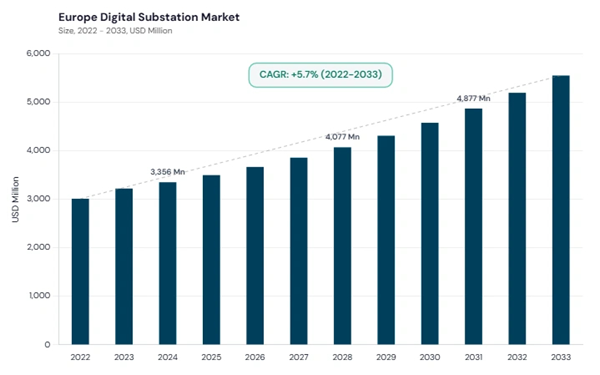
The Germany market dominated the Europe Digital Substation Market by country in 2025, and is expected to continue to be a dominant market till 2033; thereby, achieving a market value of USD 980.0 million by 2033, growing at a CAGR of 4.5% during the forecast period. The UK market is expected to witness a CAGR of 4.9% during 2026-2033. Additionally, the France market is expected to witness a CAGR of 6.9% during 2026-2033. Germany and the UK led the Europe Digital Substation Market by Country with a market share of 19.9% and 15.7% respectively in 2025.
The Europe Digital Substation Market is experiencing substantial growth driven by increasing investments in smart grid modernization, renewable energy integration, and intelligent transmission infrastructure across major European economies. Utilities and transmission system operators are rapidly transitioning toward digitally enabled substations to enhance operational efficiency, improve real-time monitoring, reduce outage risks, and strengthen grid resilience. The widespread adoption of IEC 61850 communication standards, advanced SCADA systems, cloud-based analytics, and intelligent electronic devices is accelerating digital transformation throughout Europe’s power sector.
The market is also benefiting from Europe’s ambitious decarbonization goals and rapid renewable energy deployment, particularly in countries such as Germany, France, Spain, and the UK. Rising investments in offshore wind infrastructure, EV charging networks, and distributed energy integration are creating strong demand for highly automated and digitally interconnected substations. In addition, increasing focus on cybersecurity, predictive maintenance, and AI-enabled grid management continues to support long-term growth opportunities for digital substation vendors across the region.
Component Outlook
Based on Component, the market is segmented into Hardware, Services, and Software. The Hardware segment dominated the Europe Digital Substation Market by Component in 2025, and is expected to continue to be a dominant market till 2033; thereby, achieving a market value of USD 2.92 billion by 2031, growing at a CAGR of 5.7% during the forecast period. The Services segment is expected to witness a CAGR of 6.6% during 2026-2033. The Software segment is expected to witness a CAGR of 6.9% during 2026-2033.Substation Type Outlook
Based on Substation Type, the market is segmented into Transmission Substation and Distribution Substation. The Transmission Substation segment dominated the Europe Digital Substation Market by Substation Type in 2025, and is expected to continue to be a dominant market till 2033; thereby, achieving a market value of USD 3.16 billion by 2031, growing at a CAGR of 5.9% during the forecast period. The Distribution Substation segment is expected to witness a CAGR of 6.5% during 2026-2033.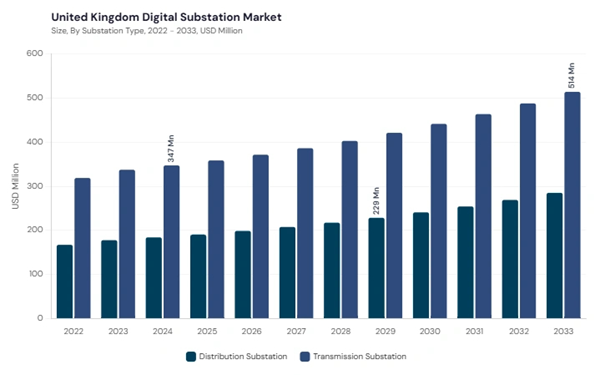
Voltage Outlook
Based on Voltage, the market is segmented into 220-500 kV, Up to 220 kV, and Above 500 kV. The 220-500 kV segment dominated the Europe Digital Substation Market in 2025, and is expected to continue to be a dominant market till 2033; thereby, achieving a market value of USD 2.7 billion by 2033, growing at a CAGR of 5.6% during the forecast period. The Up to 220 kV segment is expected to witness a CAGR of 6.5% during 2026-2033.Application Outlook
Based on Application, the market is segmented into Utilities, Industrial, Transportation, and Other Application. The Utilities segment dominated the Europe Digital Substation Market by Application in 2025, and is expected to continue to be a dominant market till 2033; thereby, achieving a market value of USD 3.8 billion by 2033, growing at a CAGR of 5.7% during the forecast period. The Industrial segment is expected to witness a CAGR of 6.4% during 2026-2033. Additionally, the Transportation segment is expected to witness the highest CAGR of 7.5% during the forecast period.Country Outlook
Germany continues to dominate the Europe Digital Substation Market due to extensive investments in renewable energy integration, smart grid deployment, and transmission infrastructure modernization. The country’s strong emphasis on energy transition initiatives and grid automation technologies is driving widespread adoption of intelligent substation solutions.The UK market is witnessing steady growth supported by investments in offshore wind integration, digital grid technologies, and modernization of aging power infrastructure. France is emerging as one of the fastest-growing markets owing to strong renewable energy expansion, nuclear grid modernization projects, and increasing focus on energy security. Spain and Italy are also recording significant growth driven by rising renewable capacity additions and expansion of intelligent transmission and distribution networks across Southern Europe.
List of Key Companies Profiled
- Siemens Energy
- ABB Ltd.
- Schneider Electric SE
- General Electric Company
- Hitachi Energy Ltd.
- Eaton Corporation plc
- Mitsubishi Electric Corporation
- Cisco Systems, Inc.
Market Report Segmentation
By Component- Hardware
- Services
- Software
- Transmission Substation
- Distribution Substation
- 220-500 kV
- Up to 220 kV
- Above 500 kV
- Utilities
- Industrial
- Transportation
- Other Application
- Germany
- UK
- France
- Russia
- Spain
- Italy
- Rest of Europe
Table of Contents
Chapter 1. Europe Market1.1 Market Overview
1.2 Key Factors Impacting Market
1.2.1 Market Drivers
1.2.2 Market Restraints
1.2.3 Market Opportunities
1.2.4 Market Challenges
1.2.5 Market Trends
1.2.6 State of Competition
1.2.7 Market Consolidation
1.2.8 Key Customer Criteria
1.3 Product Life Cycle
1.4 Segmentation By Component
1.4.1 Hardware
1.4.2 Software
1.4.3 Services
1.5 Segmentation By Substation Type
1.5.1 Transmission Substation
1.5.2 Distribution Substation
1.6 Segmentation By Voltage Type
1.6.1 Up to 220 kV
1.6.2 220-500 kV
1.6.3 Above 500 kV
1.7 Segmentation By Application Type
1.7.1 Utilities
1.7.2 Industrial
1.7.3 Transportation
1.7.4 OtherApplication
1.8 Segmentation By Country
1.8.1 Germany
1.8.1.1 Segmentation By Component
1.8.1.1.1 Hardware
1.8.1.1.2 Software
1.8.1.1.3 Services
1.8.1.2 Segmentation By Substation Type
1.8.1.2.1 Transmission Substation
1.8.1.2.2 Distribution Substation
1.8.1.3 Segmentation By Voltage
1.8.1.3.1 Up to 220 kV
1.8.1.3.2 220-500 kV
1.8.1.3.3 Above 500 kV
1.8.1.4 Segmentation By Application Type
1.8.1.4.1 Utilities
1.8.1.4.2 Industrial
1.8.1.4.3 Transportation
1.8.1.4.4 Other Application
1.8.2 United Kingdom
1.8.2.1 Segmentation By Component
1.8.2.1.1 Hardware
1.8.2.1.2 Software
1.8.2.1.3 Services
1.8.2.2 Segmentation By Substation Type
1.8.2.2.1 Transmission Substation
1.8.2.2.2 Distribution Substation
1.8.2.3 Segmentation By Voltage
1.8.2.3.1 Up to 220 kV
1.8.2.3.2 220-500 kV
1.8.2.3.3 Above 500 kV
1.8.2.4 Segmentation By Application Type
1.8.2.4.1 Utilities
1.8.2.4.2 Industrial
1.8.2.4.3 Transportation
1.8.2.4.4 Other Application
1.8.3 France
1.8.3.1 Segmentation By Component
1.8.3.1.1 Hardware
1.8.3.1.2 Software
1.8.3.1.3 Services
1.8.3.2 Segmentation By Substation Type
1.8.3.2.1 Transmission Substation
1.8.3.2.2 Distribution Substation
1.8.3.3 Segmentation By Voltage
1.8.3.3.1 Up to 220 kV
1.8.3.3.2 220-500 kV
1.8.3.3.3 Above 500 kV
1.8.3.4 Segmentation By Application Type
1.8.3.4.1 Utilities
1.8.3.4.2 Industrial
1.8.3.4.3 Transportation
1.8.3.4.4 Other Application
1.8.4 Russia
1.8.4.1 Segmentation By Component
1.8.4.1.1 Hardware
1.8.4.1.2 Software
1.8.4.1.3 Services
1.8.4.2 Segmentation By Substation Type
1.8.4.2.1 Transmission Substation
1.8.4.2.2 Distribution Substation
1.8.4.3 Segmentation By Voltage
1.8.4.3.1 Up to 220 kV
1.8.4.3.2 220-500 kV
1.8.4.3.3 Above 500 kV
1.8.4.4 Segmentation By Application Type
1.8.4.4.1 Utilities
1.8.4.4.2 Industrial
1.8.4.4.3 Transportation
1.8.4.4.4 Other Application
1.8.5 Spain
1.8.5.1 Segmentation By Component
1.8.5.1.1 Hardware
1.8.5.1.2 Software
1.8.5.1.3 Services
1.8.5.2 Segmentation By Substation Type
1.8.5.2.1 Transmission Substation
1.8.5.2.2 Distribution Substation
1.8.5.3 Segmentation By Voltage
1.8.5.3.1 Up to 220 kV
1.8.5.3.2 220-500 kV
1.8.5.3.3 Above 500 kV
1.8.5.4 Segmentation By Application Type
1.8.5.4.1 Utilities
1.8.5.4.2 Industrial
1.8.5.4.3 Transportation
1.8.5.4.4 Other Application
1.8.6 Italy
1.8.6.1 Segmentation By Component
1.8.6.1.1 Hardware
1.8.6.1.2 Software
1.8.6.1.3 Services
1.8.6.2 Segmentation By Substation Type
1.8.6.2.1 Transmission Substation
1.8.6.2.2 Distribution Substation
1.8.6.3 Segmentation By Voltage
1.8.6.3.1 Up to 220 kV
1.8.6.3.2 220-500 kV
1.8.6.3.3 Above 500 kV
1.8.6.4 Segmentation By Application Type
1.8.6.4.1 Utilities
1.8.6.4.2 Industrial
1.8.6.4.3 Transportation
1.8.6.4.4 Other Application
1.8.7 Rest of Europe
1.8.7.1 Segmentation By Component
1.8.7.1.1 Hardware
1.8.7.1.2 Software
1.8.7.1.3 Services
1.8.7.2 Segmentation By Substation Type
1.8.7.2.1 Transmission Substation
1.8.7.2.2 Distribution Substation
1.8.7.3 Segmentation By Voltage
1.8.7.3.1 Up to 220 kV
1.8.7.3.2 220-500 kV
1.8.7.3.3 Above 500 kV
1.8.7.4 Segmentation By Application Type
1.8.7.4.1 Utilities
1.8.7.4.2 Industrial
1.8.7.4.3 Transportation
1.8.7.4.4 Other Application
Chapter 2. Company Profiles
2.1 Siemens Energy AG
2.1.1 Company Overview
2.1.2 Financial Analysis
2.1.3 Segmental and Regional Analysis
2.1.2 Research & Development Expenses
2.1.5 Recent Strategies and Developments
2.1.5.1 Partnerships, Collaborations, and Agreements
2.1.5.2 Product Launches and Product Expansions
2.1.6 Company Focus
2.1.7 Strategic Insights
2.1.8 Strategy Deployed
2.1.9 SWOT Analysis
2.1.10 Future Outlook
2.2 ABB Ltd.
2.2.1 Company Overview
2.2.2 Company Focus
2.2.3 Strategic Insights
2.2.2 Strategy Deployed
2.2.5 SWOT Analysis
2.2.6 Future Outlook
2.3 GE Vernova Group
2.3.1 Company Overview
2.3.2 Financial Analysis
2.3.3 Segmental and Regional Analysis
2.3.2 Research & Development Expenses
2.3.5 Recent Strategies and Developments
2.3.5.1 Partnerships, Collaborations, and Agreements
2.3.6 Company Focus
2.3.7 Strategic Insights
2.3.8 Strategy Deployed
2.3.9 SWOT Analysis
2.3.10 Future Outlook
2.2 Hitachi Energy Ltd. (Hitachi Ltd.)
2.2.1 Company Overview
2.2.2 Financial Analysis
2.2.3 Regional Analysis
2.2.2 Recent Strategies and Developments
2.2.2.1 Product Launches and Product Expansions
2.2.5 Company Focus
2.2.6 Strategic Insights
2.2.7 Strategy Deployed
2.2.8 SWOT Analysis
2.2.9 Future Outlook
2.5 Schneider Electric SE
2.5.1 Company Overview
2.5.2 Financial Analysis
2.5.3 Segmental and Regional Analysis
2.5.2 Research & Development Expense
2.5.5 Recent Strategies and Developments
2.5.5.1 Product Launches and Product Expansions
2.5.6 Company Focus
2.5.7 Strategic Insights
2.5.8 Strategy Deployed
2.5.9 SWOT Analysis
2.5.10 Future Outlook
2.6 Schweitzer Engineering Laboratories, Inc. (SEL)
2.6.1 Company Overview
2.6.2 Company Focus
2.6.3 Strategic Insights
2.6.2 Strategy Deployed
2.6.5 SWOT Analysis
2.6.6 Future Outlook
2.7 Cisco Systems, Inc.
2.7.1 Company Overview
2.7.2 Financial Analysis
2.7.3 Regional Analysis
2.7.2 Research & Development Expense
2.7.5 Company Focus
2.7.6 Strategic Insights
2.7.7 Strategy Deployed
2.7.8 SWOT Analysis
2.7.9 Future Outlook
2.8 Eaton Corporation PLC
2.8.1 Company Overview
2.8.2 Financial Analysis
2.8.3 Segmental and Regional Analysis
2.8.2 Research & Development Expense
2.8.5 Recent Strategies and Developments
2.8.5.1 Product Launches and Product Expansions:+
2.8.6 Company Focus
2.8.7 Strategic Insights
2.8.8 Strategy Deployed
2.8.9 SWOT Analysis
2.8.10 Future Outlook
2.9 NR Electric Co., Ltd.
2.9.1 Company Overview
2.9.2 Company Focus
2.9.3 Strategic Insights
2.9.2 Strategy Deployed
2.9.5 SWOT Analysis
2.9.6 Future Outlook
2.1 Toshiba Corporation
2.10.1 Company Overview
2.10.2 Company Focus
2.10.3 Strategic Insights
2.10.2 Strategy Deployed
2.10.5 SWOT Analysis
2.10.6 Future Outlook
Companies Mentioned
- Siemens Energy
- ABB Ltd.
- Schneider Electric SE
- General Electric Company
- Hitachi Energy Ltd.
- Eaton Corporation plc
- Mitsubishi Electric Corporation
- Cisco Systems, Inc.


