



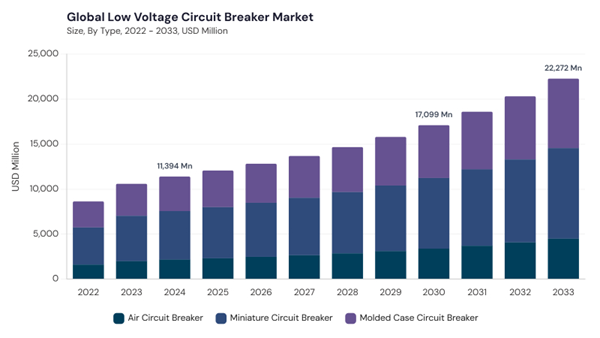
The Global Low Voltage Circuit Breaker Market size is expected to reach USD 22.27 Billion by 2033, rising at a market growth of 8.2% CAGR during the forecast period.
The market is witnessing strong growth due to increasing investments in electrical infrastructure modernization, industrial automation, and smart power distribution systems. Growing emphasis on electrical safety, energy efficiency, and renewable energy integration is further supporting market expansion across residential, commercial, and industrial applications.
The low voltage circuit breaker market has evolved significantly from conventional mechanical protection devices to intelligent and digitally connected electrical safety systems. Advancements in smart grids, industrial automation, and IoT-enabled monitoring technologies are driving the transition toward advanced circuit protection solutions with enhanced reliability and operational efficiency.
The market is experiencing rising adoption across residential buildings, commercial infrastructure, manufacturing facilities, utilities, and renewable energy projects. Growing electrification, rapid urbanization, and increasing investments in EV charging infrastructure and energy-efficient buildings are accelerating demand for advanced low voltage circuit breakers globally.
Market participants are also strengthening strategic partnerships and collaborations with automation providers, energy management firms, software developers, and utility companies to improve interoperability and expand integrated ecosystem capabilities. These partnerships support the deployment of digitally connected electrical infrastructure capable of enhancing operational efficiency, reducing downtime, and improving energy optimization across modern facilities and smart buildings.
In addition, companies are expanding manufacturing capacities, regional distribution networks, and localized production facilities to address rising infrastructure demand across Asia Pacific, North America, and Europe. Manufacturers are prioritizing supply chain optimization, regional sourcing strategies, and operational localization to improve production flexibility, reduce delivery timelines, and strengthen responsiveness to regional regulatory requirements. The increasing investments in renewable energy infrastructure, EV charging networks, industrial automation, and smart city projects are further encouraging market leaders to broaden their product portfolios and strengthen their presence in high-growth emerging economies.
The market remains moderately consolidated, with the top players collectively accounting for a significant portion of global revenue. Schneider Electric SE leads the market with an estimated share of approximately 14.22%, followed by ABB Ltd. with around 12.67%. Eaton Corporation plc and Siemens AG also maintain strong competitive positions through diversified electrification and industrial automation portfolios.
CHINT Group Co., Ltd. and Mitsubishi Electric Corporation are strengthening their global presence through smart electrical solutions and regional expansion strategies. Mid-tier and regional players continue to compete effectively in price-sensitive markets by offering customized and cost-efficient products tailored to local infrastructure requirements.
Future market share movements are expected to be driven by advancements in digital circuit protection, smart grid integration, cloud-based monitoring systems, and the growing demand for intelligent electrical infrastructure across residential, commercial, and industrial sectors.
Manufacturers are emphasizing interoperability with smart grids, building management systems, and renewable energy infrastructure. Strategic collaborations with automation companies, utilities, and digital solution providers are enabling broader ecosystem development and enhanced product functionality.
Regional expansion and pricing strategies remain important competitive factors, particularly in emerging economies where infrastructure modernization and electrification projects are growing rapidly. Global players are leveraging extensive distribution networks and localized manufacturing capabilities to strengthen their market presence and improve customer responsiveness.
The market is witnessing strong growth due to increasing investments in electrical infrastructure modernization, industrial automation, and smart power distribution systems. Growing emphasis on electrical safety, energy efficiency, and renewable energy integration is further supporting market expansion across residential, commercial, and industrial applications.
The low voltage circuit breaker market has evolved significantly from conventional mechanical protection devices to intelligent and digitally connected electrical safety systems. Advancements in smart grids, industrial automation, and IoT-enabled monitoring technologies are driving the transition toward advanced circuit protection solutions with enhanced reliability and operational efficiency.
The market is experiencing rising adoption across residential buildings, commercial infrastructure, manufacturing facilities, utilities, and renewable energy projects. Growing electrification, rapid urbanization, and increasing investments in EV charging infrastructure and energy-efficient buildings are accelerating demand for advanced low voltage circuit breakers globally.
Key Market Trends & Insights
- The Miniature Circuit Breaker segment dominated the market in 2025 with a value of USD 5.68 Billion and is expected to reach USD 10.06 Billion by 2033.
- The Commercial segment accounted for the largest share in 2025 and is projected to reach USD 9.02 Billion by 2033.
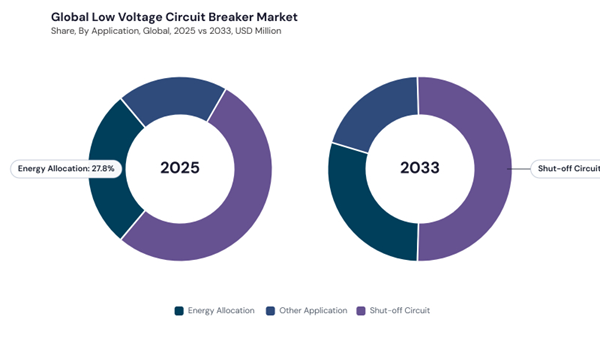
- The Shut-off Circuit segment dominated the market in 2025 with USD 6.37 Billion and is expected to reach USD 11.33 Billion by 2033.
- Asia Pacific dominated the global market in 2025 with a 37.99% share and is projected to maintain its dominance throughout the forecast period.
- The Molded Case Circuit Breaker segment is projected to reach USD 7.71 Billion by 2033 due to increasing industrial and commercial deployment.
- North America accounted for a significant market share in 2025 due to strong investments in smart grid infrastructure and industrial electrification.
Market participants are also strengthening strategic partnerships and collaborations with automation providers, energy management firms, software developers, and utility companies to improve interoperability and expand integrated ecosystem capabilities. These partnerships support the deployment of digitally connected electrical infrastructure capable of enhancing operational efficiency, reducing downtime, and improving energy optimization across modern facilities and smart buildings.
In addition, companies are expanding manufacturing capacities, regional distribution networks, and localized production facilities to address rising infrastructure demand across Asia Pacific, North America, and Europe. Manufacturers are prioritizing supply chain optimization, regional sourcing strategies, and operational localization to improve production flexibility, reduce delivery timelines, and strengthen responsiveness to regional regulatory requirements. The increasing investments in renewable energy infrastructure, EV charging networks, industrial automation, and smart city projects are further encouraging market leaders to broaden their product portfolios and strengthen their presence in high-growth emerging economies.
Driving and Restraining Factors
Drivers- Growing Demand from Electric Vehicle Infrastructure Expansion
- Regulatory Push Towards Environmentally Sustainable and Safer Electrical Components
- Advancements in Smart Circuit Breaker Technologies and Integration with IoT Systems
- Increasing Industrial Automation and Electrification of Emerging Sectors
- High Initial Capital Expenditure and Cost Sensitivity
- Complex Regulatory and Compliance Frameworks
- Technical Limitations in Integration with Smart Grid and IoT Systems
- Integration of Smart Technologies to Enable Advanced Low Voltage Circuit Breakers
- Expansion Driven by Renewable Energy Adoption and Distributed Energy Resources
- Regulatory and Infrastructure Modernization Catalyzing Demand for Enhanced Safety and Compliance
- Technological Complexity and Integration Challenges in Low Voltage Circuit Breakers
- High Compliance and Regulatory Barriers Impeding Market Expansion
- Cost Pressures and Economic Constraints Affecting Market Adoption
Market Share Analysis
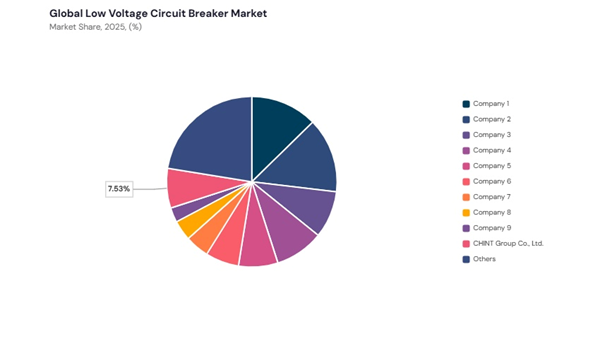
The market remains moderately consolidated, with the top players collectively accounting for a significant portion of global revenue. Schneider Electric SE leads the market with an estimated share of approximately 14.22%, followed by ABB Ltd. with around 12.67%. Eaton Corporation plc and Siemens AG also maintain strong competitive positions through diversified electrification and industrial automation portfolios.
CHINT Group Co., Ltd. and Mitsubishi Electric Corporation are strengthening their global presence through smart electrical solutions and regional expansion strategies. Mid-tier and regional players continue to compete effectively in price-sensitive markets by offering customized and cost-efficient products tailored to local infrastructure requirements.
Future market share movements are expected to be driven by advancements in digital circuit protection, smart grid integration, cloud-based monitoring systems, and the growing demand for intelligent electrical infrastructure across residential, commercial, and industrial sectors.
Type Outlook
The type segment of the low voltage circuit breaker market includes Miniature Circuit Breaker, Molded Case Circuit Breaker, and Air Circuit Breaker. The Miniature Circuit Breaker segment dominated the market in 2025 due to its widespread deployment across residential and commercial applications, compact design, and cost-effectiveness. Molded Case Circuit Breakers are witnessing increasing demand across industrial and commercial facilities owing to their higher current handling capability and advanced protection functions. Meanwhile, Air Circuit Breakers continue to gain traction in large-scale industrial infrastructure and utility applications where high fault interruption capacity and operational reliability are critical.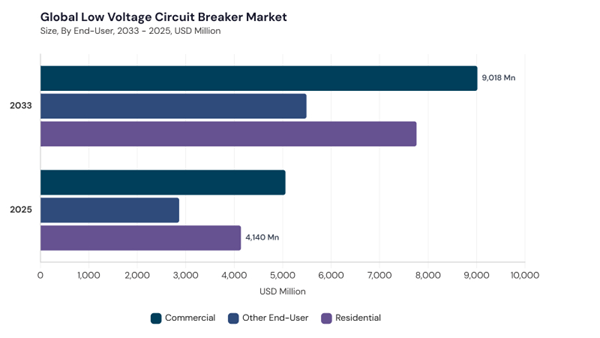
End-use Industry Outlook
The end-use industry segment comprises Residential, Commercial, and Other End-User sectors. The Commercial segment accounted for the largest share in 2025 due to growing investments in office buildings, hospitals, data centers, educational facilities, and smart commercial infrastructure. The Residential segment is expanding steadily with increasing urbanization, housing development projects, and rising awareness regarding electrical safety. The Other End-User category, including industrial and utility sectors, is also witnessing significant growth due to increasing automation, manufacturing expansion, and modernization of power distribution networks.Application Outlook
Based on application, the market is segmented into Shut-off Circuit, Energy Allocation, and Other Applications. The Shut-off Circuit segment dominated the market in 2025 owing to the critical role of circuit breakers in fault isolation and electrical protection. Energy Allocation applications are gaining momentum with the increasing adoption of smart grids, energy management systems, and distributed power networks. Other applications, including renewable energy systems, backup infrastructure, and industrial automation setups, are also contributing to market expansion as electrical systems become more advanced and interconnected.Market Competition and Attributes
The low voltage circuit breaker market is highly competitive, supported by continuous innovation in smart protection systems, IoT-enabled monitoring, and energy-efficient electrical solutions. Companies are increasingly integrating AI-driven diagnostics, cloud connectivity, and predictive maintenance features into circuit breakers to improve reliability and operational safety across industrial and commercial environments.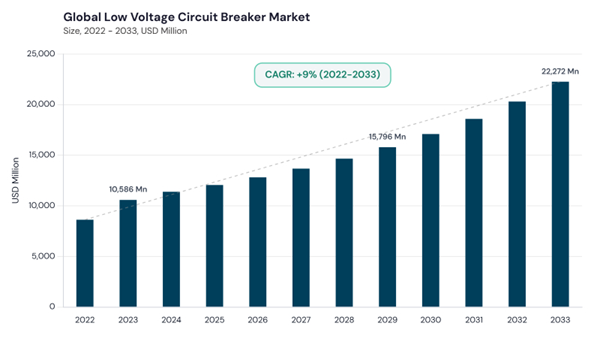
Manufacturers are emphasizing interoperability with smart grids, building management systems, and renewable energy infrastructure. Strategic collaborations with automation companies, utilities, and digital solution providers are enabling broader ecosystem development and enhanced product functionality.
Regional expansion and pricing strategies remain important competitive factors, particularly in emerging economies where infrastructure modernization and electrification projects are growing rapidly. Global players are leveraging extensive distribution networks and localized manufacturing capabilities to strengthen their market presence and improve customer responsiveness.
Recent Strategies Deployed in the Market
- August-2025: Schneider Electric SE - Introduced connected electrical equipment with predictive maintenance and real-time monitoring capabilities to strengthen intelligent power management solutions.
- August-2025: Legrand S.A. - Unveiled a sustainable smart track busway solution for data centers to improve scalable power distribution infrastructure.
- March-2026: Mitsubishi Electric Corporation - Partnered with Rauschert to enhance industrial energy management and intelligent automation systems.
- January-2025: CHINT Group Co., Ltd. - Collaborated with Xiong'an Power to support smart city infrastructure and digitalized grid development in China.
- August-2023: Siemens AG - Partnered with APS Industrial in Australia to strengthen local manufacturing and improve supply chain responsiveness.
- January-2024: ABB Ltd. - Showcased advanced electrification and smart infrastructure technologies during Electrification Innovation Week 2024.
List of Key Companies Profiled
- Schneider Electric SE
- ABB Ltd.
- Siemens AG
- Eaton Corporation plc
- Mitsubishi Electric Corporation
- CHINT Group Co., Ltd.
- Legrand S.A.
- General Electric Company
- Hager Group
- Fuji Electric Co. Ltd.
Market Report Segmentation
By Type- Miniature Circuit Breaker
- Molded Case Circuit Breaker
- Air Circuit Breaker
- Residential
- Commercial
- Other End-User
- Shut-off Circuit
- Energy Allocation
- Other Application
- North America
- US
- Canada
- Mexico
- Rest of North America
- Europe
- Germany
- UK
- France
- Russia
- Spain
- Italy
- Rest of Europe
- Asia Pacific
- China
- Japan
- India
- South Korea
- Singapore
- Malaysia
- Rest of Asia Pacific
- LAMEA
- Brazil
- Argentina
- UAE
- Saudi Arabia
- South Africa
- Nigeria
- Rest of LAMEA
Table of Contents
Chapter 1. Market Overview
Chapter 2. Key Factors Impacting Market
Chapter 5. Competition Analysis - Global
Chapter 6. Segmentation By Type
Chapter 7. Segmentation By End User
Chapter 8. Segmentation By Application
Chapter 9. North America Market
Chapter 10. Europe Market
Chapter 11. Asia Pacific Market
Chapter 12. LAMEA Market
Chapter 13. Company Profiles
Companies Mentioned
- Schneider Electric SE
- ABB Ltd.
- Siemens AG
- Eaton Corporation plc
- Mitsubishi Electric Corporation
- CHINT Group Co., Ltd.
- Legrand S.A.
- General Electric Company
- Hager Group
- Fuji Electric Co. Ltd.


