



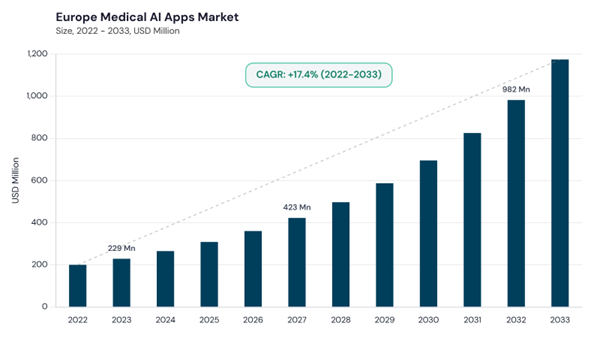
The Europe Medical AI Apps Market attained a market size of USD 308.8 million in 2025 and is expected to reach approximately USD 1.17 billion by 2033, growing at a CAGR of 18.4% during the forecast period (2026-2033).
The Germany market dominated the Europe Medical AI Apps Market by country in 2025 and is expected to continue to be a dominant market till 2033; thereby, achieving a market value of approximately USD 221.7 million by 2033. The UK market is expected to witness a CAGR of 17.3% during 2026-2033. Additionally, the France market is expected to witness a CAGR of 19.1% during 2026-2033. The Germany and UK markets led the Europe Medical AI Apps Market by Country with a market share of approximately 21.1% and 19.0% in 2025. The Spain market is expected to witness a CAGR of 19.9% throughout the forecast period.
The Europe Medical AI Apps Market has evolved rapidly due to increasing investments in healthcare digitization, growing adoption of artificial intelligence technologies in clinical workflows, and rising demand for precision healthcare solutions. Healthcare providers across Europe are increasingly deploying AI-powered applications for diagnostics, medical imaging analysis, predictive analytics, and remote patient monitoring to improve operational efficiency and patient outcomes. Advancements in machine learning, cloud computing, natural language processing, and computer vision technologies have significantly accelerated the commercialization of AI-enabled healthcare applications across hospitals and diagnostic centers. In addition, strong government support for digital health transformation, increasing healthcare expenditures, and rising prevalence of chronic diseases are driving the adoption of intelligent healthcare platforms throughout the region.
The market is witnessing significant momentum due to growing implementation of AI-assisted diagnostics, automation of administrative healthcare processes, and increasing deployment of telemedicine and remote monitoring platforms. Healthcare organizations are utilizing AI-based tools to reduce clinician workload, improve diagnostic accuracy, optimize patient management, and streamline hospital operations. Moreover, rising collaboration among healthcare institutions, research organizations, and technology providers is fostering innovation in AI-enabled medical applications. Competitive intensity remains strong as cloud providers, medical technology companies, AI startups, and healthcare software vendors continue investing in next-generation healthcare AI platforms across Europe.
The UK is emerging as another major growth market driven by increasing adoption of digital healthcare platforms, expansion of telemedicine services, and rising implementation of AI-assisted diagnostics across healthcare facilities. France is also witnessing strong growth due to increasing investments in healthcare modernization and growing deployment of intelligent clinical systems. Meanwhile, Spain and the Rest of Europe region are expected to experience robust growth owing to increasing healthcare digitalization initiatives, cloud-based healthcare infrastructure deployment, and rising demand for AI-powered patient monitoring and workflow automation solutions.
The Germany market dominated the Europe Medical AI Apps Market by country in 2025 and is expected to continue to be a dominant market till 2033; thereby, achieving a market value of approximately USD 221.7 million by 2033. The UK market is expected to witness a CAGR of 17.3% during 2026-2033. Additionally, the France market is expected to witness a CAGR of 19.1% during 2026-2033. The Germany and UK markets led the Europe Medical AI Apps Market by Country with a market share of approximately 21.1% and 19.0% in 2025. The Spain market is expected to witness a CAGR of 19.9% throughout the forecast period.
The Europe Medical AI Apps Market has evolved rapidly due to increasing investments in healthcare digitization, growing adoption of artificial intelligence technologies in clinical workflows, and rising demand for precision healthcare solutions. Healthcare providers across Europe are increasingly deploying AI-powered applications for diagnostics, medical imaging analysis, predictive analytics, and remote patient monitoring to improve operational efficiency and patient outcomes. Advancements in machine learning, cloud computing, natural language processing, and computer vision technologies have significantly accelerated the commercialization of AI-enabled healthcare applications across hospitals and diagnostic centers. In addition, strong government support for digital health transformation, increasing healthcare expenditures, and rising prevalence of chronic diseases are driving the adoption of intelligent healthcare platforms throughout the region.
The market is witnessing significant momentum due to growing implementation of AI-assisted diagnostics, automation of administrative healthcare processes, and increasing deployment of telemedicine and remote monitoring platforms. Healthcare organizations are utilizing AI-based tools to reduce clinician workload, improve diagnostic accuracy, optimize patient management, and streamline hospital operations. Moreover, rising collaboration among healthcare institutions, research organizations, and technology providers is fostering innovation in AI-enabled medical applications. Competitive intensity remains strong as cloud providers, medical technology companies, AI startups, and healthcare software vendors continue investing in next-generation healthcare AI platforms across Europe.
Component Outlook
Based on Component, the market is segmented into Software, Services, and Hardware. The Software market dominated the Europe Medical AI Apps Market by Component in 2025 and is expected to continue to be a dominant market till 2033; thereby, achieving a market value of USD 696.6 million by 2033, growing at a CAGR of 18.0% during the forecast period. The Services market is expected to witness a CAGR of 18.9% during 2026-2033. The Hardware market is expected to witness a CAGR of 18.9% during 2026-2033. Increasing demand for AI-enabled healthcare software platforms for diagnostics, workflow automation, clinical analytics, and patient monitoring is contributing significantly to software segment dominance across Europe.Application Outlook
Based on Application, the market is segmented into Medical Imaging & Diagnostics, Clinical Decision Support Systems (CDSS), Remote Patient Monitoring, Hospital Workflow & Administrative AI, and Other Application. The Medical Imaging & Diagnostics market dominated the Europe Medical AI Apps Market by Application in 2025 and is expected to continue to be a dominant market till 2033; thereby, achieving a market value of USD 376.3 million by 2033, growing at a CAGR of 17.5% during the forecast period. The Clinical Decision Support Systems (CDSS) market is expected to witness a CAGR of 18.1% during 2026-2033. The Other Application market is expected to witness a CAGR of 18.8% during 2026-2033. Growing adoption of AI-assisted radiology, intelligent imaging platforms, and predictive clinical decision-making solutions is accelerating demand for AI-powered diagnostic applications throughout Europe.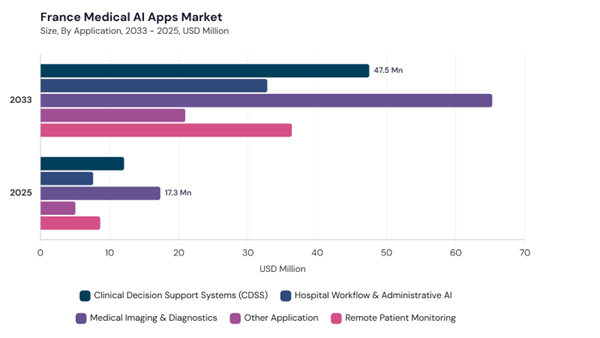
End Use Outlook
Based on End Use, the market is segmented into Hospitals, Diagnostics & Imaging Centers, Clinics, Ambulatory Surgery Centers (ASCs), and Other End Use. The Hospitals market dominated the Europe Medical AI Apps Market by End Use in 2025 and is expected to continue to be a dominant market till 2033; thereby, achieving a market value of USD 496.4 million by 2033, growing at a CAGR of 17.7% during the forecast period. The Diagnostics & Imaging Centers market is expected to witness a CAGR of 18.0% during 2026-2033. Additionally, the Clinics market is expected to witness the highest CAGR of 18.9% during 2026-2033. Increasing integration of AI-powered diagnostics, hospital workflow automation systems, and intelligent patient management solutions is contributing substantially to the growth of healthcare AI adoption across hospitals and clinical facilities in Europe.Country Outlook
Germany continues to dominate the Europe Medical AI Apps Market owing to its advanced healthcare infrastructure, strong adoption of healthcare digitization technologies, and increasing investments in artificial intelligence-enabled clinical systems. The country is witnessing growing deployment of AI-powered applications for medical imaging, clinical decision support, predictive analytics, and hospital workflow optimization. Government initiatives supporting healthcare innovation, combined with increasing collaboration between technology providers and healthcare institutions, are further accelerating market expansion across Germany. Additionally, the presence of major healthcare technology companies and research organizations is fostering continuous development of AI-enabled medical platforms throughout the country.The UK is emerging as another major growth market driven by increasing adoption of digital healthcare platforms, expansion of telemedicine services, and rising implementation of AI-assisted diagnostics across healthcare facilities. France is also witnessing strong growth due to increasing investments in healthcare modernization and growing deployment of intelligent clinical systems. Meanwhile, Spain and the Rest of Europe region are expected to experience robust growth owing to increasing healthcare digitalization initiatives, cloud-based healthcare infrastructure deployment, and rising demand for AI-powered patient monitoring and workflow automation solutions.
List of Key Companies Profiled
- Tempus AI, Inc.
- Viz.ai, Inc.
- Aidoc Medical Ltd.
- PathAI, Inc.
- Qure.ai Technologies Private Limited
- Siemens Healthineers AG
- GE HealthCare Technologies, Inc.
- NVIDIA Corporation
- Microsoft Corporation
- IBM Corporation
Market Report Segmentation
By Component- Software
- Services
- Hardware
- Medical Imaging & Diagnostics
- Clinical Decision Support Systems (CDSS)
- Remote Patient Monitoring
- Hospital Workflow & Administrative AI
- Other Application
- Hospitals
- Diagnostics & Imaging Centers
- Clinics
- Ambulatory Surgery Centers (ASCs)
- Other End Use
- Germany
- UK
- France
- Russia
- Spain
- Italy
- Rest of Europe
Table of Contents
Chapter 1. Europe Market1.1 Market Overview
1.2 Key Factors Impacting Market
1.2.1 Market Drivers
1.2.2 Market Restraints
1.2.3 Market Opportunities
1.2.4 Market Challenges
1.2.5 Market Trends
1.2.6 State of Competition
1.2.7 Market Consolidation
1.2.8 Key Customer Criteria
1.3 Product Life Cycle
1.4 Segmentation By Application
1.4.1 Medical Imaging & Diagnostics
1.4.2 Clinical Decision Support Systems (CDSS)
1.4.3 Remote Patient Monitoring
1.4.4 Hospital Workflow & Administrative AI
1.4.5 Other Application
1.5 Segmentation By End Use
1.5.1 Hospitals
1.5.2 Diagnostics & Imaging Centers
1.5.3 Clinics
1.5.4 Ambulatory Surgery Centers (ASCs)
1.5.5 Other End Use
1.6 Segmentation By Component
1.6.1 Software
1.6.2 Hardware
1.6.3 Services
1.7 Segmentation By Country
1.7.1 Germany
1.7.1.1 Segmentation By Application
1.7.1.1.1 Medical Imaging & Diagnostics
1.7.1.1.2 Clinical Decision Support Systems (CDSS)
1.7.1.1.3 Remote Patient Monitoring
1.7.1.1.4 Hospital Workflow & Administrative AI
1.7.1.1.5 Other Application
1.7.1.2 Segmentation By End Use
1.7.1.2.1 Hospitals
1.7.1.2.2 Diagnostics & Imaging Centers
1.7.1.2.3 Clinics
1.7.1.2.4 Ambulatory Surgery Centers (ASCs)
1.7.1.2.5 Other End Use
1.7.1.3 Segmentation By Component
1.7.1.3.1 Software
1.7.1.3.2 Hardware
1.7.1.3.3 Services
1.7.2 United Kingdom
1.7.2.1 Segmentation By Application
1.7.2.1.1 Medical Imaging & Diagnostics
1.7.2.1.2 Clinical Decision Support Systems (CDSS)
1.7.2.1.3 Remote Patient Monitoring
1.7.2.1.4 Hospital Workflow & Administrative AI
1.7.2.1.5 Other Application
1.7.2.2 Segmentation By End Use
1.7.2.2.1 Hospitals
1.7.2.2.2 Diagnostics & Imaging Centers
1.7.2.2.3 Clinics
1.7.2.2.4 Ambulatory Surgery Centers (ASCs)
1.7.2.2.5 Other End Use
1.7.2.3 Segmentation By Component
1.7.2.3.1 Software
1.7.2.3.2 Hardware
1.7.2.3.3 Services
1.7.3 France
1.7.3.1 Segmentation By Application
1.7.3.1.1 Medical Imaging & Diagnostics
1.7.3.1.2 Clinical Decision Support Systems (CDSS)
1.7.3.1.3 Remote Patient Monitoring
1.7.3.1.4 Hospital Workflow & Administrative AI
1.7.3.1.5 Other Application
1.7.3.2 Segmentation By End Use
1.7.3.2.1 Hospitals
1.7.3.2.2 Diagnostics & Imaging Centers
1.7.3.2.3 Clinics
1.7.3.2.4 Ambulatory Surgery Centers (ASCs)
1.7.3.2.5 Other End Use
1.7.3.3 Segmentation By Component
1.7.3.3.1 Software
1.7.3.3.2 Hardware
1.7.3.3.3 Services
1.7.4 Russia
1.7.4.1 Segmentation By Application
1.7.4.1.1 Medical Imaging & Diagnostics
1.7.4.1.2 Clinical Decision Support Systems (CDSS)
1.7.4.1.3 Remote Patient Monitoring
1.7.4.1.4 Hospital Workflow & Administrative AI
1.7.4.1.5 Other Application
1.7.4.2 Segmentation By End Use
1.7.4.2.1 Hospitals
1.7.4.2.2 Diagnostics & Imaging Centers
1.7.4.2.3 Clinics
1.7.4.2.4 Ambulatory Surgery Centers (ASCs)
1.7.4.2.5 Other End Use
1.7.4.3 Segmentation By Component
1.7.4.3.1 Software
1.7.4.3.2 Hardware
1.7.4.3.3 Services
1.7.5 Spain
1.7.5.1 Segmentation By Application
1.7.5.1.1 Medical Imaging & Diagnostics
1.7.5.1.2 Clinical Decision Support Systems (CDSS)
1.7.5.1.3 Remote Patient Monitoring
1.7.5.1.4 Hospital Workflow & Administrative AI
1.7.5.1.5 Other Application
1.7.5.2 Segmentation By End Use
1.7.5.2.1 Hospitals
1.7.5.2.2 Diagnostics & Imaging Centers
1.7.5.2.3 Clinics
1.7.5.2.4 Ambulatory Surgery Centers (ASCs)
1.7.5.2.5 Other End Use
1.7.5.3 Segmentation By Component
1.7.5.3.1 Software
1.7.5.3.2 Hardware
1.7.5.3.3 Services
1.7.6 Italy
1.7.6.1 Segmentation By Application
1.7.6.1.1 Medical Imaging & Diagnostics
1.7.6.1.2 Clinical Decision Support Systems (CDSS)
1.7.6.1.3 Remote Patient Monitoring
1.7.6.1.4 Hospital Workflow & Administrative AI
1.7.6.1.5 Other Application
1.7.6.2 Segmentation By End Use
1.7.6.2.1 Hospitals
1.7.6.2.2 Diagnostics & Imaging Centers
1.7.6.2.3 Clinics
1.7.6.2.4 Ambulatory Surgery Centers (ASCs)
1.7.6.2.5 Other End Use
1.7.6.3 Segmentation By Component
1.7.6.3.1 Software
1.7.6.3.2 Hardware
1.7.6.3.3 Services
1.7.7 Rest of Europe
1.7.7.1 Segmentation By Application
1.7.7.1.1 Medical Imaging & Diagnostics
1.7.7.1.2 Clinical Decision Support Systems (CDSS)
1.7.7.1.3 Remote Patient Monitoring
1.7.7.1.4 Hospital Workflow & Administrative AI
1.7.7.1.5 Other Application
1.7.7.2 Segmentation By End Use
1.7.7.2.1 Hospitals
1.7.7.2.2 Diagnostics & Imaging Centers
1.7.7.2.3 Clinics
1.7.7.2.4 Ambulatory Surgery Centers (ASCs)
1.7.7.2.5 Other End Use
1.7.7.3 Segmentation By Component
1.7.7.3.1 Software
1.7.7.3.2 Hardware
1.7.7.3.3 Services
Chapter 2. Company Snapshot
2.1 Tempus AI, Inc.
2.1.1 Business Overview
2.1.2 Key Information
2.1.3 Company Focus on Medical AI Apps Market
2.1.4 Strategic Insights on Medical AI Apps Market
2.1.5 Strategy Deployed for Medical AI Apps Market
2.1.6 Product & Service Portfolio
2.1.7 Portfolio Categories
2.1.8 Key Products / Services (Representative)
2.1.9 Capability Overview
2.1.10 Technology & Innovation Focus
2.1.11 SWOT Analysis (Medical AI Apps Market)
2.1.12 Customers / End Users
2.1.13 Competitive Positioning
2.1.14 Key Differentiators
2.1.15 Portfolio Matrix
2.1.16 Analyst View
2.1.17 Future Outlook for Medical AI Apps Market
2.2 Viz.ai, Inc.
2.2.1 Business Overview
2.2.2 Key Information
2.2.3 Company Focus on Medical AI Apps Market
2.2.4 Strategic Insights on Medical AI Apps Market
2.2.5 Strategy Deployed for Medical AI Apps Market
2.2.6 Product & Service Portfolio
2.2.7 Portfolio Categories
2.2.8 Key Products / Services (Representative)
2.2.9 Capability Overview
2.2.10 Technology & Innovation Focus
2.2.11 SWOT Analysis (Medical AI Apps Market)
2.2.12 Customers / End Users
2.2.13 Competitive Positioning
2.2.14 Key Differentiators
2.2.15 Portfolio Matrix
2.2.16 Analyst View
2.2.17 Future Outlook for Medical AI Apps Market
2.3 Aidoc Medical Ltd.
2.3.1 Business Overview
2.3.2 Key Information
2.3.3 Company Focus on Medical AI Apps Market
2.3.4 Strategic Insights on Medical AI Apps Market
2.3.5 Strategy Deployed for Medical AI Apps Market
2.3.6 Product & Service Portfolio
2.3.7 Portfolio Categories
2.3.8 Key Products / Services (Representative)
2.3.9 Capability Overview
2.3.10 Technology & Innovation Focus
2.3.11 SWOT Analysis (Medical AI Apps Market)
2.3.12 Customers / End Users
2.3.13 Competitive Positioning
2.3.14 Key Differentiators
2.3.15 Portfolio Matrix
2.3.16 Analyst View
2.3.17 Future Outlook for Medical AI Apps Market
2.4 PathAI, Inc.
2.4.1 Business Overview
2.4.2 Key Information
2.4.3 Company Focus on Medical AI Apps Market
2.4.4 Strategic Insights on Medical AI Apps Market
2.4.5 Strategy Deployed for Medical AI Apps Market
2.4.6 Product & Service Portfolio
2.4.7 Portfolio Categories
2.4.8 Key Products / Services (Representative)
2.4.9 Capability Overview
2.4.10 Technology & Innovation Focus
2.4.11 SWOT Analysis (Medical AI Apps Market)
2.4.12 Customers / End Users
2.4.13 Competitive Positioning
2.4.14 Key Differentiators
2.4.15 Portfolio Matrix
2.4.16 Analyst View
2.4.17 Future Outlook for Medical AI Apps Market
2.5 Qure.ai Technologies Private Limited
2.5.1 Business Overview
2.5.2 Key Information
2.5.3 Company Focus on Medical AI Apps Market
2.5.4 Strategic Insights on Medical AI Apps Market
2.5.5 Strategy Deployed for Medical AI Apps Market
2.5.6 Product & Service Portfolio
2.5.7 Portfolio Categories
2.5.8 Key Products / Services (Representative)
2.5.9 Capability Overview
2.5.10 Technology & Innovation Focus
2.5.11 SWOT Analysis (Medical AI Apps Market)
2.5.12 Customers / End Users
2.5.13 Competitive Positioning
2.5.14 Key Differentiators
2.5.15 Portfolio Matrix
2.5.16 Analyst View
2.5.17 Future Outlook for Medical AI Apps Market
2.6 K Health, Inc.
2.6.1 Business Overview
2.6.2 Key Information
2.6.3 Company Focus on Medical AI Apps Market
2.6.4 Strategic Insights on Medical AI Apps Market
2.6.5 Strategy Deployed for Medical AI Apps Market
2.6.6 Product & Service Portfolio
2.6.7 Portfolio Categories
2.6.8 Key Products / Services (Representative)
2.6.9 Capability Overview
2.6.10 Technology & Innovation Focus
2.6.11 SWOT Analysis (Medical AI Apps Market)
2.6.12 Customers / End Users
2.6.13 Competitive Positioning
2.6.14 Key Differentiators
2.6.15 Portfolio Matrix
2.6.16 Analyst View
2.6.17 Future Outlook for Medical AI Apps Market
2.7 Innovaccer, Inc.
2.7.1 Business Overview
2.7.2 Key Information
2.7.3 Company Focus on Medical AI Apps Market
2.7.4 Strategic Insights on Medical AI Apps Market
2.7.5 Strategy Deployed for Medical AI Apps Market
2.7.6 Product & Service Portfolio
2.7.7 Portfolio Categories
2.7.8 Key Products / Services (Representative)
2.7.9 Capability Overview
2.7.10 Technology & Innovation Focus
2.7.11 SWOT Analysis (Medical AI Apps Market)
2.7.12 Customers / End Users
2.7.13 Competitive Positioning
2.7.14 Key Differentiators
2.7.15 Portfolio Matrix
2.7.16 Analyst View
2.7.17 Future Outlook for Medical AI Apps Market
2.8 Cera Care
2.8.1 Business Overview
2.8.2 Key Information
2.8.3 Company Focus on Medical AI Apps Market
2.8.4 Strategic Insights on Medical AI Apps Market
2.8.5 Strategy Deployed for Medical AI Apps Market
2.8.6 Product & Service Portfolio
2.8.7 Portfolio Categories
2.8.8 Key Products / Services (Representative)
2.8.9 Capability Overview
2.8.10 Technology & Innovation Focus
2.8.11 SWOT Analysis (Medical AI Apps Market)
2.8.12 Customers / End Users
2.8.13 Competitive Positioning
2.8.14 Key Differentiators
2.8.15 Portfolio Matrix
2.8.16 Analyst View
2.8.17 Future Outlook for Medical AI Apps Market
2.9 InSilico Medicine
2.9.1 Business Overview
2.9.2 Key Information
2.9.3 Company Focus on Medical AI Apps Market
2.9.4 Strategic Insights on Medical AI Apps Market
2.9.5 Strategy Deployed for Medical AI Apps Market
2.9.6 Product & Service Portfolio
2.9.7 Portfolio Categories
2.9.8 Key Products / Services (Representative)
2.9.9 Capability Overview
2.9.10 Technology & Innovation Focus
2.9.11 SWOT Analysis (Medical AI Apps Market)
2.9.12 Customers / End Users
2.9.13 Competitive Positioning
2.9.14 Key Differentiators
2.9.15 Portfolio Matrix
2.9.16 Analyst View
2.9.17 Future Outlook for Medical AI Apps Market
2.10 Recursion Pharmaceuticals, Inc.
2.10.1 Business Overview
2.10.2 Key Information
2.10.3 Company Focus on Medical AI Apps Market
2.10.4 Strategic Insights on Medical AI Apps Market
2.10.5 Strategy Deployed for Medical AI Apps Market
2.10.6 Product & Service Portfolio
2.10.7 Portfolio Categories
2.10.8 Key Products / Services (Representative)
2.10.9 Capability Overview
2.10.10 Technology & Innovation Focus
2.10.11 SWOT Analysis (Medical AI Apps Market)
2.10.12 Customers / End Users
2.10.13 Competitive Positioning
2.10.14 Key Differentiators
2.10.15 Portfolio Matrix
2.10.16 Analyst View
2.10.17 Future Outlook for Medical AI Apps Market
Companies Mentioned
- Tempus AI, Inc.
- Viz.ai, Inc.
- Aidoc Medical Ltd.
- PathAI, Inc.
- Qure.ai Technologies Private Limited
- Siemens Healthineers AG
- GE HealthCare Technologies, Inc.
- NVIDIA Corporation
- Microsoft Corporation
- IBM Corporation


