



The North America Neural Network Software Market is expected to witness market growth of approximately 29.4% CAGR during the forecast period (2026-2033) and is expected to reach USD 77.24 billion by 2033.
The United States dominated the North America Neural Network Software Market by country in 2024 and is expected to continue to remain the leading market through 2033, reaching a market value of approximately USD 73.03 billion by 2033. Canada is anticipated to witness a CAGR of around 32.1% during 2026-2033, while Mexico is projected to grow at a CAGR of approximately 31.2% over the forecast period. The United States accounted for nearly 76% share of the regional market in 2026, highlighting its strong AI infrastructure, cloud ecosystem, and enterprise AI adoption.
The North America market evolved from foundational artificial intelligence research and early machine learning experimentation into one of the world’s most mature neural network software ecosystems. The emergence of deep learning frameworks, large-scale cloud infrastructure, GPU acceleration, and scalable data processing capabilities accelerated commercial adoption across healthcare, BFSI, automotive, and enterprise analytics applications. The region experienced rapid advancement through the integration of neurosymbolic AI, explainable AI, and hybrid cloud deployments, enabling enterprises to operationalize neural network models at scale. Regulatory emphasis on AI governance, cybersecurity resilience, and data protection has also shaped solution architectures across industries.
The market is witnessing strong momentum from edge AI deployment, AI-driven automation, and enterprise-grade MLOps integration. Organizations are increasingly adopting neural network software for predictive analytics, autonomous systems, fraud detection, and intelligent workflow automation. AI integration with cloud-native architectures and scalable deployment frameworks is improving enterprise accessibility. Competition remains highly innovation-focused, with companies emphasizing proprietary algorithms, model optimization, AI explainability, and scalable deployment capabilities. Strategic collaborations among cloud providers, semiconductor manufacturers, and AI software developers continue to strengthen market maturity and accelerate commercialization.
The Analytical Software segment dominated the North America Neural Network Software Market and is expected to maintain its leadership through 2033, supported by increasing enterprise demand for predictive analytics, fraud detection, and AI-driven business intelligence applications. The segment is projected to grow at a CAGR of approximately 29.2% during 2026-2033. The Optimization Software segment is anticipated to witness one of the fastest growth rates, with organizations increasingly adopting AI-powered optimization tools for logistics, manufacturing efficiency, and operational automation. Analysis & Future Outlook: Growing enterprise reliance on data-centric decision-making and intelligent automation is expected to sustain strong demand for analytical and optimization-focused neural network platforms.
The Software segment dominated the North America market owing to large-scale adoption of neural network applications for predictive analytics, computer vision, and intelligent automation, and is projected to grow at a CAGR of approximately 29.3% through 2033. The Platform segment is expected to witness robust growth as enterprises increasingly deploy cloud-native AI development and orchestration platforms to accelerate model deployment and lifecycle management. Analysis & Future Outlook: Demand for scalable AI infrastructure, automated deployment pipelines, and integrated neural network ecosystems will continue driving software and platform investments across the region.
The IT & Telecom segment dominated the North America Neural Network Software Market due to rising deployment of AI for network optimization, cybersecurity, and real-time analytics and is expected to witness a CAGR of around 27.6% through 2033. The Healthcare segment is projected to register strong growth driven by increasing use of neural networks in diagnostics, medical imaging, and predictive healthcare analytics. Analysis & Future Outlook: Expanding 5G infrastructure, AI-powered digital healthcare systems, and intelligent enterprise automation are expected to strengthen long-term market growth across key industries.
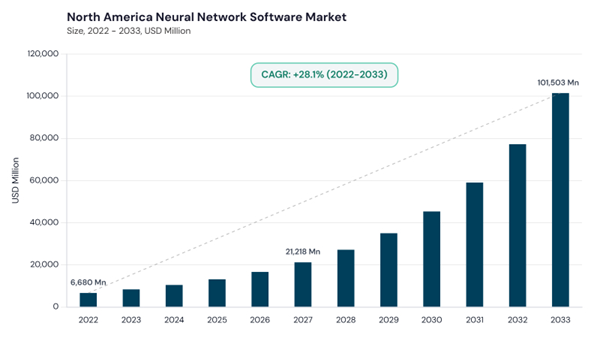
The United States dominated the North America Neural Network Software Market by country in 2024 and is expected to continue to remain the leading market through 2033, reaching a market value of approximately USD 73.03 billion by 2033. Canada is anticipated to witness a CAGR of around 32.1% during 2026-2033, while Mexico is projected to grow at a CAGR of approximately 31.2% over the forecast period. The United States accounted for nearly 76% share of the regional market in 2026, highlighting its strong AI infrastructure, cloud ecosystem, and enterprise AI adoption.
The North America market evolved from foundational artificial intelligence research and early machine learning experimentation into one of the world’s most mature neural network software ecosystems. The emergence of deep learning frameworks, large-scale cloud infrastructure, GPU acceleration, and scalable data processing capabilities accelerated commercial adoption across healthcare, BFSI, automotive, and enterprise analytics applications. The region experienced rapid advancement through the integration of neurosymbolic AI, explainable AI, and hybrid cloud deployments, enabling enterprises to operationalize neural network models at scale. Regulatory emphasis on AI governance, cybersecurity resilience, and data protection has also shaped solution architectures across industries.
The market is witnessing strong momentum from edge AI deployment, AI-driven automation, and enterprise-grade MLOps integration. Organizations are increasingly adopting neural network software for predictive analytics, autonomous systems, fraud detection, and intelligent workflow automation. AI integration with cloud-native architectures and scalable deployment frameworks is improving enterprise accessibility. Competition remains highly innovation-focused, with companies emphasizing proprietary algorithms, model optimization, AI explainability, and scalable deployment capabilities. Strategic collaborations among cloud providers, semiconductor manufacturers, and AI software developers continue to strengthen market maturity and accelerate commercialization.
Type Outlook
Based on Type, the market is segmented into Analytical Software, Data Mining & Archiving, Optimization Software, and Visualization Software.The Analytical Software segment dominated the North America Neural Network Software Market and is expected to maintain its leadership through 2033, supported by increasing enterprise demand for predictive analytics, fraud detection, and AI-driven business intelligence applications. The segment is projected to grow at a CAGR of approximately 29.2% during 2026-2033. The Optimization Software segment is anticipated to witness one of the fastest growth rates, with organizations increasingly adopting AI-powered optimization tools for logistics, manufacturing efficiency, and operational automation. Analysis & Future Outlook: Growing enterprise reliance on data-centric decision-making and intelligent automation is expected to sustain strong demand for analytical and optimization-focused neural network platforms.
Component Outlook
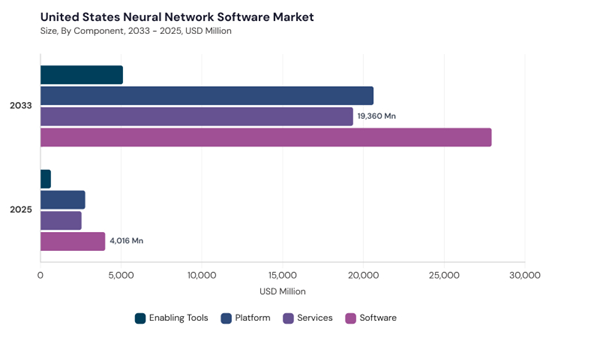
Based on Component, the market is segmented into Software, Platform, Services, and Enabling Tools.The Software segment dominated the North America market owing to large-scale adoption of neural network applications for predictive analytics, computer vision, and intelligent automation, and is projected to grow at a CAGR of approximately 29.3% through 2033. The Platform segment is expected to witness robust growth as enterprises increasingly deploy cloud-native AI development and orchestration platforms to accelerate model deployment and lifecycle management. Analysis & Future Outlook: Demand for scalable AI infrastructure, automated deployment pipelines, and integrated neural network ecosystems will continue driving software and platform investments across the region.
Industry Outlook
Based on Industry, the market is segmented into IT & Telecom, BFSI, Healthcare, Industrial Manufacturing, Media, and Other Industry.The IT & Telecom segment dominated the North America Neural Network Software Market due to rising deployment of AI for network optimization, cybersecurity, and real-time analytics and is expected to witness a CAGR of around 27.6% through 2033. The Healthcare segment is projected to register strong growth driven by increasing use of neural networks in diagnostics, medical imaging, and predictive healthcare analytics. Analysis & Future Outlook: Expanding 5G infrastructure, AI-powered digital healthcare systems, and intelligent enterprise automation are expected to strengthen long-term market growth across key industries.
Country Outlook
The United States continues to lead the North America Neural Network Software Market due to its advanced AI research ecosystem, large-scale cloud infrastructure, and strong presence of leading technology providers. Enterprises across healthcare, BFSI, media, and manufacturing are rapidly integrating neural network platforms into operational workflows for predictive intelligence and automation. The market benefits from strong venture capital investments, AI-focused government initiatives, and extensive semiconductor innovation. Increasing demand for explainable AI, MLOps automation, and edge AI deployment is further accelerating adoption. Strategic collaborations between cloud providers, AI startups, and hardware companies are strengthening the commercialization of next-generation neural network platforms. The country’s leadership in generative AI and large language model deployment is also positioning the US as a global innovation hub for neural network software technologies.List of Key Companies Profiled
- Google LLC (Alphabet Inc.)
- Microsoft Corporation
- NVIDIA Corporation
- IBM Corporation
- Oracle Corporation
- Intel Corporation
- Qualcomm Incorporated
- OpenAI, LLC
- SAP SE
- SAS Institute Inc.
Market Report Segmentation
By Type- Analytical Software
- Data Mining & Archiving
- Optimization Software
- Visualization Software
- Software
- Platform
- Services
- Enabling Tools
- IT & Telecom
- BFSI
- Healthcare
- Industrial Manufacturing
- Media
- Other Industry
- United States
- Canada
- Mexico
- Rest of North America
Table of Contents
Chapter 1. North America Market1.1 Market Overview
1.2 Key Factors Impacting Market
1.2.1 Market Drivers
1.2.2 Market Restraints
1.2.3 Market Opportunities
1.2.4 Market Challenges
1.2.5 Market Trends
1.2.6 State of Competition
1.2.7 Market Consolidation
1.2.8 Key Customer Criteria
1.3 Product Life Cycle
1.4 Segmentation By Type
1.4.1 Analytical Software
1.4.2 Data Mining & Archiving
1.4.3 Optimization Software
1.4.4 Visualization Software
1.5 Segmentation By Component
1.5.1 Software
1.5.2 Platform
1.5.3 Services
1.5.4 Enabling Tools
1.6 Segmentation By Industry
1.6.1 IT & Telecom
1.6.2 BFSI
1.6.3 Healthcare
1.6.4 Industrial Manufacturing
1.6.5 Media
1.6.6 Other Industry
1.7 Segmentation By Country
1.7.1 United States
1.7.1.1 Segmentation By Type
1.7.1.1.1 Analytical Software
1.7.1.1.2 Data Mining & Archiving
1.7.1.1.3 Optimization Software
1.7.1.1.4 Visualization Software
1.7.1.2 Segmentation By Component
1.7.1.2.1 Software
1.7.1.2.2 Platform
1.7.1.2.3 Services
1.7.1.2.4 Enabling Tools
1.7.1.3 Segmentation By Industry
1.7.1.3.1 IT & Telecom
1.7.1.3.2 BFSI
1.7.1.3.3 Healthcare
1.7.1.3.4 Industrial Manufacturing
1.7.1.3.5 Media
1.7.1.3.6 Other Industry
1.7.2 Canada
1.7.2.1 Segmentation By Type
1.7.2.1.1 Analytical Software
1.7.2.1.2 Data Mining & Archiving
1.7.2.1.3 Optimization Software
1.7.2.1.4 Visualization Software
1.7.2.2 Segmentation By Component
1.7.2.2.1 Software
1.7.2.2.2 Platform
1.7.2.2.3 Services
1.7.2.2.4 Enabling Tools
1.7.2.3 Segmentation By Industry
1.7.2.3.1 IT & Telecom
1.7.2.3.2 BFSI
1.7.2.3.3 Healthcare
1.7.2.3.4 Industrial Manufacturing
1.7.2.3.5 Media
1.7.2.3.6 Other Industry
1.7.3 Mexico
1.7.3.1 Segmentation By Type
1.7.3.1.1 Analytical Software
1.7.3.1.2 Data Mining & Archiving
1.7.3.1.3 Optimization Software
1.7.3.1.4 Visualization Software
1.7.3.2 Segmentation By Component
1.7.3.2.1 Software
1.7.3.2.2 Platform
1.7.3.2.3 Services
1.7.3.2.4 Enabling Tools
1.7.3.3 Segmentation By Industry
1.7.3.3.1 IT & Telecom
1.7.3.3.2 BFSI
1.7.3.3.3 Healthcare
1.7.3.3.4 Industrial Manufacturing
1.7.3.3.5 Media
1.7.3.3.6 Other Industry
1.7.4 Rest of North America
1.7.4.1 Segmentation By Type
1.7.4.1.1 Analytical Software
1.7.4.1.2 Data Mining & Archiving
1.7.4.1.3 Optimization Software
1.7.4.1.4 Visualization Software
1.7.4.2 Segmentation By Component
1.7.4.2.1 Software
1.7.4.2.2 Platform
1.7.4.2.3 Services
1.7.4.2.4 Enabling Tools
1.7.4.3 Segmentation By Industry
1.7.4.3.1 IT & Telecom
1.7.4.3.2 BFSI
1.7.4.3.3 Healthcare
1.7.4.3.4 Industrial Manufacturing
1.7.4.3.5 Media
1.7.4.3.6 Other Industry
Chapter 2. Company Profiles
2.1 ABB Ltd.
2.1.1 Company Overview
2.1.2 Recent Strategies and Developments
2.1.2.1 Product Launches and Product Expansions
2.1.3 Company Focus
2.1.2 Strategic Insights
2.1.5 Strategy Deployed
2.1.6 SWOT Analysis
2.1.7 Future Outlook
2.2 Schneider Electric SE
2.2.1 Company Overview
2.2.2 Financial Analysis
2.2.3 Segmental and Regional Analysis
2.2.2 Research & Development Expense
2.2.5 Recent Strategies and Developments
2.2.5.1 Product Launches and Product Expansions
2.2.5.2 Geographical Expansions
2.2.6 Company Focus
2.2.7 Strategic Insights
2.2.8 Strategy Deployed
2.2.9 SWOT Analysis
2.2.10 Future Outlook
2.3 Siemens AG
2.3.1 Company Overview
2.3.2 Financial Analysis
2.3.3 Segmental and Regional Analysis
2.3.2 Research & Development Expense
2.3.5 Recent Strategies and Developments
2.3.5.1 Partnerships, Collaborations, and Agreements
2.3.6 Company Focus
2.3.7 Strategic Insights
2.3.8 Strategy Deployed
2.3.9 SWOT Analysis
2.3.10 Future Outlook
2.2 Eaton Corporation PLC
2.2.1 Company Overview
2.2.2 Financial Analysis
2.2.3 Segmental and Regional Analysis
2.2.2 Research & Development Expense
2.2.5 Company Focus
2.2.6 Strategic Insights
2.2.7 Strategy Deployed
2.2.8 SWOT Analysis
2.2.9 Future Outlook
2.5 Mitsubishi Electric Corporation
2.5.1 Company Overview
2.5.2 Financial Analysis
2.5.3 Segmental and Regional Analysis
2.5.2 Research & Development Expense
2.5.5 Recent Strategies and Developments
2.5.5.1 Partnerships, Collaborations, and Agreements
2.5.5.2 Product Launches and Product Expansions
2.5.6 Company Focus
2.5.7 Strategic Insights
2.5.8 Strategy Deployed
2.5.9 SWOT Analysis
2.5.10 Future Outlook
2.6 Legrand S.A. (Legrand Group)
2.6.1 Company Overview
2.6.2 Financial Analysis
2.6.3 Regional Analysis
2.6.2 Research & Development Expense
2.6.5 Recent Strategies and Developments
2.6.5.1 Product Launches and Product Expansions
2.6.6 Company Focus
2.6.7 Strategic Insights
2.6.8 Strategy Deployed
2.6.9 SWOT Analysis
2.6.10 Future Outlook
2.7 General Electric Company
2.7.1 Company Overview
2.7.2 Company Focus
2.7.3 Strategic Insights
2.7.2 Strategy Deployed
2.7.5 SWOT Analysis
2.7.6 Future Outlook
2.8 Hager Group
2.8.1 Company Overview
2.8.2 Company Focus
2.8.3 Strategic Insights
2.8.2 Strategy Deployed
2.8.5 SWOT Analysis
2.8.6 Future Outlook
2.9 Fuji Electric Co. Ltd.
2.9.1 Company Overview
2.9.2 Financial Analysis
2.9.3 Segmental and Regional Analysis
2.9.2 Research & Development Expense
2.9.5 Company Focus
2.9.6 Strategic Insights
2.9.7 Strategy Deployed
2.9.8 SWOT Analysis
2.9.9 Future Outlook
2.1 CHINT Group Co., Ltd.
2.10.1 Company Overview
2.10.2 Recent Strategies and Developments
2.10.2.1 Partnerships, Collaborations, and Agreements
2.10.2.2 Geographical Expansions
2.10.3 Company Focus
2.10.2 Strategic Insights
2.10.5 Strategy Deployed
2.10.6 SWOT Analysis
2.10.7 Future Outlook
Companies Mentioned
- Google LLC (Alphabet Inc.)
- Microsoft Corporation
- NVIDIA Corporation
- IBM Corporation
- Oracle Corporation
- Intel Corporation
- Qualcomm Incorporated
- OpenAI, LLC
- SAP SE
- SAS Institute Inc.


