



The Asia Pacific Radio Frequency Duplexer Market size is expected to reach USD 2.89 Billion by 2030, rising at a market growth of 12.6% CAGR during the forecast period.
The China market dominated the Asia Pacific Radio Frequency Duplexer Market by country in 2025, and is expected to continue to be a dominant market till 2033; thereby, achieving a market value of USD 1.37 Billion by 2033. The Japan market is expected to witness a CAGR of 11.0% during 2026-2033. Additionally, the India market is expected to witness a CAGR of 13.8% during 2026-2033. China and Japan collectively accounted for a significant revenue share in the Asia Pacific Radio Frequency Duplexer Market in 2025.
The Asia Pacific Radio Frequency Duplexer Market is experiencing substantial growth due to the rapid expansion of 5G networks, increasing smartphone penetration, rising industrial automation, and growing investments in advanced wireless communication infrastructure. Radio frequency duplexers are essential components in wireless communication systems as they enable simultaneous transmission and reception of signals while minimizing interference and improving communication efficiency.
Countries such as China, Japan, India, South Korea, Singapore, and Malaysia are heavily investing in next-generation telecommunications infrastructure and semiconductor technologies. The rapid adoption of connected devices, IoT-enabled systems, smart factories, autonomous vehicles, and smart city initiatives is significantly boosting demand for RF duplexers across the region.
Japan remains a key market driven by advanced telecommunications infrastructure, increasing deployment of high-frequency wireless systems, and strong demand for RF components in automotive electronics and industrial applications. The country’s focus on innovation and advanced semiconductor technologies continues to strengthen its market position.
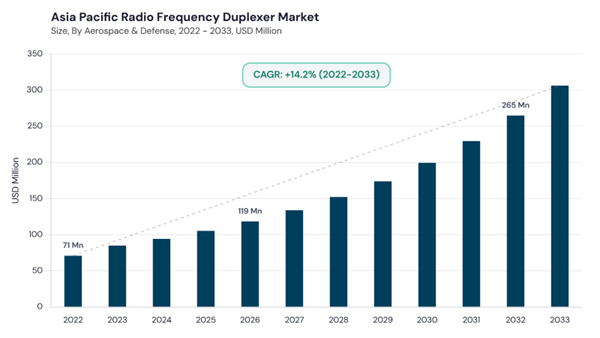
The China market dominated the Asia Pacific Radio Frequency Duplexer Market by country in 2025, and is expected to continue to be a dominant market till 2033; thereby, achieving a market value of USD 1.37 Billion by 2033. The Japan market is expected to witness a CAGR of 11.0% during 2026-2033. Additionally, the India market is expected to witness a CAGR of 13.8% during 2026-2033. China and Japan collectively accounted for a significant revenue share in the Asia Pacific Radio Frequency Duplexer Market in 2025.
The Asia Pacific Radio Frequency Duplexer Market is experiencing substantial growth due to the rapid expansion of 5G networks, increasing smartphone penetration, rising industrial automation, and growing investments in advanced wireless communication infrastructure. Radio frequency duplexers are essential components in wireless communication systems as they enable simultaneous transmission and reception of signals while minimizing interference and improving communication efficiency.
Countries such as China, Japan, India, South Korea, Singapore, and Malaysia are heavily investing in next-generation telecommunications infrastructure and semiconductor technologies. The rapid adoption of connected devices, IoT-enabled systems, smart factories, autonomous vehicles, and smart city initiatives is significantly boosting demand for RF duplexers across the region.
Type Outlook
Based on Type, the market is segmented into SAW Duplexer, BAW Duplexer, Dielectric / Ceramic Duplexer, and Cavity Duplexer. The SAW Duplexer segment dominated the Asia Pacific Radio Frequency Duplexer Market by Type in 2025 and is expected to continue to be a dominant market till 2033; thereby, achieving a market value of USD 1.18 Billion by 2030. The BAW Duplexer market is expected to witness a CAGR of 12.4% during the forecast period. Additionally, the Cavity Duplexer market is projected to witness the fastest CAGR of 15.8% during the forecast period.Frequency Band Outlook
Based on Frequency Band, the market is segmented into 1 GHz - 3 GHz, Below 1 GHz, and Above 3 GHz. The 1 GHz - 3 GHz segment dominated the Asia Pacific Radio Frequency Duplexer Market by Frequency Band in 2025 and is expected to continue to maintain its dominance till 2033; thereby, achieving a market value of USD 1.30 Billion by 2030. The Below 1 GHz segment is anticipated to witness strong growth due to increasing deployment of wide-area wireless communication systems. The Above 3 GHz segment is expected to witness the highest CAGR of 13.2% during the forecast period owing to rapid adoption of mmWave 5G and advanced communication technologies.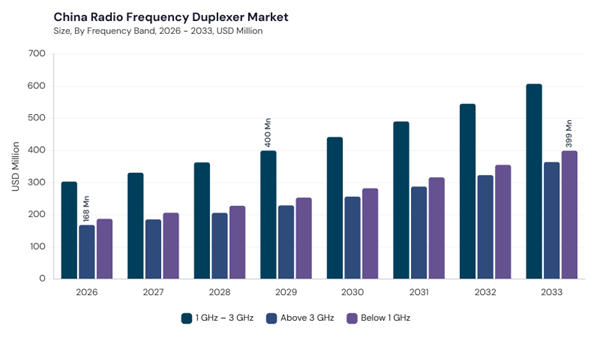
Application Outlook
Based on Application, the market is segmented into Mobile Devices (Smartphones, Tablets), Telecommunications Infrastructure, Industrial & IoT, Automotive, Aerospace & Defense, and Other Application. The Mobile Devices segment dominated the Asia Pacific Radio Frequency Duplexer Market by Application in 2025 and is expected to continue to be a dominant market till 2033; thereby, achieving a market value of USD 1.39 Billion by 2030. The Telecommunications Infrastructure segment is expected to witness substantial growth supported by aggressive 5G infrastructure expansion across the region. Additionally, the Industrial & IoT segment is expected to witness the highest CAGR of 12.1% during the forecast period.Country Outlook
China continues to dominate the Asia Pacific Radio Frequency Duplexer Market due to strong investments in 5G infrastructure, semiconductor manufacturing, smartphone production, and industrial automation technologies. The country’s expanding telecommunications ecosystem and leadership in consumer electronics manufacturing are significantly contributing to market growth.Japan remains a key market driven by advanced telecommunications infrastructure, increasing deployment of high-frequency wireless systems, and strong demand for RF components in automotive electronics and industrial applications. The country’s focus on innovation and advanced semiconductor technologies continues to strengthen its market position.
List of Key Companies Profiled
- Murata Manufacturing Co., Ltd.
- Skyworks Solutions, Inc.
- Qorvo, Inc.
- Broadcom Inc.
- Qualcomm Incorporated
- TDK Corporation
- Taiyo Yuden Co., Ltd.
- Infineon Technologies AG
- Akoustis Technologies, Inc.
- STMicroelectronics N.V.
Market Report Segmentation
By Type- SAW Duplexer
- BAW Duplexer
- Dielectric / Ceramic Duplexer
- Cavity Duplexer
- 1 GHz - 3 GHz
- Below 1 GHz
- Above 3 GHz
- Mobile Devices (Smartphones, Tablets)
- Telecommunications Infrastructure
- Industrial & IoT
- Automotive
- Aerospace & Defense
- Other Application
- China
- Japan
- India
- South Korea
- Singapore
- Malaysia
- Rest of Asia Pacific
Table of Contents
Chapter 1. Asia Pacific Market1.1 Market Overview
1.2 Key Factors Impacting Market
1.2.1 Market Drivers
1.2.2 Market Restraints
1.2.3 Market Opportunities
1.2.4 Market Challenges
1.2.5 Market Trends
1.2.6 State of Competition
1.2.7 Market Consolidation
1.2.8 Key Customer Criteria
1.3 Product Life Cycle
1.4 Segmentation By Type
1.4.1 SAW Duplexer
1.4.2 BAW Duplexer
1.4.3 Cavity Duplexer
1.4.4 Dielectric / Ceramic Duplexer
1.5 Segmentation By Frequency Band
1.5.1 Below 1 GHz
1.5.2 1 GHz - 3 GHz
1.5.3 Above 3 GHz
1.6 Segmentation By Application
1.6.1 Mobile Devices (Smartphones, Tablets)
1.6.2 Telecommunications Infrastructure
1.6.3 Automotive
1.6.4 Aerospace & Defense
1.6.5 Industrial & IoT
1.6.6 Other Application
1.7 Segmentation By Country
1.7.1 China
1.7.1.1 Segmentation By Type
1.7.1.1.1 SAW Duplexer
1.7.1.1.2 BAW Duplexer
1.7.1.1.3 Cavity Duplexer
1.7.1.1.4 Dielectric / Ceramic Duplexer
1.7.1.2 Segmentation By Frequency Band
1.7.1.2.1 Below 1 GHz
1.7.1.2.2 1 GHz - 3 GHz
1.7.1.2.3 Above 3 GHz
1.7.1.3 Segmentation By Application
1.7.1.3.1 Mobile Devices (Smartphones, Tablets)
1.7.1.3.2 Telecommunications Infrastructure
1.7.1.3.3 Automotive
1.7.1.3.4 Aerospace & Defense
1.7.1.3.5 Industrial & IoT
1.7.1.3.6 Other Application
1.7.2 Japan
1.7.2.1 Segmentation By Type
1.7.2.1.1 SAW Duplexer
1.7.2.1.2 BAW Duplexer
1.7.2.1.3 Cavity Duplexer
1.7.2.1.4 Dielectric / Ceramic Duplexer
1.7.2.2 Segmentation By Frequency Band
1.7.2.2.1 Below 1 GHz
1.7.2.2.2 1 GHz - 3 GHz
1.7.2.2.3 Above 3 GHz
1.7.2.3 Segmentation By Application
1.7.2.3.1 Mobile Devices (Smartphones, Tablets)
1.7.2.3.2 Telecommunications Infrastructure
1.7.2.3.3 Automotive
1.7.2.3.4 Aerospace & Defense
1.7.2.3.5 Industrial & IoT
1.7.2.3.6 Other Application
1.7.3 India
1.7.3.1 Segmentation By Type
1.7.3.1.1 SAW Duplexer
1.7.3.1.2 BAW Duplexer
1.7.3.1.3 Cavity Duplexer
1.7.3.1.4 Dielectric / Ceramic Duplexer
1.7.3.2 Segmentation By Frequency Band
1.7.3.2.1 Below 1 GHz
1.7.3.2.2 1 GHz - 3 GHz
1.7.3.2.3 Above 3 GHz
1.7.3.3 Segmentation By Application
1.7.3.3.1 Mobile Devices (Smartphones, Tablets)
1.7.3.3.2 Telecommunications Infrastructure
1.7.3.3.3 Automotive
1.7.3.3.4 Aerospace & Defense
1.7.3.3.5 Industrial & IoT
1.7.3.3.6 Other Application
1.7.4 South Korea
1.7.4.1 Segmentation By Type
1.7.4.1.1 SAW Duplexer
1.7.4.1.2 BAW Duplexer
1.7.4.1.3 Cavity Duplexer
1.7.4.1.4 Dielectric / Ceramic Duplexer
1.7.4.2 Segmentation By Frequency Band
1.7.4.2.1 Below 1 GHz
1.7.4.2.2 1 GHz - 3 GHz
1.7.4.2.3 Above 3 GHz
1.7.4.3 Segmentation By Application
1.7.4.3.1 Mobile Devices (Smartphones, Tablets)
1.7.4.3.2 Telecommunications Infrastructure
1.7.4.3.3 Automotive
1.7.4.3.4 Aerospace & Defense
1.7.4.3.5 Industrial & IoT
1.7.4.3.6 Other Application
1.7.5 Singapore
1.7.5.1 Segmentation By Type
1.7.5.1.1 SAW Duplexer
1.7.5.1.2 BAW Duplexer
1.7.5.1.3 Cavity Duplexer
1.7.5.1.4 Dielectric / Ceramic Duplexer
1.7.5.2 Segmentation By Frequency Band
1.7.5.2.1 Below 1 GHz
1.7.5.2.2 1 GHz - 3 GHz
1.7.5.2.3 Above 3 GHz
1.7.5.3 Segmentation By Application
1.7.5.3.1 Mobile Devices (Smartphones, Tablets)
1.7.5.3.2 Telecommunications Infrastructure
1.7.5.3.3 Automotive
1.7.5.3.4 Aerospace & Defense
1.7.5.3.5 Industrial & IoT
1.7.5.3.6 Other Application
1.7.6 Malaysia
1.7.6.1 Segmentation By Type
1.7.6.1.1 SAW Duplexer
1.7.6.1.2 BAW Duplexer
1.7.6.1.3 Cavity Duplexer
1.7.6.1.4 Dielectric / Ceramic Duplexer
1.7.6.2 Segmentation By Frequency Band
1.7.6.2.1 Below 1 GHz
1.7.6.2.2 1 GHz - 3 GHz
1.7.6.2.3 Above 3 GHz
1.7.6.3 Segmentation By Application
1.7.6.3.1 Mobile Devices (Smartphones, Tablets)
1.7.6.3.2 Telecommunications Infrastructure
1.7.6.3.3 Automotive
1.7.6.3.4 Aerospace & Defense
1.7.6.3.5 Industrial & IoT
1.7.6.3.6 Other Application
1.7.7 Rest of Asia Pacific
1.7.7.1 Segmentation By Type
1.7.7.1.1 SAW Duplexer
1.7.7.1.2 BAW Duplexer
1.7.7.1.3 Cavity Duplexer
1.7.7.1.4 Dielectric / Ceramic Duplexer
1.7.7.2 Segmentation By Frequency Band
1.7.7.2.1 Below 1 GHz
1.7.7.2.2 1 GHz - 3 GHz
1.7.7.2.3 Above 3 GHz
1.7.7.3 Segmentation By Application
1.7.7.3.1 Mobile Devices (Smartphones, Tablets)
1.7.7.3.2 Telecommunications Infrastructure
1.7.7.3.3 Automotive
1.7.7.3.4 Aerospace & Defense
1.7.7.3.5 Industrial & IoT
1.7.7.3.6 Other Application
Chapter 2. Company Snapshots
2.1 Murata Manufacturing Co., Ltd.
2.1.1 Business Overview
2.1.2 Key Information
2.1.3 Company Focus
2.1.4 Strategic Insights
2.1.5 Strategy Deployed
2.1.6 Product & Service Portfolio
2.1.7 Capability Overview
2.1.8 Technology & Innovation Focus
2.1.9 Customers / End Users
2.1.10 Competitive Positioning
2.1.11 Key Differentiators
2.1.12 Portfolio Matrix
2.1.13 SWOT Analysis
2.1.14 Future Outlook
2.2 Qualcomm Incorporated (Qualcomm Technologies, Inc.)
2.2.1 Business Overview
2.2.2 Key Information
2.2.3 Company Focus
2.2.4 Strategic Insights
2.2.5 Strategy Deployed
2.2.6 Product & Service Portfolio
2.2.7 Capability Overview
2.2.8 Technology & Innovation Focus
2.2.9 Customers / End Users
2.2.10 Competitive Positioning
2.2.11 Key Differentiators
2.2.12 Portfolio Matrix
2.2.13 SWOT Analysis
2.2.14 Future Outlook
2.3 Broadcom Inc.
2.3.1 Business Overview
2.3.2 Key Information
2.3.3 Company Focus
2.3.4 Strategic Insights
2.3.5 Strategy Deployed
2.3.6 Product & Service Portfolio
2.3.7 Capability Overview
2.3.8 Technology & Innovation Focus
2.3.9 Customers / End Users
2.3.10 Competitive Positioning
2.3.11 Key Differentiators
2.3.12 Portfolio Matrix
2.3.13 SWOT Analysis
2.3.14 Future Outlook
2.4 Qorvo, Inc.
2.4.1 Business Overview
2.4.2 Key Information
2.4.3 Company Focus
2.4.4 Strategic Insights
2.4.5 Strategy Deployed
2.4.6 Product & Service Portfolio
2.4.7 Capability Overview
2.4.8 Technology & Innovation Focus
2.4.9 Customers / End Users
2.4.10 Competitive Positioning
2.4.11 Key Differentiators
2.4.12 Portfolio Matrix
2.4.13 SWOT Analysis
2.4.14 Future Outlook
2.5 TDK Corporation
2.5.1 Business Overview
2.5.2 Key Information
2.5.3 Company Focus
2.5.4 Strategic Insights
2.5.5 Strategy Deployed
2.5.6 Product & Service Portfolio
2.5.7 Capability Overview
2.5.8 Technology & Innovation Focus
2.5.9 Customers / End Users
2.5.10 Competitive Positioning
2.5.11 Key Differentiators
2.5.12 Portfolio Matrix
2.5.13 SWOT Analysis
2.5.14 Future Outlook
2.6 Skyworks Solutions, Inc.
2.6.1 Business Overview
2.6.2 Key Information
2.6.3 Company Focus
2.6.4 Strategic Insights
2.6.5 Strategy Deployed
2.6.6 Product & Service Portfolio
2.6.7 Capability Overview
2.6.8 Technology & Innovation Focus
2.6.9 Customers / End Users
2.6.10 Competitive Positioning
2.6.11 Key Differentiators
2.6.12 Portfolio Matrix
2.6.13 SWOT Analysis
2.6.14 Future Outlook
2.7 TAIYO YUDEN CO., LTD.
2.7.1 Business Overview
2.7.2 Key Information
2.7.3 Company Focus
2.7.4 Strategic Insights
2.7.5 Strategy Deployed
2.7.6 Product & Service Portfolio
2.7.7 Capability Overview
2.7.8 Technology & Innovation Focus
2.7.9 Customers / End Users
2.7.10 Competitive Positioning
2.7.11 Key Differentiators
2.7.12 Portfolio Matrix
2.7.13 SWOT Analysis
2.7.14 Future Outlook
2.8 Kyocera Corporation
2.8.1 Business Overview
2.8.2 Key Information
2.8.3 Company Focus
2.8.4 Strategic Insights
2.8.5 Strategy Deployed
2.8.6 Product & Service Portfolio
2.8.7 Capability Overview
2.8.8 Technology & Innovation Focus
2.8.9 Customers / End Users
2.8.10 Competitive Positioning
2.8.11 Key Differentiators
2.8.12 Portfolio Matrix
2.8.13 SWOT Analysis
2.8.14 Future Outlook
2.9 CTS Corporation
2.9.1 Business Overview
2.9.2 Key Information
2.9.3 Company Focus
2.9.4 Strategic Insights
2.9.5 Strategy Deployed
2.9.6 Product & Service Portfolio
2.9.7 Capability Overview
2.9.8 Technology & Innovation Focus
2.9.9 Customers / End Users
2.9.10 Competitive Positioning
2.9.11 Key Differentiators
2.9.12 Portfolio Matrix
2.9.13 SWOT Analysis
2.9.14 Future Outlook
2.10 TAI-SAW TECHNOLOGY CO., LTD.
2.10.1 Business Overview
2.10.2 Key Information
2.10.3 Company Focus
2.10.4 Strategic Insights
2.10.5 Strategy Deployed
2.10.6 Product & Service Portfolio
2.10.7 Capability Overview
2.10.8 Technology & Innovation Focus
2.10.9 Customers / End Users
2.10.10 Competitive Positioning
2.10.11 Key Differentiators
2.10.12 Portfolio Matrix
2.10.13 SWOT Analysis
2.10.14 Future Outlook
Companies Mentioned
- Murata Manufacturing Co., Ltd.
- Skyworks Solutions, Inc.
- Qorvo, Inc.
- Broadcom Inc.
- Qualcomm Incorporated
- TDK Corporation
- Taiyo Yuden Co., Ltd.
- Infineon Technologies AG
- Akoustis Technologies, Inc.
- STMicroelectronics N.V.


