



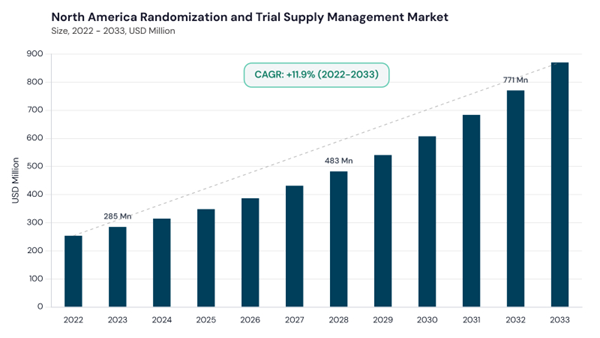
The North America Randomization And Trial Supply Management Market is expected to witness market growth of 12.3% CAGR during the forecast period (2026-2033) reachin amarket value of USD USD 770.7 million by 2032.
The US market dominated the North America Randomization And Trial Supply Management Market by country in 2025, and is expected to continue to be a dominant market till 2033; thereby, achieving a market value of USD705.7 million by 2033. The Canada market is expected to witness a CAGR of 15.9% during 2026-2033. Additionally, the Mexico market is expected to witness a CAGR of 14.6% during 2026-2033. The US and Canada led the North America Randomization And Trial Supply Management Market by Country with a market share of 85% and 7.1% in 2025. The regional market attained a value of USD348.3 million in 2025 and is projected to reach USD870.2 million by 2033.
The market for randomization and trial supply management in North America has evolved significantly alongside the increasing digitization of clinical trial operations and rising complexity of global drug development programs. Initially focused on basic patient randomization and inventory allocation, the market has progressed toward highly integrated systems capable of managing adaptive trial designs, real-time drug supply optimization, and decentralized clinical workflows. The growing number of multinational clinical studies, biologics development programs, and precision medicine initiatives has accelerated the adoption of advanced RTSM platforms across pharmaceutical companies, CROs, hospitals, and research institutions. Regulatory emphasis on patient safety, data traceability, and compliance management has also contributed to widespread deployment of automated trial supply technologies throughout the region.
AI-driven trial optimization, predictive inventory management, and cloud-enabled clinical trial platforms are becoming increasingly prominent across the North American market. Organizations are integrating analytics, automation, and real-time monitoring capabilities to improve patient enrollment efficiency, reduce trial delays, and minimize medication wastage. The expansion of decentralized and hybrid clinical trial models is further encouraging investments in scalable RTSM infrastructure. In addition, rising outsourcing activities among pharmaceutical companies and increasing partnerships between biotechnology firms and CROs are supporting market expansion. Competition in the region is largely driven by platform interoperability, regulatory compliance capabilities, operational scalability, and advanced analytics integration rather than pricing strategies alone.
The US market dominated the North America Randomization And Trial Supply Management Market by country in 2025, and is expected to continue to be a dominant market till 2033; thereby, achieving a market value of USD705.7 million by 2033. The Canada market is expected to witness a CAGR of 15.9% during 2026-2033. Additionally, the Mexico market is expected to witness a CAGR of 14.6% during 2026-2033. The US and Canada led the North America Randomization And Trial Supply Management Market by Country with a market share of 85% and 7.1% in 2025. The regional market attained a value of USD348.3 million in 2025 and is projected to reach USD870.2 million by 2033.
The market for randomization and trial supply management in North America has evolved significantly alongside the increasing digitization of clinical trial operations and rising complexity of global drug development programs. Initially focused on basic patient randomization and inventory allocation, the market has progressed toward highly integrated systems capable of managing adaptive trial designs, real-time drug supply optimization, and decentralized clinical workflows. The growing number of multinational clinical studies, biologics development programs, and precision medicine initiatives has accelerated the adoption of advanced RTSM platforms across pharmaceutical companies, CROs, hospitals, and research institutions. Regulatory emphasis on patient safety, data traceability, and compliance management has also contributed to widespread deployment of automated trial supply technologies throughout the region.
AI-driven trial optimization, predictive inventory management, and cloud-enabled clinical trial platforms are becoming increasingly prominent across the North American market. Organizations are integrating analytics, automation, and real-time monitoring capabilities to improve patient enrollment efficiency, reduce trial delays, and minimize medication wastage. The expansion of decentralized and hybrid clinical trial models is further encouraging investments in scalable RTSM infrastructure. In addition, rising outsourcing activities among pharmaceutical companies and increasing partnerships between biotechnology firms and CROs are supporting market expansion. Competition in the region is largely driven by platform interoperability, regulatory compliance capabilities, operational scalability, and advanced analytics integration rather than pricing strategies alone.
Delivery Mode Outlook
Based on Delivery Mode, the market is segmented into Cloud-based and On-premise. The Cloud-based segment dominated the North America Randomization And Trial Supply Management Market by Delivery Mode in 2025, and is expected to continue to be a dominant segment till 2033; thereby, achieving a market value of USD683.8 million by 2033. The On-premise segment is expected to witness a CAGR of 13.6% during 2026-2033. The growing adoption of decentralized clinical trials, remote monitoring technologies, and real-time collaboration tools is accelerating demand for cloud-enabled RTSM platforms across the region.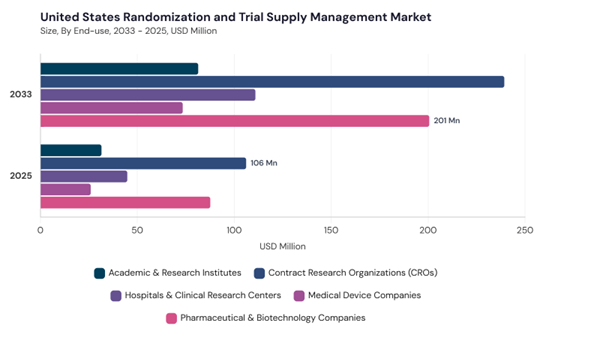
End-use Outlook
Based on End-use, the market is segmented into Contract Research Organizations (CROs), Pharmaceutical & Biotechnology Companies, Hospitals & Clinical Research Centers, Academic & Research Institutes, and Medical Device Companies. The Contract Research Organizations (CROs) segment dominated the North America Randomization And Trial Supply Management Market by End-use in 2025, and is expected to continue to be a dominant segment till 2033; thereby, achieving a market value of USD295.6 million by 2033. The Medical Device Companies segment is anticipated to register the highest CAGR of 14.7% during 2026-2033. Additionally, the Hospitals & Clinical Research Centers segment would witness a CAGR of 12.8% during the forecast period. Increasing outsourcing of clinical trial management activities and growing demand for operational efficiency continue to support segment growth.Country Outlook
The US randomization and trial supply management market represents the largest regional ecosystem in North America due to the country’s extensive pharmaceutical R&D infrastructure, high concentration of biotechnology innovators, and large volume of clinical trial activities. Strong adoption of digital health technologies and increasing investments in adaptive clinical trials have accelerated deployment of advanced RTSM solutions across the country. Pharmaceutical companies and CROs are increasingly implementing AI-enabled trial management systems to optimize patient randomization, supply forecasting, and site coordination. The rise of decentralized trials and remote patient participation models is also driving demand for cloud-native RTSM platforms. Furthermore, regulatory requirements related to patient safety, trial transparency, and data integrity continue to encourage modernization of clinical trial supply management processes across the US healthcare and life sciences ecosystem.- IQVIA Holdings Inc.
- Oracle Corporation
- Medidata Solutions, Inc.
- Parexel International Corporation
- Signant Health
- 4G Clinical
- Bioclinica, Inc.
- Calyx
- Endpoint Clinical, Inc.
- Almac Group
North America Randomization And Trial Supply Management Market Report Segmentation
By Delivery Mode- Cloud-based
- On-premise
- Contract Research Organizations (CROs)
- Pharmaceutical & Biotechnology Companies
- Hospitals & Clinical Research Centers
- Academic & Research Institutes
- Medical Device Companies
- US
- Canada
- Mexico
- Rest of North America
List of Key Companies Profiled
- IQVIA Holdings Inc.
- Oracle Corporation
- Medidata Solutions, Inc.
- Parexel International Corporation
- Signant Health
- 4G Clinical
- Bioclinica, Inc.
- Calyx
- Endpoint Clinical, Inc.
- Almac Group
Market Report Segmentation
By Delivery Mode- Cloud-based
- On-premise
- Contract Research Organizations (CROs)
- Pharmaceutical & Biotechnology Companies
- Hospitals & Clinical Research Centers
- Academic & Research Institutes
- Medical Device Companies
- US
- Canada
- Mexico
- Rest of North America
Table of Contents
Chapter 1. North America Market1.1 Market Overview
1.2 Key Factors Impacting Market
1.2.1 Market Drivers
1.2.2 Market Restraints
1.2.3 Market Opportunities
1.2.4 Market Challenges
1.2.5 Market Trends
1.2.6 State of Competition
1.2.7 Market Consolidation
1.2.8 Key Customer Criteria
1.3 Product Life Cycle
1.4 Segmentation By Delivery Mode
1.4.1 On-Premise
1.4.2 Cloud-Based
1.5 Segmentation By End-use
1.5.1 Pharmaceutical & Biotechnology Companies
1.5.2 Contract Research Organizations (CROs)
1.5.3 Academic & Research Institutes
1.5.4 Hospitals & Clinical Research Centers
1.5.5 Medical Device Companies
1.6 Segmentation By Country
1.6.1 US
1.6.1.1 Segmentation By Delivery Mode
1.6.1.1.1 On-premise
1.6.1.1.2 Cloud-based
1.6.1.2 Segmentation By End-use
1.6.1.2.1 Pharmaceutical & Biotechnology Companies
1.6.1.2.2 Contract Research Organizations (CROs)
1.6.1.2.3 Academic & Research Institutes
1.6.1.2.4 Hospitals & Clinical Research Centers
1.6.1.2.5 Medical Device Companies
1.6.2 Canada
1.6.2.1 Segmentation By Delivery Mode
1.6.2.1.1 On-premise
1.6.2.1.2 Cloud-based
1.6.2.2 Segmentation By End-use
1.6.2.2.1 Pharmaceutical & Biotechnology Companies
1.6.2.2.2 Contract Research Organizations (CROs)
1.6.2.2.3 Academic & Research Institutes
1.6.2.2.4 Hospitals & Clinical Research Centers
1.6.2.2.5 Medical Device Companies
1.6.3 Mexico
1.6.3.1 Segmentation By Delivery Mode
1.6.3.1.1 On-premise
1.6.3.1.2 Cloud-based
1.6.3.2 Segmentation By End-use
1.6.3.2.1 Pharmaceutical & Biotechnology Companies
1.6.3.2.2 Contract Research Organizations (CROs)
1.6.3.2.3 Academic & Research Institutes
1.6.3.2.4 Hospitals & Clinical Research Centers
1.6.3.2.5 Medical Device Companies
1.6.4 Rest of North America
1.6.4.1 Segmentation By Delivery Mode
1.6.4.1.1 On-premise
1.6.4.1.2 Cloud-based
1.6.4.2 Segmentation By End-use
1.6.4.2.1 Pharmaceutical & Biotechnology Companies
1.6.4.2.2 Contract Research Organizations (CROs)
1.6.4.2.3 Academic & Research Institutes
1.6.4.2.4 Hospitals & Clinical Research Centers
1.6.4.2.5 Medical Device Companies
Chapter 2. Company Snapshot
2.1 IQVIA Holdings, Inc.
2.1.1 Business Overview
2.1.2 Key Information
2.1.3 Company Focus
2.1.4 Strategic Insights
2.1.5 Strategy Deployed
2.1.6 Product & Service Portfolio
2.1.7 Capability Overview
2.1.8 Technology & Innovation Focus
2.1.9 Customers / End Users
2.1.10 Competitive Positioning
2.1.11 Key Differentiators
2.1.12 Portfolio Matrix
2.1.13 SWOT Analysis
2.1.14 Future Outlook
2.2 Oracle Corporation
2.2.1 Business Overview
2.2.2 Key Information
2.2.3 Company Focus
2.2.4 Strategic Insights
2.2.5 Strategy Deployed
2.2.6 Product & Service Portfolio
2.2.7 Capability Overview
2.2.8 Technology & Innovation Focus
2.2.9 Customers / End Users
2.2.10 Competitive Positioning
2.2.11 Key Differentiators
2.2.12 Portfolio Matrix
2.2.13 SWOT Analysis
2.2.14 Future Outlook
2.3 Veeva Systems, Inc.
2.3.1 Business Overview
2.3.2 Key Information
2.3.3 Company Focus
2.3.4 Strategic Insights
2.3.5 Strategy Deployed
2.3.6 Product & Service Portfolio
2.3.7 Capability Overview
2.3.8 Technology & Innovation Focus
2.3.9 Customers / End Users
2.3.10 Competitive Positioning
2.3.11 Key Differentiators
2.3.12 Portfolio Matrix
2.3.13 SWOT Analysis
2.3.14 Future Outlook
2.4 Medidata Solutions, Inc. (Dassault Systèmes SE)
2.4.1 Business Overview
2.4.2 Key Information
2.4.3 Company Focus
2.4.4 Strategic Insights
2.4.5 Strategy Deployed
2.4.6 Product & Service Portfolio
2.4.7 Capability Overview
2.4.8 Technology & Innovation Focus
2.4.9 Customers / End Users
2.4.10 Competitive Positioning
2.4.11 Key Differentiators
2.4.12 Portfolio Matrix
2.4.13 SWOT Analysis
2.4.14 Future Outlook
2.5 Parexel International Corporation
2.5.1 Business Overview
2.5.2 Key Information
2.5.3 Company Focus
2.5.4 Strategic Insights
2.5.5 Strategy Deployed
2.5.6 Product & Service Portfolio
2.5.7 Capability Overview
2.5.8 Technology & Innovation Focus
2.5.9 Customers / End Users
2.5.10 Competitive Positioning
2.5.11 Key Differentiators
2.5.12 Portfolio Matrix
2.5.13 SWOT Analysis
2.5.14 Future Outlook
2.6 Almac Group
2.6.1 Business Overview
2.6.2 Key Information
2.6.3 Company Focus
2.6.4 Strategic Insights
2.6.5 Strategy Deployed
2.6.6 Product & Service Portfolio
2.6.7 Capability Overview
2.6.8 Technology & Innovation Focus
2.6.9 Customers / End Users
2.6.10 Competitive Positioning
2.6.11 Key Differentiators
2.6.12 Portfolio Matrix
2.6.13 SWOT Analysis
2.6.14 Future Outlook
2.7 ICON plc
2.7.1 Business Overview
2.7.2 Key Information
2.7.3 Company Focus
2.7.4 Strategic Insights
2.7.5 Strategy Deployed
2.7.6 Product & Service Portfolio
2.7.7 Capability Overview
2.7.8 Technology & Innovation Focus
2.7.9 Customers / End Users
2.7.10 Competitive Positioning
2.7.11 Key Differentiators
2.7.12 Portfolio Matrix
2.7.13 SWOT Analysis
2.7.14 Future Outlook
2.8 Suvoda LLC
2.8.1 Business Overview
2.8.2 Key Information
2.8.3 Company Focus
2.8.4 Strategic Insights
2.8.5 Strategy Deployed
2.8.6 Product & Service Portfolio
2.8.7 Capability Overview
2.8.8 Technology & Innovation Focus
2.8.9 Customers / End Users
2.8.10 Competitive Positioning
2.8.11 Key Differentiators
2.8.12 Portfolio Matrix
2.8.13 SWOT Analysis
2.8.14 Future Outlook
2.9 Signant Health
2.9.1 Business Overview
2.9.2 Key Information
2.9.3 Company Focus
2.9.4 Strategic Insights
2.9.5 Strategy Deployed
2.9.6 Product & Service Portfolio
2.9.7 Capability Overview
2.9.8 Technology & Innovation Focus
2.9.9 Customers / End Users
2.9.10 Competitive Positioning
2.9.11 Key Differentiators
2.9.12 Portfolio Matrix
2.9.13 SWOT Analysis
2.9.14 Future Outlook
2.10 Endpoint Clinical L.P.
2.10.1 Business Overview
2.10.2 Key Information
2.10.3 Company Focus
2.10.4 Strategic Insights
2.10.5 Strategy Deployed
2.10.6 Product & Service Portfolio
2.10.7 Capability Overview
2.10.8 Technology & Innovation Focus
2.10.9 Customers / End Users
2.10.10 Competitive Positioning
2.10.11 Key Differentiators
2.10.12 Portfolio Matrix
2.10.13 SWOT Analysis
2.10.14 Future Outlook
Companies Mentioned
- IQVIA Holdings Inc.
- Oracle Corporation
- Medidata Solutions, Inc.
- Parexel International Corporation
- Signant Health
- 4G Clinical
- Bioclinica, Inc.
- Calyx
- Endpoint Clinical, Inc.
- Almac Group


