



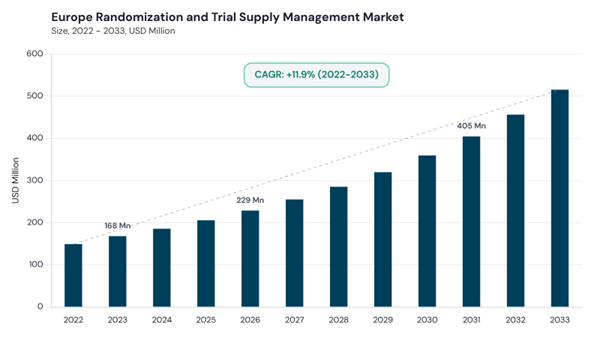
The Europe Randomization And Trial Supply Management Market is expected to reach USD404.69 million by 2031, growing at a CAGR of 12.3% during the forecast period (2026-2033).
The Germany market dominated the Europe Randomization And Trial Supply Management Market by country in 2025, and is expected to continue to be a dominant market till 2033; thereby, achieving a market value of USD102.4 million by 2033. The UK market is expected to witness a CAGR of 11.3% during 2026-2033. Additionally, the France market is expected to witness a CAGR of 13.1% during 2026-2033. The Germany and UK led the Europe Randomization And Trial Supply Management Market by Country with a market share of 22.1% and 18.9% in 2025. The Spain market is expected to witness a CAGR of 14.2% throughout the forecast period. The regional market was valued at USD205.9 million in 2025 and is projected to reach USD515.5 million by 2033.
The Europe randomization and trial supply management market has evolved substantially with the increasing digitization of clinical trial workflows and rising complexity of multinational drug development programs. Initially focused on basic patient randomization and inventory tracking functions, RTSM platforms have transformed into highly integrated ecosystems capable of supporting adaptive trial designs, predictive supply optimization, and decentralized clinical operations. Pharmaceutical companies, biotechnology firms, and clinical research organizations across Europe are increasingly adopting automated RTSM systems to streamline patient enrollment, optimize drug allocation, and strengthen regulatory compliance. The expansion of precision medicine initiatives, biologics development pipelines, and remote patient monitoring technologies has further accelerated market adoption across the region. In addition, growing collaboration between CROs, hospitals, and life sciences companies continues to support innovation in cloud-enabled trial management infrastructure.
The market is witnessing strong momentum due to increasing adoption of AI-driven analytics, predictive inventory management, and cloud-native clinical trial platforms. Organizations are integrating machine learning capabilities and real-time monitoring systems into RTSM environments to improve trial efficiency, minimize drug wastage, and enhance patient engagement. Decentralized clinical trial models and hybrid study frameworks are further driving demand for scalable and remotely accessible RTSM solutions. Competitive dynamics across Europe remain centered on interoperability, automation capabilities, compliance management, and integration flexibility. Vendors are increasingly focusing on advanced analytics, mobile accessibility, API integration, and cybersecurity enhancements to strengthen platform differentiation across pharmaceutical and clinical research ecosystems.
Cloud-native deployment models are expected to remain the primary growth engine across Europe due to increasing demand for decentralized clinical trials, real-time collaboration capabilities, and scalable digital trial ecosystems. However, on-premise platforms are likely to maintain steady adoption among organizations prioritizing advanced data governance, regulatory control, and customized deployment environments.
The Germany market dominated the Europe Randomization And Trial Supply Management Market by country in 2025, and is expected to continue to be a dominant market till 2033; thereby, achieving a market value of USD102.4 million by 2033. The UK market is expected to witness a CAGR of 11.3% during 2026-2033. Additionally, the France market is expected to witness a CAGR of 13.1% during 2026-2033. The Germany and UK led the Europe Randomization And Trial Supply Management Market by Country with a market share of 22.1% and 18.9% in 2025. The Spain market is expected to witness a CAGR of 14.2% throughout the forecast period. The regional market was valued at USD205.9 million in 2025 and is projected to reach USD515.5 million by 2033.
The Europe randomization and trial supply management market has evolved substantially with the increasing digitization of clinical trial workflows and rising complexity of multinational drug development programs. Initially focused on basic patient randomization and inventory tracking functions, RTSM platforms have transformed into highly integrated ecosystems capable of supporting adaptive trial designs, predictive supply optimization, and decentralized clinical operations. Pharmaceutical companies, biotechnology firms, and clinical research organizations across Europe are increasingly adopting automated RTSM systems to streamline patient enrollment, optimize drug allocation, and strengthen regulatory compliance. The expansion of precision medicine initiatives, biologics development pipelines, and remote patient monitoring technologies has further accelerated market adoption across the region. In addition, growing collaboration between CROs, hospitals, and life sciences companies continues to support innovation in cloud-enabled trial management infrastructure.
The market is witnessing strong momentum due to increasing adoption of AI-driven analytics, predictive inventory management, and cloud-native clinical trial platforms. Organizations are integrating machine learning capabilities and real-time monitoring systems into RTSM environments to improve trial efficiency, minimize drug wastage, and enhance patient engagement. Decentralized clinical trial models and hybrid study frameworks are further driving demand for scalable and remotely accessible RTSM solutions. Competitive dynamics across Europe remain centered on interoperability, automation capabilities, compliance management, and integration flexibility. Vendors are increasingly focusing on advanced analytics, mobile accessibility, API integration, and cybersecurity enhancements to strengthen platform differentiation across pharmaceutical and clinical research ecosystems.
Delivery Mode Outlook
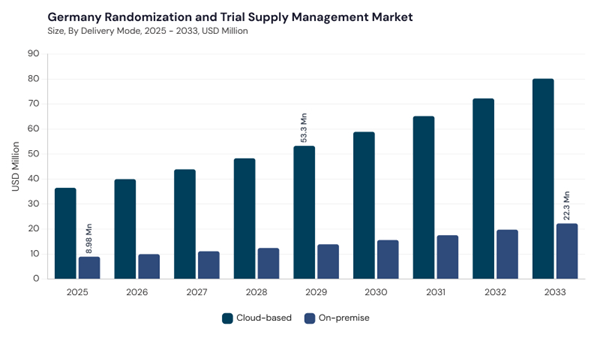
Based on Delivery Mode, the market is segmented into Cloud-based and On-premise. The Cloud-based segment dominated the Europe Randomization And Trial Supply Management Market by Delivery Mode in 2025, and is expected to continue to be a dominant segment till 2033; thereby, achieving a market value of USD406.9 million by 2033, growing at a CAGR of 12.0% during the forecast period. The On-premise segment is expected to witness a CAGR of 13.7% during 2026-2033. The Germany market dominated the Europe Cloud-based Market by country in 2025, and is expected to continue to be a dominant market till 2033; thereby, achieving a market value of USD80.2 million by 2033. Additionally, the France Cloud-based market is expected to witness a CAGR of 12.8% during the forecast period.Cloud-native deployment models are expected to remain the primary growth engine across Europe due to increasing demand for decentralized clinical trials, real-time collaboration capabilities, and scalable digital trial ecosystems. However, on-premise platforms are likely to maintain steady adoption among organizations prioritizing advanced data governance, regulatory control, and customized deployment environments.
End-use Outlook
Based on End-use, the market is segmented into Contract Research Organizations (CROs), Pharmaceutical & Biotechnology Companies, Hospitals & Clinical Research Centers, Academic & Research Institutes, and Medical Device Companies. The Contract Research Organizations (CROs) segment dominated the Europe Randomization And Trial Supply Management Market by End-use in 2025, and is expected to continue to be a dominant segment till 2033; thereby, achieving a market value of USD175.9 million by 2033, growing at a CAGR of 11.5% during the forecast period. The Pharmaceutical & Biotechnology Companies segment is expected to witness a CAGR of 11.8% during 2026-2033. Additionally, the Hospitals & Clinical Research Centers segment is expected to witness a CAGR of 12.8% during the forecast period, while the Medical Device Companies segment is projected to register the highest CAGR of 14.9% during 2026-2033.Country Outlook
Germany represents the leading market for randomization and trial supply management solutions in Europe due to the country’s advanced pharmaceutical manufacturing ecosystem, strong biotechnology research infrastructure, and increasing adoption of digital clinical trial technologies. The Germany RTSM market attained a value of USD45.5 million in 2025 and is projected to reach USD102.4 million by 2033, growing at a CAGR of 10.8% during the forecast period. Cloud-based deployment dominated the Germany market in 2025 and is expected to continue its leadership position through 2033 with a projected market value of USD80.2 million by 2033. The Contract Research Organizations (CROs) segment led the Germany market by End-use in 2025 and is forecast to reach USD34.7 million by 2033. Increasing investments in precision medicine, adaptive clinical trials, and decentralized research models continue to accelerate adoption of advanced RTSM platforms across Germany’s pharmaceutical and clinical research ecosystem.List of Key Companies Profiled
- IQVIA Holdings Inc.
- Oracle Corporation
- Medidata Solutions, Inc.
- Parexel International Corporation
- Signant Health
- 4G Clinical
- Bioclinica, Inc.
- Calyx
- Endpoint Clinical, Inc.
- Almac Group
Market Report Segmentation
By Delivery Mode- Cloud-based
- On-premise
- Contract Research Organizations (CROs)
- Pharmaceutical & Biotechnology Companies
- Hospitals & Clinical Research Centers
- Academic & Research Institutes
- Medical Device Companies
- Germany
- UK
- France
- Russia
- Spain
- Italy
- Rest of Europe
Table of Contents
Chapter 1. Europe Market1.1 Market Overview
1.2 Key Factors Impacting Market
1.2.1 Market Drivers
1.2.2 Market Restraints
1.2.3 Market Opportunities
1.2.4 Market Challenges
1.2.5 Market Trends
1.2.6 State of Competition
1.2.7 Market Consolidation
1.2.8 Key Customer Criteria
1.3 Product Life Cycle
1.4 Segmentation By Delivery Mode
1.4.1 On-premise
1.4.2 Cloud-based
1.5 Segmentation By End-use
1.5.1 Pharmaceutical & Biotechnology Companies
1.5.2 Contract Research Organizations (CROs)
1.5.3 Academic & Research Institutes
1.5.4 Hospitals & Clinical Research Centers
1.5.5 Medical Device Companies
1.6 Segmentation By Country
1.6.1 Germany
1.6.1.1 Segmentation By Delivery Mode
1.6.1.1.1 On-premise
1.6.1.1.2 Cloud-based
1.6.1.2 Segmentation By End-use
1.6.1.2.1 Pharmaceutical & Biotechnology Companies
1.6.1.2.2 Contract Research Organizations (CROs)
1.6.1.2.3 Academic & Research Institutes
1.6.1.2.4 Hospitals & Clinical Research Centers
1.6.1.2.5 Medical Device Companies
1.6.2 UK
1.6.2.1 Segmentation By Delivery Mode
1.6.2.1.1 On-premise
1.6.2.1.2 Cloud-based
1.6.2.2 Segmentation By End-use
1.6.2.2.1 Pharmaceutical & Biotechnology Companies
1.6.2.2.2 Contract Research Organizations (CROs)
1.6.2.2.3 Academic & Research Institutes
1.6.2.2.4 Hospitals & Clinical Research Centers
1.6.2.2.5 Medical Device Companies
1.6.3 France
1.6.3.1 Segmentation By Delivery Mode
1.6.3.1.1 On-premise
1.6.3.1.2 Cloud-based
1.6.3.2 Segmentation By End-use
1.6.3.2.1 Pharmaceutical & Biotechnology Companies
1.6.3.2.2 Contract Research Organizations (CROs)
1.6.3.2.3 Academic & Research Institutes
1.6.3.2.4 Hospitals & Clinical Research Centers
1.6.3.2.5 Medical Device Companies
1.6.4 Russia
1.6.4.1 Segmentation By Delivery Mode
1.6.4.1.1 On-premise
1.6.4.1.2 Cloud-based
1.6.4.2 Segmentation By End-use
1.6.4.2.1 Pharmaceutical & Biotechnology Companies
1.6.4.2.2 Contract Research Organizations (CROs)
1.6.4.2.3 Academic & Research Institutes
1.6.4.2.4 Hospitals & Clinical Research Centers
1.6.4.2.5 Medical Device Companies
1.6.5 Spain
1.6.5.1 Segmentation By Delivery Mode
1.6.5.1.1 On-premise
1.6.5.1.2 Cloud-based
1.6.5.2 Segmentation By End-use
1.6.5.2.1 Pharmaceutical & Biotechnology Companies
1.6.5.2.2 Contract Research Organizations (CROs)
1.6.5.2.3 Academic & Research Institutes
1.6.5.2.4 Hospitals & Clinical Research Centers
1.6.5.2.5 Medical Device Companies
1.6.6 Italy
1.6.6.1 Segmentation By Delivery Mode
1.6.6.1.1 On-premise
1.6.6.1.2 Cloud-based
1.6.6.2 Segmentation By End-use
1.6.6.2.1 Pharmaceutical & Biotechnology Companies
1.6.6.2.2 Contract Research Organizations (CROs)
1.6.6.2.3 Academic & Research Institutes
1.6.6.2.4 Hospitals & Clinical Research Centers
1.6.6.2.5 Medical Device Companies
1.6.7 Rest of Europe
1.6.7.1 Segmentation By Delivery Mode
1.6.7.1.1 On-premise
1.6.7.1.2 Cloud-based
1.6.7.2 Segmentation By End-use
1.6.7.2.1 Pharmaceutical & Biotechnology Companies
1.6.7.2.2 Contract Research Organizations (CROs)
1.6.7.2.3 Academic & Research Institutes
1.6.7.2.4 Hospitals & Clinical Research Centers
1.6.7.2.5 Medical Device Companies
Chapter 2. Company Snapshot
2.1 IQVIA Holdings, Inc.
2.1.1 Business Overview
2.1.2 Key Information
2.1.3 Company Focus
2.1.4 Strategic Insights
2.1.5 Strategy Deployed
2.1.6 Product & Service Portfolio
2.1.7 Capability Overview
2.1.8 Technology & Innovation Focus
2.1.9 Customers / End Users
2.1.10 Competitive Positioning
2.1.11 Key Differentiators
2.1.12 Portfolio Matrix
2.1.13 SWOT Analysis
2.1.14 Future Outlook
2.2 Oracle Corporation
2.2.1 Business Overview
2.2.2 Key Information
2.2.3 Company Focus
2.2.4 Strategic Insights
2.2.5 Strategy Deployed
2.2.6 Product & Service Portfolio
2.2.7 Capability Overview
2.2.8 Technology & Innovation Focus
2.2.9 Customers / End Users
2.2.10 Competitive Positioning
2.2.11 Key Differentiators
2.2.12 Portfolio Matrix
2.2.13 SWOT Analysis
2.2.14 Future Outlook
2.3 Veeva Systems, Inc.
2.3.1 Business Overview
2.3.2 Key Information
2.3.3 Company Focus
2.3.4 Strategic Insights
2.3.5 Strategy Deployed
2.3.6 Product & Service Portfolio
2.3.7 Capability Overview
2.3.8 Technology & Innovation Focus
2.3.9 Customers / End Users
2.3.10 Competitive Positioning
2.3.11 Key Differentiators
2.3.12 Portfolio Matrix
2.3.13 SWOT Analysis
2.3.14 Future Outlook
2.4 Medidata Solutions, Inc. (Dassault Systèmes SE)
2.4.1 Business Overview
2.4.2 Key Information
2.4.3 Company Focus
2.4.4 Strategic Insights
2.4.5 Strategy Deployed
2.4.6 Product & Service Portfolio
2.4.7 Capability Overview
2.4.8 Technology & Innovation Focus
2.4.9 Customers / End Users
2.4.10 Competitive Positioning
2.4.11 Key Differentiators
2.4.12 Portfolio Matrix
2.4.13 SWOT Analysis
2.4.14 Future Outlook
2.5 Parexel International Corporation
2.5.1 Business Overview
2.5.2 Key Information
2.5.3 Company Focus
2.5.4 Strategic Insights
2.5.5 Strategy Deployed
2.5.6 Product & Service Portfolio
2.5.7 Capability Overview
2.5.8 Technology & Innovation Focus
2.5.9 Customers / End Users
2.5.10 Competitive Positioning
2.5.11 Key Differentiators
2.5.12 Portfolio Matrix
2.5.13 SWOT Analysis
2.5.14 Future Outlook
2.6 Almac Group
2.6.1 Business Overview
2.6.2 Key Information
2.6.3 Company Focus
2.6.4 Strategic Insights
2.6.5 Strategy Deployed
2.6.6 Product & Service Portfolio
2.6.7 Capability Overview
2.6.8 Technology & Innovation Focus
2.6.9 Customers / End Users
2.6.10 Competitive Positioning
2.6.11 Key Differentiators
2.6.12 Portfolio Matrix
2.6.13 SWOT Analysis
2.6.14 Future Outlook
2.7 ICON plc
2.7.1 Business Overview
2.7.2 Key Information
2.7.3 Company Focus
2.7.4 Strategic Insights
2.7.5 Strategy Deployed
2.7.6 Product & Service Portfolio
2.7.7 Capability Overview
2.7.8 Technology & Innovation Focus
2.7.9 Customers / End Users
2.7.10 Competitive Positioning
2.7.11 Key Differentiators
2.7.12 Portfolio Matrix
2.7.13 SWOT Analysis
2.7.14 Future Outlook
2.8 Suvoda LLC
2.8.1 Business Overview
2.8.2 Key Information
2.8.3 Company Focus
2.8.4 Strategic Insights
2.8.5 Strategy Deployed
2.8.6 Product & Service Portfolio
2.8.7 Capability Overview
2.8.8 Technology & Innovation Focus
2.8.9 Customers / End Users
2.8.10 Competitive Positioning
2.8.11 Key Differentiators
2.8.12 Portfolio Matrix
2.8.13 SWOT Analysis
2.8.14 Future Outlook
2.9 Signant Health
2.9.1 Business Overview
2.9.2 Key Information
2.9.3 Company Focus
2.9.4 Strategic Insights
2.9.5 Strategy Deployed
2.9.6 Product & Service Portfolio
2.9.7 Capability Overview
2.9.8 Technology & Innovation Focus
2.9.9 Customers / End Users
2.9.10 Competitive Positioning
2.9.11 Key Differentiators
2.9.12 Portfolio Matrix
2.9.13 SWOT Analysis
2.9.14 Future Outlook
2.10 Endpoint Clinical L.P.
2.10.1 Business Overview
2.10.2 Key Information
2.10.3 Company Focus
2.10.4 Strategic Insights
2.10.5 Strategy Deployed
2.10.6 Product & Service Portfolio
2.10.7 Capability Overview
2.10.8 Technology & Innovation Focus
2.10.9 Customers / End Users
2.10.10 Competitive Positioning
2.10.11 Key Differentiators
2.10.12 Portfolio Matrix
2.10.13 SWOT Analysis
2.10.14 Future Outlook
Companies Mentioned
- IQVIA Holdings Inc.
- Oracle Corporation
- Medidata Solutions, Inc.
- Parexel International Corporation
- Signant Health
- 4G Clinical
- Bioclinica, Inc.
- Calyx
- Endpoint Clinical, Inc.
- Almac Group


