



The Asia Pacific Reusable E-commerce Packaging Market size is expected to reach USD 5.13 billion by 2033, rising at a market growth of 10.5% CAGR during the forecast period (2026-2033).
The China market dominated the Asia Pacific Reusable E-commerce Packaging Market by country in 2025, and is expected to continue to be a dominant market till 2033; thereby, achieving a market value of USD 1.56 billion by 2033. The Japan market is expected to witness a CAGR of 9.5% during 2026-2033. Additionally, the India market is expected to witness a CAGR of 11.2% during 2026-2033. The China and Japan led the Asia Pacific Reusable E-commerce Packaging Market by Country with a market share of 34.4% and 13.7% in 2025. The Malaysia market is expected to witness a CAGR of 13.4% throughout the forecast period.
The market for reusable e-commerce packaging in Asia Pacific has expanded rapidly alongside the region’s booming e-commerce ecosystem and growing environmental awareness. Initially, reusable packaging solutions were adopted mainly by large logistics companies and multinational retailers looking to reduce operational costs and packaging waste. Over time, rising government regulations against single-use plastics, combined with increasing investments in circular economy initiatives, accelerated the adoption of reusable shipping containers, boxes, mailers, and pallets throughout the region. Countries such as China, Japan, South Korea, India, and Australia have emerged as major contributors to market growth due to rising online shopping penetration and rapid logistics infrastructure development.
Smart reusable packaging systems integrated with RFID tracking, QR code monitoring, IoT-enabled sensors, and reverse logistics technologies are becoming increasingly common across the Asia Pacific market. E-commerce companies are increasingly focusing on packaging lifecycle management, carbon footprint reduction, and waste minimization strategies to improve sustainability performance. Furthermore, rising consumer awareness regarding environmentally friendly packaging solutions and increasing corporate ESG commitments are encouraging retailers and logistics providers to adopt scalable reusable packaging ecosystems across multiple product categories including food delivery, electronics, pharmaceuticals, and apparel.
Competition within the Asia Pacific Reusable E-commerce Packaging Market is driven by innovation in lightweight durable materials, cost optimization, and expansion of reverse logistics capabilities. Companies are increasingly collaborating with e-commerce platforms, warehouse operators, and logistics service providers to improve collection systems and reuse efficiency. Rapid urbanization, increasing internet penetration, and the continued expansion of cross-border e-commerce activities are expected to further strengthen market growth across the region throughout the forecast period.
Based on Product Type, the market is segmented into Boxes & Containers, Mailers & Envelopes, Bags, and Pallets & Crates. The Boxes & Containers segment dominated the Asia Pacific Reusable E-commerce Packaging Market by Product Type in 2025 and is expected to continue to be a dominant market till 2033; thereby, achieving a market value of USD 1.51 billion by 2032. The Mailers & Envelopes segment is expected to witness strong growth owing to increasing adoption in fashion, apparel, and consumer goods deliveries. Additionally, the Pallets & Crates segment is anticipated to witness notable growth due to increasing warehouse automation and large-scale logistics operations throughout the region.
The Japan reusable e-commerce packaging market is witnessing steady growth driven by rising environmental awareness, advanced logistics systems, and increasing corporate sustainability commitments. Businesses across the country are increasingly adopting reusable packaging formats and digital tracking technologies to improve packaging efficiency and support circular economy objectives.
The India reusable e-commerce packaging market is expected to witness strong growth due to rapidly expanding e-commerce penetration, rising urbanization, and increasing government focus on reducing plastic waste. Growing investments in logistics modernization, warehouse automation, and sustainable packaging technologies are expected to create significant growth opportunities for reusable packaging providers throughout the country.
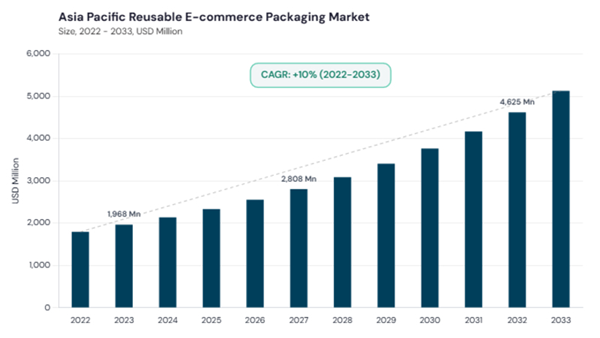
The China market dominated the Asia Pacific Reusable E-commerce Packaging Market by country in 2025, and is expected to continue to be a dominant market till 2033; thereby, achieving a market value of USD 1.56 billion by 2033. The Japan market is expected to witness a CAGR of 9.5% during 2026-2033. Additionally, the India market is expected to witness a CAGR of 11.2% during 2026-2033. The China and Japan led the Asia Pacific Reusable E-commerce Packaging Market by Country with a market share of 34.4% and 13.7% in 2025. The Malaysia market is expected to witness a CAGR of 13.4% throughout the forecast period.
The market for reusable e-commerce packaging in Asia Pacific has expanded rapidly alongside the region’s booming e-commerce ecosystem and growing environmental awareness. Initially, reusable packaging solutions were adopted mainly by large logistics companies and multinational retailers looking to reduce operational costs and packaging waste. Over time, rising government regulations against single-use plastics, combined with increasing investments in circular economy initiatives, accelerated the adoption of reusable shipping containers, boxes, mailers, and pallets throughout the region. Countries such as China, Japan, South Korea, India, and Australia have emerged as major contributors to market growth due to rising online shopping penetration and rapid logistics infrastructure development.
Smart reusable packaging systems integrated with RFID tracking, QR code monitoring, IoT-enabled sensors, and reverse logistics technologies are becoming increasingly common across the Asia Pacific market. E-commerce companies are increasingly focusing on packaging lifecycle management, carbon footprint reduction, and waste minimization strategies to improve sustainability performance. Furthermore, rising consumer awareness regarding environmentally friendly packaging solutions and increasing corporate ESG commitments are encouraging retailers and logistics providers to adopt scalable reusable packaging ecosystems across multiple product categories including food delivery, electronics, pharmaceuticals, and apparel.
Competition within the Asia Pacific Reusable E-commerce Packaging Market is driven by innovation in lightweight durable materials, cost optimization, and expansion of reverse logistics capabilities. Companies are increasingly collaborating with e-commerce platforms, warehouse operators, and logistics service providers to improve collection systems and reuse efficiency. Rapid urbanization, increasing internet penetration, and the continued expansion of cross-border e-commerce activities are expected to further strengthen market growth across the region throughout the forecast period.
Material Outlook
Based on Material, the market is segmented into Paper & Paperboard, Plastic, Metal, and Other Material. The Paper & Paperboard segment dominated the Asia Pacific Reusable E-commerce Packaging Market by Material in 2025 and is expected to continue to be a dominant market till 2033; thereby, achieving a market value of USD 2 billion by 2031. The Plastic segment is expected to witness substantial growth due to increasing utilization of reusable polymer-based packaging systems across logistics and retail applications. Additionally, the Metal segment is anticipated to witness steady growth driven by increasing demand for heavy-duty reusable transport packaging solutions.Product Type Outlook
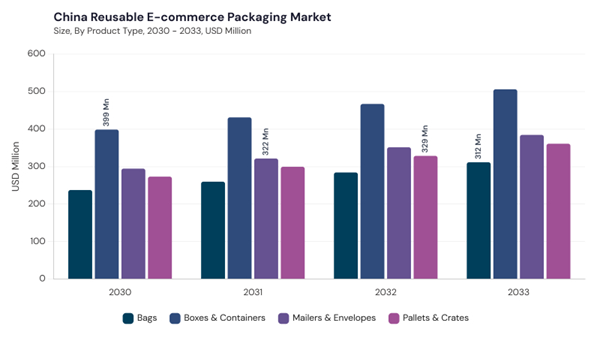
Based on Product Type, the market is segmented into Boxes & Containers, Mailers & Envelopes, Bags, and Pallets & Crates. The Boxes & Containers segment dominated the Asia Pacific Reusable E-commerce Packaging Market by Product Type in 2025 and is expected to continue to be a dominant market till 2033; thereby, achieving a market value of USD 1.51 billion by 2032. The Mailers & Envelopes segment is expected to witness strong growth owing to increasing adoption in fashion, apparel, and consumer goods deliveries. Additionally, the Pallets & Crates segment is anticipated to witness notable growth due to increasing warehouse automation and large-scale logistics operations throughout the region.
Packaging Type Outlook
Based on Packaging Type, the market is segmented into Returnable Packaging, Reusable Shipping Packaging, and Refillable Packaging. The Returnable Packaging segment acquired the largest revenue share in the Asia Pacific Reusable E-commerce Packaging Market in 2025 and is expected to continue to be a dominant market till 2033; thereby, achieving a market value of USD 1.49 billion by 2030. The Reusable Shipping Packaging segment is expected to witness robust growth due to increasing parcel shipment volumes and rising demand for sustainable delivery packaging solutions. Additionally, the Refillable Packaging segment is expected to witness promising growth driven by increasing adoption of refill-based packaging systems across personal care, food, and household product applications.End-user Outlook
Based on End-user, the market is segmented into Food & Beverages, Pharmaceuticals, Apparel & Fashion, Electronics & Electricals, Personal Care & Cosmetics, and Retail & Consumer Goods. The Food & Beverages segment dominated the Asia Pacific Reusable E-commerce Packaging Market by End-user in 2025 and is expected to continue to be a dominant market till 2033 owing to increasing online grocery and food delivery activities throughout the region. The Pharmaceuticals segment is expected to witness substantial growth due to increasing demand for temperature-controlled reusable packaging solutions and expanding healthcare logistics infrastructure. Additionally, the Apparel & Fashion segment is anticipated to witness strong growth supported by increasing adoption of reusable mailers among online fashion retailers.Country Outlook
The China reusable e-commerce packaging market has emerged as the leading market in Asia Pacific owing to the country’s massive e-commerce industry, extensive logistics infrastructure, and strong government support for sustainable packaging initiatives. Major e-commerce companies are increasingly investing in reusable packaging programs and advanced reverse logistics systems to reduce waste generation and improve operational efficiency.The Japan reusable e-commerce packaging market is witnessing steady growth driven by rising environmental awareness, advanced logistics systems, and increasing corporate sustainability commitments. Businesses across the country are increasingly adopting reusable packaging formats and digital tracking technologies to improve packaging efficiency and support circular economy objectives.
The India reusable e-commerce packaging market is expected to witness strong growth due to rapidly expanding e-commerce penetration, rising urbanization, and increasing government focus on reducing plastic waste. Growing investments in logistics modernization, warehouse automation, and sustainable packaging technologies are expected to create significant growth opportunities for reusable packaging providers throughout the country.
List of Key Companies Profiled
- DS Smith Plc
- Amcor plc
- Mondi plc
- Smurfit Kappa Group plc
- International Paper Company
- Sealed Air Corporation
- Stora Enso Oyj
- WestRock Company
- Berry Global Group, Inc.
- Ranpak Holdings Corp.
Market Report Segmentation
By Material- Paper & Paperboard
- Plastic
- Metal
- Other Material
- Boxes & Containers
- Mailers & Envelopes
- Bags
- Pallets & Crates
- Returnable Packaging
- Reusable Shipping Packaging
- Refillable Packaging
- Food & Beverages
- Pharmaceuticals
- Apparel & Fashion
- Electronics & Electricals
- Personal Care & Cosmetics
- Retail & Consumer Goods
- China
- Japan
- India
- South Korea
- Singapore
- Malaysia
- Rest of Asia Pacific
Table of Contents
Chapter 1. Asia Pacific Market1.1 Market Overview
1.2 Key Factors Impacting Market
1.2.1 Market Drivers
1.2.2 Market Restraints
1.2.3 Market Opportunities
1.2.4 Market Challenges
1.2.5 Market Trends
1.2.6 State of Competition
1.2.7 Market Consolidation
1.2.8 Key Customer Criteria
1.3 Product Life Cycle
1.4 Segmentation By Material
1.4.1 Paper & Paperboard
1.4.2 Plastic
1.4.3 Metal
1.4.4 Other Material
1.5 Segmentation By Product Type
1.5.1 Boxes & Containers
1.5.2 Mailers & Envelopes
1.5.3 Bags
1.5.4 Pallets & Crates
1.6 Segmentation By Packaging Type
1.6.1 Returnable Packaging
1.6.2 Reusable Shipping Packaging
1.6.3 Refillable Packaging
1.7 Segmentation By End-user
1.7.1 Food & Beverages
1.7.2 Apparel & Fashion
1.7.3 Electronics & Electricals
1.7.4 Pharmaceuticals
1.7.5 Retail & Consumer Goods
1.8 Segmentation By Country
1.8.1 China
1.8.1.1 Segmentation By Material
1.8.1.1.1 Paper & Paperboard
1.8.1.1.2 Plastic
1.8.1.1.3 Metal
1.8.1.1.4 Other Material
1.8.1.2 Segmentation By Product Type
1.8.1.2.1 Boxes & Containers
1.8.1.2.2 Mailers & Envelopes
1.8.1.2.3 Bags
1.8.1.2.4 Pallets & Crates
1.8.1.3 Segmentation By Packaging Type
1.8.1.3.1 Returnable Packaging
1.8.1.3.2 Reusable Shipping Packaging
1.8.1.3.3 Refillable Packaging
1.8.1.4 Segmentation By End-user
1.8.1.4.1 Food & Beverages
1.8.1.4.2 Pharmaceuticals
1.8.1.4.3 Personal Care & Cosmetics
1.8.1.4.4 Electronics & Electricals
1.8.1.4.5 Apparel & Fashion
1.8.1.4.6 Retail & Consumer Goods
1.8.2 Japan
1.8.2.1 Segmentation By Material
1.8.2.1.1 Paper & Paperboard
1.8.2.1.2 Plastic
1.8.2.1.3 Metal
1.8.2.1.4 Other Material
1.8.2.2 Segmentation By Product Type
1.8.2.2.1 Boxes & Containers
1.8.2.2.2 Mailers & Envelopes
1.8.2.2.3 Bags
1.8.2.2.4 Pallets & Crates
1.8.2.3 Segmentation By Packaging Type
1.8.2.3.1 Returnable Packaging
1.8.2.3.2 Reusable Shipping Packaging
1.8.2.3.3 Refillable Packaging
1.8.2.4 Segmentation By End-user
1.8.2.4.1 Food & Beverages
1.8.2.4.2 Pharmaceuticals
1.8.2.4.3 Personal Care & Cosmetics
1.8.2.4.4 Electronics & Electricals
1.8.2.4.5 Apparel & Fashion
1.8.2.4.6 Retail & Consumer Goods
1.8.3 India
1.8.3.1 Segmentation By Material
1.8.3.1.1 Paper & Paperboard
1.8.3.1.2 Plastic
1.8.3.1.3 Metal
1.8.3.1.4 Other Material
1.8.3.2 Segmentation By Product Type
1.8.3.2.1 Boxes & Containers
1.8.3.2.2 Mailers & Envelopes
1.8.3.2.3 Bags
1.8.3.2.4 Pallets & Crates
1.8.3.3 Segmentation By Packaging Type
1.8.3.3.1 Returnable Packaging
1.8.3.3.2 Reusable Shipping Packaging
1.8.3.3.3 Refillable Packaging
1.8.3.4 Segmentation By End-user
1.8.3.4.1 Food & Beverages
1.8.3.4.2 Pharmaceuticals
1.8.3.4.3 Personal Care & Cosmetics
1.8.3.4.4 Electronics & Electricals
1.8.3.4.5 Apparel & Fashion
1.8.3.4.6 Retail & Consumer Goods
1.8.4 South Korea
1.8.4.1 Segmentation By Material
1.8.4.1.1 Paper & Paperboard
1.8.4.1.2 Plastic
1.8.4.1.3 Metal
1.8.4.1.4 Other Material
1.8.4.2 Segmentation By Product Type
1.8.4.2.1 Boxes & Containers
1.8.4.2.2 Mailers & Envelopes
1.8.4.2.3 Bags
1.8.4.2.4 Pallets & Crates
1.8.4.3 Segmentation By Packaging Type
1.8.4.3.1 Returnable Packaging
1.8.4.3.2 Reusable Shipping Packaging
1.8.4.3.3 Refillable Packaging
1.8.4.4 Segmentation By End-user
1.8.4.4.1 Food & Beverages
1.8.4.4.2 Pharmaceuticals
1.8.4.4.3 Personal Care & Cosmetics
1.8.4.4.4 Electronics & Electricals
1.8.4.4.5 Apparel & Fashion
1.8.4.4.6 Retail & Consumer Goods
1.8.5 Singapore
1.8.5.1 Segmentation By Material
1.8.5.1.1 Paper & Paperboard
1.8.5.1.2 Plastic
1.8.5.1.3 Metal
1.8.5.1.4 Other Material
1.8.5.2 Segmentation By Product Type
1.8.5.2.1 Boxes & Containers
1.8.5.2.2 Mailers & Envelopes
1.8.5.2.3 Bags
1.8.5.2.4 Pallets & Crates
1.8.5.3 Segmentation By Packaging Type
1.8.5.3.1 Returnable Packaging
1.8.5.3.2 Reusable Shipping Packaging
1.8.5.3.3 Refillable Packaging
1.8.5.4 Segmentation By End-user
1.8.5.4.1 Food & Beverages
1.8.5.4.2 Pharmaceuticals
1.8.5.4.3 Personal Care & Cosmetics
1.8.5.4.4 Electronics & Electricals
1.8.5.4.5 Apparel & Fashion
1.8.5.4.6 Retail & Consumer Goods
1.8.6 Malaysia
1.8.6.1 Segmentation By Material
1.8.6.1.1 Paper & Paperboard
1.8.6.1.2 Plastic
1.8.6.1.3 Metal
1.8.6.1.4 Other Material
1.8.6.2 Segmentation By Product Type
1.8.6.2.1 Boxes & Containers
1.8.6.2.2 Mailers & Envelopes
1.8.6.2.3 Bags
1.8.6.2.4 Pallets & Crates
1.8.6.3 Segmentation By Packaging Type
1.8.6.3.1 Returnable Packaging
1.8.6.3.2 Reusable Shipping Packaging
1.8.6.3.3 Refillable Packaging
1.8.6.4 Segmentation By End-user
1.8.6.4.1 Food & Beverages
1.8.6.4.2 Pharmaceuticals
1.8.6.4.3 Personal Care & Cosmetics
1.8.6.4.4 Electronics & Electricals
1.8.6.4.5 Apparel & Fashion
1.8.6.4.6 Retail & Consumer Goods
1.8.7 Rest of Asia Pacific
1.8.7.1 Segmentation By Material
1.8.7.1.1 Paper & Paperboard
1.8.7.1.2 Plastic
1.8.7.1.3 Metal
1.8.7.1.4 Other Material
1.8.7.2 Segmentation By Product Type
1.8.7.2.1 Boxes & Containers
1.8.7.2.2 Mailers & Envelopes
1.8.7.2.3 Bags
1.8.7.2.4 Pallets & Crates
1.8.7.3 Segmentation By Packaging Type
1.8.7.3.1 Returnable Packaging
1.8.7.3.2 Reusable Shipping Packaging
1.8.7.3.3 Refillable Packaging
1.8.7.4 Segmentation By End-user
1.8.7.4.1 Food & Beverages
1.8.7.4.2 Pharmaceuticals
1.8.7.4.3 Personal Care & Cosmetics
1.8.7.4.4 Electronics & Electricals
1.8.7.4.5 Apparel & Fashion
1.8.7.4.6 Retail & Consumer Goods
Chapter 2. Company Snapshot
2.1 DS Smith Plc
2.1.1 Business Overview
2.1.2 Key Information
2.1.3 Company Focus
2.1.4 Strategic Insights
2.1.5 Strategy Deployed
2.1.6 Product & Service Portfolio
2.1.7 Capability Overview
2.1.8 Technology & Innovation Focus
2.1.9 Customers / End Users
2.1.10 Competitive Positioning
2.1.11 Key Differentiators
2.1.12 Portfolio Matrix
2.1.13 SWOT Analysis
2.1.14 Future Outlook
2.2 Stora Enso Oyj
2.2.1 Business Overview
2.2.2 Key Information
2.2.3 Company Focus
2.2.4 Strategic Insights
2.2.5 Strategy Deployed
2.2.6 Product & Service Portfolio
2.2.7 Capability Overview
2.2.8 Technology & Innovation Focus
2.2.9 Customers / End Users
2.2.10 Competitive Positioning
2.2.11 Key Differentiators
2.2.12 Portfolio Matrix
2.2.13 SWOT Analysis
2.2.14 Future Outlook
2.3 THIMM Group GmbH + Co. KG
2.3.1 Business Overview
2.3.2 Key Information
2.3.3 Company Focus
2.3.4 Strategic Insights
2.3.5 Strategy Deployed
2.3.6 Product & Service Portfolio
2.3.7 Capability Overview
2.3.8 Technology & Innovation Focus
2.3.9 Customers / End Users
2.3.10 Competitive Positioning
2.3.11 Key Differentiators
2.3.12 Portfolio Matrix
2.3.13 SWOT Analysis
2.3.14 Future Outlook
2.4 Corplex (Group Companies)
2.4.1 Business Overview
2.4.2 Key Information
2.4.3 Company Focus
2.4.4 Strategic Insights
2.4.5 Strategy Deployed
2.4.6 Product & Service Portfolio
2.4.7 Capability Overview
2.4.8 Technology & Innovation Focus
2.4.9 Customers / End Users
2.4.10 Competitive Positioning
2.4.11 Key Differentiators
2.4.12 Portfolio Matrix
2.4.13 SWOT Analysis
2.4.14 Future Outlook
2.5 Smurfit Kappa Group plc
2.5.1 Business Overview
2.5.2 Key Information
2.5.3 Company Focus
2.5.4 Strategic Insights
2.5.5 Strategy Deployed
2.5.6 Product & Service Portfolio
2.5.7 Capability Overview
2.5.8 Technology & Innovation Focus
2.5.9 Customers / End Users
2.5.10 Competitive Positioning
2.5.11 Key Differentiators
2.5.12 Portfolio Matrix
2.5.13 SWOT Analysis
2.5.14 Future Outlook
2.6 RePack Ltd
2.6.1 Business Overview
2.6.2 Key Information
2.6.3 Company Focus
2.6.4 Strategic Insights
2.6.5 Strategy Deployed
2.6.6 Product & Service Portfolio
2.6.7 Capability Overview
2.6.8 Technology & Innovation Focus
2.6.9 Customers / End Users
2.6.10 Competitive Positioning
2.6.11 Key Differentiators
2.6.12 Portfolio Matrix
2.6.13 SWOT Analysis
2.6.14 Future Outlook
2.7 LimeLoop, Inc.
2.7.1 Business Overview
2.7.2 Key Information
2.7.3 Company Focus
2.7.4 Strategic Insights
2.7.5 Strategy Deployed
2.7.6 Product & Service Portfolio
2.7.7 Capability Overview
2.7.8 Technology & Innovation Focus
2.7.9 Customers / End Users
2.7.10 Competitive Positioning
2.7.11 Key Differentiators
2.7.12 Portfolio Matrix
2.7.13 SWOT Analysis
2.7.14 Future Outlook
2.8 EcoEnclose Inc.
2.8.1 Business Overview
2.8.2 Key Information
2.8.3 Company Focus
2.8.4 Strategic Insights
2.8.5 Strategy Deployed
2.8.6 Product & Service Portfolio
2.8.7 Capability Overview
2.8.8 Technology & Innovation Focus
2.8.9 Customers / End Users
2.8.10 Competitive Positioning
2.8.11 Key Differentiators
2.8.12 Portfolio Matrix
2.8.13 SWOT Analysis
2.8.14 Future Outlook
2.9 Movopack SB Srl
2.9.1 Business Overview
2.9.2 Key Information
2.9.3 Company Focus
2.9.4 Strategic Insights
2.9.5 Strategy Deployed
2.9.6 Product & Service Portfolio
2.9.7 Capability Overview
2.9.8 Technology & Innovation Focus
2.9.9 Customers / End Users
2.9.10 Competitive Positioning
2.9.11 Key Differentiators
2.9.12 Portfolio Matrix
2.9.13 SWOT Analysis
2.9.14 Future Outlook
2.10 Returnity Innovations Inc.
2.10.1 Business Overview
2.10.2 Key Information
2.10.3 Company Focus
2.10.4 Strategic Insights
2.10.5 Strategy Deployed
2.10.6 Product & Service Portfolio
2.10.7 Capability Overview
2.10.8 Technology & Innovation Focus
2.10.9 Customers / End Users
2.10.10 Competitive Positioning
2.10.11 Key Differentiators
2.10.12 Portfolio Matrix
2.10.13 SWOT Analysis
2.10.14 Future Outlook
Companies Mentioned
- DS Smith Plc
- Amcor plc
- Mondi plc
- Smurfit Kappa Group plc
- International Paper Company
- Sealed Air Corporation
- Stora Enso Oyj
- WestRock Company
- Berry Global Group, Inc.
- Ranpak Holdings Corp.


