



The LAMEA Telecom Network Densification Market size is projected to reach USD 1.14 billion by 2029, growing at a CAGR of 12.5% during the forecast period (2026-2033).
The LAMEA Telecom Network Densification Market is experiencing strong growth due to the increasing demand for high-speed mobile connectivity, rising smartphone penetration, and accelerating deployment of 4G and 5G infrastructure across Latin America, the Middle East, and Africa. Telecom operators are increasingly investing in small cells, distributed antenna systems (DAS), and advanced radio access technologies to improve network coverage, reduce latency, and enhance network capacity in densely populated urban areas. Growing adoption of IoT devices, cloud applications, smart city initiatives, and digital transformation programs across industries is further driving the need for telecom network densification throughout the region.
Additionally, supportive government initiatives promoting digital inclusion, spectrum allocation reforms, and investments in broadband infrastructure are contributing to market expansion. The increasing implementation of Open RAN architectures, AI-driven network automation, and edge computing technologies is helping telecom providers optimize operational efficiency and improve network scalability. Rising demand for fixed wireless access (FWA), industrial automation, and mission-critical communication systems is also accelerating deployment of dense telecom infrastructure across LAMEA countries.
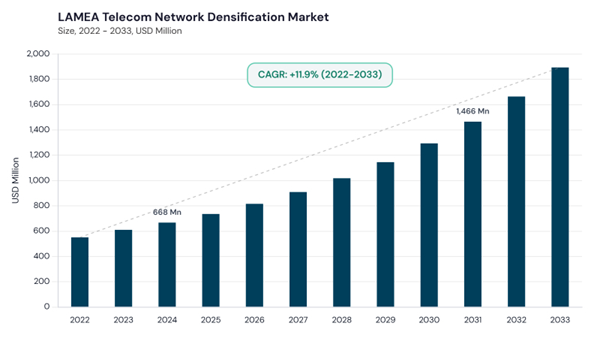
The LAMEA Telecom Network Densification Market is experiencing strong growth due to the increasing demand for high-speed mobile connectivity, rising smartphone penetration, and accelerating deployment of 4G and 5G infrastructure across Latin America, the Middle East, and Africa. Telecom operators are increasingly investing in small cells, distributed antenna systems (DAS), and advanced radio access technologies to improve network coverage, reduce latency, and enhance network capacity in densely populated urban areas. Growing adoption of IoT devices, cloud applications, smart city initiatives, and digital transformation programs across industries is further driving the need for telecom network densification throughout the region.
Additionally, supportive government initiatives promoting digital inclusion, spectrum allocation reforms, and investments in broadband infrastructure are contributing to market expansion. The increasing implementation of Open RAN architectures, AI-driven network automation, and edge computing technologies is helping telecom providers optimize operational efficiency and improve network scalability. Rising demand for fixed wireless access (FWA), industrial automation, and mission-critical communication systems is also accelerating deployment of dense telecom infrastructure across LAMEA countries.
Spectrum Band Outlook
Based on Spectrum Band, the market is segmented into Sub-6 GHz, Hybrid, and mmWave (24-71 GHz). The Sub-6 GHz segment dominated the LAMEA Telecom Network Densification Market in 2025 and is expected to reach USD 522.8 million by 2029. The segment benefits from wider coverage capabilities and cost-effective deployment suitable for developing telecom infrastructure across emerging economies. The Hybrid segment is witnessing growing adoption as telecom operators increasingly combine Sub-6 GHz and mmWave deployments to optimize network performance and capacity. Meanwhile, the mmWave segment is gradually expanding in dense urban environments requiring ultra-high-speed connectivity and low-latency communication.Deployment Location Outlook
Based on Deployment Location, the market is segmented into Indoor and Outdoor. The Indoor segment accounted for the largest market share in 2025 and is projected to attain USD 716.6 million by 2029. Increasing deployment of indoor small cells and DAS solutions across commercial buildings, airports, shopping malls, hospitals, and enterprise facilities is driving segment growth. The Outdoor segment is also witnessing steady growth due to increasing deployment of street-level telecom infrastructure and urban connectivity enhancement projects across major cities in the region.Application Outlook
Based on Application, the market is segmented into Enhanced Mobile Broadband, Fixed Wireless Access, Industrial IoT / Industry 4.0, Smart Cities & Public Venues, Connected & Autonomous Mobility, and Mission-Critical & Public Safety. The Enhanced Mobile Broadband segment dominated the market in 2025 and is projected to reach USD 386.6 million by 2029 due to rising mobile video consumption, cloud gaming, and increasing usage of digital content services. The Fixed Wireless Access segment is gaining momentum as telecom operators expand broadband connectivity in underserved areas. Industrial IoT / Industry 4.0 applications are also witnessing significant growth owing to increasing automation initiatives in sectors such as mining, manufacturing, oil & gas, and logistics.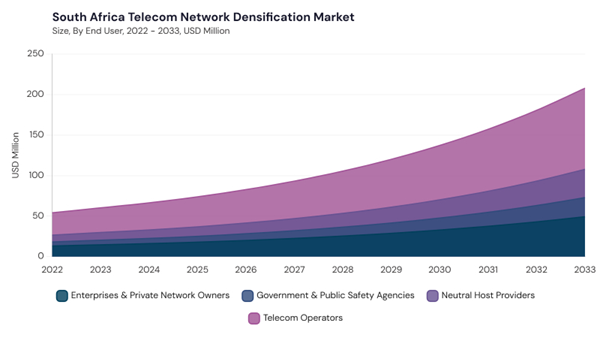
End User Outlook
Based on End User, the market is segmented into Telecom Operators, Enterprises & Private Network Owners, Neutral Host Providers, and Government & Public Safety Agencies. Telecom Operators held the dominant market share in 2025 owing to aggressive investments in telecom infrastructure modernization and 5G expansion projects across LAMEA countries. Enterprises & Private Network Owners are increasingly deploying private wireless networks to support industrial digitalization and enterprise connectivity requirements. Neutral Host Providers are also witnessing increasing adoption due to growing demand for infrastructure sharing models aimed at reducing deployment costs and improving network scalability.Regional Outlook
Countries such as Brazil, UAE, Saudi Arabia, South Africa, and Nigeria are among the leading contributors to the LAMEA Telecom Network Densification Market due to rising mobile data traffic, increasing urbanization, and accelerating 5G rollout programs. Government initiatives promoting digital transformation, smart city development, and rural broadband connectivity are positively influencing market growth across the region. Additionally, growing investments in fiber backhaul infrastructure, AI-powered network management systems, and sustainable telecom technologies are expected to continue supporting telecom network densification throughout LAMEA over the forecast period.List of Key Companies Profiled
- Nokia Corporation
- Telefonaktiebolaget LM Ericsson
- Deutsche Telekom AG
- Vodafone Group Plc
- Orange S.A.
- Cisco Systems, Inc.
- Huawei Technologies Co., Ltd.
- NEC Corporation
- CommScope Holding Company, Inc.
- Telefónica S.A.
Market Report Segmentation
By Spectrum Band- Sub-6 GHz
- Hybrid
- mmWave (24-71 GHz)
- Indoor
- Outdoor
- Enhanced Mobile Broadband
- Fixed Wireless Access
- Industrial IoT / Industry 4.0
- Smart Cities & Public Venues
- Connected & Autonomous Mobility
- Mission-Critical & Public Safety
- Telecom Operators
- Enterprises & Private Network Owners
- Neutral Host Providers
- Government & Public Safety Agencies
- Brazil
- Argentina
- UAE
- Saudi Arabia
- South Africa
- Nigeria
- Rest of LAMEA
Table of Contents
Chapter 1. LAMEA Market1.1 Market Overview
1.2 Key Factors Impacting Market
1.2.1 Market Drivers
1.2.2 Market Restraints
1.2.3 Market Opportunities
1.2.4 Market Challenges
1.2.5 Market Trends
1.2.6 State of Competition
1.2.7 Market Consolidation
1.2.8 Key Customer Criteria
1.3 Product Life Cycle
1.4 Segmentation By Deployment Location
1.4.1 Indoor Deployment
1.4.2 Outdoor Deployment
1.5 Segmentation By Spectrum Band
1.5.1 Sub-6 GHz
1.5.2 mmWave (24-71 GHz)
1.5.3 Hybrid
1.6 Segmentation By Application
1.6.1 Enhanced Mobile Broadband
1.6.2 Fixed Wireless Access
1.6.3 Industrial IoT / Industry 4.0
1.6.4 Smart Cities & Public Venues
1.6.5 Mission-Critical & Public Safety
1.6.6 Connected & Autonomous Mobility
1.7 Segmentation By End User
1.7.1 Telecom Operators
1.7.2 Enterprises & Private Network Owners
1.7.3 Neutral Host Providers
1.7.4 Government & Public Safety Agencies
1.8 Segmentation By Country
1.8.1 Brazil
1.8.1.1 Segmentation By Spectrum Band
1.8.1.1.1 Sub-6 GHz
1.8.1.1.2 Hybrid
1.8.1.1.3 mmWave (24-71 GHz)
1.8.1.2 Segmentation By End User
1.8.1.2.1 Telecom Operators
1.8.1.2.2 Enterprises & Private Network Owners
1.8.1.2.3 Neutral Host Providers
1.8.1.2.4 Government & Public Safety Agencies
1.8.1.3 Segmentation By Deployment Location
1.8.1.3.1 Indoor
1.8.1.3.2 Outdoor
1.8.1.4 Segmentation By Application
1.8.1.4.1 Enhanced Mobile Broadband
1.8.1.4.2 Fixed Wireless Access
1.8.1.4.3 Industrial IoT / Industry 4.0
1.8.1.4.4 Smart Cities & Public Venues
1.8.1.4.5 Connected & Autonomous Mobility
1.8.1.4.6 Mission-Critical & Public Safety
1.8.2 Argentina
1.8.2.1 Segmentation By Spectrum Band
1.8.2.1.1 Sub-6 GHz
1.8.2.1.2 Hybrid
1.8.2.1.3 mmWave (24-71 GHz)
1.8.2.2 Segmentation By End User
1.8.2.2.1 Telecom Operators
1.8.2.2.2 Enterprises & Private Network Owners
1.8.2.2.3 Neutral Host Providers
1.8.2.2.4 Government & Public Safety Agencies
1.8.2.3 Segmentation By Deployment Location
1.8.2.3.1 Indoor
1.8.2.3.2 Outdoor
1.8.2.4 Segmentation By Application
1.8.2.4.1 Enhanced Mobile Broadband
1.8.2.4.2 Fixed Wireless Access
1.8.2.4.3 Industrial IoT / Industry 4.0
1.8.2.4.4 Smart Cities & Public Venues
1.8.2.4.5 Connected & Autonomous Mobility
1.8.2.4.6 Mission-Critical & Public Safety
1.8.3 UAE
1.8.3.1 Segmentation By Spectrum Band
1.8.3.1.1 Sub-6 GHz
1.8.3.1.2 Hybrid
1.8.3.1.3 mmWave (24-71 GHz)
1.8.3.2 Segmentation By End User
1.8.3.2.1 Telecom Operators
1.8.3.2.2 Enterprises & Private Network Owners
1.8.3.2.3 Neutral Host Providers
1.8.3.2.4 Government & Public Safety Agencies
1.8.3.3 Segmentation By Deployment Location
1.8.3.3.1 Indoor
1.8.3.3.2 Outdoor
1.8.3.4 Segmentation By Application
1.8.3.4.1 Enhanced Mobile Broadband
1.8.3.4.2 Fixed Wireless Access
1.8.3.4.3 Industrial IoT / Industry 4.0
1.8.3.4.4 Smart Cities & Public Venues
1.8.3.4.5 Connected & Autonomous Mobility
1.8.3.4.6 Mission-Critical & Public Safety
1.8.4 Saudi Arabia
1.8.4.1 Segmentation By Spectrum Band
1.8.4.1.1 Sub-6 GHz
1.8.4.1.2 Hybrid
1.8.4.1.3 mmWave (24-71 GHz)
1.8.4.2 Segmentation By End User
1.8.4.2.1 Telecom Operators
1.8.4.2.2 Enterprises & Private Network Owners
1.8.4.2.3 Neutral Host Providers
1.8.4.2.4 Government & Public Safety Agencies
1.8.4.3 Segmentation By Deployment Location
1.8.4.3.1 Indoor
1.8.4.3.2 Outdoor
1.8.4.4 Segmentation By Application
1.8.4.4.1 Enhanced Mobile Broadband
1.8.4.4.2 Fixed Wireless Access
1.8.4.4.3 Industrial IoT / Industry 4.0
1.8.4.4.4 Smart Cities & Public Venues
1.8.4.4.5 Connected & Autonomous Mobility
1.8.4.4.6 Mission-Critical & Public Safety
1.8.5 South Africa
1.8.5.1 Segmentation By Spectrum Band
1.8.5.1.1 Sub-6 GHz
1.8.5.1.2 Hybrid
1.8.5.1.3 mmWave (24-71 GHz)
1.8.5.2 Segmentation By End User
1.8.5.2.1 Telecom Operators
1.8.5.2.2 Enterprises & Private Network Owners
1.8.5.2.3 Neutral Host Providers
1.8.5.2.4 Government & Public Safety Agencies
1.8.5.3 Segmentation By Deployment Location
1.8.5.3.1 Indoor
1.8.5.3.2 Outdoor
1.8.5.4 Segmentation By Application
1.8.5.4.1 Enhanced Mobile Broadband
1.8.5.4.2 Fixed Wireless Access
1.8.5.4.3 Industrial IoT / Industry 4.0
1.8.5.4.4 Smart Cities & Public Venues
1.8.5.4.5 Connected & Autonomous Mobility
1.8.5.4.6 Mission-Critical & Public Safety
1.8.6 Nigeria
1.8.6.1 Segmentation By Spectrum Band
1.8.6.1.1 Sub-6 GHz
1.8.6.1.2 Hybrid
1.8.6.1.3 mmWave (24-71 GHz)
1.8.6.2 Segmentation By End User
1.8.6.2.1 Telecom Operators
1.8.6.2.2 Enterprises & Private Network Owners
1.8.6.2.3 Neutral Host Providers
1.8.6.2.4 Government & Public Safety Agencies
1.8.6.3 Segmentation By Deployment Location
1.8.6.3.1 Indoor
1.8.6.3.2 Outdoor
1.8.6.4 Segmentation By Application
1.8.6.4.1 Enhanced Mobile Broadband
1.8.6.4.2 Fixed Wireless Access
1.8.6.4.3 Industrial IoT / Industry 4.0
1.8.6.4.4 Smart Cities & Public Venues
1.8.6.4.5 Connected & Autonomous Mobility
1.8.6.4.6 Mission-Critical & Public Safety
1.8.7 Rest of LAMEA
1.8.7.1 Segmentation By Spectrum Band
1.8.7.1.1 Sub-6 GHz
1.8.7.1.2 Hybrid
1.8.7.1.3 mmWave (24-71 GHz)
1.8.7.2 Segmentation By End User
1.8.7.2.1 Telecom Operators
1.8.7.2.2 Enterprises & Private Network Owners
1.8.7.2.3 Neutral Host Providers
1.8.7.2.4 Government & Public Safety Agencies
1.8.7.3 Segmentation By Deployment Location
1.8.7.3.1 Indoor
1.8.7.3.2 Outdoor
1.8.7.4 Segmentation By Application
1.8.7.4.1 Enhanced Mobile Broadband
1.8.7.4.2 Fixed Wireless Access
1.8.7.4.3 Industrial IoT / Industry 4.0
1.8.7.4.4 Smart Cities & Public Venues
1.8.7.4.5 Connected & Autonomous Mobility
1.8.7.4.6 Mission-Critical & Public Safety
Chapter 2. Company Snapshot
2.1 American Tower Corporation - Company Profile (Telecom Network Densification Market)
2.1.1 Business Overview
2.1.2 Company Profile
2.1.3 Company Focus on Telecom Network Densification Market
2.1.4 Strategic Insights on Telecom Network Densification Market
2.1.5 Strategy Deployed for Telecom Network Densification Market
2.1.6 Product & Service Portfolio
2.1.7 Portfolio Categories
2.1.8 Key Products / Services (Representative)
2.1.9 Capability Overview
2.1.10 SWOT Analysis
2.1.11 Customers / End Users
2.1.12 Competitive Positioning
2.1.13 Key Differentiators
2.1.14 Portfolio Matrix
2.1.15 Analyst View
2.1.16 Future Outlook for Telecom Network Densification Market
2.2 Crown Castle Inc. - Company Profile (Telecom Network Densification Market)
2.2.1 Business Overview
2.2.2 Company Profile
2.2.3 Company Focus on Telecom Network Densification Market
2.2.4 Strategic Insights on Telecom Network Densification Market
2.2.5 Strategy Deployed for Telecom Network Densification Market
2.2.6 Product & Service Portfolio
2.2.7 Key Products / Services (Representative)
2.2.8 Capability Overview
2.2.9 Technology & Innovation Focus
2.2.10 SWOT Analysis
2.2.11 Customers / End Users
2.2.12 Competitive Positioning
2.2.13 Key Differentiators
2.2.14 Portfolio Matrix
2.2.15 Analyst View
2.2.16 Future Outlook for Telecom Network Densification Market
2.3 Cellnex Telecom, S.A. - Company Profile (Telecom Network Densification Market)
2.3.1 Business Overview
2.3.2 Company Profile
2.3.3 Company Focus on Telecom Network Densification Market
2.3.4 Strategic Insights on Telecom Network Densification Market
2.3.5 Strategy Deployed for Telecom Network Densification Market
2.3.6 Product & Service Portfolio
2.3.7 Key Products / Services (Representative)
2.3.8 Capability Overview
2.3.9 Technology & Innovation Focus
2.3.10 SWOT Analysis
2.3.11 Customers / End Users
2.3.12 Competitive Positioning
2.3.13 Key Differentiators
2.3.14 Portfolio Matrix
2.3.15 Analyst View
2.3.16 Future Outlook for Telecom Network Densification Market
2.4 ZTE Corporation - Company Profile (Telecom Network Densification Market)
2.4.1 Business Overview
2.4.2 Company Profile
2.4.3 Company Focus on Telecom Network Densification Market
2.4.4 Strategic Insights on Telecom Network Densification Market
2.4.5 Strategy Deployed for Telecom Network Densification Market
2.4.6 Product & Service Portfolio
2.4.7 Key Products / Services (Representative)
2.4.8 Capability Overview
2.4.9 Technology & Innovation Focus
2.4.10 SWOT Analysis
2.4.11 Customers / End Users
2.4.12 Competitive Positioning
2.4.13 Key Differentiators
2.4.14 Portfolio Matrix
2.4.15 Analyst View
2.4.16 Future Outlook for Telecom Network Densification Market
2.5 Indus Towers Limited - Company Profile (Telecom Network Densification Market)
2.5.1 Business Overview
2.5.2 Company Profile
2.5.3 Company Focus on Telecom Network Densification Market
2.5.4 Strategic Insights on Telecom Network Densification Market
2.5.5 Strategy Deployed for Telecom Network Densification Market
2.5.6 Product & Service Portfolio
2.5.7 Key Products / Services (Representative)
2.5.8 Capability Overview
2.5.9 Technology & Innovation Focus
2.5.10 SWOT Analysis
2.5.11 Customers / End Users
2.5.12 Competitive Positioning
2.5.13 Key Differentiators
2.5.14 Portfolio Matrix
2.5.15 Analyst View
2.5.16 Future Outlook for Telecom Network Densification Market
2.6 AT&T Inc. - Company Profile (Telecom Network Densification Market)
2.6.1 Business Overview
2.6.2 Company Profile
2.6.3 Company Focus on Telecom Network Densification Market
2.6.4 Strategic Insights on Telecom Network Densification Market
2.6.5 Strategy Deployed for Telecom Network Densification Market
2.6.6 Product & Service Portfolio
2.6.7 SWOT Analysis
2.6.8 Customers / End Users
2.6.9 Competitive Positioning
2.6.10 Key Differentiators
2.6.11 Portfolio Matrix
2.6.12 Analyst View
2.6.13 Future Outlook for Telecom Network Densification Market
2.7 Verizon Communications, Inc. - Company Profile (Telecom Network Densification Market)
2.7.1 Business Overview
2.7.2 Company Profile
2.7.3 Company Focus on Telecom Network Densification Market
2.7.4 Strategic Insights on Telecom Network Densification Market
2.7.5 Strategy Deployed for Telecom Network Densification Market
2.7.6 Product & Service Portfolio
2.7.7 Key Products / Services (Representative)
2.7.8 SWOT Analysis
2.7.9 Customers / End Users
2.7.10 Competitive Positioning
2.7.11 Key Differentiators
2.7.12 Portfolio Matrix
2.7.13 Analyst View
2.7.14 Future Outlook for Telecom Network Densification Market
2.7.15 Business Overview
2.7.16 Company Profile
2.7.17 Company Focus on Telecom Network Densification Market
2.7.18 Strategic Insights on Telecom Network Densification Market
2.7.19 Strategy Deployed for Telecom Network Densification Market
2.7.20 Product & Service Portfolio
2.7.21 SWOT Analysis
2.7.22 Customers / End Users
2.7.23 Competitive Positioning
2.7.24 Key Differentiators
2.7.25 Portfolio Matrix
2.7.26 Analyst View
2.7.27 Future Outlook for Telecom Network Densification Market
2.7.28 Business Overview
2.7.29 Key Information
2.7.30 Company Focus on Telecom Network Densification Market
2.7.31 Strategic Insights on Telecom Network Densification Market
2.7.32 Strategy Deployed for Telecom Network Densification Market
2.7.33 Product & Service Portfolio
2.7.34 SWOT Analysis
2.7.35 Customers / End Users
2.7.36 Competitive Positioning
2.7.37 Key Differentiators
2.7.38 Portfolio Matrix
2.7.39 Analyst View
2.7.40 Future Outlook for Telecom Network Densification Market
2.7.41 Business Overview
2.7.42 Key Information
2.7.43 Company Focus on Telecom Network Densification Market
2.7.44 Strategic Insights on Telecom Network Densification Market
2.7.45 Strategy Deployed for Telecom Network Densification Market
2.7.46 Product & Service Portfolio
2.7.47 Key Products / Services (Representative)
2.7.48 Capability Overview
2.7.49 Technology & Innovation Focus
2.7.50 SWOT Analysis (Telecom Network Densification Market)
2.7.51 Customers / End Users
2.7.52 Competitive Positioning
2.7.53 Key Differentiators
2.7.54 Portfolio Matrix
2.7.55 Analyst View
2.7.56 Future Outlook for Telecom Network Densification Market
Companies Mentioned
- Huawei Technologies Co., Ltd.
- Nokia Corporation
- Telefonaktiebolaget LM Ericsson
- Samsung Electronics Co., Ltd.
- ZTE Corporation
- NEC Corporation
- Cisco Systems, Inc.
- Fujitsu Limited
- CommScope Holding Company, Inc.
- NTT DOCOMO, INC.


