



The Europe Utility Management System Market size is projected to reach USD 6.00 billion by 2031, growing at a CAGR of 10.0% during the forecast period (2026-2033).
The market is witnessing strong growth due to increasing investments in smart grid modernization, energy efficiency initiatives, and digital transformation across utility infrastructure. Governments and utility providers across Europe are increasingly focusing on sustainable energy management, carbon reduction targets, and intelligent utility monitoring systems to optimize operational performance and improve resource utilization. The adoption of advanced metering infrastructure (AMI), cloud-based analytics, AI-enabled predictive maintenance, and IoT-integrated monitoring solutions is significantly contributing to market expansion across the region.
Furthermore, rising deployment of renewable energy infrastructure, expansion of smart city initiatives, and increasing focus on building automation systems are supporting demand for utility management systems throughout Europe. Utility operators are increasingly implementing real-time monitoring platforms, SCADA systems, digital twin technologies, and automated energy optimization solutions to improve grid reliability and minimize operational costs. Additionally, growing cybersecurity investments and increasing adoption of cloud-based utility management platforms are expected to further strengthen the market growth trajectory over the forecast period.
The market is witnessing strong growth due to increasing investments in smart grid modernization, energy efficiency initiatives, and digital transformation across utility infrastructure. Governments and utility providers across Europe are increasingly focusing on sustainable energy management, carbon reduction targets, and intelligent utility monitoring systems to optimize operational performance and improve resource utilization. The adoption of advanced metering infrastructure (AMI), cloud-based analytics, AI-enabled predictive maintenance, and IoT-integrated monitoring solutions is significantly contributing to market expansion across the region.
Furthermore, rising deployment of renewable energy infrastructure, expansion of smart city initiatives, and increasing focus on building automation systems are supporting demand for utility management systems throughout Europe. Utility operators are increasingly implementing real-time monitoring platforms, SCADA systems, digital twin technologies, and automated energy optimization solutions to improve grid reliability and minimize operational costs. Additionally, growing cybersecurity investments and increasing adoption of cloud-based utility management platforms are expected to further strengthen the market growth trajectory over the forecast period.
System Outlook
Based on System, the market is segmented into Industrial Utility Management Systems (IUMS) and Building Utility Management Systems (BUMS). The Industrial Utility Management Systems (IUMS) segment dominated the Europe Utility Management System Market in 2025 and is expected to attain USD 3.74 billion by 2031 owing to rising deployment of predictive maintenance and energy optimization solutions across industrial facilities. Meanwhile, the Building Utility Management Systems (BUMS) segment is anticipated to register a CAGR of 10.5% during the forecast period (2026-2033) due to increasing adoption of smart building infrastructure and intelligent energy monitoring systems across commercial and residential buildings.Component Outlook
Based on Component, the market is segmented into Software, Services, and Hardware. The Software segment accounted for the largest revenue share in 2025 driven by growing implementation of AI-powered analytics platforms, utility automation software, and cloud-enabled monitoring systems. The segment is projected to reach USD 2.57 billion by 2031. In addition, the Hardware segment is expected to witness a CAGR of 10.5% during 2026-2033 supported by increasing deployment of smart meters, sensors, controllers, and communication devices across utility networks.Deployment Outlook
Based on Deployment, the market is segmented into On-Premises and Cloud. The On-Premises segment held the dominant position in 2025 owing to increasing preference for secure and regulation-compliant utility management environments across critical infrastructure operations. The segment is forecast to achieve USD 3.19 billion by 2031. On the other hand, the Cloud segment is projected to grow at a CAGR of 10.3% during the forecast period (2026-2033) due to rising adoption of scalable and cost-efficient cloud-based utility management platforms.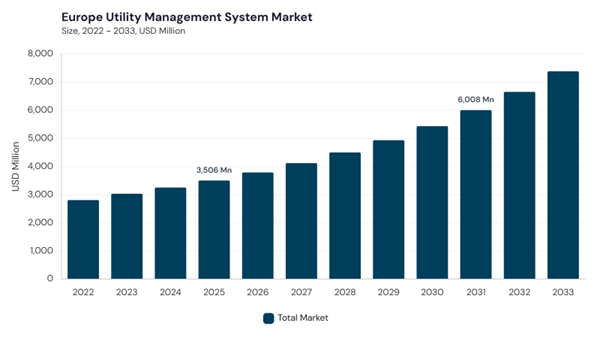
End Use Outlook
Based on End Use, the market is segmented into Manufacturing & Industrial, Energy & Utilities, Commercial Buildings, Residential Complexes, and Other End Use. The Manufacturing & Industrial segment dominated the Europe Utility Management System Market in 2025 and is anticipated to reach USD 1.91 billion by 2031 owing to increasing industrial automation and energy efficiency initiatives. Additionally, the Residential Complexes segment is expected to exhibit a CAGR of 11.0% during 2026-2033 driven by rising adoption of smart home technologies, automated utility monitoring systems, and intelligent residential energy management solutions.Country Outlook
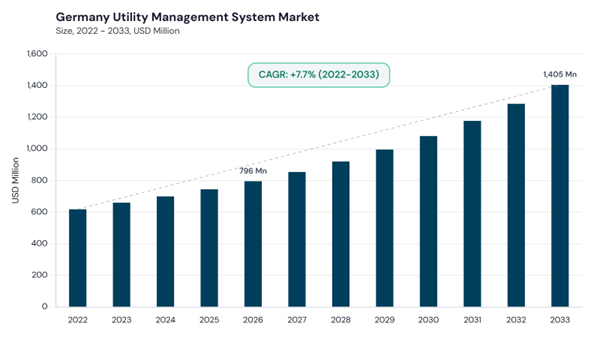
Germany accounted for the leading share in the Europe Utility Management System Market in 2025 due to strong investments in industrial automation, smart grids, and digital utility infrastructure. The Germany market is expected to reach USD 1.17 billion by 2031. Meanwhile, Spain is anticipated to witness the fastest growth with a CAGR of 11.5% during the forecast period (2026-2033) supported by rising investments in smart city infrastructure, renewable energy integration, and intelligent building management systems.List of Key Companies Profiled
- Schneider Electric SE
- Siemens AG
- ABB Ltd.
- Honeywell International Inc.
- Eaton Corporation plc
- IBM Corporation
- Oracle Corporation
- SAP SE
- Cisco Systems, Inc.
- General Electric Company
Market Report Segmentation
By System- Industrial Utility Management Systems (IUMS)
- Building Utility Management Systems (BUMS)
- Software
- Services
- Hardware
- On-Premises
- Cloud
- Manufacturing & Industrial
- Energy & Utilities
- Commercial Buildings
- Residential Complexes
- Other End Use
- Germany
- UK
- France
- Russia
- Spain
- Italy
- Rest of Europe
Table of Contents
Chapter 1. Europe Market1.1 Market Overview
1.2 Key Factors Impacting Market
1.2.1 Market Drivers
1.2.2 Market Restraints
1.2.3 Market Opportunities
1.2.4 Market Challenges
1.2.5 Market Trends
1.2.6 State of Competition
1.2.7 Market Consolidation
1.2.8 Key Customer Criteria
1.3 Product Life Cycle
1.4 Segmentation By System
1.4.1 Industrial Utility Management Systems (IUMS)
1.4.2 Building Utility Management Systems (BUMS)
1.5 Segmentation By Deployment
1.5.1 Cloud
1.5.2 On-Premises
1.6 Segmentation By End Use
1.6.1 Manufacturing & Industrial
1.6.2 Commercial Buildings
1.6.3 Energy & Utilities
1.6.4 Residential Complexes
1.6.5 Other End Use
1.7 Segmentation By Component
1.7.1 Hardware
1.7.2 Software
1.7.3 Services
1.8 Segmentation By Country
1.8.1 Germany
1.8.1.1 Segmentation By System
1.8.1.1.1 Industrial Utility Management Systems (IUMS)
1.8.1.1.2 Building Utility Management Systems (BUMS)
1.8.1.2 Segmentation By Deployment
1.8.1.2.1 Cloud
1.8.1.2.2 On-Premises
1.8.1.3 Segmentation By End Use
1.8.1.3.1 Manufacturing & Industrial
1.8.1.3.2 Commercial Buildings
1.8.1.3.3 Energy & Utilities
1.8.1.3.4 Residential Complexes
1.8.1.3.5 Other End Use
1.8.1.4 Segmentation By Component
1.8.1.4.1 Hardware
1.8.1.4.2 Software
1.8.1.4.3 Services
1.8.2 UK
1.8.3 France
1.8.4 Russia
1.8.5 Spain
1.8.6 Italy
1.8.7 Rest of Europe
Chapter 2. Company Snapshot
2.1 Siemens AG
2.1.1 Business Overview
2.1.2 Key Information
2.1.3 Company Focus
2.1.4 Strategic Insights
2.1.5 Strategy Deployed
2.1.6 Product & Service Portfolio
2.1.7 Capability Overview
2.1.8 Technology & Innovation Focus
2.1.9 Customers / End Users
2.1.10 Competitive Positioning
2.1.11 Key Differentiators
2.1.12 Portfolio Matrix
2.1.13 SWOT Analysis
2.1.14 Future Outlook
2.2 Schneider Electric SE
2.2.1 Business Overview
2.2.2 Key Information
2.2.3 Company Focus
2.2.4 Strategic Insights
2.2.5 Strategy Deployed
2.2.6 Product & Service Portfolio
2.2.7 Capability Overview
2.2.8 Technology & Innovation Focus
2.2.9 Customers / End Users
2.2.10 Competitive Positioning
2.2.11 Key Differentiators
2.2.12 Portfolio Matrix
2.2.13 SWOT Analysis
2.2.14 Future Outlook
2.3 IBM Corporation
2.3.1 Business Overview
2.3.2 Key Information
2.3.3 Company Focus
2.3.4 Strategic Insights
2.3.5 Strategy Deployed
2.3.6 Product & Service Portfolio
2.3.7 Capability Overview
2.3.8 Technology & Innovation Focus
2.3.9 Customers / End Users
2.3.10 Competitive Positioning
2.3.11 Key Differentiators
2.3.12 Portfolio Matrix
2.3.13 SWOT Analysis
2.3.14 Future Outlook
2.4 SAP SE
2.4.1 Business Overview
2.4.2 Key Information
2.4.3 Company Focus
2.4.4 Strategic Insights
2.4.5 Strategy Deployed
2.4.6 Product & Service Portfolio
2.4.7 Capability Overview
2.4.8 Technology & Innovation Focus
2.4.9 Customers / End Users
2.4.10 Competitive Positioning
2.4.11 Key Differentiators
2.4.12 Portfolio Matrix
2.4.13 SWOT Analysis
2.4.14 Future Outlook
2.5 Oracle Corporation
2.5.1 Business Overview
2.5.2 Key Information
2.5.3 Company Focus
2.5.4 Strategic Insights
2.5.5 Strategy Deployed
2.5.6 Product & Service Portfolio
2.5.7 Capability Overview
2.5.8 Technology & Innovation Focus
2.5.9 Customers / End Users
2.5.10 Competitive Positioning
2.5.11 Key Differentiators
2.5.12 Portfolio Matrix
2.5.13 SWOT Analysis
2.5.14 Future Outlook
2.6 Microsoft Corporation
2.6.1 Business Overview
2.6.2 Key Information
2.6.3 Company Focus
2.6.4 Strategic Insights
2.6.5 Strategy Deployed
2.6.6 Product & Service Portfolio
2.6.7 Capability Overview
2.6.8 Technology & Innovation Focus
2.6.9 Customers / End Users
2.6.10 Competitive Positioning
2.6.11 Key Differentiators
2.6.12 Portfolio Matrix
2.6.13 SWOT Analysis
2.6.14 Future Outlook
2.7 Salesforce, Inc.
2.7.1 Business Overview
2.7.2 Key Information
2.7.3 Company Focus
2.7.4 Strategic Insights
2.7.5 Strategy Deployed
2.7.6 Product & Service Portfolio
2.7.7 Capability Overview
2.7.8 Technology & Innovation Focus
2.7.9 Customers / End Users
2.7.10 Competitive Positioning
2.7.11 Key Differentiators
2.7.12 Portfolio Matrix
2.7.13 SWOT Analysis
2.7.14 Future Outlook
2.8 GE Vernova Group
2.8.1 Business Overview
2.8.2 Key Information
2.8.3 Company Focus
2.8.4 Strategic Insights
2.8.5 Strategy Deployed
2.8.6 Product & Service Portfolio
2.8.7 Capability Overview
2.8.8 Technology & Innovation Focus
2.8.9 Customers / End Users
2.8.10 Competitive Positioning
2.8.11 Key Differentiators
2.8.12 Portfolio Matrix
2.8.13 SWOT Analysis
2.8.14 Future Outlook
2.9 EnergyCAP, LLC
2.9.1 Business Overview
2.9.2 Key Information
2.9.3 Company Focus
2.9.4 Strategic Insights
2.9.5 Strategy Deployed
2.9.6 Product & Service Portfolio
2.9.7 Capability Overview
2.9.8 Technology & Innovation Focus
2.9.9 Customers / End Users
2.9.10 Competitive Positioning
2.9.11 Key Differentiators
2.9.12 Portfolio Matrix
2.9.13 SWOT Analysis
2.9.14 Future Outlook
2.10 ABB Ltd.
2.10.1 Business Overview
2.10.2 Key Information
2.10.3 Company Focus
2.10.4 Strategic Insights
2.10.5 Strategy Deployed
2.10.6 Product & Service Portfolio
2.10.7 Capability Overview
2.10.8 Technology & Innovation Focus
2.10.9 Customers / End Users
2.10.10 Competitive Positioning
2.10.11 Key Differentiators
2.10.12 Portfolio Matrix
2.10.13 SWOT Analysis
2.10.14 Future Outlook
Companies Mentioned
- Schneider Electric SE
- Siemens AG
- ABB Ltd.
- Honeywell International Inc.
- Eaton Corporation plc
- IBM Corporation
- Oracle Corporation
- SAP SE
- Cisco Systems, Inc.
- General Electric Company


