



The Global Automotive Heat Exchanger Market size is estimated at $23.38 billion in 2025 and is expected to reach $32.69 billion by 2032, rising at a market growth of 4.9% CAGR during the forecast period (2025-2032). This market is growing because more cars are being made, electric vehicles need more thermal management, and emission rules are getting stricter. The use of lightweight materials and energy-efficient cooling technologies is growing, and the growth of automotive aftermarket services will keep growing.
The automotive heat exchanger market has developed prominently from its origin in basic engine cooling systems in early internal combustion vehicles. The automotive heat exchangers market has advanced along with rising demands for reduced emissions, enhanced efficiency, and improved vehicle performance. The transition has driven innovation in high-efficiency, compact heat exchangers and the integration of digital tools like virtual prototyping, simulation, and digital twins to optimize performance and design within largely complex vehicle architectures. The automotive heat exchanger market is driven by key elements, including the rising focus on electric vehicle-specific thermal systems, the integration of digital technologies in production and design, and the adoption of manufacturing techniques and advanced materials.
Key market players are focusing on strategic partnerships, research & development, and regional expansion to strengthen their position, along with leveraging acquisitions with the aim of improving capabilities. The market seems to be intensively competitive, with key players prioritizing standardization and innovation, and regional players capitalizing on regional manufacturing and cost advantage. The market is looking for more durable, efficient, and environmentally sustainable solutions, driven by regulatory pressures, developing propulsion technologies, and the requirement for high-performance thermal management systems.
The leading players in the market are competing with diverse innovative offerings to remain competitive in the market. The above illustration shows the percentage of revenue shared by some of the leading companies in the market. The leading players of the market are adopting various strategies in order to cater demand coming from the different industries. The key developmental strategies in the market are Acquisitions, and Partnerships & Collaborations.
In Asia Pacific and LAMEA regions, the automotive heat exchanger market is projected to capture prominent growth. The market is supported by expanding EV adoption, high vehicle production volumes, especially in nations such as Japan, South Korea, and China and rising investment in automotive manufacturing infrastructure. The presence of key component suppliers and cost-effective production capabilities further strengthens the region’s growth. Furthermore, LAMEA’s automotive heat exchanger market is offering lucrative opportunities. This is because of expanding automotive aftermarket services, enhancing industrialization, and increasing vehicle demand. Rising regulatory awareness and foreign investments are predicted to drive modernization.
Key Market Trends & Insights:
- The Asia Pacific market dominated Global Automotive Heat Exchanger Market in 2024, accounting for a 48.36% revenue share in 2024.
- The China market is projected to maintain its leadership in Asia Pacific, reaching a market size of USD 58.00 billion by 2032.
- Among the Type, the Liquid-to-Air segment dominated the North America market, contributing a revenue share of 59.54% in 2024.
- In terms of Propulsion, ICE segment are expected to lead the Europe market, with a projected revenue share of 75.01% by 2032.
- The Passenger Cars market emerged as the leading Vehicle Type in 2024, capturing a 69.76% revenue share, and is projected to retain its dominance during the forecast period.
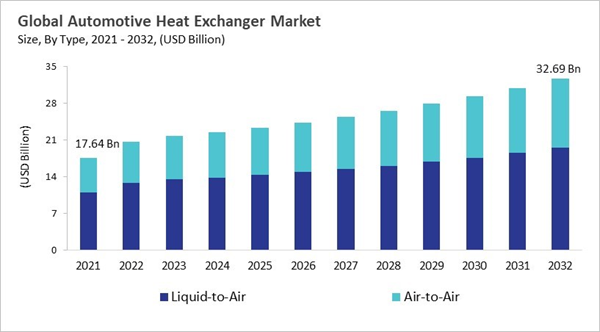
The automotive heat exchanger market has developed prominently from its origin in basic engine cooling systems in early internal combustion vehicles. The automotive heat exchangers market has advanced along with rising demands for reduced emissions, enhanced efficiency, and improved vehicle performance. The transition has driven innovation in high-efficiency, compact heat exchangers and the integration of digital tools like virtual prototyping, simulation, and digital twins to optimize performance and design within largely complex vehicle architectures. The automotive heat exchanger market is driven by key elements, including the rising focus on electric vehicle-specific thermal systems, the integration of digital technologies in production and design, and the adoption of manufacturing techniques and advanced materials.
Key market players are focusing on strategic partnerships, research & development, and regional expansion to strengthen their position, along with leveraging acquisitions with the aim of improving capabilities. The market seems to be intensively competitive, with key players prioritizing standardization and innovation, and regional players capitalizing on regional manufacturing and cost advantage. The market is looking for more durable, efficient, and environmentally sustainable solutions, driven by regulatory pressures, developing propulsion technologies, and the requirement for high-performance thermal management systems.
Driving and Restraining Factors
Drivers- Growing Demand For Enhanced Fuel Efficiency And Emission Reduction Technologies
- Electrification Of Vehicles And The Rising Need For Thermal Management Of Battery Systems
- Technological Advancements In Heat Exchanger Design And Materials Driving Market Expansion
- Expansion Of Global Automotive Production And Supply Chain Innovation Supporting Market Growth
- Strict Regulatory Compliance And Environmental Standards
- High Production And Material Costs
- Technological Complexity And Integration Challenges
- Integration Of Advanced Thermal Management Systems Using Smart Technologies
- Expansion Of Production Capacity In Response To Growing Market Demand
- Development Of Heat Exchange Solutions For Emerging Green Mobility Technologies
- Thermal Efficiency And Size Optimization Constraints
- Supply Chain Volatility And Material Cost Pressures
- Regulatory Compliance Complexity And Environmental Standards
Market Share Analysis
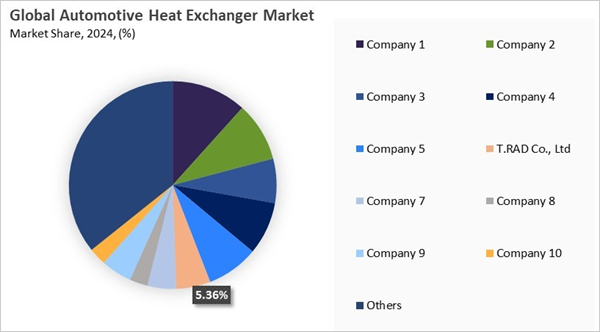
The leading players in the market are competing with diverse innovative offerings to remain competitive in the market. The above illustration shows the percentage of revenue shared by some of the leading companies in the market. The leading players of the market are adopting various strategies in order to cater demand coming from the different industries. The key developmental strategies in the market are Acquisitions, and Partnerships & Collaborations.
COVID-19 Impact Analysis
Before the COVID-19 pandemic, the automotive heat exchanger market was growing steadily because vehicle production and demand for internal combustion engine technologies were stable. The pandemic caused a lot of problems with this path, like supply chain breakdowns, production delays, and lower manufacturing capacity because of lockdowns and workforce restrictions. It also caused a drop in demand for cars. But it also sped up the shift to digital technology, with manufacturers using more advanced monitoring systems and making their supply chains more resilient. The move toward cleaner transportation also led to more new ideas in heat exchangers for electric and hybrid cars. As the recovery went on, the market bounced back with better operational strategies and a renewed focus on advanced materials and smart thermal solutions. This showed that the recovery had an overall adverse effect with long-term transformative effects. Thus, the COVID-19 pandemic had a negative impact on the Automotive Heat Exchanger Market.Type Outlook
Based on Type, the market is segmented into Liquid-to-Air, and Air-to-Air. The Air-to-Air segment garnered 38.46% revenue share in the Automotive Heat Exchanger market in 2024. This segment is witnessing considerable demand due to its cost-effectiveness and simpler design in turbocharged engines. It is widely adopted in applications where moderate cooling efficiency is sufficient. Growing integration in commercial vehicles and performance optimization systems supports its expansion.Propulsion Outlook
Based on Propulsion, the market is segmented into ICE, and Electric. The Electric segment garnered 23.83% revenue share in the Automotive Heat Exchanger market in 2024. This segment is witnessing strong demand due to the rapid growth of electric vehicles and the need for efficient battery thermal management systems. Increasing investments in EV infrastructure and supportive government policies are key drivers. Advancements in liquid cooling technologies and integrated thermal systems further accelerate adoption.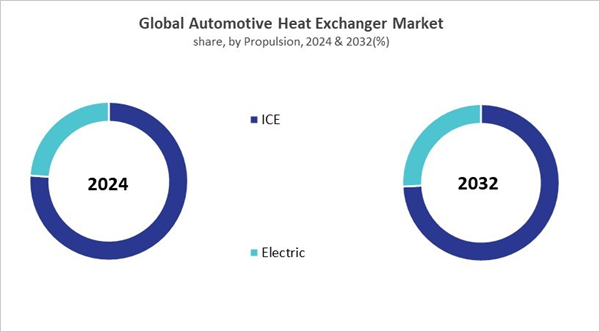
Regional Outlook
Region-wise, the Automotive Heat Exchanger Market is analyzed across North America, Europe, Asia Pacific, and LAMEA. The automotive heat exchanger market is estimated to experience significant growth in the North America and Europe regions. The market is driven by the rapid adoption of electrified vehicles and strict emission regulations. In North America, the presence of rising EV production, the presence of major automotive OEMs, and strong investments in advanced thermal management technologies are raising the demand for high-performance heat exchangers. Regulatory frameworks focused on carbon reduction and fuel efficiency encourage the integration of compact and efficient thermal systems. Moreover, the European automotive heat exchanger market is anticipated to grow at a noticeable rate. Stringent environmental policies and aggressive electrification targets have surged the transformation toward hybrid and electric vehicles, substantially boosting the demand for multi-functional heat exchangers. Also, the region’s strong focus on circular economy practices encourages the use of energy-efficient manufacturing processes and lightweight materials, supporting innovation in thermal management solutions.In Asia Pacific and LAMEA regions, the automotive heat exchanger market is projected to capture prominent growth. The market is supported by expanding EV adoption, high vehicle production volumes, especially in nations such as Japan, South Korea, and China and rising investment in automotive manufacturing infrastructure. The presence of key component suppliers and cost-effective production capabilities further strengthens the region’s growth. Furthermore, LAMEA’s automotive heat exchanger market is offering lucrative opportunities. This is because of expanding automotive aftermarket services, enhancing industrialization, and increasing vehicle demand. Rising regulatory awareness and foreign investments are predicted to drive modernization.
Recent Strategies Deployed in the Market
- Nov-2025: Valeo SA teamed up with 2CRSi to develop advanced liquid cooling solutions, initially for data centers but with strong potential in automotive applications such as EV battery cooling. The collaboration enhances thermal efficiency through innovative heat exchanger technologies, strengthening Valeo’s capabilities in next-generation thermal systems and driving cross-industry innovation.
- Jul-2024: Modine Manufacturing Company unveiled the EVantage Cabin Climate System, an integrated thermal management solution for heavy-duty electric vehicle HVAC. Featuring smart electric components, heat exchangers, and a master controller, it delivers efficient heating and cooling. The system is customizable, rugged, and designed for fast integration across commercial, industrial, and specialty EV applications.
- Feb-2024: Mahle GmbH unveiled new features and expanded its electric vehicle technology portfolio with advanced thermal management systems and heat exchanger components. These innovations enhance heat transfer efficiency and reduce energy use in battery and power electronics cooling. The move strengthens MAHLE’s position in the automotive heat exchanger market, supporting efficient solutions for next-generation electrified powertrains.
- Sep-2023: Denso Corporation unveiled Everycool, an advanced truck cooling system offering driver comfort and energy efficiency when the engine is off. Compact, lightweight, and adaptable to various vehicles, it reduces power consumption and environmental impact, enhances rest breaks, maintains cargo capacity, and supports safe, efficient logistics operations in Japan and beyond.
- Jul-2023: Marelli Holdings Co., Ltd. unveiled its integrated Thermal Management Module (iTMM) for electric vehicles, combining battery, e-powertrain, and cabin thermal systems into one component. This optimizes energy use, reduces system complexity, enhances safety, supports ultra-fast charging, and increases driving range up to 20%, while offering compact size, assembly simplicity, and cost efficiency.
- Jan-2023: Valeo SA unveiled four new evaporator references, enhancing fit and cooling efficiency for vehicles like Renault Duster, GM Beat, Mahindra Scorpio, and Honda Amaze. With over 60 years of expertise, Valeo ensures reliable thermal solutions, addressing common AC issues like dirty, frozen, or damaged coils for optimal vehicle climate control.
List of Key Companies Profiled
- Denso Corporation
- Valeo SA
- Marelli Holdings Co., Ltd.
- Mahle GmbH (Mahle Stiftung GmbH)
- Hanon Systems (Hahn & Co. Auto Holdings Co., Ltd.)
- T.RAD Co., Ltd.
- hejiang Yinlun Machinery Co., Ltd.
- Weifang Hengan Radiator Group Co., Ltd.
- Modine Manufacturing Company
- Banco Products (India) Ltd.
Market Report Segmentation
By Type- Liquid-to-Air
- Air-to-Air
- ICE
- Electric
- Passenger Cars
- Commercial Vehicles
- North America
- US
- Canada
- Mexico
- Rest of North America
- Europe
- Germany
- UK
- France
- Russia
- Spain
- Italy
- Rest of Europe
- Asia Pacific
- China
- Japan
- India
- South Korea
- Singapore
- Malaysia
- Rest of Asia Pacific
- LAMEA
- Brazil
- Argentina
- UAE
- Saudi Arabia
- South Africa
- Nigeria
- Rest of LAMEA
Table of Contents
Chapter 1. Market Scope & Methodology
Chapter 2. Market at a Glance
Chapter 3. Market Overview
Chapter 4. Market Trends - Automotive Heat Exchanger Market
Chapter 5. State of Competition - Automotive Heat Exchanger Market
Chapter 6. Market Consolidation - Automotive Heat Exchanger Market
Chapter 7. Key Customer Criteria - Automotive Heat Exchanger Market
Chapter 8. Product Life Cycle - Automotive Heat Exchanger Market
Chapter 10. Competition Analysis - Global
Chapter 11. Global Automotive Heat Exchanger Market by Type
Chapter 12. Global Automotive Heat Exchanger Market by Propulsion
Chapter 13. Global Automotive Heat Exchanger Market by Vehicle Type
Chapter 14. Global Automotive Heat Exchanger Market by Region
Chapter 15. Company Profiles
Companies Mentioned
- Denso Corporation
- Valeo SA
- Marelli Holdings Co., Ltd.
- Mahle GmbH (Mahle Stiftung GmbH)
- Hanon Systems (Hahn & Co. Auto Holdings Co., Ltd.)
- T.RAD Co., Ltd.
- hejiang Yinlun Machinery Co., Ltd.
- Weifang Hengan Radiator Group Co., Ltd.
- Modine Manufacturing Company
- Banco Products (India) Ltd.


