



The Latin America, Middle East and Africa Intrinsically Safe Equipment Market is expected to reach $380.76 million by 2028 and is expected to witness market growth of 8.7% CAGR during the forecast period (2025-2032).
The Brazil market dominated the LAMEA Intrinsically Safe Equipment Market by country in 2024, and is expected to continue to be a dominant market till 2032; thereby, achieving a market value of $87.1 million by 2032. The Argentina market is showcasing a CAGR of 10.6% during 2025-2032. Additionally, the UAE market would register a CAGR of 7.5% during 2025-2032. The Brazil and Argentina led the LAMEA Intrinsically Safe Equipment Market by Country with a market share of 18.8% and 15.4% in 2024. The South Africa market is expected to witness a CAGR of 10.4% during throughout the forecast period.
The LAMEA Intrinsically Safe Equipment Market has grown from its early roots in industrial safety needs, especially in high-risk fields like oil and gas, mining, and chemical processing. At first, the market focused on strong mechanical designs and explosion-proof enclosures because of strict rules and the need to keep things from catching fire in dangerous places. Over time, improvements in material science, the miniaturization of electronics, and the standardization of certification standards across the region made it possible to make small, high-performance intrinsically safe devices. The addition of digital technologies and wireless communication made these solutions even smarter, allowing for real-time monitoring and predictive diagnostics that balance safety with operational efficiency.
There are three main trends that are shaping the market right now: the use of Industry 4.0 technologies, stricter rules, and a greater focus on sustainability. Leading companies are using innovation, strategic partnerships, and expansion into new markets to strengthen their presence in the market. They are focusing on IoT-enabled devices and product development that meets regulatory requirements. A balance between global companies with strong R&D capabilities and regional companies that offer localized expertise and quick support defines the competitive landscape. In this market, success is becoming more and more dependent on the credibility of certifications, technological progress, and the ability to provide customized, energy-efficient solutions that meet both safety and environmental standards.
The Brazil market dominated the LAMEA Intrinsically Safe Equipment Market by country in 2024, and is expected to continue to be a dominant market till 2032; thereby, achieving a market value of $87.1 million by 2032. The Argentina market is showcasing a CAGR of 10.6% during 2025-2032. Additionally, the UAE market would register a CAGR of 7.5% during 2025-2032. The Brazil and Argentina led the LAMEA Intrinsically Safe Equipment Market by Country with a market share of 18.8% and 15.4% in 2024. The South Africa market is expected to witness a CAGR of 10.4% during throughout the forecast period.
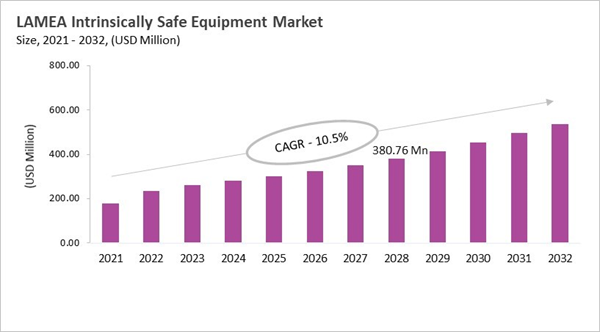
The LAMEA Intrinsically Safe Equipment Market has grown from its early roots in industrial safety needs, especially in high-risk fields like oil and gas, mining, and chemical processing. At first, the market focused on strong mechanical designs and explosion-proof enclosures because of strict rules and the need to keep things from catching fire in dangerous places. Over time, improvements in material science, the miniaturization of electronics, and the standardization of certification standards across the region made it possible to make small, high-performance intrinsically safe devices. The addition of digital technologies and wireless communication made these solutions even smarter, allowing for real-time monitoring and predictive diagnostics that balance safety with operational efficiency.
There are three main trends that are shaping the market right now: the use of Industry 4.0 technologies, stricter rules, and a greater focus on sustainability. Leading companies are using innovation, strategic partnerships, and expansion into new markets to strengthen their presence in the market. They are focusing on IoT-enabled devices and product development that meets regulatory requirements. A balance between global companies with strong R&D capabilities and regional companies that offer localized expertise and quick support defines the competitive landscape. In this market, success is becoming more and more dependent on the credibility of certifications, technological progress, and the ability to provide customized, energy-efficient solutions that meet both safety and environmental standards.
Class Type Outlook
Based on Class Type, the market is segmented into Class 1, Class 2, and Class 3. With a compound annual growth rate (CAGR) of 10% over the projection period, the Class 1 Market, dominate the South Africa Intrinsically Safe Equipment Market by Class Type in 2024 and would be a prominent market until 2032. The Class 2 market is expected to witness a CAGR of 10.7% during 2025-2032.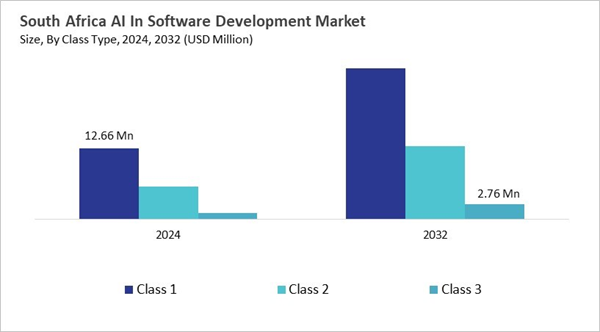
End Use Outlook
Based on End Use, the market is segmented into Oil & Gas, Chemical & Petrochemical, Mining, Power, Power, and Processing Industries & Other. The Oil & Gas market segment dominated the Brazil Intrinsically Safe Equipment Market by End Use is expected to grow at a CAGR of 6 % during the forecast period thereby continuing its dominance until 2032. Also, The Processing Industries & Other market is anticipated to grow as a CAGR of 6.9 % during the forecast period during 2025-2032.Country Outlook
The Brazil Intrinsically Safe Equipment Market has changed from simple safety devices that limit energy to more advanced, digitally integrated solutions. This is because of strict regulations, and the safety needs of high-risk industries like oil and gas, mining, and chemicals. Technological advances like IoT-enabled monitoring, predictive analytics, and smart sensors have made operations much safer and more efficient. As regulations become more in line with international standards, they continue to drive innovation, raise product quality, and make it harder for new businesses to get started. At the same time, concerns about sustainability are affecting how equipment is designed and how it is managed over its lifetime. Market players are using innovation, partnerships, and localization strategies to grow their businesses. Competition, on the other hand, is stillList of Key Companies Profiled
- Banner Engineering Corporation
- Honeywell International Inc.
- Eaton Corporation plc
- Emerson Electric Co.
- Rockwell Automation, Inc.
- Schneider Electric SE
- Siemens AG
- Fluke Corporation (Fortive Corporation)
- Pepperl+Fuchs SE
- R. STAHL AG
Market Report Segmentation
By Class Type- Class 1
- Class 2
- Class 3
- Oil & Gas
- Chemical & Petrochemical
- Mining
- Power
- Processing Industries & Other
- Zone 1
- Zone 2
- Zone 22
- Zone 0
- Zone 21
- Zone 20
- Sensors
- Detectors
- Transmitters
- Isolators / Barriers
- Switches
- LED Indicators
- Other Product
- Brazil
- Argentina
- UAE
- Saudi Arabia
- South Africa
- Nigeria
- Rest of LAMEA
Table of Contents
Chapter 1. Market Scope & Methodology
Chapter 2. Market at a Glance
Chapter 3. Market Overview
Chapter 4. Market Trends - LAMEA Intrinsically Safe Equipment Market
Chapter 5. State Of Competition - LAMEA Intrinsically Safe Equipment Market
Chapter 6. Market Consolidation - Intrinsically Safe Equipment Market
Chapter 7. Key Customer Criteria - LAMEA Intrinsically Safe Equipment Market
Chapter 8. Product Life Cycle - LAMEA Intrinsically Safe Equipment Market
Chapter 9. Value Chain Analysis of Intrinsically Safe Equipment Market
Chapter 10. Competition Analysis - Global
Chapter 11. LAMEA Intrinsically Safe Equipment Market by Class Type
Chapter 12. LAMEA Intrinsically Safe Equipment Market by End Use
Chapter 13. LAMEA Intrinsically Safe Equipment Market by Zone
Chapter 14. LAMEA Intrinsically Safe Equipment Market by Product
Chapter 15. LAMEA Intrinsically Safe Equipment Market by Country
Chapter 16. Company Profiles
Companies Mentioned
- Banner Engineering Corporation
- Honeywell International Inc.
- Eaton Corporation plc
- Emerson Electric Co.
- Rockwell Automation, Inc.
- Schneider Electric SE
- Siemens AG
- Fluke Corporation (Fortive Corporation)
- Pepperl+Fuchs SE
- R. STAHL AG


