



The North America Self-Healing Networks Market is expected to reach $829.87 million by 2027 and is expected to witness market growth of 30.3% CAGR during the forecast period (2025-2032).
The US market dominated the North America Self-Healing Networks Market by country in 2024, and is expected to continue to be a dominant market till 2032; thereby, achieving a market value of $2.29 billion by 2032. The Canada market is experiencing a CAGR of 33.1% during 2025-2032. Additionally, the Mexico market is expected to exhibit a CAGR of 31.9% during 2025-2032. The US and Canada led the North America Self-Healing Networks Market by Country with a market share of 76.1% and 11.9% in 2024.
Self-healing networks in North America have evolved into intelligent communication systems that can identify, diagnose, and resolve network issues autonomously. This is because of the growing amount of data traffic, the need for high reliability across enterprise, telecom, cloud, and government infrastructures, and the need for distributed architectures. These networks turn raw telemetry into useful information using AI, machine learning, and real-time monitoring. This lets them make predictions and recommendations that cut down on the need for human intervention and lower operational costs. As the cloud has grown, hybrid IT environments have become more common, and the Internet of Things (IoT) has grown; the use of these systems has sped up. This is because they promise near-zero downtime, automated fault detection, and smooth performance across multi-cloud, edge, and data center networks.
Key networking companies like Cisco and Nokia are at the top of the market with AI-powered agent-based frameworks and autonomous network strategies that include observability, cross-domain analytics, and closed-loop corrective actions. Cisco's Crosswork platform and AI-native NetOps solutions make it possible to predict and fix problems before they happen and make network management easier. Nokia's Sense-Think-Act framework and Autonomous Network Fabric offer full automation, security, and support for hybrid deployments. In North America, companies compete by offering unique features like AI-driven automation, cloud compatibility, and a wide range of integrations. The biggest players focus on proactive, self-correcting infrastructure that is resilient, supports 5G and edge deployments, and reduces the need for manual network operations.
The US market dominated the North America Self-Healing Networks Market by country in 2024, and is expected to continue to be a dominant market till 2032; thereby, achieving a market value of $2.29 billion by 2032. The Canada market is experiencing a CAGR of 33.1% during 2025-2032. Additionally, the Mexico market is expected to exhibit a CAGR of 31.9% during 2025-2032. The US and Canada led the North America Self-Healing Networks Market by Country with a market share of 76.1% and 11.9% in 2024.
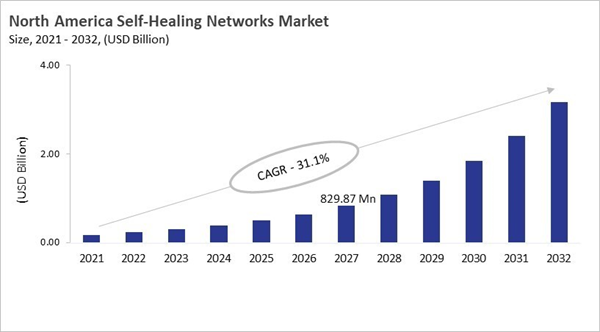
Self-healing networks in North America have evolved into intelligent communication systems that can identify, diagnose, and resolve network issues autonomously. This is because of the growing amount of data traffic, the need for high reliability across enterprise, telecom, cloud, and government infrastructures, and the need for distributed architectures. These networks turn raw telemetry into useful information using AI, machine learning, and real-time monitoring. This lets them make predictions and recommendations that cut down on the need for human intervention and lower operational costs. As the cloud has grown, hybrid IT environments have become more common, and the Internet of Things (IoT) has grown; the use of these systems has sped up. This is because they promise near-zero downtime, automated fault detection, and smooth performance across multi-cloud, edge, and data center networks.
Key networking companies like Cisco and Nokia are at the top of the market with AI-powered agent-based frameworks and autonomous network strategies that include observability, cross-domain analytics, and closed-loop corrective actions. Cisco's Crosswork platform and AI-native NetOps solutions make it possible to predict and fix problems before they happen and make network management easier. Nokia's Sense-Think-Act framework and Autonomous Network Fabric offer full automation, security, and support for hybrid deployments. In North America, companies compete by offering unique features like AI-driven automation, cloud compatibility, and a wide range of integrations. The biggest players focus on proactive, self-correcting infrastructure that is resilient, supports 5G and edge deployments, and reduces the need for manual network operations.
Enterprise Type Outlook
Based on Enterprise Type, the market is segmented into Large Enterprises and Small & Medium Enterprises (SMEs). The Large Enterprises market segment dominated the Canada Self-Healing Networks Market by Enterprise Type is expected to grow at a CAGR of 32.7 % during the forecast period thereby continuing its dominance until 2032. Also, The Small & Medium Enterprises (SMEs) market is anticipated to grow as a CAGR of 33.7 % during the forecast period during 2025-2032.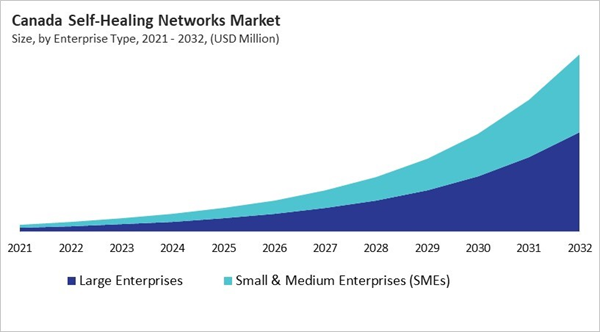
Industry Vertical Outlook
Based on Industry Vertical, the market is segmented into IT & ITES, Telecommunications, BFSI, Healthcare, Retail, Education and Other Industry Vertical. Among various US Self-Healing Networks Market by Industry Vertical; The IT & ITES market achieved a market size of USD $71.5 Million in 2024 and is expected to grow at a CAGR of 27 % during the forecast period. The Education market is predicted to experience a CAGR of 31.4% throughout the forecast period from (2025-2032).Country Outlook
The US self-healing networking market is growing because business and telecom networks are getting more complicated, digital transformation is happening faster, and cloud, 5G, IoT, and edge computing are becoming more popular. According to Cisco, self-healing networks use AI-driven analytics and automation to find, fix, and prevent problems without the need for human intervention. This improves uptime and operational efficiency. Advanced IT and telecom infrastructure, along with strict SLAs, encourage people to start using predictive and intent-based networking solutions early. Cisco and other major OEMs are adding machine learning to network monitoring platforms. This lets them fix problems before they happen in distributed environments. Companies and service providers that use these technologies have a competitive edge because they have less downtime, lower operational costs, and faster troubleshooting. This makes the US market technologically advanced and ready for growth.List of Key Companies Profiled
- Cisco Systems, Inc.
- Ericsson AB
- Hewlett Packard Enterprise Company
- Huawei Technologies Co., Ltd. (Huawei Investment & Holding Co., Ltd.)
- IBM Corporation
- Juniper Networks, Inc.
- Nokia Corporation
- VMware, Inc. (Broadcom Inc.)
- CommScope Holding Company, Inc.
- BMC Software, Inc. (KKR & Co., Inc.)
Market Report Segmentation
By Enterprise Type- Large Enterprises
- Small & Medium Enterprises (SMEs)
- Solutions
- Services
- Hybrid
- Physical
- Virtual
- Network Traffic Management
- Networking Configuration & Provisioning
- Root Cause Analysis
- Network Access Control
- Security Compliance Management & Others
- IT & ITES
- Telecommunications
- BFSI
- Healthcare
- Retail
- Education
- Other Industry Vertical
- US
- Canada
- Mexico
- Rest of North America
Table of Contents
Chapter 1. Market Scope & Methodology
Chapter 2. Market at a Glance
Chapter 3. Market Overview
Chapter 10. Competition Analysis - Global
Chapter 11. North America Self-Healing Networks Market by Enterprise Type
Chapter 12. North America Self-Healing Networks Market by Offering
Chapter 13. North America Self-Healing Networks Market by Network Type
Chapter 14. North America Self-Healing Networks Market by Application
Chapter 15. North America Self-Healing Networks Market by Industry Vertical
Chapter 16. North America Self-Healing Networks Market by Country
Chapter 17. Company Profiles
Companies Mentioned
- Cisco Systems, Inc.
- Ericsson AB
- Hewlett Packard Enterprise Company
- Huawei Technologies Co., Ltd. (Huawei Investment & Holding Co., Ltd.)
- IBM Corporation
- Juniper Networks, Inc.
- Nokia Corporation
- VMware, Inc. (Broadcom Inc.)
- CommScope Holding Company, Inc.
- BMC Software, Inc. (KKR & Co., Inc.)


