



The Global Data Broker Market size is estimated at $287.47 billion in 2025 and is expected to reach $464.75 billion by 2032, rising at a market growth of 7.1% CAGR during the forecast period (2025-2032). This market is growing because digital ecosystems are growing quickly, connected devices are making more data, and there is a growing need for analytics and marketing that are based on data. Businesses in all fields are using third-party data insights more and more to make better decisions, target customers more effectively, and personalize their services.
The data broker market consists of companies that analyze, collect, and sell information about businesses and individuals to third parties. These enterprises gather data from government filings, public records, consumer transactions, online activities, and mobile location tracking, and then package it for uses like identity verification, risk assessment, marketing, and fraud detection. The rise of the internet, connected devices, and digital advertising technologies has significantly expanded the detail and amount of data that can be collected. With web tracking tools like cookies and mobile identifiers become common, companies gained the capability to monitor purchasing pattern, online behavior, and location history at a wide scale.
Data brokers became key players in the modern data-driven economy, providing services used in customer analytics, targeted advertising, and risk profiling. Major companies like Acxiom, Experian, TransUnion, Oracle, and Equifax built extensive databases covering billions of individuals globally. The market has faced largely scrutiny from privacy advocates and governments because of concerns over consumer consent, transparency, and the potential misuse of sensitive data like geolocation information. New policy initiatives and regulations like California’s Delete Act and proposed federal privacy laws are encouraging the industry toward stronger compliance systems, greater transparency, and privacy-focused practices. Many data brokers are shifting from simple data sales to advanced analytics services powered by AI, while also strengthening data security, governance, and partnerships with enterprise technology ecosystems and advertising platforms.
The leading players in the market are competing with diverse innovative offerings to remain competitive in the market. The above illustration shows the percentage of revenue shared by some of the leading companies in the market. The leading players of the market are adopting various strategies in order to cater demand coming from the different industries. The key developmental strategies in the market are Acquisitions, and Partnerships & Collaborations.
In the Asia Pacific and LAMEA regions, the data brokers market is predicted to grow at a substantial rate. This is because of expanding internet usage and rapid digital transformation. Asia Pacific is estimated to capture steady growth, propelled by e-commerce expansion, increasing smartphone adoption, and large-scale digitalization initiatives in nations like Japan, India, China, and South Korea. Rising data generation from financial services, online platforms, and smart city programs is creating strong demand for brokered datasets and data analytics. Furthermore, the LAMEA data brokers market is expected to expand significantly during the projection period. Businesses are adopting data-driven strategies, and governments are investing in digital infrastructure, which is leading to market expansion. Nations like South Africa, Brazil, and the UAE are leading regional growth, supported by rising internet penetration, mobile connectivity, and rising adoption of analytics in finance, telecommunication, and retail.
Key Market Trends & Insights:
- The North America market dominated Global Data Broker Market in 2024, accounting for a 39.85% revenue share in 2024.
- The U.S. market is projected to maintain its leadership in North America, reaching a market size of USD 141.14 billion by 2032.
- Among the Data Type, the Structured Data segment dominated the Europe market, contributing a revenue share of 48.96% in 2024.
- In terms of Pricing, Subscription segment are expected to lead the Asia Pacific market, with a projected revenue share of 54.78% by 2032.
- The Consumer Data market emerged as the leading Data Category in 2024, capturing a 33.42% revenue share, and is projected to retain its dominance during the forecast period.
- The BFSI Market in End-Use Industry is poised to grow at the market in 2032 in North America with a market size of USD 44.29 billion and is projected to maintain its dominant position throughout the forecast period.
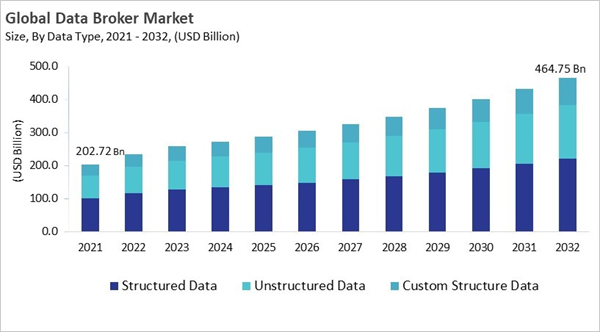
The data broker market consists of companies that analyze, collect, and sell information about businesses and individuals to third parties. These enterprises gather data from government filings, public records, consumer transactions, online activities, and mobile location tracking, and then package it for uses like identity verification, risk assessment, marketing, and fraud detection. The rise of the internet, connected devices, and digital advertising technologies has significantly expanded the detail and amount of data that can be collected. With web tracking tools like cookies and mobile identifiers become common, companies gained the capability to monitor purchasing pattern, online behavior, and location history at a wide scale.
Data brokers became key players in the modern data-driven economy, providing services used in customer analytics, targeted advertising, and risk profiling. Major companies like Acxiom, Experian, TransUnion, Oracle, and Equifax built extensive databases covering billions of individuals globally. The market has faced largely scrutiny from privacy advocates and governments because of concerns over consumer consent, transparency, and the potential misuse of sensitive data like geolocation information. New policy initiatives and regulations like California’s Delete Act and proposed federal privacy laws are encouraging the industry toward stronger compliance systems, greater transparency, and privacy-focused practices. Many data brokers are shifting from simple data sales to advanced analytics services powered by AI, while also strengthening data security, governance, and partnerships with enterprise technology ecosystems and advertising platforms.
Driving and Restraining Factors
Drivers- Growing Demand for Customer Insights and Personalized Marketing
- Rapid Expansion of Data-Driven Decision-Making Across Industries
- Digital Transformation, Cloud Computing, AI and Big Data Integration
- Growth of Digital Commerce, Online Interactions, Mobile Usage and Data Volume
- Intensifying Privacy Regulations and Compliance Burdens
- Public Backlash and Consumer Distrust Over Personal Data Usage
- Legal and Ethical Challenges Around Data Collection and Security
- Expansion of Advanced Data Collaboration and Connectivity Platforms
- Integration With AI-Powered Analytics and Real-Time Decision Systems
- Expansion of Vertical-Specific Solutions and Compliance-Focused Data Services
- Regulatory Uncertainty and Escalating Privacy Compliance Burdens
- Transparency, Trust, and Ethical Backlash in Public Perception
- Technical Complexity of Data Quality, Integration, and Governance
Market Share Analysis
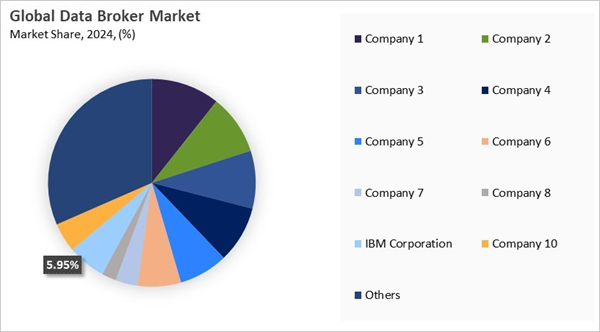
The leading players in the market are competing with diverse innovative offerings to remain competitive in the market. The above illustration shows the percentage of revenue shared by some of the leading companies in the market. The leading players of the market are adopting various strategies in order to cater demand coming from the different industries. The key developmental strategies in the market are Acquisitions, and Partnerships & Collaborations.
COVID-19 Impact Analysis
The COVID-19 pandemic had a major adverse impact on this Market, especially at first, when widespread lockdowns and economic uncertainty made businesses cut back on how much they spent on third-party data services. Many businesses put cost control and operational stability first, which led to data acquisition contracts being put on hold or canceled, and less demand from sectors like retail, travel, and automotive. Restrictions on movement also made it harder to collect data, which made location-based and behavioral data less available and less accurate, and slowed down data processing and analytics. At the same time, stricter rules about how digital data can be used and privacy compliance made it more expensive for data brokers to do business. Also, lower marketing and advertising spending in many industries made the need for targeted consumer insights less urgent, which slowed market growth and made competition even tougher. Thus, the COVID-19 pandemic had a negative impact on the market.Pricing Outlook
Based on Pricing, the market is segmented into Subscription, Hybrid, and Pay-per-Use. The hybrid segment recorded 25% revenue share in the data broker market in 2024. Enterprises operating across multiple regions often require baseline data access while purchasing specialized datasets, premium analytics, or region-specific intelligence on demand. The hybrid model allows organizations to optimize costs while maintaining scalability and operational flexibility. Technological advancements in usage tracking, automated billing systems, and cloud infrastructure have facilitated the expansion of hybrid pricing globally, particularly among large multinational corporations and data-intensive industries.Data Category Outlook
Based on Data Category, the market is segmented into Consumer Data, Business Data, Financial Data, Health Data, and Location Data. The business data segment acquired 20% revenue share in the data broker market in 2024. Enterprises use brokered business data for lead generation, account-based marketing, competitive benchmarking, and investment analysis. The globalization of trade and expansion of B2B digital platforms have increased the need for reliable cross-border company intelligence. Business data is relatively less sensitive than personal data, allowing steady adoption across regions, particularly in sectors such as manufacturing, technology, and professional services.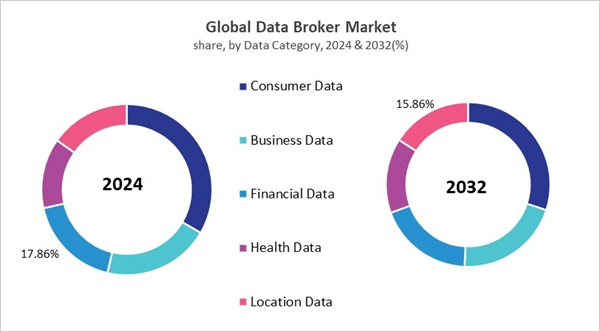
Regional Outlook
Region-wise, the Data Broker Market is analyzed across North America, Europe, Asia Pacific, and LAMEA. The North America segment recorded 40% revenue share in the Data Broker Market in 2024. The data broker market is anticipated to grow at a significant rate in the North America and Europe regions. This is because of strong enterprise demand for data analytics, advanced digital ecosystems, and the presence of major market players. The market is further driven by widespread usage of brokered data across industry verticals, including retail, banking, healthcare, and advertising. The region further has presence of leading ad-tech platforms and data broker firms, which leverage cloud computing, AI, and large consumer datasets to support fraud detection, targeted marketing, and credit decisioning. Additionally, Europe data brokers market is projected to procure prominent growth during the forecast period. The growth is supported by rising demand for consumer insights in nations like Germany, France, and the UK.In the Asia Pacific and LAMEA regions, the data brokers market is predicted to grow at a substantial rate. This is because of expanding internet usage and rapid digital transformation. Asia Pacific is estimated to capture steady growth, propelled by e-commerce expansion, increasing smartphone adoption, and large-scale digitalization initiatives in nations like Japan, India, China, and South Korea. Rising data generation from financial services, online platforms, and smart city programs is creating strong demand for brokered datasets and data analytics. Furthermore, the LAMEA data brokers market is expected to expand significantly during the projection period. Businesses are adopting data-driven strategies, and governments are investing in digital infrastructure, which is leading to market expansion. Nations like South Africa, Brazil, and the UAE are leading regional growth, supported by rising internet penetration, mobile connectivity, and rising adoption of analytics in finance, telecommunication, and retail.
List of Key Companies Profiled
- Accenture PLC
- Equifax Inc.
- CoreLogic, Inc.
- Epsilon Data Management, LLC (Publicis Groupe)
- Oracle Corporation
- ZoomInfo Technologies Inc.
- Lusha Systems Inc.
- Clearbit (HubSpot, Inc.)
- IBM Corporation
- 6sense
Market Report Segmentation
By Data Type- Structured Data
- Unstructured Data
- Custom Structure Data
- Subscription
- Hybrid
- Pay-per-Use
- Consumer Data
- Business Data
- Financial Data
- Health Data
- Location Data
- BFSI
- Retail & E-commerce
- Media & Entertainment
- Healthcare
- IT & Telecom
- Government
- Automotive
- Other End-Use Industry
- North America
- US
- Canada
- Mexico
- Rest of North America
- Europe
- Germany
- UK
- France
- Russia
- Spain
- Italy
- Rest of Europe
- Asia Pacific
- China
- Japan
- India
- South Korea
- Singapore
- Malaysia
- Rest of Asia Pacific
- LAMEA
- Brazil
- Argentina
- UAE
- Saudi Arabia
- South Africa
- Nigeria
- Rest of LAMEA
Table of Contents
Chapter 1. Market Scope & Methodology
Chapter 2. Market at a Glance
Chapter 3. Market Overview
Chapter 10. Competition Analysis - Global
Chapter 11. Global Data Broker Market by Data Type
Chapter 12. Global Data Broker Market by Pricing
Chapter 13. Global Data Broker Market by Data Category
Chapter 14. Global Data Broker Market by End-Use Industry
Chapter 15. Global Data Broker Market by Region
Chapter 16. Company Profiles
Companies Mentioned
- Accenture PLC
- Equifax Inc.
- CoreLogic, Inc.
- Epsilon Data Management, LLC (Publicis Groupe)
- Oracle Corporation
- ZoomInfo Technologies Inc.
- Lusha Systems Inc.
- Clearbit (HubSpot, Inc.)
- IBM Corporation
- 6sense


